
Life, 1907-02-14 · page 16 of 28
Life — February 14, 1907 — page 16: what you’re looking at
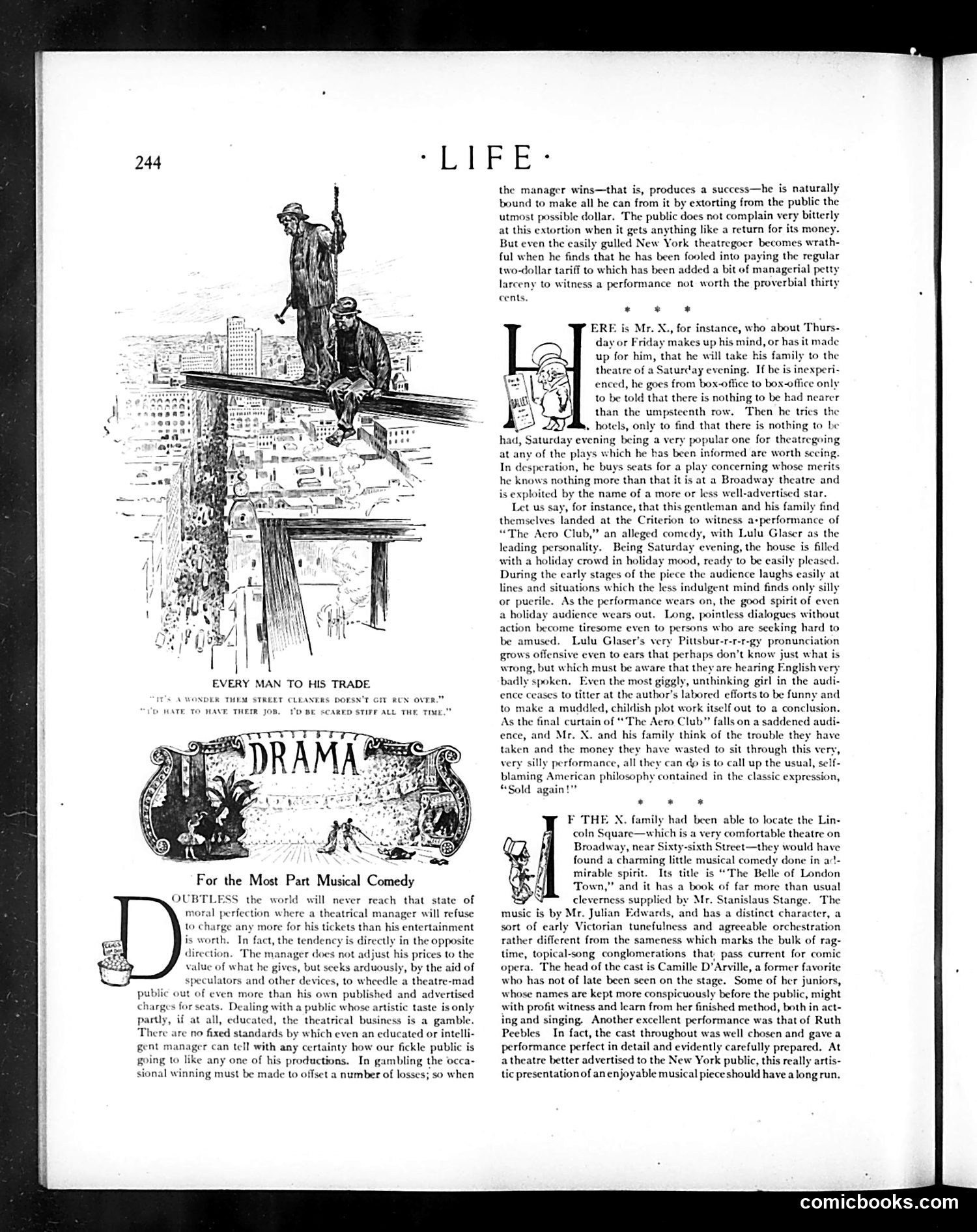
What you’re looking at
This page contains two distinct pieces of Life magazine satire: **"Every Man to His Trade"** (top): A cartoon mocking street cleaners' dangerous work, with figures perched precariously on a building ledge above city streets. The caption suggests amazement they don't get hit by vehicles—dark humor about occupational hazard. **"For the Most Part Musical Comedy"** (bottom): A lengthy essay criticizing theatrical managers who overcharge audiences. The author argues managers extract maximum profit from successful shows without adjusting prices to actual entertainment value. He illustrates this with "Mr. X," an average theatergoer who pays inflated prices to see "The Aero Club" at the Criterion Theatre, only to endure a poorly-written comedy with actress Lulu Glaser (whose "Pittsbur-r-r-g" accent grates). The satire targets both theatrical greed and low-quality productions that exploit captive audiences unable to find alternative entertainment.
📄 Transcribed text from this page (OCR, searchable)
Machine-transcribed from the original scan — historical spelling and the odd misread are preserved.
*LIPE* EVERY MAN TO HIS TRADE + A WONDER THES STREET CLEANERS DOFSN'T GIT RUN OVER.” ) MATE TO HAVE THEIR JOB. 1'D BE SCARED STIFF ALL THE TIM.” For the Most Part Musical Comedy OUBTLESS will never reach that state of moral perfectis ¢ a theatrical manager will refuse arge any more for his tickets than his entertainment h. In fact, the tendency is directly in the opposite . The manager does not adjust his prices to the value of what he gives, but seeks arduously, by the aid of ators and other devices, to wheedle a theatre-mad public out of even more than his own published and advertised charges for seats. Dealing with a public whose artistic taste is only partly, if at all, educated, the theatrical business is a gamble. There are no fixed standards by which even an educated or intelli- ger can tell with any certainty how our fickle public is to like any one of his productions. In gambling the occa- sional winning must be made to offset a number of lo: > when the manager wins—that is, produces a success—he is naturally bound to make all he can from it by extorting from the public the utmost possible dollar. ‘The public does not complain very bitter at this extortion when it gets anything like a return for its money. But even the easily gulled New York theatregocr becomes wrath- ful when he finds that he has been fooled into paying the regular two-dollar tariff to which has been added a bit of managerial pet larceny to witness a performance not worth the proverbial thirty cents. * + Mr. X., for instance, who about Thurs- y or Friday makes up his mind, or has it made up for him, that he will take his family to the theatre of a Saturday evening. If he is inexperi- enced, he goes from box-office to box-office only to be told that there is nothing to be had nearer than the umpsteenth row. Then he trics the . hotels, only to find that there is nothing to be ay evening being a very popular one for theatregoing at any of the plays which he has been informed are worth sccing. In desperation, he buys seats for a play concerning whose merits he knows nothing more than that it is at a Broadway theatre and is exploited by the name of a more or less well-advertised star. Let us say, for instance, that this gentleman and his family find themselves landed at the Criterion to witness a+performance of “The Acro Club,” an alleged comedy, with Lulu Glaser as the leading personality. Being Saturday evening, the house is filled with a holiday crowd in holiday mood, ready to be easily pleased. During the early stages of the piece the audience laughs easily at lines and situations which the less indulgent mind finds only sill or puerile. As the performance wears on, the good spirit of even holiday audience wears out. Long, pointless dialogues without action become tiresome even to persons who are seeking hard to be amused. Lulu Glaser’s very Pittsbur-r-r-t-gy pronunciation grows offensive even to ears that perhaps don’t know just what is wrong, but which must be aware that they are hearing English very badly spoken. Even the most giggly, unthinking girl in the audi- ence ceases to titter at the author’s labored efforts to be funny and. to make a muddled, childish plot work itself out to a conclusion. As the final curtain of “The Aero Club” falls on a saddened audi- ence, and Mr. and his think of the trouble they have taken and the money they have wasted to sit through this very, to call up the usu: blaming American philosophy contained in the classic expression, very silly performance, all they can dp eo 8 & . family had been able to locate the Lin- coln Square—which is a very comfortable theatre on Broadway, near Sixty-sixth Street—they would have found a charming little musical comedy done in a’- mirable spirit. Its title is “The Belle of London and it has a book of far more than usual cleverness supplied by Mr. Stanislaus ge. The music is by Mr. Julian Edwards, and has a distinct character, a sort of early Victorian tunefulness and agreeable orchestration rather different from the sameness which marks the bulk of rag- time, topical-song conglomerations that: pass current for comic opera. The head of the cast is Camille D’Arville, a former favorite who has not of late been scen on the stage. Some of ber juniors, whose names are kept more conspicuously before the public, might with profit witness and learn from her finished method, both in act- ing and singing. Another excellent performance was that of Ruth Peebles In fact, the cast throughout was well chosen and gave a performance perfect in detail and evidently carefully prepared. At a theatre better advertised to the New York public, this really arti: tic presentation of an enjoyable musical piece should have along run, comicbooks.com