
Life, 1907-02-14 · page 18 of 28
Life — February 14, 1907 — page 18: what you’re looking at
What you’re looking at
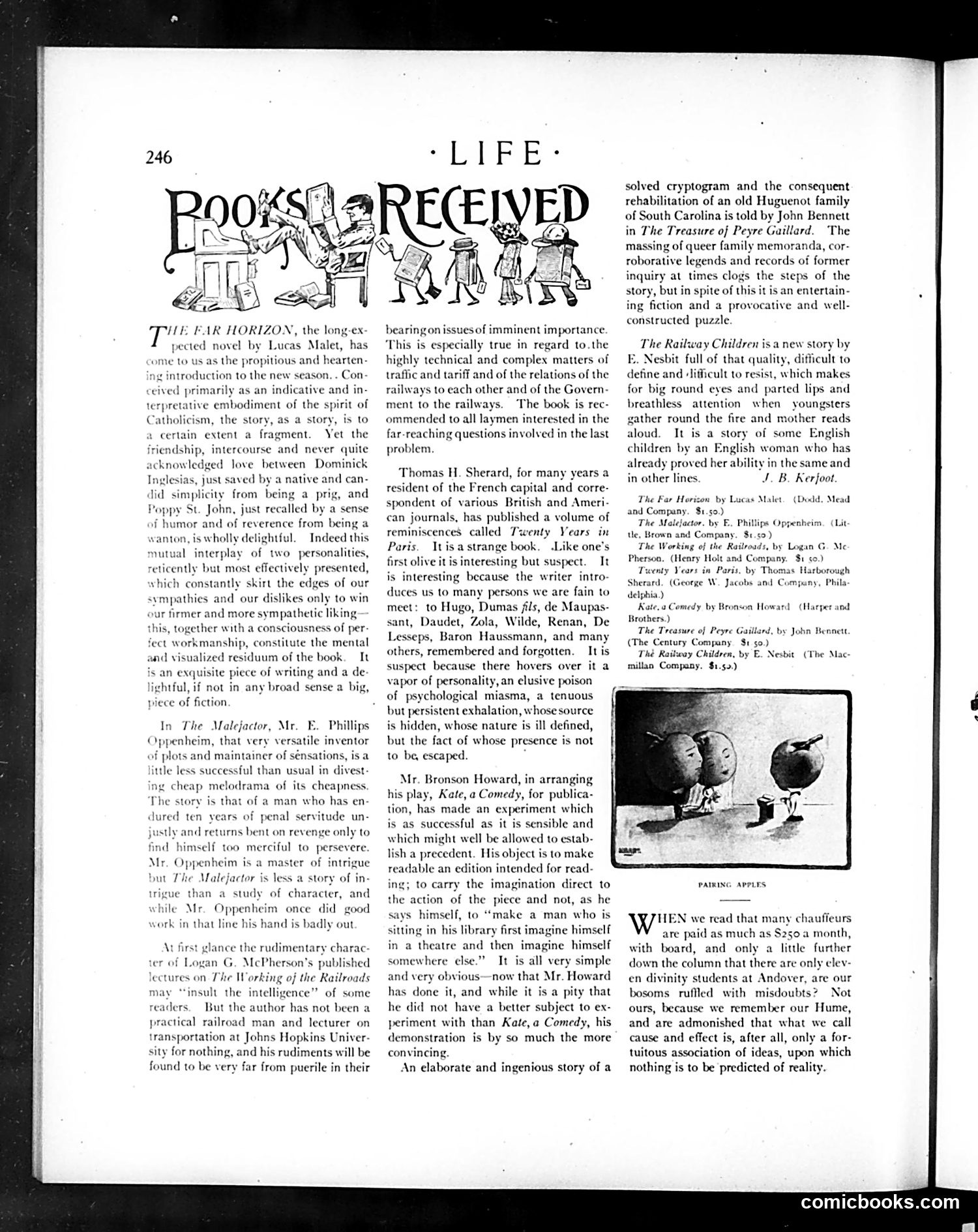
This is a **book review section** from Life magazine, not a political cartoon. The page reviews several new publications, including novels by Lucas Malet and E. Phillips Oppenheim, and a work on railroad economics by Logan G. McPherson. The single illustration labeled "PAIRING APPLES" shows two figures examining apples—likely a humorous domestic scene unrelated to the reviews above it. The page's humor is literary rather than political. It critiques authors' strengths and weaknesses: praising Malet's character work while noting Oppenheim relies too heavily on melodrama, and commending McPherson's technical railroad knowledge despite his "rudimentary" storytelling. The reviews assume educated readers interested in contemporary fiction and economic policy—typical Life magazine content for a literate, middle-to-upper-class American audience of the late 19th/early 20th century.
📄 Transcribed text from this page (OCR, searchable)
Machine-transcribed from the original scan — historical spelling and the odd misread are preserved.
HE FAR HORIZON, the long-ex pected novel by Lucas Malet, has ome to us as the propitious and hearten- ntroduction to the new season, . Con cived primarily as an indicative and in- terpretative embodiment of the spirit of Catholicism, the story, as a story, is to certain extent a fragment. Yet the riendship, intercourse and never quite acknowledged love between Dominick Inglesias, just saved by a native and can- did simplicity from being a prig, and Poppy St. John, just recalled by a sense i humor and of reverence from being a nton, is wholly delightful. Indeed this mutual interplay of two personalities, reticently but most effectively presented, ich constantly skirt the edges of our sympathies and our dislikes only to win iking this, together with a consciousness of per: fect workmanship, constitute the mental and visualized residuum of the book. It is an exquisite piece of writing and a de our firmer and more sympathetic ightful, if not in any broad sense a big, piece of fiction The Malejactor, Mr. E. Phillips Oppenheim, that very versatile inventor of plots and maintainer of sénsations, is a tle less successful than usual in divest ng cheap melodrama of its cheapness The story is that of a man who has en- dured ten years of penal servitude un- justly and returns bent on revenge only to find himself too merciful to persevere Mr. Oppenheim is a master of intrigue but The Mal of in- ue than a study of character, and while Mr. Oppenheim once did good vork in that line his hand is badly out ctor is less a story \t first glance the rudimentary charac ter of Logan G, MePherson’s published Working of the Railroads sult the intelligence” o But the author has not been a practical railroad man and lecturer on transportation at Johns Hopkins Univer- sity for nothing, and his rudiments will be found to be very far from puerile in their ectures on T may some readers. bearing on issues of imminent importance. ‘This is especially true in regard to.the highly technical and complex matters of traffic and tariff and of the relations of the railways to each other and of the Govern- ment to the railways. The book is rec- ommended to all laymen interested in the far-reaching questions involved in the last problem. Thomas H. Sherard, for many years a resident of the French capital and corre- spondent of various British and Ameri- can journals, has published a volume of reminiscences called Twenty Years in Paris. Itisastrange book. Like one’s first olive it is interesting but suspect. It is interesting because the writer intro- duces us to many persons we are fain to meet: to Hugo, Dumas fils, de Maupas- sant, Daudet, Zola, Wilde, Renan, De Lesseps, Baron Haussmann, and many others, remembered and forgotten. It is suspect because there hovers over it a vapor of personality, an elusive poison of psychological miasma, a tenuous but persistent exhalation, whose source is hidden, whose nature is ill defined, but the fact of whose presence is not to be, escaped. Mr. Bronson Howard, in arranging his play, Kate, a Comedy, for publica- tion, has made an experiment which is as successful as it is sensible and which might well be allowed to estab- lish a precedent. His object is to mak readable an edition intended for read- ing; to carry the imagination direct to the action of the piece and not, as he says himself, to “make a man who is sitting in his library first imagine himself in a theatre and then imagine himself somewhere else.” It is all very simple and very obvious—now that Mr. Howard has done it, and while it is a pity that he did not have a better subject to ex- periment with than Kate, a Comedy, his demonstration is by so much the more convincing. An elaborate and ingenious story of a solved cryptogram and the consequent rehabilitation of an old Huguenot family of South Carolina is told by John Bennett in The Treasure of Peyre Gaillard. The massing of queer family memoranda, cor- roborative legends and records of former inquiry at times clogs the steps of the story, but in spite of this it is an entertain- ing fiction and a provocative and well- constructed puzzle. The Railway Children is a new story by E. Nesbit full of that quality, difficult to define and ‘lifficult to resist, which makes for big round eyes and parted lips and breathless attention when youngsters ather round the fire and mother reads loud. It is a story of some English children by an English woman who has already proved her ability in the same and in other lines J.B. Kerjoot. The Far Horizon by Lucas Malet and Company. $1.50.) The Malejactor. by E. Phillips Oppenheim. (Lit Ue, Brown and Company. $1.59) The Working of the Raitrosds, by Logan G. Mc Pherson, (Henry Holt and Company. $1 50.) Twenty Years in Paris, by Thomas Harbor Sherard Phila delphia.) Kate,a Comedy by Bronson Howard Brothers.) The Treasure of Peyre Gaillard, by John Bennett (The Century Company $1 50.) Thé Railway Children, by E. Nesbit millan Company. $1.52.) (Dodd. Mead (George W. Jacobs and Company (Harper and (The Mac- PAIRING APPLES HEN we read that many chauffeurs are paid as much as $250 a month, with board, and only a little further down the column that there are only clev- en divinity students at Andover, are our bosoms ruffled with misdoubts? Not ours, because we remember our Hume, and are admonished that what we call cause and effect is, after all, only a for- tuitous association of ideas, upon which nothing is to be predicted of reality. comicbooks.com