
Life, 1907-02-14 · page 19 of 28
Life — February 14, 1907 — page 19: what you’re looking at
What you’re looking at
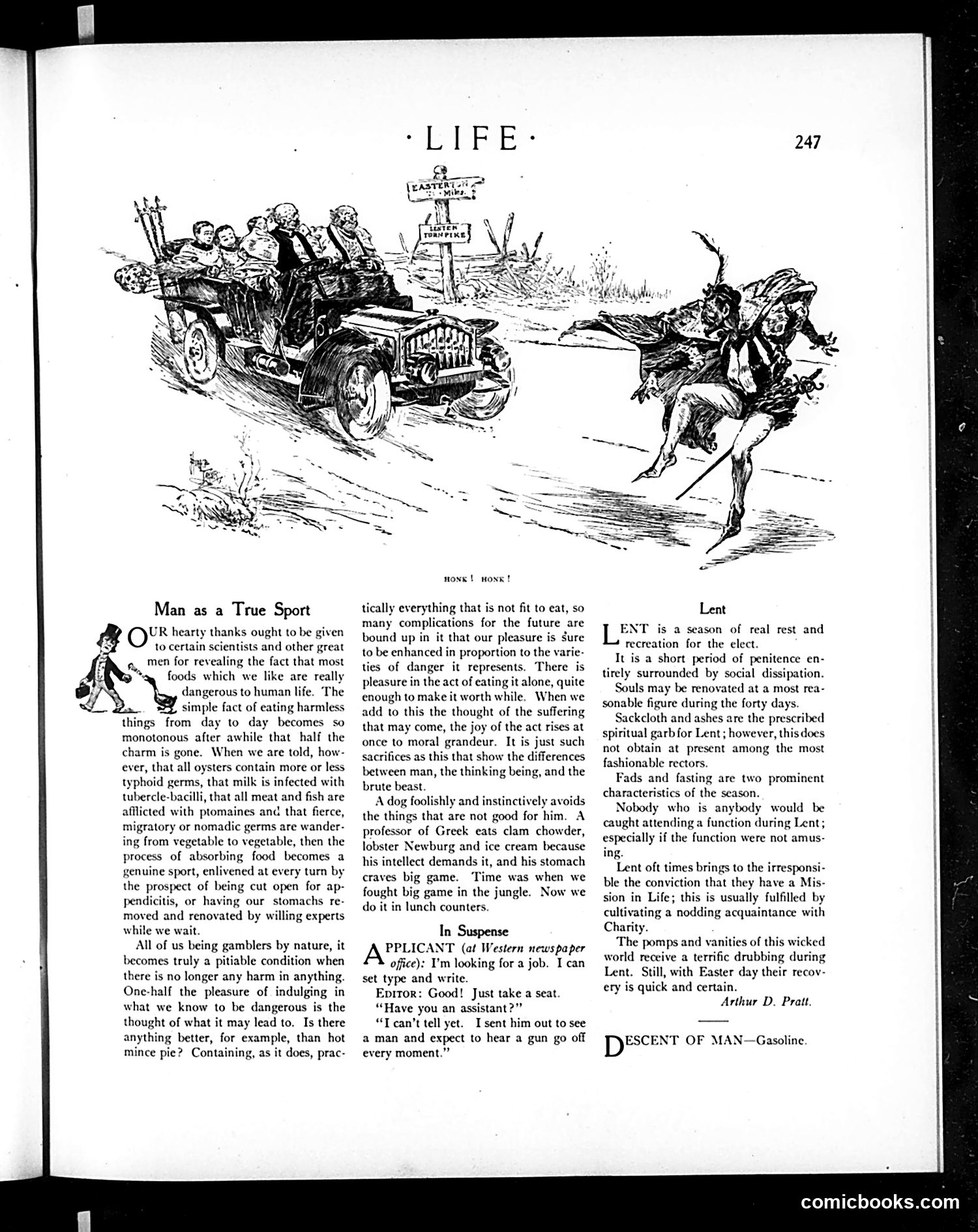
This satirical page from *Life* magazine contains two main pieces mocking early 20th-century attitudes: **"Man as a True Sport"** satirizes the contemporary obsession with newly-discovered food contamination dangers. Scientists had recently revealed that oysters, milk, and meats contained typhoid germs and other pathogens. The author mockingly argues that eating these dangerous foods has become thrilling precisely *because* they're hazardous—turning ordinary meals into a "sport" of gambling with one's health. The joke: humans perversely enjoy risks (like eating mince pie) specifically for their potential consequences, unlike dogs who simply avoid what's bad for them. **"In Suspense"** is a brief joke about newspaper office chaos: an editor has sent his assistant to meet someone and expects gunfire "every moment"—suggesting either extreme danger or that the assistant himself is unreliable/violent. **"Lent"** section mocks wealthy society's hypocritical observance of the religious season—claiming fashionable people attend functions during Lent despite claiming abstinence, and that charitable impulses vanish after Easter. The cartoon above depicts a car full of people and a horse bolting away, likely illustrating the "gasoline" theme and early automobile era anxieties.
📄 Transcribed text from this page (OCR, searchable)
Machine-transcribed from the original scan — historical spelling and the odd misread are preserved.
Man as a True Sport PR hearty thanks ought to be given > to certain scientists and other great n,, men for revealing the fact that most % foods which we like are really dangerous to human life. The simple fact of eating harmless things from day to day becomes so monotonous after awhile that half the charm is gone. When we are told, how- ever, that all oysters contain more or less typhoid germs, that milk is infected with tubercle-bacilli, that all meat and fish are afflicted with ptomaines and that fierce, migratory or nomadic germs are wander- ing from vegetable to vegetable, then the process of absorbing food becomes a genuine sport, enlivened at every turn by the prospect of being cut open for ap- pendicitis, or having our stomachs re- moved and renovated by willing experts while we wait. All of us being gamblers by nature, it becomes truly a pitiable condition when there is no longer any harm in anything. One-half the pleasure of indulging in what we know to be dangerous is the thought of what it may lead to. Is there anything better, for example, than hot mince pie? Containing, as it does, prac- Hons | Honk! tically everything that is not fit to eat, so many complications for the future are bound up in it that our pleasure is sure to be enhanced in proportion to the vari ties of danger it represents. There is pleasure in the act of eating it alone, quite enough to make it worth while. When we add to this the thought of the suffering that may come, the joy of the act rises at once to moral grandeur. It is just such sacrifices as this that show the differences between man, the thinking being, and the brute beast. A dog foolishly and instinctively avoids the things that are not good for him. A professor of Greek eats clam chowder, lobster Newburg and ice cream because his intellect demands it, and his stomach craves big game. Time was when we fought big game in the jungle. Now we do it in lunch counters. In Suspense PPLICANT (at Western newspaper office): I'm looking for a job. I can set type and write. Epitor: Good! Just take a seat “Have you an assistant?” “Tcan’t tell yet. [sent him out to see a man and expect to hear a gun go off every moment.” INT is a season of real rest and recreation for the elect. It is a short period of penitence en- tirely surrounded by social dissipation. Souls may be renovated at a most rea- sonable figure during the forty days. Sackcloth and ashes are the prescribed spiritual garb for Lent ; however, this docs not obtain at present among the most fashionable rectors. Fads and fasting are two prominent characteristics of the season. Nobody who is anybody would be caught attending a function during Lent; especially if the function were not amus- ing. Lent oft times brings to the irrespo! ble the conviction that they have a M sion in Life; this is usually fulfilled by cultivating a nodding acquaintance with Charity. ‘The pomps and vanities of this wicked world receive a terrific drubbing during Lent. Still, with Easter day their recov- ery is quick and certain. Arthur D. Pratt. DECENT OF MAN—Gasoline. comicbooks.com