
A complete issue · 24 pages · 1907
Life — January 24, 1907
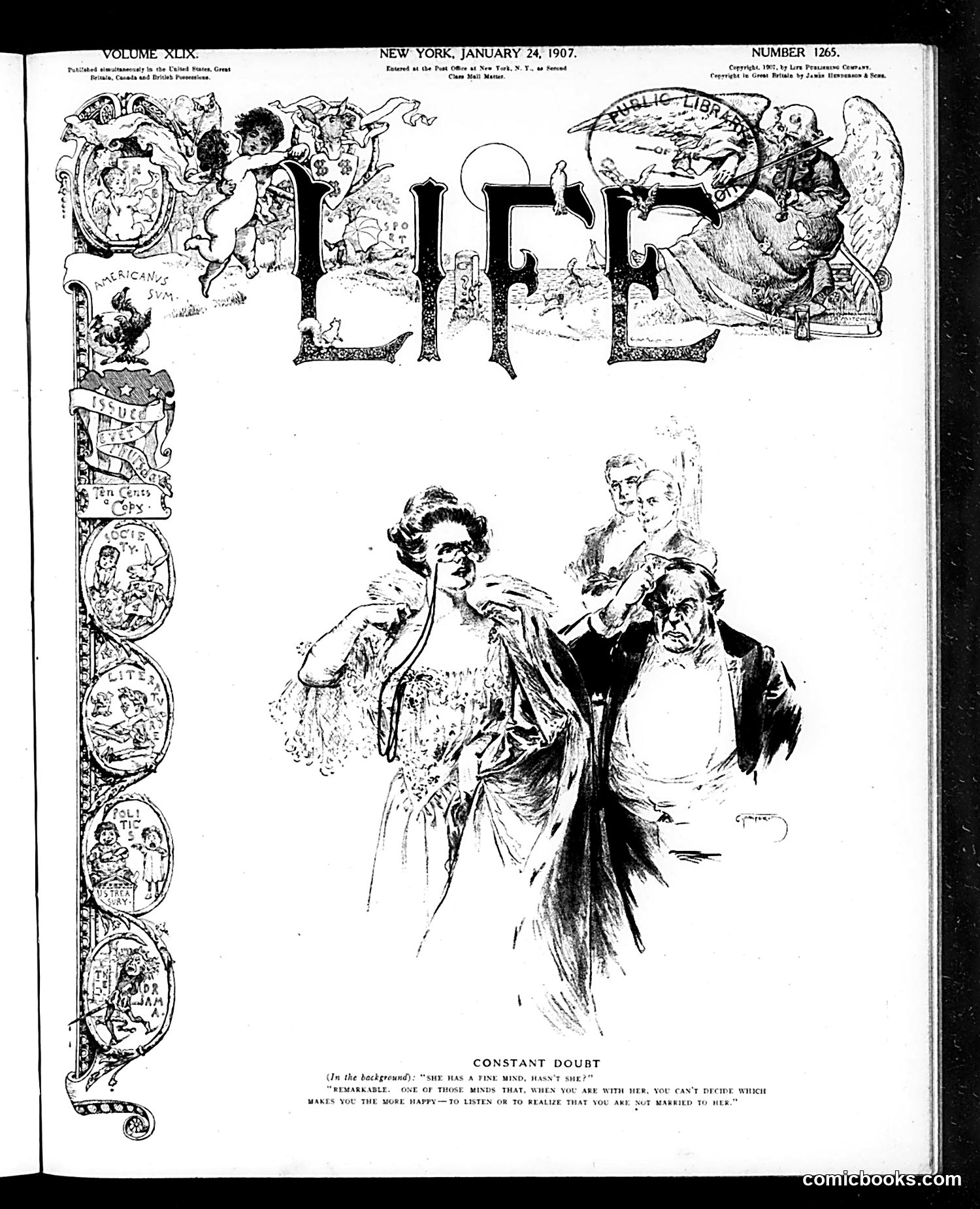
This satirical cartoon depicts a domestic scene titled "Constant Doubt." A well-dressed woman appears to be confronting or questioning a man, with another figure (possibly a servant or observer) in the background. The caption presents dialogue: a woman observes that her husband has "a fine mind" and asks "hasn't she?"—referring to another woman. The joke suggests the husband cannot decide which woman he prefers, making him "more happy" by maintaining uncertainty about his marital satisfaction. The satire targets upper-class gender relations and infidelity anxieties of the Edwardian era, mocking both the husband's indecision and the woman's resigned acceptance of his divided attention. The elaborate decorative border reinforces the magazine's sophisticated, affluent readership.
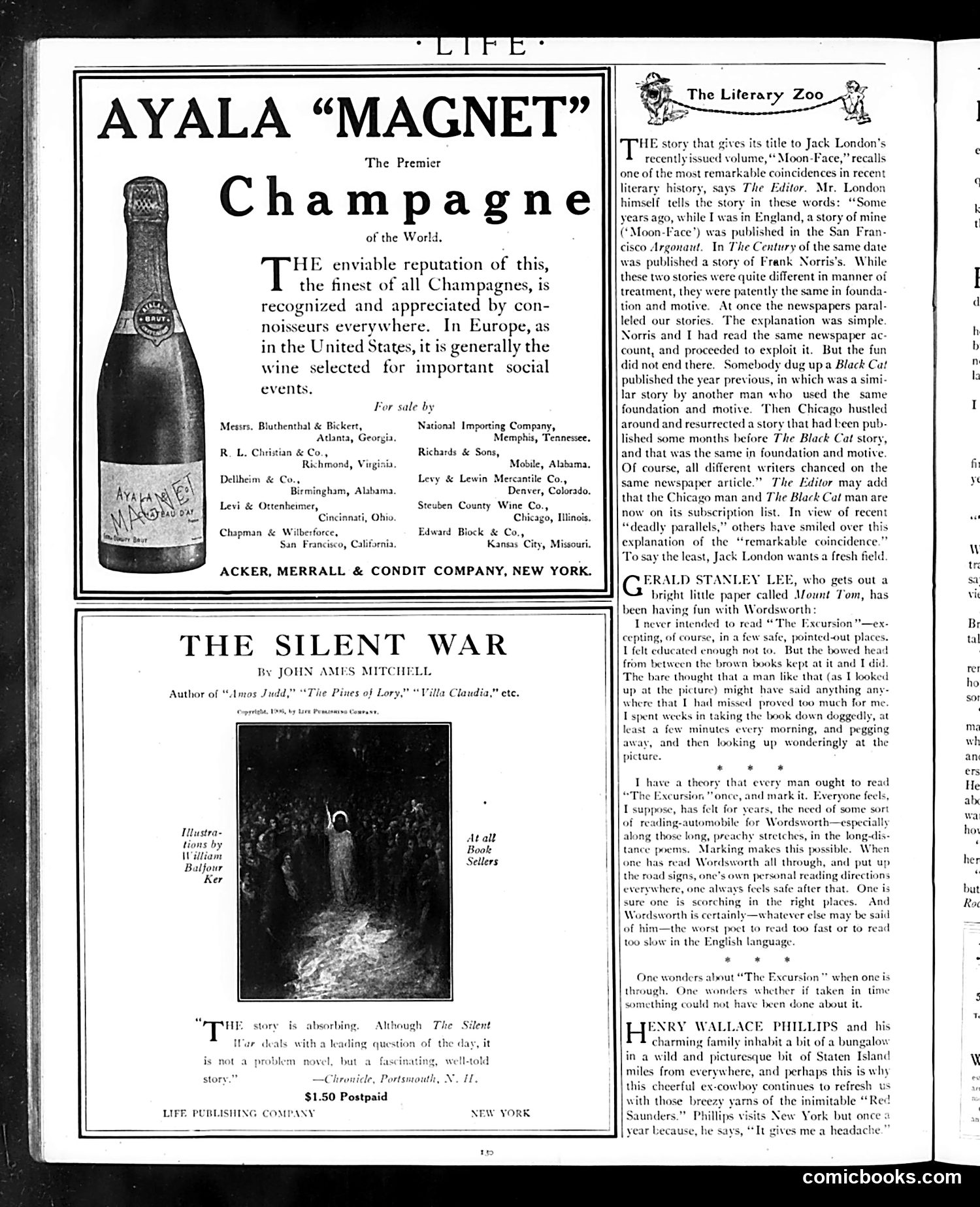
This page is **primarily advertising and literary content**, not political satire. The top half features an advertisement for Ayala "Magnet" Champagne, highlighting it as "the Premier Champagne of the World" and listing distributors across the United States. The bottle image and descriptive text are standard commercial promotion. Below is the beginning of a serialized story, "The Silent War" by John James Mitchell. The accompanying illustration shows a crowd scene, though details are unclear from this reproduction. The right column contains "The Literary Zoo," a brief essay discussing coincidences in recent literary publications—specifically Jack London's "Moon-Face" and similar stories by other authors. This appears to be a typical **early 20th-century Life magazine page** mixing advertisements with serialized fiction and literary commentary, rather than political cartoons or satire.
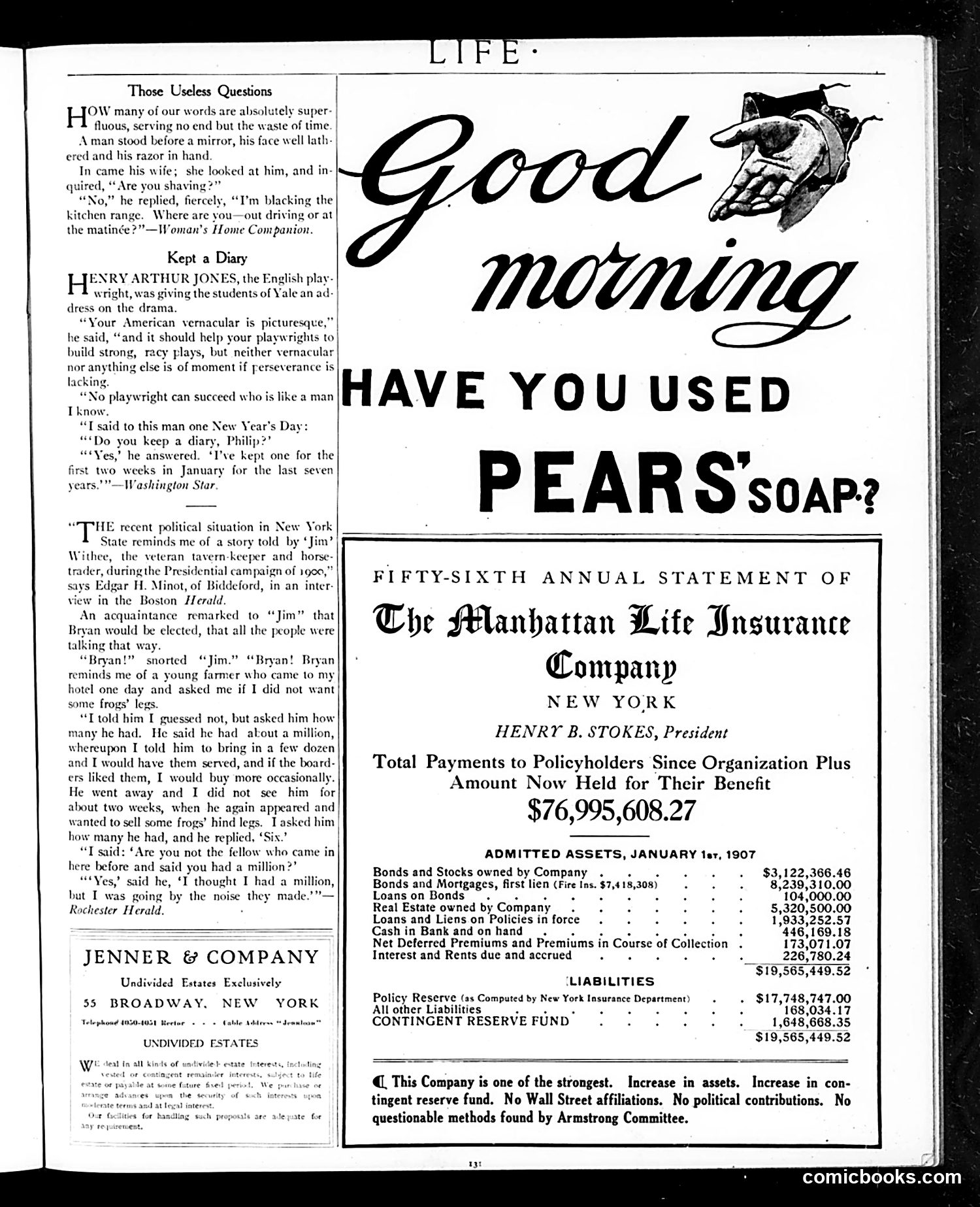
This page is primarily **advertising rather than satire**. The dominant content is a full-page advertisement for The Manhattan Life Insurance Company's "Fifty-Sixth Annual Statement" (1907), emphasizing financial strength and trustworthiness. The "Good morning" greeting with a rooster illustration is a generic morning motif. The Pears' Soap advertisement uses simple product promotion rather than political commentary. The left column contains three brief anecdotes about word usage and political gossip (including a reference to Bryan and the 1896 Presidential campaign), but these are humorous observations rather than systematic satire. **There is no significant political cartoon on this page.** It represents typical *Life* magazine content: mixed advertising, light humor, and social commentary rather than pointed political critique.
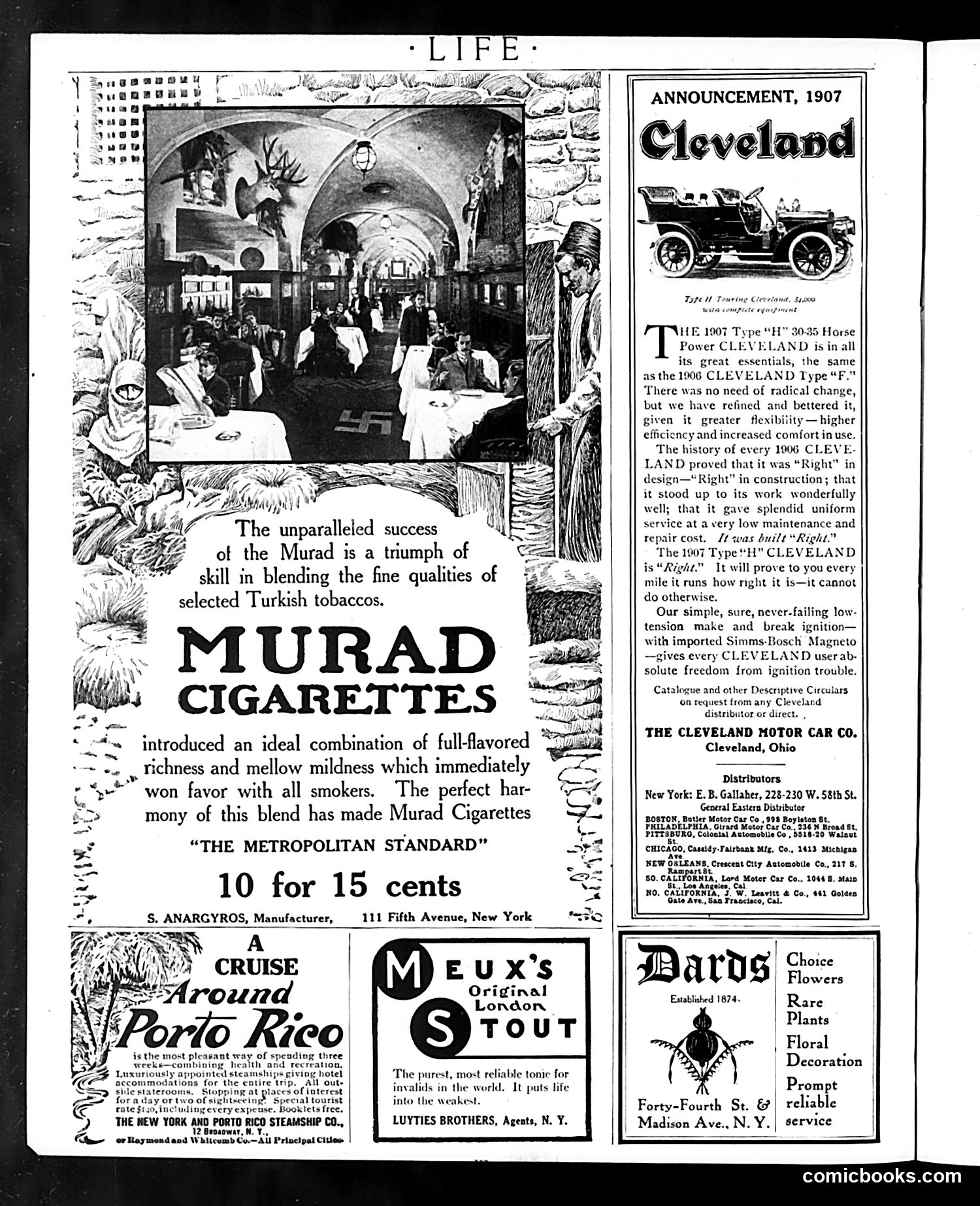
This page is primarily **advertisements rather than satirical content**. The main items are: 1. **Murad Cigarettes** - Features an ornate Turkish-themed dining scene, marketing Turkish tobacco blends as "the metropolitan standard" at 10 for 15 cents. 2. **Cleveland Automobile** (1907) - A Type "H" motorcar announcement emphasizing reliability and low maintenance costs. 3. **Porto Rico Cruise** - Promotes luxury steamship travel to Puerto Rico. 4. **Meux's Stout** - Beer advertisement targeting invalids, claiming it provides life-giving properties. 5. **Dard's Flowers** - Floral decoration service advertisement. The page reflects early 1900s consumer culture, with products marketed through appeals to sophistication, health claims, and leisure travel.
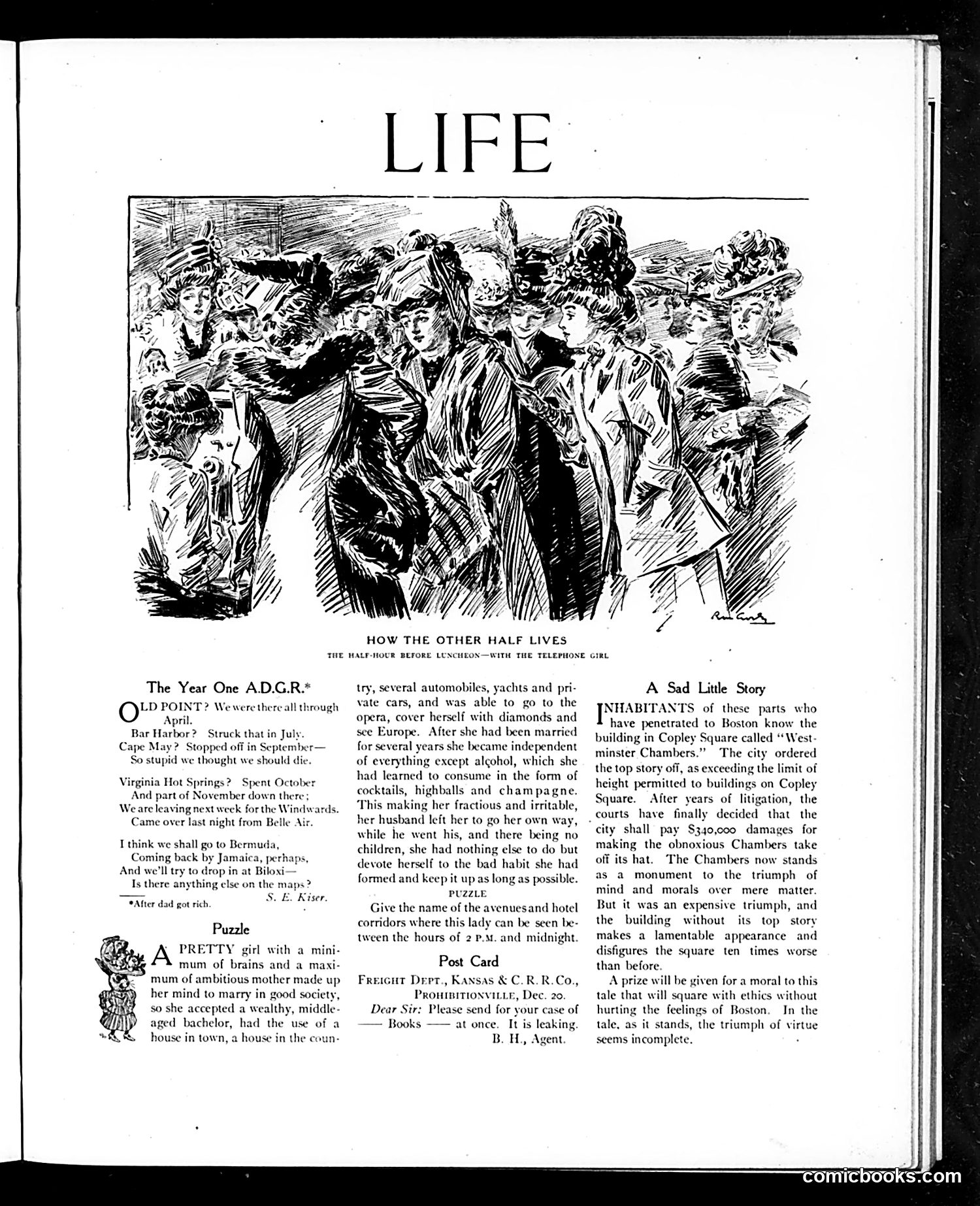
The main illustration depicts "How the Other Half Lives: The Half-Hour Before Luncheon—With the Telephone Girl," showing a crowded social scene of well-dressed women and fashionable figures from early 20th-century high society. The accompanying article "A Sad Little Story" satirizes wealthy society's moral contradictions. It describes a woman who achieved independence through a wealthy marriage but then became an alcoholic, eventually losing everything. The piece critiques how the newly wealthy Copley Square development in Boston—meant as a monument to "triumph of mind and morals"—becomes a lamentable eyesore instead. The overall satire mocks the pretensions and hollow values of the upper class, suggesting their wealth masks moral bankruptcy and hypocrisy. The "telephone girl" reference likely indicates how new technology was penetrating even exclusive social circles.
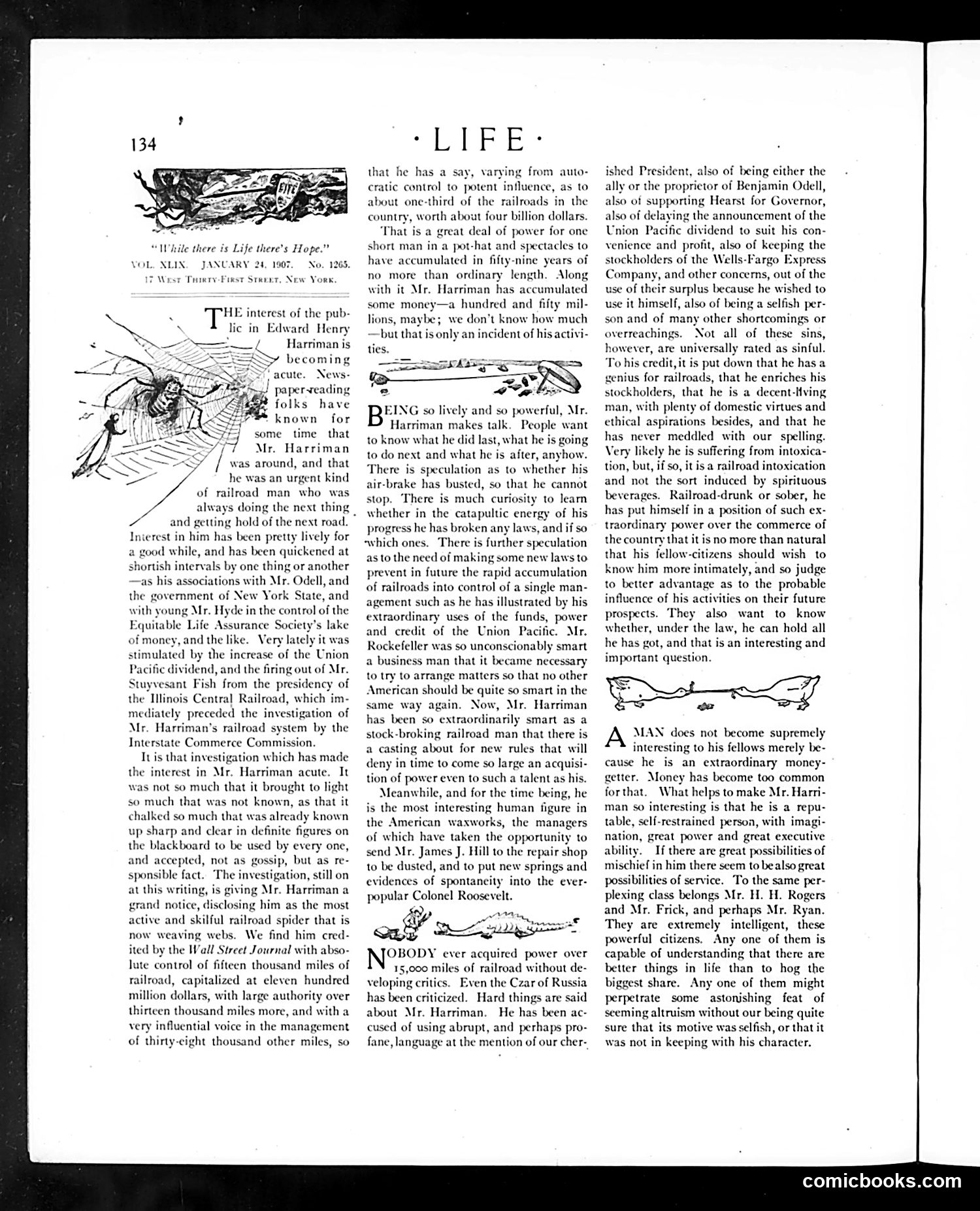
This page examines railroad magnate **E.H. Harriman**, who controlled approximately one-third of American railroad mileage worth roughly $4 billion—extraordinary power for a single individual in the early 1900s. The article presents Harriman as a complex figure: a brilliant financial strategist who accumulated vast wealth and influence, yet also someone criticized for "abrupt" and "profane" language. The text defends him somewhat, crediting his intelligence and domestic virtue while acknowledging public concern about his concentrated power. The decorative line illustrations appear to be generic period embellishments rather than specific satirical caricatures. The overall tone is analytical rather than purely mocking—examining whether such concentrated railroad authority benefited or threatened the American public.
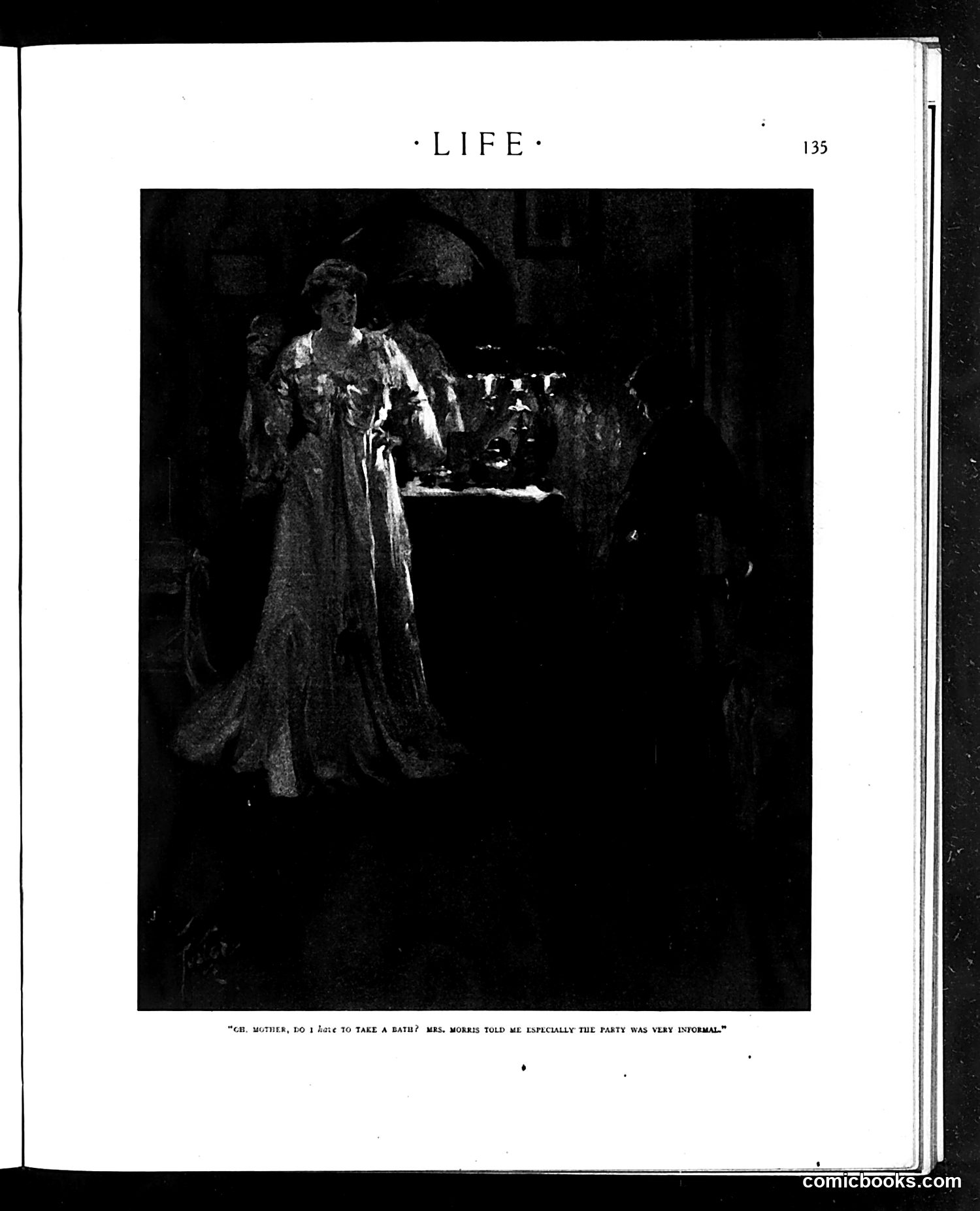
This page from *Life* magazine (page 135) contains a single satirical illustration showing what appears to be a social scene. The caption reads: "Oh, mother, do I have to take a bath? Mrs. Morris told me especially the party was very informal." The joke targets social pretension and class anxiety. A child resists bathing before attending what was described as an "informal" party, apparently believing that informal gatherings don't require the usual grooming standards. The satire likely mocks either: (1) parents who obsess over propriety regardless of actual circumstances, or (2) the absurdity of social climbers who nervously over-prepare for casual events, misunderstanding what "informal" means. The humor relies on the child's literal interpretation creating a clash with parental social anxieties of the era.
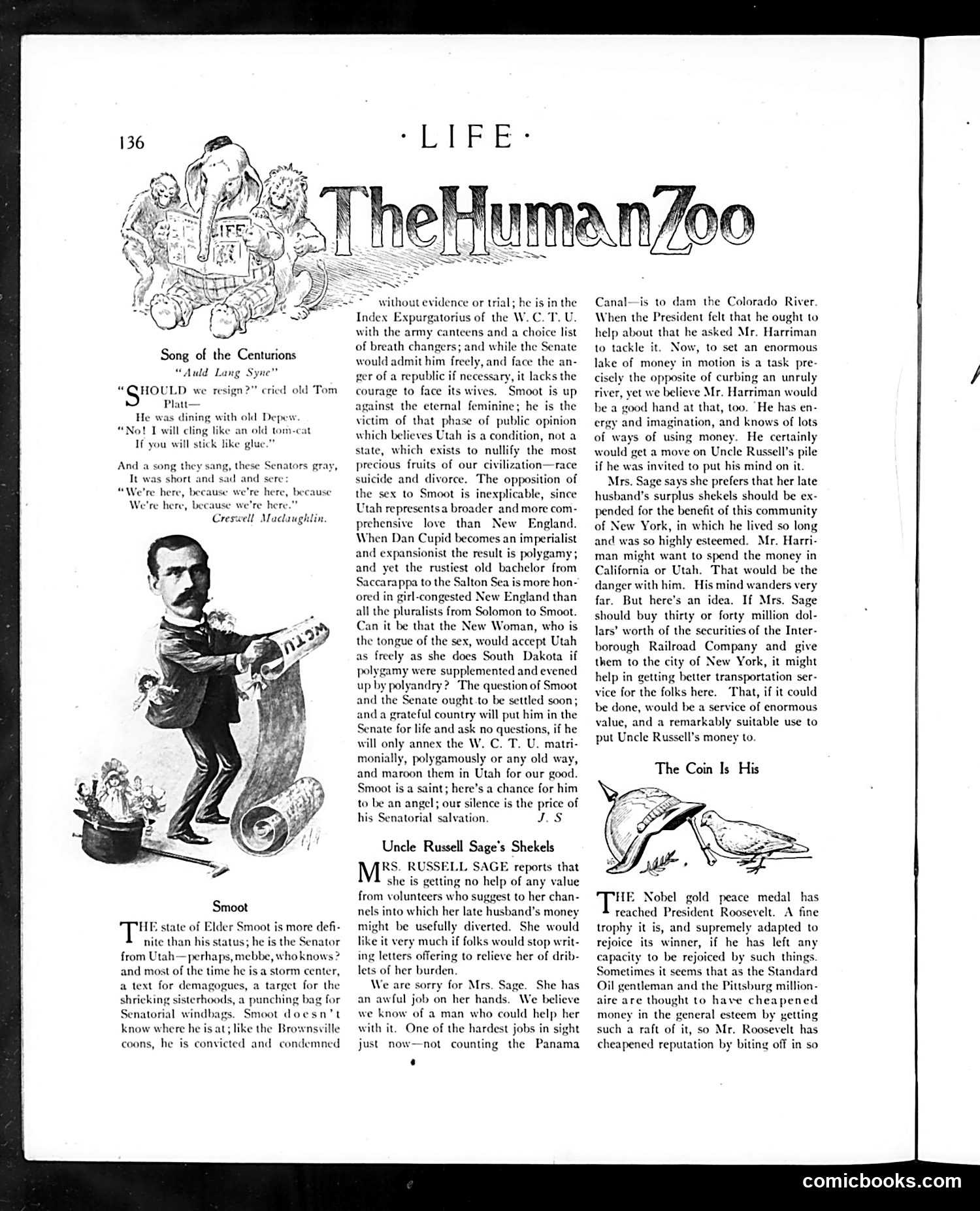
This page satirizes American political figures and social issues circa early 1900s. The main cartoon mocks Senator **Smoot** (identified in text), depicted as a performing fool in a tuxedo, suggesting he's making a spectacle of himself in the Senate. The accompanying "Song of the Centurions" poem ridicules senators debating Utah's polygamy and statehood, implying they're hypocritical ("here's a chance for him to be an angel"). A secondary section discusses **Mrs. Russell Sage** (widow of a wealthy industrialist) and her inability to effectively deploy her late husband's fortune—suggesting even vast wealth can't solve complex social problems. The "Human Zoo" title frames these politicians and wealthy figures as curiosities on public display, worthy of mockery.
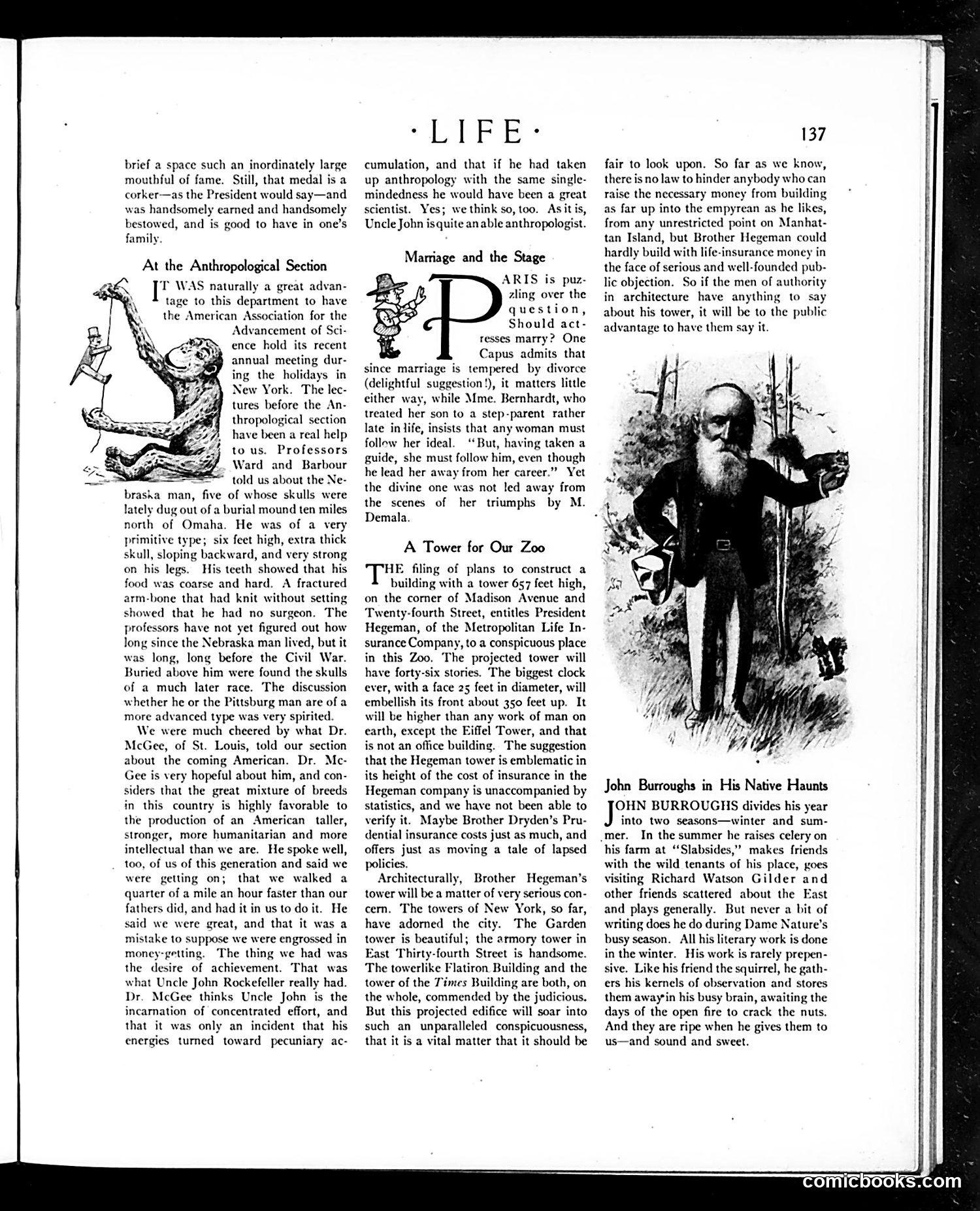
This page contains three distinct sections: **Left column:** Discusses an Anthropological Section meeting featuring skulls of a "brassa man" excavated from Nebraska, contrasting scientific progress with Uncle John Rockefeller's philanthropic achievements. **Center:** "Marriage and the Stage" debates whether actors should marry, referencing actress Mme. Bernhardt's advice that women follow their husbands' guidance. **Right side:** An illustrated article titled "John Burroughs in His Native Haunts" depicts the naturalist writer in his rural setting, describing his seasonal farm life and observations of squirrels and nuts. The page reflects early 1900s Life magazine's mix of social commentary, celebrity gossip, and cultural interest pieces, with satirical undertones typical of the publication's style.
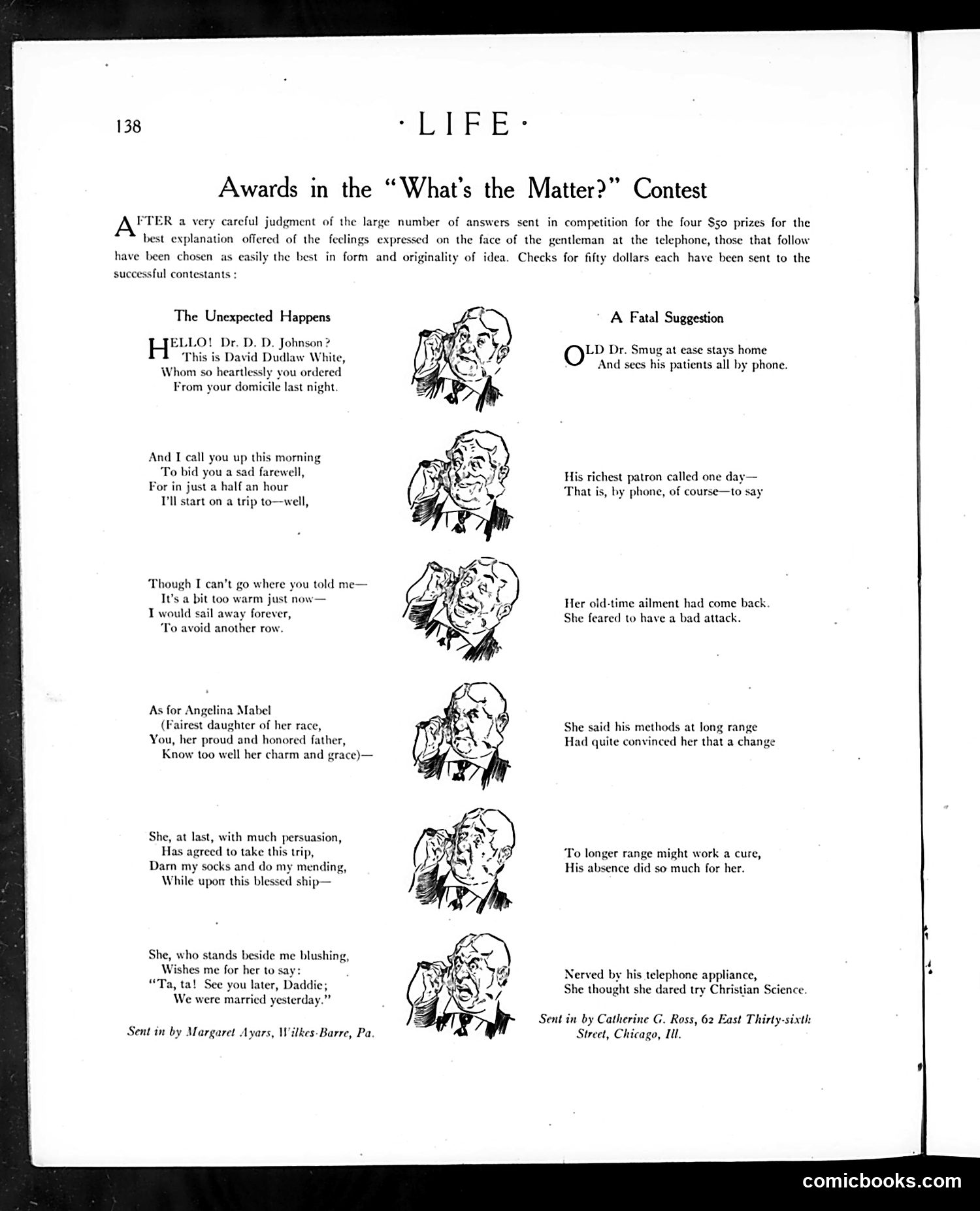
This page presents winning entries from a contest asking readers to explain a gentleman's distressed facial expressions shown in repeated caricatures down the left side. The two winning submissions use humor to critique early 20th-century professional life: **"The Unexpected Happens"** satirizes a doctor (Dr. D.D. Johnson) receiving an unwanted house call from a patient at night, disrupting his personal life. **"A Fatal Suggestion"** mocks a physician (Dr. Smug) whose patient consultation via telephone leads to medical misadventure—the patient's rich patron calling by phone about his mistress's illness results in a treatment that worsens her condition, forcing the doctor to contemplate the consequences of remote medical practice. Both entries humorously critique professional boundaries and the emerging technology of telephone consultation in medicine.
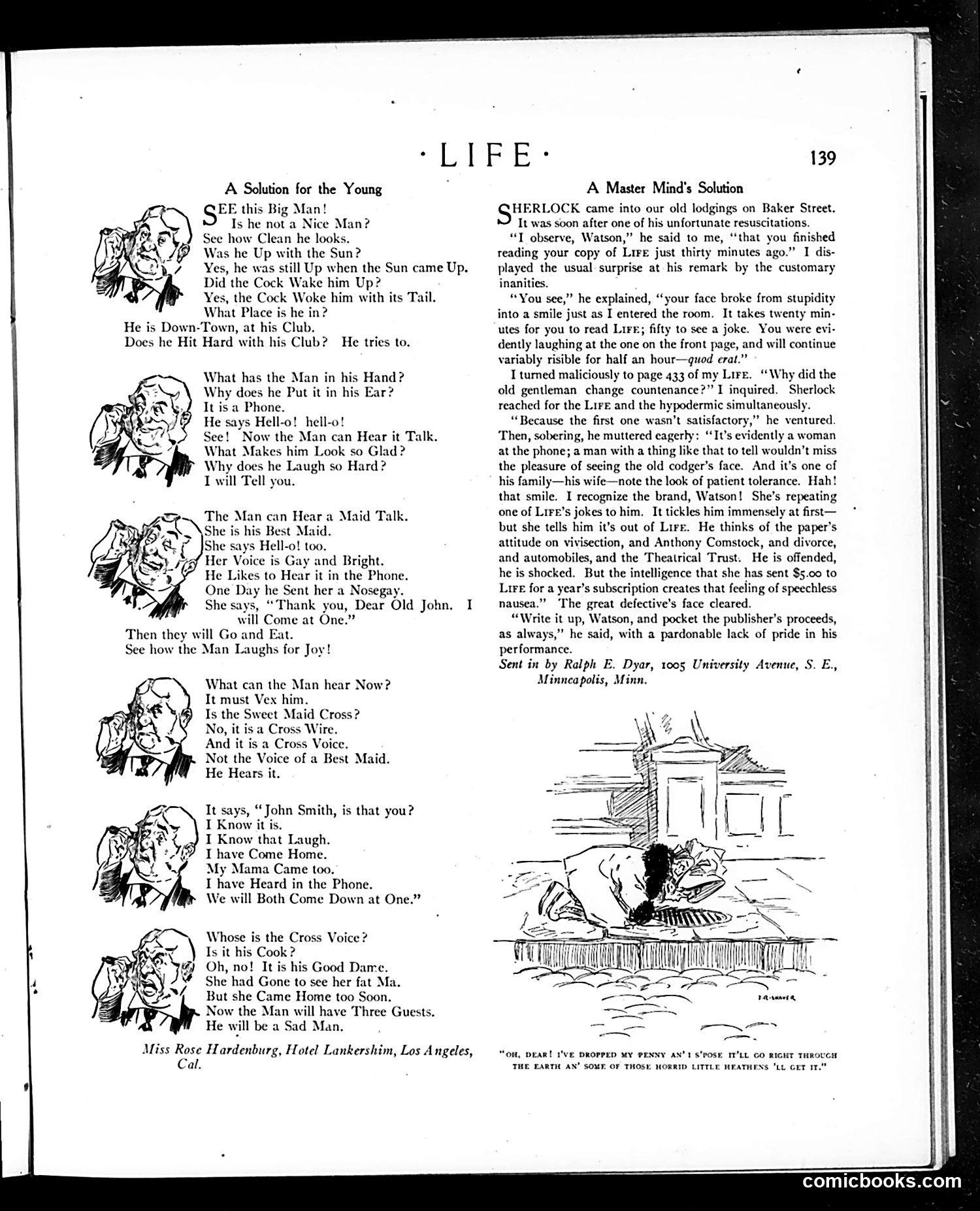
The left side presents a humorous poem about a man with various mysterious attributes—he's described as "Big," "clean," "up with the Sun," and possesses a telephone. The repeated question-and-answer format builds comedic confusion about his identity and purpose. The right side features Sherlock Holmes arriving at a lodging on Baker Street (his famous address). Watson has just finished reading *Life* magazine and expresses surprise at Holmes's deductive abilities. Holmes mockingly explains his "deduction": Watson simply looked ridiculous while reading the magazine's jokes, which Holmes finds obvious rather than impressive. The satire targets both Holmes's legendary deductive prowess and *Life*'s comedic value—suggesting the magazine's humor is so obvious that even stating it seems absurd.
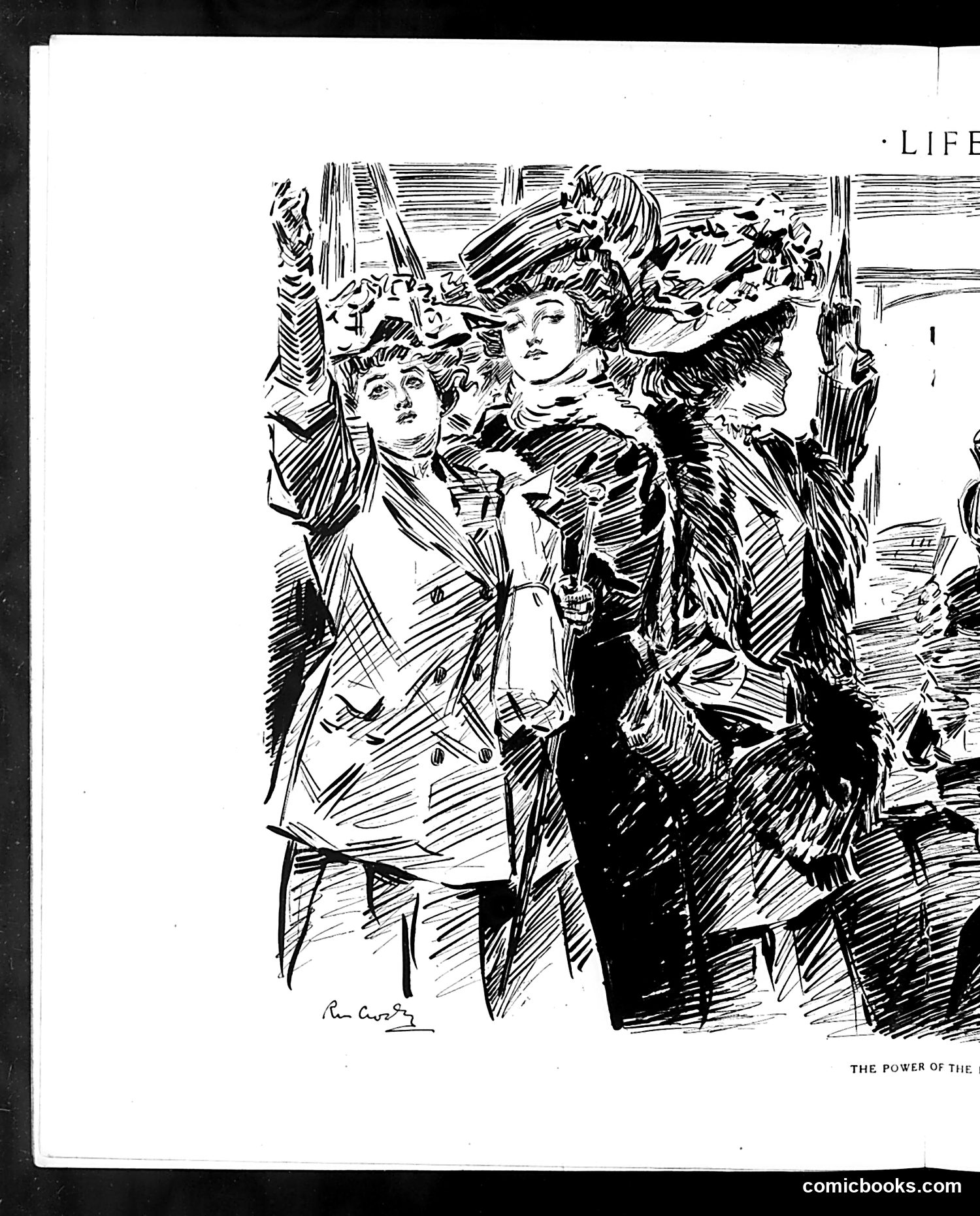
This appears to be a sketch from Life magazine showing fashionably dressed women in early 20th-century attire. The illustration is signed by the artist (signature appears to read "R. Cody" or similar). The partial text visible at the bottom reads "THE POWER OF THE" — suggesting this relates to women's social or political influence, likely commentary on female fashion, beauty, or emerging women's rights movements of the era. The women are depicted with elaborate hats, furs, and fitted clothing characteristic of the Gibson Girl era or similar period. Without the complete caption or full context, I cannot definitively explain the specific satirical point, though it likely comments on women's social power, fashion trends, or gender roles of the time. The sketch style and composition suggest social satire typical of Life's editorial cartoons from that period.
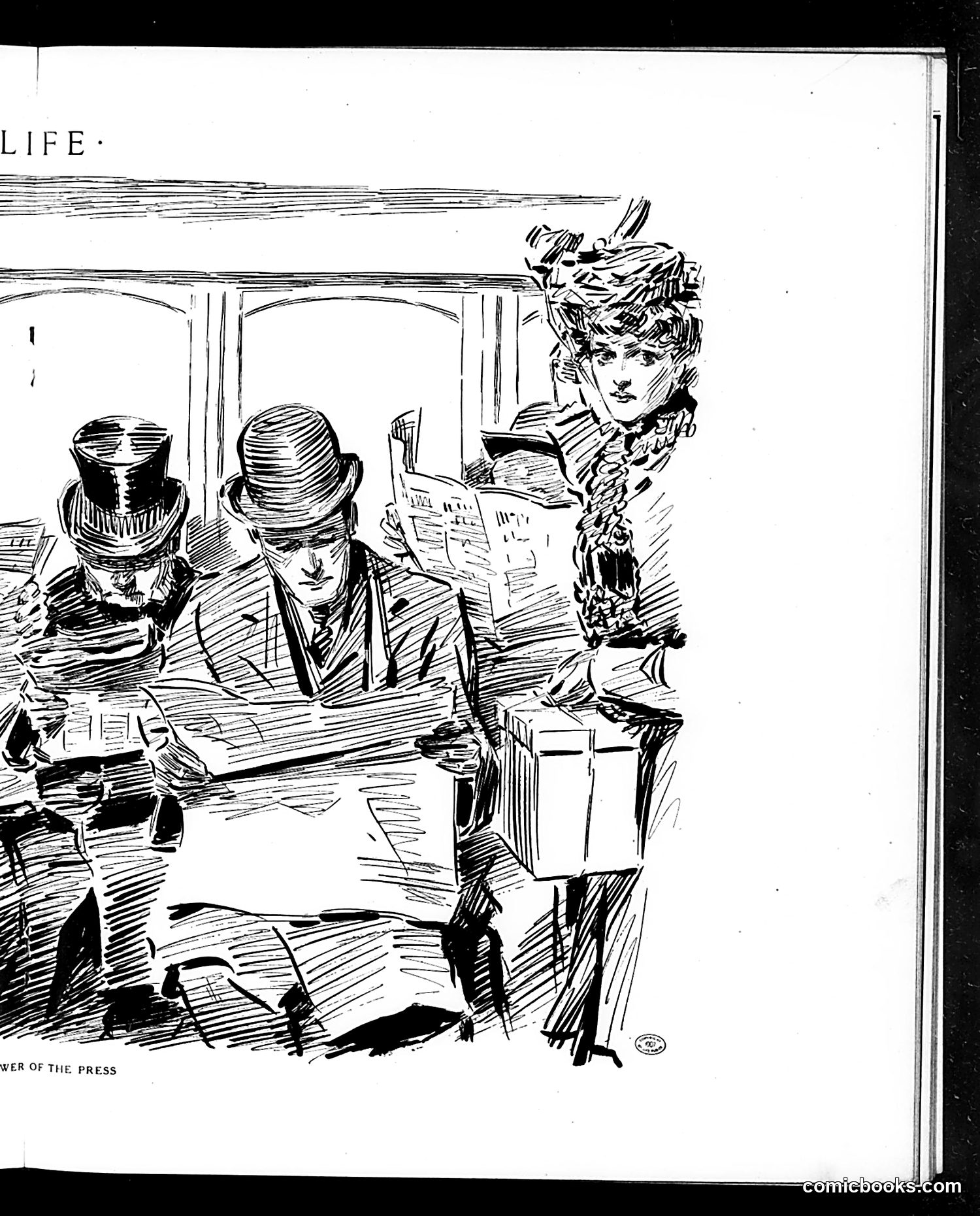
This appears to be a satirical illustration titled "Power of the Press," showing what looks like newspaper editors or journalists at a desk examining documents and newspapers. The figure on the right, drawn with elaborate hair and fashionable dress, appears to be a woman—likely representing either a society figure, actress, or political personality of the era being scrutinized by the press. The cartoon satirizes how newspapers and media outlets dissect and publicize the lives of prominent individuals. The composition emphasizes the "power" newspapers wielded in shaping public perception, with multiple figures focused intently on papers and documents. This reflects early 20th-century concerns about invasive press coverage and the media's influence on public opinion regarding notable figures.
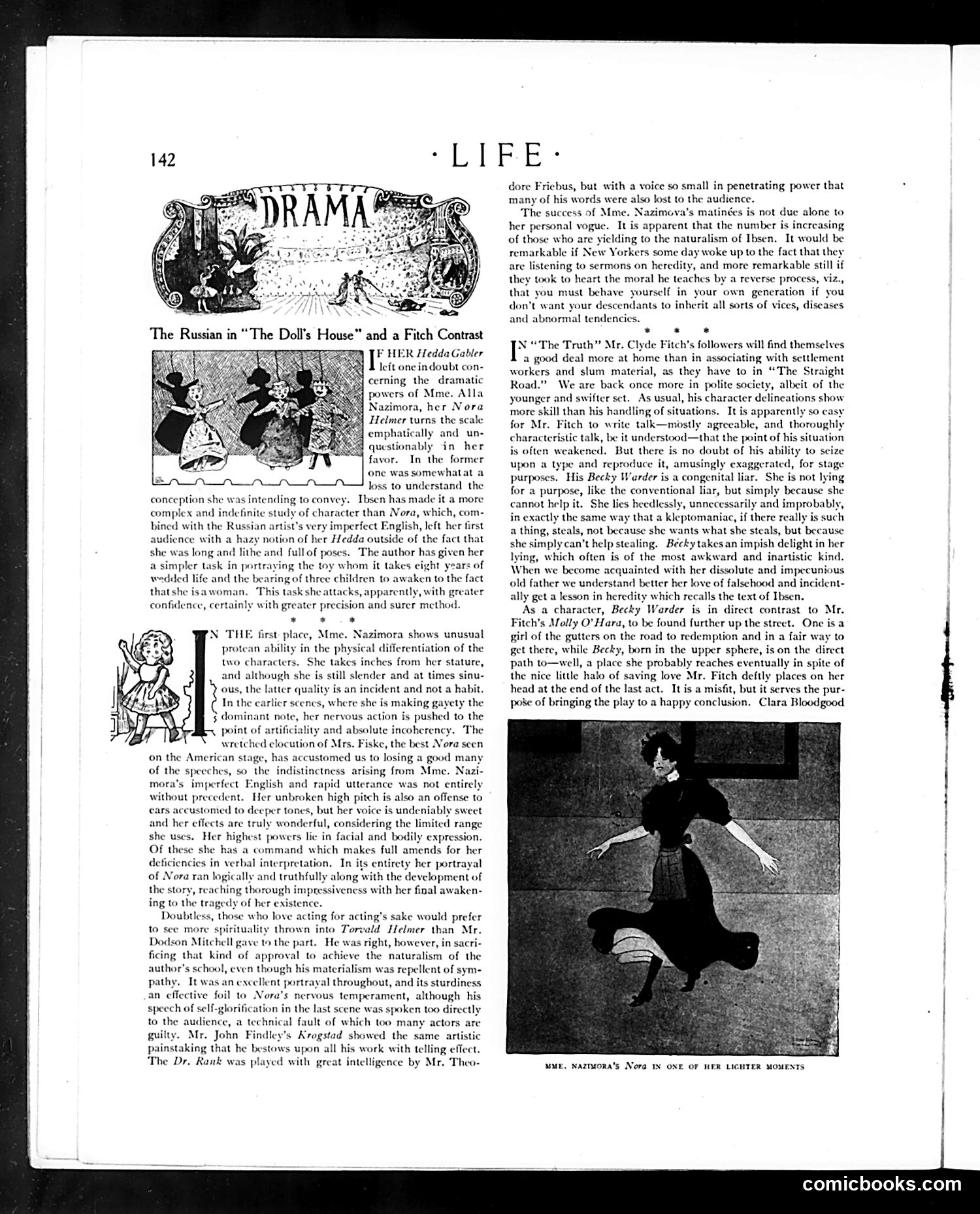
This is a theater review of Alla Nazimova's performance in Henrik Ibsen's *A Doll's House* (where the character is named Nora Helmer). The critic praises Nazimova's portrayal of Nora as superior to her earlier performance in *Hedda Gabler*. The review notes that Nazimova, a Russian actress with imperfect English and a high-pitched voice, compensates through exceptional physical acting and facial expression. Her performance is compared favorably to Mrs. Fiske's acclaimed American interpretation. The critic observes that *A Doll's House*—with its naturalistic style and themes about heredity and personal responsibility—represents growing New York appreciation for Ibsen's serious moral drama. The "contrast" in the title likely refers to Nazimova's portrayal versus Fiske's, or perhaps her earlier Hedda performance versus this Nora.
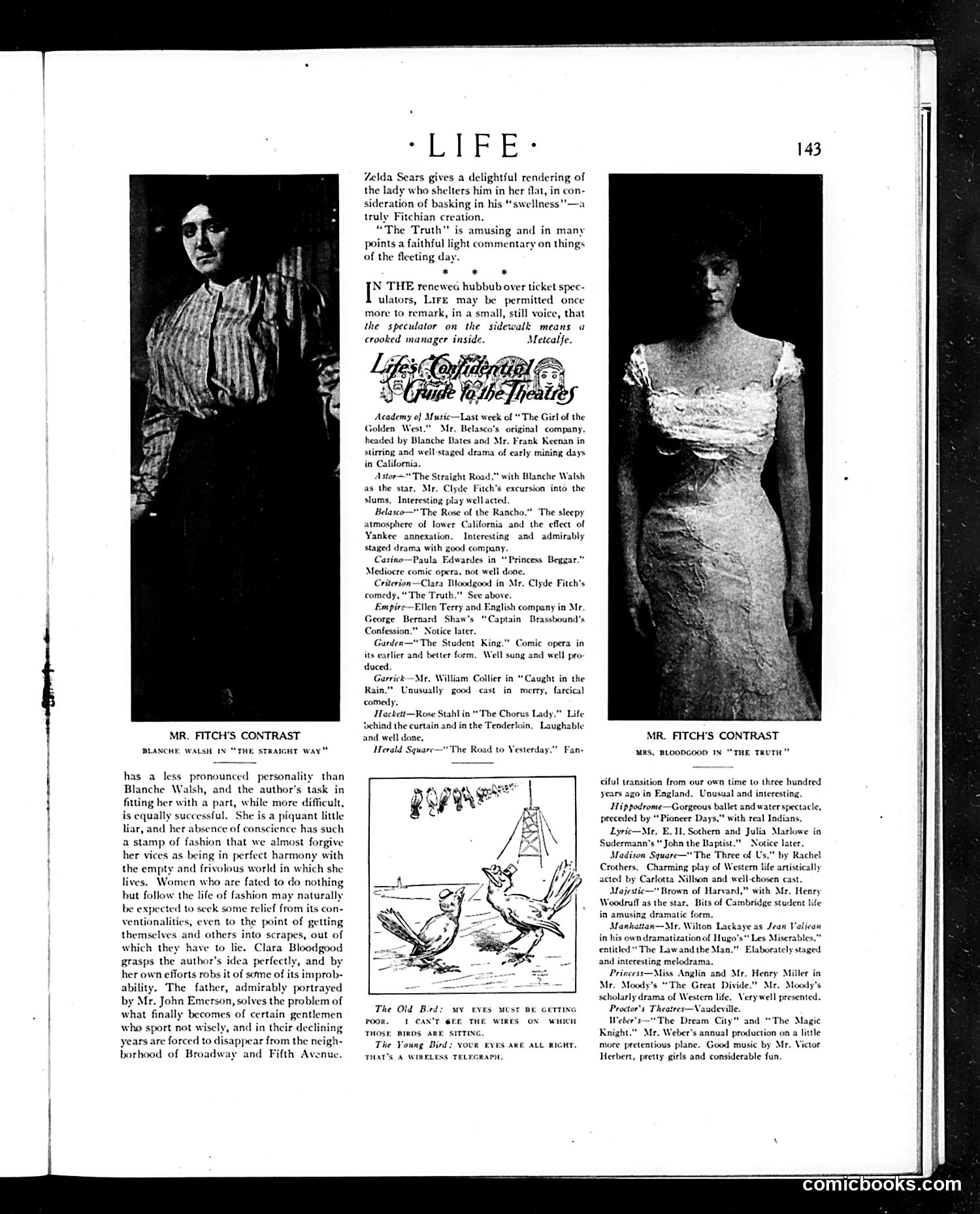
This is a theater review page from *Life* magazine featuring commentary on Broadway productions. The two photographs show actresses in "Mr. Fitch's Contrast"—likely comparing performances in works by playwright Clyde Fitch. The main text reviews several theatrical productions, including *The Straight Road* (starring Blanche Walsh), *The Truth* (featuring Clara Bloodgood), and other contemporary plays at venues like the Astor, Belasco, and Empire theaters. The cartoon depicts two birds on a wire discussing a "wireless telegraph"—a topical reference to the newly invented wireless technology of the early 1900s. The joke plays on the birds' confusion: the older bird thinks the wires are physical connections, while the younger bird explains it's "wireless," creating humor from the technological novelty that would have seemed paradoxical to contemporary readers unfamiliar with radio transmission.
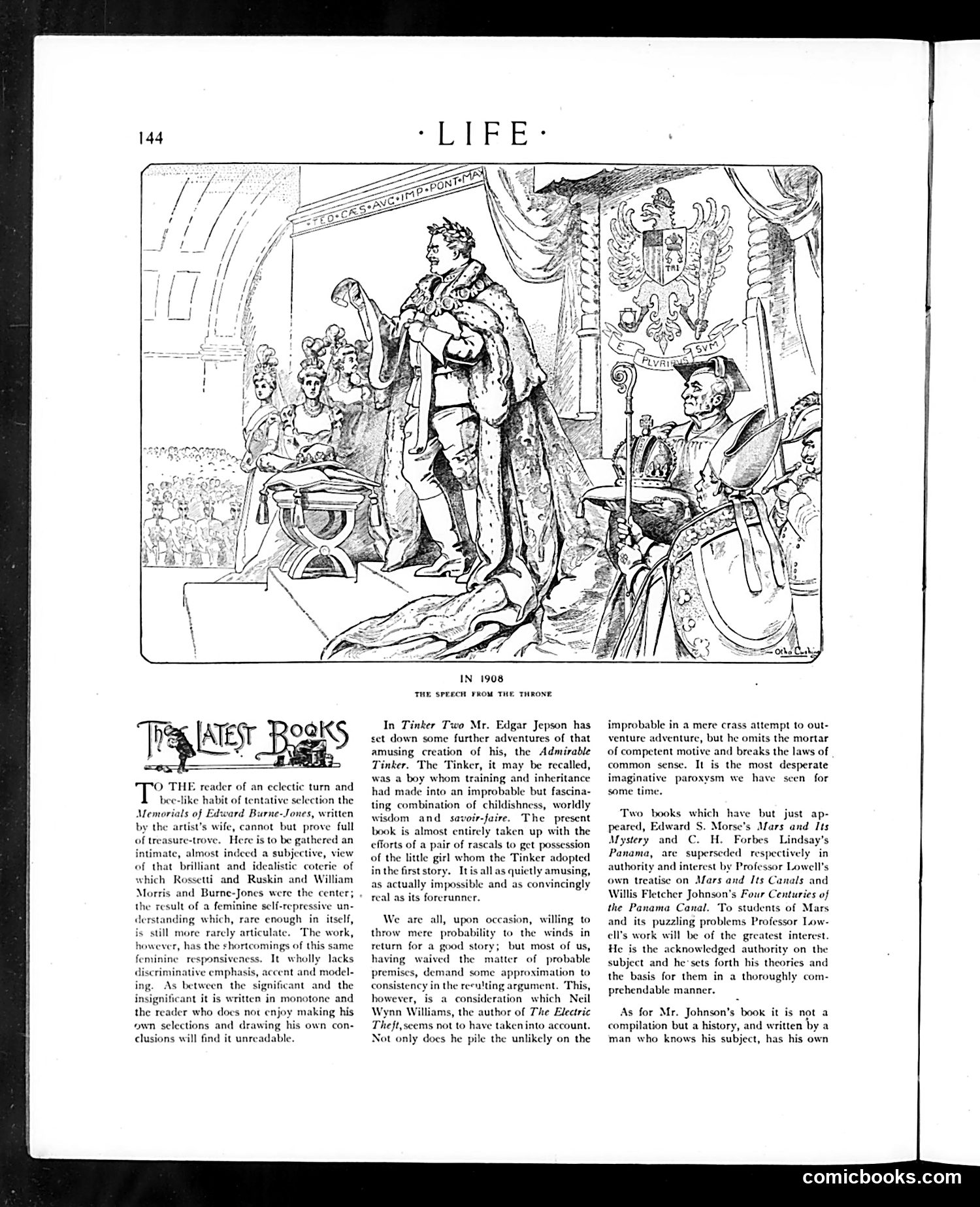
The illustration depicts a formal royal court scene, likely representing a British monarch delivering a throne speech. The central figure in elaborate regalia stands addressing assembled courtiers and observers. This page is primarily a **book review section** titled "The Latest Books." The illustration accompanies discussion of contemporary 1908 publications, including critiques of novels like "Tinker Two" by Edgar Jepson and "The Electric Theft" by Neil Wynn Williams. The reviews are somewhat sardonic—praising Jepson's work as cleverly amusing while dismissing Williams's novel as illogical and overwrought ("the most desperate imaginative paroxysm"). The page also favorably compares recent books on Mars and the Panama Canal to established authorities. **The cartoon itself appears to be a generic historical or literary illustration** rather than political satire—likely chosen to frame the literary discussion, possibly referencing a classic work or representing ceremonial authority as a thematic header for the book reviews.
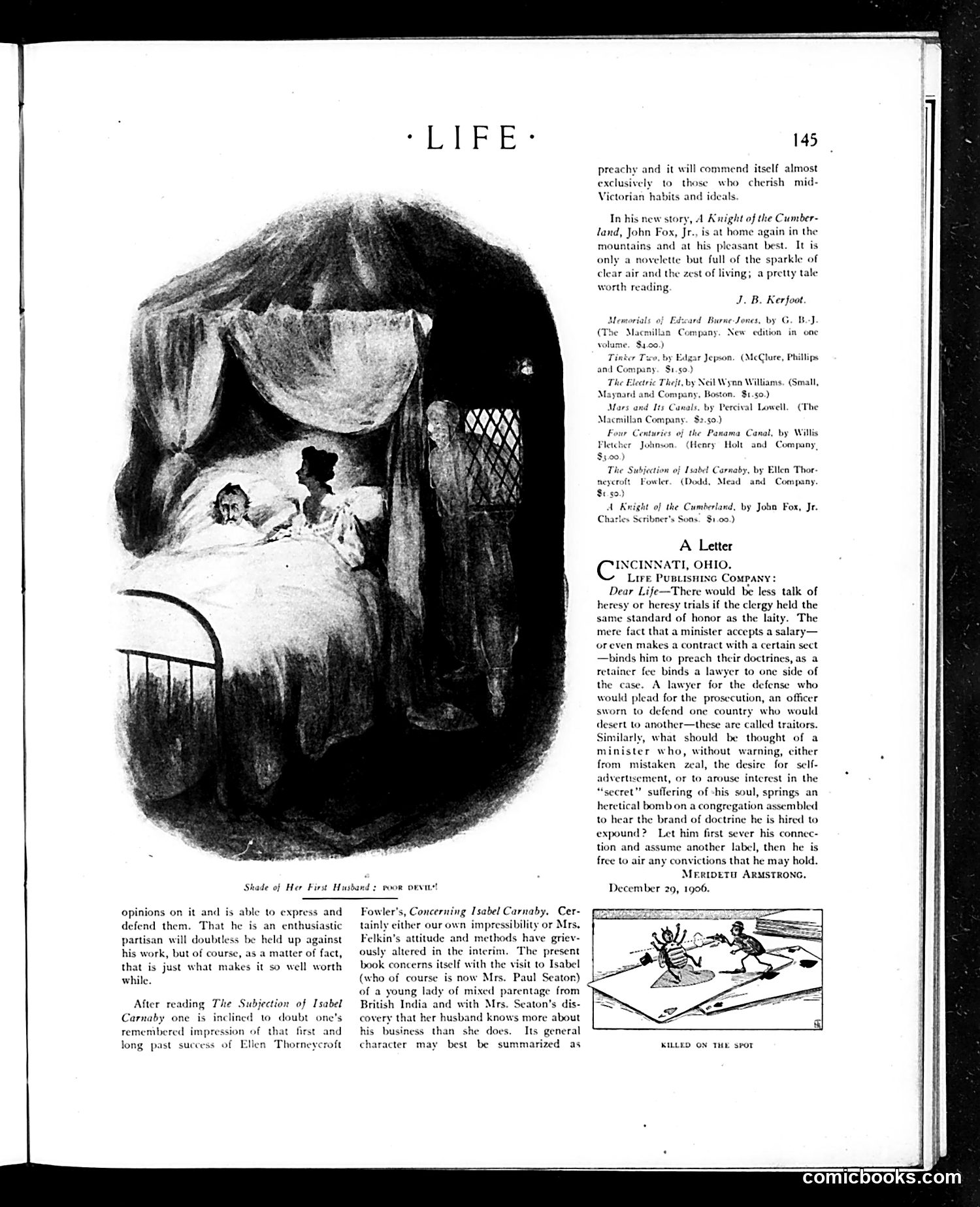
The main illustration, captioned "Shade of Her First Husband: poor devil!", depicts a ghostly figure observing a couple in bed. This appears to be a visual joke accompanying a book review of Ellen Thorneycroft Fowler's *The Subjection of Isabel Carnaby*—a novel about a woman named Isabel who has remarried (becoming Mrs. Paul Seaton) and discovers her new husband knows more about business than she does. The "poor devil" caption humorously suggests the first husband's spirit sympathizes with or pities the second husband's predicament of being married to this particular woman. The page primarily consists of book reviews and a published letter to the editor from Meredith Armstrong criticizing clergy who preach doctrines they're paid to defend while secretly harboring heretical beliefs—comparing such conduct to a lawyer defending both sides or a soldier deserting his country.
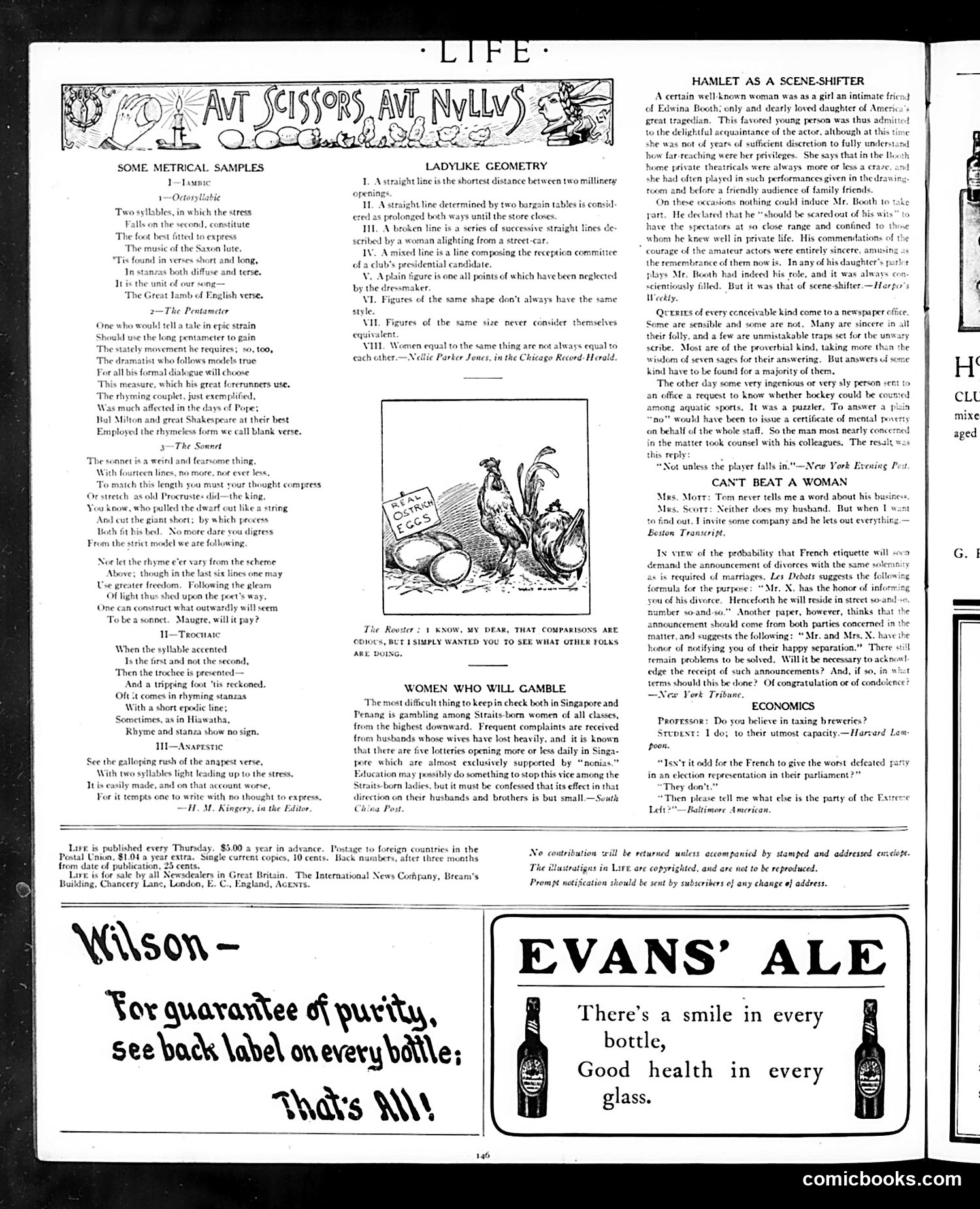
This page from *Life* magazine contains primarily **educational and humorous content** rather than political satire: **"Some Metrical Samples"** offers verse instruction explaining English poetic forms (iambic pentameter, sonnets, trochaic meter, anapestic verse)—technical poetry lessons for readers. **"Ladylike Geometry"** is satirical social commentary disguised as geometry theorems. It mocks women's behavior through geometric metaphors: women treating shopping (millinery openings, bargain tables) as "straight lines," women of equal "size" not being equivalent in character, and dressmakers neglecting women's figures. The satire targets frivolous female consumerism and vanity. **"Women Who Will Gamble"** reports seriously on gambling addiction among women in Singapore and Penang, framed as a social problem requiring legislative intervention. **"Hamlet as a Scene-Shifter"** appears to be an anecdotal story about theatrical connections (text is partially cut off). The page reflects early 20th-century attitudes: educational content mixed with gentle mockery of women's perceived social weaknesses (shopping obsession, gambling), presented as entertainment.
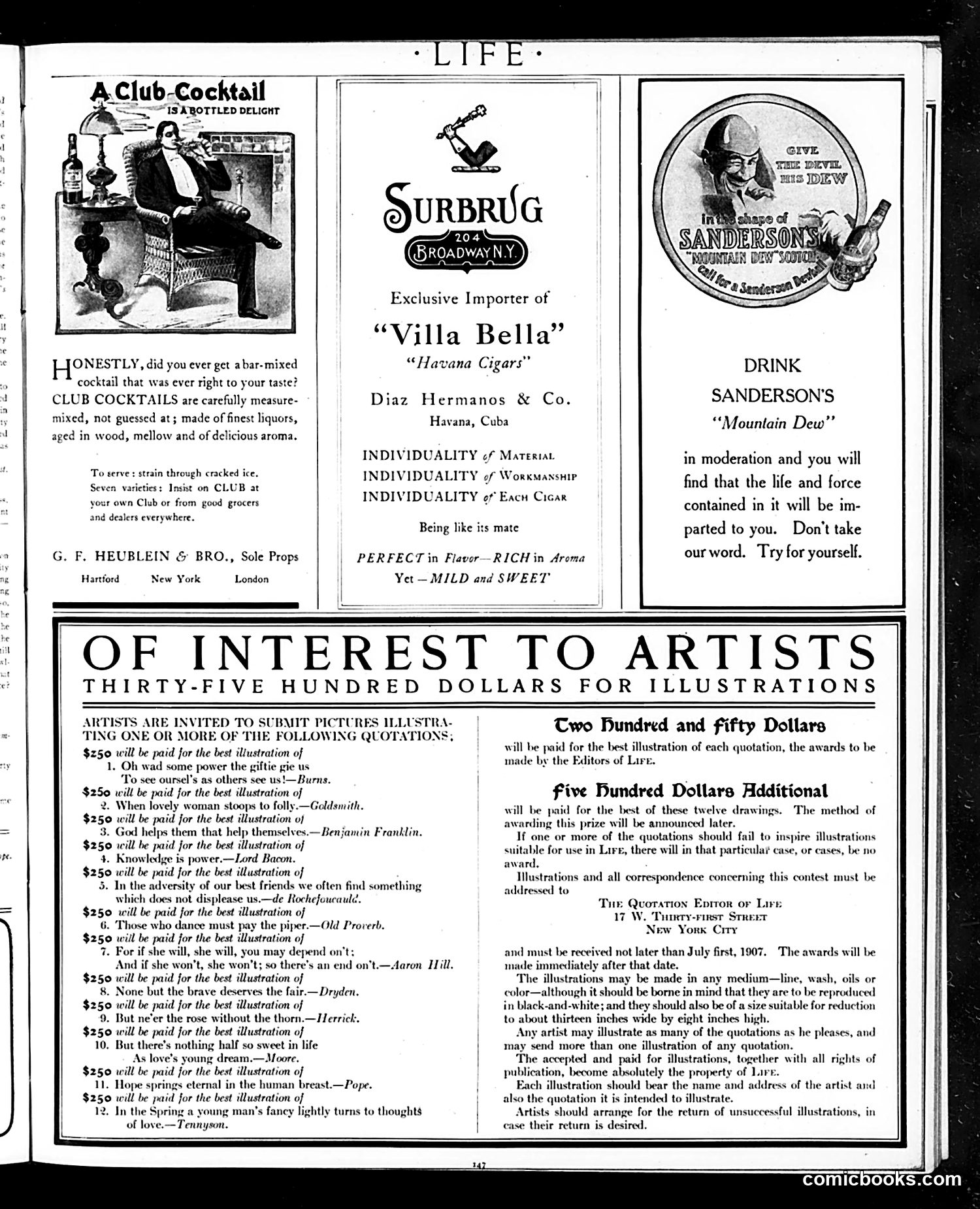
This page is primarily **advertising and a contest announcement**, not political satire. The top three-quarters features product advertisements: Club Cocktails (made by Heublein & Bros.), Villa Bella Havana cigars (imported by Diaz Hermanos & Co.), and Sanderson's Mountain Dew whiskey. These ads use typical early-1900s marketing imagery—a gentleman mixing drinks, product endorsements emphasizing quality and craftsmanship. The bottom half announces **Life's illustration contest**: $250 per quotation ($3,500 total) for artists to submit pictures illustrating classical literary and proverbial quotes (Burns, Goldsmith, Dryden, Tennyson, etc.). The contest solicits work by July 1, 1907, with illustrations to be reproduced in Life magazine. There is **no political cartoon or satire** visible here—it's a straightforward commercial and editorial page typical of Life's mixed content model during this era.
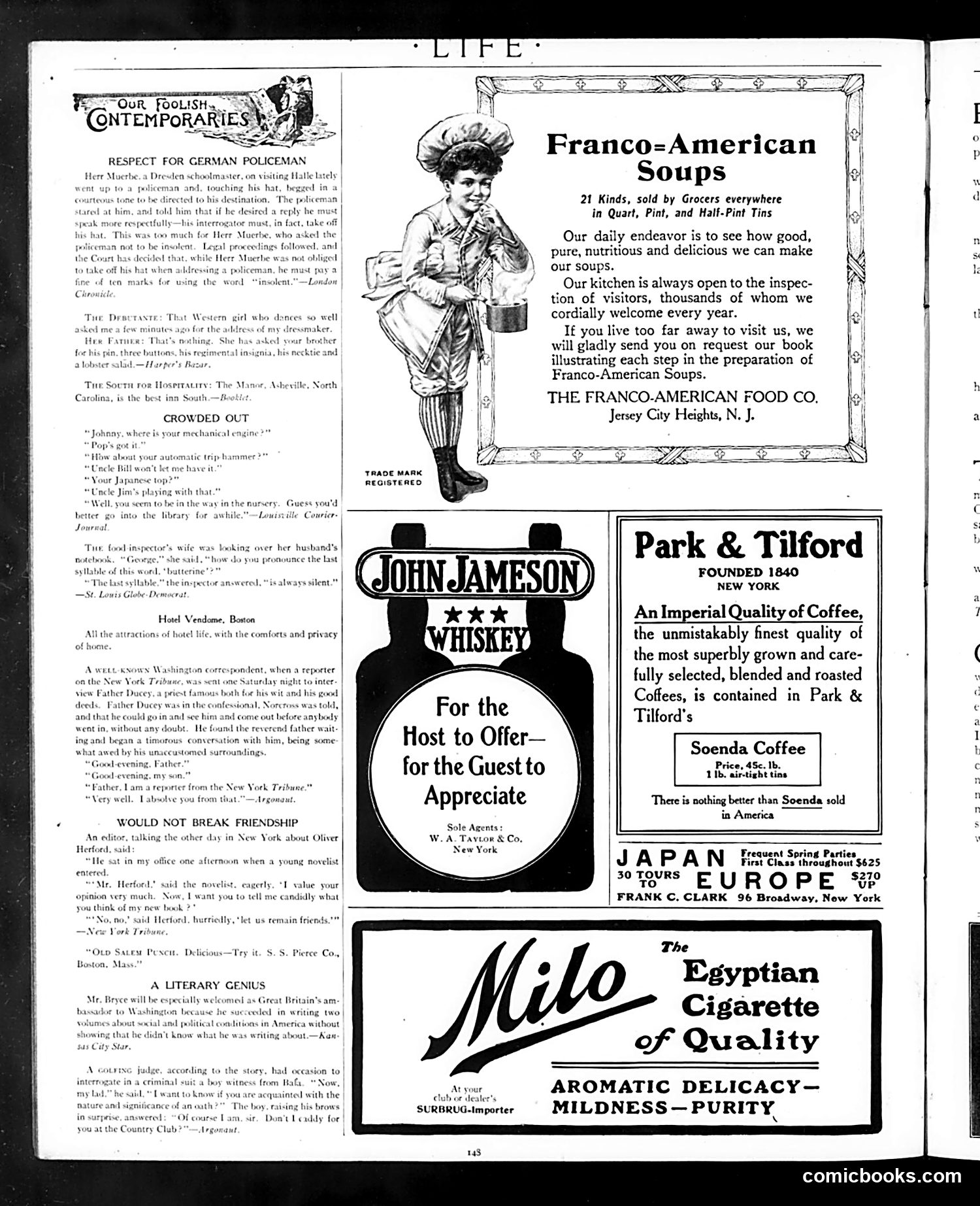
This page from *Life* magazine is primarily a **humor and advertising section** rather than political cartooning. **"Our Foolish Contemporaries"** features brief satirical anecdotes mocking contemporary social behaviors—including a story about a German policeman's indignation at being called "insolent," and another about novelist Oliver Herford's blunt critique offending a young writer. These are gentle social satire targeting middle-class manners and pretension. **The advertisements** dominate the page: Franco-American soups, John Jameson whiskey, Park & Tilford coffee, Milo Egyptian cigarettes, and travel services. These ads reveal period consumer culture and product positioning. The **central illustration**—a chef or cook in chef's hat—promotes Franco-American soups, emphasizing factory transparency and quality to reassure consumers about food safety—a concern in the early 20th century before modern food regulation. Overall, this reflects *Life*'s dual function: satirizing contemporary foibles while serving as an advertising medium for upscale consumer goods.
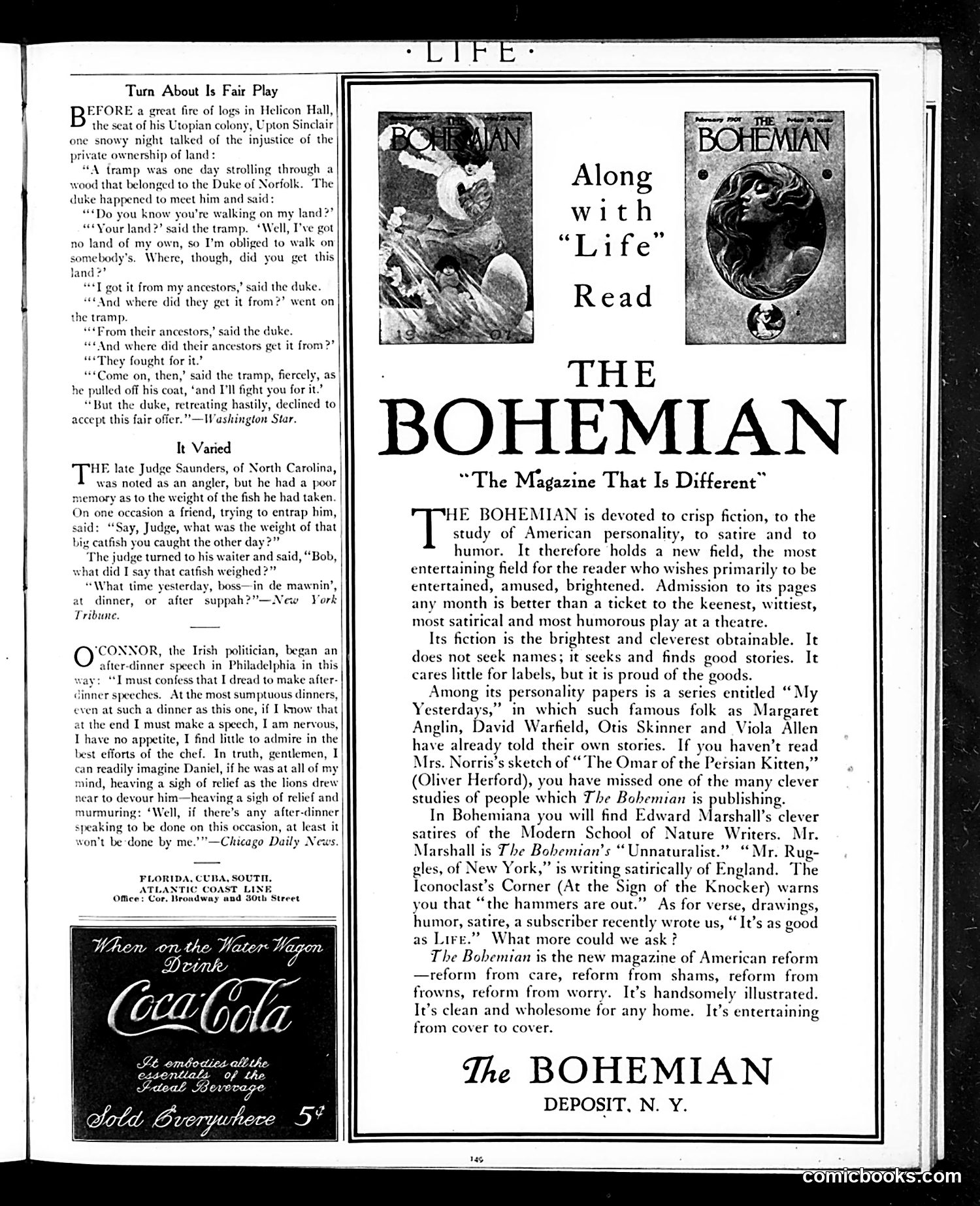
This Life magazine page contains three satirical anecdotes mocking land ownership and pretension, plus advertising for *The Bohemian* magazine. The opening story references **Upton Sinclair**, the muckraking socialist author, debating land rights at his utopian community Helicon Hall. A tramp challenges a duke's inherited claim to land—if ancestors "fought for it," why can't the tramp fight for it now? The joke satirizes inherited privilege and the absurdity of claiming perpetual ownership through ancestry alone. The second anecdote ridicules a judge's unreliable memory about fish weights; his servant's sarcastic response about different times of day mocks the judge's tendency to exaggerate. The third features **O'Connor**, an Irish politician, complaining that after-dinner speaking ruins his appetite—even Daniel in the lion's den would prefer that to making speeches. All three use humor to critique social pretension, inherited wealth, and pomposity—typical of *Life* magazine's satirical mission during the Progressive Era.
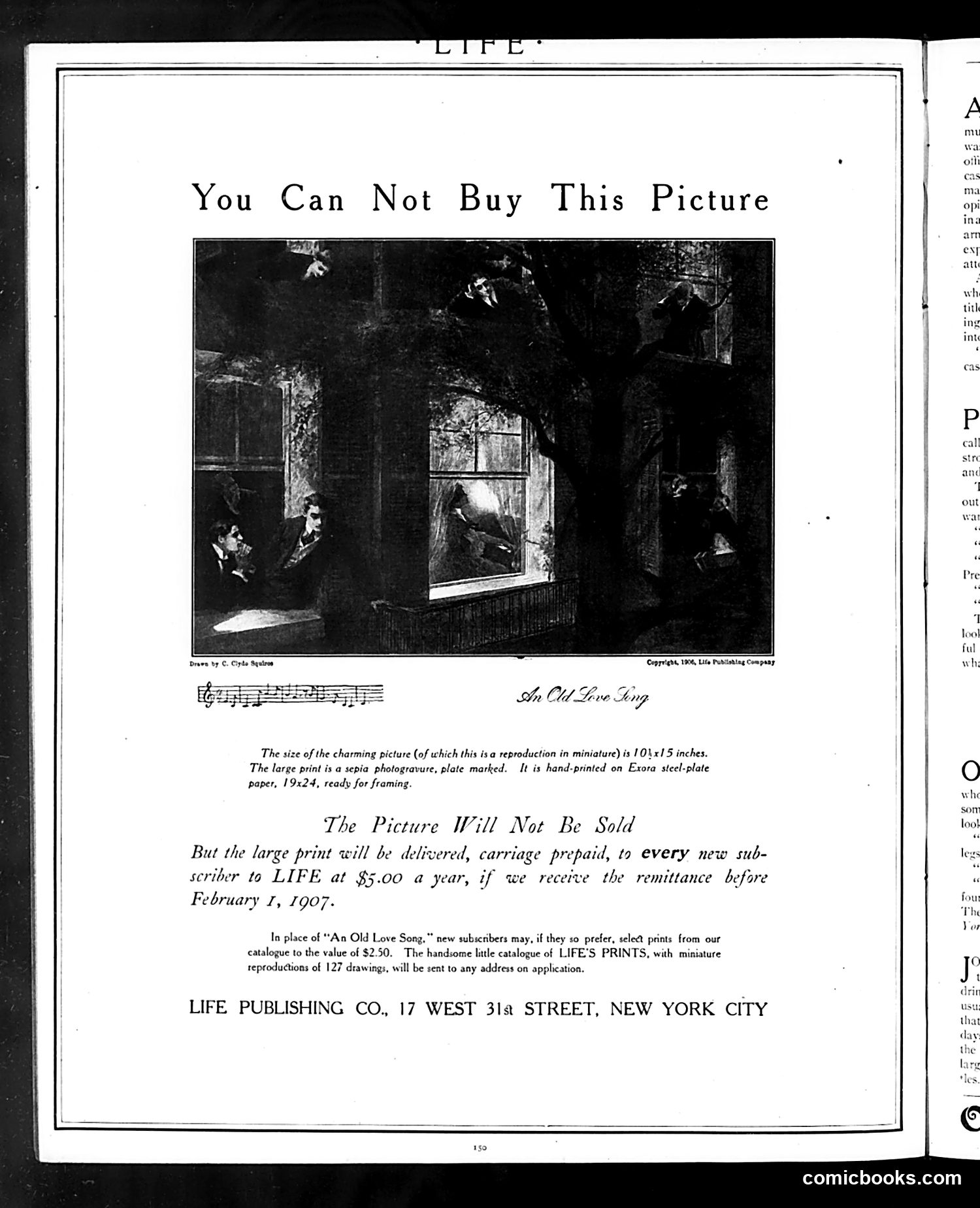
This page is primarily a **subscription advertisement**, not political satire. It promotes a sepia photogravure print by C. Clyde Squires titled "An Old Love Song," showing figures gazing out a lit window at night—a sentimental romantic scene. The clever hook: **"You Cannot Buy This Picture"** alone. Life Publishing offered it free as an incentive to new subscribers paying $5 annually (remittance due by February 1, 1907). The large 19x24-inch framed print was valuable enough to justify a year's subscription. Alternatively, new subscribers could select different prints from Life's catalog worth $2.50. This was a common **early-1900s marketing strategy**—using desirable art reproductions to attract magazine subscriptions rather than selling prints directly. The page reflects the magazine's positioning as a sophisticated publication offering cultural value beyond mere entertainment.
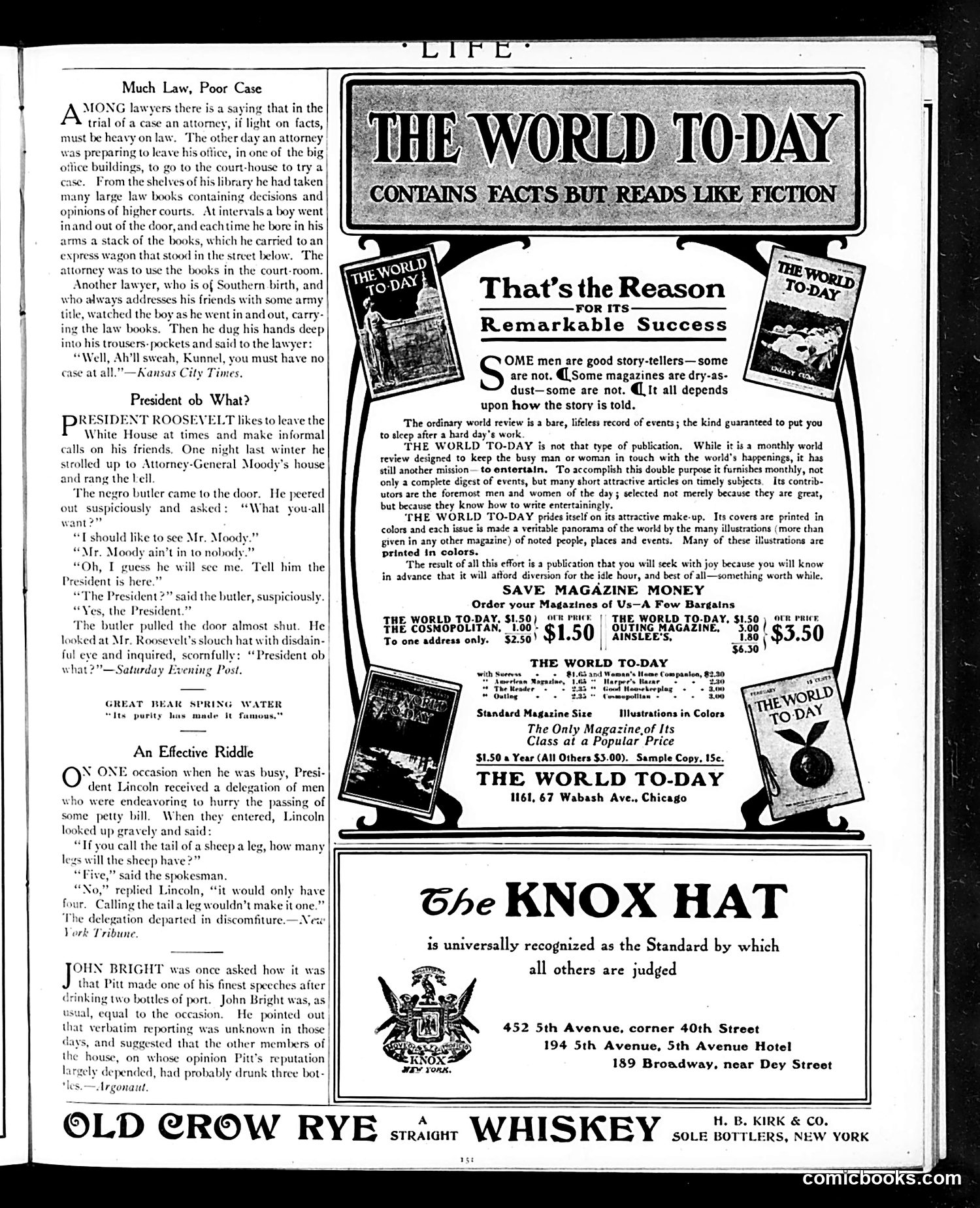
This page contains **anecdotal humor** rather than political cartoons. It reprints four brief jokes about famous American figures: 1. **"Much Law, Poor Case"**: A Southern lawyer jokes that another attorney carrying many law books to court must have a weak case—needing heavy legal references rather than facts. 2. **"President ob What?"**: A domestic servant at Attorney General Moody's house doesn't recognize President Roosevelt at the door and skeptically questions whether he's really "the President." 3. **"An Effective Riddle"**: Lincoln uses logical wordplay to dismiss a delegation—calling a sheep's tail a leg doesn't make it one—as a metaphor for refusing their spurious request. 4. **"John Bright" anecdote**: Claims Bright explained Pitt's eloquent speech after drinking port by noting that without verbatim reporting, others had probably drunk more. The bulk of the page advertises **"The World To-Day"** magazine, emphasizing it combines news with entertaining writing and colorful illustrations. Additional ads promote the Knox Hat and Old Crow Whiskey.
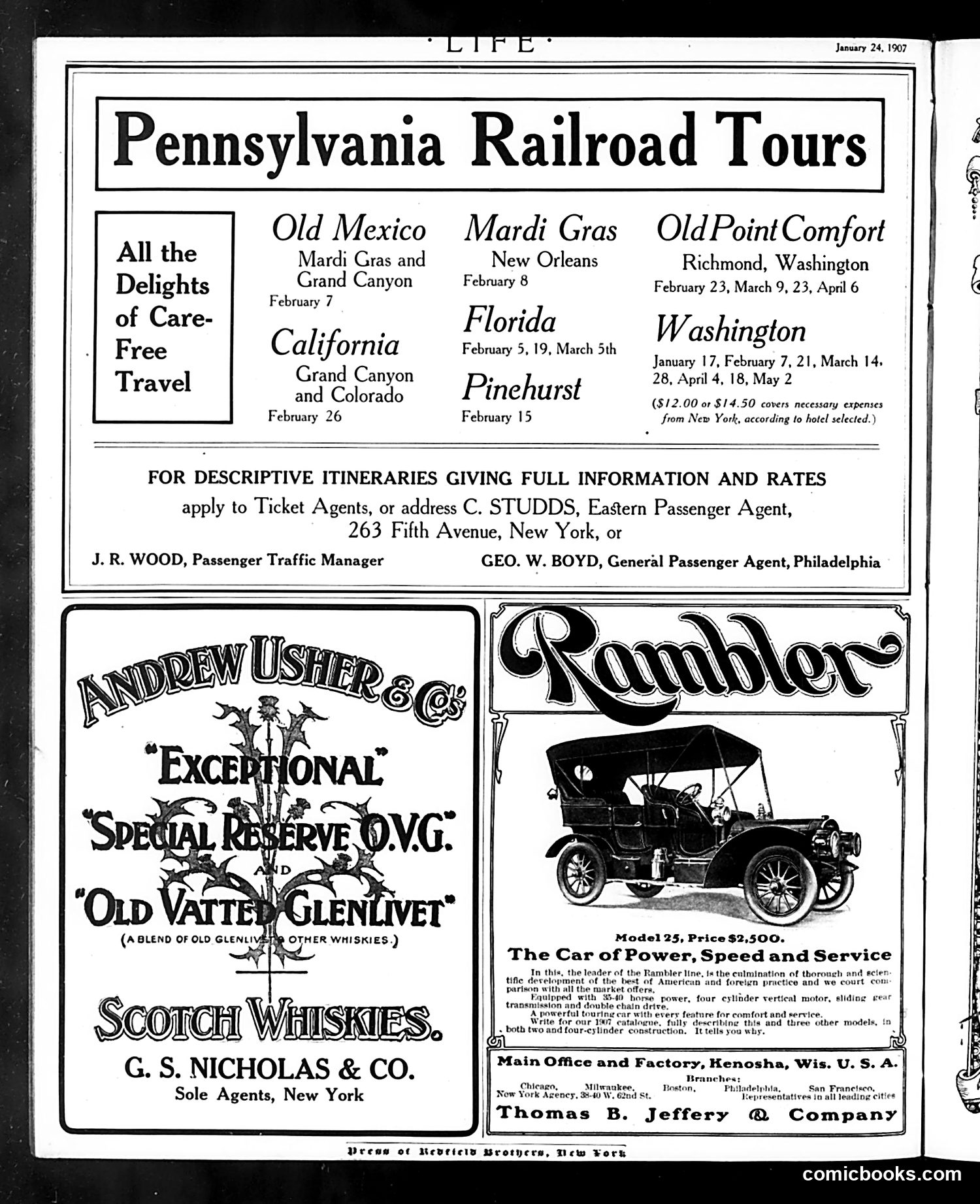
This is primarily a **advertisements page**, not a satirical cartoon page. It contains four distinct ads from January 24, 1907: 1. **Pennsylvania Railroad Tours** — promoting luxury vacation packages to destinations like Mexico, California, Florida, New Orleans, and Washington D.C., with prices ranging $12-$14.50 from New York. 2. **Andrew Usher & Co.** — advertising Scotch whiskies including "Special Reserve O.V.G." and "Old Vatted Glenlivet," positioned as premium products. 3. **Rambler automobile** — promoting the Model 25 car at $2,500, emphasizing "Power, Speed and Service" with factory in Kenosha, Wisconsin. 4. **Thomas B. Jeffery Company** — the Rambler's manufacturer listing branches in major cities. The page reflects early 1900s consumer culture: leisure travel for the wealthy, imported spirits, and the emerging automobile industry. There is **no satire or political content** visible—it's straightforward commercial advertising typical of *Life* magazine's revenue model.