
Life, 1907-01-24 · page 21 of 24
Life — January 24, 1907 — page 21: what you’re looking at
What you’re looking at
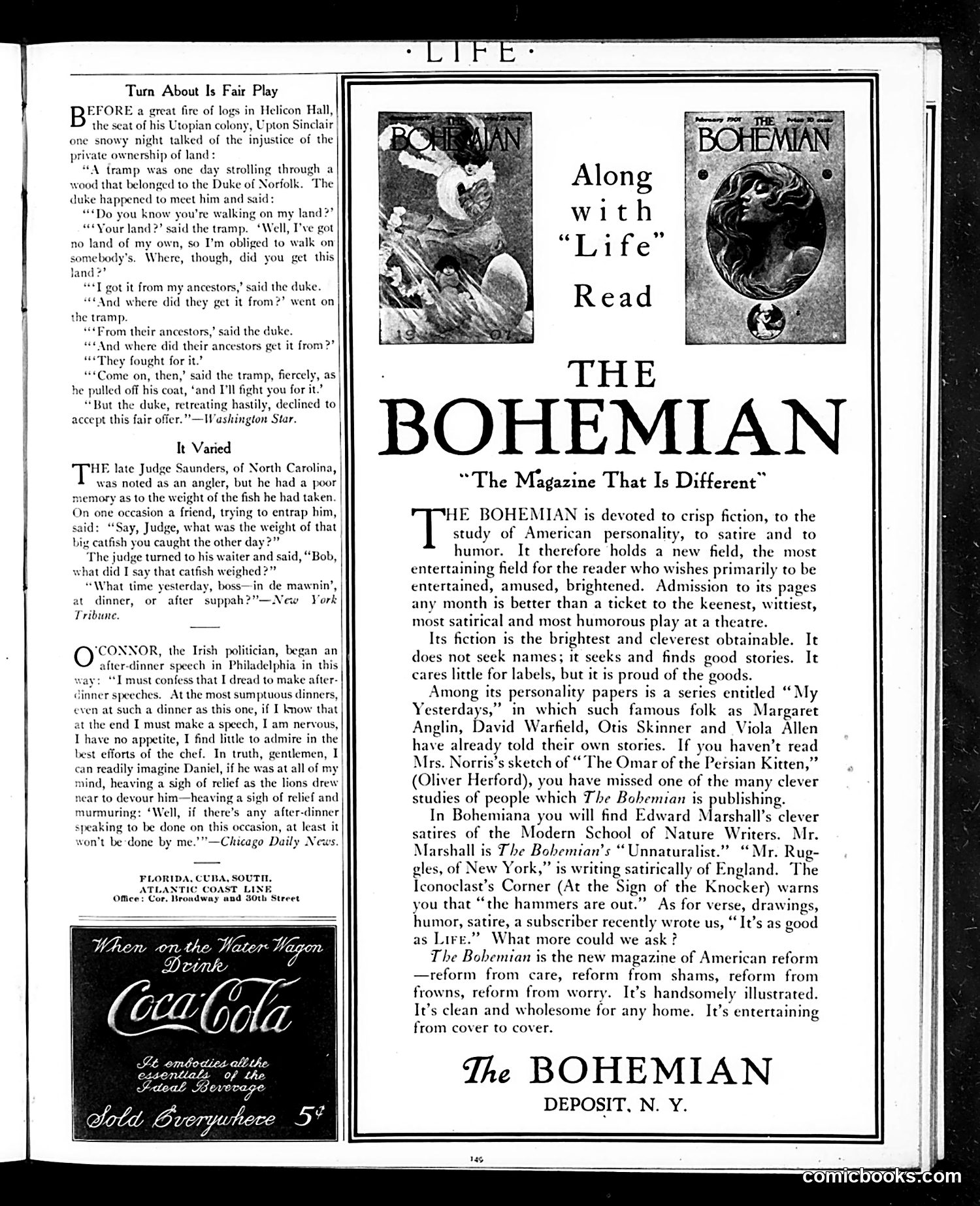
This Life magazine page contains three satirical anecdotes mocking land ownership and pretension, plus advertising for *The Bohemian* magazine. The opening story references **Upton Sinclair**, the muckraking socialist author, debating land rights at his utopian community Helicon Hall. A tramp challenges a duke's inherited claim to land—if ancestors "fought for it," why can't the tramp fight for it now? The joke satirizes inherited privilege and the absurdity of claiming perpetual ownership through ancestry alone. The second anecdote ridicules a judge's unreliable memory about fish weights; his servant's sarcastic response about different times of day mocks the judge's tendency to exaggerate. The third features **O'Connor**, an Irish politician, complaining that after-dinner speaking ruins his appetite—even Daniel in the lion's den would prefer that to making speeches. All three use humor to critique social pretension, inherited wealth, and pomposity—typical of *Life* magazine's satirical mission during the Progressive Era.
📄 Transcribed text from this page (OCR, searchable)
Machine-transcribed from the original scan — historical spelling and the odd misread are preserved.
Turn About Is Fair Play B ORE a great fire of logs in Helicon Hall, | the seat of his Utopian colony, Upton Sinclair snowy night talked of the injustice of the ate ownership of land : “A tramp was one day strolling through a wood that belonged to the Duke of Norfolk. The | duke happened to meet him and said: “Do you know you're walking on my land?’ “Your land?’ said the tramp. ‘Well, I've got no land of my own, so I’m obliged to walk on somebody's. Where, though, did you get this Jand ?” I got it from my ancestors,’ said the duke. “And where did they get it from?’ went on the tramp. “*From their ancestors, “*And where did thei “*They fought for it.’ “*Come on, then,’ said the tramp, fiercely, as he pulled off his coat, ‘and I'll fight you for it.” “But the duke, retreating hastily, declined to accept this fair offer.” —Washington Star. Tt Varied HE late Judge Saunders, of North Carolina, was noted as an angler, but he had a poor memory as to the weight of the fish he had taken. | On one occasion a friend, trying to entrap him, said: “Say, Judge, what was the weight of that big catfish you caught the other day?” The judge tumed to his waiter and said, “Bob, what did I say that catfish weighed?” | “What time yesterday, boss—in de mawnin’, at dinner, or after suppah?”—New York Tribune. id the duke. ancestors get it from ?? “CONNOR, the Irish politician, began an fter-dinner speech in Philadelphia in this : ‘I must confess that I dread to make after- dinner speeches. At the most sumptuous dinners, such a dinner as this one, if I know that at the end I must make a speech, I am nervous, I have no appetite, I find little to admire in the best efforts of the chef. In truth, gentlemen, 1) can readily imagine Daniel, if he was at all of mind, heaving a sigh of relief as the lions drew near to devour him—heaving a sigh of relief and murmuring: ‘Well, if the any after-dinner speaking to be done on this occasion, at i won't be-done by me.’"—Chicago Daily Nec even FLORIDA, CUBA, SOUTI, ATLANTIC COAST LIN OMice: Cor. Hroadway and 30th Street When on the Water Wegon Detrnk Kt embodies alt the essentlals of the Leal Beverage Sota Ovoryuh ce 5% THE OHEMIAN “The Magazine That Is Different” "|e BOHEMIAN is devoted to crisp fiction, to the study of American personality, to satire and to humor. It therefore holds a new field, the most entertaining field for the reader who wishes primarily to be entertained, amused, brightened. Admission to its pages any month is better than a ticket to the keenest, wittiest, most satirical and most humorous play at a theatre. Its fiction is the brightest and cleverest obtainable. It does not seek names; it seeks and finds good stories. It cares little for labels, but it is proud of the goods. Among its personality papers is a series entitled “My Yesterdays,” in which such famous folk as Margaret Anglin, David Warfeld, Otis Skinner and Viola Allen have already told their own stories. If you haven’t read Mrs. Norris’s sketch of “The Omar of the Pe Kitten,” (Oliver Herford), you have missed one of the many clever studies of people which The Bohemian is publishing. In Bohemiana you will find Edward Marshall’s clever satires of the Modern School of Nature Writers. Mr. Marshall is The Bobemian’s “ Unnaturalist.” “Mr. Rug- gles, of New York,” is writing satirically of England. The Iconoclast’s Corner (At the Sign of the Knocker) warns you that “the hammers are out.” As for verse, drawings, humor, satire, a subscriber recently wrote us, “It’s as good as Lire.” What more could we ask ? The Bobemian is the new magazine of American reform —reform from care, reform from shams, reform from frowns, reform from worry. It’s handsomely illustrated. It’s clean and wholesome for any home. It’s entertaining from cover to cover. The BOHEMIAN DEPOSIT, N. Y.