
Life, 1907-01-24 · page 16 of 24
Life — January 24, 1907 — page 16: what you’re looking at
What you’re looking at
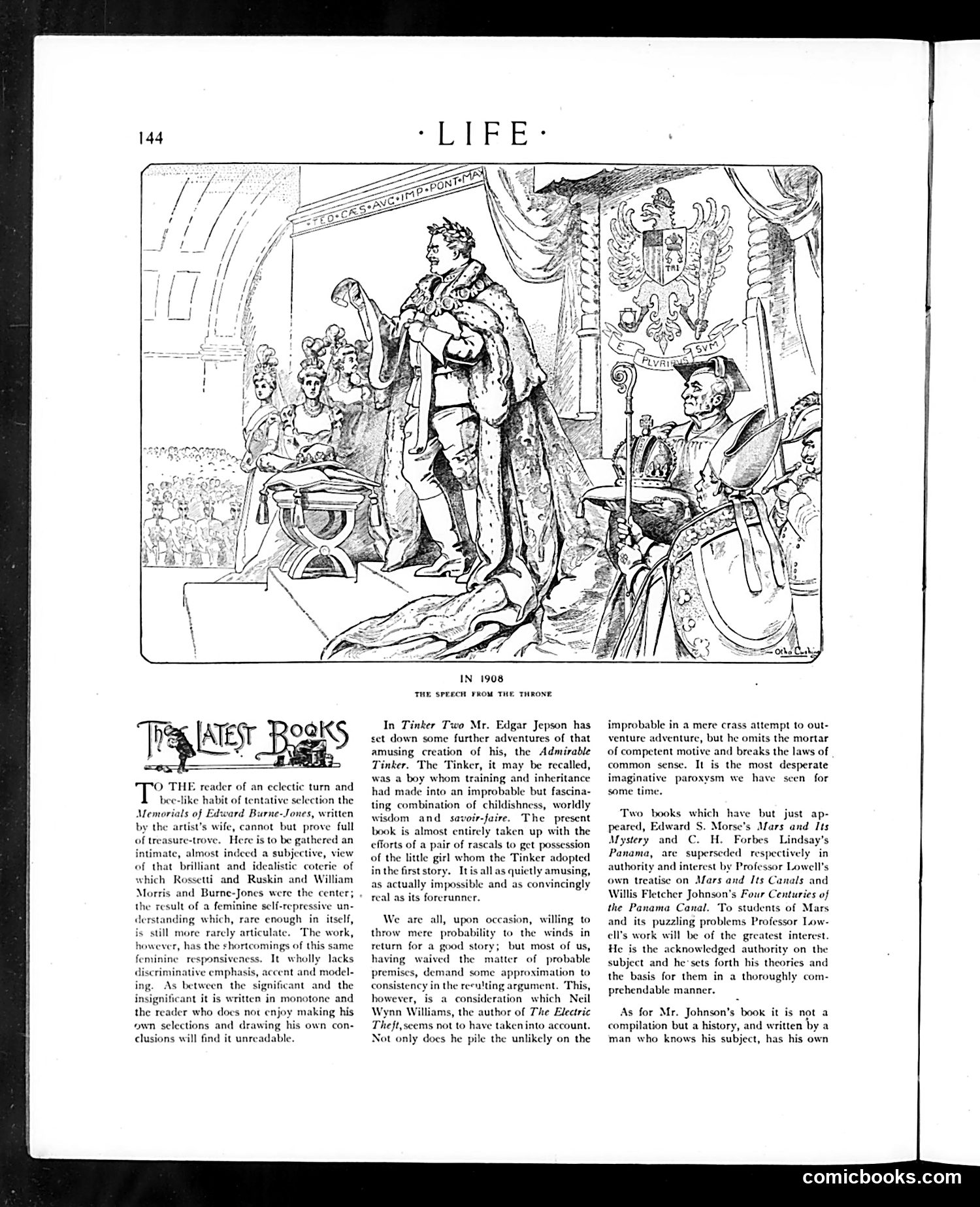
The illustration depicts a formal royal court scene, likely representing a British monarch delivering a throne speech. The central figure in elaborate regalia stands addressing assembled courtiers and observers. This page is primarily a **book review section** titled "The Latest Books." The illustration accompanies discussion of contemporary 1908 publications, including critiques of novels like "Tinker Two" by Edgar Jepson and "The Electric Theft" by Neil Wynn Williams. The reviews are somewhat sardonic—praising Jepson's work as cleverly amusing while dismissing Williams's novel as illogical and overwrought ("the most desperate imaginative paroxysm"). The page also favorably compares recent books on Mars and the Panama Canal to established authorities. **The cartoon itself appears to be a generic historical or literary illustration** rather than political satire—likely chosen to frame the literary discussion, possibly referencing a classic work or representing ceremonial authority as a thematic header for the book reviews.
📄 Transcribed text from this page (OCR, searchable)
Machine-transcribed from the original scan — historical spelling and the odd misread are preserved.
pe. © THE reader of an eclectic turn and bee-like habit of tent on the Memorials of Edward Burne-Jones, written : artist’s wife, cannot but prove full sure-trove. Here is to be gathered an intimate, almost indeed a subjective, view of that brilliant and idealistic coterie of which Rossetti and Ruskin and William Morris and Burne-Jones were the center; the result of a feminine self-repressive un- derstanding which, rare enough in itself, is still more rarely articulate. The work, however, has the shortcomings of this same feminine eness, It wholly lacks discriminative emphasis, accent and model- ing. As between the significant and the insignificant it is written in monotone and y making his own selections and drawing his own con- clusions will find it unreadable. respons the reader who does not enje IN 1908 THE SPEECH YROM THE THRONE In Tinker Two Mr. Edgar Jepson has set down some further adventures of that amusing creation of his, the Admirable Tinker. The Tinker, it may be recalled, was a boy whom training and inheritance had made into an improbable but fascina- ting combination of childishness, worldly wisdom and savoir-faire. The present book is almost entirely taken up with the efforts of a pair of rascals to get possession of the little girl whom the Tinker adopted inthe first story. Itisall as quictly amusing, as actually impossible and as convincingly real as its forerunner. We are all, upon occasion, willing to throw mere probability to the winds in return for a good story; but most of us, having waived the matter of probable premises, demand some approximation to consistency in the reeulting argument. This, however, is a consideration which Neil Wynn Williams, the author of The Electric Theft, seems not to have taken into account. Not only docs he pile the unlikely on the improbable in a mere crass attempt to out- venture adventure, but he omits the mortar of competent motive and breaks the laws of common sense. It is the most desperate imaginative paroxysm we have seen for some time, Two books which have but just ap- peared, Edward S. Morse’s Mars and Its Mystery and C. H. Forbes Lindsay’s Panama, are superseded respectively in authority and interest by Professor Lowell's own treatise on Mars and Its Canals and Willis Fletcher Johnson's Four Centuries of the Panama Canal. ‘To students of Mars and its puzzling problems Professor Low- cll’s work will be of the greatest interest. He is the acknowledged authority on the subject and he’ sets forth his theories and the basis for them in a thoroughly com- prehendable manner. As for Mr. Johnson’s book it is not a tion but a history, and written by a man who knows his subject, has his own comicbooks.com