
Life, 1907-01-24 · page 14 of 24
Life — January 24, 1907 — page 14: what you’re looking at
What you’re looking at
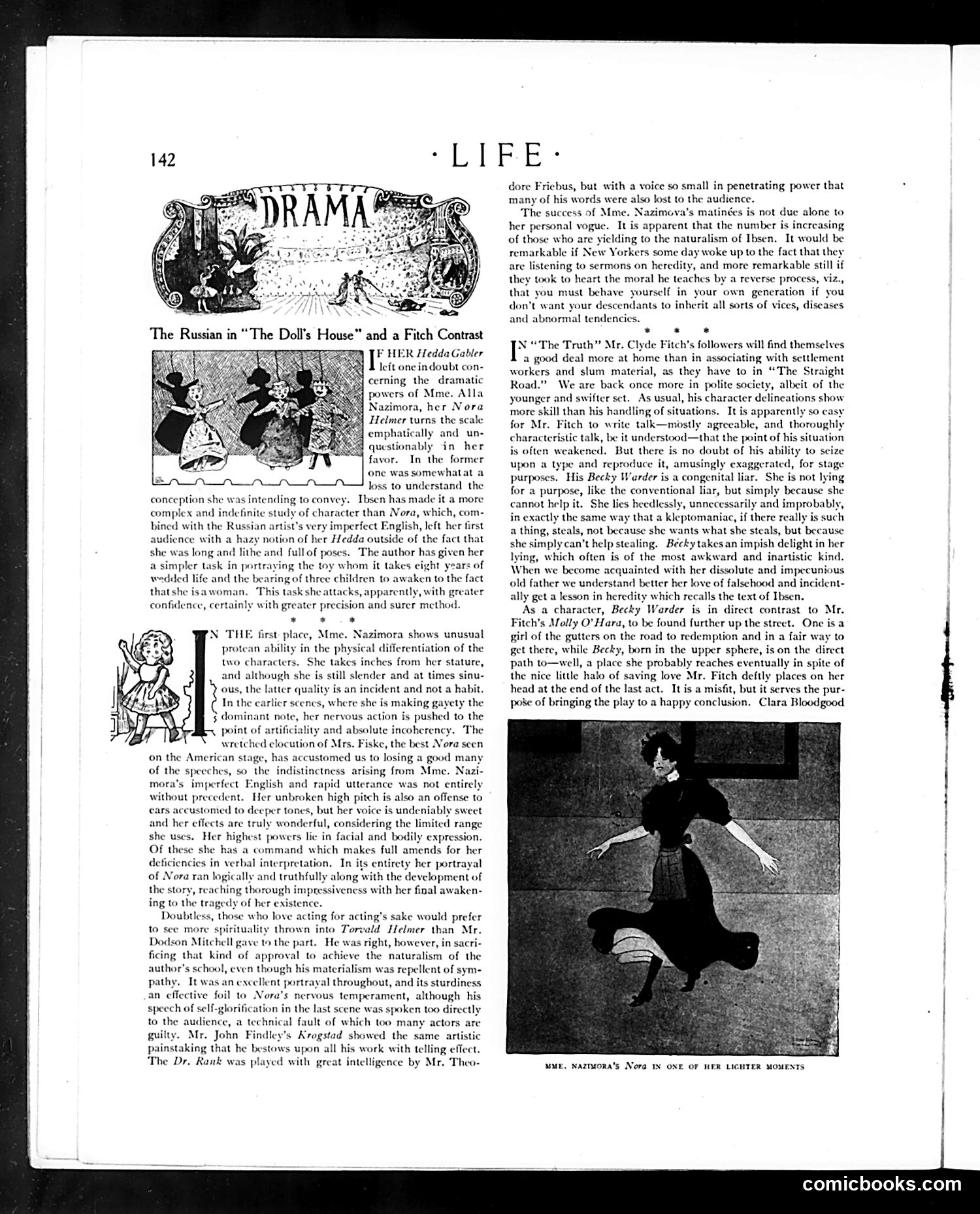
This is a theater review of Alla Nazimova's performance in Henrik Ibsen's *A Doll's House* (where the character is named Nora Helmer). The critic praises Nazimova's portrayal of Nora as superior to her earlier performance in *Hedda Gabler*. The review notes that Nazimova, a Russian actress with imperfect English and a high-pitched voice, compensates through exceptional physical acting and facial expression. Her performance is compared favorably to Mrs. Fiske's acclaimed American interpretation. The critic observes that *A Doll's House*—with its naturalistic style and themes about heredity and personal responsibility—represents growing New York appreciation for Ibsen's serious moral drama. The "contrast" in the title likely refers to Nazimova's portrayal versus Fiske's, or perhaps her earlier Hedda performance versus this Nora.
📄 Transcribed text from this page (OCR, searchable)
Machine-transcribed from the original scan — historical spelling and the odd misread are preserved.
The Russian in “The Doll's House” and a Fitch Contrast F HER HeddaGabler left oneindoubt con- cerning the dramatic q powers of Mme. Alla q Nazimora, her Nora Helmer turns the scale emphatically and un- d questionably in her favor. In the former one was somewhat at oss to understand the conception she was intending to convey. Ibsen has made it a more complex and indefinite study of character than Nora, which, com- bined with the Russian artist's very imperfect English, left her first audience with a hazy notion of her Hedda outside of the fact that she was long and lithe and fullof poses. ‘The author has given her mpler task in portraying the toy whom it takes eight years of wedded life and the bearing of three children to awaken to the fact thatshe isawoman. This task she attacks, apparently, with greater confidence, certainly with greater precision and surer method. + * 8 N THE first place, Mme. Nazimora shows unusual protean ability in the physical diffcrentiation of the two characters. She takes inches from her stature, and although she is still slender and at times sinu- ous, the latter quality is an incident and not a habit. In the earlier scenes, where she is making gayety the 3 dominant note, her nervous action is pushed to the point of artificiality and absolute incoherency. ‘The wretched elocution of Mrs. Fiske, the best Nora seen on the American stage, has accustomed us to losing a good many of the speeches, so the indistinctness arising from Mme. Naz mora’s imperfect English and rapid utterance was not entirely without precedent. Her unbroken high pitch is also an offense to cars accustomed to deeper tones, but her voice is undeniably sweet and her effects are truly wonderful, considering the limited range she uses. Her highest powers lic in facial and bodily expression. Of these she has a command which makes full amends for her deficiencies in verbal interpretation. In its entirety her portrayal of Nora ran logically and truthfully along with the development of the story, reaching thorough impressiveness with her final awaken- ing to the tragedy of her existence. Doubtless, those who love acting for acting’s sake would prefer to see more spirituality thrown into Torvald Helmer than Mr. Dodson Mitchell gave to the part. He was right, however, in sacri- ficing that kind of approval to achieve the naturalism of the author's school, even though his materialism was repellent of sym= pathy. It was an excellent portrayal throughout, and its sturdiness an effective foil to Nora’s nervous temperament, although his speech of self-glorification in the last scene was spoken too directly to the audience, a technical fault of which too many actors are guilty. Mr. John Findley’s Krogstad showed the same artistic painstaking that he bestows upon all his work with telling effect. The Dr. Rank was played with great intelligence by Mr. Theo- *LIFE: dore Friebus, but with a voice so small in penetrating power that many of his words were also lost to the audience. The success of Mme. Nazimova's matinées is not duc alone to her personal vogue. It is apparent that the number is increasing of those who are yielding to the naturalism of Ibsen. It would be remarkable if New Yorkers some day woke up to the fact that they are listening to sermons on heredity, and more remarkable still if they took to heart the moral he teaches by a reverse process, viz., that you must behave yourself in your own generation if you don't want your descendants to inherit all sorts of vices, diseases and abnormal tendencies. * 8 * N “The Truth” Mr. Clyde Fitch’s followers will find themselves a good deal more at home than in associating with settlement workers and slum material, as they have to in “The Straight Road.” We are back once more in polite society, albeit of the younger and swifter set. As usual, his character delineations show more skill than his handling of situations. It is apparently so casy for Mr. Fitch to write talk—miostly agreeable, and thoroughly characteristic talk, be it understood—that the point of his situation kened. But there is no doubt of his ability to seize upon a type and reproduce it, amusingly exaggerated, for stage purposes. His Becky Warder is a congenital liar. She is not lying for a purpose, like the conventional liar, but simply because she cannot help it. She lies heedlessly, unnecessarily and improbab in exactly the same way that a kleptomaniac, if there really is such. a thing, steals, not because she wants what she steals, but because she simplycan’t help stealing. Becky takesan impish delight in her lying, which often is of the most awkward and inartistic kind. When we become acquainted with her dissolute and impecunious old father we understand better her love of falsehood and incident- ally get a lesson in heredity which recalls the text of Ibsen. As a character, Becky Warder is in direct contrast to Mr. Fitch’s Molly O'Hara, to be found further up the street. One is a girl of the gutters on the road to redemption and in a fair way to get there, while Becky, born in the upper sphere, is on the direct path to—well, a place she probably reaches eventually in spite of the nice little halo of saving love Mr. Fitch deftly places on her head at the end of the last act. It is a misfit, but it serves the pur- pote of bringing the play to a happy conclusion. Clara Bloodgood is often wea we. Nazmwora’s Nora IN ONE OF HER LIGHTER MOMENTS comicbooks.com