
Life, 1907-01-24 · page 6 of 24
Life — January 24, 1907 — page 6: what you’re looking at
What you’re looking at
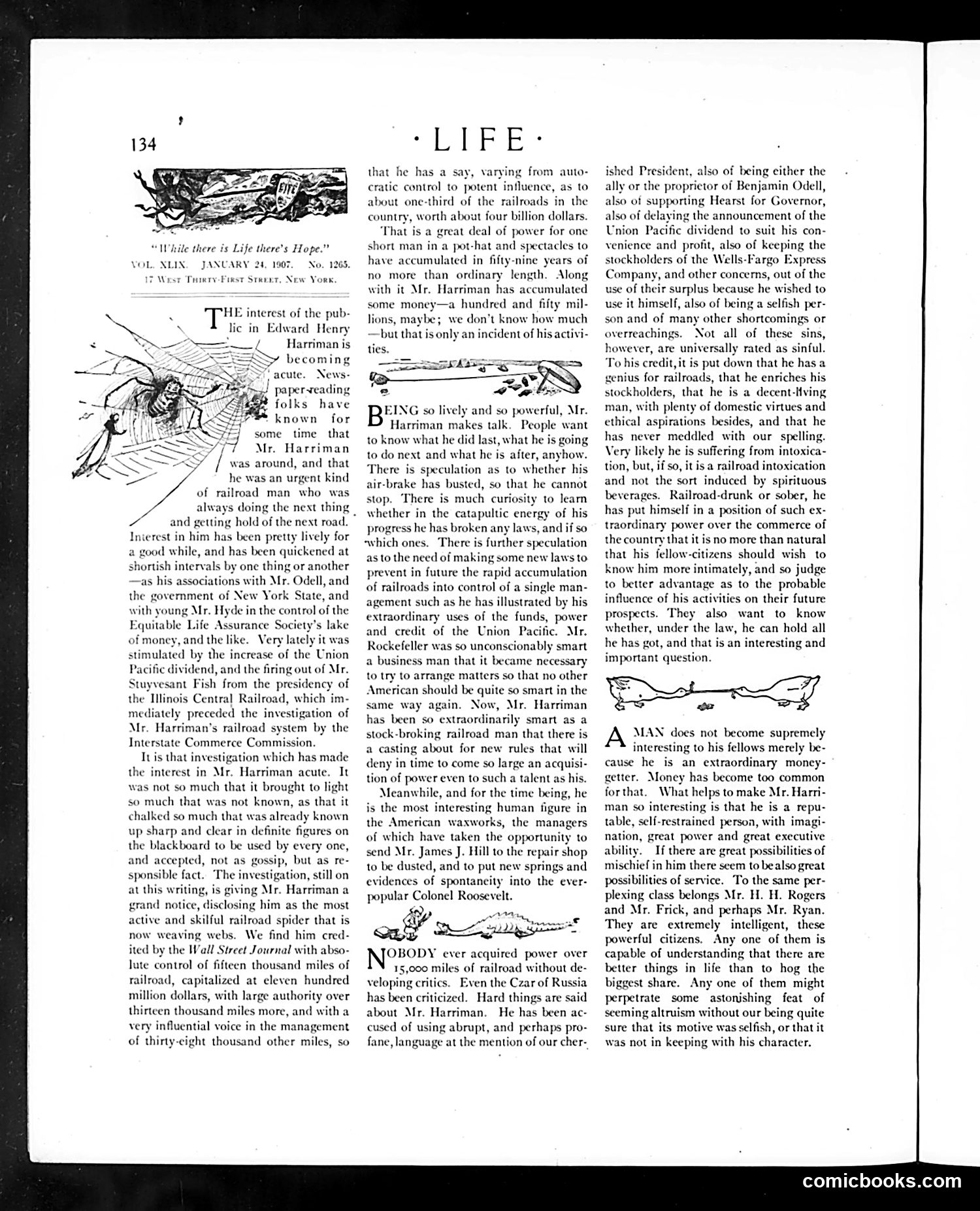
This page examines railroad magnate **E.H. Harriman**, who controlled approximately one-third of American railroad mileage worth roughly $4 billion—extraordinary power for a single individual in the early 1900s. The article presents Harriman as a complex figure: a brilliant financial strategist who accumulated vast wealth and influence, yet also someone criticized for "abrupt" and "profane" language. The text defends him somewhat, crediting his intelligence and domestic virtue while acknowledging public concern about his concentrated power. The decorative line illustrations appear to be generic period embellishments rather than specific satirical caricatures. The overall tone is analytical rather than purely mocking—examining whether such concentrated railroad authority benefited or threatened the American public.
📄 Transcribed text from this page (OCR, searchable)
Machine-transcribed from the original scan — historical spelling and the odd misread are preserved.
“While there is Life there's Hope.” NLIN. JANUARY 24, 1907, No. West Trnery-Fixst Steeer, 1265. New York, HE interest of the pub- lic in Edward Henry —~ Harriman is = S becoming ST acute. News- >>! paperveading ce folks have known for some time that Mr. Harriman fi was around, and that he was an urgent kind of railroad man who wa always doing the next thing a and getting hold of the next road. Interest in him has been pretty lively for a good while, and has been quickened at shortish intervals by one thing or another —as his associations with Mr. Odell, and the government of New York State, and with young Mr. Hyde in the control of the =quitable Life Assurance Society’s lake of moncy, and the like. Very lately it stimulated by the increase of the Union Pacific dividend, and the firing out of Mr. Stuyvesant Fish from the presidency of the Illinois Central Railroad, which im- mediately preceded the investigation of Mr. Harriman’s railroad system by the Interstate Commerce Commission. It is that investigation which has made the interest in Mr. Harriman acute. It was not so much that it brought to light so much that was not known, as that it chalked so much that was already known. up sharp and clear in definite figures on the blackboard to be used by every one, and accepted, not as gossip, but as re- sponsible fact. The investigation, still on at this writing, is giving Mr. Harriman a grand notice, disclosing him as the most active and skilful railroad spider that is now weaving webs. We find him cred- ited by the Wall Street Journal with abso- lute control of fifteen thousand miles of railroad, capitalized at eleven hundred million dollars, with large authority over thirteen thousand miles more, and with a very influential voice in the management of thirty-eight thousand other miles, so "GIFE- that he has a say, varying from auto- cratic control to potent influence, as to about one-third of the railroads in the country, worth about four billion dollars. ‘That is a great deal of power for one short man in a pot-hat and spectacles to have accumulated in fifty-nine years of no more than ordinary length. Along with it Mr. Harriman has accumulated some money—a hundred and fifty mil- lions, maybe; we don’t know how much but that is only an incident of his activi- ties. ETA S e ZING so lively and so powerful, Mr. Harriman makes talk. People w: to know what he did last, what he is going to do next and what he is after, anyhow. There is speculation as to whether his air-brake has busted, so that he cannot stop. There is much curiosity to leam whether in the catapultic energy of his progress he has broken any laws, and if so swhich ones. There is further speculation as to the need of making some new laws to prevent in future the rapid accumulation of railroads into control of a single man- agement such as he has illustrated by his extraordinary uses of the funds, power and credit of the Union Pacific. Mr. Rockefeller was so unconscionably smart a business man that it became necessary to try to arrange matters so that no other American should be quite so smart in the same way again. Now, Mr. Harriman has been so extraordinarily smart as a stock-broking railroad man that there is a casting about for new rules that will deny in time to come so large an acquisi tion of power even to such a talent as hi: Meanwhile, and for the time being, he is the most interesting human figure in the American waxworks, the managers of which have taken the opportunity to send Mr. James J. Hill to the repair shop to be dusted, and to put new springs and evidences of spontancity into the ev popular Colonel Roosevelt. OBODY ever acquired power over 15,000 miles of railroad without de- veloping critics. Even the Czar of Russia has been criticized. Hard things are said about Mr. Harriman. He has been ac- cused of using abrupt, and perhaps pro- fane, langua t the mention of our cher- ished President, also of being either the lly or the proprietor of Benjamin Odell, Iso of supporting Hearst for Governor, also of delaying the announcement of the Union Pacific dividend to suit his con- venience and profit, also of keeping the stockholders of the Wells-Fargo Express. Company, and other concerns, out of the use of their surplus because he wished to. use it himself, also of being a selfish pe: son and of many other shortcomings or overreachings. Not all of these sins, however, are universally rated as sinful. To his credit, it is put down that he has a genius for railroads, that he enriches his stockholders, that he is a decent-Hving man, with plenty of domestic virtues and ethical aspirations besides, and that he has never meddled with our spelling. Very likely he is suffering from intoxica- tion, but, if so, it is a railroad intoxication and not the sort induced by spirituous beverages. Railroad-drunk or sober, he has put himself in a position of such ex- traordinary power over the commerce of the country that it is no more than natural that his fellow-citizens should wish to know him more intimately, and so judge to better advantage as to the probable influence of his activities on their future prospects. They also want to know whether, under the law, he can hold all he has got, and that is an interesting and important question. MAN does not become supremely interesting to his fellows merely be- cause he is an extraordinary moncy- getter. Money has become too common forthat. What helps to mal fr. Harri- man so interesting is that he is a repu- table, self-restrained person, with imagi- nation, great power and great executive ability. If there are great possibilities of mischief in him there seem to bealso great possibilities of service. To the same per- plexing class belongs Mr. H. H. Rogers and Mr. Frick, and perhaps Mr. Ryan. They are extremely intelligent, these powerful citizens, Any one of them is capable of understanding that there are better things in life than to hog the biggest share. Any one of them might perpetrate some astonishing feat of seeming altruism without our being quite sure that its motive was selfish, or that it was not in keeping with his character. comicbooks.com