
Life, 1907-01-24 · page 9 of 24
Life — January 24, 1907 — page 9: what you’re looking at
What you’re looking at
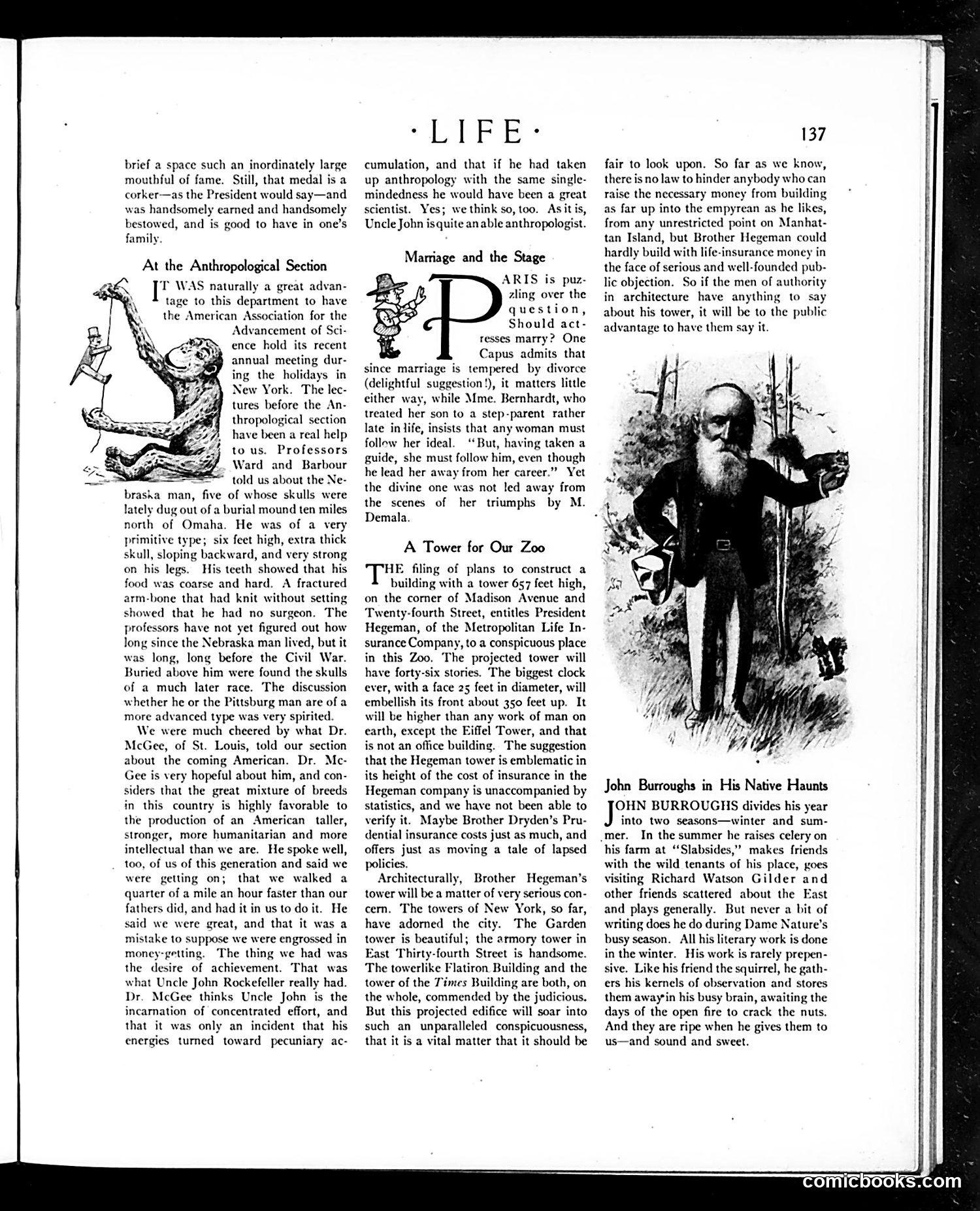
This page contains three distinct sections: **Left column:** Discusses an Anthropological Section meeting featuring skulls of a "brassa man" excavated from Nebraska, contrasting scientific progress with Uncle John Rockefeller's philanthropic achievements. **Center:** "Marriage and the Stage" debates whether actors should marry, referencing actress Mme. Bernhardt's advice that women follow their husbands' guidance. **Right side:** An illustrated article titled "John Burroughs in His Native Haunts" depicts the naturalist writer in his rural setting, describing his seasonal farm life and observations of squirrels and nuts. The page reflects early 1900s Life magazine's mix of social commentary, celebrity gossip, and cultural interest pieces, with satirical undertones typical of the publication's style.
📄 Transcribed text from this page (OCR, searchable)
Machine-transcribed from the original scan — historical spelling and the odd misread are preserved.
brief a space such an inordinately large mouthful of fame. Still, that medal is a corker—as the President would say—and was handsomely earned and handsomely bestowed, and is good to have in one’s family. At the Anthropological Section T WAS naturally a great advan- tage to this department to have the American Association for the Advancement of ence hold its recent annual meeting dur- ing the holidays in New York. The lec- tures before the An- thropological section have been a real help to us. Professors Ward and Barbour told us about the Ne- braska man, five of whose skulls were lately dug out of a burial mound ten miles north of Omaha. He was of a very primitive type; six feet high, extra thick skull, sloping backward, and very strong on his legs. His teeth showed that his food was coarse and hard. A fractured arm-bone that had knit without setting showed that he had no surgeon. The professors have not yet figured out how long since the Nebraska man lived, but it was long, long before the Civil War. Buried above him were found the skulls of a much later race. The discussion whether he or the Pittsburg man are of a more advanced type was very spirited. We were much cheered by what Dr. McGee, of St. Louis, told our section about the coming American. Dr. Mc- Gee is very hopeful about him, and con- siders that the great mixture of breeds in this country is highly favorable to the production of an American taller, stronger, more humanitarian and more intellectual than we are. He spoke well, too, of us of this generation and said we were getting on; that we walked a quarter of a mile an hour faster than our fathers did, and had it in us to do it. He said we were great, and that it was a mistake to suppose we were engrossed in money-getting. The thing we had was the desire of achievement. That was what Uncle John Rockefeller really had. Dr. McGee thinks Uncle John is the incarnation of concentrated effort, and that it was only an incident that his energies turned toward pecuniary ac- LIFE cumulation, and that if he had taken up anthropology with the same single- mindedness he would have been a great scientist. Yes; we think so, too. As iti: Uncle John is quite an able anthropologist. Marriage and the Stage ARIS is puz- zling over the question, Should act- resses marry? One Capus admits that since marriage is tempered by divorce (delightful suggestion !), it matters little cither way, while Mme. Bernhardt, who treated her son to a step-parent rather late in life, insists that any woman must follow her ideal. “But, having taken a guide, she must follow him, even though he lead her away from her career.” Yet the divine one was not led away from the scenes of her triumphs by M. Demala. A Tower for Our Zoo 'HE filing of plans to construct a building with a tower 657 feet high, on the corner of Madison Avenue and Twenty-fourth Street, entitles President Hegeman, of the Metropolitan Life In- surance Company, to a conspicuous place in this Zoo. The projected tower will have forty-six stories. The biggest clock ever, with a face 25 feet in diameter, will embellish its front about 350 feet up. It will be higher than any work of man on earth, except the Eiffel Tower, and that is not an office building. The suggestion that the Hegeman tower is emblematic in its height of the cost of insurance in the Hegeman company is unaccompanied by statistics, and we have not been able to verify it. Maybe Brother Dryden’s Pru- dential insurance costs just as much, and offers just as moving a tale of lapsed policies. Architecturally, Brother Hegeman’s tower will be a matter of very serious con- cern. The towers of New York, so far, have adorned the city. The Garden tower is beautiful; the armory tower in East Thirty-fourth Street is handsome. The towerlike Flatiron Building and the tower of the Times Building are both, on the whole, commended by the judicious. But this projected edifice will soar into such an unparalleled conspicuousness, that it is a vital matter that it should be 137 fair to look upon. So far as we know, there is no law to hinder anybody who can raise the necessary money from building as far up into the empyrean as he likes, from any unrestricted point on Manhat- tan Island, but Brother Hegeman could hardly build with life-insurance money in the face of serious and well-founded pub- lic objection. So if the men of authority in architecture have anything to say about his tower, it will be to the public advantage to have them say it. John Burroughs in His Native Haunts OHN BURROUGHS divides his year into two seasons—winter and sum- mer. In the summer he raises celery on his farm at “Slabsides,” makes friends with the wild tenants of his place, goes visiting Richard Watson Gilder and other friends scattered about the East and plays generally. But never a bit of writing does he do during Dame Nature's busy season. All his literary work is done in the winter. His work is rarely prepen- . Like his friend the squirrel, he gath- ers his kernels of observation and stores them away’in his busy brain, awaiting the days of the open fire to crack the nuts. And they are ripe when he gives them to us—and sound and sweet. el Comicbooks.com