
A complete issue · 24 pages · 1906
Life — September 27, 1906
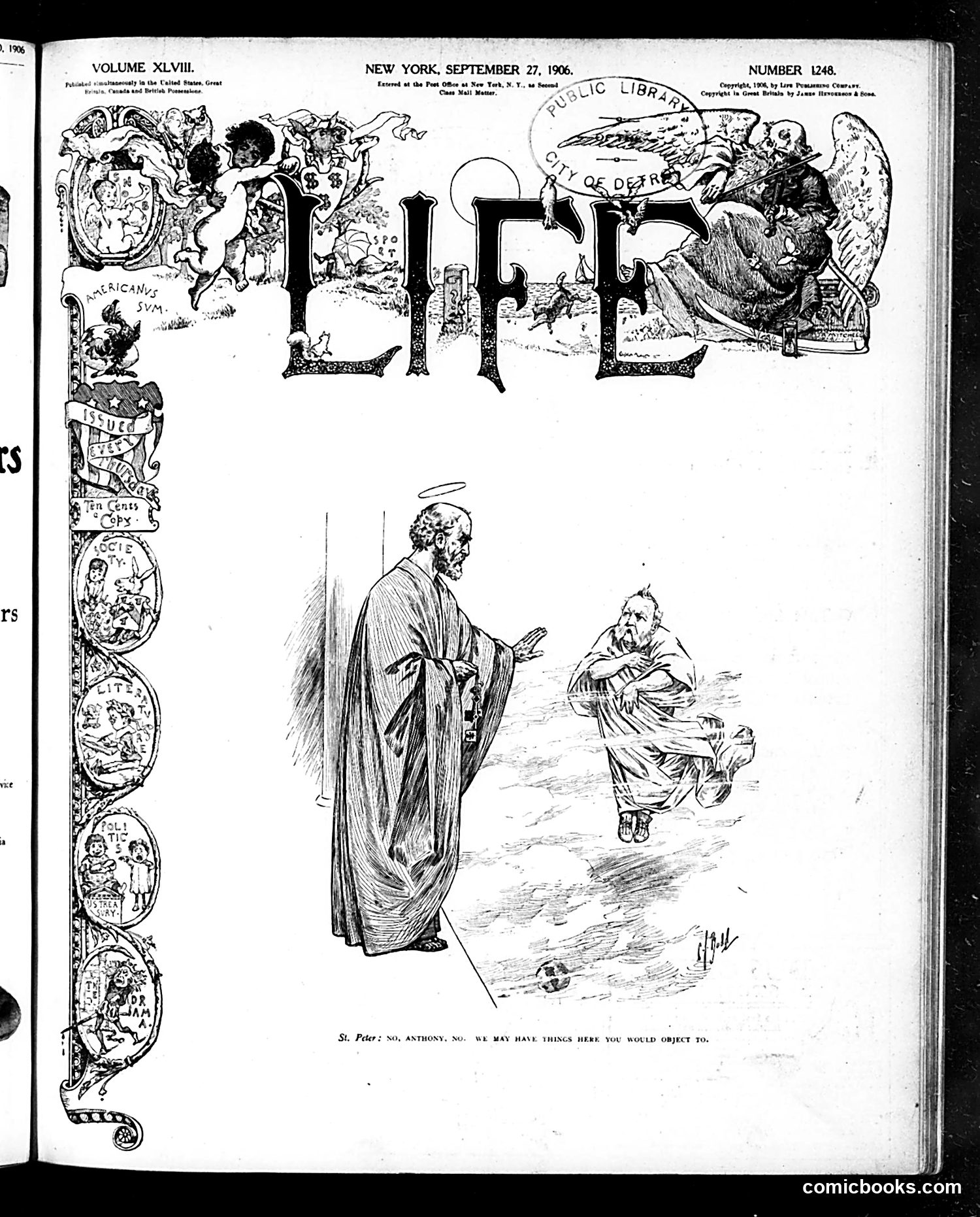
This page features a religious cartoon depicting St. Peter (identified by his halo and robes) speaking to St. Anthony. The caption reads: "ST. PETER: NO, ANTHONY, NO. WE MAY HAVE THINGS HERE YOU WOULD OBJECT TO." The satire appears to target Anthony's ascetic religious practices—he was a historical saint known for extreme self-denial and withdrawal from worldly pleasures. The joke suggests that even Heaven contains comforts or compromises that a strict ascetic like Anthony would reject on principle, implying his standards were so impossibly rigid that even paradise couldn't satisfy him. This reflects early 1900s satirical commentary on extreme religious devotion and monasticism.
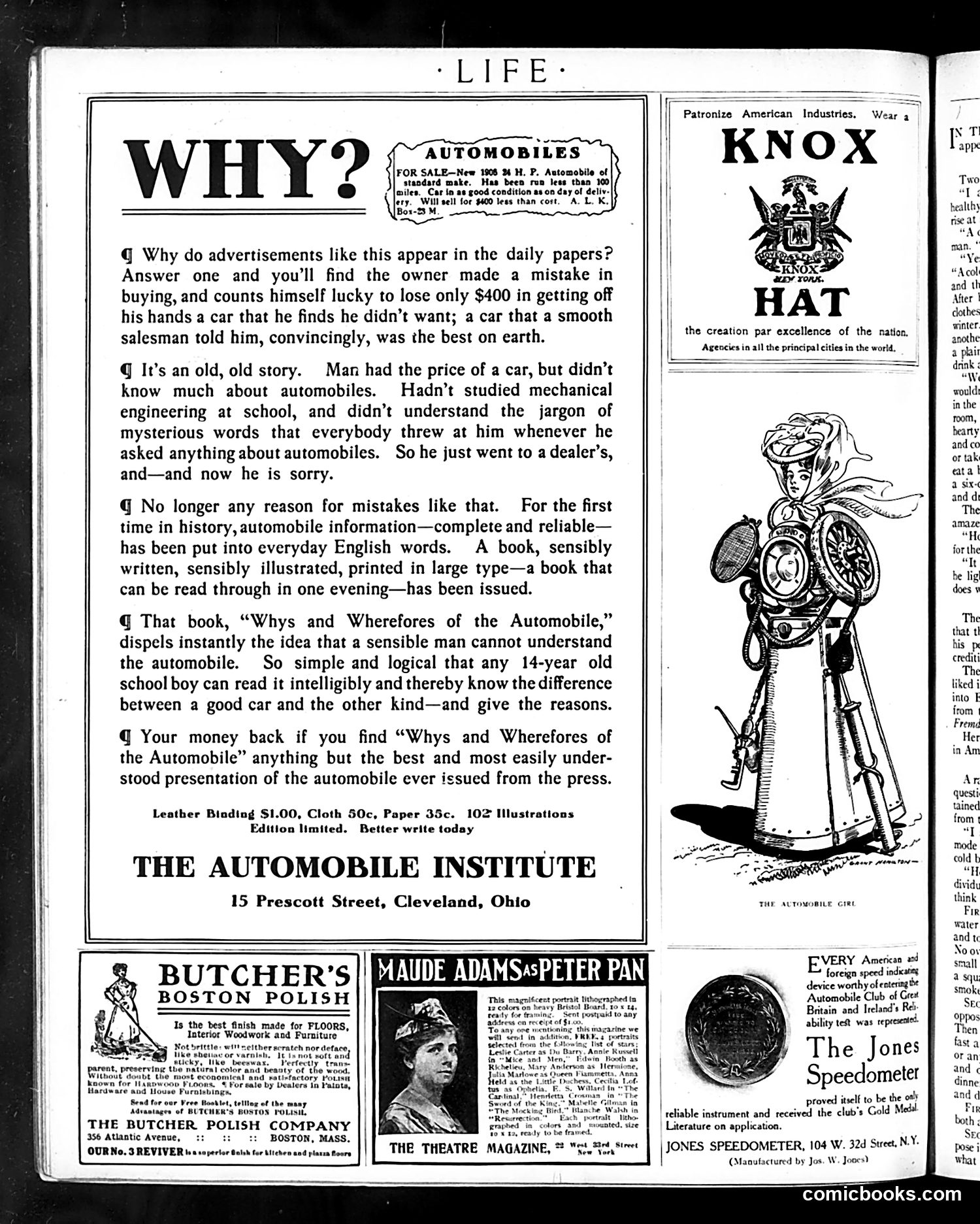
This page is primarily **advertising**, not satire or political commentary. The left side features a large ad for "Whys and Wherefores of the Automobile," a book by The Automobile Institute (Cleveland, Ohio). The ad mocks consumers who make uninformed car purchases—specifically someone who lost $400 buying a lemon from a smooth-talking salesman. The pitch promises the book will educate even a 14-year-old about automobiles in simple terms. The right side contains unrelated ads: Knox hats ("the creation of excellence"), Butcher's Boston Polish floor finish, a theatre magazine advertisement featuring "Maude Adams as Peter Pan," and Jones Speedometer. The page reflects early 1900s consumer culture—the automobile was still novel enough to require instructional books for ordinary buyers.
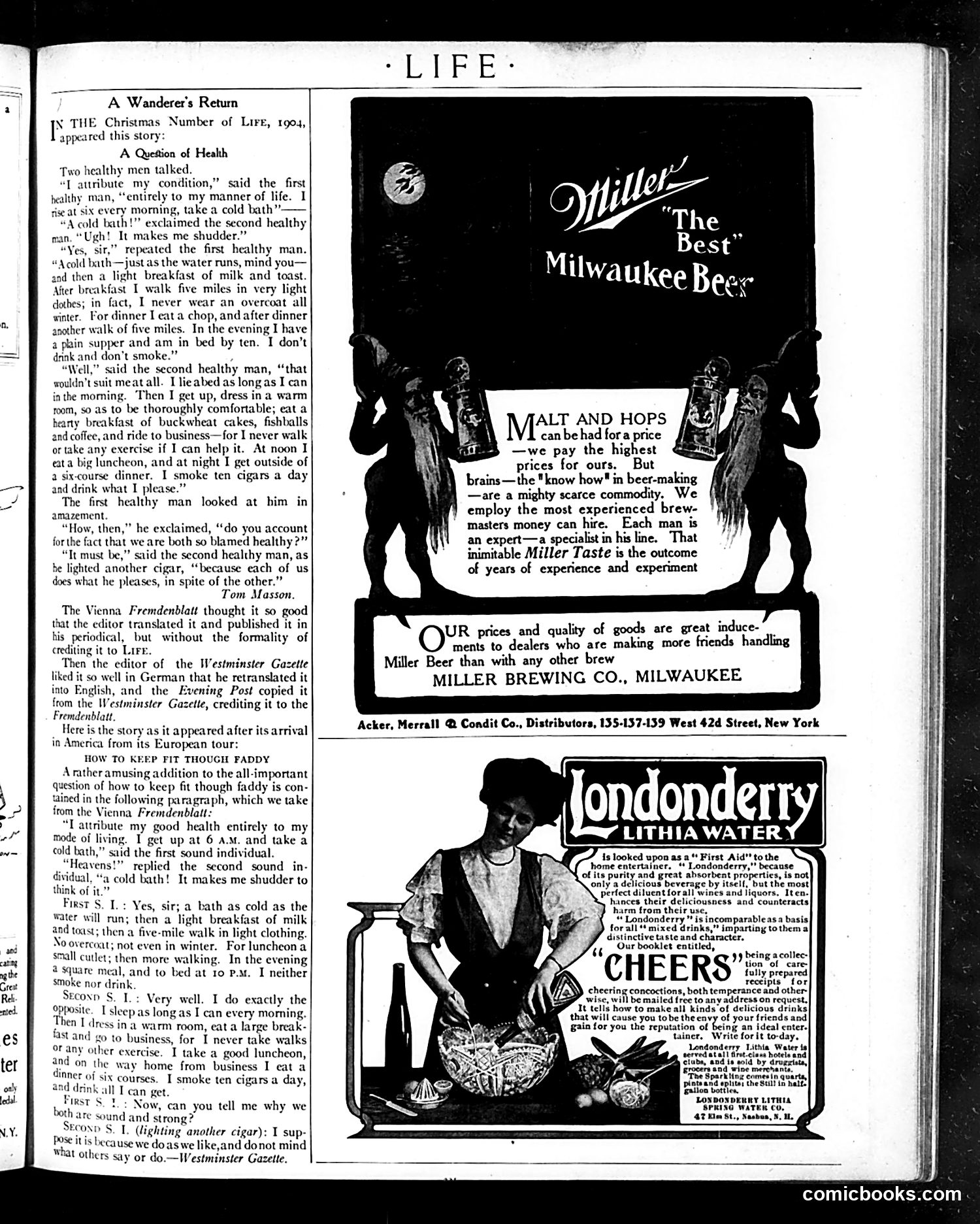
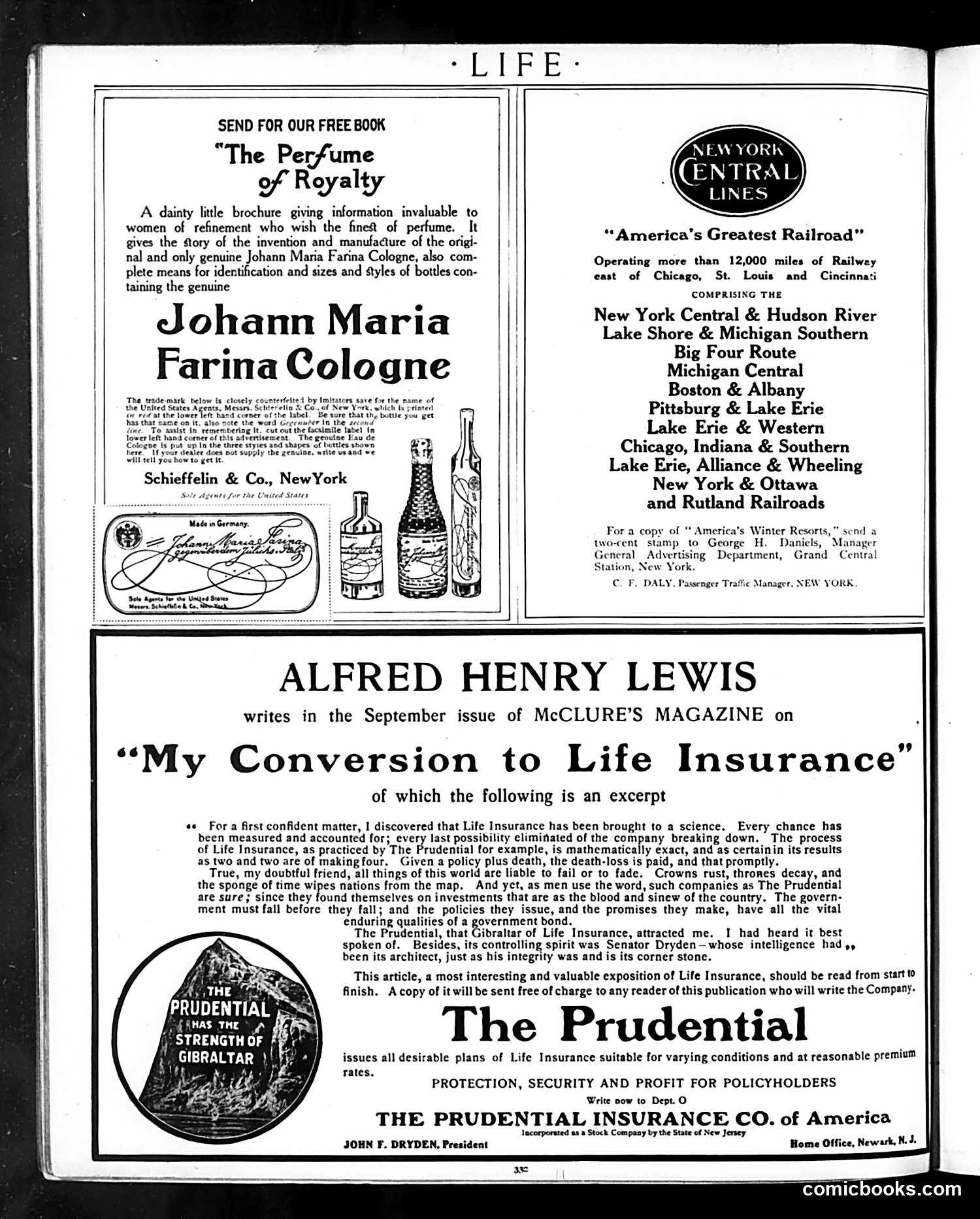
This page is primarily **advertising rather than satirical content**. It contains three distinct advertisements: 1. **Johann Maria Farina Cologne** (top left): A perfume ad from Schieffelin & Co. promoting genuine German-made cologne, emphasizing authenticity against counterfeits. 2. **New York Central Lines** (top right): Railroad advertising claiming to be "America's Greatest Railroad," listing extensive route networks across the northeastern and midwestern United States. 3. **The Prudential Insurance Company** (bottom): A substantial ad featuring Alfred Henry Lewis's article excerpt about life insurance from McClure's Magazine, with the company's Gibraltar rock logo symbolizing strength and stability. There are no political cartoons or satirical commentary visible on this page—it functions entirely as a commercial vehicle for these three major companies.
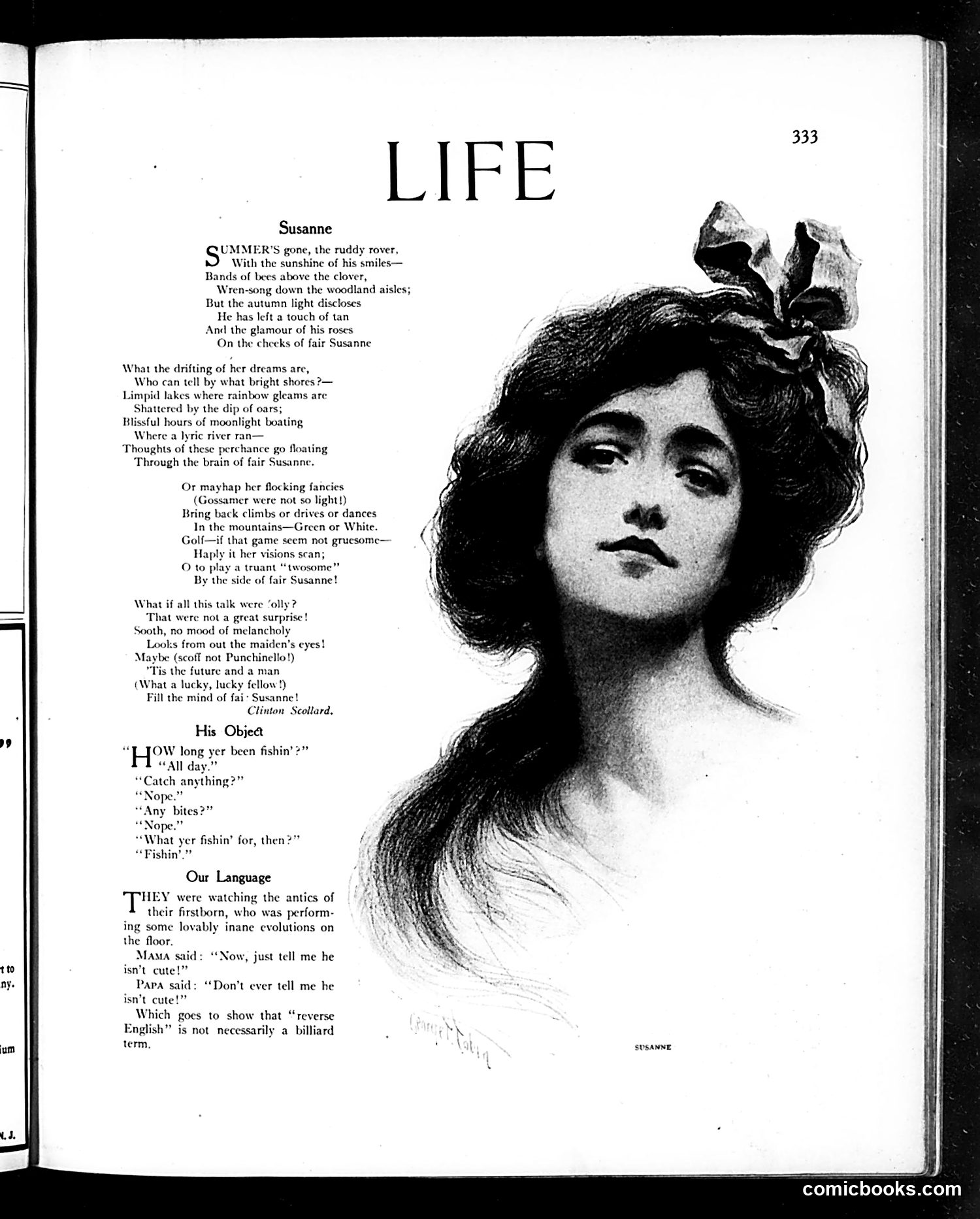
This page features a poem titled "Susanne" by Graham Scollard, accompanied by a portrait illustration of a woman's face. The poem is romantic/sentimental, describing a woman named Susanne through dreamy, idealizing imagery—her smile, dreams, and various romantic scenarios. Below are two brief prose sections: "His Object" (a humorous dialogue about fishing) and "Our Language" (a joke about parents debating whether to call their baby "cute"). This appears to be **literary and humor content rather than political satire**. The page showcases Life magazine's role as a venue for light verse, romantic poetry, and domestic humor—typical content for early 20th-century American magazines mixing literature, illustration, and gentle comedy. No political figures or events are referenced.
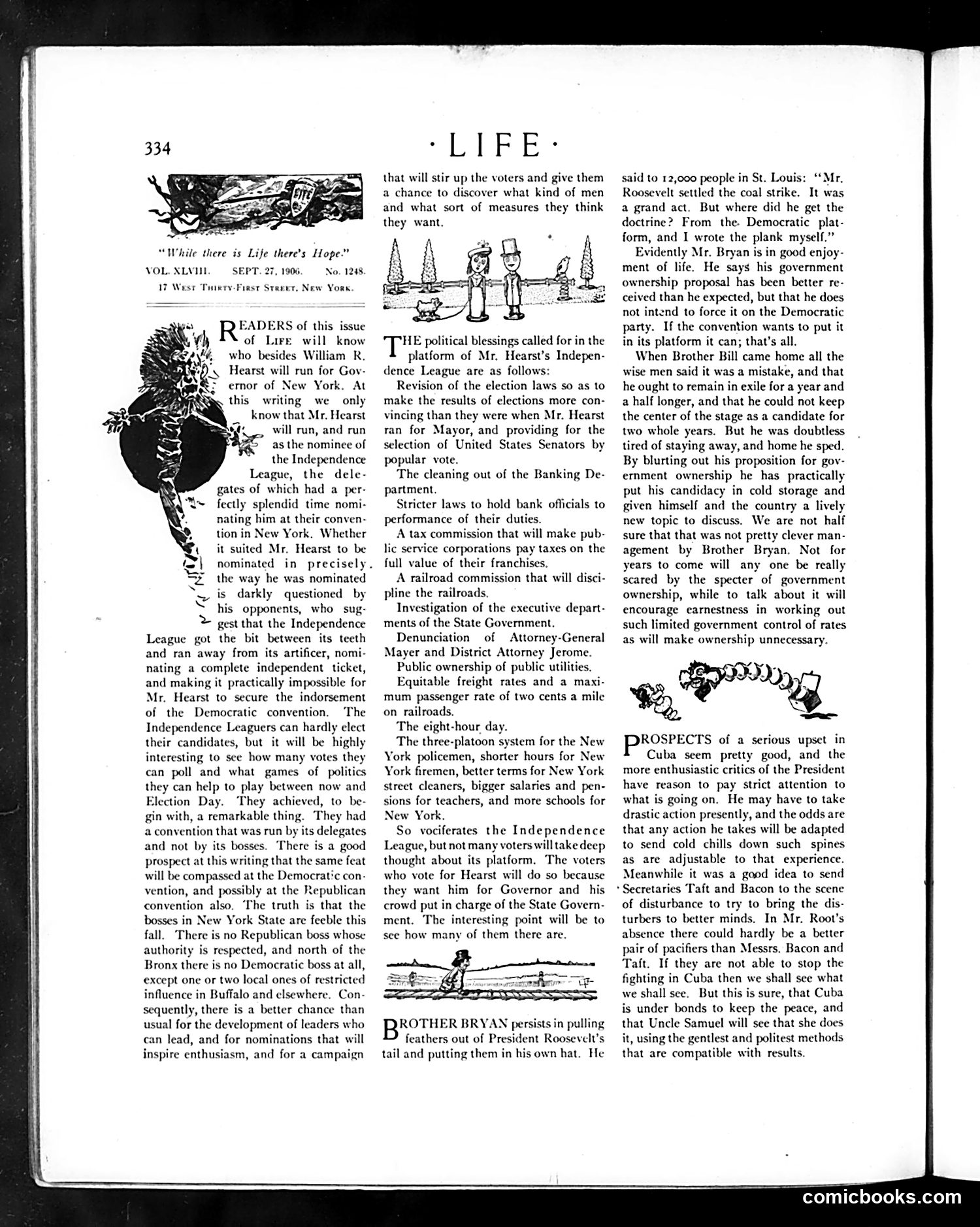
This page contains political commentary on William Randolph Hearst's bid to become New York Governor as head of the Independence League. The left illustration depicts Hearst's face in profile, caricatured in the exaggerated style typical of early 20th-century political satire. The text criticizes Hearst's platform proposals—including banking reform, railroad regulation, and public utility ownership—as insufficiently novel or practical. The author suggests Hearst's candidacy is largely a vanity project designed to boost his newspaper's influence rather than genuinely serve voters. The right column discusses Brother Bryan (William Jennings Bryan) and mentions Cuban unrest, reflecting broader Democratic Party concerns of the era.
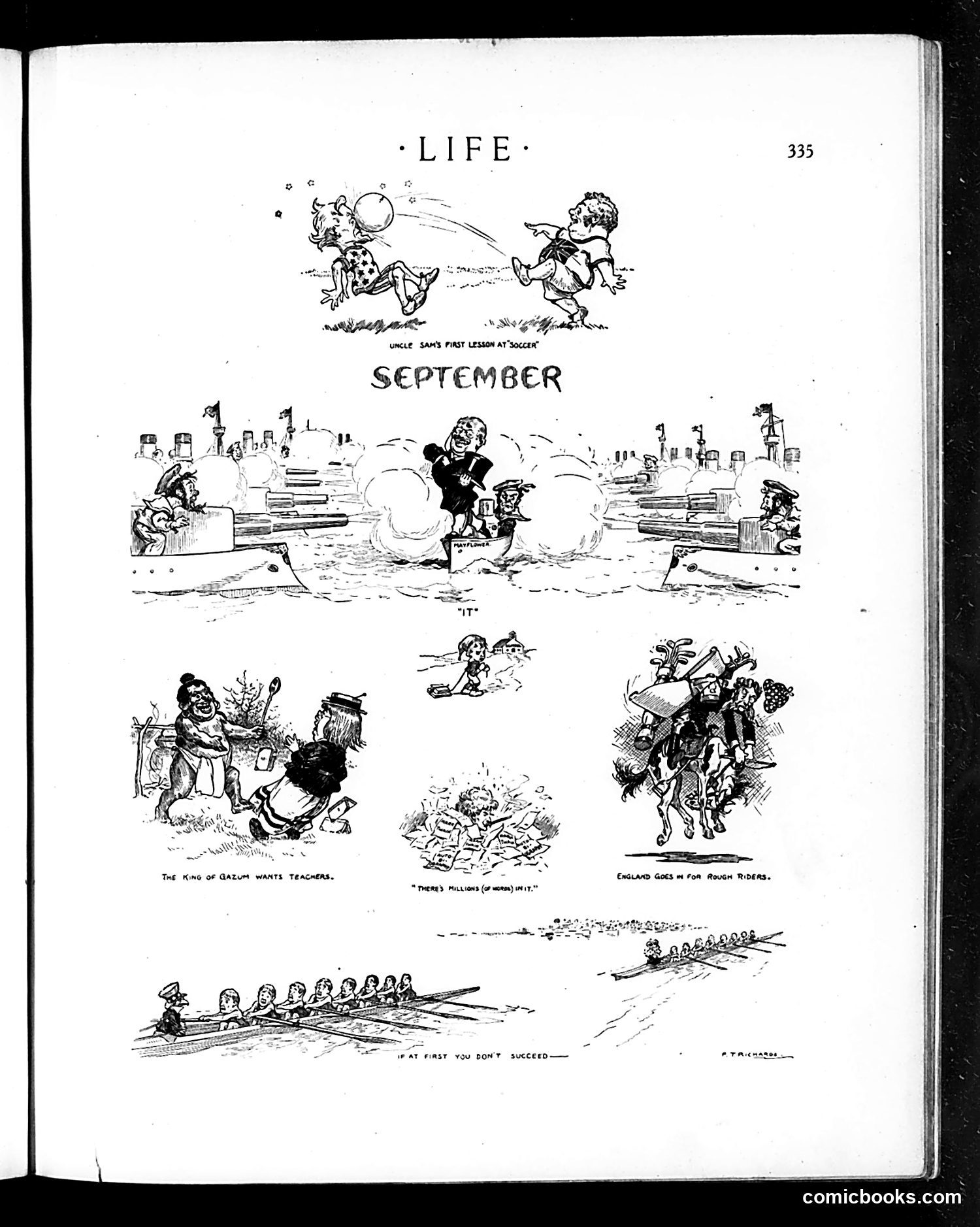
This satirical page presents several September-themed cartoons mocking contemporary American life circa early 20th century. The top cartoon shows children playing soccer, captioned "Uncle Sam's First Lesson at Soccer," suggesting America's unfamiliarity with the sport. Other panels mock: - **"The King of Gaum Wants Teachers"** — likely satirizing an international ruler seeking American educators - **"There's Millions in it"** — apparently about financial schemes - **"England Goes in for Rough Riders"** — mocking British adoption of American cowboy culture - **Bottom panels** about rowing, with "If at First You Don't Succeed" — joking about repeated attempts at competitive sports The overall theme appears to ridicule American cultural exports and the nation's sporting obsessions during this period, using exaggerated caricatures and physical comedy typical of Life's satirical style.
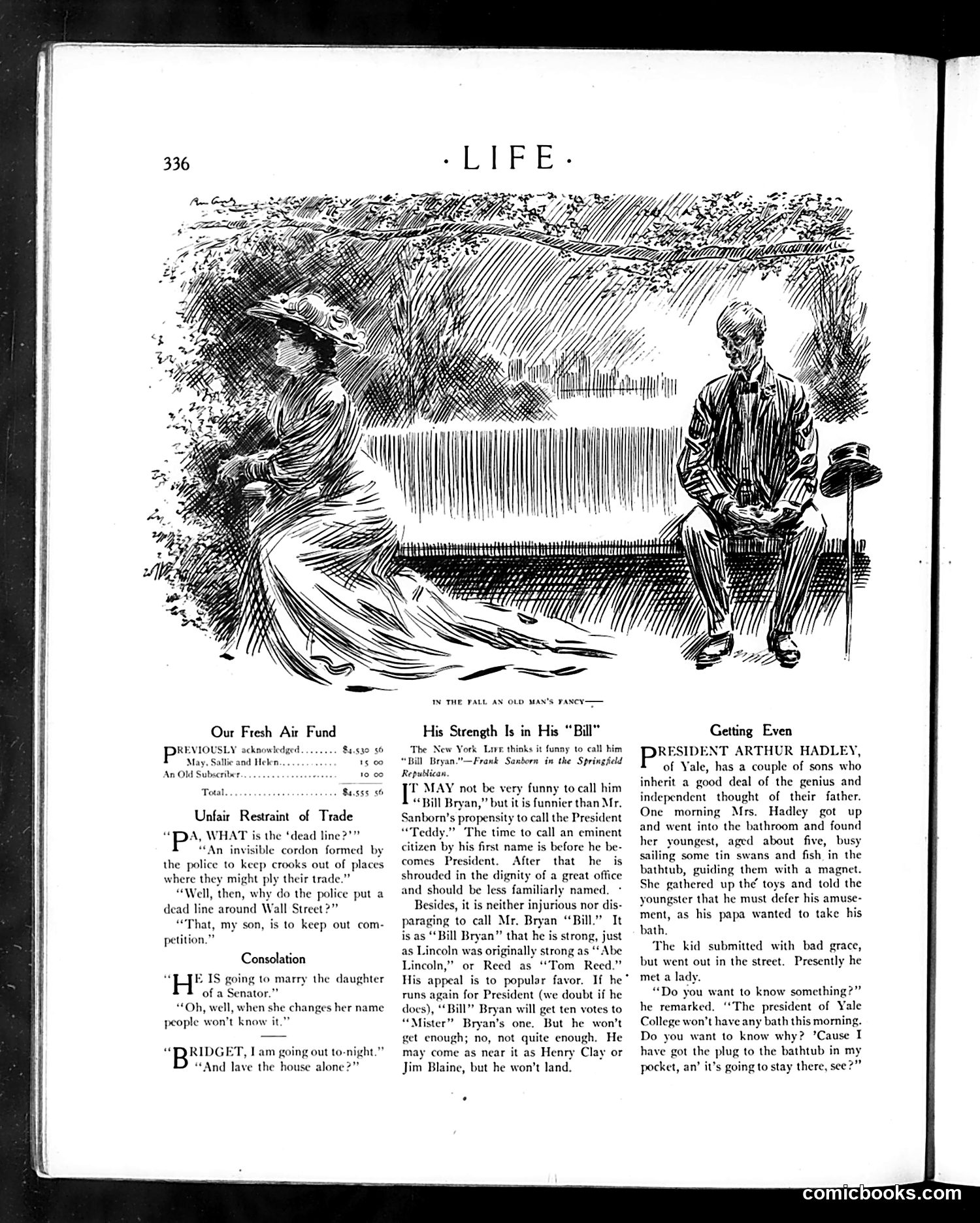
The main illustration depicts a couple in a park—a woman in a hat and flowing dress seated on the left, a man sitting separately on the right. This visual appears to accompany satirical commentary about political naming conventions. The text mocks William Jennings Bryan's casual first-name familiarity with political figures. The joke centers on the informality of calling the President "Bill" rather than by his proper title—suggesting this undermines presidential dignity. The satire critiques both Bryan's perceived presumption and broader anxieties about proper decorum in politics. Additional short humor pieces address domestic matters: a "Fresh Air Fund," trade restraints, and a Yale student's bathroom access. These appear to be typical satirical vignettes mocking contemporary social and class concerns of the early 20th century.
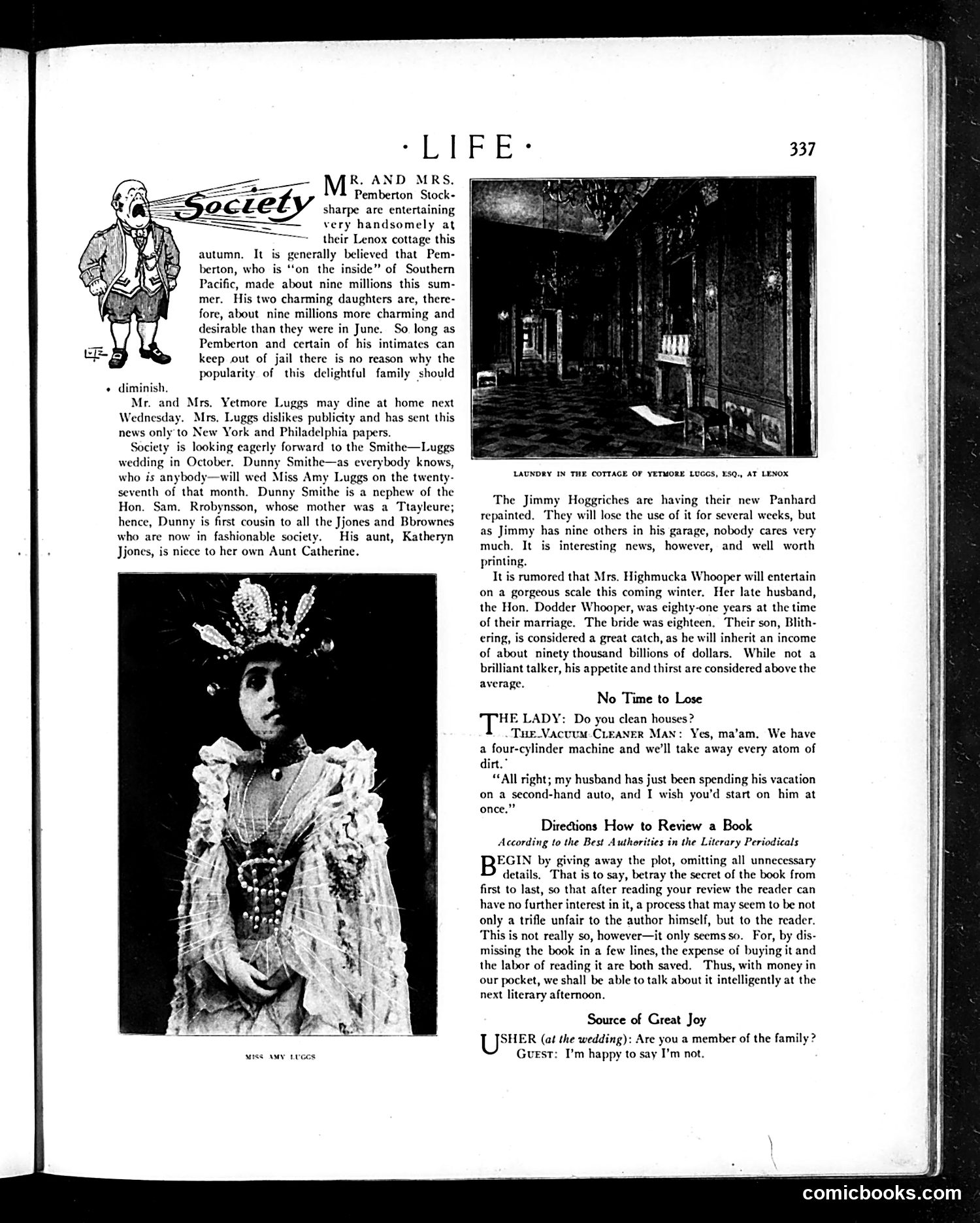
This page contains society gossip and humor rather than political satire. The "Society" section reports on wealthy families—the Pemberton Stocksharpes, Vetmore Luggs, and others—documenting their social activities and marriages. The cartoons appear to be humorous illustrations rather than political commentary. The photograph labeled "Miss Amy Luggs" shows a woman in elaborate Edwardian dress with an ornate headdress, exemplifying the fashionable appearance of upper-class society women of the era. The page includes comic dialogues mocking servant-employer interactions and literary pretension ("How to Review a Book"). The humor targets social conventions and class dynamics rather than political issues, reflecting *Life* magazine's focus on satirizing American high society and middle-class aspirations during this period.
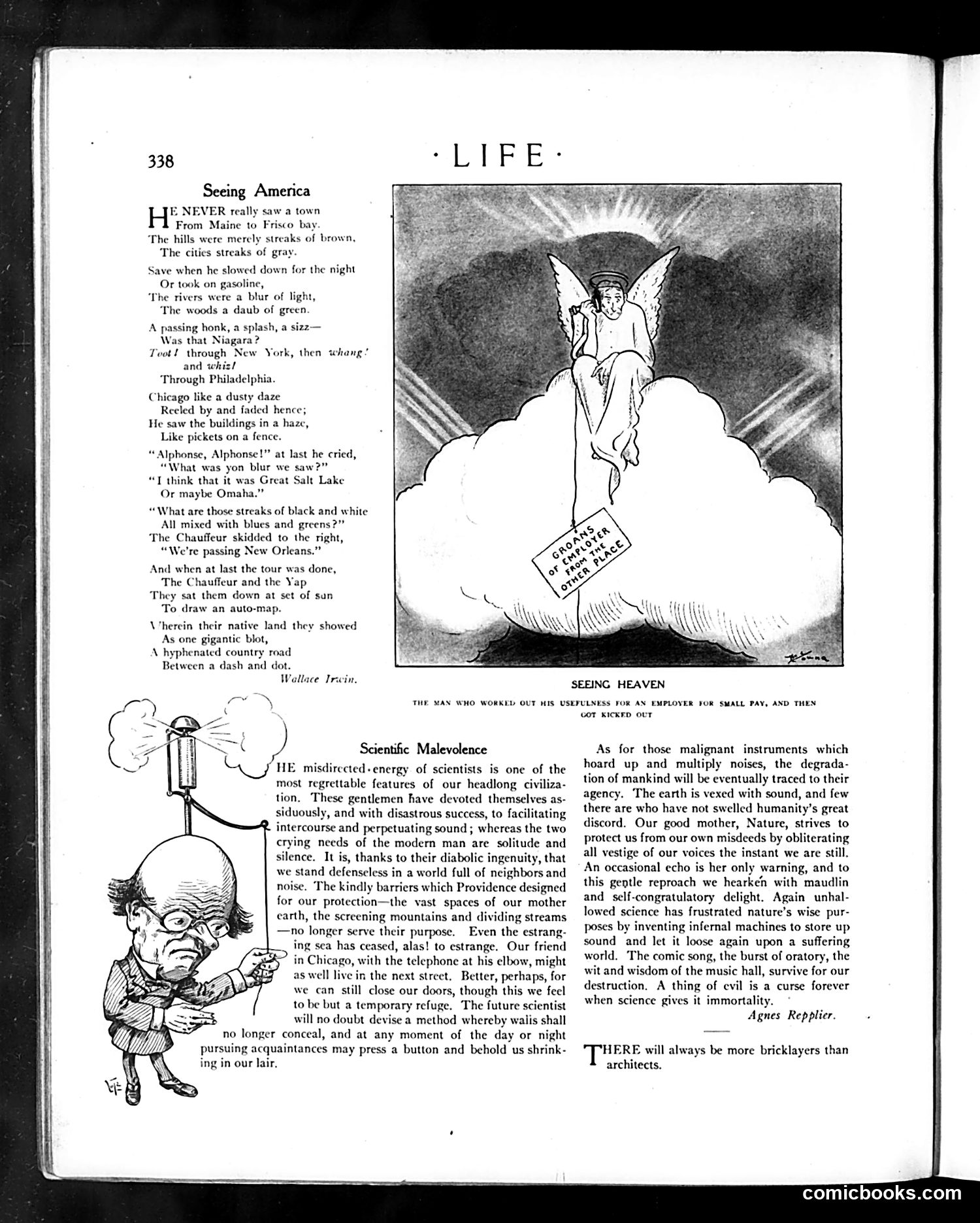
The page contains two distinct satirical pieces: **"Seeing Heaven"** (top cartoon): Shows a man on a cloud holding a sign reading "George Washington's Farewell Address." This satirizes someone who has died and discovered that the founding document's warnings were accurate—likely critiquing Americans who ignored Washington's advice about avoiding entangling alliances or partisan division. **"Scientific Malevolence"** (bottom): A caricatured scientist with wild hair operates a mechanical device producing noise and discord. The accompanying essay criticizes scientists who misdirect their talents toward destructive inventions (particularly sound-amplifying technology) rather than serving human welfare. It argues this represents a broader civilizational failure—that science enables noise pollution and chaos rather than protecting people from modern annoyances. Both pieces critique how progress can harm rather than help society.
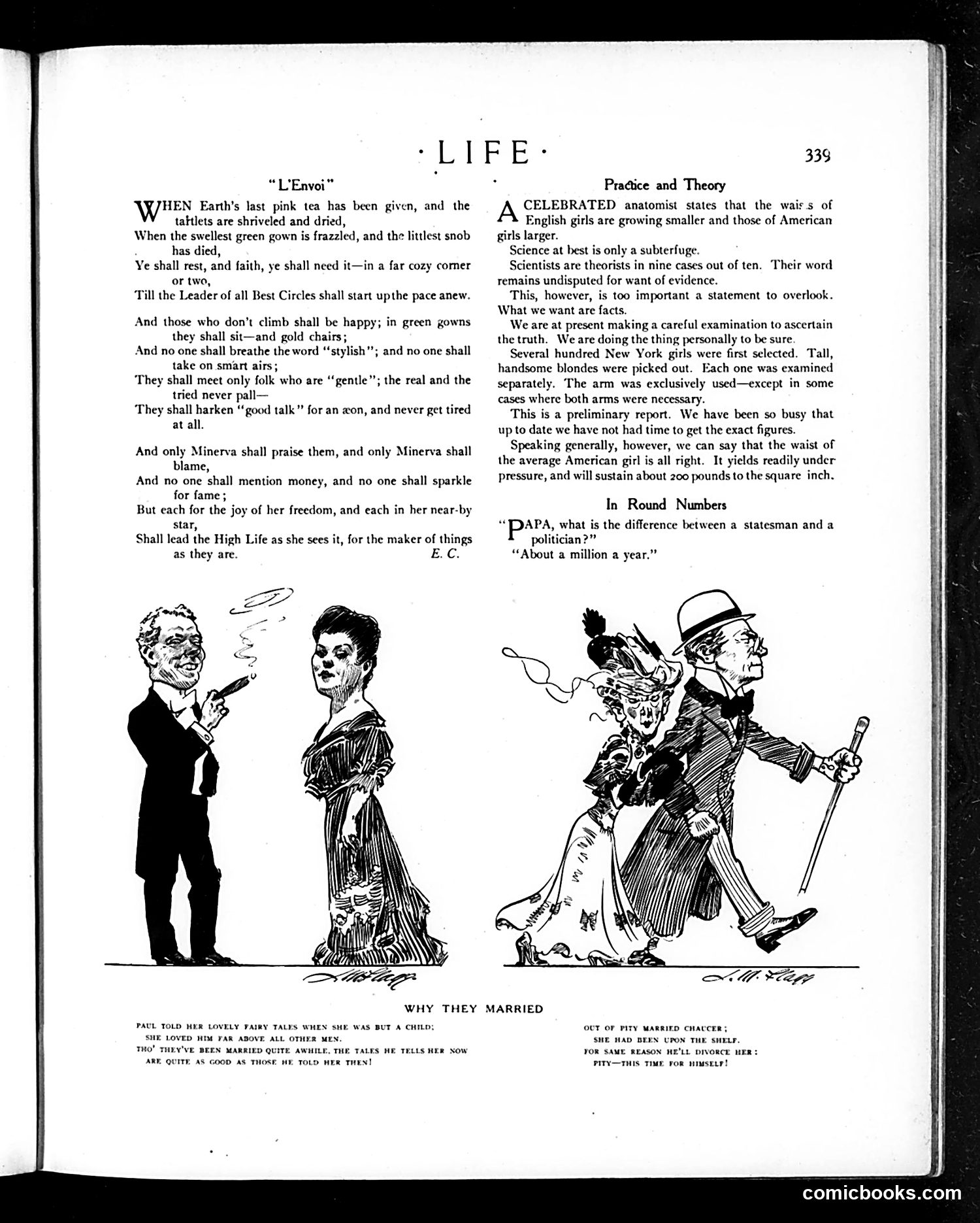
This page contains two distinct sections: **Top section**: An article titled "Practice and Theory" discusses anatomical differences between English and American girls' physiques, noting scientists' claims about waist measurements and arm strength. The tone is skeptical of such generalizations. **Bottom section**: Two cartoon pairs illustrating "Why They Married" and "Out of Pity Married Chaucer." The captions suggest commentary on marital motivations—one pair shows a man telling "fairy tales" to a woman who loved him despite other suitors; the other depicts a woman who married out of pity, now seeking divorce "this time for himself." The cartoons satirize marriage as a transaction based on illusion or obligation rather than genuine compatibility, reflecting early 20th-century attitudes about romantic relationships and gender dynamics.
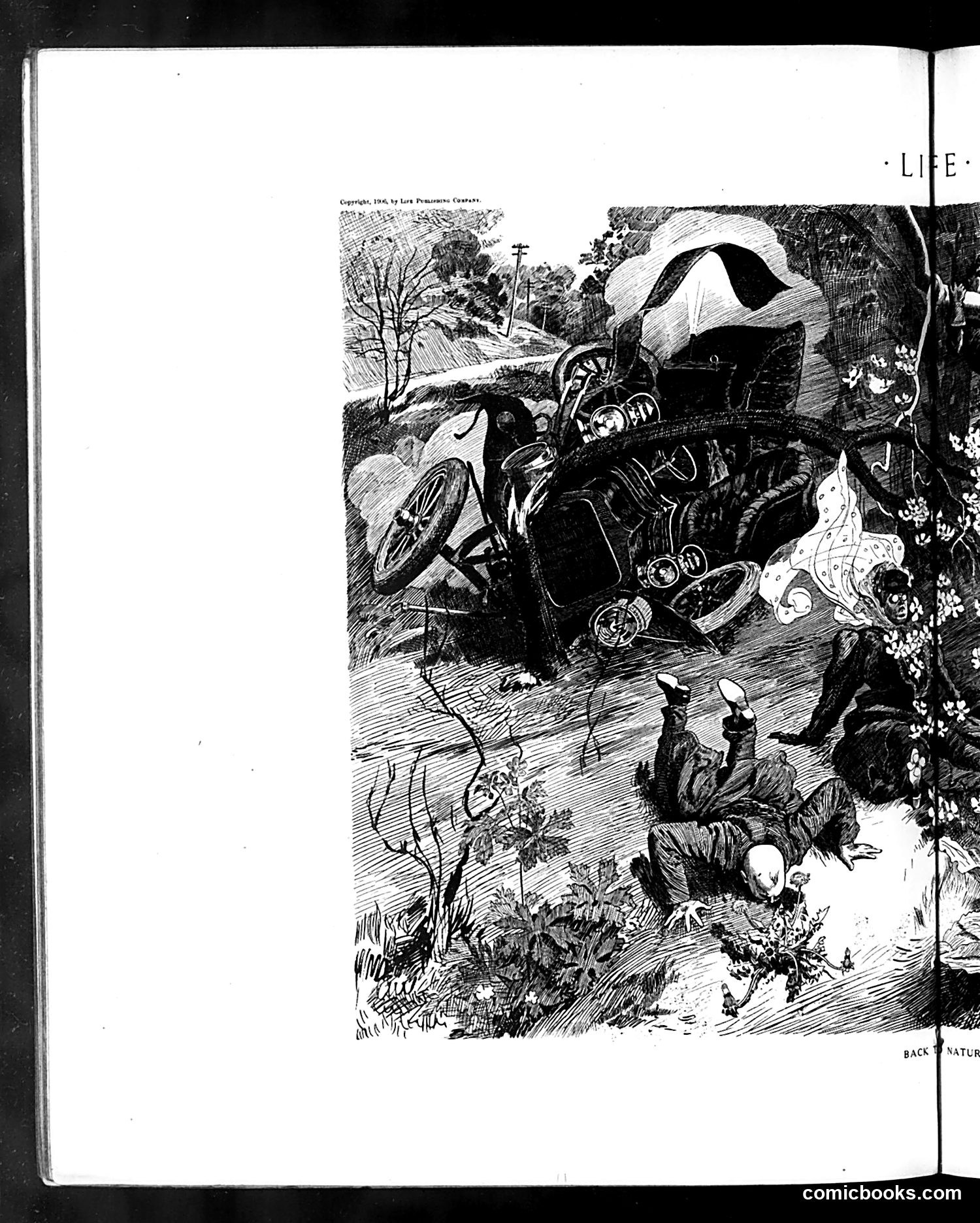
This appears to be a humorous illustration depicting an automobile accident or breakdown scene from early 20th-century Life magazine. The detailed pen-and-ink drawing shows a damaged or overturned car with its canvas top torn, surrounded by onlookers in period dress. The rural setting with bare trees and power lines suggests this commentary on early automobile culture. The satire likely mocks either the unreliability of early automobiles or the spectacle such breakdowns created in small towns. The gathered crowd of rural figures observing the mechanical mishap suggests mockery of both the new automotive technology and public fascination with it. The anarchic composition and detailed linework are characteristic of Life's satirical illustration style from this era.
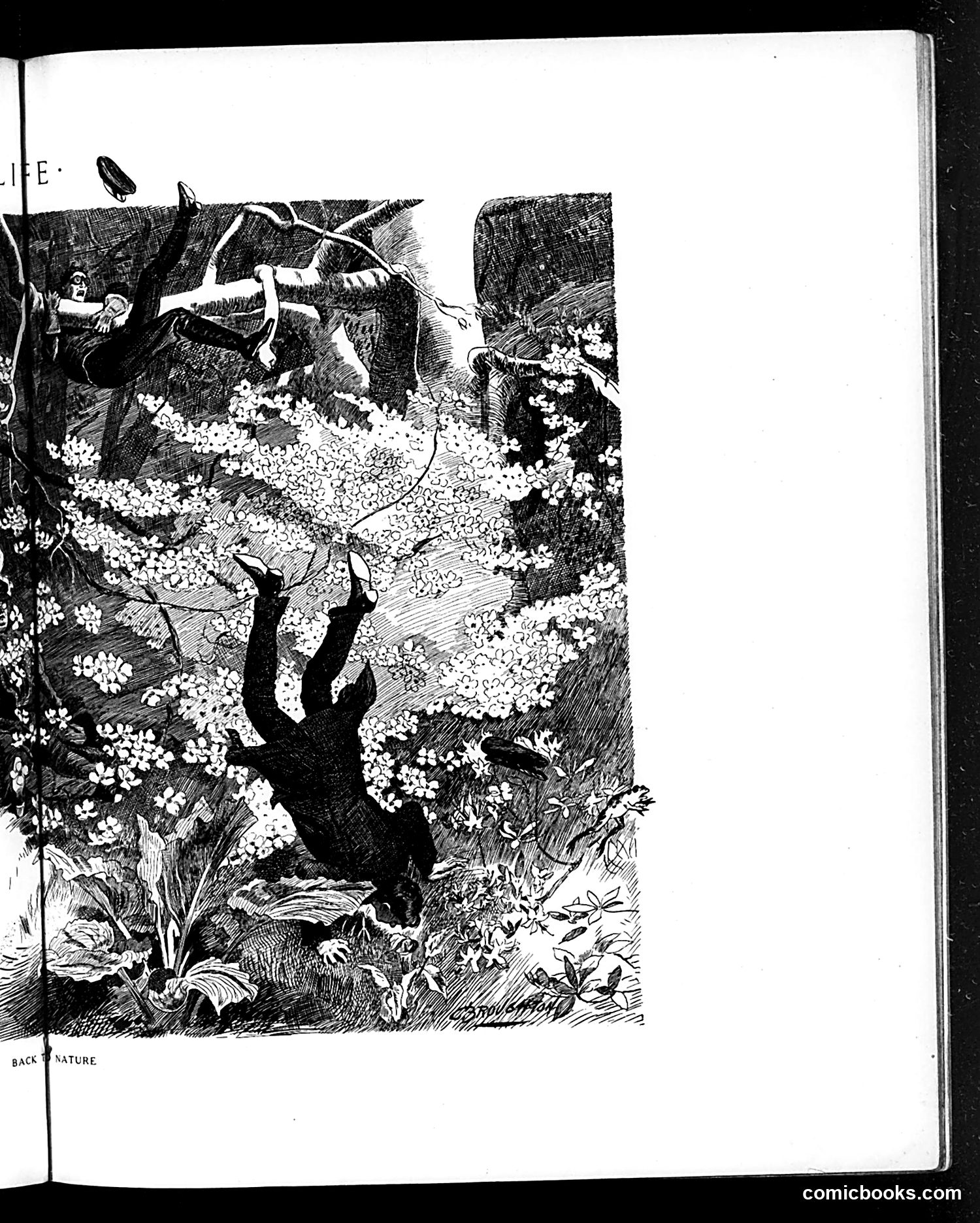
This illustration depicts a satirical scene of people attempting to "return to nature." The composition shows figures in an idealized natural setting with abundant flowering plants and trees, but their poses suggest awkwardness and discomfort rather than harmony with nature. The central figure lies on their back in an unnatural position among the vegetation, while others perch uncomfortably in trees or among flowers. The exaggerated, contorted body positions mock the romantic notion—popular in early 20th-century culture—that modern people could simply abandon civilization and achieve natural simplicity. The satire targets the "back to nature" movement's impracticality, suggesting that city dwellers cannot genuinely embrace natural life while maintaining their civilized habits and physical awkwardness. The elaborate crosshatching emphasizes the discord between human artificiality and authentic nature.
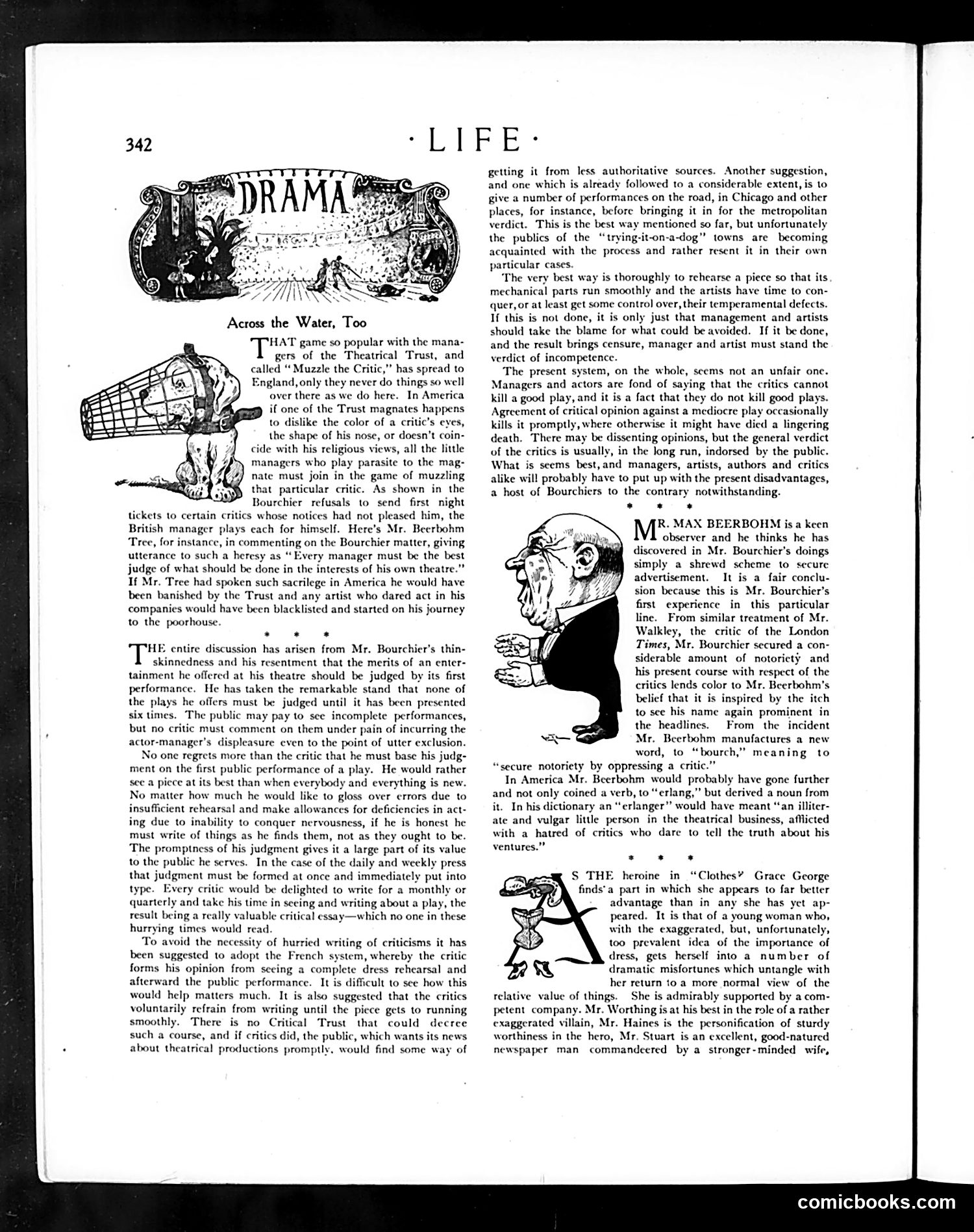
This page satirizes the "Theatrical Trust's" practice of punishing theater critics who give negative reviews by blacklisting them from opening-night performances. **The main cartoon** depicts a crouching figure (likely theater manager Herbert Beerbohm Tree, named in the text) being muzzled—literally silenced—referencing the "Muzzle the Critic" game. **The satire's point:** American theater managers enforce uniform punishment against critical dissent through the Theatrical Trust monopoly. British managers like Bourchier operate independently, each "playing for himself." The article mocks Bourchier's attempt to exclude critics from reviewing unfinished productions, arguing critics must judge opening performances immediately for daily/weekly publications. **The underlying conflict:** Actor-managers want control over when/how their work is judged; critics assert they must report honestly on what audiences actually see, without sanitizing incomplete rehearsals. The text uses Tree's statement that managers should judge their own theaters as "heresy"—implying such independence would be crushed in America's Trust-controlled system.
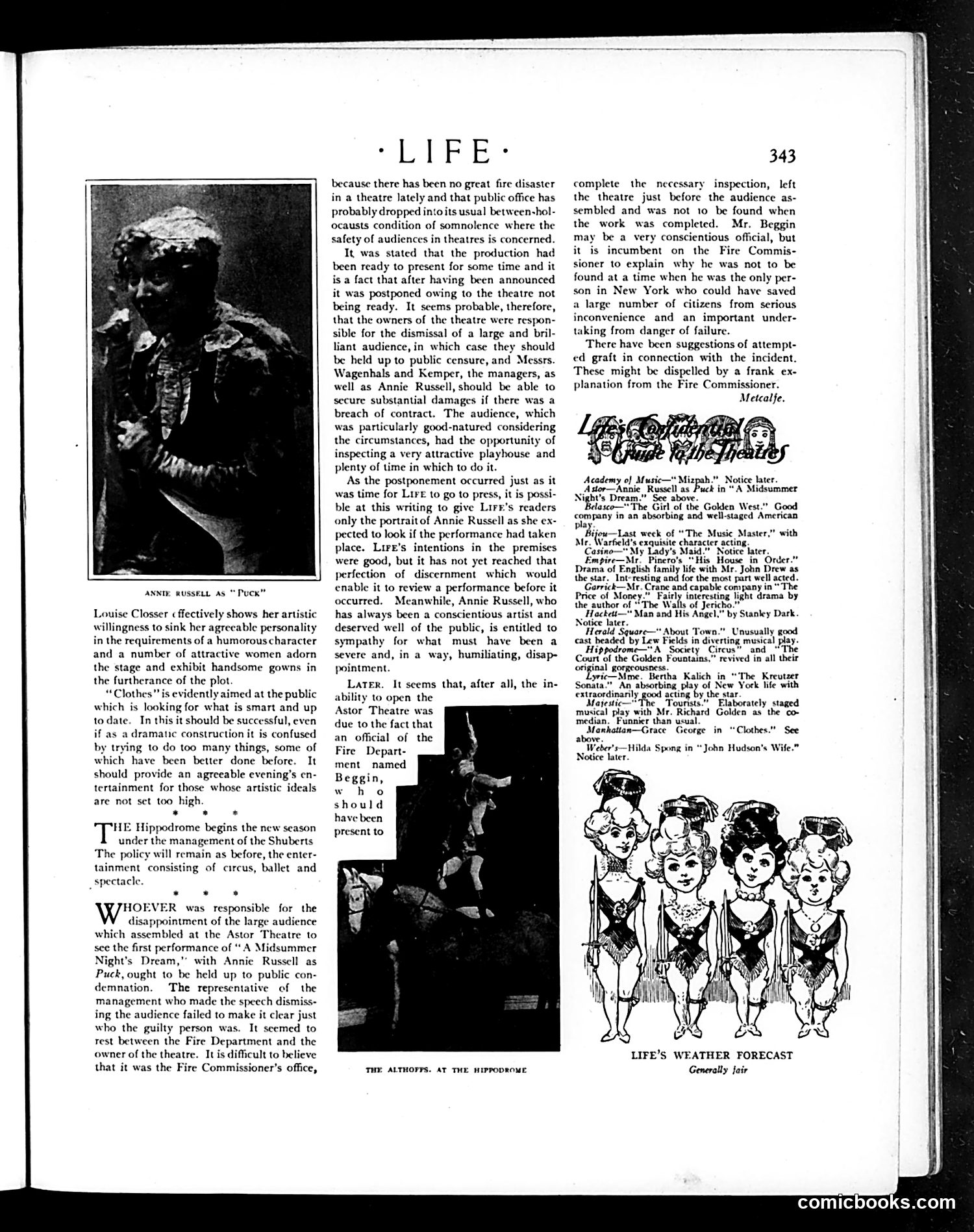
This page discusses a theatrical controversy at New York's Astor Theatre. Actress Annie Russell was scheduled to perform as Puck in "A Midsummer Night's Dream," but the opening was cancelled when Fire Department official Beggin failed to complete a mandatory safety inspection before the audience assembled. Life's initial editorial assumes theatre ownership bears responsibility for the disappointing cancellation. However, a "Later" note clarifies that Beggin—a fire inspector—disappeared before completing his inspection, making *him* the culpable party. The satirical point: bureaucratic incompetence, not negligence by theatre management or safety oversight, caused public inconvenience. The accompanying photograph shows Russell in costume as Puck, presumably what audiences would have seen. The cartoon "Life's Weather Forecast" at bottom appears unrelated social commentary, depicting four stylized women's heads.
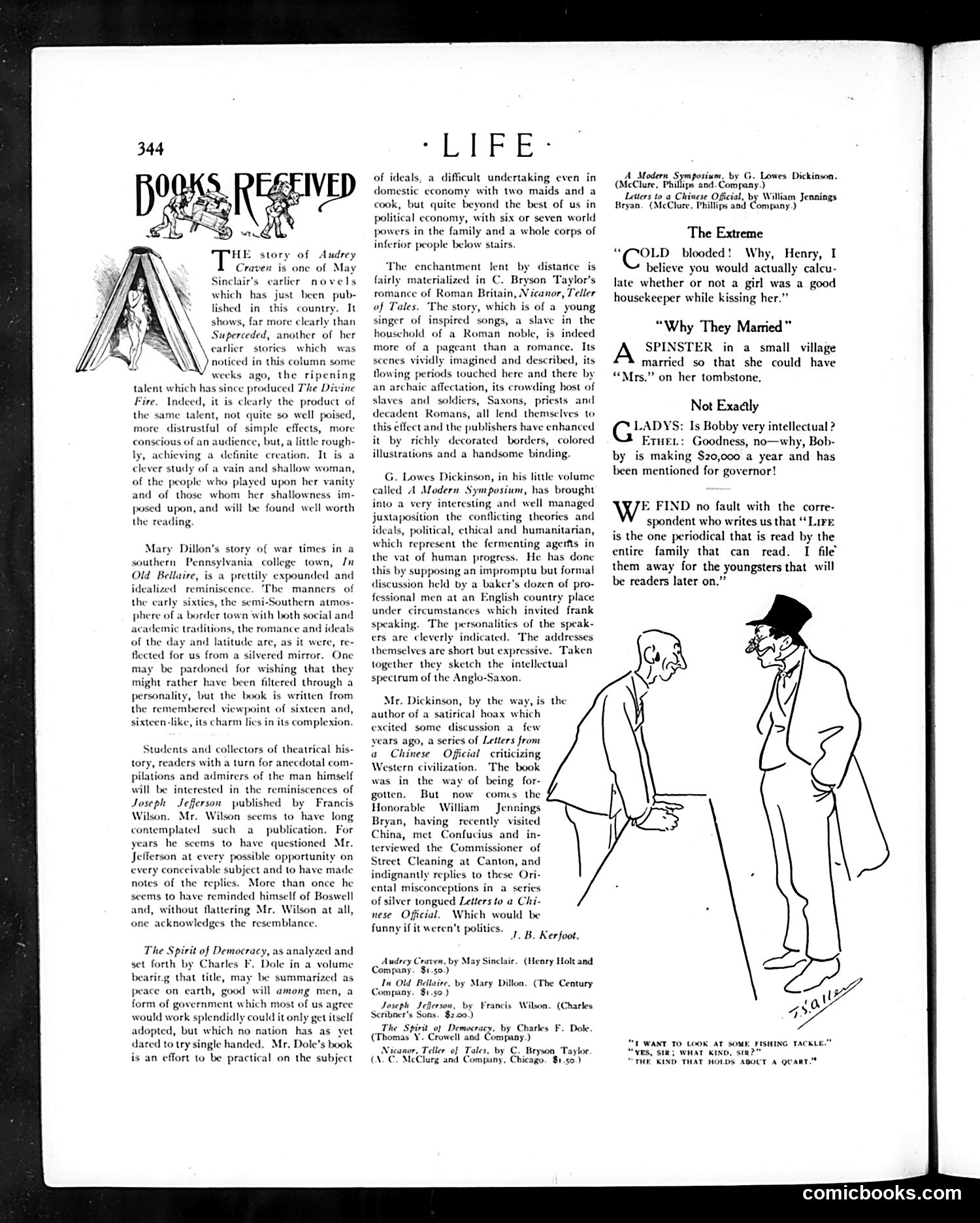
This page from *Life* magazine reviews several contemporary books while critiquing broader social and political issues. The right-hand cartoon—captioned "I want to look at some fishing tackle"—appears to depict two men in conversation, with one man's response humorously deflecting the other's request by saying "Yes, sir; what kind, sir? / The kind that finds about a quart." The joke likely satirizes either commercial deception (fishing tackle that doesn't work as advertised) or possibly refers to Prohibition-era bootlegging slang ("finding a quart" of illegal liquor). The cartoon illustrates *Life*'s characteristic style of social satire through everyday encounters. The book reviews themselves contain pointed social commentary, particularly criticism of idealistic political philosophy as impractical when applied to real-world governance involving competing "world powers" and social hierarchies—a subtle jab at naive progressive thinking.
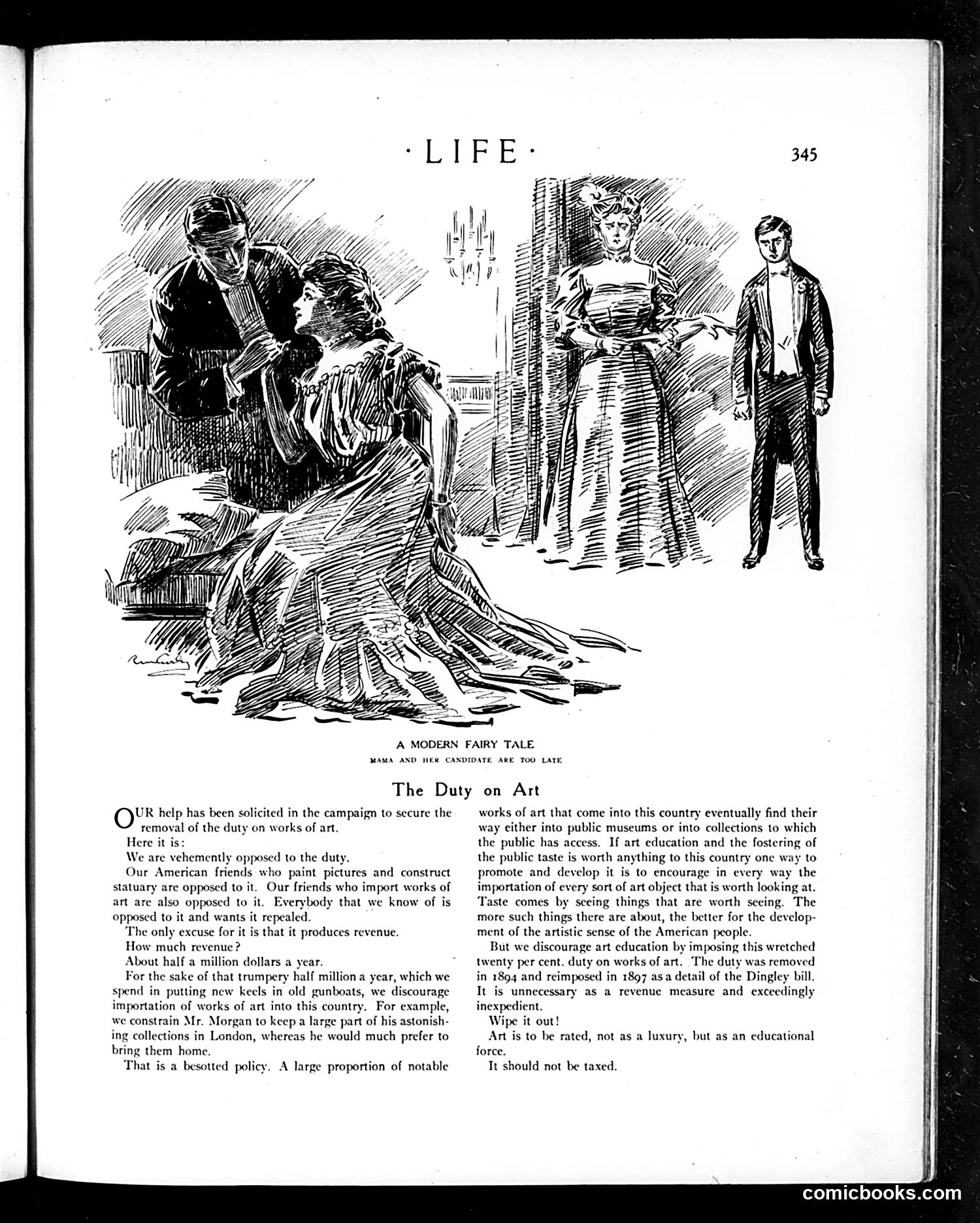
This page satirizes the political failure to remove tariffs on imported artworks. The cartoon depicts a woman (likely representing art patrons or the public interest) arriving too late—her "candidate" for duty removal has apparently lost or the moment has passed. The accompanying article argues passionately against a 20% import duty on art, imposed in the 1897 Dingley Tariff. Life's editors contend the duty harms American cultural development by discouraging art imports into public collections and museums. They cite J.P. Morgan as an example—forced to keep his collections in London due to tariff costs. The satire targets the absurdity of taxing art as a "luxury" when it serves educational purposes, and criticizes spending mere half-million dollars in tariff revenue while simultaneously funding military shipbuilding. The "fairy tale" framing suggests the hope for duty removal is as unrealistic as fantasy—a "too late" commentary on political inaction favoring wealthy collectors and domestic artists over public cultural enrichment.
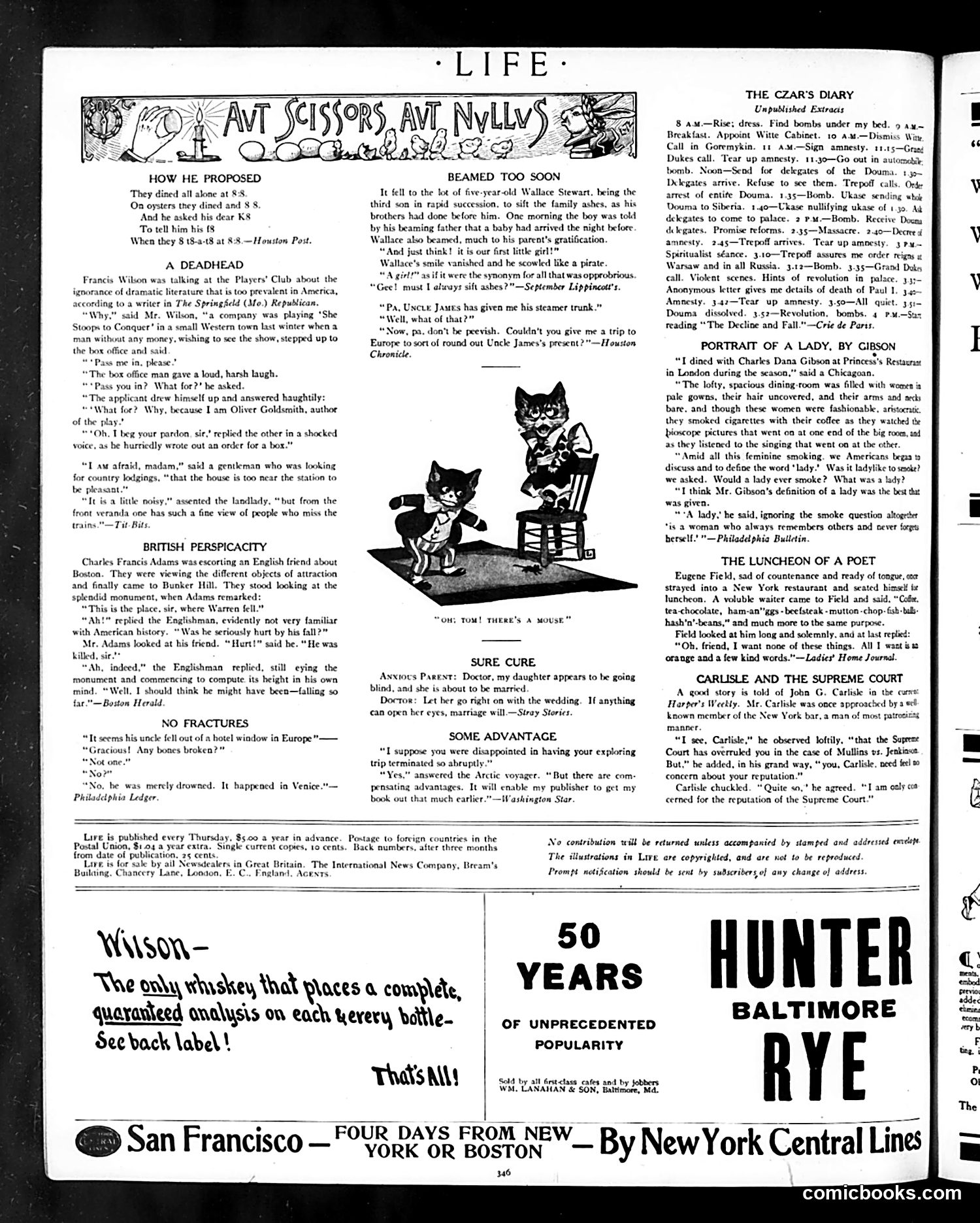
This page from *Life* magazine contains several brief humorous anecdotes and one significant political reference: **"The Czar's Diary"** is the most historically grounded piece. It's a satirical mock-diary of Russia's Czar (Nicholas II), written during the 1905 Russian Revolution. The jokes reference real events: appointing and dismissing the Witte Cabinet, granting amnesty, the Douma (parliament), and repeated bomb threats. The humor lies in depicting the Czar's chaotic, reactive governance—constantly flip-flopping policies while facing revolutionary violence. The other items are light anecdotes about social mishaps: a theater deadhead not recognized as the famous playwright Oliver Goldsmith; a British visitor's literal misunderstanding of "Warren fell" at Bunker Hill; a child disappointed his new sibling is a girl; and various domestic comedies. The cartoon shows two anthropomorphic cats, likely illustrating one of the brief jokes, though the specific reference is unclear from visible text.
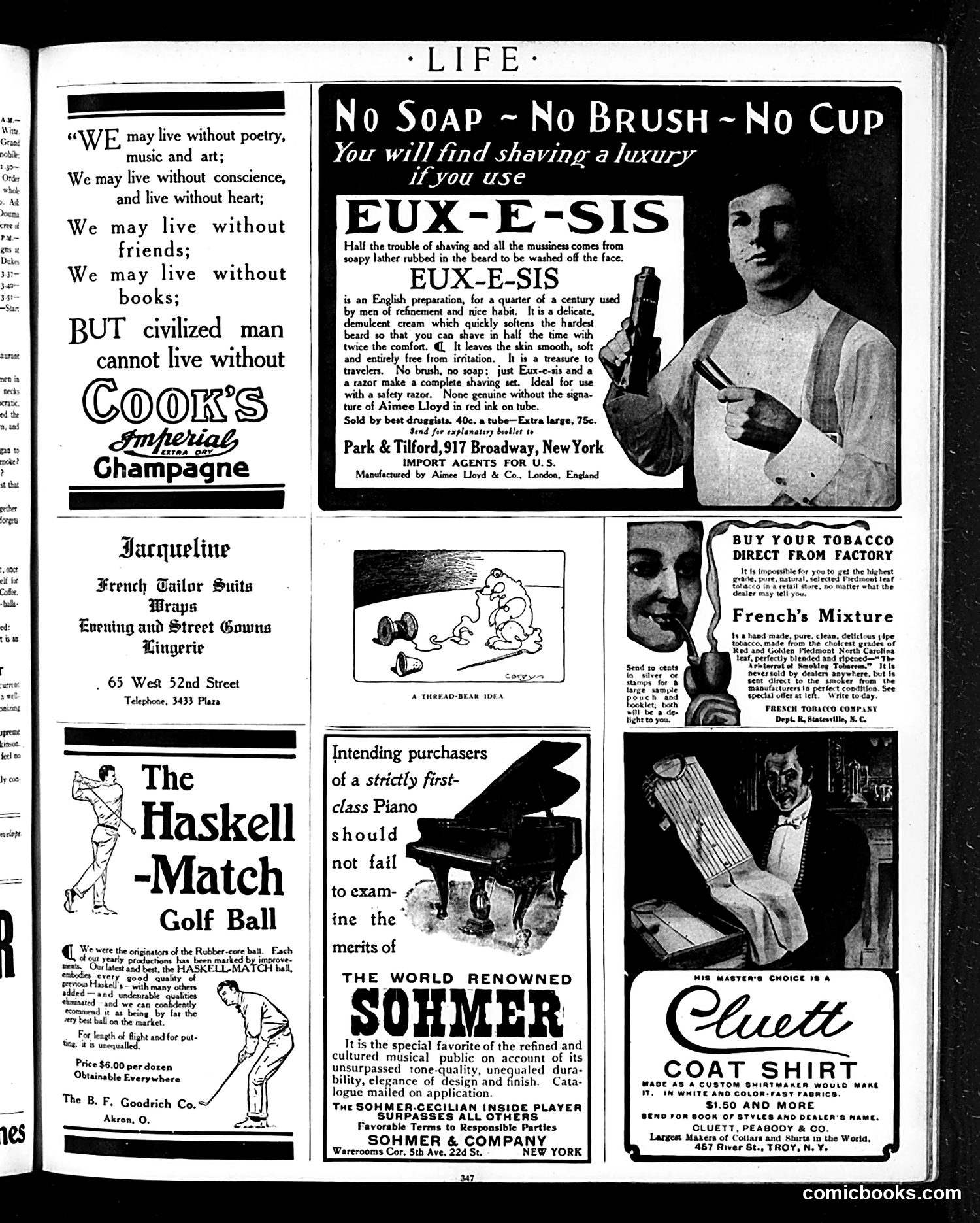
This page is primarily **advertising**, not political satire. However, it opens with a humorous mock-philosophical poem (left column) that parodies serious literature—likely referencing famous verses about human necessities. The joke: it lists things civilization can supposedly do without (poetry, conscience, friends, books) before punchline-declaring that "civilized man cannot live without COOK'S Champagne." This is gentle commercial humor playing on class aspirations and consumer culture. The remaining content consists of period product advertisements (1910s-1920s era): shaving cream, golf balls, French tailoring, tobacco, pianos, and dress shirts. The ads emphasize luxury, refinement, and "scientific" product benefits—typical of early 20th-century marketing targeting affluent readers. No political figures or satire are present on this page.
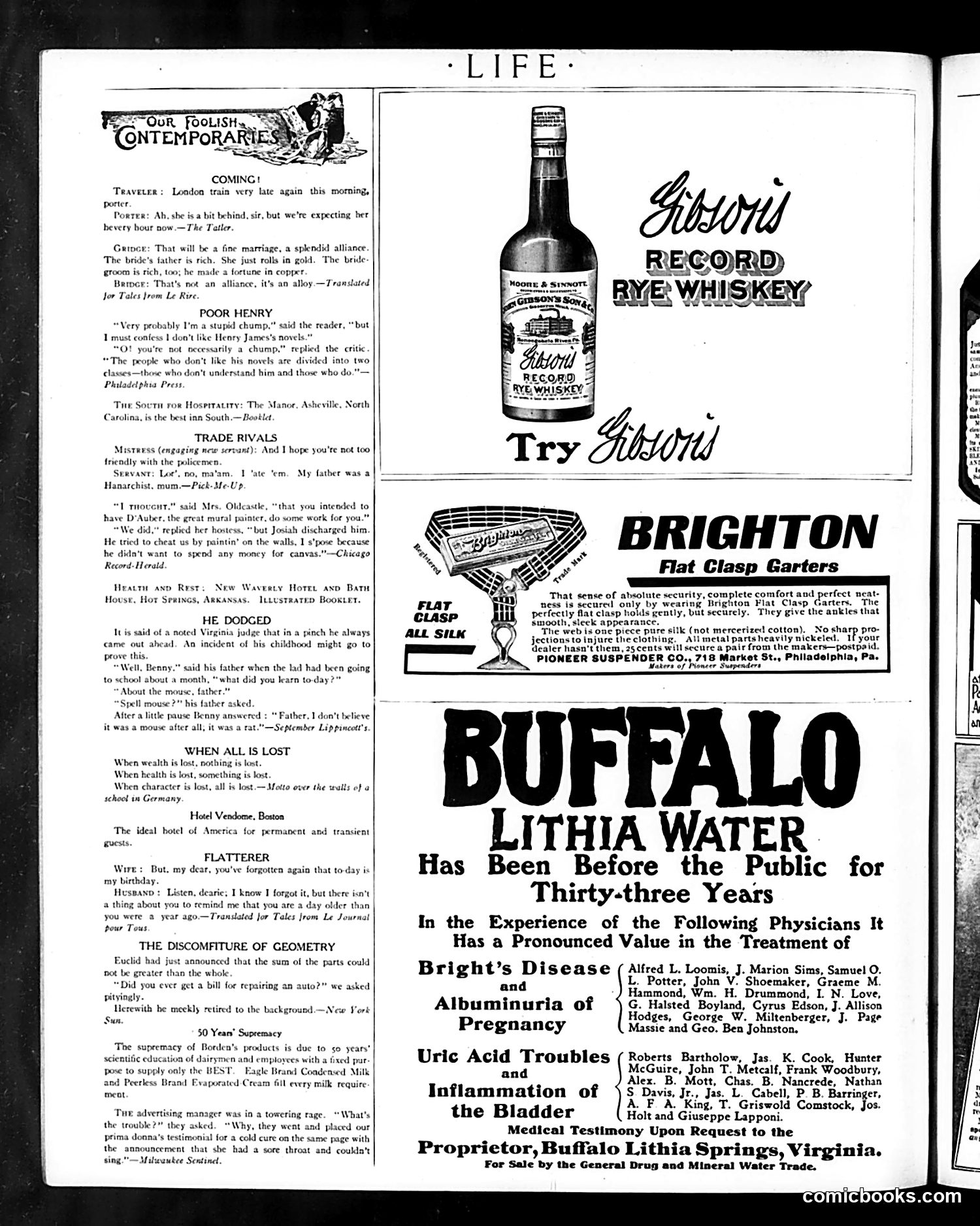
This page is primarily **advertising and humor columns** rather than political satire. The content includes: **"Our Foolish Contemporaries"** — A humor section with brief satirical anecdotes about everyday life, including jokes about: - A porter's pun about a late train ("expecting her bevery hour") - A critic's quip about Henry James novel readers divided into those who don't understand him and those who do - A servant claiming anarchist sympathies to seem tough - A Virginia judge's childhood cleverness **Advertisements** dominate the right side: Gibson's Record Rye Whiskey, Brighton Flat Clasp Garters, and Buffalo Lithia Water (claiming medical benefits for various ailments, endorsed by numerous physicians). The humor reflects early 20th-century magazine wit—light, observational comedy aimed at educated urban readers. No specific political figures or events are referenced. The page exemplifies how Life balanced satirical social commentary with commercial advertising to appeal to middle-class readers.
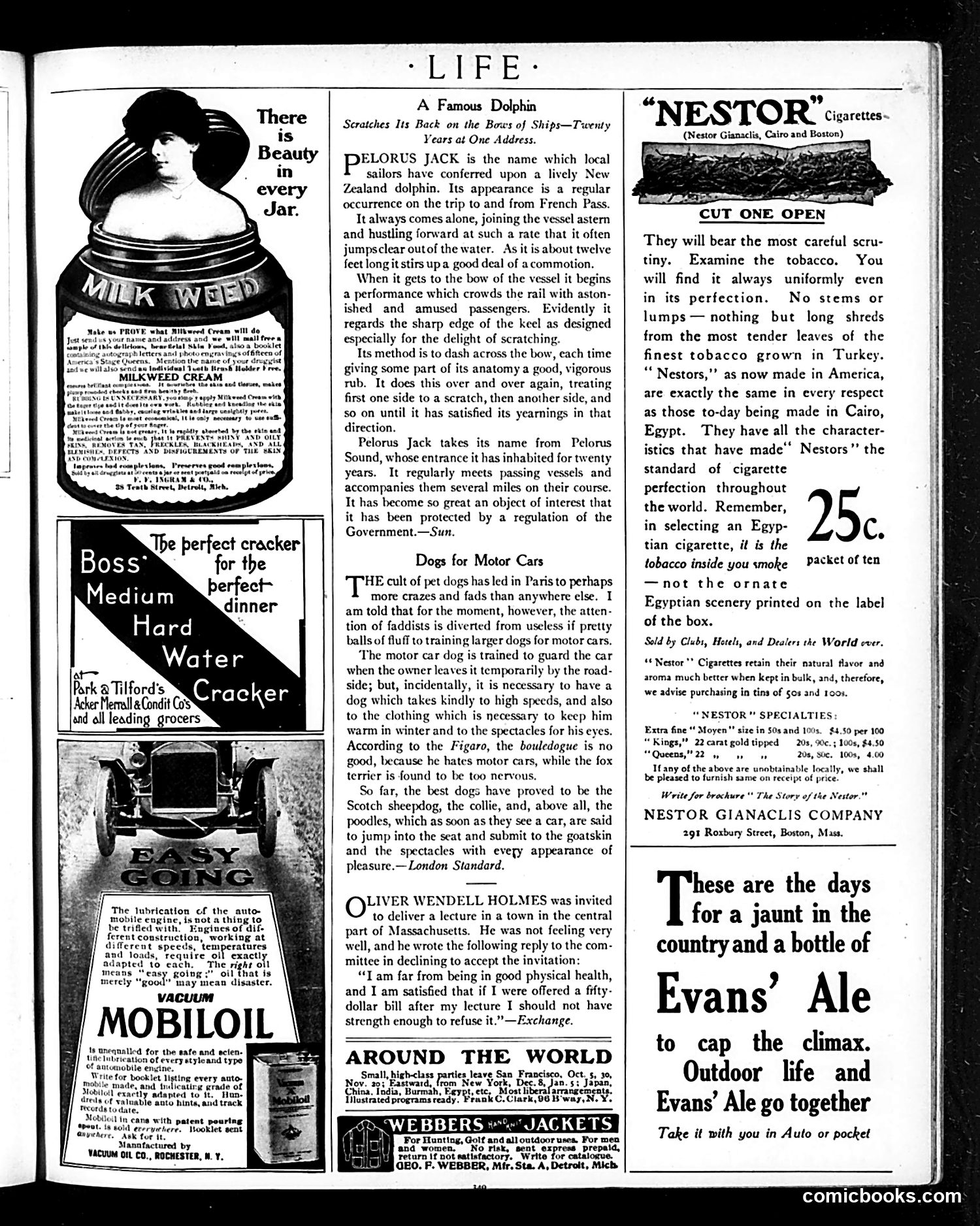
This is primarily an **advertising page** from Life magazine, not satire. The main content includes: **The Featured Story**: "Pelorus Jack," a famous New Zealand dolphin that has inhabited the same strait for twenty years. It regularly visits passing ships and scratches itself on their keels—a genuine historical phenomenon that delighted passengers. The piece treats this as natural history curiosity. **Secondary Articles**: Brief anecdotes about dogs trained for Parisian motor cars (a wealthy fad), and Oliver Wendell Holmes humorously declining a lecture invitation due to ill health, joking he lacks strength to refuse payment. **The Advertisements**: The page is dominated by product ads—Milkweed Cream, Boss Cracker, Mobiloil engine lubricant, Evans' Ale, and Nestor Cigarettes—typical early-20th-century magazine monetization. There is **no political satire** visible here; this is straightforward editorial content mixed with commercial promotion, reflecting Life's dual function as both humor magazine and advertising vehicle.
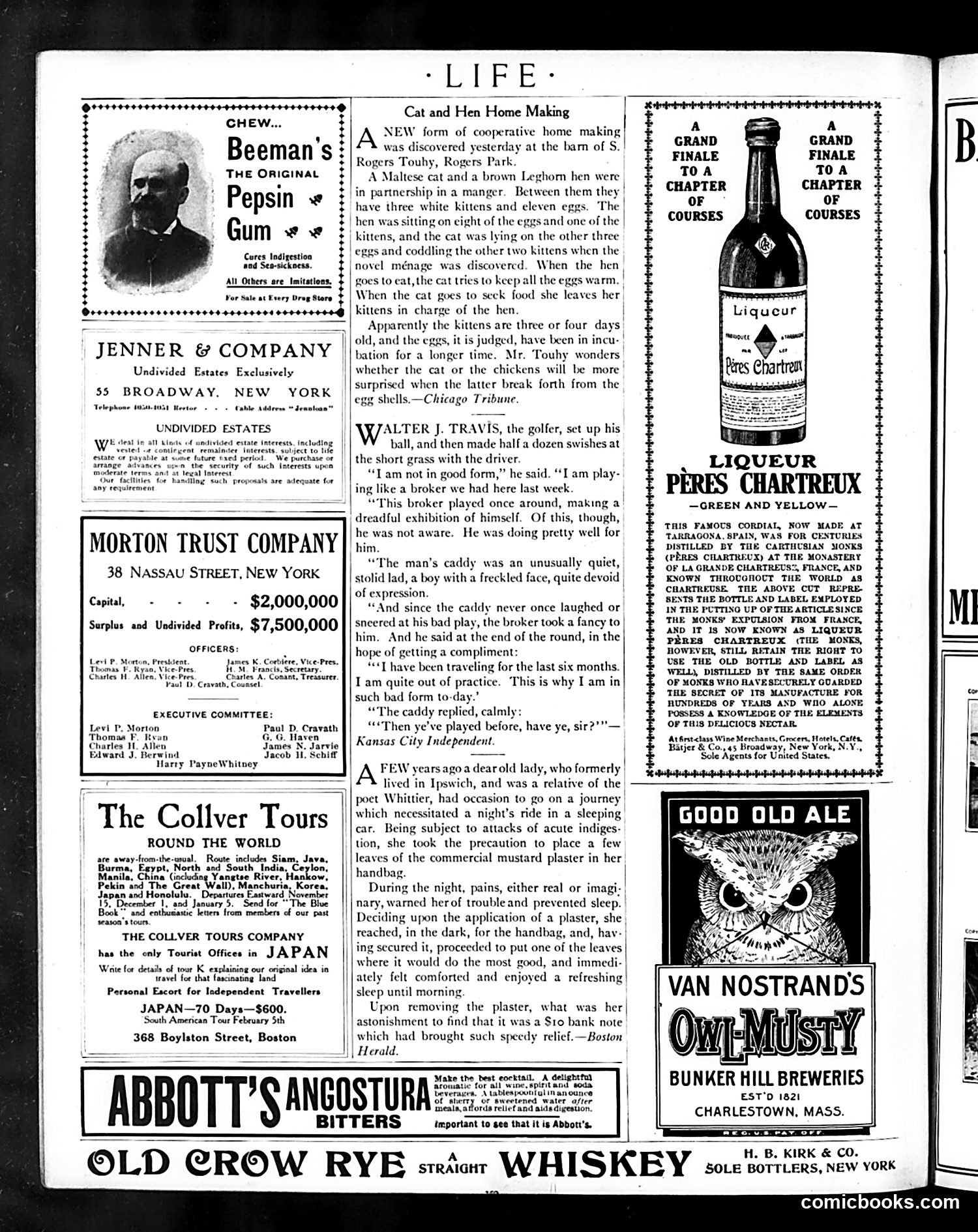
This is primarily an **advertising and miscellaneous content page** rather than a satirical cartoon page. The page contains: **Main Content:** - A humorous anecdote about a cat and hen sharing nesting duties at a Chicago farm - A golf story about a taciturn caddy who deflates a broker's ego by implying he's played poorly before - A brief story about a woman using mustard plaster for indigestion relief **None of these are political satire.** They're human-interest humor pieces typical of *Life* magazine's genteel comedy. The golf caddy story is the closest to satire—gently mocking a wealthy broker's vanity—but it's mild social observation rather than biting political commentary. **Advertisements** dominate the page: Beeman's Pepsin Gum, real estate/trust companies, luxury liqueur, ale, and whiskey. These reflect early 20th-century consumer culture. The page lacks the caricatured figures or explicit political commentary one might expect from a "satirical magazine." It represents *Life*'s evolution toward general-interest humor and lifestyle content.
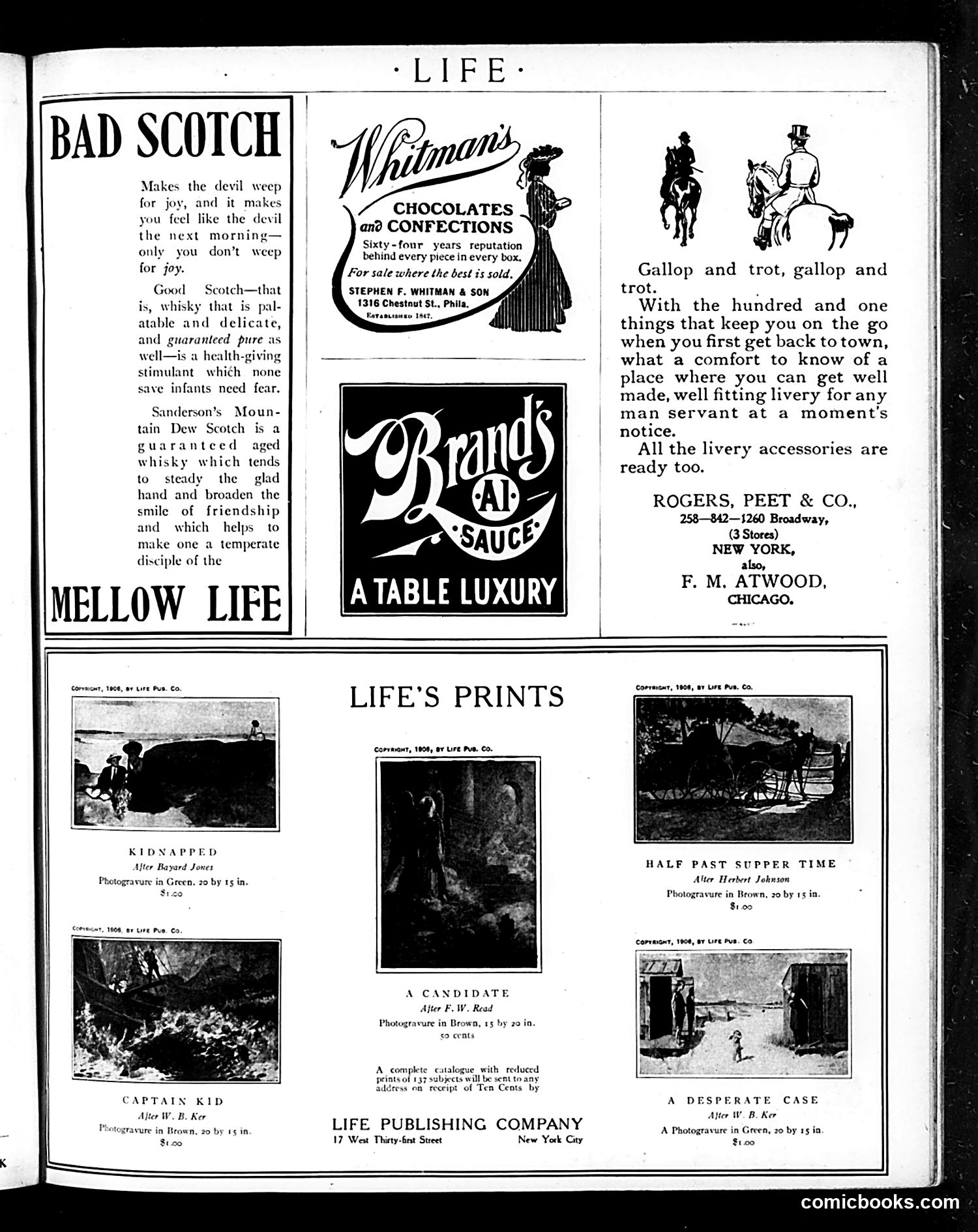
This is primarily an **advertising page** from Life magazine (circa 1908), not a satirical cartoon page. The upper section contains advertisements for Scotch whisky, Whitman's chocolates, and Brand's sauce, with messaging about quality and health benefits typical of early 1900s advertising. The lower half showcases **"Life's Prints"**—photogravure art reproductions for sale by the Life Publishing Company. These appear to be literary or narrative illustrations based on source material: "Kidnapped" (Bayard Jones), "Captain Kidd" (W.B. Ker), "A Candidate" (F.W. Read), "Half Past Supper Time" (Herbert Johnson), and "A Desperate Case" (W.B. Ker). The small equestrian illustrations in the upper right advertise Rogers, Peet & Co. livery services in New York and Chicago. No political satire or social commentary is evident on this page—it's a commercial product listing.
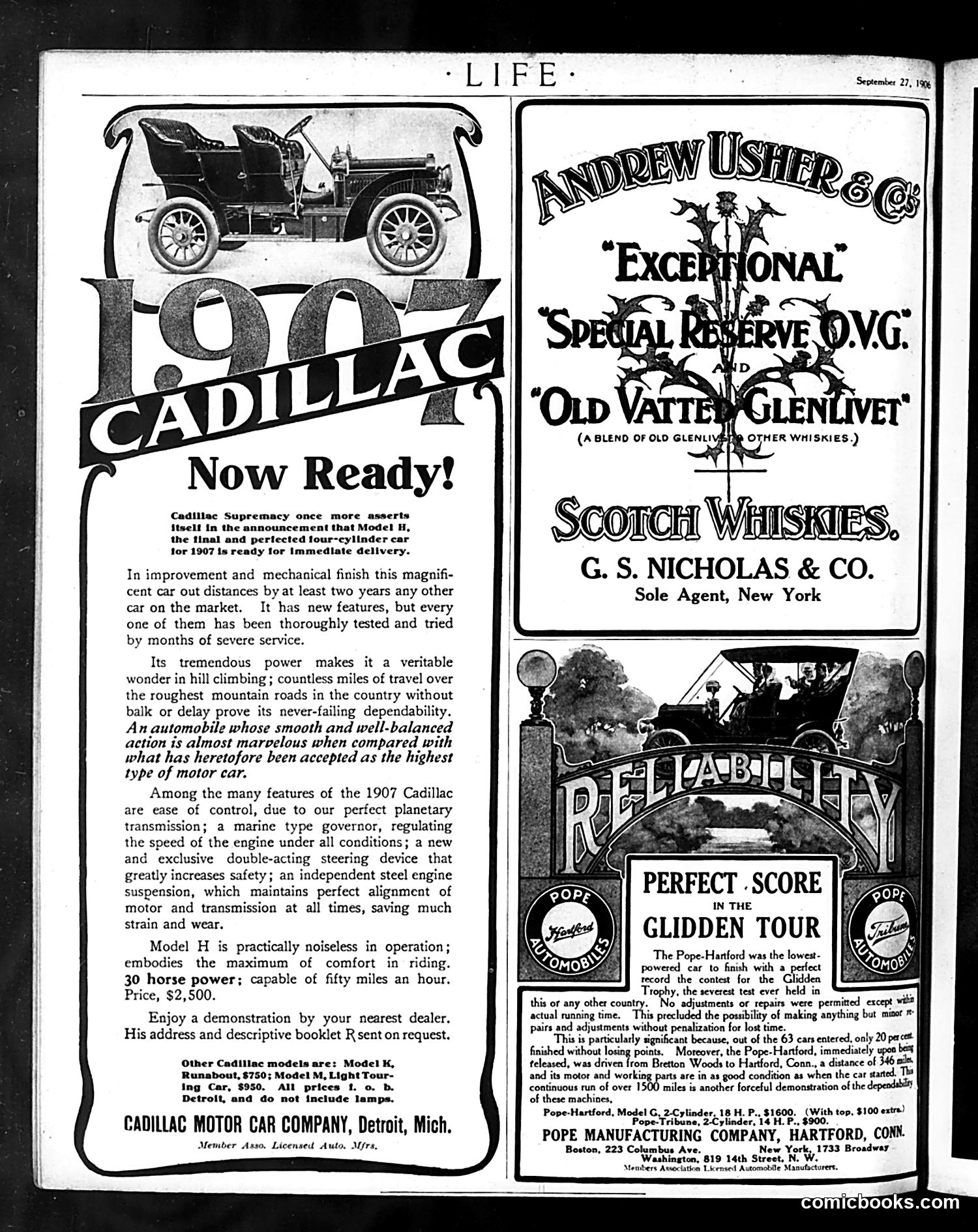
This page contains **no cartoons or satire**—it is primarily **automobile advertising** from the early automotive era. The left advertisement promotes the **1907 Cadillac Model H**, emphasizing its mechanical superiority: planetary transmission, marine governor, double-acting steering, independent suspension, and 30 horsepower capable of 50 mph. The $2,500 price signals a luxury vehicle. The right side advertises **Scotch whiskeys** (Andrew Usher & Co.) and the **Pope-Hartford automobile**, which claims a "perfect score" in the Glidden Tour—a prestigious 1906 reliability road race. The Pope Manufacturing Company highlights that their 2-cylinder car finished with only minor maintenance among 63 competitors. This reflects the **early 1900s automotive boom**, when competing manufacturers used reliability claims and engineering specifications as selling points. The page demonstrates how nascent automobile companies competed through demonstrated durability and performance rather than styling—a stark contrast to modern auto advertising.