
Life, 1906-09-27 · page 17 of 24
Life — September 27, 1906 — page 17: what you’re looking at
What you’re looking at
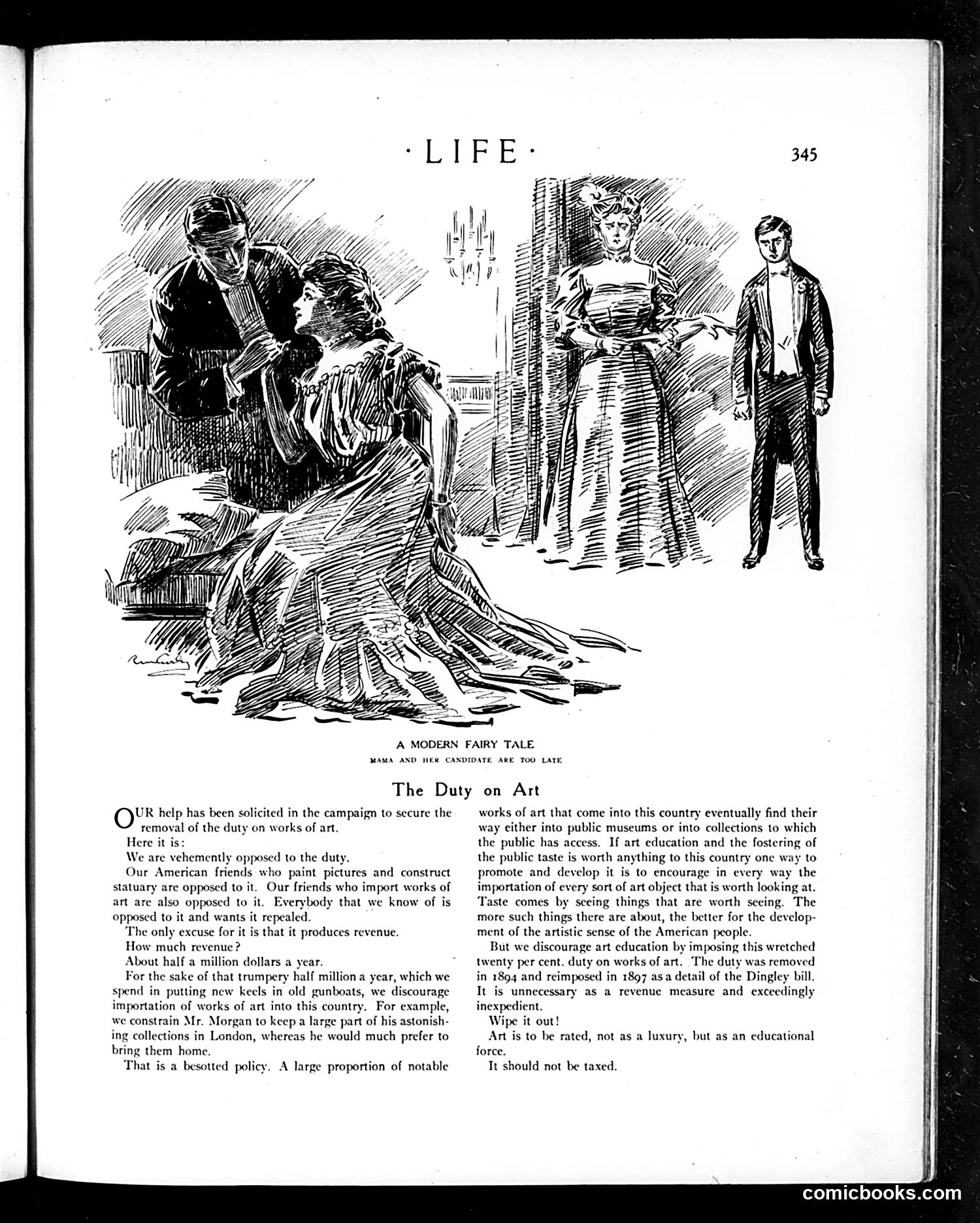
This page satirizes the political failure to remove tariffs on imported artworks. The cartoon depicts a woman (likely representing art patrons or the public interest) arriving too late—her "candidate" for duty removal has apparently lost or the moment has passed. The accompanying article argues passionately against a 20% import duty on art, imposed in the 1897 Dingley Tariff. Life's editors contend the duty harms American cultural development by discouraging art imports into public collections and museums. They cite J.P. Morgan as an example—forced to keep his collections in London due to tariff costs. The satire targets the absurdity of taxing art as a "luxury" when it serves educational purposes, and criticizes spending mere half-million dollars in tariff revenue while simultaneously funding military shipbuilding. The "fairy tale" framing suggests the hope for duty removal is as unrealistic as fantasy—a "too late" commentary on political inaction favoring wealthy collectors and domestic artists over public cultural enrichment.
📄 Transcribed text from this page (OCR, searchable)
Machine-transcribed from the original scan — historical spelling and the odd misread are preserved.
AWN TaN) AN AN Ae A MODERN FAIRY TALE MAMA AND IER CANDIDATE ARE TOO LATE The Duty on Art OLR help has been solicited in the campaign to secure the removal of the duty on works of art, Here it is: We are vehemently opposed to the duty. Our American friends who paint pictures and construct statuary are opposed to it. Our friends who import works of art are also opposed to it. Everybody that we know of is opposed to it and wants it repealed. The only excuse for it is that it produces revenue. How much revenue ? About half a million dollars a year. For the sake of that trumpery half million a year, which we spend in putting new keels in old gunboats, we discourage importation of works of art into this country, For example, we constrain Mr. Morgan to keep a large part of his astonish- ing collections in London, whereas he would much prefer to bring them home. That is a besotted policy. A large proportion of notable works of art that come into this country eventually find their way either into public museums or into collections to which the public has access. If art education and the fostering of the public taste is worth anything to this country one way to promote and develop it is to encourage in every way the importation of every sort of art object that is worth looking at. Taste comes by sceing things that are worth seeing. The more such things there are about, the better for the develop- ment of the artistic sense of the American people. But we discourage art education by imposing this wretched twenty per cent. duty on works of art. The duty was removed in 1894 and reimposed in 1897 asa detail of the Dingley bill. It is unnecessary as a revenue measure and exceedingly inexpedient. Wipe it out! Art is to be rated, not as a luxury, but as an educational force. It should not be taxed. comicbooks.com