
Life, 1906-09-27 · page 10 of 24
Life — September 27, 1906 — page 10: what you’re looking at
What you’re looking at
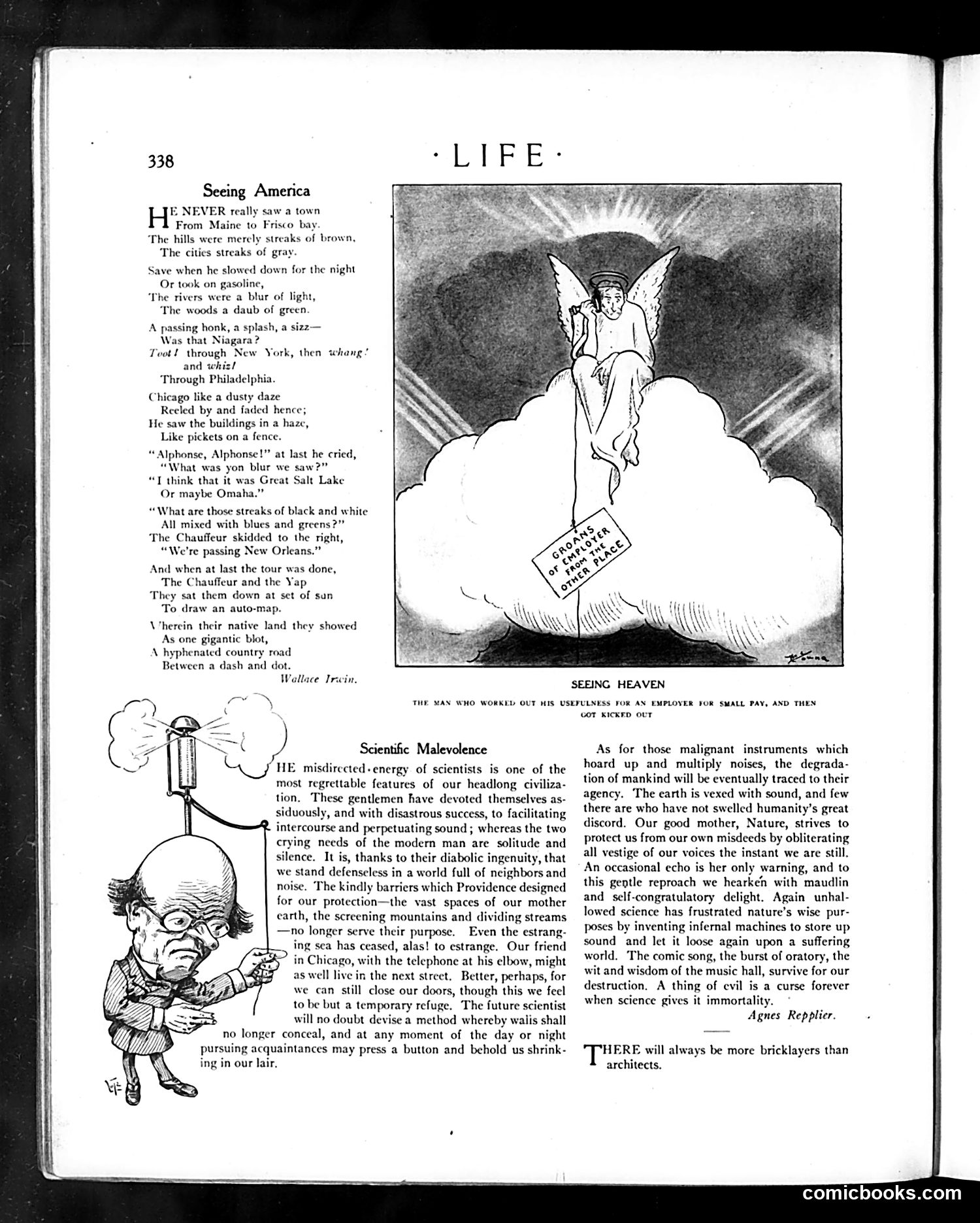
The page contains two distinct satirical pieces: **"Seeing Heaven"** (top cartoon): Shows a man on a cloud holding a sign reading "George Washington's Farewell Address." This satirizes someone who has died and discovered that the founding document's warnings were accurate—likely critiquing Americans who ignored Washington's advice about avoiding entangling alliances or partisan division. **"Scientific Malevolence"** (bottom): A caricatured scientist with wild hair operates a mechanical device producing noise and discord. The accompanying essay criticizes scientists who misdirect their talents toward destructive inventions (particularly sound-amplifying technology) rather than serving human welfare. It argues this represents a broader civilizational failure—that science enables noise pollution and chaos rather than protecting people from modern annoyances. Both pieces critique how progress can harm rather than help society.
📄 Transcribed text from this page (OCR, searchable)
Machine-transcribed from the original scan — historical spelling and the odd misread are preserved.
338 Seeing America E NEVER really saw a town From Maine to Frisco bay. ‘The hills were merely streaks of brown, The cities streaks of gray. Save when he slowed down for the night Or took on gasoline, ‘The rivers were a blur of light, ‘The woods a daub of green. A passing honk, a splash, a sizz— Was that Niagara? Toot! through New York, then whang’ and wi ‘Through Philadelphia. Chicago like a dusty daze Reeled by and faded hence; He saw the buildings in a haze, Like pickets on a fence. “Alphonse, Alphonse!” at last he cried, “What was yon blur we saw?” “T think that it was Great Salt Lake Or maybe Omaha.” “What are those streaks of black and white All mixed with blues and greens?” The Chauffeur skidded to the right, “We're passing New Orleans.” And when at last the tour was done, ‘The Chauffeur and the Yap ‘They sat them down at set of sun To draw an auto-map. Vtherein their native land they showed As one gigantic blot, \ hyphenated country road Between a dash and dot. Wallace Irvin. SEEING HEAVEN Scientific Malevolence Ky /'HE misdirected -energy of scientists is one of the most regrettable features of our headlong civiliza- tion. These gentlemen have devoted themselves as- siduously, and with disastrous success, to facilitating intercourse and perpetuating sound ; whereas the two crying needs of the modern man are solitude and silence. It is, thanks to their diabolic ingenuity, that we stand defenseless in a world full of neighbors and noise. The kindly barriers which Providence designed for our protection—the vast spaces of our mother carth, the screening mountains and dividing streams —no longer serve their purpose. Even the estrang- ing sea has ceased, alas! to estrange. Our friend in Chicago, with the telephone at his elbow, might as well live in the next street. Better, perhaps, for we can still close our doors, though this we feel to be but a temporary refuge. The future scientist will no doubt devise a method whereby walis shall no longer conceal, and at any moment of the day or night pursuing acquaintances may press a button and behold us shrink- ing in our lair, Gor KICKED oT As for those malignant instruments which hoard up and multiply noises, the degrada- tion of mankind will be eventually traced to their agency. The earth is vexed with sound, and few there are who have not swelled humanity’s great discord. Our good mother, Nature, strives to protect us from our own misdeeds by obliterating all vestige of our voices the instant we are still. An occasional echo is her only warning, and to this gentle reproach we hearkeh with maudlin and self-congratulatory delight. Again unhal- lowed science has frustrated nature’s wise pur- poses by inventing infernal machines to store up sound and let it loose again upon a suffering world. The comic song, the burst of oratory, the wit and wisdom of the music hall, survive for our destruction. A thing of evil is a curse forever when science gives it immortality. Agnes Repplier. 'HERE will always be more bricklayers than architects. comicbooks.com