
Life, 1906-09-27 · page 16 of 24
Life — September 27, 1906 — page 16: what you’re looking at
What you’re looking at
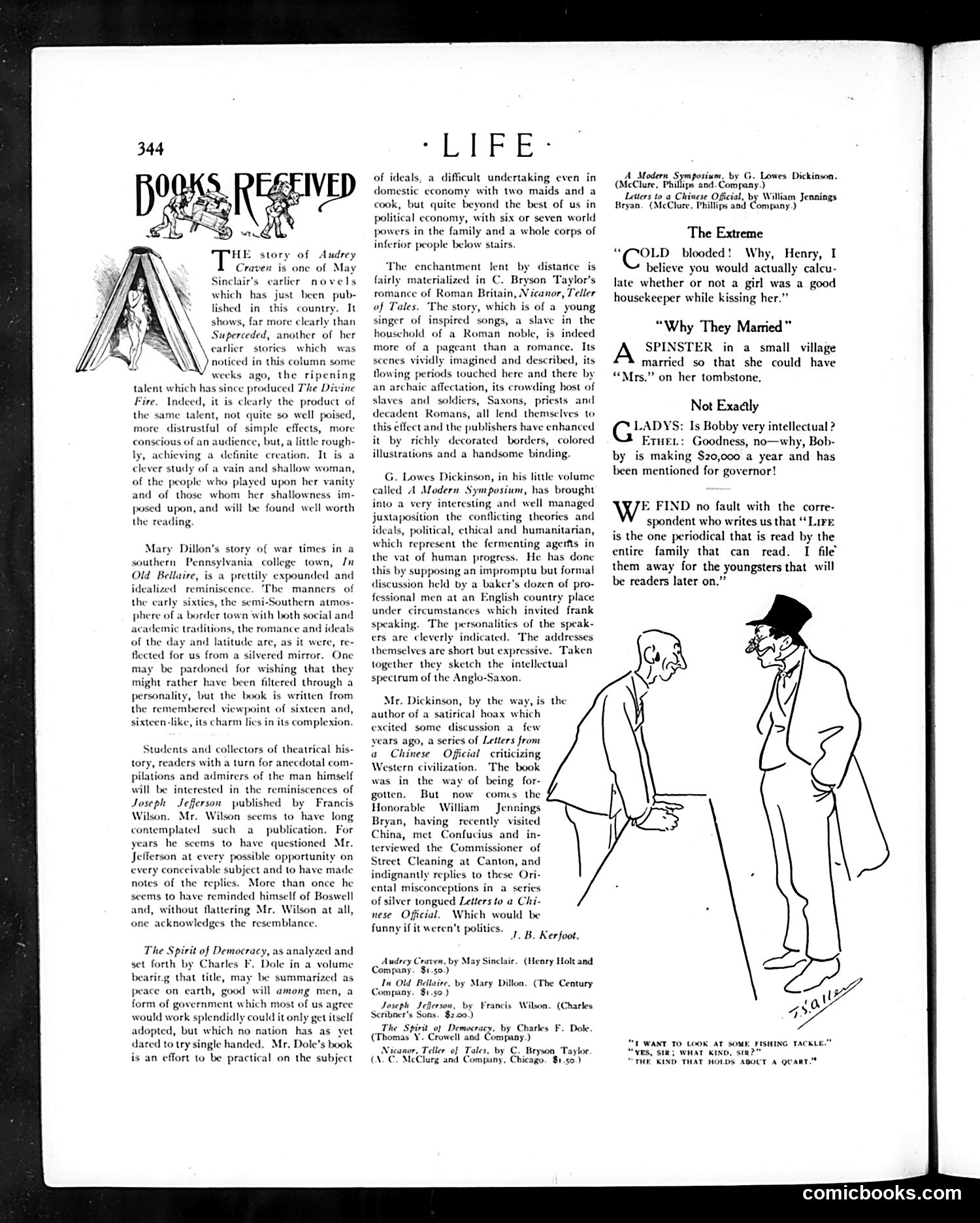
This page from *Life* magazine reviews several contemporary books while critiquing broader social and political issues. The right-hand cartoon—captioned "I want to look at some fishing tackle"—appears to depict two men in conversation, with one man's response humorously deflecting the other's request by saying "Yes, sir; what kind, sir? / The kind that finds about a quart." The joke likely satirizes either commercial deception (fishing tackle that doesn't work as advertised) or possibly refers to Prohibition-era bootlegging slang ("finding a quart" of illegal liquor). The cartoon illustrates *Life*'s characteristic style of social satire through everyday encounters. The book reviews themselves contain pointed social commentary, particularly criticism of idealistic political philosophy as impractical when applied to real-world governance involving competing "world powers" and social hierarchies—a subtle jab at naive progressive thinking.
📄 Transcribed text from this page (OCR, searchable)
Machine-transcribed from the original scan — historical spelling and the odd misread are preserved.
story of Audrey Craven is one of May Sinclair's which has just been pub- lished in this country, It shows, far more clearly than Superceded, another of her carlier storics which noticed in this column some weeks ago, the ripening talent which has since produced The Divine Fire. Indeed, it is clearly the product of the same talent, not quite so well poised, more distrustful of simple effects, more conscious of an audience, but, a little rough- ly, achieving a d Nis a of a vain and shallow w rlier novels was nite creation. clever stud. of the people who played upon her vanity and of those whom her shallowness im- posed upon, and will be found well worth the reading. an, Mary Dillon's story of war times in a southern Pennsylvania college town, Jn Old Bellaire, is @ prettily expounded and idealized reminiscence. ‘The manners of the carly sixties, the semi-Southern atmos- phere of a border town with both social and academic traditions, the romance and ideals of the day and latitude are, as it were, re- flected for us from a silvered mirror. One may be pardoned for wishing that they might rather have been filtered through a personality, but the book is written from the remembered viewpoint of sixteen and, sixteen-like, its charm lics in its complexion. Students and collectors of theatrical his- tory, readers with a turn for anecdotal com- pilations and admirers of the man himself will be interested in the reminiscences of Joseph Jefferson published by Fi Wilson, Mr. Wilson seems to have long contemplated such a publication. For years he scems to have questioned Mr. Jeiferson at every possible opportunity on every conceivable subject and to have made notes of the replies. More than once he seems to have reminded himself of Boswell and, without flattering Mr. Wilson at all, one acknowledges the resemblance. ncis The Spirit of Democracy, as analyzed and set forth by Charles F. Dole in a volume bearing that title, may be summarized as peace on earth, good will among men, a form of government which most of us agree would work splendidly could it only get itself adopted, but which no nation has as yet dared to try single handed. Mr. Dole’s book is an effort to be practical on the subject *LIFE- of ideals, a difficult undertaking even in domestic economy with two maids and a cook, but quite beyond the best of us in political economy, with six or seven world powers in the family and a whole corps of inferior people below stairs. The enchantment lent by distance is fairly materialized in C. Bryson Taylor's romance of Roman Britain, Nicanor, Teller of Tales. The story, which is of a young singer of inspired songs, a slave in the houschold of a Roman noble, is indeed more of a pageant than a romance. Its scenes vividly imagined and described, its flowing periods touched here and there by an archaic affectation, its crowding host of slaves and soldiers, Saxons, priests and decadent Romans, all lend themselves to this effect and the publishers have enhanced it by richly decorated borders, colored illustrations and a handsome binding. G. Lowes Dickinson, in his little volume called A Modern Symposium, has brought into a very interesting and well managed juxtaposition the conflicting theories and ideals, political, ethical and humanitarian, which represent the fermenting agerfs in the vat of human progress. He has done this by supposing an impromptu but formal discussion held by a baker's dozen of pro- fessional men at an English country place under circumstances which invited frank speaking. The personalities of the spcak- ers are cleverly indicated. The addresses themselves are short but expressive. Taken together they sketch the intellectual spectrum of the Anglo-Saxon. Mr. Dickinson, by the way, is the author of a satirical hoax which exeit some discussion a few years ago, a series of Letters from a Chinese Oficial criticizing Western civilization. The book was in the way of being for- gotten. But now comes the Honorable William Jennings Bryan, having recently visited China, met Confucius and in- terviewed the Commissioner of Strect Cleaning at Canton, and indignantly replies to these Ori- ental misconceptions in a. series of silver tongued Letters to a Chi- nese Official. Which would be funny iit weren't politics. 7B Kerjoop Audrey Craven, by May Sinclair Company. $1.50.) In Old Bellaire. by Mary Dillon Company. $1.0) Joseph Jeferson, by Scribner's Sons. $2.00.) The Spirit of Democracy. by Charles F. Dole. (Thomas Y. Crowell and Company.) Nicanor, Teller of Tales. by C. Bryson, Taylor. (XC. McClurg and Company, Chicago. 81.50.) (Henry Holt and (The Century Francis Wilson, (Charles A Modern Symposium. by G. Lowes Dickinson. (McClure, Phillips and. Company.) Laters to @ Chinese Oficial, by William Jennings Bryan. (McClure, Phillips and Company.) The Extreme “(OLD blooded! Why, Henry, I believe you would actually calcu- late whether or not a girl was a good housekeeper while kis ing her.” “Why They Married” SPINSTER in a small village married so that she could have “Mrs.” on her tombstone, Not Exadly G ADYS: Is Bobby very intellectual ? Etne.: Goodness, no—why, Bob- by is making $20,000 a year and has been mentioned for governor! E FIND no fault with the corre- spondent who writes us that “Lire is the one periodical that is read by the entire family that can read. I file them away for the youngsters that will be readers later on.” 4 4° 1 WANT TO LOOK AT SOME FISHING TACK! “YES, SIR; WHAT KIND, ste?” “THE KIND THAT HOLDS ABOUT A QvART." comicbooks.com