
Life, 1906-09-27 · page 14 of 24
Life — September 27, 1906 — page 14: what you’re looking at
What you’re looking at
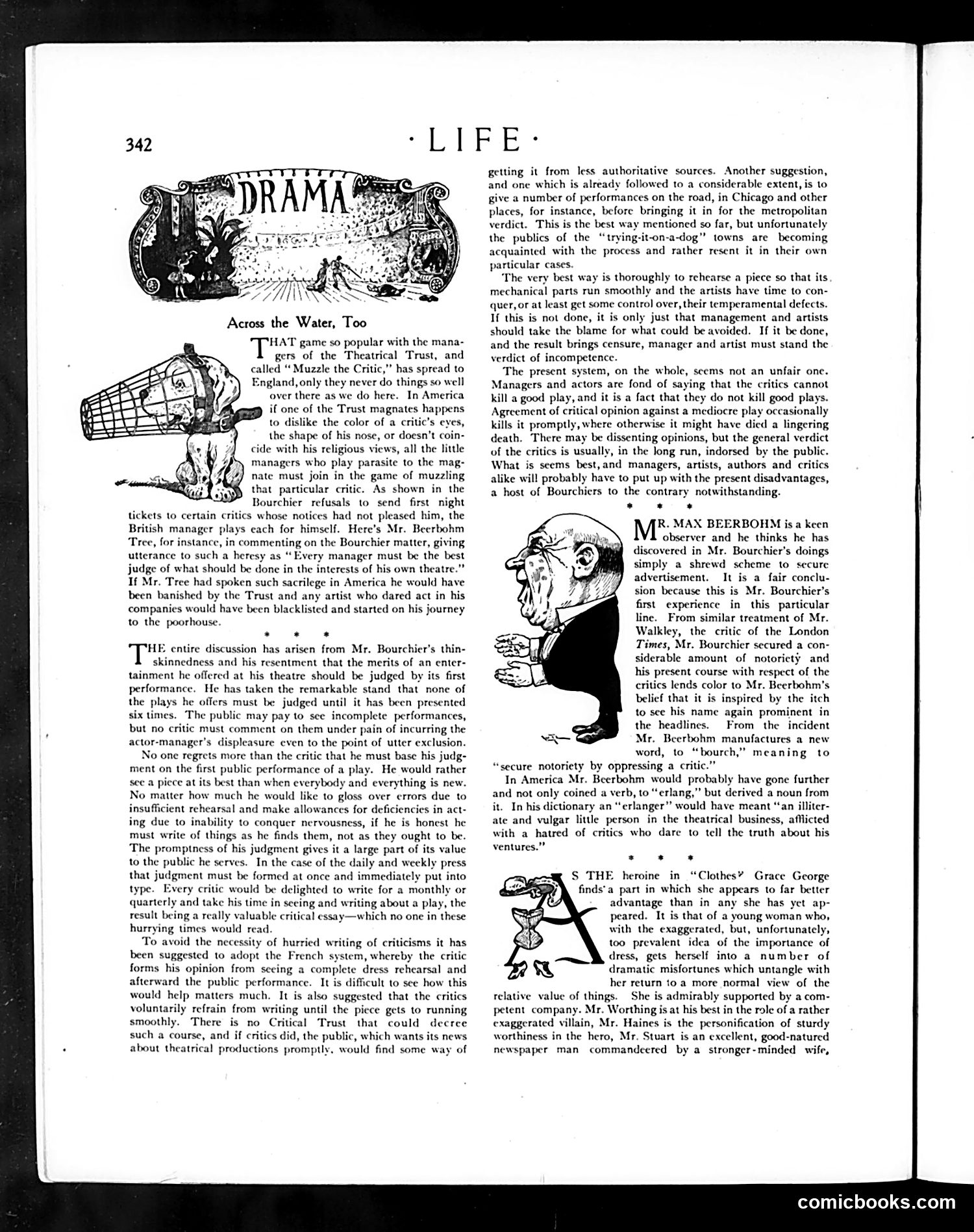
This page satirizes the "Theatrical Trust's" practice of punishing theater critics who give negative reviews by blacklisting them from opening-night performances. **The main cartoon** depicts a crouching figure (likely theater manager Herbert Beerbohm Tree, named in the text) being muzzled—literally silenced—referencing the "Muzzle the Critic" game. **The satire's point:** American theater managers enforce uniform punishment against critical dissent through the Theatrical Trust monopoly. British managers like Bourchier operate independently, each "playing for himself." The article mocks Bourchier's attempt to exclude critics from reviewing unfinished productions, arguing critics must judge opening performances immediately for daily/weekly publications. **The underlying conflict:** Actor-managers want control over when/how their work is judged; critics assert they must report honestly on what audiences actually see, without sanitizing incomplete rehearsals. The text uses Tree's statement that managers should judge their own theaters as "heresy"—implying such independence would be crushed in America's Trust-controlled system.
📄 Transcribed text from this page (OCR, searchable)
Machine-transcribed from the original scan — historical spelling and the odd misread are preserved.
“LIFE Across the Water, Too HAT game so popular with the mana- gers of the Theatrical Trust, and called “ Muzzle the Critic,” has spread to England, only they never do things so well over there as we do here. In America if one of the Trust magnates happens to dislike the color of a critic’s eve: the shape of his nose, or doesn’t coin- cide with his religious views, all the little managers who play parasite to the mag- nate must join in the game of muzzling that particular critic. As shown in the Bourchier refusals to send first night to certain critics whose notices had not pleased him, the British manager plays cach for himself. Here’s Mr. Beerbohm Tree, for instance, in commenting on the Bourchier matter, giving utterance to such a heresy as “Every manager must be the best judge of what should be done in the interests of his own theatre.”” If Mr. Tree had spoken such sacrilege in America he would have been banished by the Trust and any artist who dared act in his companies would have been blacklisted and started on his journey to the poorhouse. * 8 6 'HE entire discussion has arisen from Mr. Bourchier’s thin- skinnedness and his resentment that the merits of an enter- tainment he offered at his theatre should be judged by its first performance. He has taken the remarkable stand that none of he offers must be judged until it has been presented The public may pay to see incomplete performances, but no critic must comment on them under pain of incurring the actor-manager’s displeasure even to the point of utter exclusion. No one regrets more than the critic that he must base his judg- ment on the first public performance of a play. He would rather see a piece at its best than when everybody and everything is new. No matter how much he would like to gloss over errors due to insufficient rehearsal and make allowances for deficiencies in act- ing due to inability to conquer nervousness, if he is honest he must write of things as he finds them, not as they ought to be. The promptness of his judgment gives it a large part of its value to the public he serves. In the case of the daily and weekly press that judgment must be formed at once and immediately put into type. Every critic would be delighted to write for a monthly or quarterly and take his time in seeing and writing about a play, the result being a really valuable critical essay—which no one in these hurrying times would read. To avoid the necessity of hurried writing of criticisms it has been suggested to adopt the French system, whereby the critic forms his opinion from seeing a complete dress rehearsal and afterward the public performance. It is difficult to see how this would help matters much. It is also suggested that the critics voluntarily refrain from writing until the piece gets to running smoothly. There is no Critical Trust that could decree such a course, and if critics did, the public, which wants its news about theatrical productions promptly, would find some way of getting it from less authoritative sources. Another suggestion, and one which is already followed to a considerable extent, is to give a number of performances on the road, in Chicago and other places, for instance, before bringing it in for the metropolitan verdict. This is the best way mentioned so far, but unfortunately the publics of the “trying-it-on-a-dog” towns are becoming acquainted with the process and rather resent it in their own particular cases. ‘The very best way is thoroughly to rehearse a piece so that its mechanical parts run smoothly and the artists have time to con- quer, or at least get some control over, their temperamental defects. If this is not done, it is only just that management and artists should take the blame for what could be avoided. If it be done, and the result brings censure, manager and artist must stand the verdict of incompetence. The present system, on the whole, seems not an unfair onc. Managers and actors are fond of saying that the critics cannot kill a good play, and it is a fact that they do not kill good plays. Agreement of critical opinion against a mediocre play occasionally kills it promptly, where otherwise it might have died a lingering death. There may be dissenting opinions, but the general verdict of the critics is usually, in the long run, indorsed by the public. What is scems best, and managers, artists, authors and critics alike will probably have to put up with the present disadvantages, a host of Bourchicrs to the contrary notwithstanding. * 6 R. MAX BEERBOHM is a keen observer and he thinks he has discovered in Mr. Bourchier’s doings simply a shrewd scheme to secure advertisement. It is a fair conclu- sion because this is Mr. Bourchier’s first experience in this particular line. From similar treatment of Mr. Walkley, the critic of the London Times, Mr. Bourchier secured a con- siderable amount of notoricty and his present course with respect of the critics lends color to Mr. Beerbohm’s belief that it is inspired by the itch to sce his name again prominent in the headlines. From the incident Mr. Beerbohm manufactures a new word, to “bourch,” meaning to “secure notoriety by oppressing a critic.” In America Mr. Beerbohm would probably have gone further and not only coined a verb, to “erlang,” but derived a noun from it. In his dictionary an “erlanger” would have meant “an illiter- te and vulgar little person in the theatrical business, afflicted with a hatred of critics who dare to tell the truth about his ventures. s 8 8 S THE heroine in “Clothes” Grace George finds'a part in which she appears to far better advantage than in any she has yet ap- peared. It is that of a young woman who, with the exaggerated, but, unfortunately, too prevalent idea of the importance of dress, gets herself into a number of dramatic misfortunes which untangle with her return to a more normal view of the relative value of things. She is admirably supported by a com- petent company. Mr. Worthing is at his best in the role of a rather cxaggcrated villain, Mr. Haines is the personification of sturdy worthiness in the hero, Mr. Stuart is an excellent, good-natured newspaper man commandeered by a stronger-minded wife, comicbooks.com