
A complete issue · 20 pages · 1906
Life — August 30, 1906
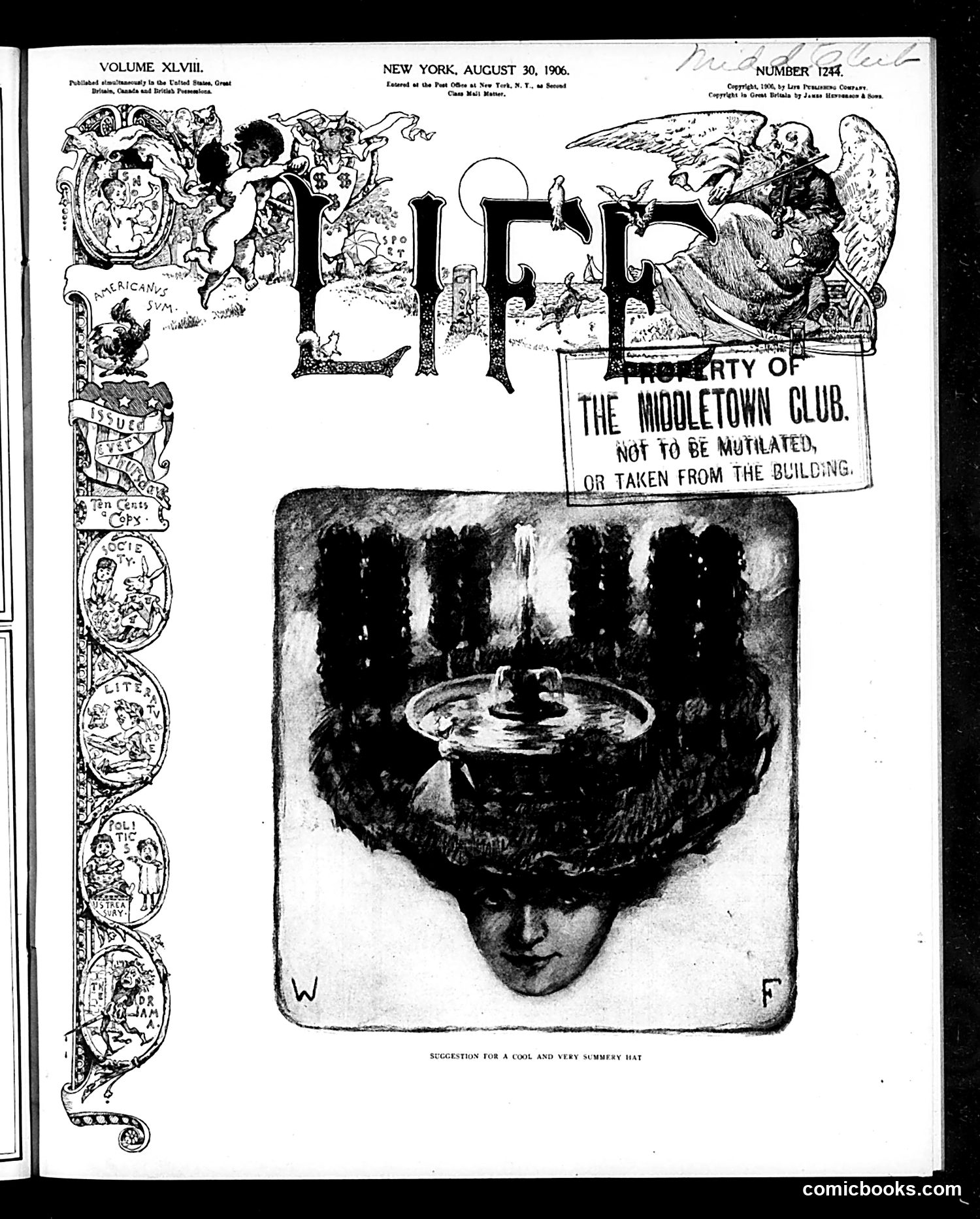
This page features decorative header artwork and a central photograph labeled "SUGGESTION FOR A COOL AND VERY SUMMERY HAT." The image shows a woman's head wearing an extremely wide, elaborate hat decorated with what appears to be a garden scene—complete with plants, water features, and possibly small structures. The hat is so enormous it dwarfs the wearer's face. This is satirical commentary on the absurdly large, ornate hats fashionable among wealthy women in the Edwardian era. The "joke" mocks the impracticality and excess of contemporary women's fashion, suggesting such hats were so oversized they resembled miniature gardens or landscapes. The tongue-in-cheek "suggestion" format emphasizes the satirical intent—presenting outlandish millinery as if it were a serious fashion proposal.
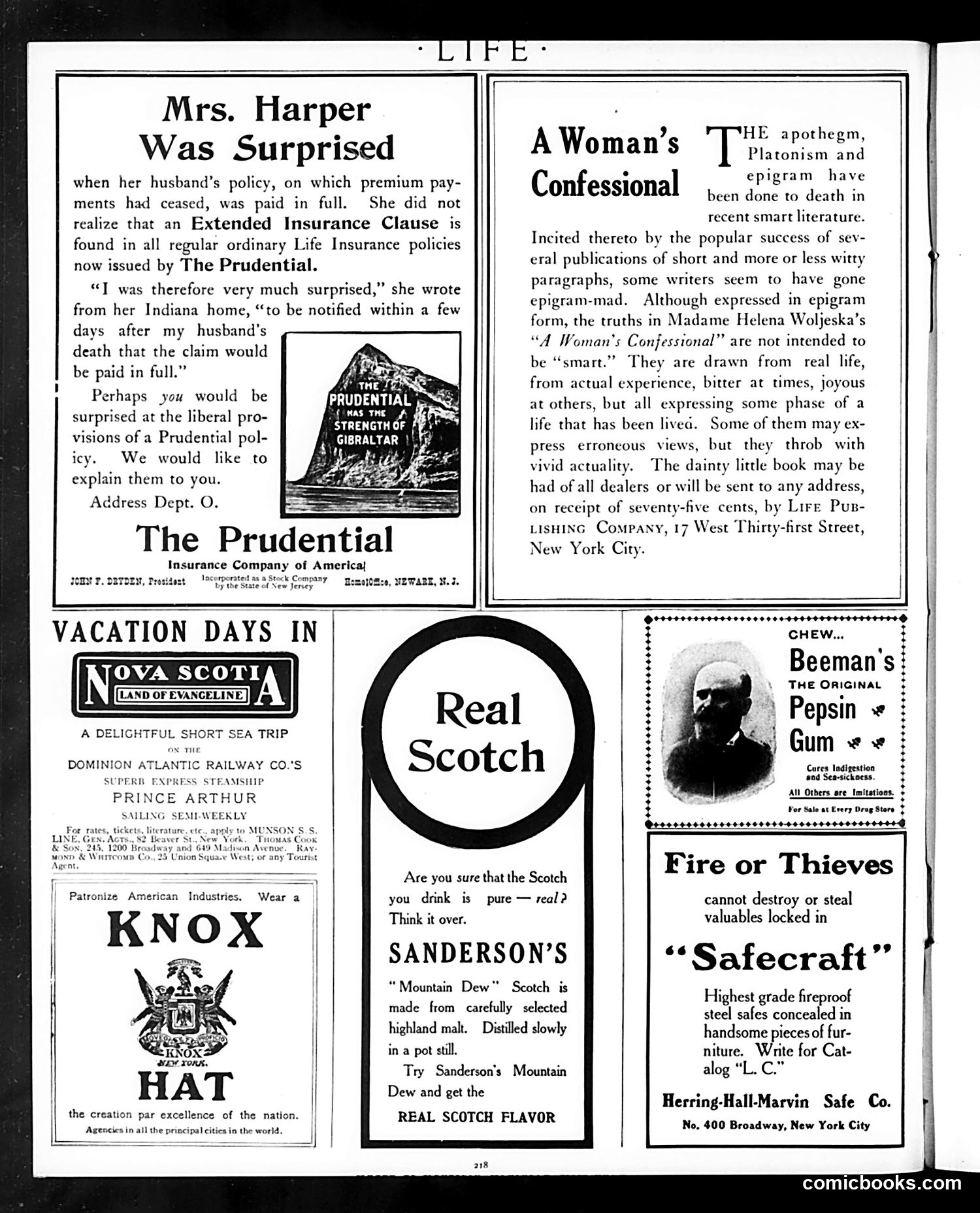
This page is primarily **advertising**, not political satire. The main content includes: 1. **The Prudential Insurance** (top left): An ad highlighting their "Extended Insurance Clause," featuring a customer testimonial from Mrs. Harper praising the company's generous policy terms. 2. **"A Woman's Confessional"** (top right): A book advertisement for Madame Helena Wojewska's work, described as honest confessions "drawn from real life" rather than witty epigrams—seventy-five cents. 3. **Additional ads**: Knox Hat, Nova Scotia tourism, Beeman's Pepsin Gum, Sanderson's Scotch whisky, and Safecraft fireproof safes. No political figures or satirical commentary appears. The page represents typical early 20th-century *Life* magazine advertising, mixing consumer products with lifestyle content.
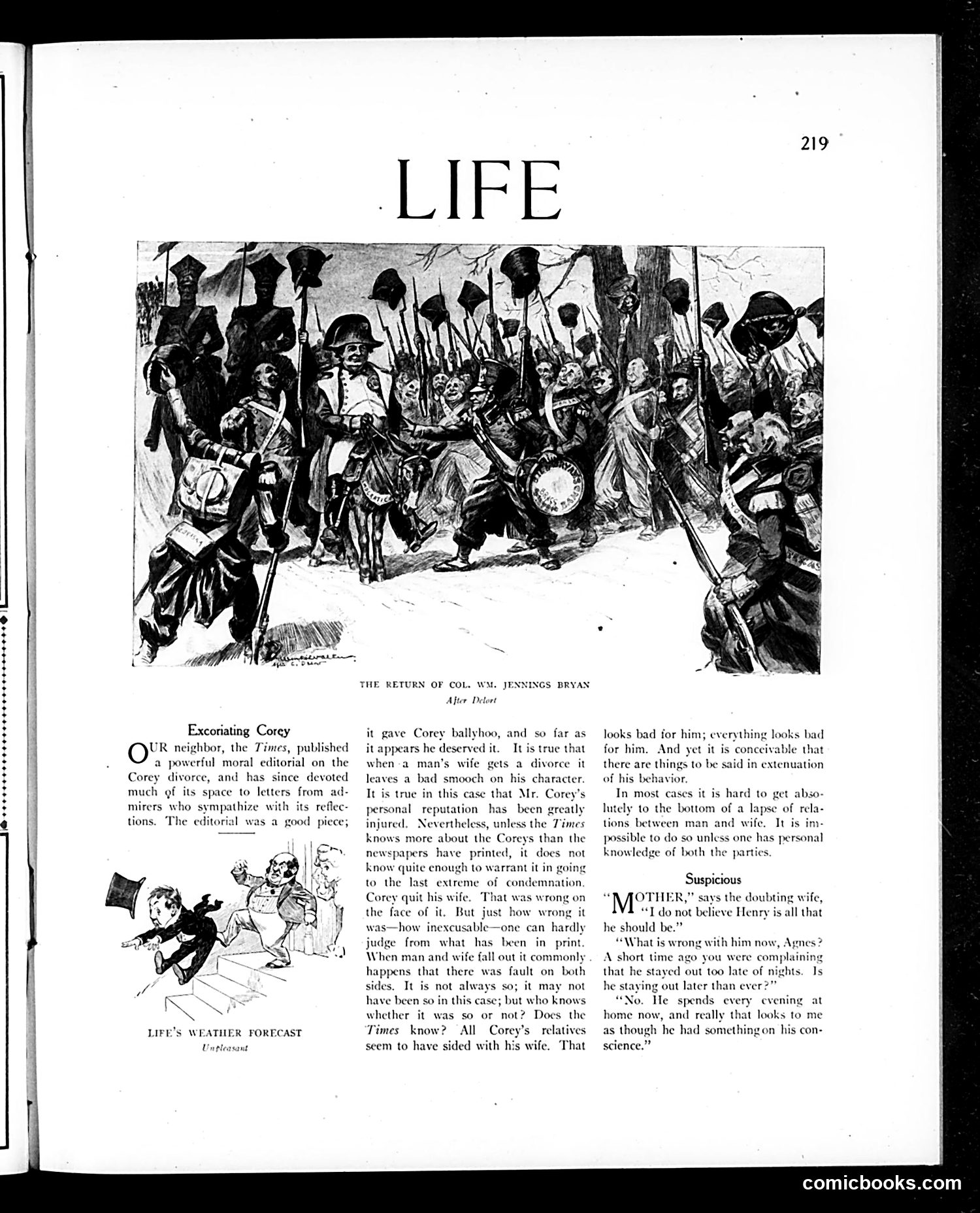
This page from *Life* magazine satirizes a divorce involving someone named Corey. The upper illustration depicts "The Return of Col. Wm. Jennings Bryan" (a political reference, likely comparing Corey's situation to Bryan's public prominence). The text discusses how Corey's divorce received substantial media coverage. The editorial notes that while Corey's reputation suffered, his wife also faced blame—the piece criticizes how divorce cases typically pit spouses against each other publicly, making fair judgment difficult without knowing both sides. The "Suspicious" section presents a domestic dialogue where a wife questions her husband Henry about his late nights, suspecting infidelity or dishonesty. The humor derives from the husband's evasive explanation about "science," implying marital distrust. Overall, the page satirizes both media sensationalism around divorce and common marital suspicions.
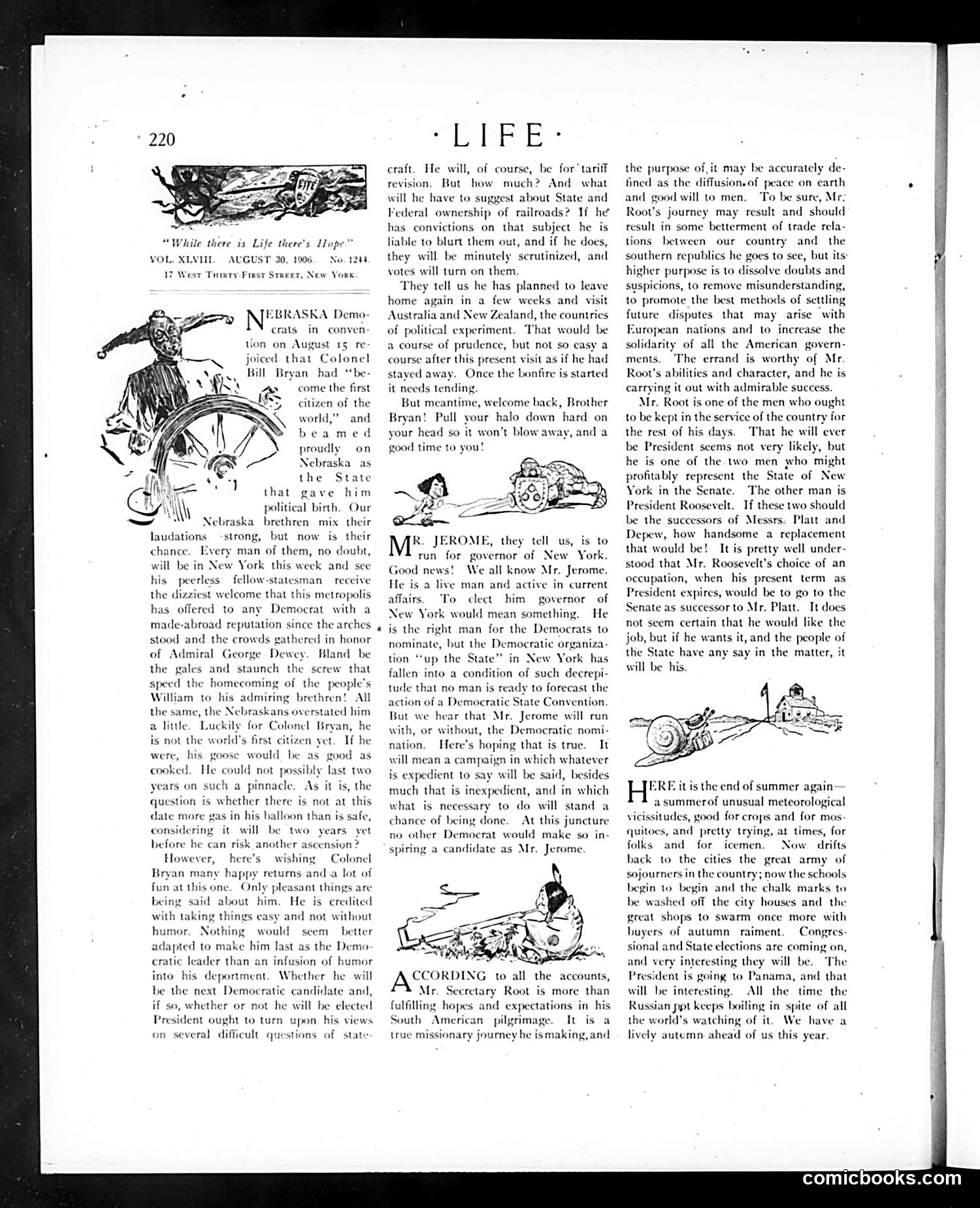
This page discusses potential Democratic candidates for the presidency following Theodore Roosevelt's administration. The article mentions **William Jennings Bryan** returning to Nebraska as a welcomed figure, and discusses **Mr. Jerome** (likely William Travers Jerome, reform-minded New York politician) as a possible gubernatorial candidate. The piece sarcastically notes that Democrats hope Jerome will run for New York governor while suggesting the Democratic Party organization has "fallen into a condition of such decrepitude that no man is ready to forecast the action of a Democratic State Convention." The cartoons illustrate these political figures and the satirical commentary on the state of Democratic leadership and electoral prospects during the Progressive Era.
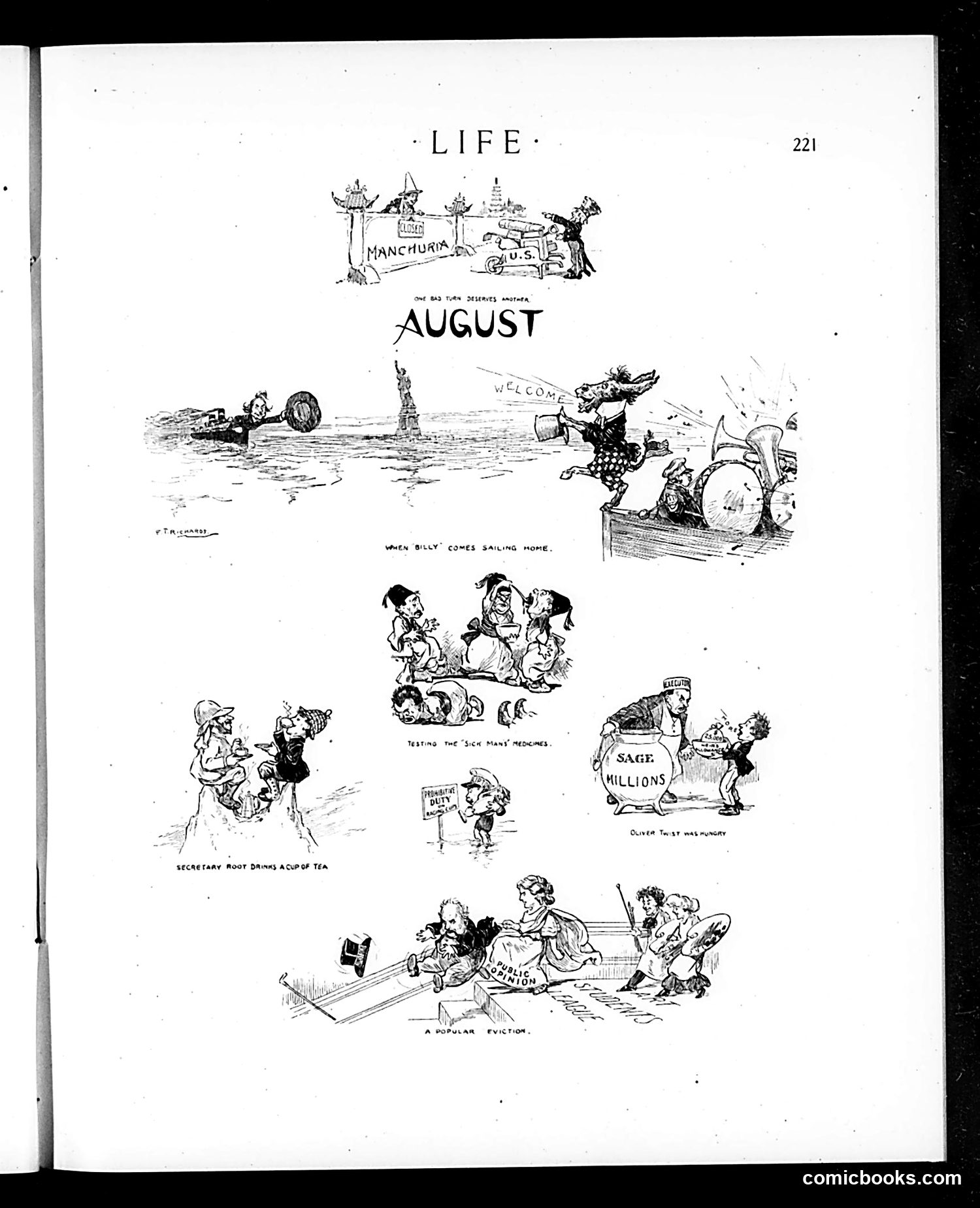
This page contains several political cartoons mocking August events and figures. The top illustration references "Manchuria" and U.S. interests, likely relating to early 20th-century colonial tensions in East Asia. "When Billy Comes Sailing Home" depicts a sailor's joyful return. "Testing the 'Sure Cure' Medicines" mocks fraudulent patent medicines—a common satire target of the era. "Secretary Root Brings Acqua Tea" references Secretary of State Elihu Root, appearing to ridicule diplomatic activities. "Sage Millions" likely critiques wealth or financial speculation. "A Popular Eviction" shows figures being removed, possibly commenting on contemporary housing or labor disputes. The cartoons use caricature and visual puns typical of Life's satirical style, targeting contemporary politicians, social problems, and popular follies without always being immediately transparent to modern readers.
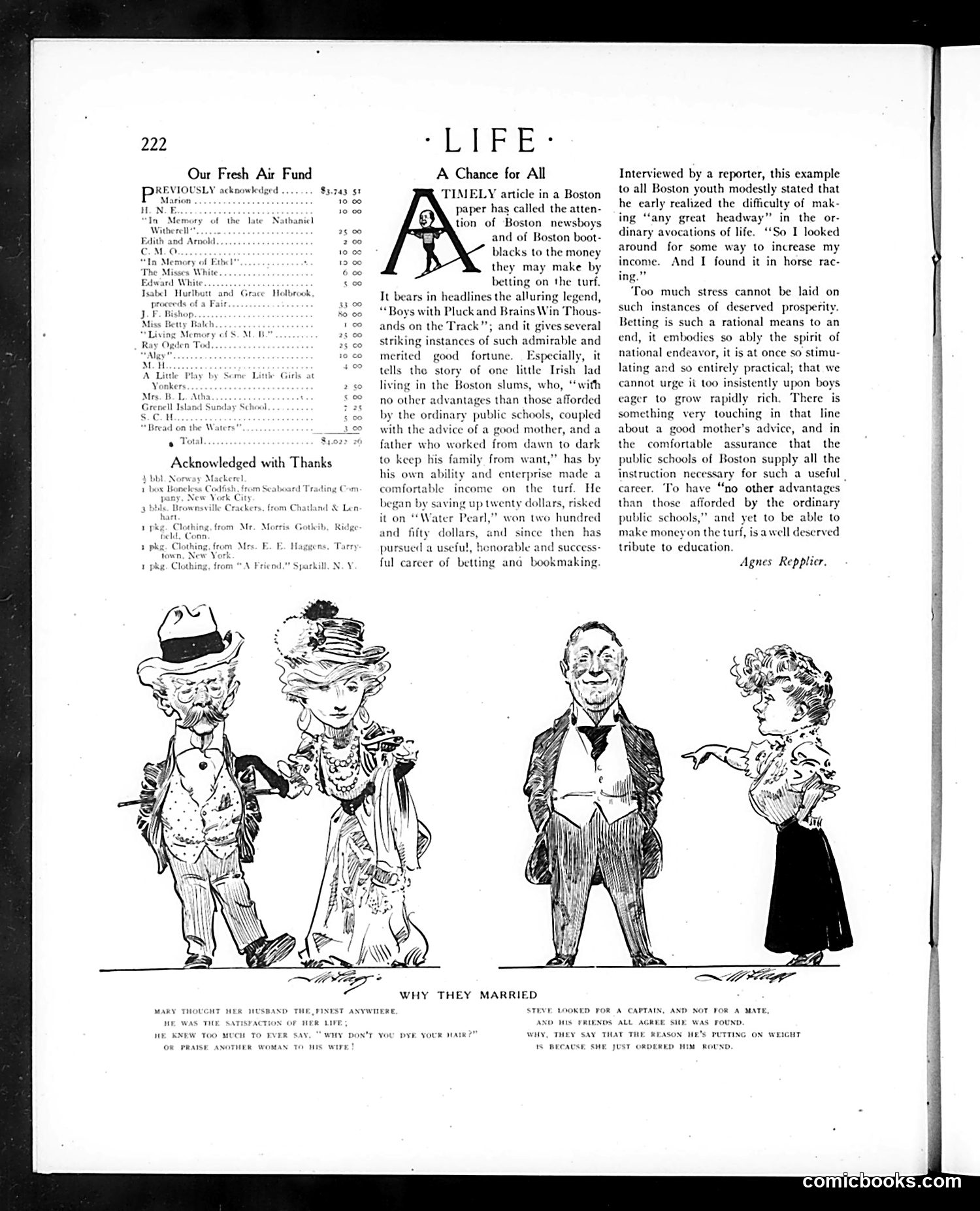
This page contains two main sections: **"Our Fresh Air Fund"** (top left) lists charitable contributions, totaling $1,027.70, acknowledging donations to a youth welfare program. **"A Chance for All"** (main article) celebrates a Boston Irish boy's success through betting on horse racing and bookmaking. The piece argues that despite lacking formal education advantages, he achieved prosperity through enterprise and thrift—a narrative promoting self-made success. **"Why They Married"** (bottom cartoons) shows two couple vignettes with satirical captions about marriage motivations: one woman married for financial security ("finest anywhere"), the other depicts a man seeking a "captain" rather than mate, with the joke being she's overweight ("putting on weight"). The page reflects early 20th-century attitudes toward class mobility, gender roles, and working-class aspiration, mixing charitable uplift narratives with somewhat crude humor about marriage and appearance.
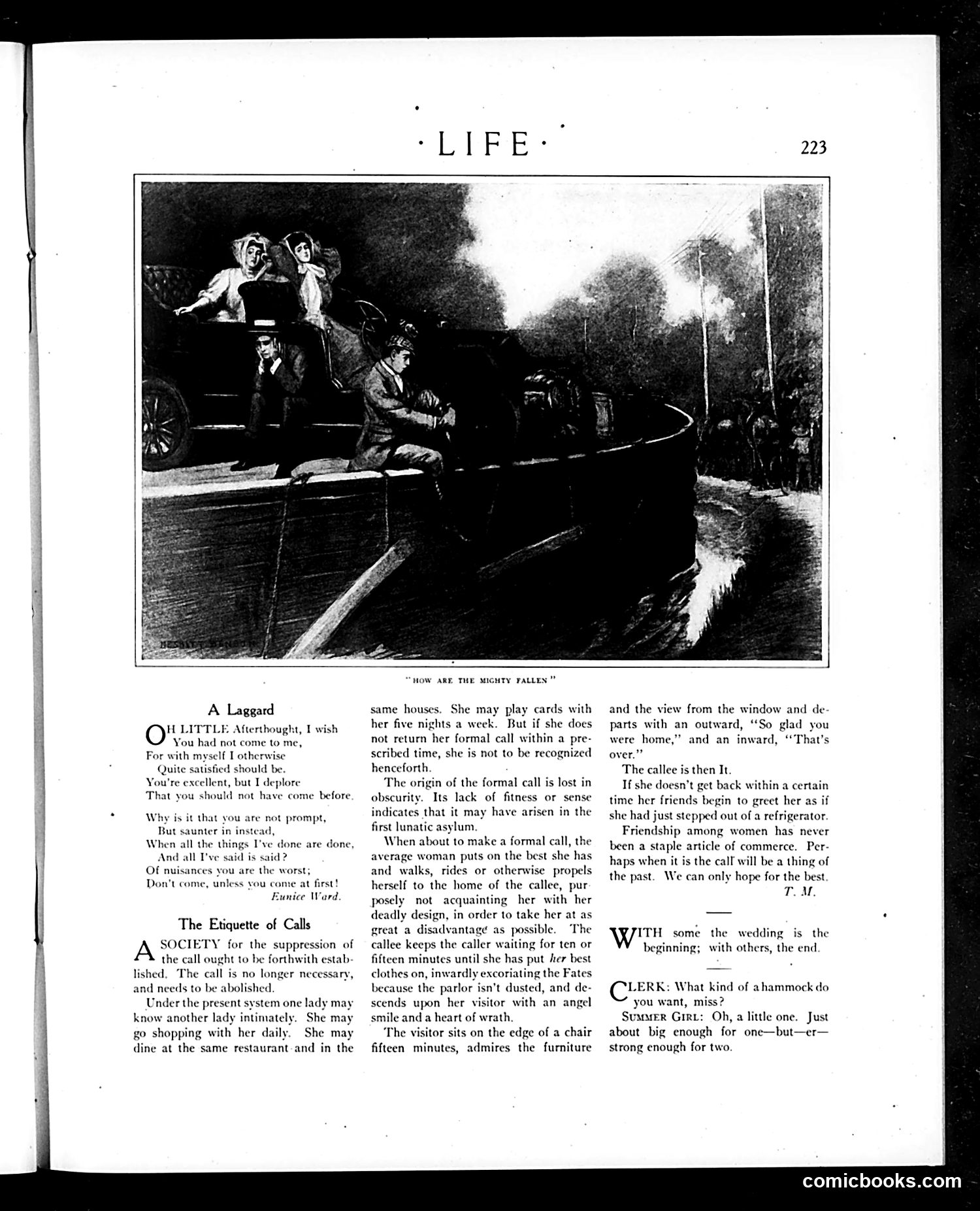
This page satirizes the decline of the formal social call—a Victorian-era ritual where ladies paid visits to each other's homes to maintain social standing. The illustration shows a woman stuck in a ditch beside a car, while well-dressed passengers pass by in vehicles, ignoring her plight. The text explains that the formal call is becoming obsolete under the modern system where women can socialize casually (shopping, dining, playing cards) without rigid etiquette. The cartoon's title references this social collapse: the "mighty" institution of formal calling has literally fallen into disrepair, replaced by automobile culture and informal friendships. The satire mocks both the old pretentious system and the new casual world it's being replaced by.
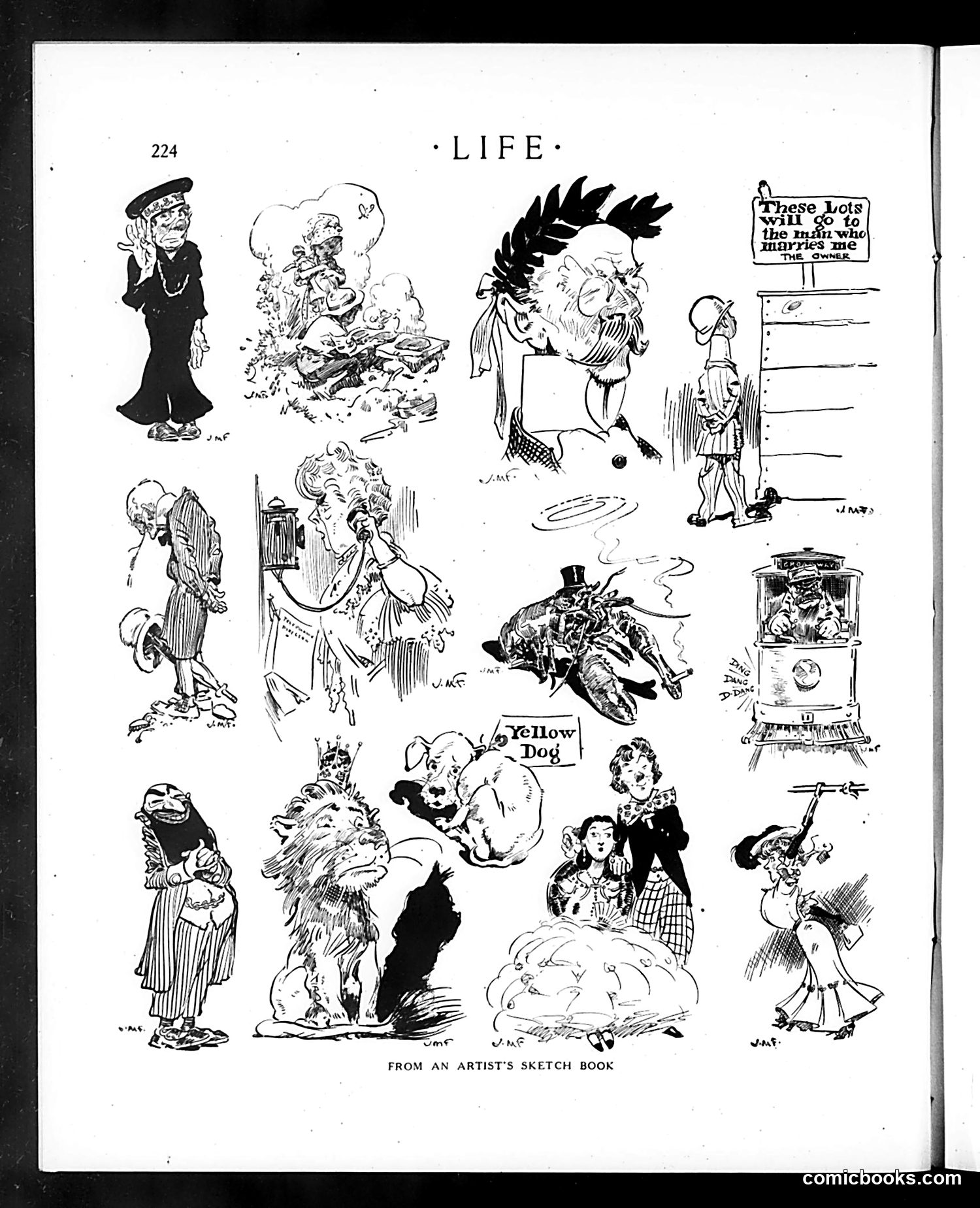
This page contains a collection of satirical sketches "FROM AN ARTIST'S SKETCH BOOK" depicting various social types and situations. The cartoons appear to mock middle and upper-class life through exaggerated character studies: wealthy women in elaborate dress, a pompous man with a large nose, a "Yellow Dog" (likely political reference to Democratic loyalists), and domestic scenes involving children and family dynamics. One panel explicitly references "These Lots Still Sell to the man who marries me—THE OWNER," satirizing women's mercenary attitudes toward marriage and property. The overall theme critiques social pretension, class consciousness, and the materialism of American society during Life magazine's heyday as a humor publication. The sketchy style emphasizes caricature and exaggeration typical of early-20th-century satirical illustration.
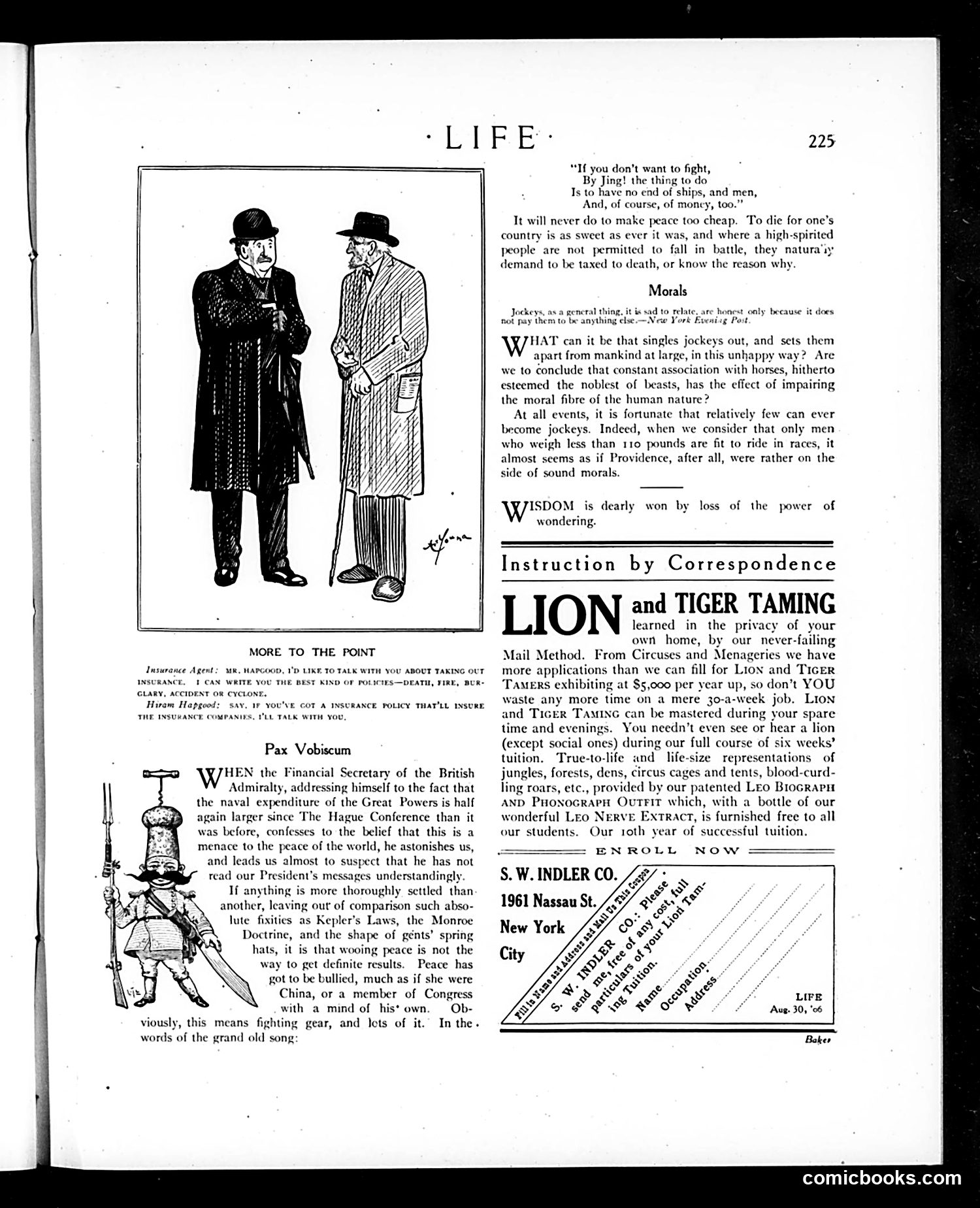
The top cartoon, titled "MORE TO THE POINT," depicts two men in conversation about insurance. The left figure (identified as "Insurance Agent") appears to be pitching a policy, while the right figure ("Hiram Hagood") responds skeptically. The joke concerns the agent's pitch about insurance protection—Hagood quips that he needs assurance the insurance company itself will remain solvent to pay claims. The lower section, "Pax Vobiscum," discusses a British Admiral's statement about naval expenditure. The accompanying military illustration shows a formal soldier, likely satirizing militarism and peace rhetoric. The page concludes with a correspondence-school advertisement for "Lion and Tiger Taming" instruction, which appears humorous rather than serious editorial content.
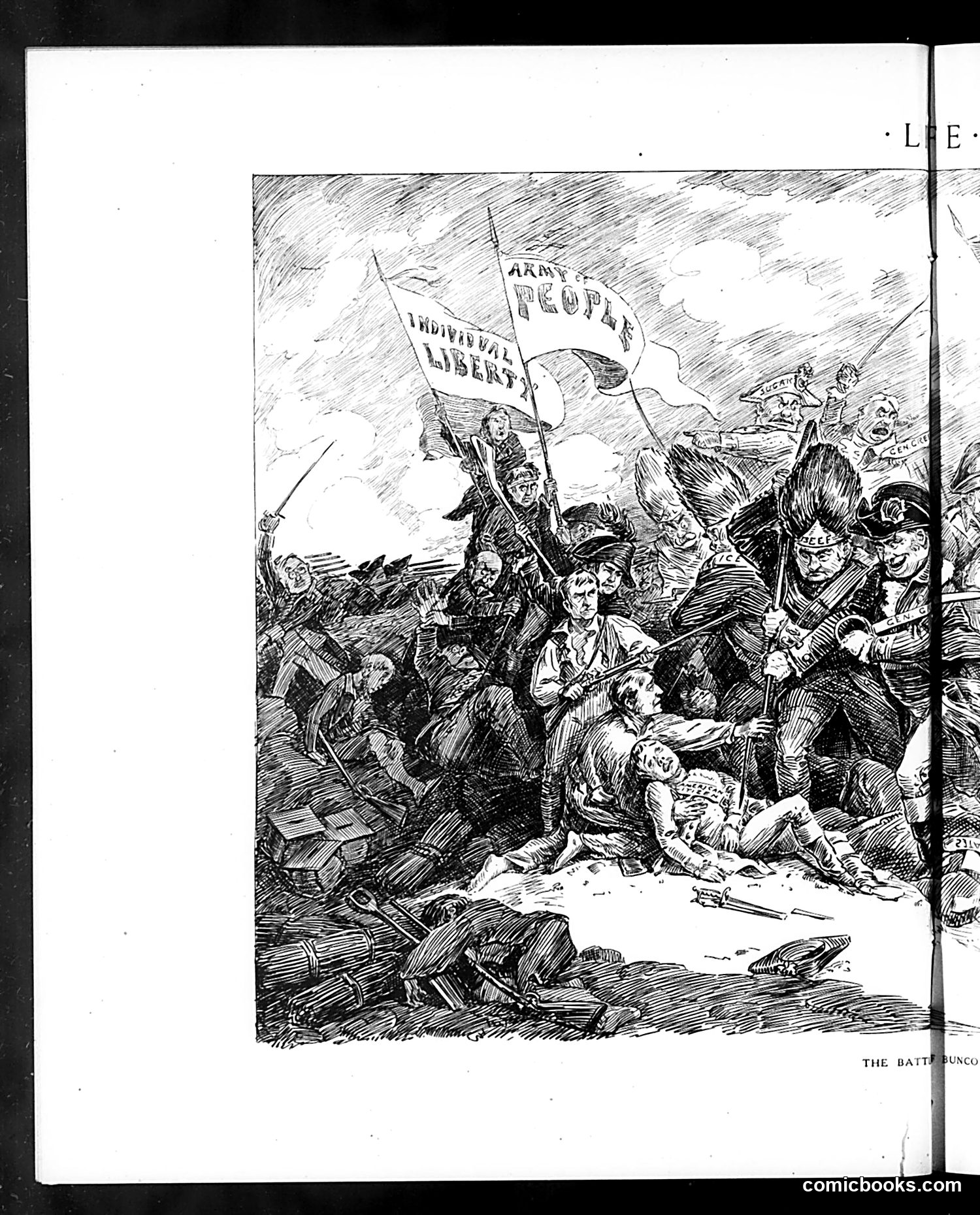
This engraving depicts a chaotic military scene titled "The Battle Bunch" (visible at bottom). Two flags are prominently displayed: "Individual Liberty" and "Army People" (or similar text—the second flag is partially unclear). The cartoon satirizes a clash between individualism and militarism or collective authority. Soldiers and military figures surround civilians, with adults and children caught in the conflict. The composition suggests tension between personal freedoms and state/military control. The detailed cross-hatching and period engraving style indicate this is from Life magazine's satirical tradition. Without additional context about the specific historical moment, the exact political figures remain unclear, though the symbolism of conflicting ideologies—individual liberty versus organized military force—is evident. The inclusion of families suggests concern about how such conflicts affect ordinary citizens.
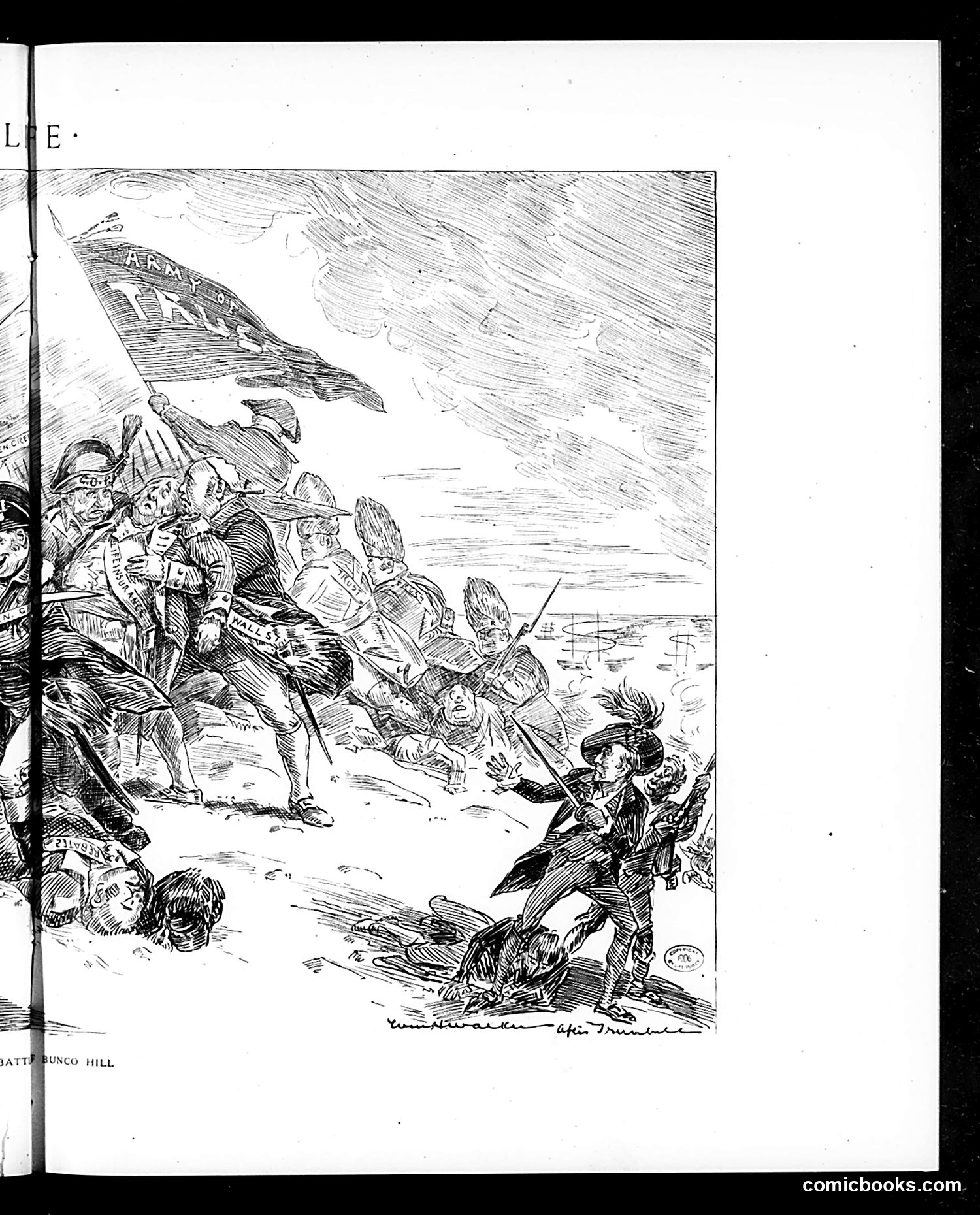
This appears to be a satirical cartoon depicting a military or naval scene, likely from the early 20th century based on the style. The image shows soldiers or sailors gathered around what appears to be a shipwreck or battle scene, with a vessel visible in the upper left bearing what looks like a flag or insignia. The cartoon likely comments on military incompetence, defeat, or a specific historical naval disaster. The chaotic composition—with figures in various states of distress or activity—suggests satirical critique of military leadership or strategy. However, without clearer identification of the specific vessel's markings, date, or visible text labels on the figures, I cannot definitively identify which historical event or political figures are being referenced. The artist's signature appears present but is not clearly legible in this reproduction.
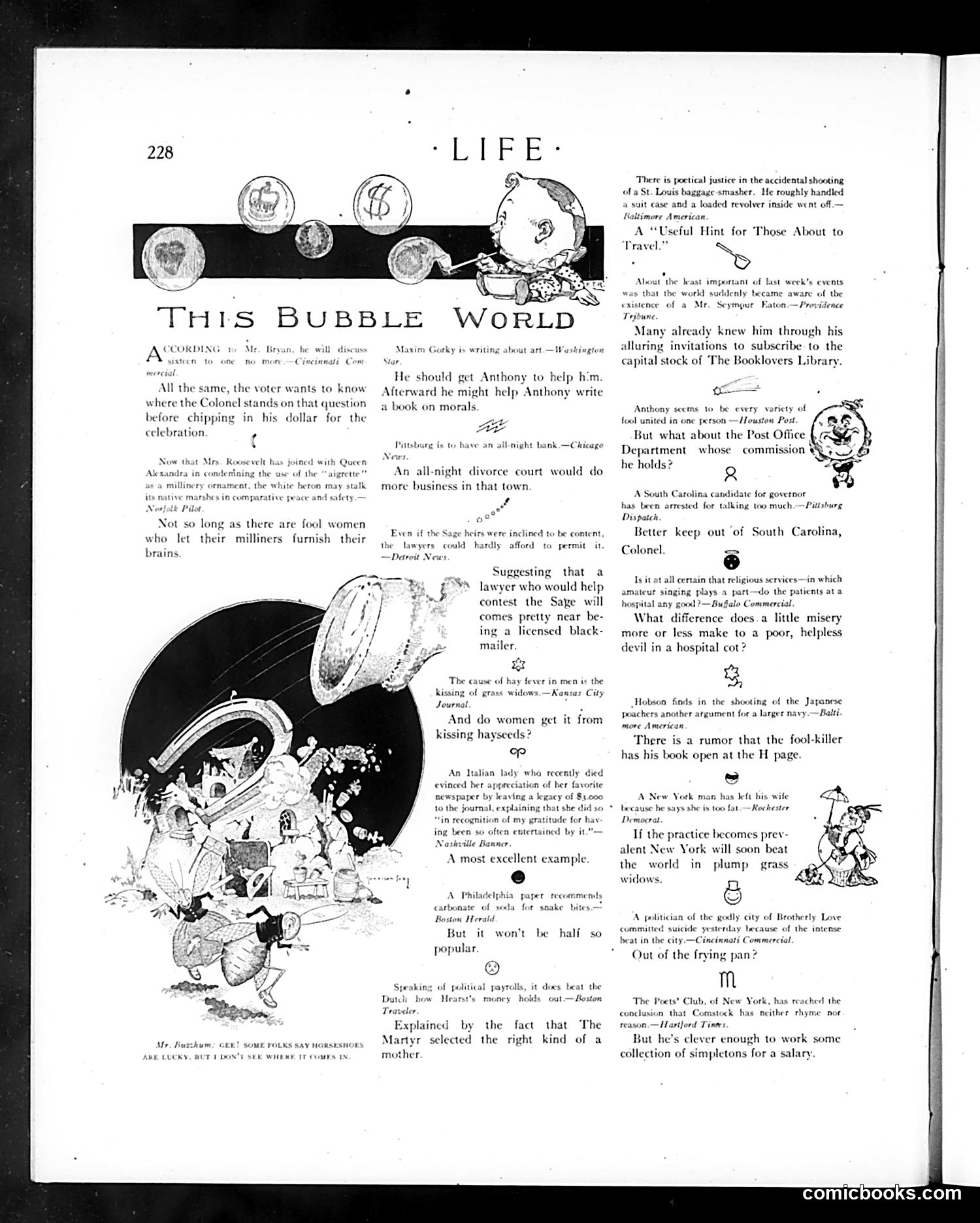
This page satirizes early 20th-century American society through a large illustration of a bubble-filled world and surrounding editorial quips. The main cartoon depicts various social absurdities—likely representing political corruption, frivolous wealth, and social pretension—contained within bubbles that appear fragile and destined to burst. The surrounding text references contemporary scandals and figures: divorce courts doing excessive business, millinery industries, newspaper feuds, and political payrolls. There are jabs at lawyers, religious hypocrisy, and civic incompetence. The "bubble" metaphor suggests these social phenomena are unstable illusions built on false premises—a common Progressive Era critique of Gilded Age excess and corruption.
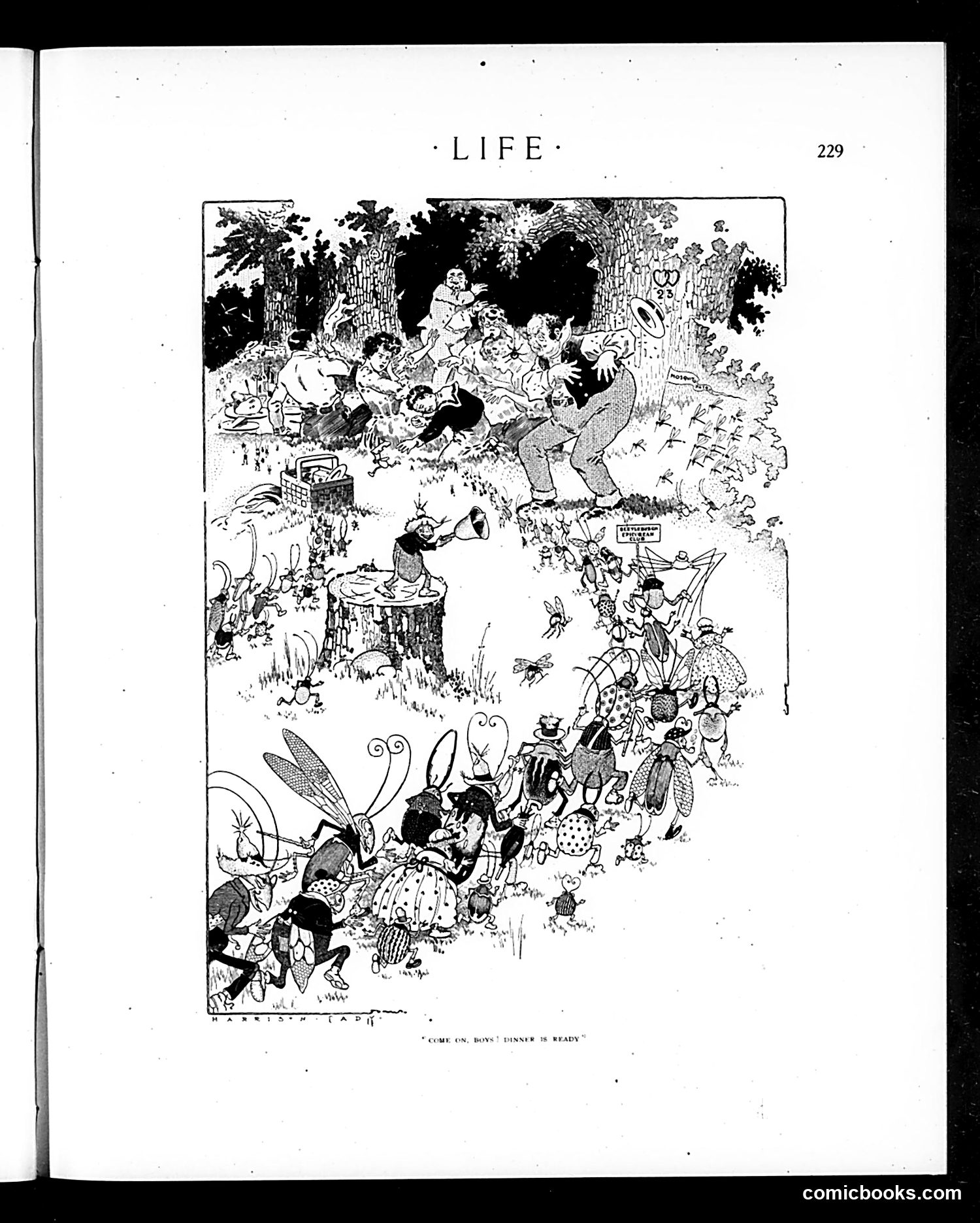
This page features a whimsical illustration titled "Come On, Boys! Dinner is Ready" showing a woodland picnic scene. The cartoon depicts anthropomorphized insects and small creatures gathered for a meal in nature, with larger human figures observing or participating in the background among trees. The satire appears to be visual rather than political—a humorous commentary on the natural world's "social hierarchy" and dining customs, rendered through a children's-book-like style. The juxtaposition of insects having an organized dinner party suggests gentle mockery of human pretension or social conventions by comparing them to animal behavior. Without additional context or visible attribution, the specific cartoonist and intended satirical target remain unclear, though the tone suggests lighthearted social commentary rather than pointed political critique.
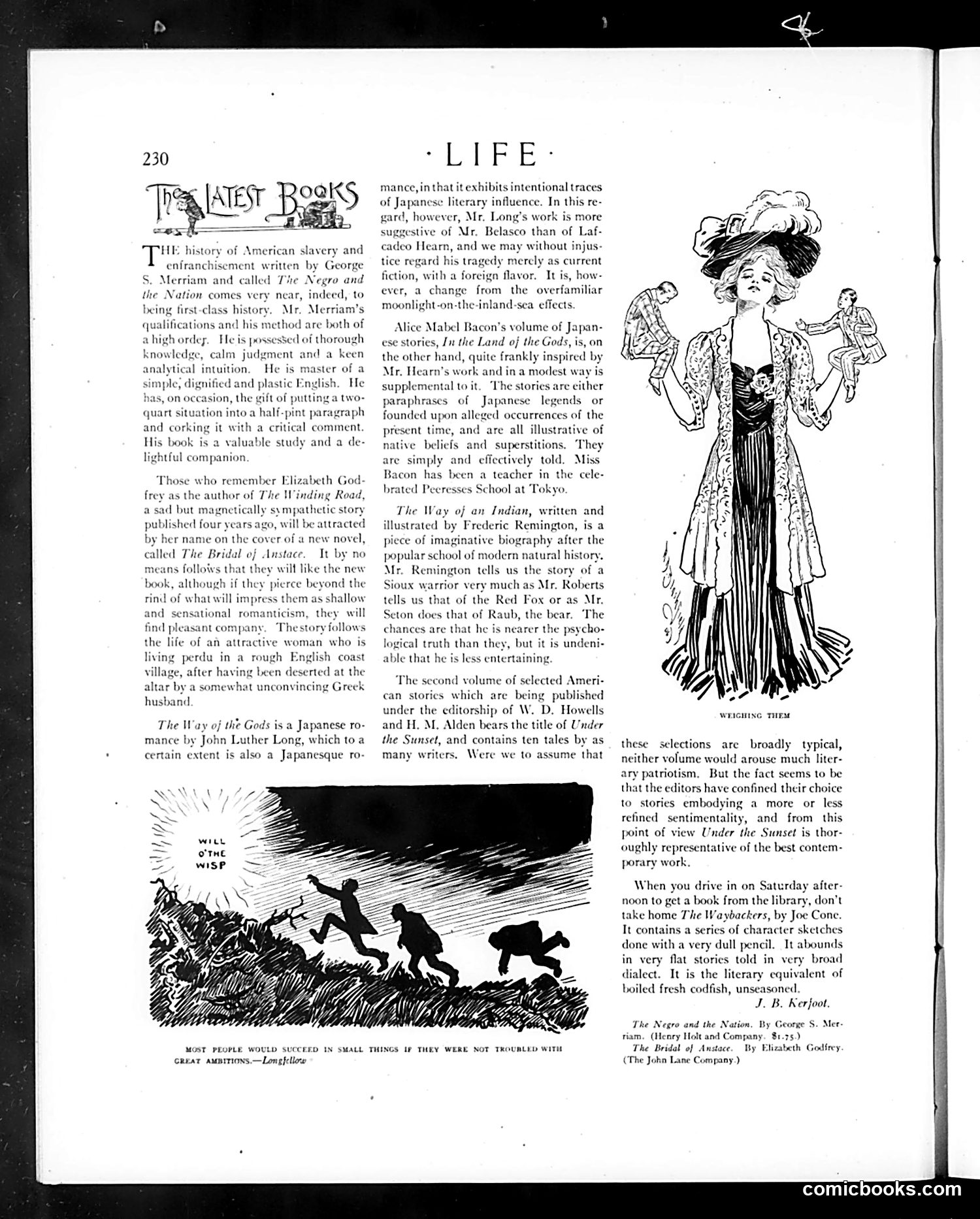
This is a book review section from *Life* magazine (appears early 20th century based on style). The page discusses recent American and Japanese literature, including works on slavery history, romantic novels, and Japanese-inspired fiction. The political/social content centers on **Japanese literary influence in American writing**—authors like John Luther Long and Alice Mabel Bacon were adapting Japanese themes and aesthetics. The reviews note this trend with mixed reactions: some find it refreshingly novel, others see it as derivative of playwright David Belasco's theatrical "Japanesque" style. The cartoon at bottom (captioned with a Longfellow quote about ambition hindering small achievements) shows three figures struggling uphill—satirizing how grand ambitions often prevent practical success. The book reviews themselves are literary criticism rather than overt political satire, reflecting *Life*'s role as a cultural commentary magazine.
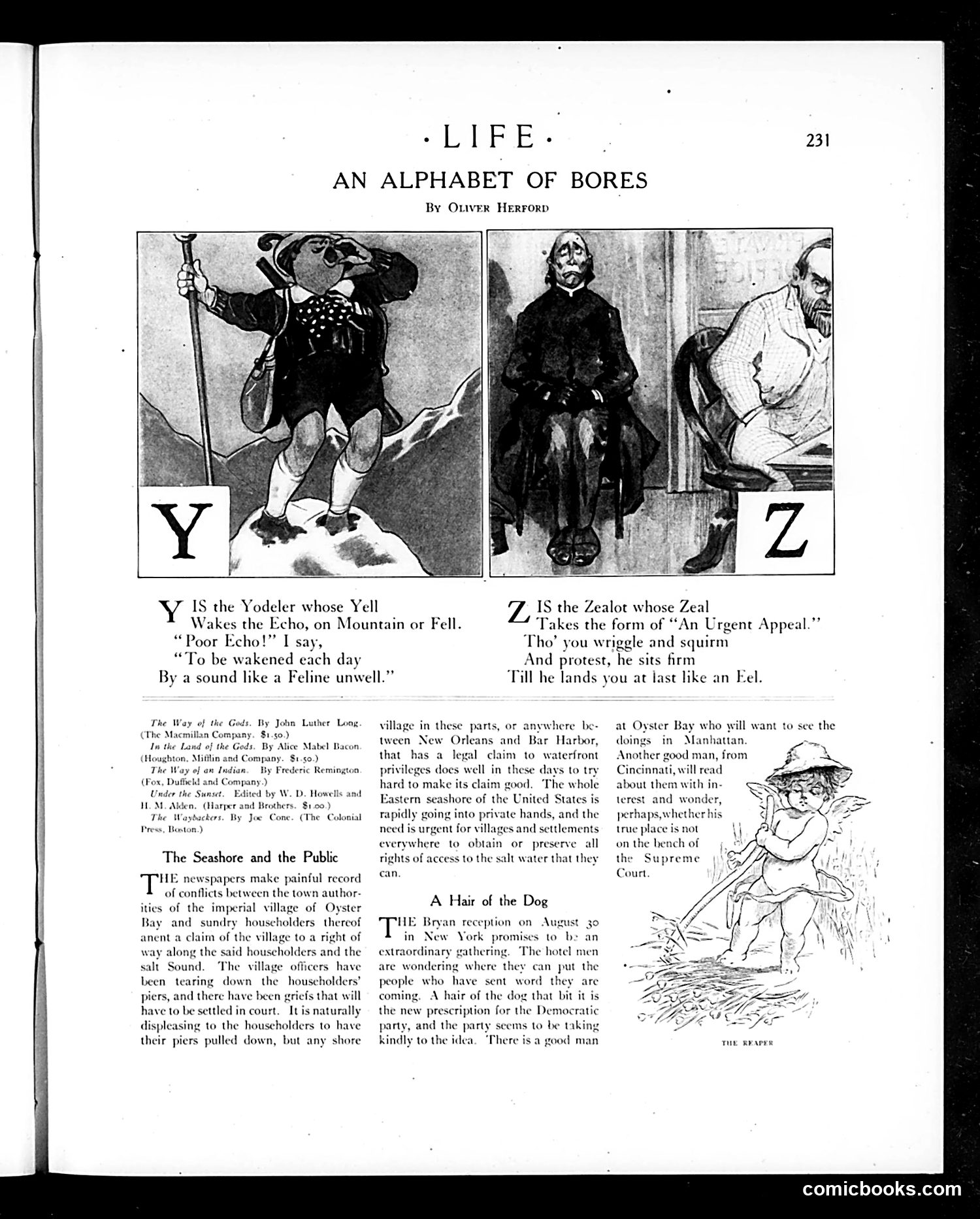
This satirical alphabet uses exaggerated character types to mock tedious social archetypes. The final entries shown are: **Y - The Yodeler**: A mountain climber whose annoying yodeling echo disturbs peace, representing people who make unnecessary noise. **Z - The Zealot**: A stern figure whose obsessive "Urgent Appeal" activism annoys others into submission, satirizing self-righteous crusaders. The page also contains articles about contemporary issues: tensions between Oyster Bay residents and householders over waterfront access rights, and a Bryan political reception (likely William Jennings Bryan, a prominent Democratic figure). These blend social commentary with political satire typical of *Life* magazine's format—mixing illustrated humor with commentary on actual current events and social frustrations. The cartoons mock both personal irritants (the bore types) and public figures/movements through satirical observation.
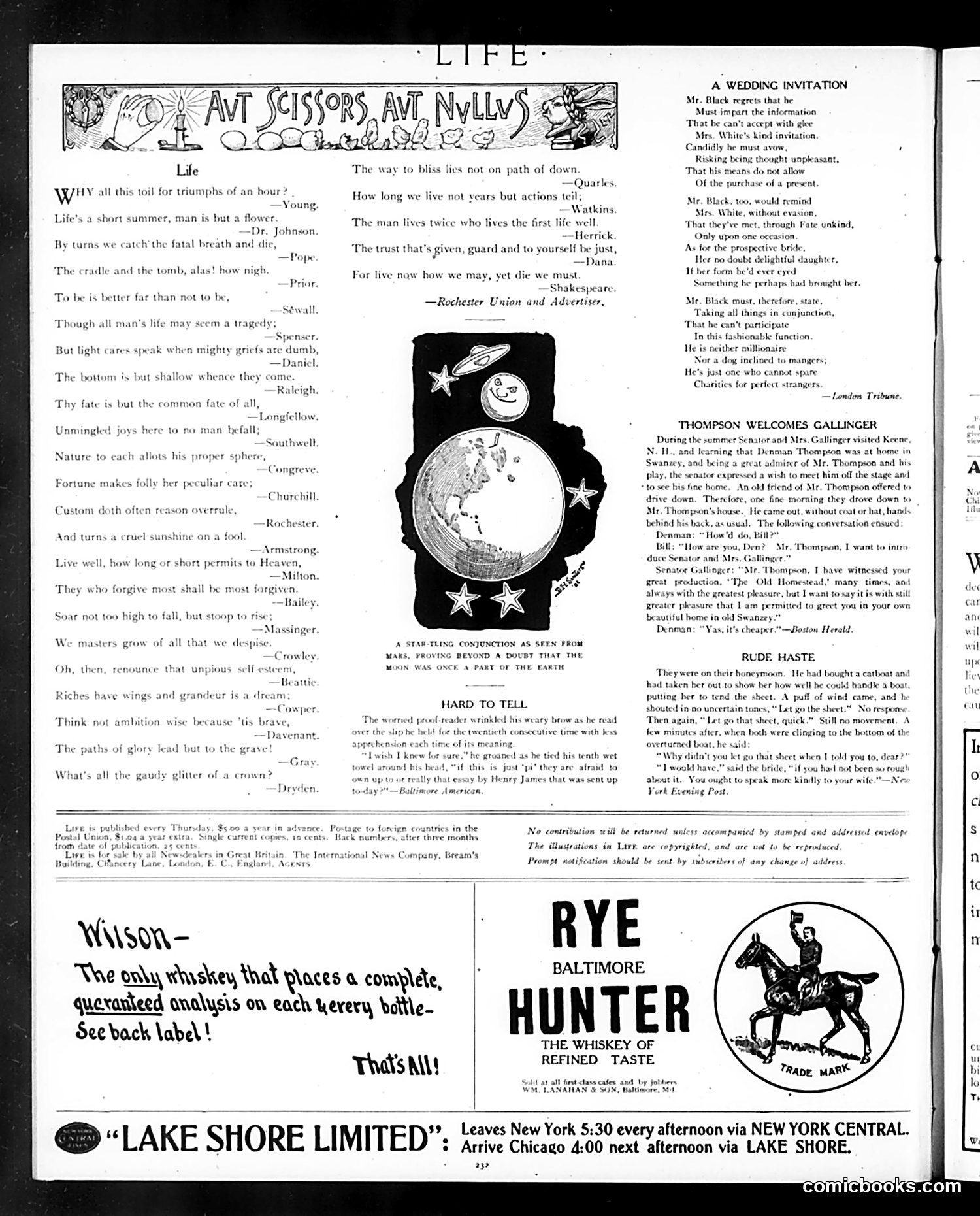
This page contains multiple satirical pieces typical of Life magazine's format: **Main Visual Cartoon**: The "Mars conjunction" illustration depicts Earth and Moon as celestial bodies, sarcastically "proving" the Moon was once part of Earth—a humorous jab at pseudo-scientific claims popular in the era. **"A Wedding Invitation"**: A social satire where Mr. Black declines Mrs. White's wedding invitation, candidly explaining he cannot afford the expected gift and barely knows the family. The satire targets the pretension and financial burden of formal society weddings. **"Thompson Welcomes Gallinger"**: A sketch featuring Denman Thompson (likely the 19th-century playwright/actor) meeting Senator Gallinger. When the Senator praises Thompson's theater production "The Old Homestead," Thompson curtly replies "Yas, it's cheaper"—mocking upper-class social pleasantries with rural bluntness. **"Rude Haste"**: Begins a humorous honeymoon anecdote (text cuts off). The page primarily satirizes social pretension, false cordiality, and class conventions.
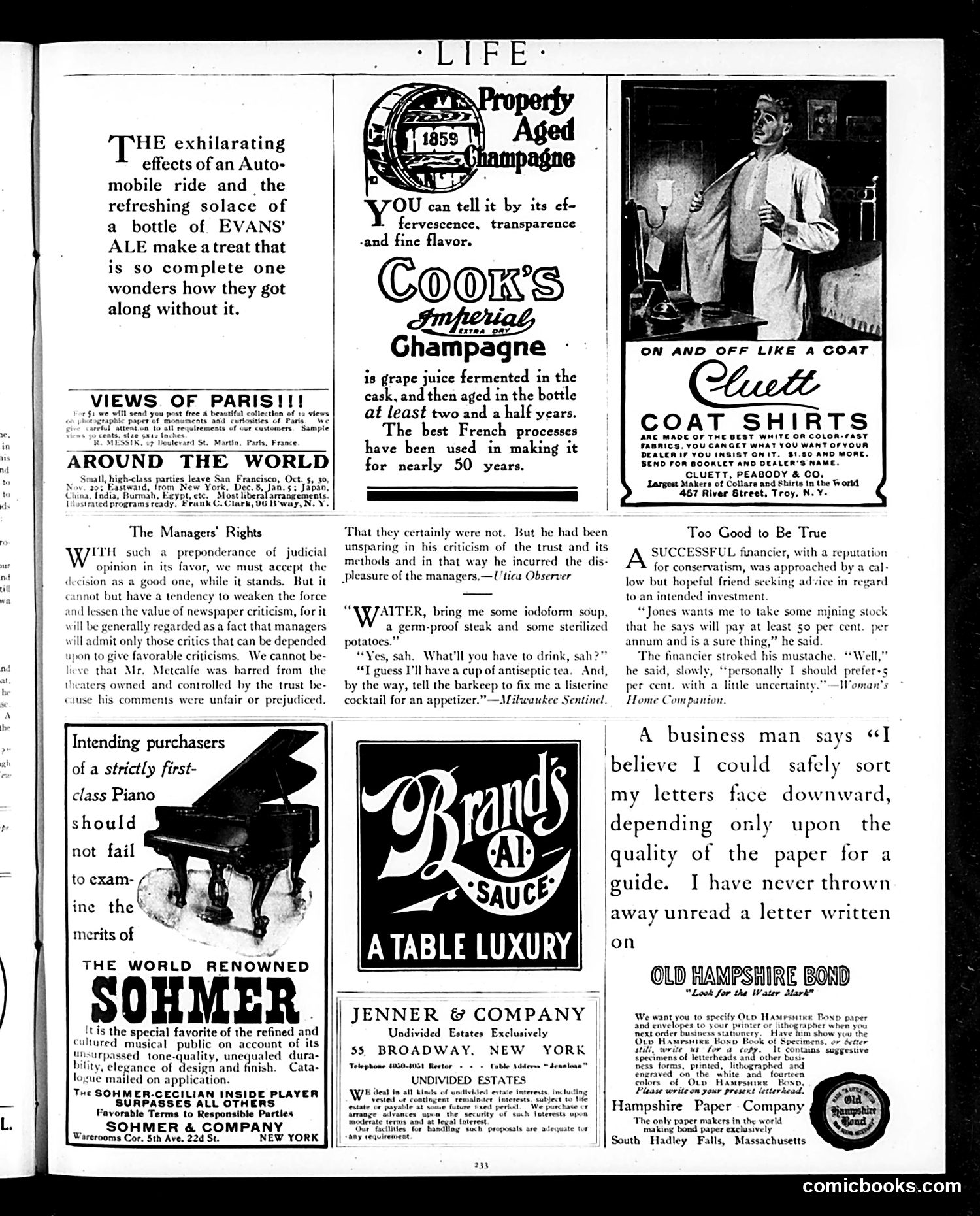
This is primarily an **advertising page** from Life magazine's early era, with minimal editorial content. The main elements are: **Editorial Content:** - "The Managers' Rights": A brief column defending newspaper critics' freedom, referencing a legal dispute (appears to involve theater manager Mr. Metcalfe being barred from venues) - Two short humorous anecdotes: one mocking germ-consciousness ("iodoform soup," "antiseptic tea") and another about conservative investing ("50 per cent. with a little uncertainty") **Advertisements:** Multiple product placements for luxury goods—Evans' Ale, Cook's Champagne, Sohmer pianos, Cluett coat-shirts, Hampshire Bond paper—typical of Life's affluent readership. **Historical Context:** The germ-consciousness joke reflects early 1900s anxieties about sanitation following germ theory's popularization. The investment joke satirizes get-rich-quick schemes common during the era. The page reflects Life's dual function: satirical commentary for the educated elite alongside advertisements reinforcing their consumer preferences.
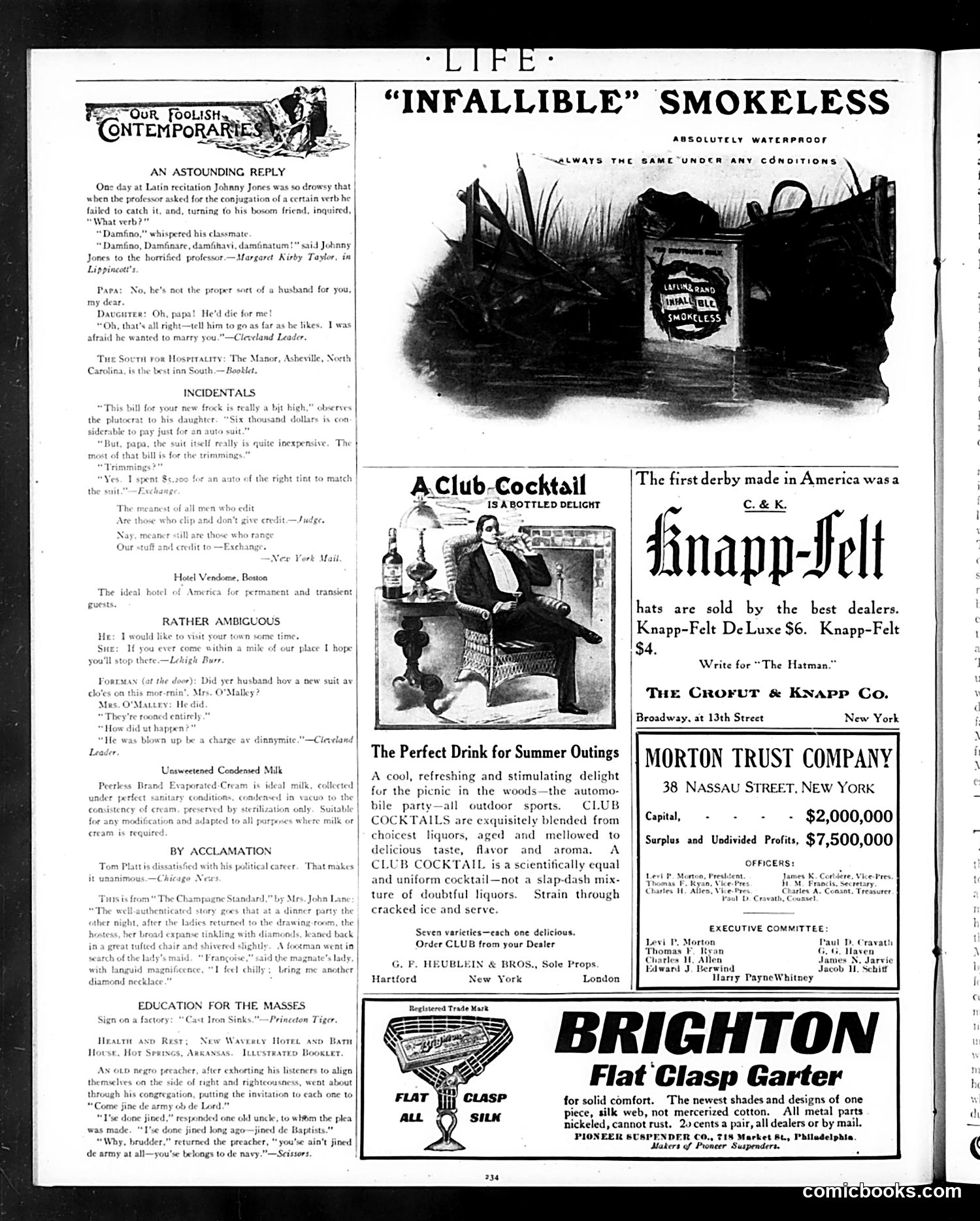
This page is primarily **advertising with light humor content**. The upper left contains several short jokes typical of *Life* magazine's satirical humor section ("Our Foolish Contemporaries"): - A Latin class joke about a drowsy student - Domestic humor about marriage and husbands - Miscellaneous quips about hotels, condensed milk, and factory signs The satire is gentle social commentary on everyday absurdities—a student's linguistic confusion, marital dynamics, and class pretensions—rather than political commentary. The rest of the page is **commercial advertising** for products including smokeless powder, cocktails, hats, a trust company, and garters. The ads reflect early 20th-century consumer goods and financial services marketed to middle/upper-class readers. There are no identifiable political figures or events. The page represents *Life* magazine's dual function: satirizing contemporary manners and morals while monetizing reader attention through advertising.
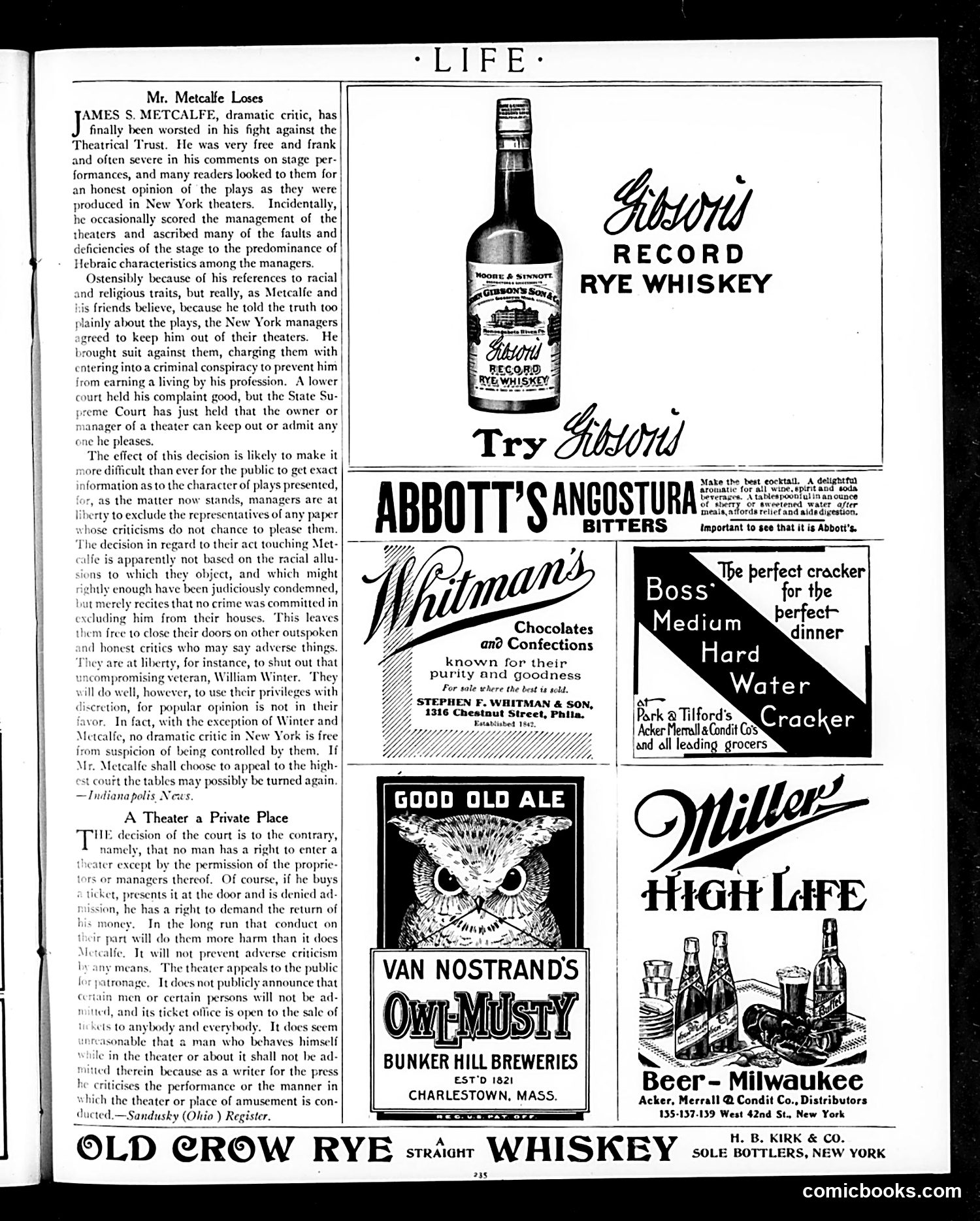
This page primarily consists of **advertisements with two opinion pieces** about a legal case involving dramatic critic James S. Metcalfe. ## The Main Content The articles discuss Metcalfe's lawsuit against New York theater managers who excluded him from their venues. Metcalfe had written critical reviews, including commentary on what the text calls "Hebraic characteristics among the managers"—indicating antisemitic remarks. The New York Supreme Court ruled that theater owners have the right to admit or exclude anyone. The two pieces debate this decision: the first argues it harms public access to honest criticism; the second defends theaters as private property. ## The Satire/Context This reflects **early 20th-century tensions** between theater critics' free speech and management control. Notably, the text acknowledges Metcalfe's antisemitic commentary while suggesting his *real* offense was truthful criticism of plays and management—a convenient distinction that allows sympathy for him despite his prejudice. ## The Advertisements The page is otherwise filled with period product ads: whiskey, beer, chocolates, and bitters—typical of Life magazine's revenue model.
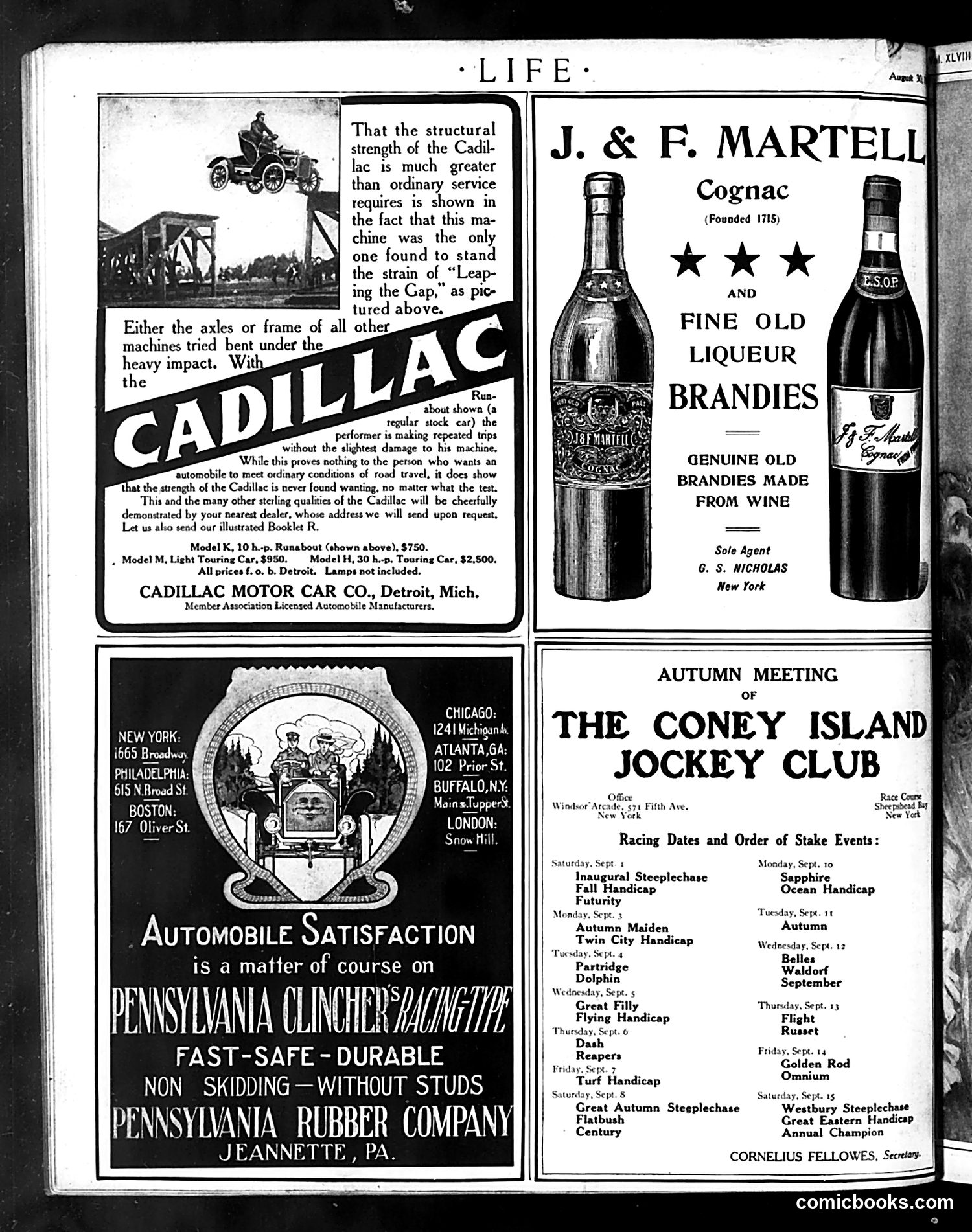
This is a **commercial advertising page**, not a satirical cartoon page. It contains four separate advertisements: 1. **Cadillac automobiles**: Features a stunt photo of a car "leaping a gap" to demonstrate structural strength. The ad argues that Cadillac's durability exceeds ordinary needs—a performance-based marketing claim. 2. **J. & F. Martell Cognac**: A liquor advertisement showing brandy bottles, emphasizing the brand's founding date (1715) and quality. 3. **Pennsylvania Clincher Racing Tires**: Promotes tire durability with claims of "fast-safe-durable" performance and "non-skidding" technology. 4. **Coney Island Jockey Club**: Lists September horse-racing events and stake races. These represent early 20th-century magazine advertising targeting affluent readers interested in automobiles, luxury goods, and leisure activities. There is no political satire or cartoon humor present on this page.