
Life, 1906-08-30 · page 14 of 20
Life — August 30, 1906 — page 14: what you’re looking at
What you’re looking at
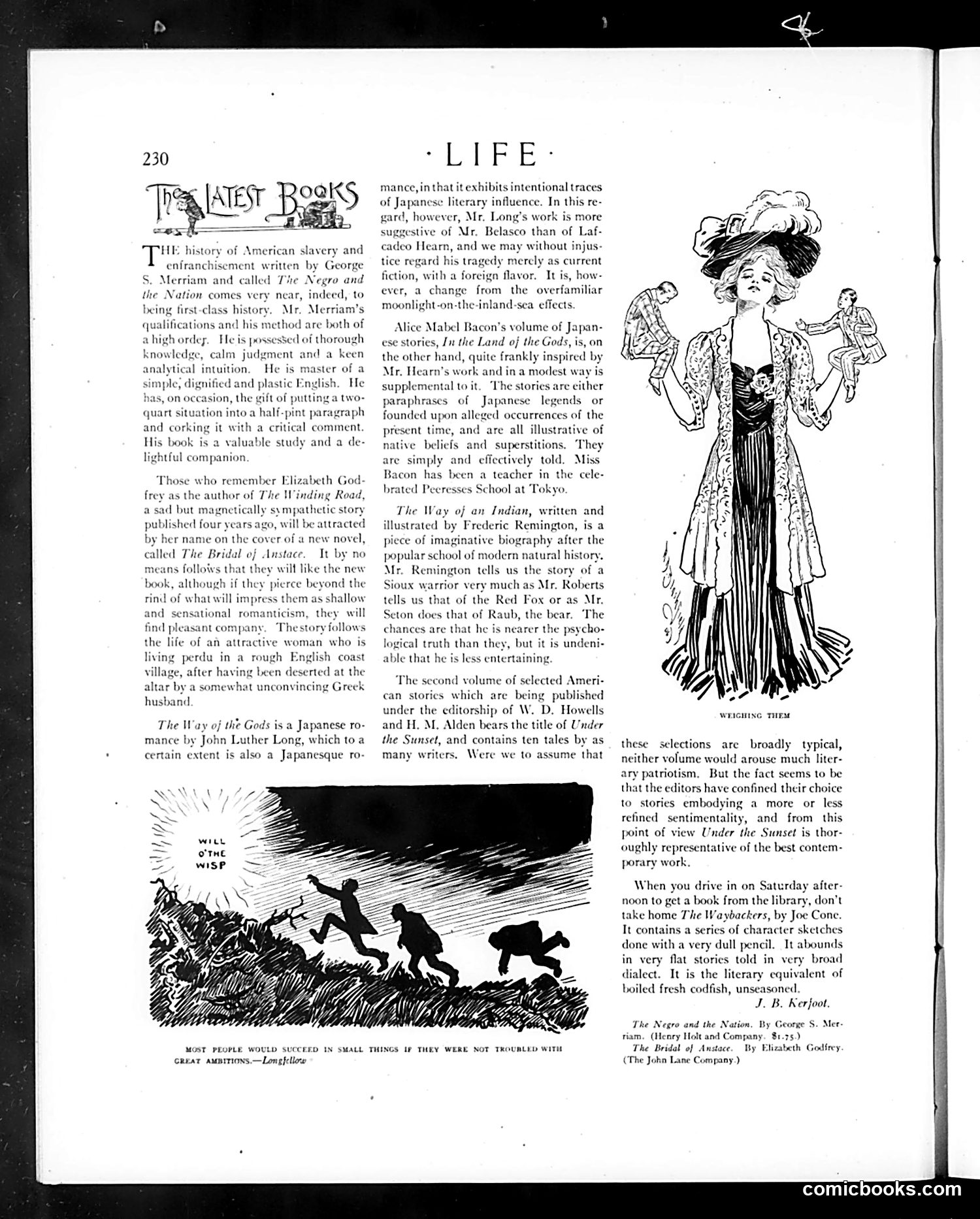
This is a book review section from *Life* magazine (appears early 20th century based on style). The page discusses recent American and Japanese literature, including works on slavery history, romantic novels, and Japanese-inspired fiction. The political/social content centers on **Japanese literary influence in American writing**—authors like John Luther Long and Alice Mabel Bacon were adapting Japanese themes and aesthetics. The reviews note this trend with mixed reactions: some find it refreshingly novel, others see it as derivative of playwright David Belasco's theatrical "Japanesque" style. The cartoon at bottom (captioned with a Longfellow quote about ambition hindering small achievements) shows three figures struggling uphill—satirizing how grand ambitions often prevent practical success. The book reviews themselves are literary criticism rather than overt political satire, reflecting *Life*'s role as a cultural commentary magazine.
📄 Transcribed text from this page (OCR, searchable)
Machine-transcribed from the original scan — historical spelling and the odd misread are preserved.
hisement written by George m and called The Negro and Nation comes very near, indeed, te being first-class history. Mr. Merriam thod are both of He is possessed of thorough the qualifications and his a high ordey knowledge, calm judgment and a keen analytical intuition. He ism simple; dignified and plastic En has, on occasion, the gift o quart situation into a hal and corking it with pint] a critical ¢¢ His book is a valuable study and a de- lightful companion Those who remember Elizabeth God frey as the author of The Iinding Road, a sad but magnetically sympathetic st published four years ago, will be attractec by her name on the cover of a new novel, called The Bridal of Anstace. It by no mi ows that they will like the new book, althou rind of what will impress them as shallow and sensational romanticism, they will pany. Thestory follows they pierce beyond the f af attractive woman who is perdu in a rough English coast village, after having been deserted at the altar by a soi hust what unconvincing Greek and The Way oj the Gods is a Japanese ro- mance by John Luther Long, which to a certain extent is also a Japanesque ro- Mie YEG, Wy, LIFE mance, in that it exhibits intentional trace of Japanese literary influence. In this re- gard, however, Mr, Long’s work is more suggestive of Mr. Belasco than of Laf- 2, and we may without injus- tice regard his tragedy merely current fiction, with a foreign flavor. It is, how- ever, a change from the overfamiliar moonlight-on-the-inland-sea effects. Alice Mabel Bacon's volume of Japan- ese stories, In the Land of the Gods, is, on the other hand, quite frankly inspired by Mr. Hearn’s work and ina modest way is supplemental to it. ‘The stories are either paraphrases of Japanese legends or founded upon alleged occurrences of the present time, and are all illustrative of native belief ‘They are simply and effectively told. Miss con has been a teacher in the cele- brated Peeresses School at Tokyo. and_ superstition: The Way of an Indian, written and illustrated by Frederic Remington, is a piece of imaginative biography after the popular school of modern natural history. Mr. Remington tells us the y ofa Sioux warrior very much as Mr. Roberts tells us that of the Red Fox or as Mr. Seton does that of Raub, the bear. The chances are that he is nearer the psycho- logical truth than they, but it is undeni- able that he is less entertaining. The second volume of selected Ameri- can stories which are being published under the editorship of W. D. Howells and H. M, Alden bears the title of Under the Sunset, and contains ten tales by many writers. Were we to assume that AU MOST PEOPLE WOULD SUCCEED IN SMALL THINGS If THEY WERE NOT TROUBLED WITH GREAT auprnions.—Longfellow these selections are broadly typical, neither volume would arouse much lite! ary patriotism, But the fact seems to be that the editors have confined their choice to stories embodying a more or less refined sentimentality, and from thi point of view Under the Sunset is thor- oughly representative of the best contem- porary work, When you drive in on Saturday after noon to get a book from the library take home The Waybackers, by Joe Cone. It contains a series of character sketches done with a very dull pencil. It abounds in very flat stories told in very broad dialect. It is the literary equivalent of boiled fresh codfish, unseasoned, J. B. Kerfoot. The Negro and the Nat riam. (Henry Holt and Company The Bridal of Anstace. By Elizateth Gosfrey (The John Lane Company.) comicbooks.com