
Life, 1906-08-30 · page 19 of 20
Life — August 30, 1906 — page 19: what you’re looking at
What you’re looking at
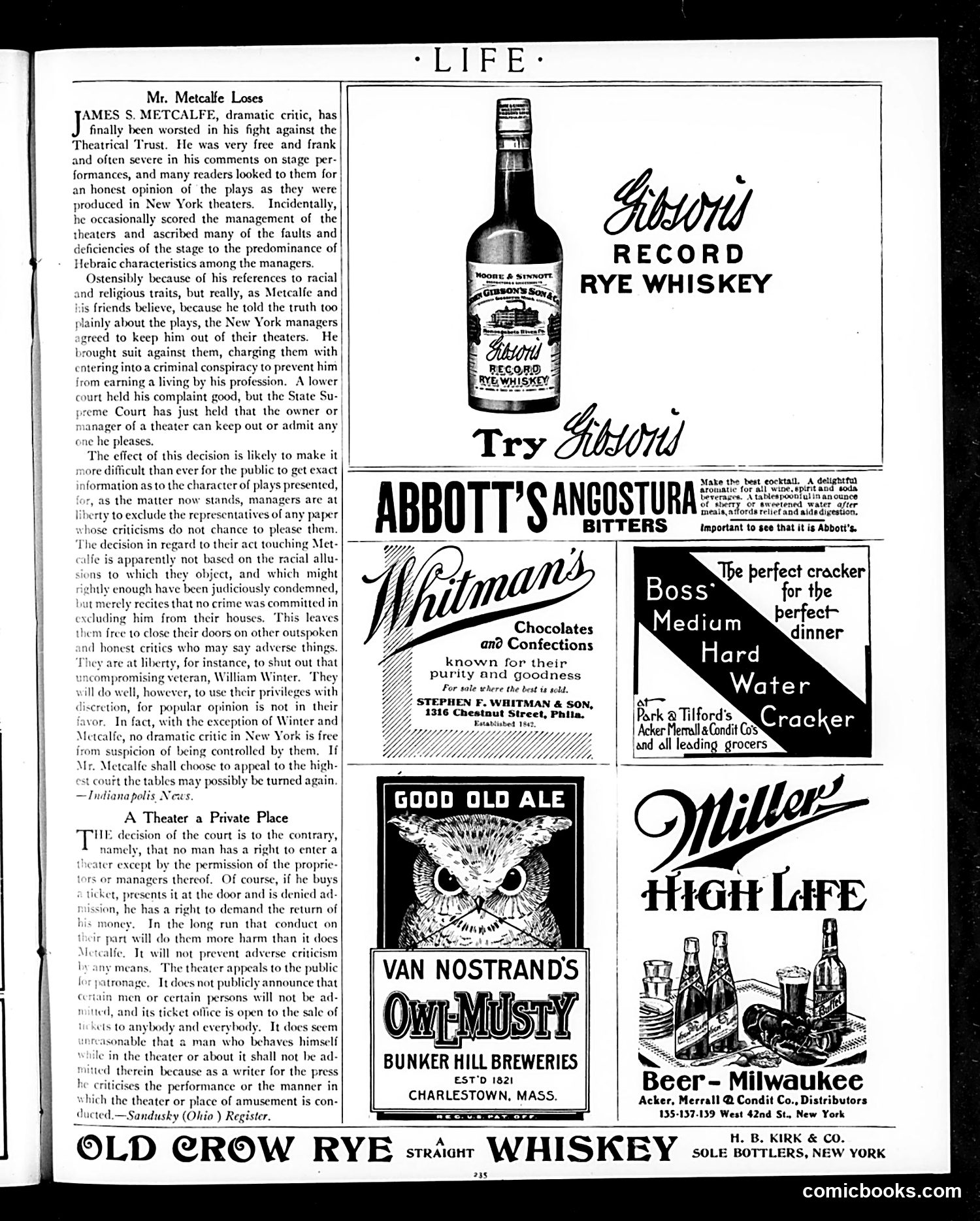
This page primarily consists of **advertisements with two opinion pieces** about a legal case involving dramatic critic James S. Metcalfe. ## The Main Content The articles discuss Metcalfe's lawsuit against New York theater managers who excluded him from their venues. Metcalfe had written critical reviews, including commentary on what the text calls "Hebraic characteristics among the managers"—indicating antisemitic remarks. The New York Supreme Court ruled that theater owners have the right to admit or exclude anyone. The two pieces debate this decision: the first argues it harms public access to honest criticism; the second defends theaters as private property. ## The Satire/Context This reflects **early 20th-century tensions** between theater critics' free speech and management control. Notably, the text acknowledges Metcalfe's antisemitic commentary while suggesting his *real* offense was truthful criticism of plays and management—a convenient distinction that allows sympathy for him despite his prejudice. ## The Advertisements The page is otherwise filled with period product ads: whiskey, beer, chocolates, and bitters—typical of Life magazine's revenue model.
📄 Transcribed text from this page (OCR, searchable)
Machine-transcribed from the original scan — historical spelling and the odd misread are preserved.
Mr. Metcalfe Loses AMES S. METCALFE, dramatic critic, has J finally been worsted in his fight against the | Theatrical Trust. He was very free and frank and often severe in his comments on stage per- formances, and many readers looked to them for | an honest opinion of the plays as they were | produced in New York theaters. Incidentally, he occasionally scored the management of the theaters and ascribed many of the faults and ieficiencies of the stage to the predominance of Hebraic characteristics among the managers. Ostensibly because of his references to racial and religious traits, but really, as Metcalfe and is friends believe, because he told the truth too plainly about the plays, the New York managers greed to keep him out of their theaters. He} brought suit against them, charging them with} entering into a criminal conspiracy to prevent him | from earning a living by his profession. A lower court held his complaint good, but the State Su- preme Court has just held that the owner or manager of a theater can keep out or admit any one he pleases. The effect of this decision is likely to make it more difficult than ever for the public to get exact nformation as to the character of plays presented, as the matter now stands, managers are at 10 exclude the repr ives of any paper whose criticisms do not chance to ple them. ‘The decision in regard to their act touching Met- calfe is apparently not based on the racial allu- sions to which they object id which might rightly enough have been judiciously condemned, but merely recites that no crime was committed in excluding him from their houses. This leaves them free to close their doors on other outspoken nd honest critics who ma They are at liberty, for instance, uncompromising veteran, William Winter. ‘They will do well, however, to use their privileges with discretion, for popular opinion is not in their favor. In fact, with the exception of Winter and Metcalfe, no dramatic critic in New York is free irom suspicion of being controlled by them, If calfe shall choose to appeal to the high- | t the tables may possibly be turned again. —Indianapolis News | A Theater a Private Place HE decision of the court is to the contrary, namely, that no man has a right to enter a theater except by the permission of the proprie- tors or managers thereof. Of course, if he buys cket, presents it at the door and is denied ad on, he has a right to demand the return of ney. In the long run that conduct on art will do them more harm than it does alic, Tt will not prevent adverse criticism by any means, The theater appeals to the public lorpatronage. It does not publicly announce that certain men or certain persons will not be ad- mitted, and its ticket office is open to the sale of els to anybody and everybody. It doe: breasonable that a man who es himself le in the theater or about it shall not be ad- mitted therein because as a writer for the press he criticises the performance or the manner in which the theater or place of amusement is con- Sucted.—Sandusky (Ohio ) Register. RECOR bird RYE WHISKEY D ABBOTT'S ANGOSTURA: best cocktail. A delightfu for all wine, spirit and soda \ tapiesnodniulin an ounce weetent t ater after gestion. , Chocolates and Confections known for their purity and goodness 4, For sale where the best is sold. Yj; STEPHEN F. WHITMAN & SON, lat Y jj 1516 Chestnut Street, Phita. [Pork a Tilfords FG zapp, YELL. te I A OS OSTRANDS] | BUNKER HILL BREWERIES EST'D 1821 CHARLESTOWN, MASS. Ss <2 Beer-M Acker, Merrall @ Condit Co., Distributors 135-157-139 West 42nd St.. New York WHISKEY :o $s H. B. KIRK & CO. BOTTLERS, NEW YORK comicbooks.com