
Life, 1906-08-30 · page 7 of 20
Life — August 30, 1906 — page 7: what you’re looking at
What you’re looking at
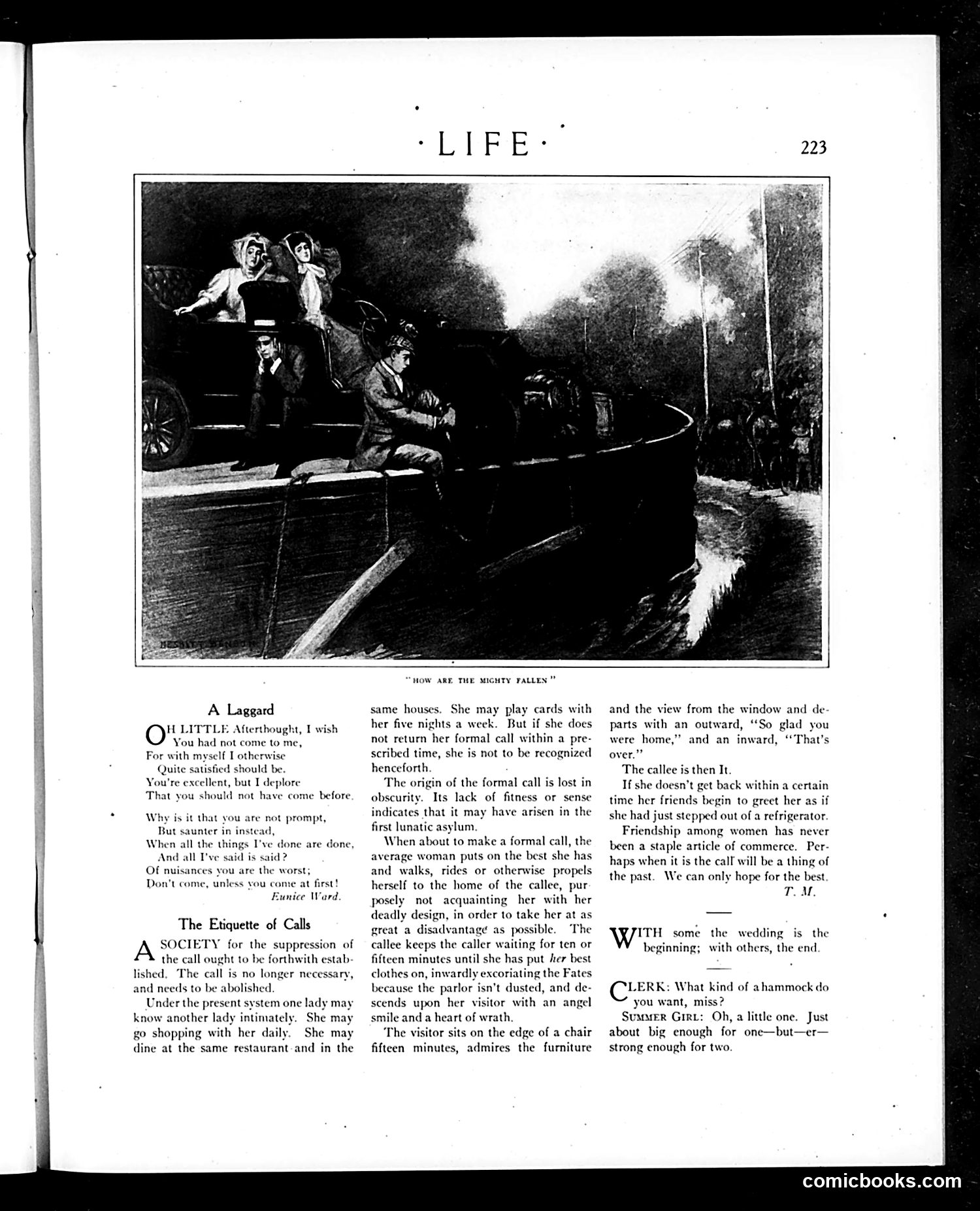
This page satirizes the decline of the formal social call—a Victorian-era ritual where ladies paid visits to each other's homes to maintain social standing. The illustration shows a woman stuck in a ditch beside a car, while well-dressed passengers pass by in vehicles, ignoring her plight. The text explains that the formal call is becoming obsolete under the modern system where women can socialize casually (shopping, dining, playing cards) without rigid etiquette. The cartoon's title references this social collapse: the "mighty" institution of formal calling has literally fallen into disrepair, replaced by automobile culture and informal friendships. The satire mocks both the old pretentious system and the new casual world it's being replaced by.
📄 Transcribed text from this page (OCR, searchable)
Machine-transcribed from the original scan — historical spelling and the odd misread are preserved.
A Laggard H LITTLE Afterthought, I wish You had not come to me, For with myself To Quite satisfied should be. You're excellent, but I deplore That you should not have come before Why is it that you are not prompt, But saunter in instead, When all the things I’ve done are done, And all I've said is said? Of nuisances you are the worst; Don't come, unless you come at first! Eunice Ward. The Etiquette of Calls SOCIETY for the suppression of the call ought to be forthwith estab- lished, The call is no longer necessary, and needs to be abolished Under the present system one lady may know another lady intimately. She ma go shopping with her daily. She may dine at the same restaurant-and in the “MOW ARE THE MIGHTY FALLEN" same houses. She may play cards with her five nights a week. But if she does not return her formal call within a pre- scribed time, she is not to be recognized henceforth The origin of the formal call is lost in obscurity. Its lack of fitness or sense indicates that it may have arisen in the first lunatic asylum, When about to make a formal call, the average woman puts on the best she has and walks, rides or otherwise prope herself to the home of the callee, pur posely not acquainting her with her deadly design, in order to take her at as great a disadvantage as possible. ‘The callee keeps the caller waiting for ten or fifteen minutes until she has put her best clothes on, inwardly excoriating the F because the parlor isn’t dusted, and de- ends upon her visitor with an angel smile and a heart of wrath. The visitor sits on the edge of a chair fifteen minutes, admires the furniture and the view from the window and de parts with an outward, “So glad you were home,” and an inward, “That’s over.”” The callee is then It If she doesn’t get back within a certain time her friends begin to greet her as if she had just stepped out of a refrigerator. Friendship among women has never been a staple article of commerce. Per- haps when it is the calf will be a thing of the past. We can only hope for the best MM. ITH some the wedding is the beginning; with others, the end LERK: What kind of ahammock do you want, miss? Sumarer Girt: Oh, a little one. Just about big enough for one—but—er— strong enough for two. comicbooks.com