
Life, 1906-08-30 · page 6 of 20
Life — August 30, 1906 — page 6: what you’re looking at
What you’re looking at
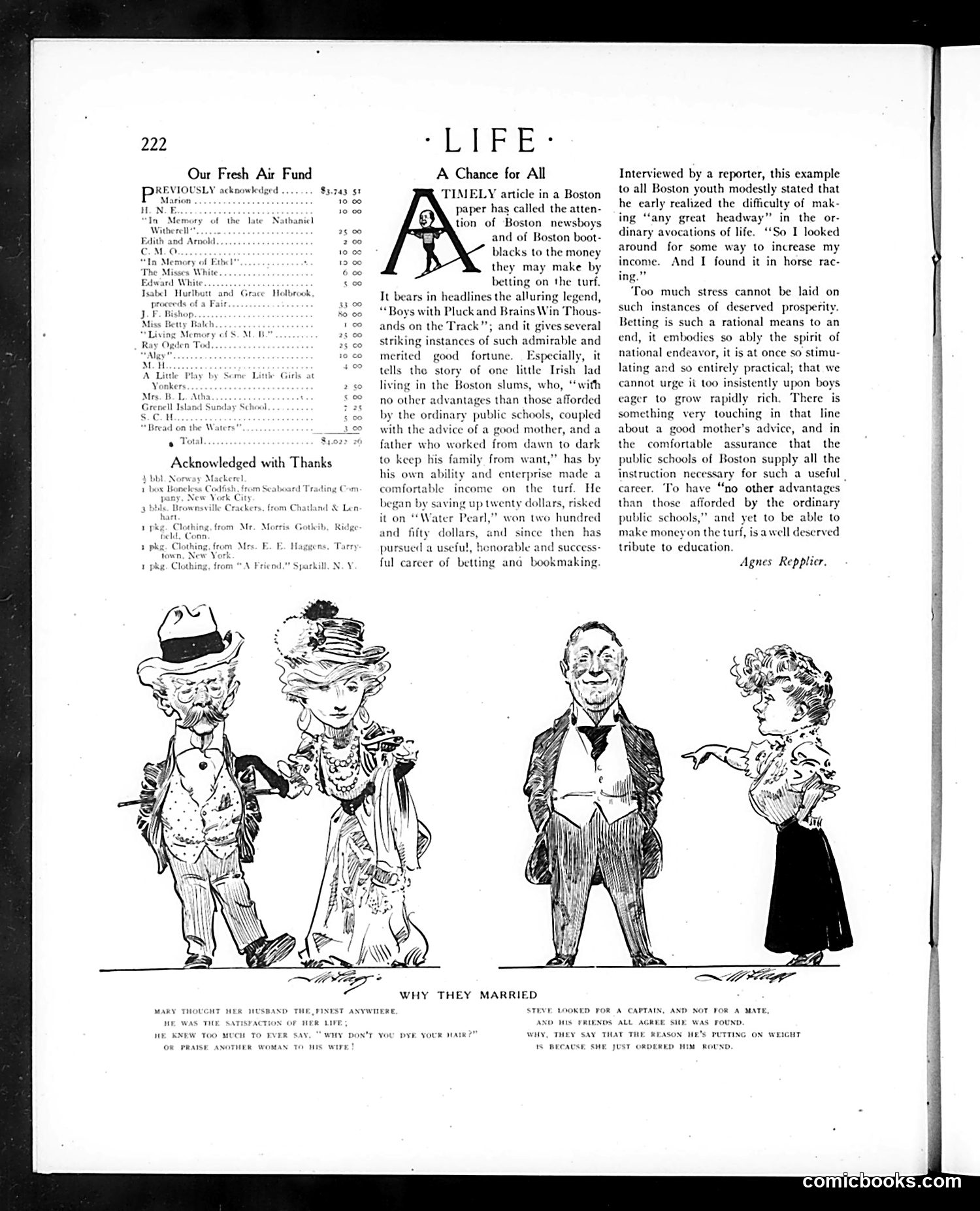
This page contains two main sections: **"Our Fresh Air Fund"** (top left) lists charitable contributions, totaling $1,027.70, acknowledging donations to a youth welfare program. **"A Chance for All"** (main article) celebrates a Boston Irish boy's success through betting on horse racing and bookmaking. The piece argues that despite lacking formal education advantages, he achieved prosperity through enterprise and thrift—a narrative promoting self-made success. **"Why They Married"** (bottom cartoons) shows two couple vignettes with satirical captions about marriage motivations: one woman married for financial security ("finest anywhere"), the other depicts a man seeking a "captain" rather than mate, with the joke being she's overweight ("putting on weight"). The page reflects early 20th-century attitudes toward class mobility, gender roles, and working-class aspiration, mixing charitable uplift narratives with somewhat crude humor about marriage and appearance.
📄 Transcribed text from this page (OCR, searchable)
Machine-transcribed from the original scan — historical spelling and the odd misread are preserved.
222 Our Fresh Air Fund REVIOUSLY acknowledged ... M x Nathaniel Holbrook and Grace Acknowledged with Thanks Ub. Norway Mackerel 1 box Boneless Corfish, from Seaboard Tr y. New Vork City from Mr. Morris -LIFE: A Chance for All TIMELY article in a Boston paper has called the atten- tion of Boston newsboys and of Boston boot- blacks to the money they may make by betting on the turf. It bears in headlines the alluring legend, “Boys with Pluck and Brains Win Thous- ands on the Track”; and it gives several striking instances of such admirable and merited good fortune. Especially, it tells the story of one little Trish lad living in the Boston slums, who, “with no other advantages than those afforded by the ordinary public schools, coupled with the advice of a good mother, and a father who worked from dawn to dark to keep his family from want,” has by his own ability and enterprise made a comfortable income on the turf. He began by saving up twenty dollars, risked it on “Water Pearl,” won two hundred and fifty dollars, and since then hi pursued a usefu norable and success: ful career of betting ana bookmaking. MARY THOUGHT MER MUSBAND THE FINEST ANYWHERE HE WAS TICE SATISFACTION OF THER LIFES Interviewed by a reporter, this example to all Boston youth modestly stated that he early realized the difficulty of mak- ing ‘‘any great headway” in the or- dinary avocations of life. ‘‘So I looked around for some way to increase my income. And I found it in horse rac- ing.” ‘Too much stress cannot be laid on such instances of deserved prosperity. Betting is such a rational means to an end, it embodies so ably the spirit of national endeavor, it is at once so stimu- lating and so entirely practical, that we cannot urge i stently upon boys. cager to grow rapidly rich, There is something very touching in that line about a good mother’s advice, and in the comfortable assurance that the public schools of Boston supply all the instruction necessary for such ‘a useful . ave “no other advantages than those afforded by the ordinary public schools,” and yet to be able to make money on the turf, is a well deserved tribute to education: Agnes Repplier. it too i career. To ~~” STEVE LOOKED TOR A CAPTAIN, AND NOT TOR A MATE AND WIS FRIENDS ALL AGREE SIE WAS FOUND. THEY SAY THAT THE REASON HE'S PUTTING ON WEIGHT ROUND, WHY DON'T YoU PYF YOUR AIR?’ wity S BECAUSE SHE JUST ORDERED 1 HE KNEW TOO MUCH TO EVER SAY OR PRAISE ANOTHER WOMAN TO MIS wire!