
Life, 1906-08-30 · page 3 of 20
Life — August 30, 1906 — page 3: what you’re looking at
What you’re looking at
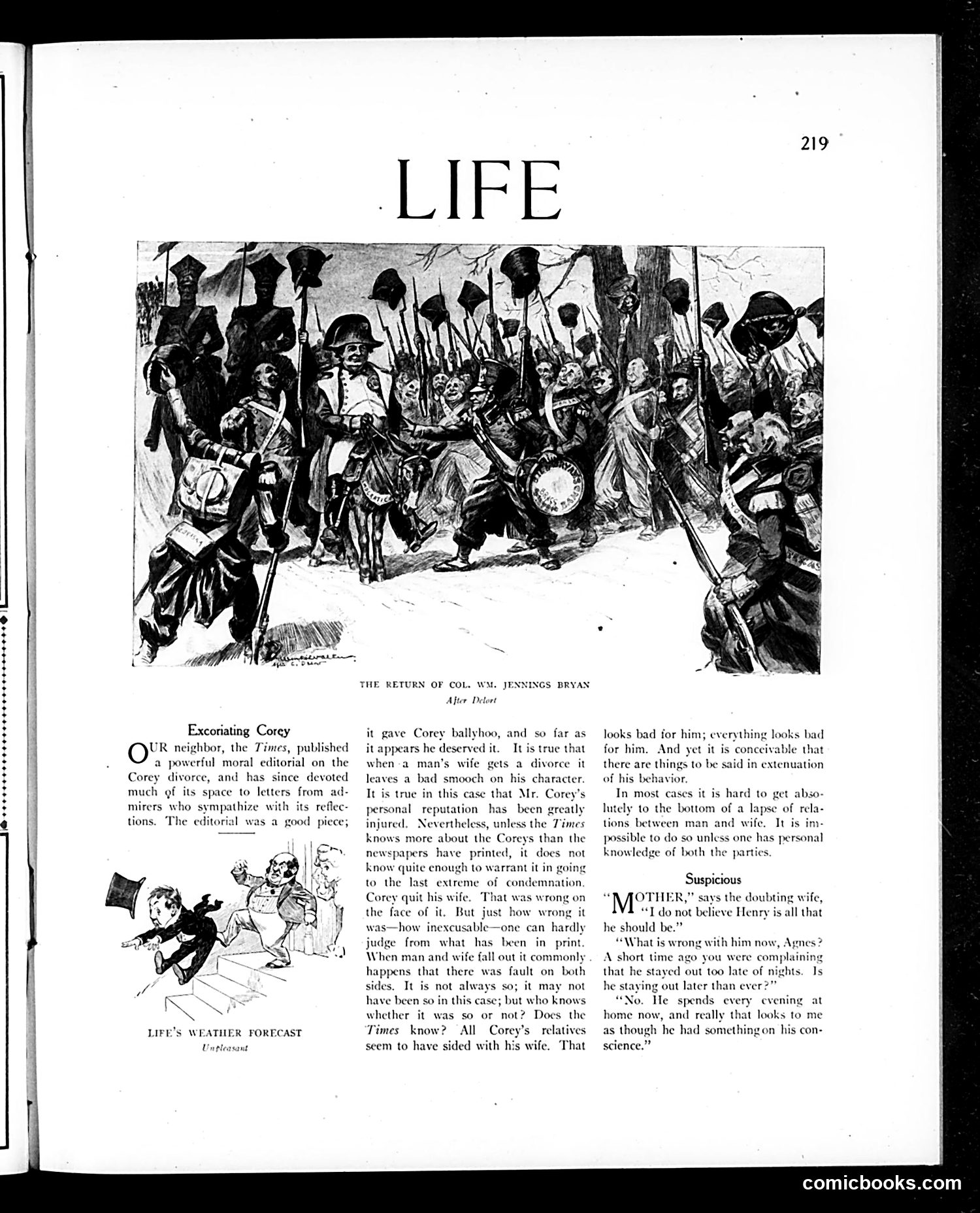
This page from *Life* magazine satirizes a divorce involving someone named Corey. The upper illustration depicts "The Return of Col. Wm. Jennings Bryan" (a political reference, likely comparing Corey's situation to Bryan's public prominence). The text discusses how Corey's divorce received substantial media coverage. The editorial notes that while Corey's reputation suffered, his wife also faced blame—the piece criticizes how divorce cases typically pit spouses against each other publicly, making fair judgment difficult without knowing both sides. The "Suspicious" section presents a domestic dialogue where a wife questions her husband Henry about his late nights, suspecting infidelity or dishonesty. The humor derives from the husband's evasive explanation about "science," implying marital distrust. Overall, the page satirizes both media sensationalism around divorce and common marital suspicions.
📄 Transcribed text from this page (OCR, searchable)
Machine-transcribed from the original scan — historical spelling and the odd misread are preserved.
.' BID CS SESE HOSS SSS OSES OTOOHOOFOTHT® | Excoriating Corey R neighbor, the Times, published a powerfy 11 moral editorial on the Corey divorce, and has since devoted much of its 5 mirers who tions. The to letters from ad- mpathize with its ref 1 was a good piece; THE RETURN OF COL. WM. JENNINGS BRYAN After Detort it gave Corey ballyhoo, and so far as it appears he deserved it. It is true that when-a man’s wife gets a divorce it lea bad smooch on his character. It is true in this case that Mr. Corey’s personal reputation has been greatly injured. Nevertheless, unless the Times knows more about the Coreys than the newspapers have printed, it docs not know quite enough to warrant it in going to the last extreme of condemnation. Corey quit his wife. That was wrong on the face of it. But just how wrong it how inexcusable—one can hardly judge from what has been in print When man and wife fall out it commonly happens that there was fault on both sides. It is not always so; it may not have been so in this case; but who knows hether it was so or not? Does the Times know? All Corey’s relat seem to have sided with his wife. That looks bad for him; everything for him. And yet it is conceivable that there are things to be said in extenuation of his behavior. In most cases it is hard to get abso- lutely to the bottom of a lapse of r tions between man and wife. It is im- possible to do so unless one has personal knowledge of both the parties. Suspicious “ OTHER,” says the doubting wife, “TI do not believe Henry is all that he should be.” “What is wrong with him now, Agnes? A short time ago you were complaining that he stayed out too late of nights. Is out later than ever?” No. He spends every evening at home now, and really that looks to me as though he had somethingon his con- science.” comicbooks.com