
A complete issue · 22 pages · 1906
Life — May 31, 1906
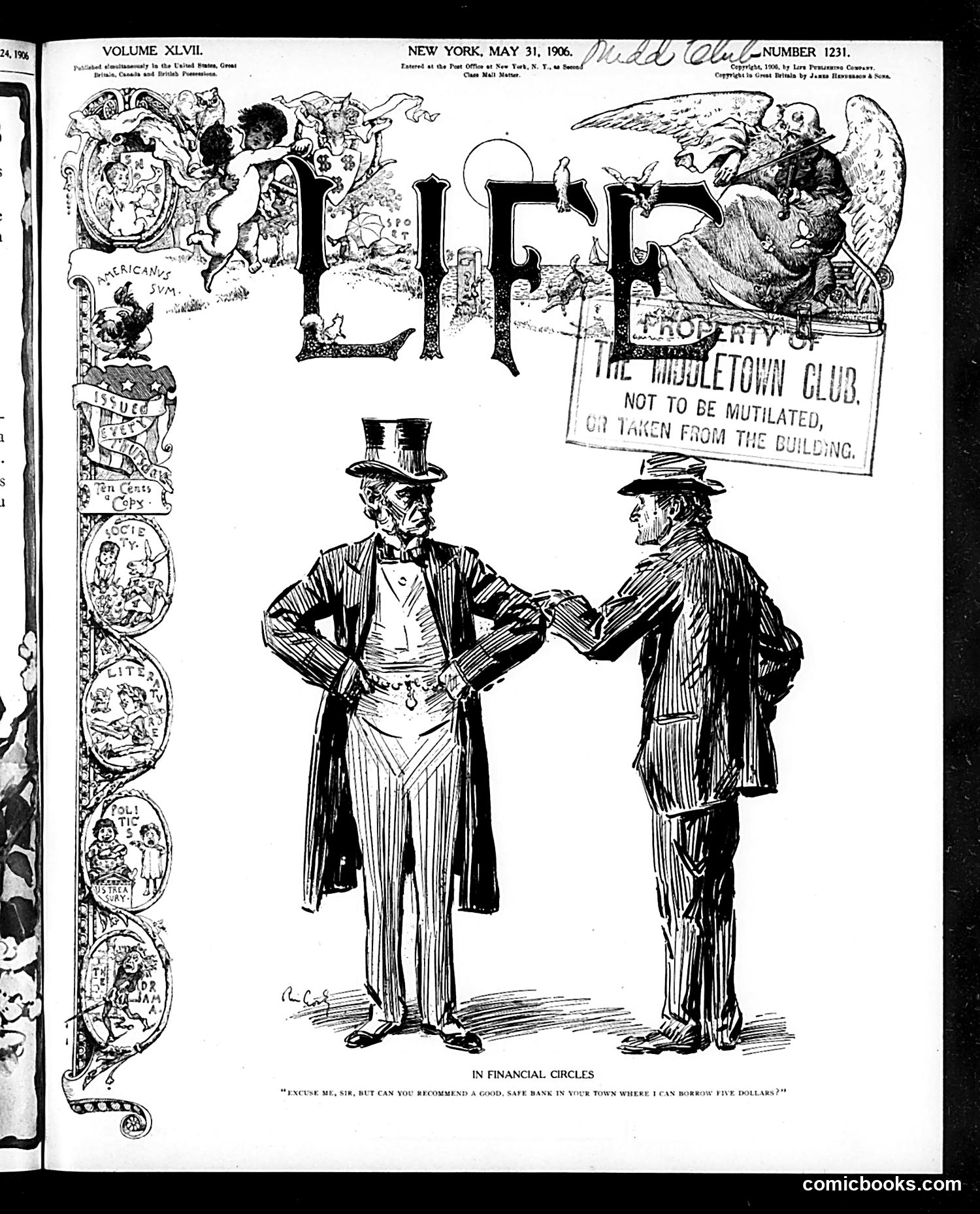
This page contains a satirical cartoon titled "In Financial Circles" depicting two well-dressed gentlemen in top hats. The figure on the left stands with hands on hips while the other gestures toward him. The caption reads: "Excuse me, sir, but can you recommend a good, safe bank in your town where I can borrow five dollars?" The satire targets banking practices and financial credibility of the era. The joke appears to mock the irony of approaching someone for a bank recommendation while simultaneously asking to borrow money from them—suggesting either distrust in local banking institutions or the absurdity of the financial system itself. The cartoon likely comments on post-1906 financial instability or banking scandals, though the specific incident remains unclear without additional context.
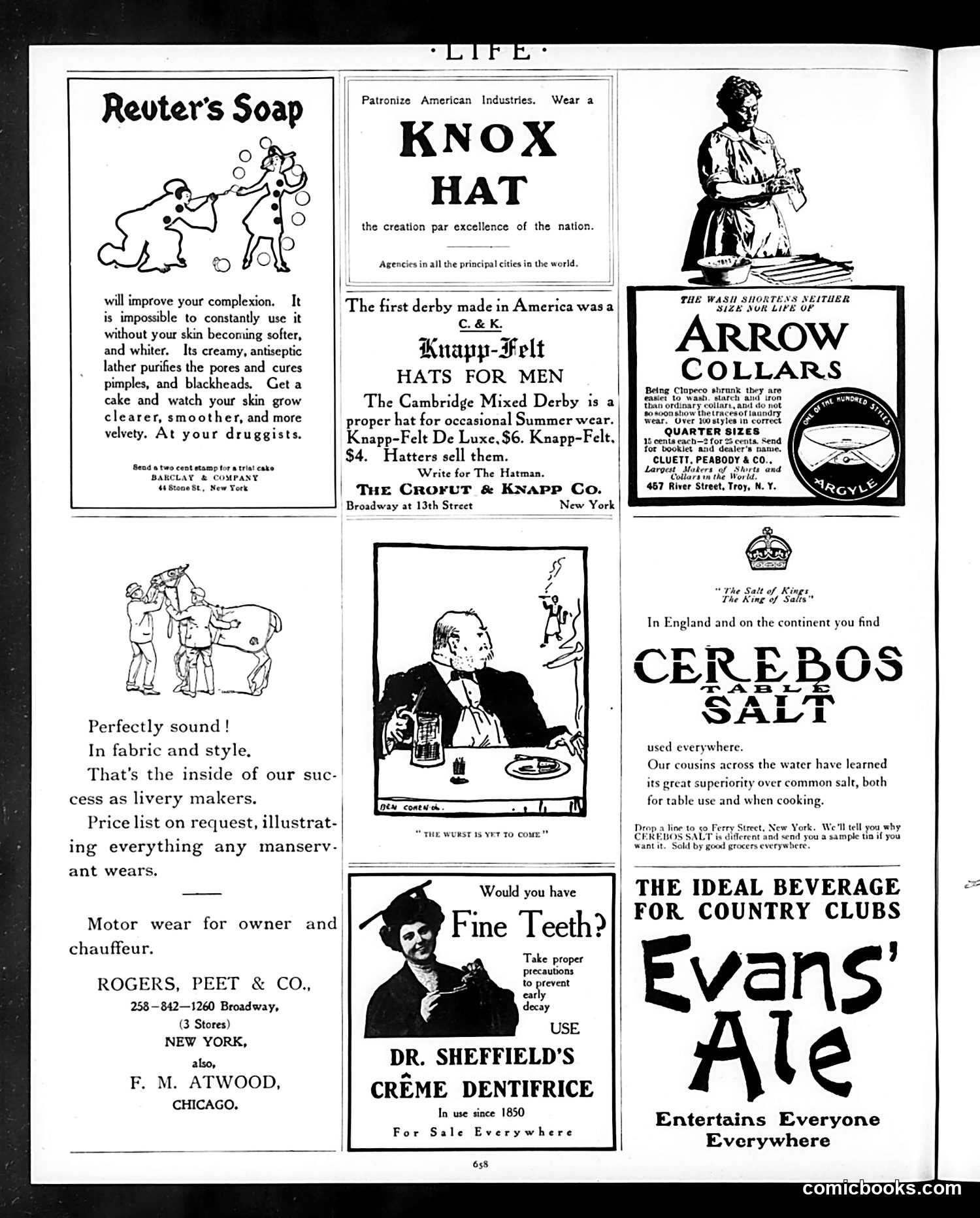
This page is primarily **advertisements**, not satirical cartoons. The ads showcase early 1900s consumer products: Reuter's Soap (promising complexion improvement), Knox Hats, Knapp-Felt Hats, Arrow Collars, Cerebos Salt, Evans' Ale, and Dr. Sheffield's Crème Dentifrice. One small illustration shows a man at dinner with a waiter—captioned "THE WORST IS YET TO COME"—but this appears to be part of the toothpaste ad's humor about dental decay, not political satire. The page demonstrates Life magazine's dual role: it combined satirical editorial content with advertisements for American manufacturers and consumer goods. The ads emphasize quality, American production, and social respectability—appeals typical of the period.
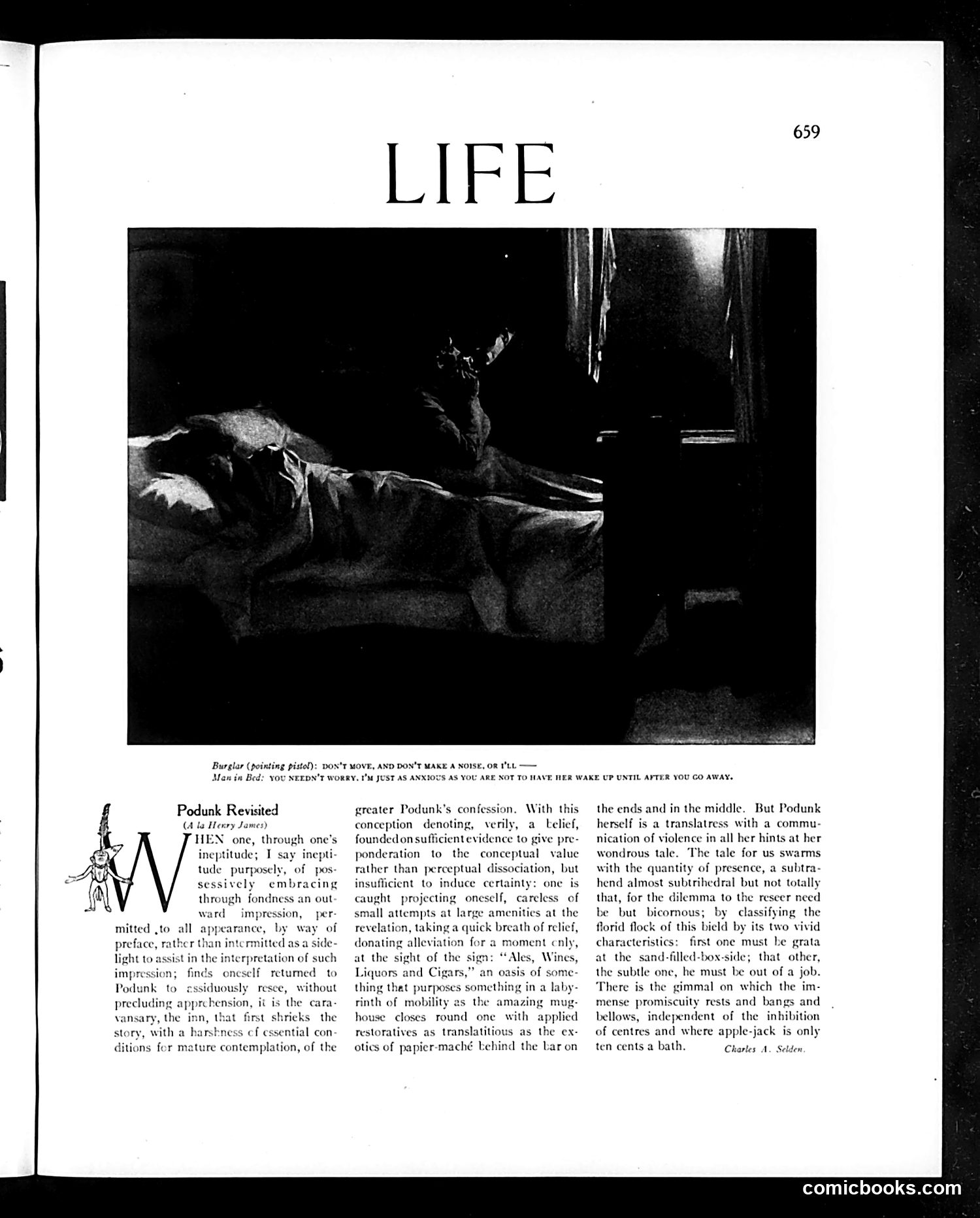
This page features a theatrical or film still (dark, dramatic lighting) accompanying a review titled "Podunk Revisited." The article critiques a stage production, discussing how the work attempts to capture small-town American life ("Podunk" being period slang for a remote, unsophisticated village). The reviewer argues the production uses superficial techniques—applied decorative elements and papier-mâché props—rather than authentic insight to depict rural characters. The critic suggests the actress playing the lead is a "translatress with a communication of violence," implying she performs the role through exaggerated mannerisms rather than genuine understanding of small-town life. The piece appears to be satirizing theatrical pretension and the artificial representation of American provincial life on stage.
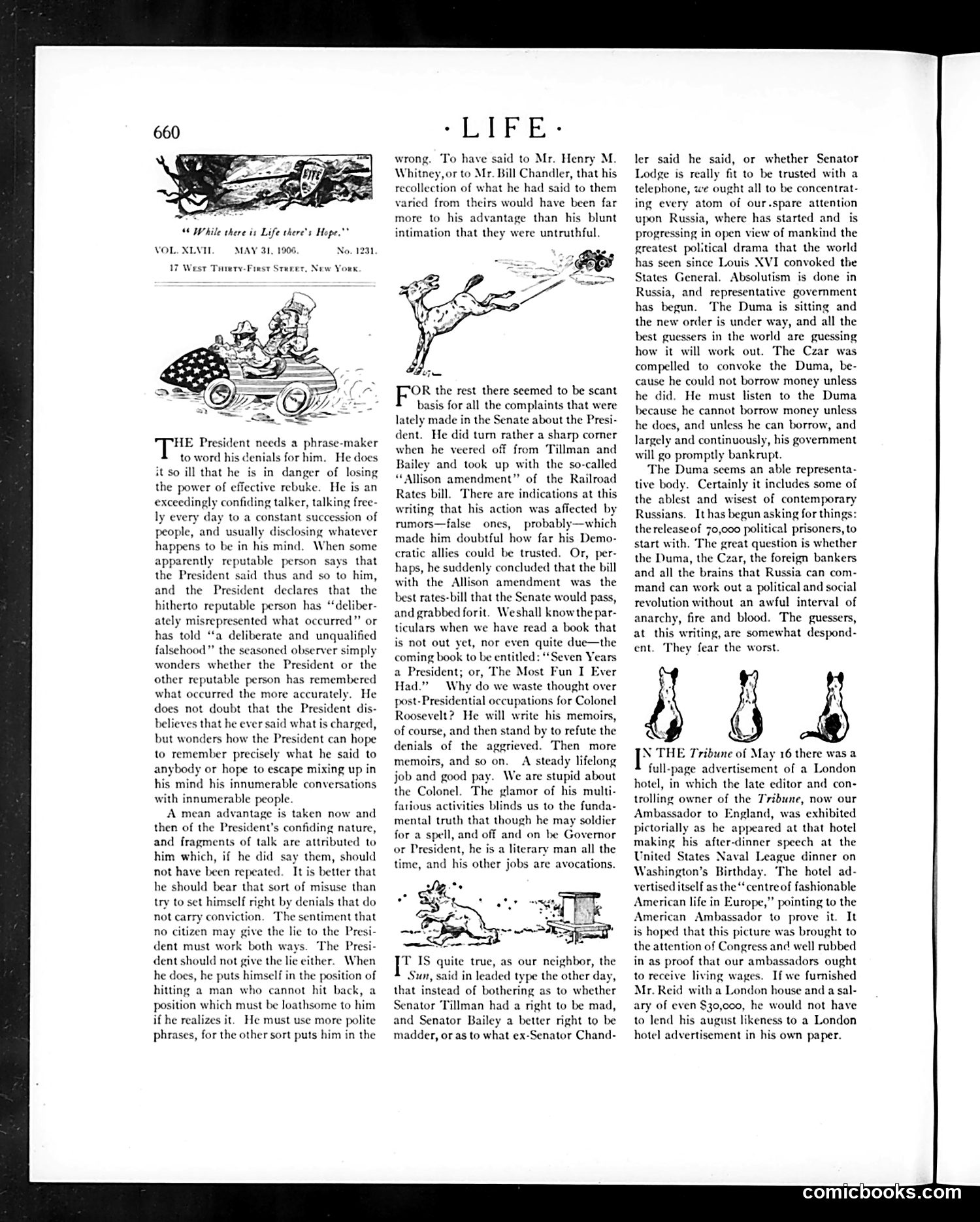
This editorial page critiques President Theodore Roosevelt's communication style and political denials. The main article argues that Roosevelt needs a "phrase-maker" because he frequently denies saying things he actually said to various political figures (Henry M. Whitney, Bill Chandler, Senator Lodge). The author notes Roosevelt's contradictions undermine trust. The piece then discusses Roosevelt's "Allison amendment" regarding railroad rates and his apparent doubts about Democratic allies' trustworthiness. A secondary item mentions a London hotel advertisement featuring the American Ambassador, suggesting Congress should see it as evidence of American prestige abroad. The cartoons (small sketches visible) appear to satirize these political inconsistencies, though specific subjects are difficult to identify clearly in this reproduction.
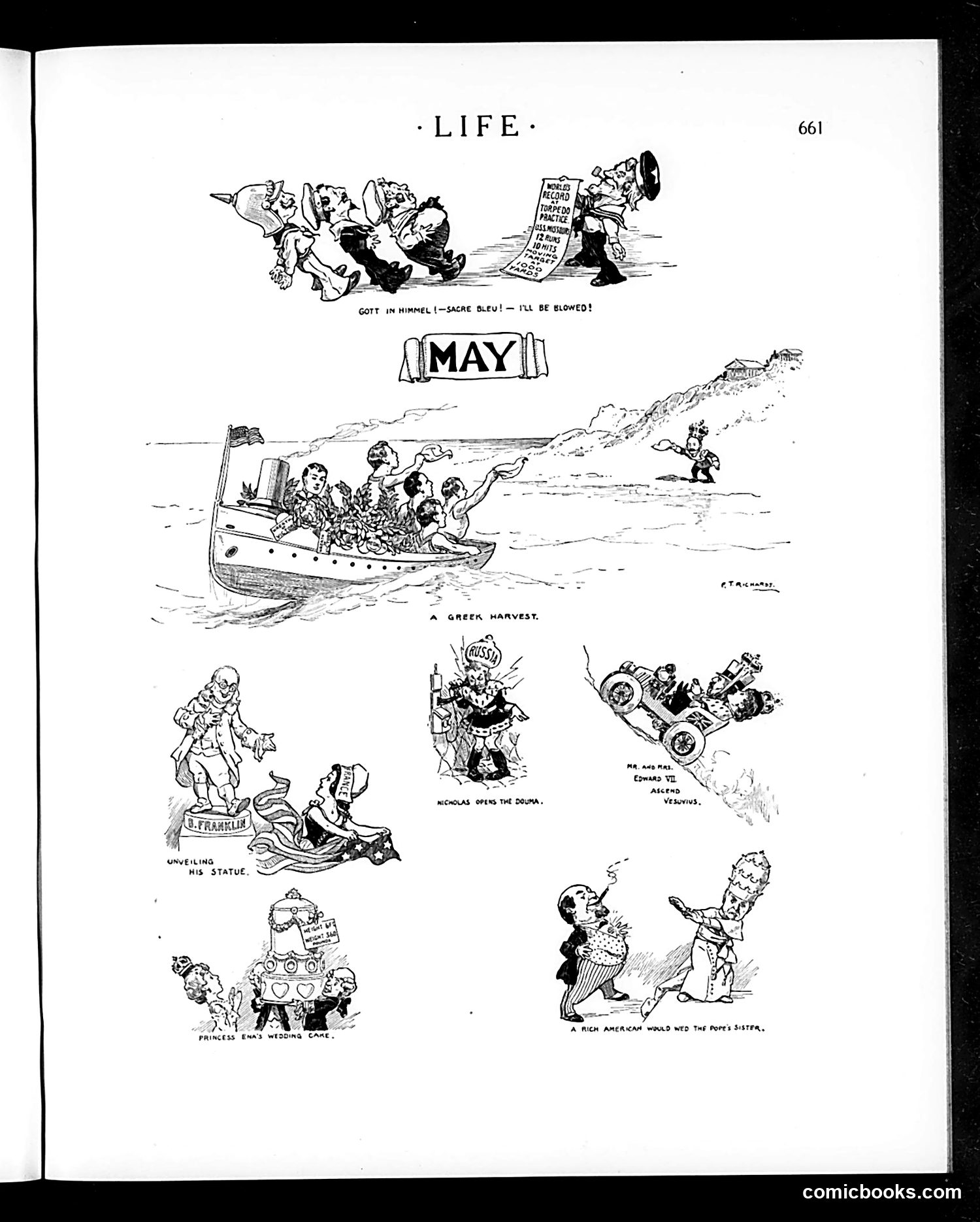
This page contains several satirical cartoons commenting on 1910s-1920s events and figures: **Top cartoon**: References German militarism ("Gott in Himmel!—Sacre Bleu!—I'll be blowed!"), likely depicting Allied concerns about German aggression. **"A Greek Harvest"**: Shows a crowded boat, possibly referencing Greek territorial expansion or population displacement during this period's Balkan conflicts. **Other panels**: Include "Unveiling His Statue" (political monument satire), "Nicholas Opens the Duma" (Russian legislative body), "A Rich American Would Wed the Pope's Niece" (satirizing wealthy Americans' social climbing through European marriages), and "Princess Ena's Wedding Cake" (royal wedding satire). The cartoons mock international diplomacy, military posturing, class pretension, and newsworthy events of the era through exaggerated character drawings typical of Life's editorial style.
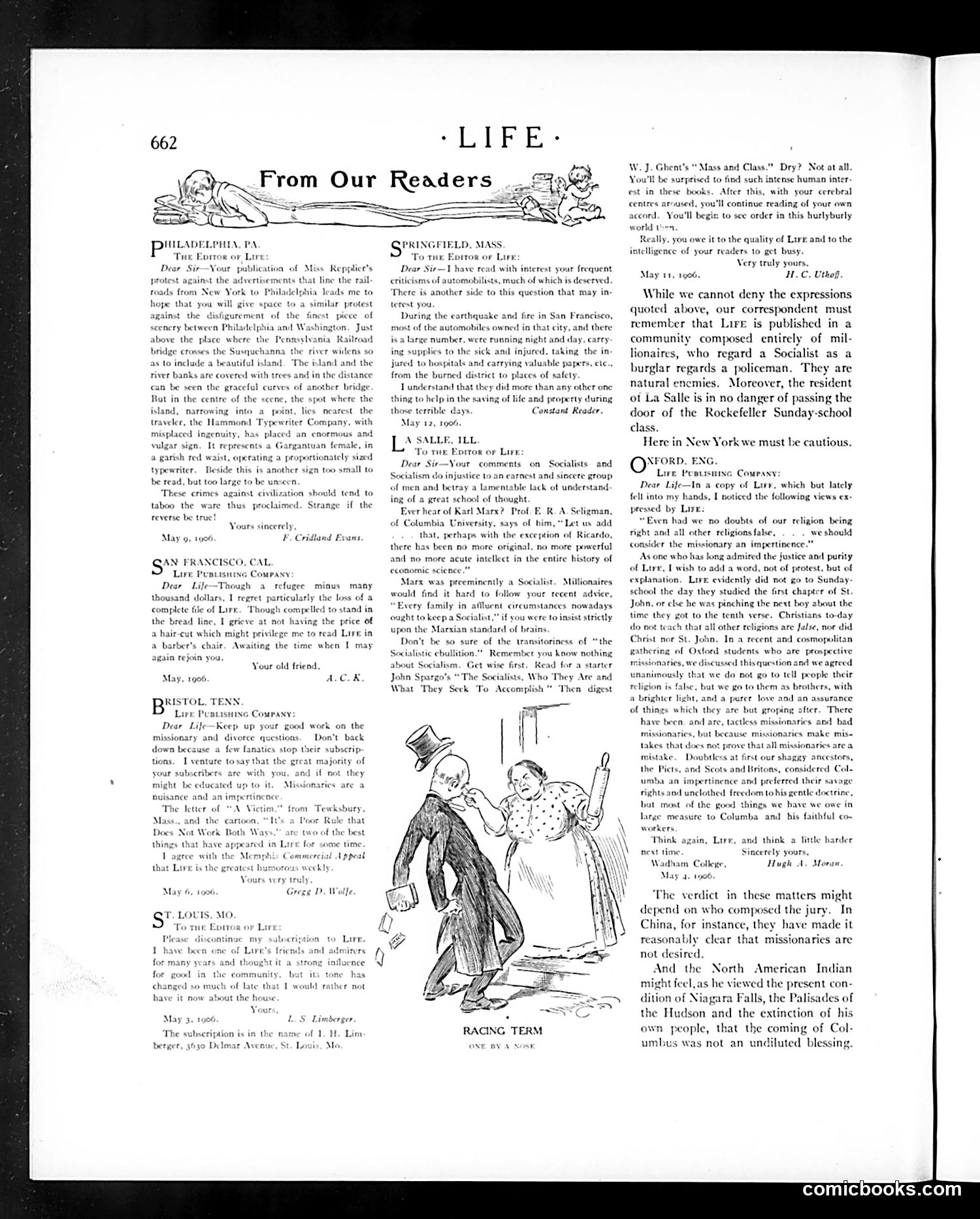
This cartoon depicts two figures in a "racing" pose—one appears to be a wealthy gentleman in formal attire, the other a working-class man. The caption "Racing Term" and subtitle "One by a Nose" suggests a close competition. Given the page's context discussing socialism, Karl Marx, and working-class issues, this likely satirizes the competitive struggle between labor and capital classes. The "nose" reference suggests an extremely narrow margin—perhaps mocking claims that one side (likely the wealthy) barely maintains advantage over the other, or conversely, that workers are nearly catching up. The cartoon appears in a readers' section debating socialism's merits, reflecting early 20th-century American anxieties about class conflict and economic inequality.
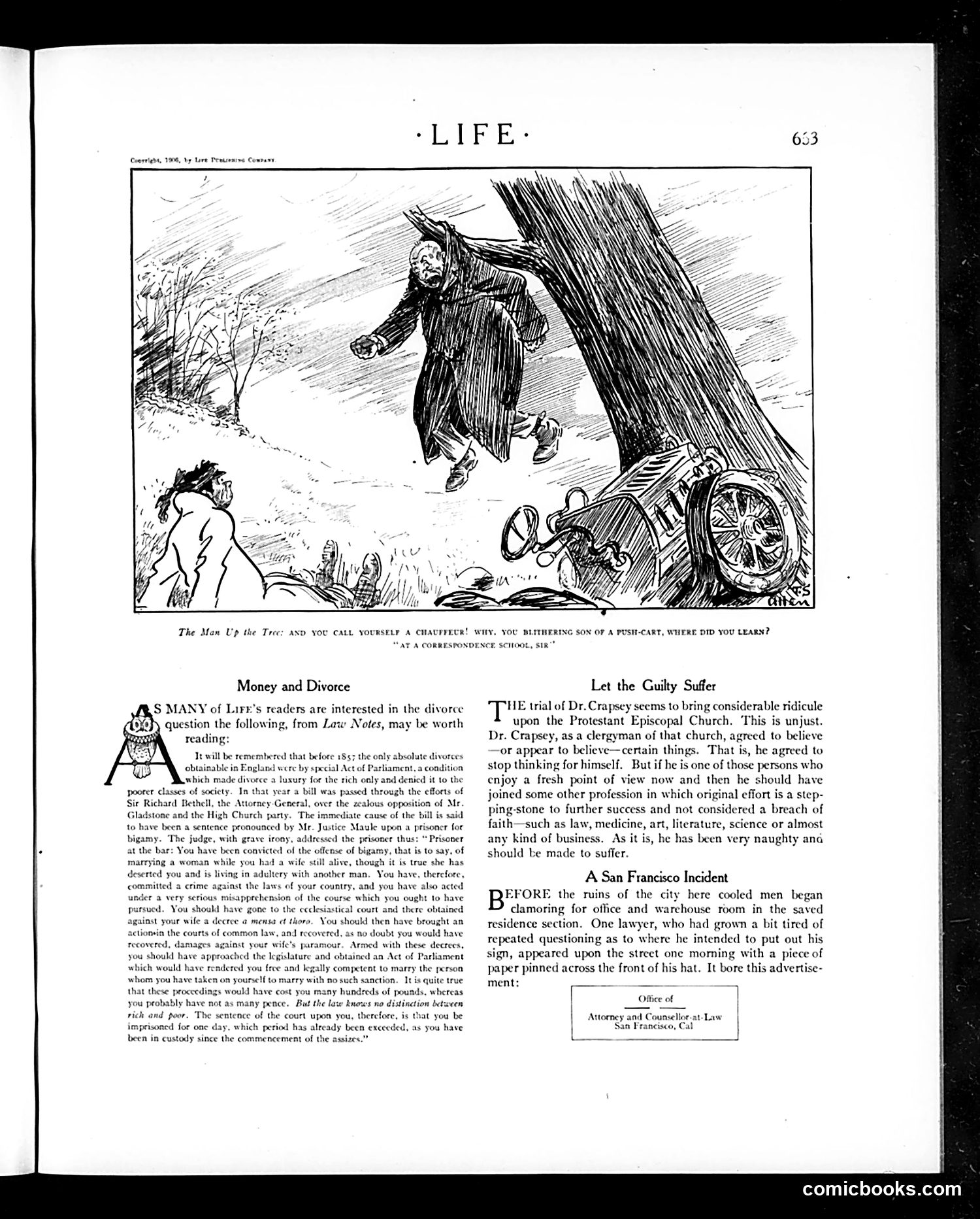
The main cartoon depicts an old man in ragged clothes confronting a well-dressed gentleman beneath a large tree, with a bicycle and abandoned items visible. The caption references the man being called a "chauffeur" despite driving a "push-cart," implying he claims false status or education from "a correspondence school." The page contains three articles: "Money and Divorce" discusses English divorce law and parliamentary proceedings; "Let the Guilty Suffer" critiques Dr. Crapsey, a clergyman involved in controversy who abandoned his duties; and "A San Francisco Incident" appears to advertise legal services. The satire targets social pretension, religious hypocrisy, and possibly correspondence-school fraud—common early-20th-century American concerns about false credentials and status-climbing among the working classes.
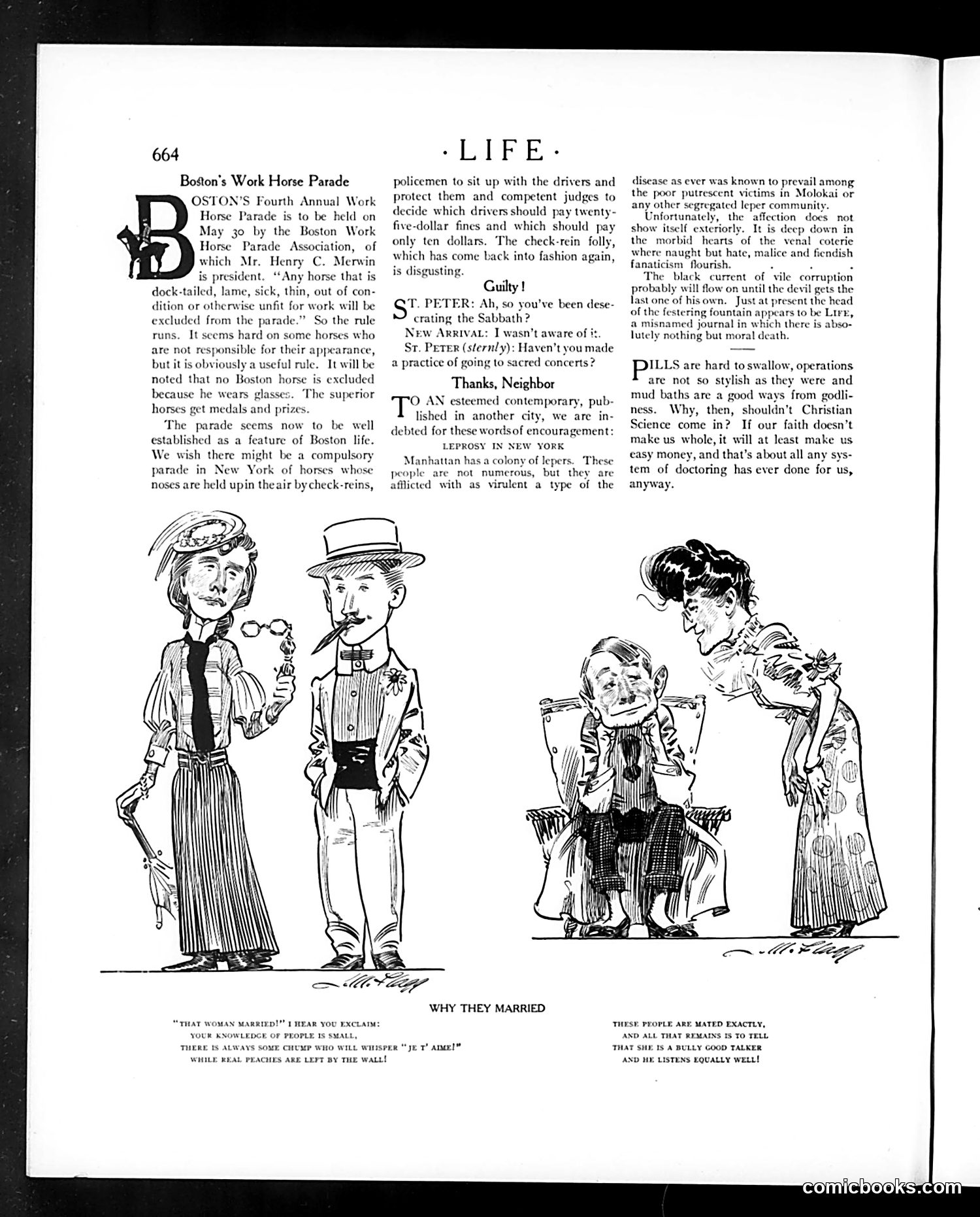
This Life magazine page contains two sections: **Top section** discusses Boston's Fourth Annual Work Horse Parade (May 3), where Mr. Henry C. Merwin presided. The parade excluded unfit horses, establishing standards for working animals in the city. **Bottom cartoons** satirize marriage through two scenarios: Left cartoon mocks a man claiming his wife is "always some gruff who will whisper 'if I aint!'" while she's excluded—satirizing domestic nagging and marital discord. Right cartoon ("Why They Married") shows a couple perfectly matched because she's "exactly as good a talker" as he is and "listens equally well"—ironic commentary suggesting couples succeed when both equally dominate conversation, poking fun at marital compatibility and communication patterns of the era.
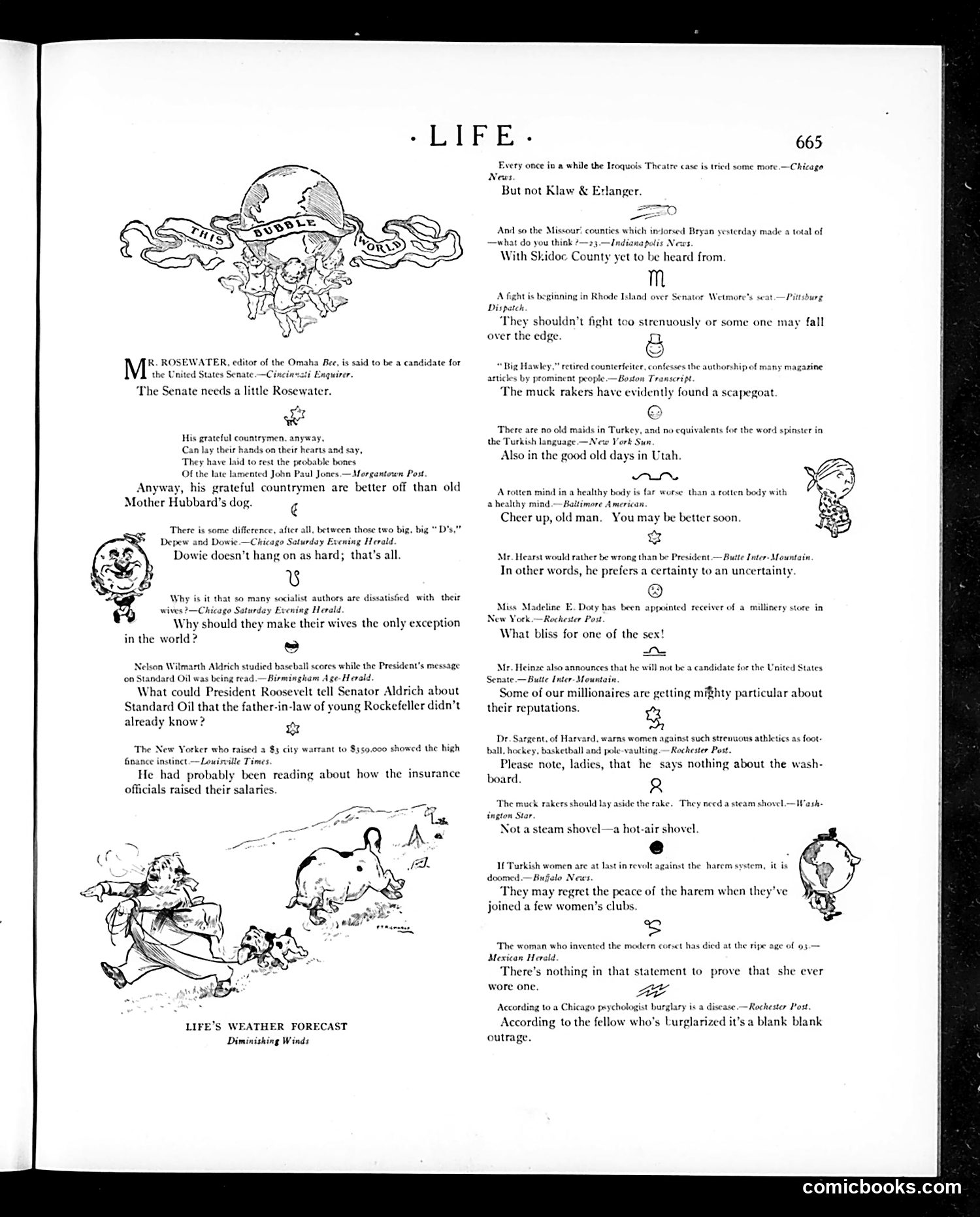
This satirical page mocks contemporary political and social figures through brief, witty commentary paired with illustrations. Key targets include: **Political figures**: Senator Rosewater (mentioned regarding Standard Oil), and candidates for the U.S. Senate. **Social commentary**: The page ridicules wealthy industrialists concerned with their reputations, particularly regarding Standard Oil dealings. It mocks socialist authors, insurance company officials raising salaries, and Harvard doctors dispensing moral advice about women's athletics. **The humor**: Relies on ironic reversals—praising hypocrites for their "certainty," suggesting muck-rakers need "steam shovels," and quipping that a corset inventor never wore one. The illustration titled "Life's Weather Forecast: Diminishing Winds" appears to satirize declining influence or changing times, though its specific target is unclear without additional context.
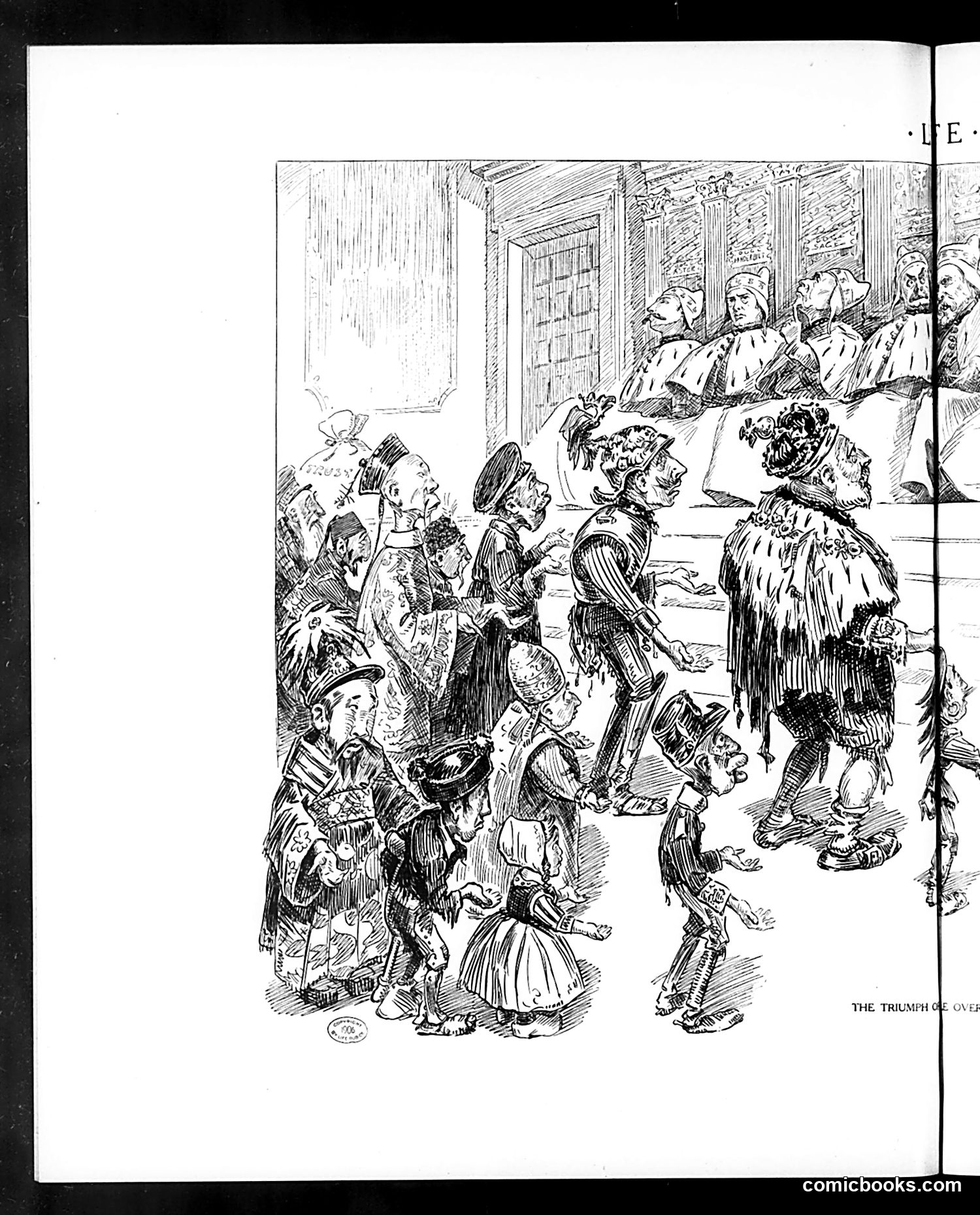
This appears to be a satirical illustration showing what the caption identifies as "THE TRIUMPH OF OV[ER]" (text cut off). The sketch depicts a formal court or official proceeding, with nobility or dignitaries seated elevated on the right, observing a crowd of common people below—many appearing to be caricatured with exaggerated features characteristic of late 19th/early 20th-century satirical art. The composition suggests a commentary on social hierarchy or a specific political event involving the masses appealing to or being judged by authority figures. Without the complete caption, the specific historical reference remains unclear, though the crowded, chaotic scene of ordinary people below contrasted with orderly officials above suggests satire about power dynamics or popular petition versus institutional authority.
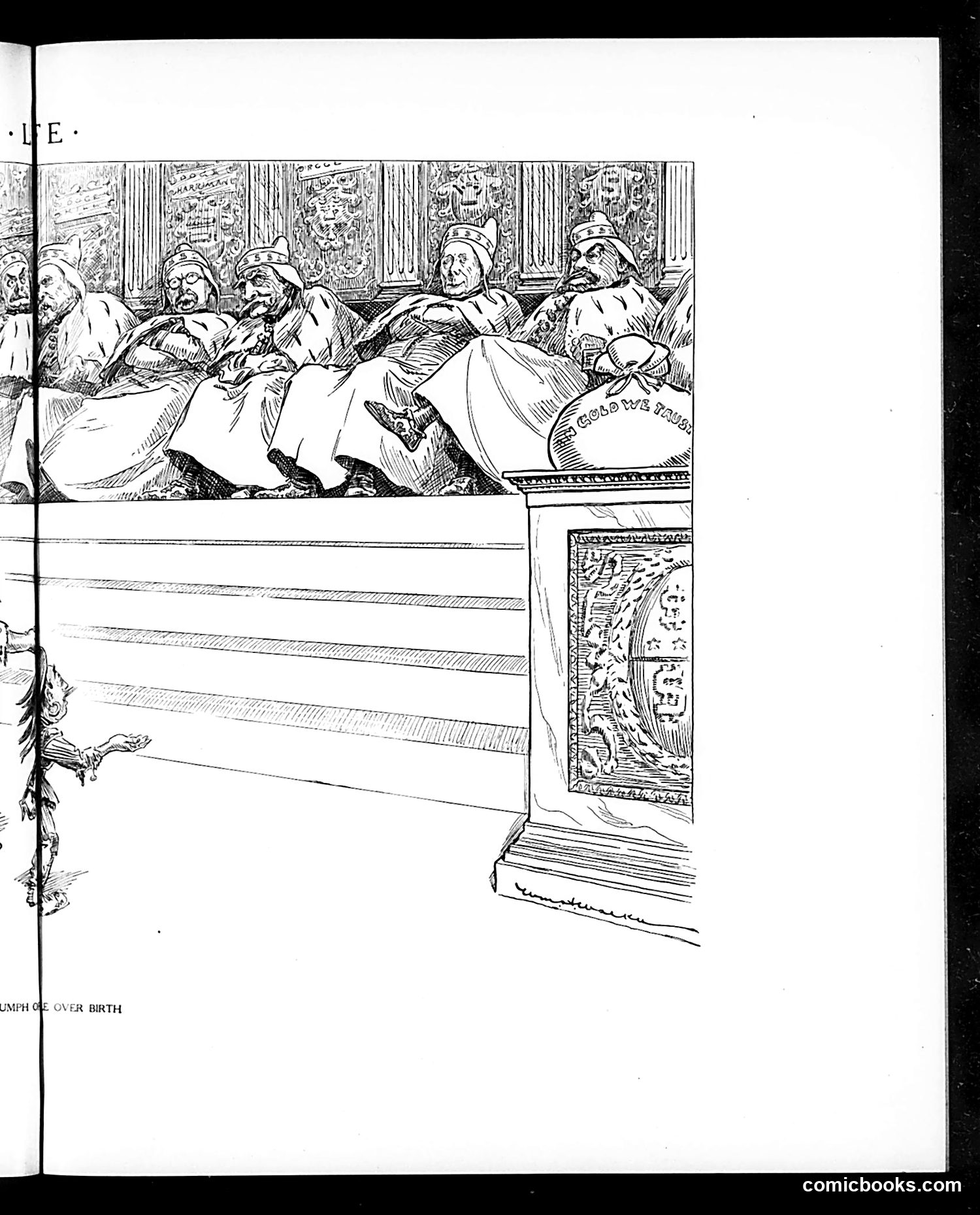
This page shows a single illustrated scene depicting five men in bed together, wearing nightcaps. They appear to be sleeping or resting in what looks like an ornate interior with decorated panels visible in the background. The caption at bottom reads "TRIUMPH OVER BIRTH" (partially visible). Without additional context from the magazine's date or surrounding articles, the specific satirical target is unclear. However, the image appears to be mocking some group of public figures or political personalities through the device of showing them in an undignified domestic situation. The crowded bed arrangement suggests either commentary on overcrowding, shared interests, or possibly political alliance/collusion. The artistic style is consistent with early-to-mid 20th century American satirical cartooning, but without date information or identifying labels visible on the figures themselves, I cannot definitively identify which specific individuals or political situation is being lampooned.
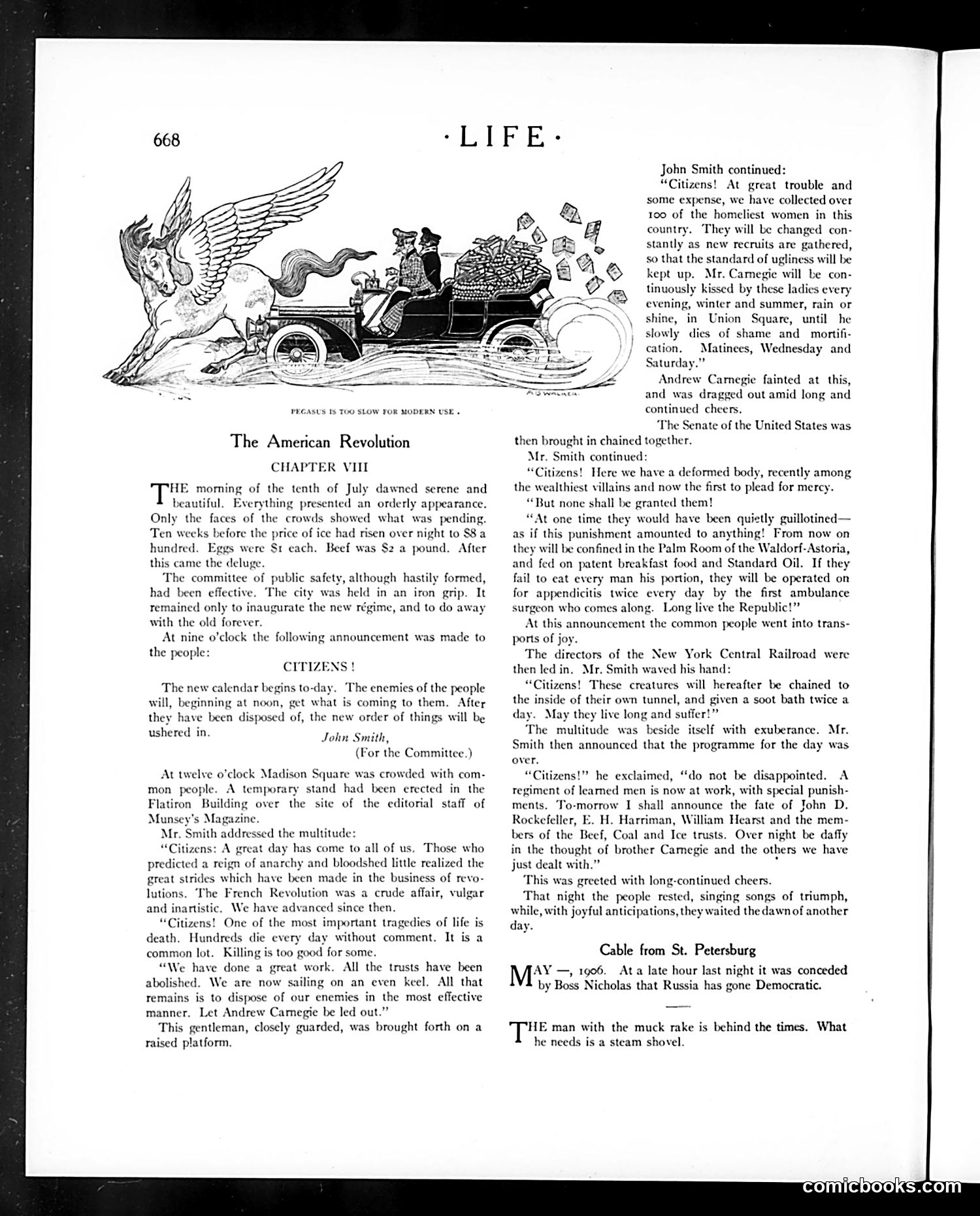
The main cartoon depicts **Pegasus (the mythical winged horse) pulling a modern automobile** laden with money and wealthy figures. The caption reads "PEGASUS IS TOO SLOW FOR MODERN USE," satirizing how even mythical speed cannot keep pace with contemporary American capitalism and greed. The text below presents satirical dialogue attributed to "John Smith" addressing a public gathering about the American Revolution. Smith's rhetoric grotesquely perverts revolutionary ideals into justifications for punishing the poor and enriching industrialists like Andrew Carnegie and Rockefeller. The satire targets how wealthy business magnates of the Gilded Age co-opted patriotic language to legitimize exploitation and inequality, disguising capitalist excess as civic duty. The winged horse symbolizes how even mythology fails to match modernity's relentless material ambition.
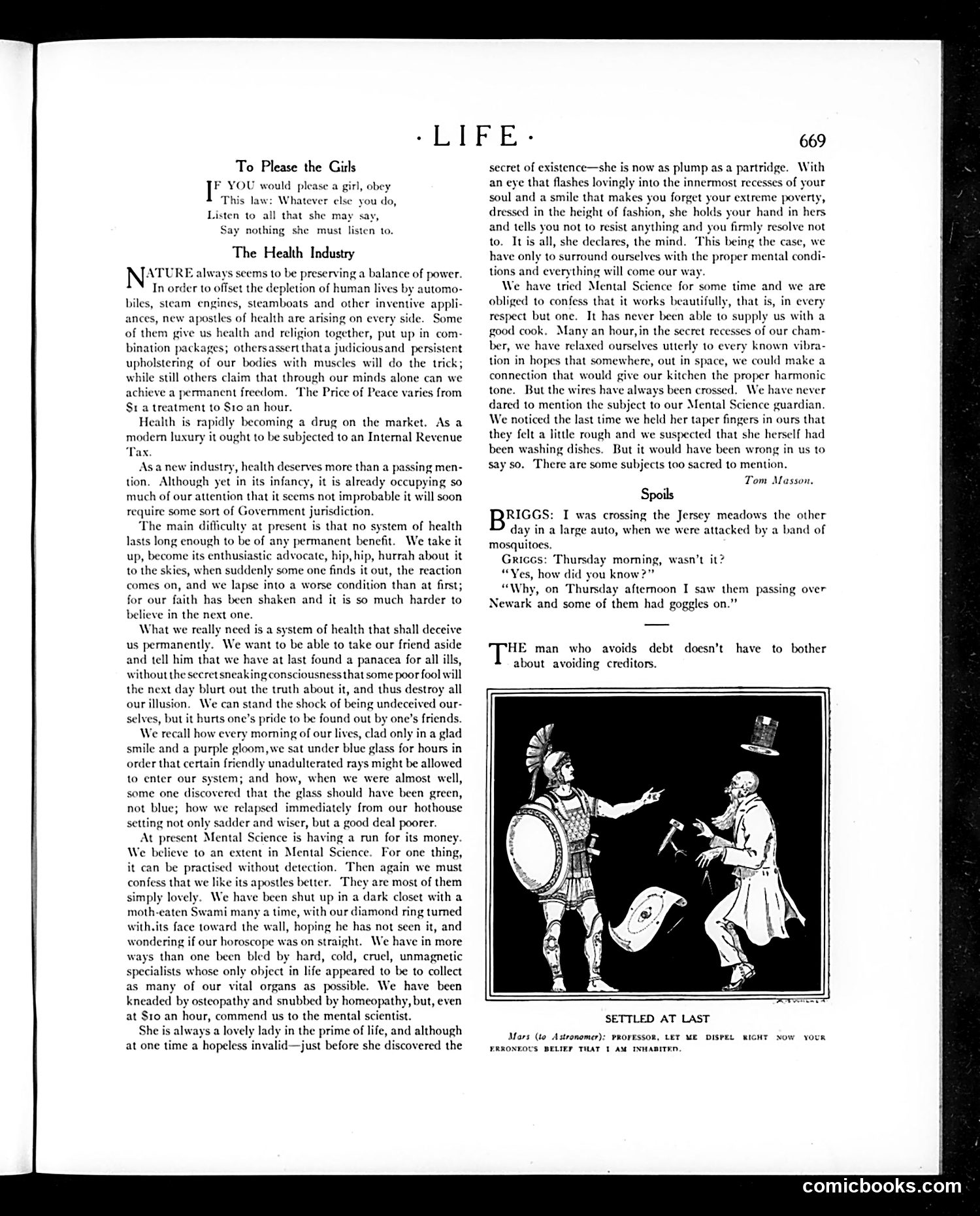
This cartoon depicts a military figure (appears to be a general or high-ranking officer, based on uniform and drum) confronting a smaller civilian figure. The caption reads: "Professor, let me dispel right now your erroneous belief that I am uneducated." The satire likely mocks military-intellectual tensions of the era—specifically, the stereotype that military officers lack education or intellectual capacity. The professor's apparent surprise at the officer's articulate speech inverts expected class hierarchies. The "settled at last" headline suggests this represents a resolution to ongoing cultural debates about military competence and education. The surrounding text discusses health industries and mental science, unrelated to the cartoon's military-intellectual theme.
This poem by W. D. Nesbit mocks the early 20th-century obsession with scientific and expert-driven methods applied to every stage of life. Each stanza references contemporary figures who pioneered new "systems": - **Pasteur/Froebel/Morgan** represent scientific advances in food safety, education, and business organization - **Tarbell/Lawson** are muckraking journalists exposing corporate corruption - **Osler** was a famous physician advocating medical intervention in aging The satire's point: modern life has become over-systematized. From infancy ("Pasteurized") through old age ("Oslerized"), Americans are subjected to endless expert methods and reformist interventions—each naming a real figure whose work became trendy. The poem suggests this obsession with optimization and exposure of wrongdoing, while perhaps well-intentioned, has made existence exhaustingly methodical and vulnerable to constant scrutiny and "correction."
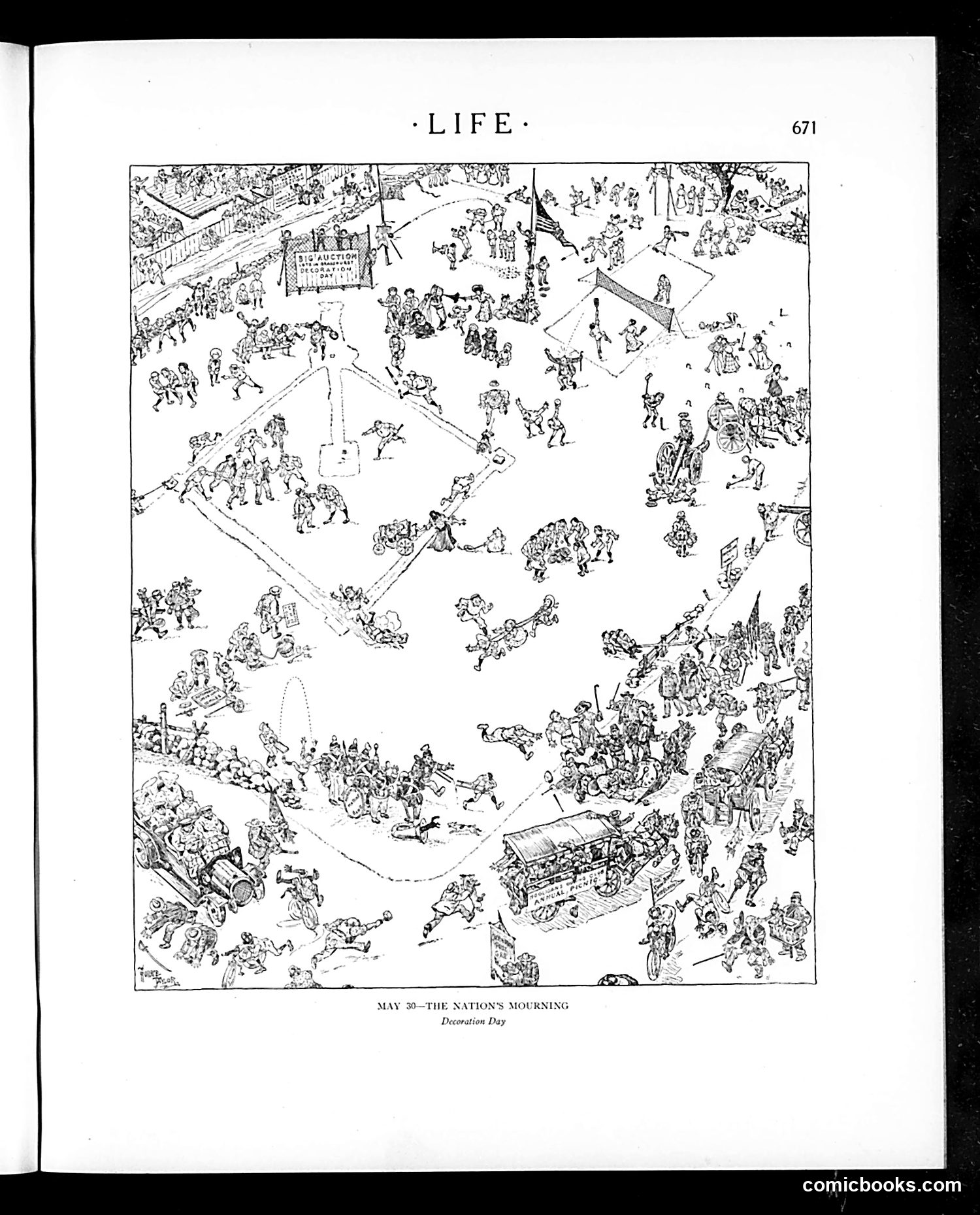
This is a detailed bird's-eye-view illustration depicting Decoration Day (now Memorial Day) observances. The drawing shows a cemetery scene with numerous people scattered throughout—some gathered in groups around graves, others processing or standing in procession. There's what appears to be a flag or banner visible in the upper left, and various monuments or structures typical of a cemetery layout. The satire likely critiques how Americans observed this patriotic holiday—possibly commenting on the contrast between solemn memorial purpose and actual public behavior, crowd management, or commercialization of the day. The crowded, somewhat chaotic composition with figures engaged in varied activities suggests commentary on how the nation actually "mourned" versus how it should have. The specific social critique remains unclear without additional historical context.
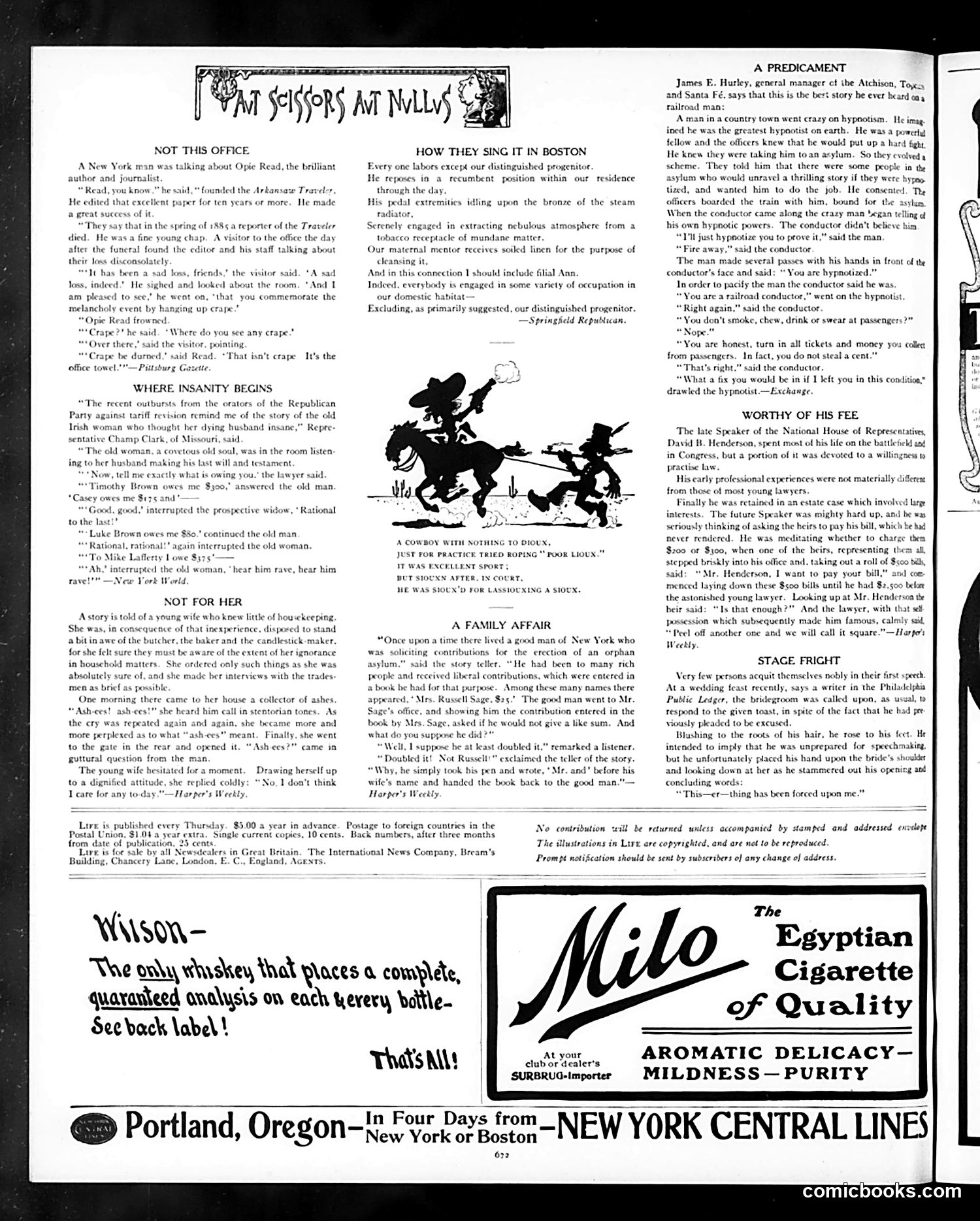
This Life magazine page contains several satirical pieces mocking human foibles and social pretensions: **"Not This Office"** ridicules an editor's false sentimentality—he refuses to hang mourning crepe for a dead reporter, dismissing it as merely "the office towel." **"Where Insanity Begins"** satirizes a dying man's confused priorities: as he lists his debtors to his wife, she interrupts only when he mentions money *owed to him*—revealing her mercenary nature. **"Not For Her"** jokes about a housewife's insecurity about domestic knowledge; mishearing "ashes" (ashcans), she pretentiously refuses them, fearing the tradesman will expose her ignorance. **"How They Sing It in Boston"** parodies overly elaborate, pretentious Boston speech patterns by rendering commonplace domestic life in absurdly flowery language. The cartoons use exaggeration and irony to expose vanity, greed, and class anxiety among ordinary Americans.
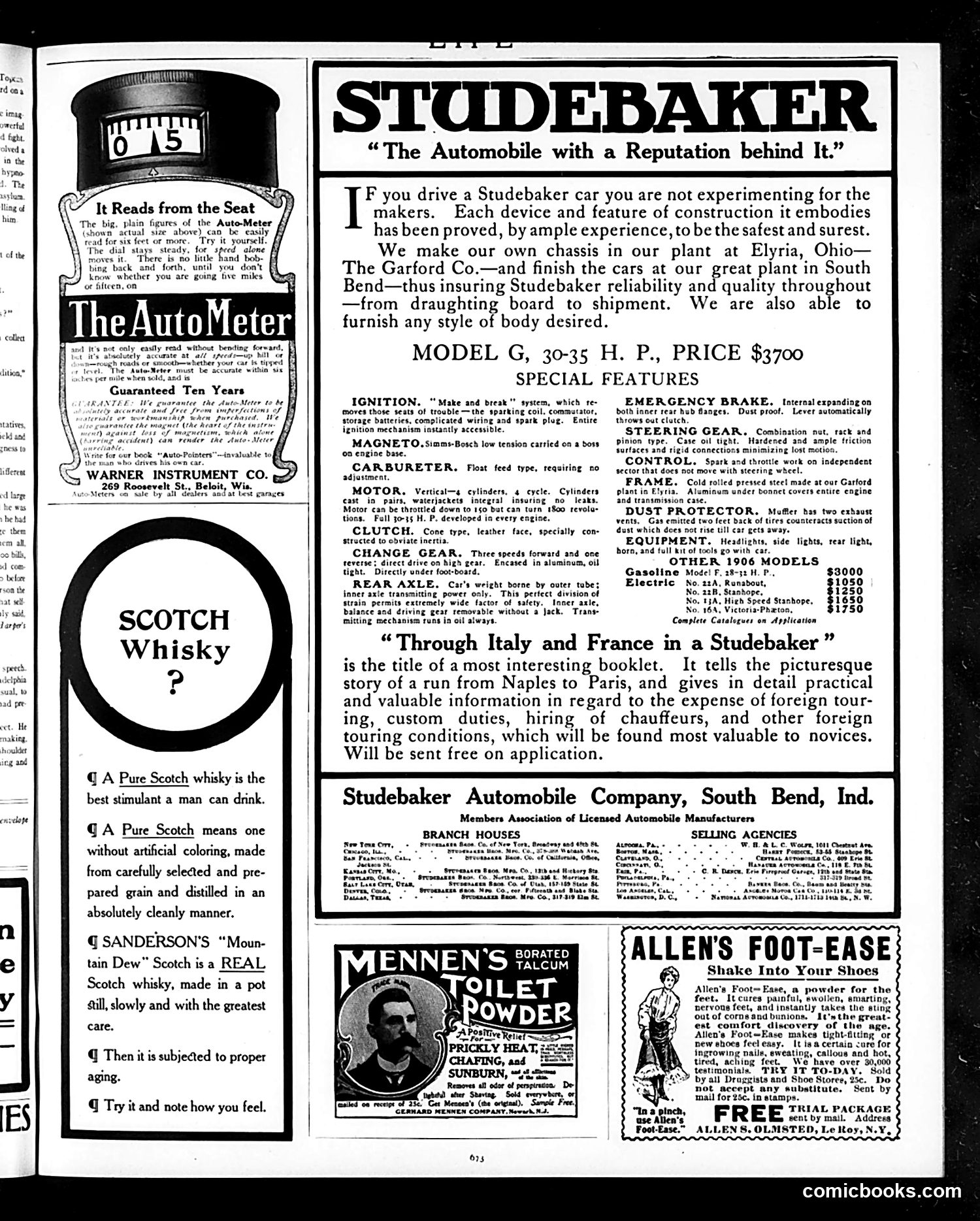
This page is primarily **advertising**, not political satire. It contains three separate ads: 1. **The AutoMeter** (top left): A speedometer advertisement emphasizing easy readability and accuracy—a novel feature when cars were still relatively new. 2. **Studebaker automobiles** (center/right): The main ad highlights the Model G priced at $3,700, emphasizing that each component has been "proved by ample experience" to be "safe and surest." This reflects early automotive marketing's focus on reliability and safety as selling points—concerns for a still-experimental technology. 3. **Scotch whisky and other products** (left and bottom right): Period advertisements for Sanderson's whisky and Allen's Foot-Ease powder. There is **no political cartoon or satire** on this page. It represents typical early 1900s magazine advertising, when automobiles were luxury items requiring detailed explanation of mechanical features to potential buyers unfamiliar with automotive technology.
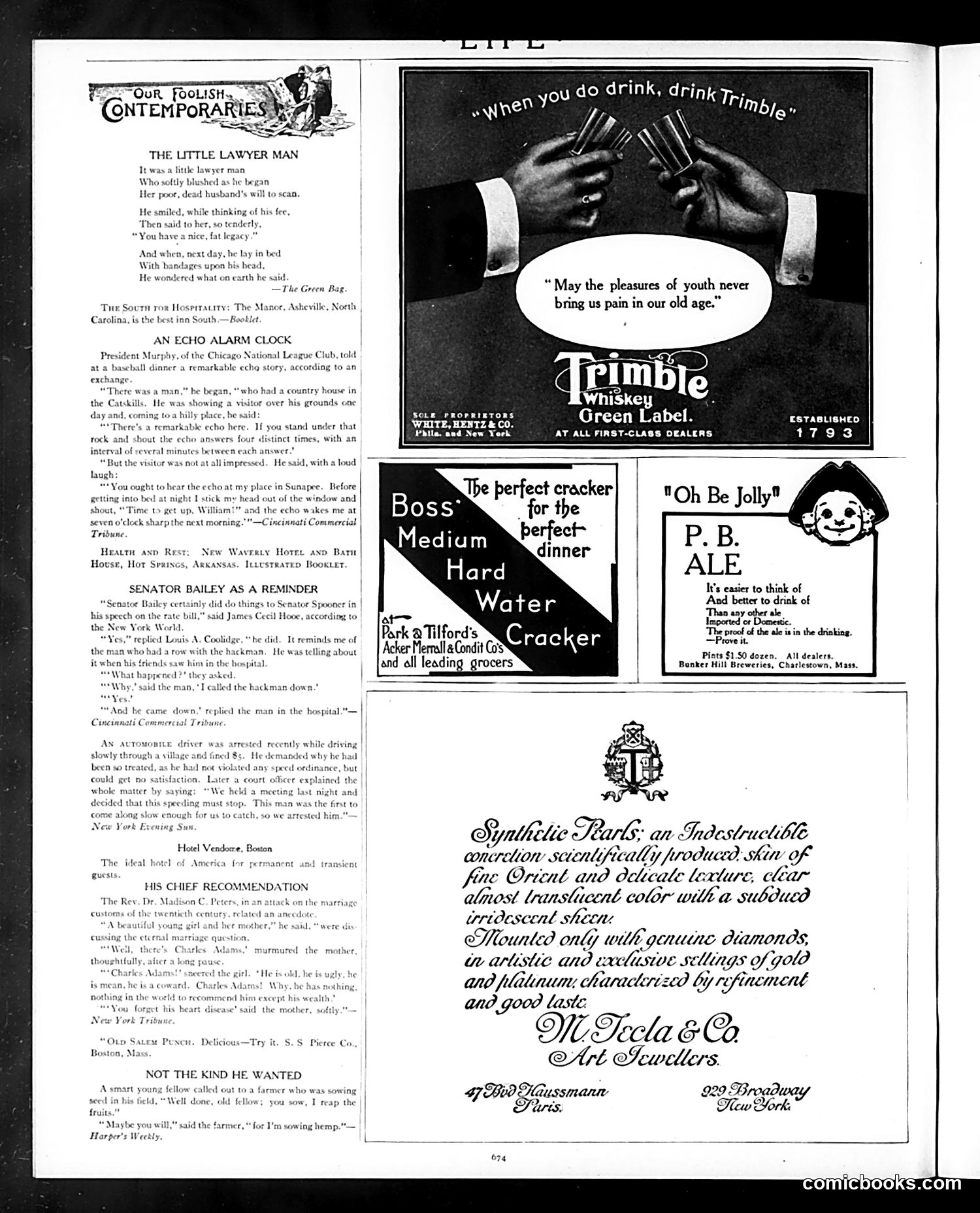
This page from *Life* magazine is primarily **advertising**, not political satire. It contains several liquor and luxury goods advertisements typical of the early 20th century. The content includes humorous anecdotes and short stories in the left column—including "The Little Lawyer Man," "Senator Bailey as a Reminder," and "His Chief Recommendation"—which appear to be satirical vignettes mocking human nature and social pretension, though their specific targets are unclear without fuller context. The advertisements dominate: **Trimble Whiskey** (established 1793) uses a moralistic drinking toast; **Boss Hard Water Cracker** emphasizes product quality; **P.B. Ale** makes a playful drinking reference; and **M. Tecla & Co.** advertises synthetic pearls and jewelry. The page reflects early 1900s commercial culture and period advertising conventions, with little overt political content visible.
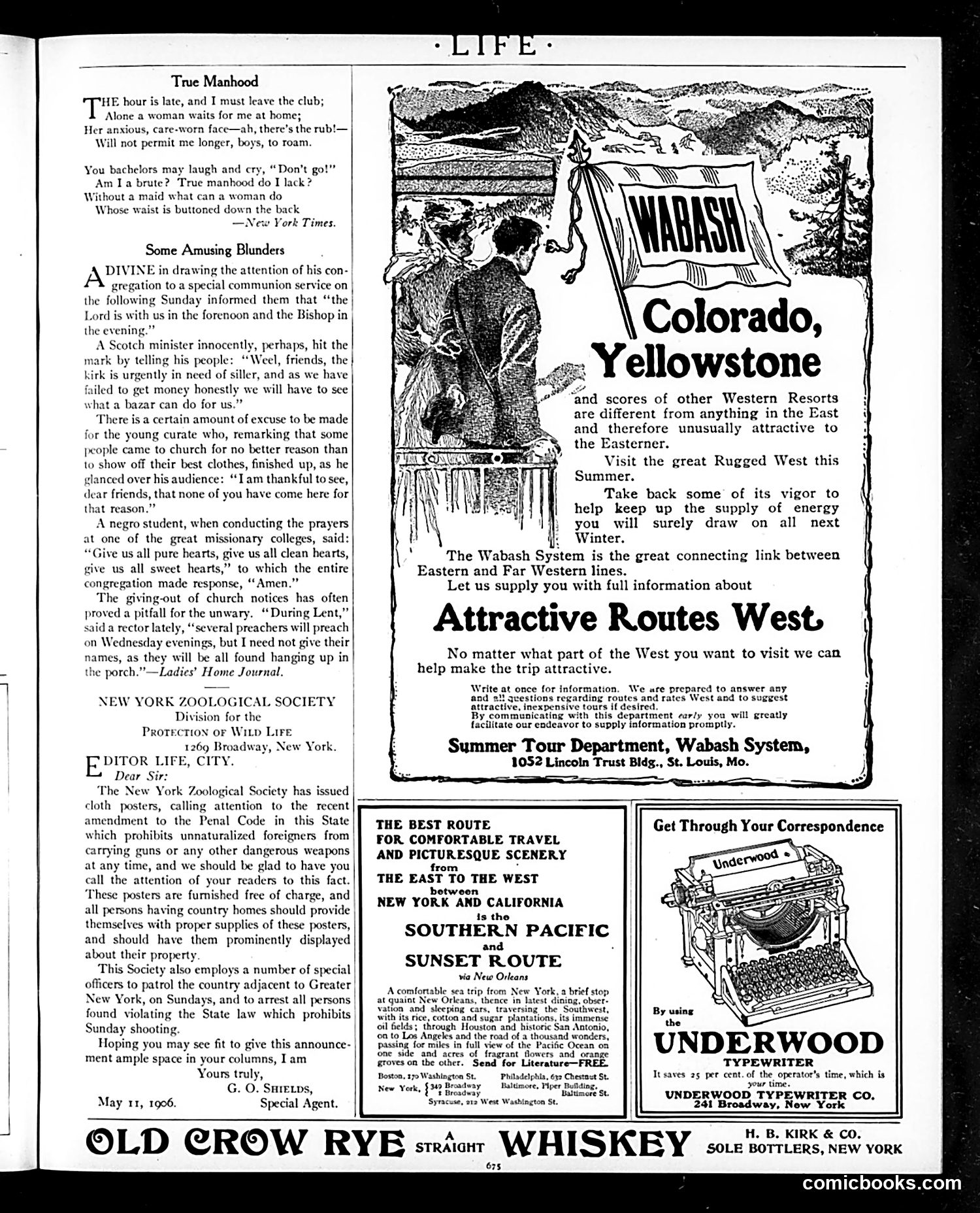
This page contains three distinct sections: **"True Manhood" Poem**: Satirizes married men who linger at clubs while wives await them at home. The joke hinges on the final line's absurd logic—the wife's corset ("waist is buttoned down the back") becomes the reason a man must leave, implying women are helpless without male assistance. This mocks both domestic expectations and the restrictive fashion of the era. **"Some Amusing Blunders"**: A humor column collecting unintentional comedic remarks from clergy. Examples include a minister accidentally equating the Bishop with God, and a rector's unclear church notices. These lampoon clerical pretension and verbal mistakes. **Advertisements**: The page is largely advertising—railroad tourism (Wabash System, Southern Pacific), typewriters (Underwood), and whiskey (Old Crow Rye)—interspersed with a letter from the NYC Zoological Society about gun regulations for unnaturalized foreigners. The cartoons are minimal; the satire is primarily textual, targeting marital dynamics, religious figures, and male club culture.
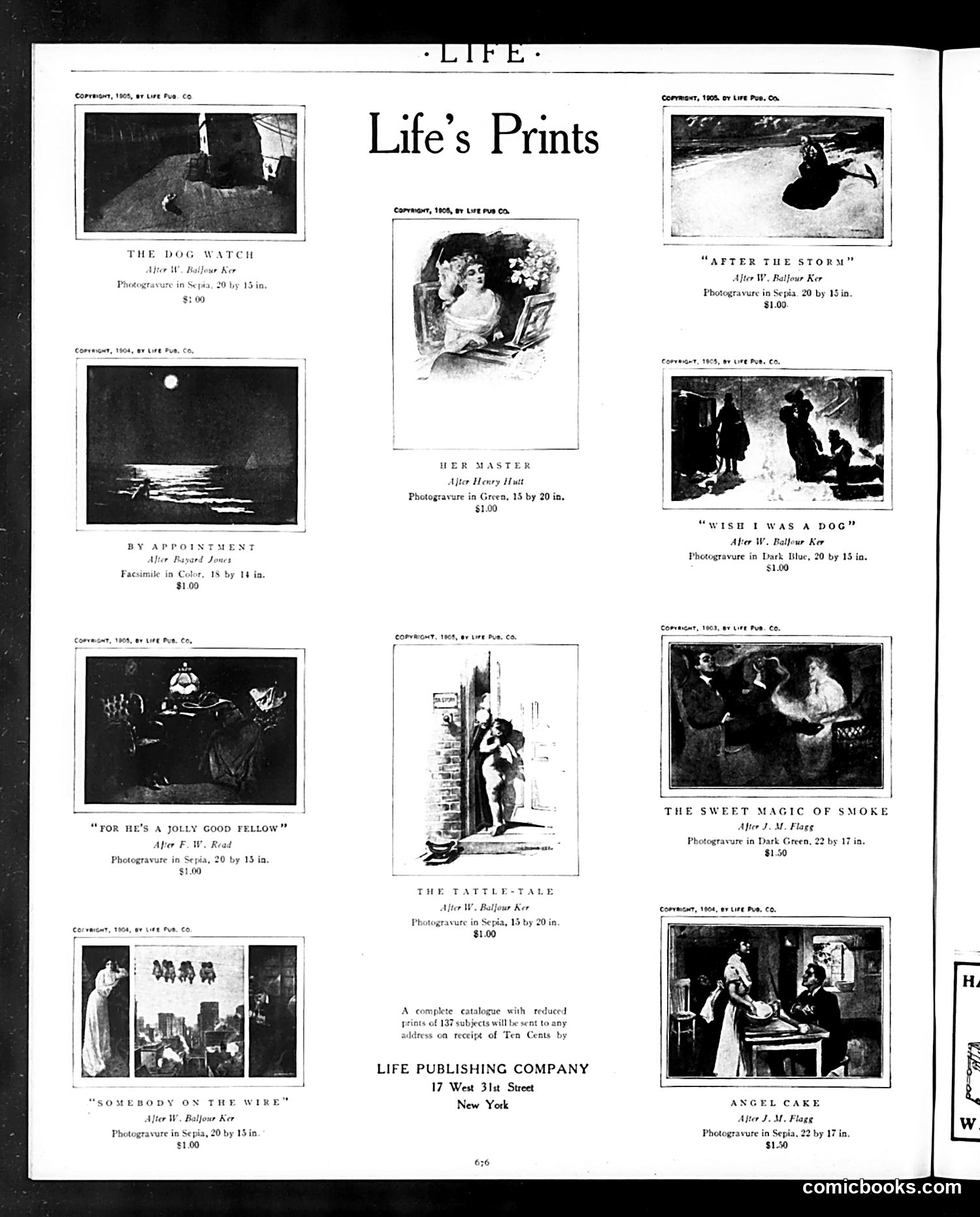
This page is a **catalog of art prints** for sale by Life Publishing Company, not political satire. It advertises photogravures and facsimiles of illustrations by popular artists including W. Balfour Ker, Henry Hutt, J.M. Flagg, and others. The titles suggest **sentimental or humorous domestic scenes** typical of the era: "Her Master" (likely a dog), "Wish I Was a Dog," "Angel Cake," "The Sweet Magic of Smoke," and "For He's a Jolly Good Fellow." These appear to be genre illustrations capturing everyday life and sentiment. Prices ranged from $1.00 to $1.50. The company offered a complete 137-subject catalog for ten cents. This represents Life's merchandising of its editorial artwork as home decoration—a common publishing practice in the early 1900s.
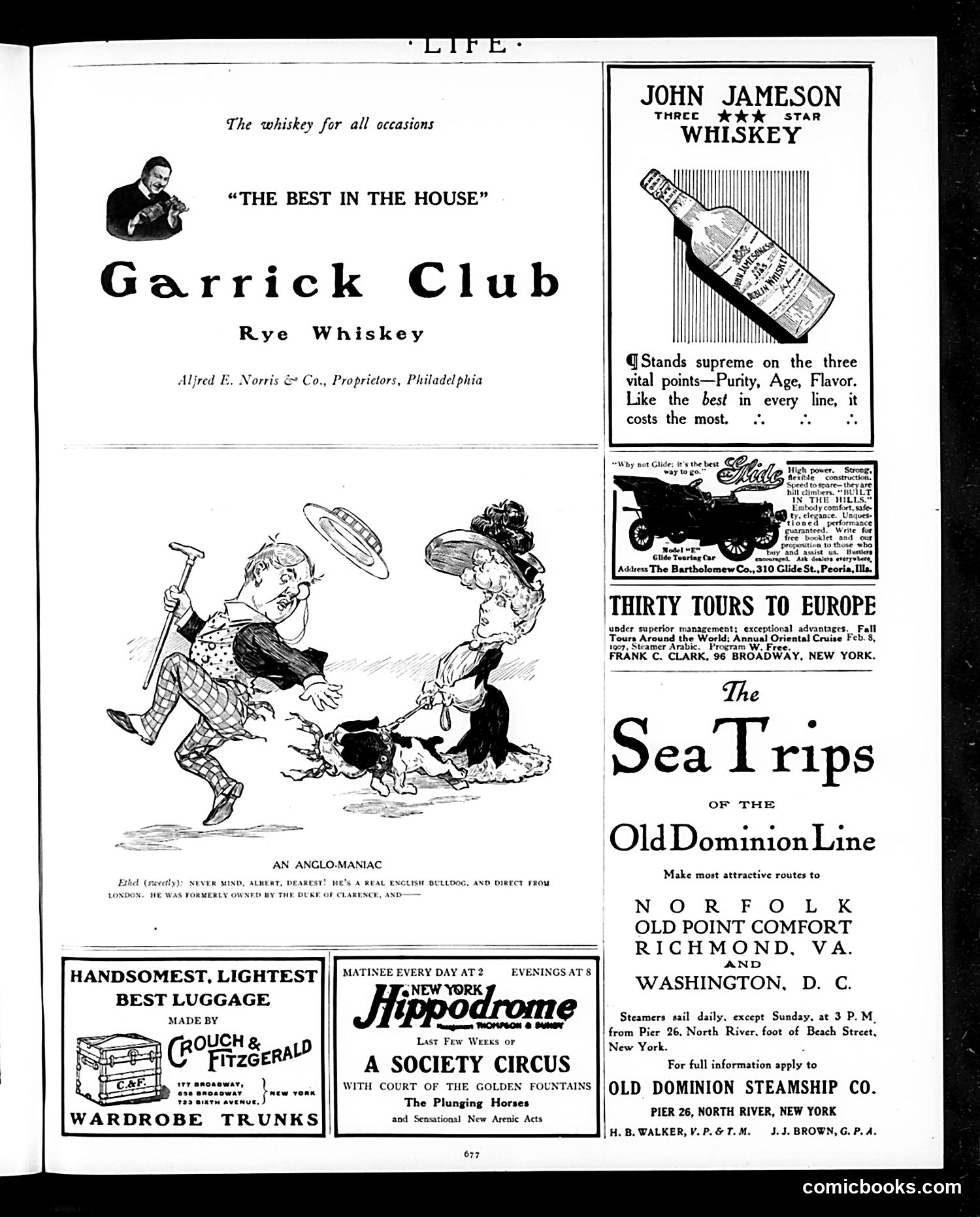
This page is primarily **advertising**, with one small cartoon titled "An Anglo-Maniac." The cartoon depicts a woman (Ethel) presenting a bulldog to a man (Albert), claiming it's "a real English bulldog, direct from London" formerly owned by the Duke of Clarence. The satire targets **Anglophilia**—the affectation of adopting British manners and possessions among wealthy Americans. The joke is that Ethel is ostentatiously name-dropping aristocratic ownership to impress Albert, suggesting that Americans of this era were susceptible to snobbish appeals to British prestige. The page otherwise contains period advertisements for whiskey (Garrick Club, John Jameson), travel tours to Europe, steamship lines, luggage trunks, and theater entertainment—typical early-1900s Life magazine content aimed at affluent readers.
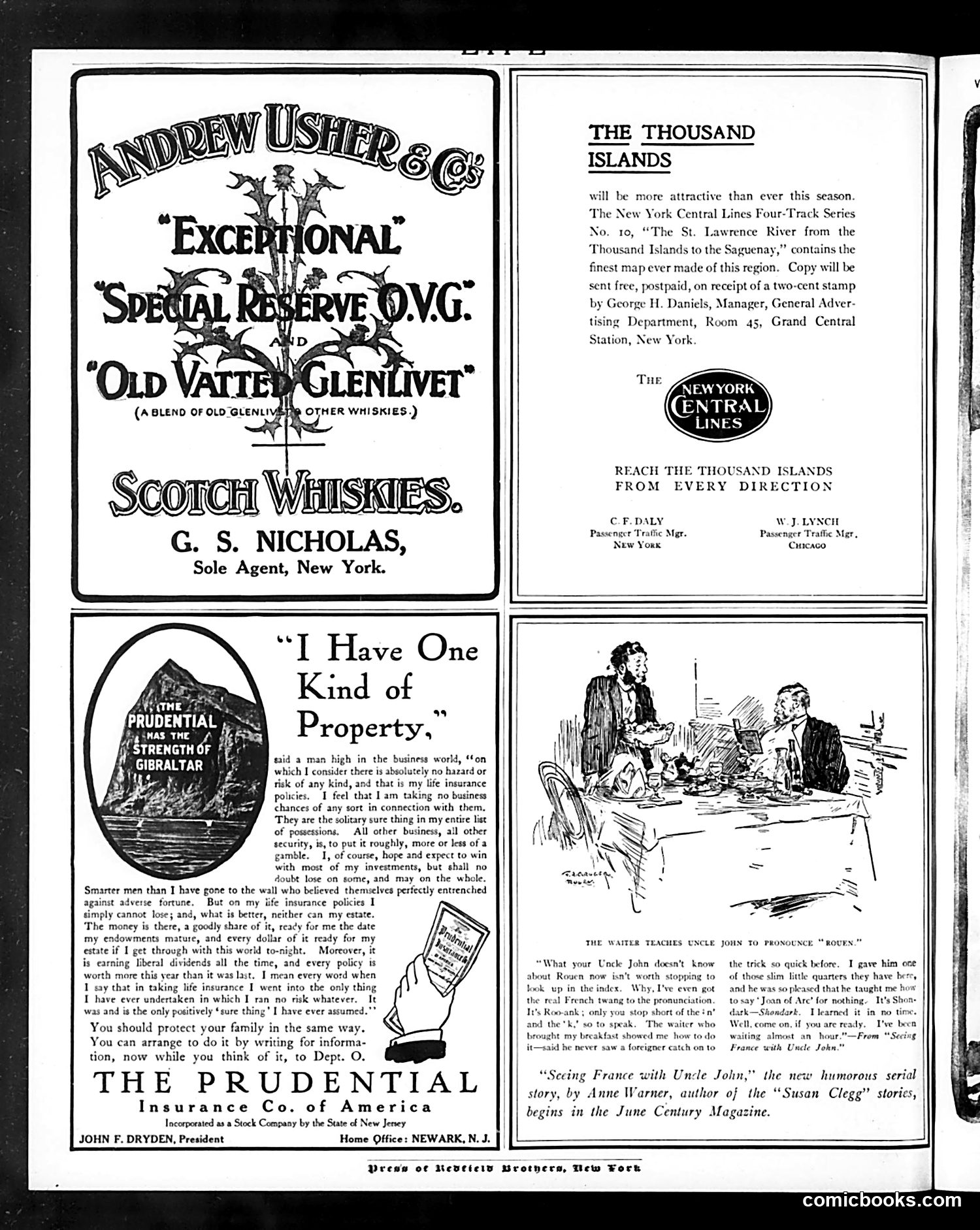
This page is primarily **advertising**, with three distinct sections: **Top Left:** Whisky advertisement for Andrew Usher & Co.'s Scotch whiskies, sold by G.S. Nicholas in New York. **Top Right:** New York Central Lines railroad ad promoting tourist travel to the Thousand Islands region. **Bottom Left:** Prudential Insurance advertisement featuring a businessman's testimonial about life insurance as the only "sure thing" in business—a safe investment guaranteed to protect his family. The ad emphasizes security and guaranteed returns. **Bottom Right:** A cartoon illustration captioned "The Waiter Teaches Uncle John to Pronounce 'Rouen,'" depicting a humorous scene where a waiter corrects an American tourist's mispronunciation of the French city. This illustrates an advertisement for an upcoming serial story called "Seeing France with Uncle John" by Anne Warner, appearing in *Century Magazine*—poking gentle fun at American travelers abroad. The page reflects early 20th-century consumer culture targeting middle-class readers through lifestyle advertising and serialized fiction.