
Life, 1906-05-31 · page 4 of 22
Life — May 31, 1906 — page 4: what you’re looking at
What you’re looking at
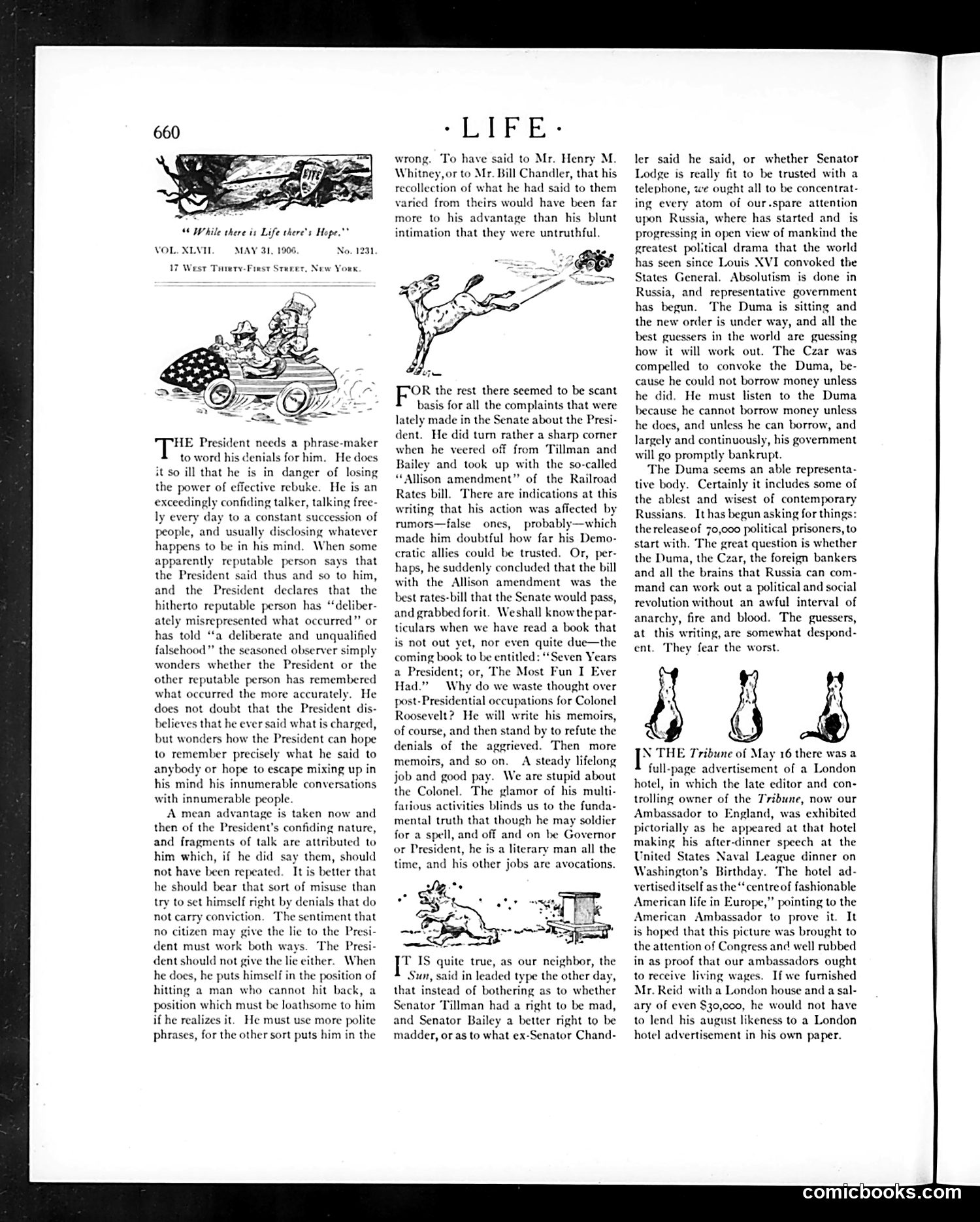
This editorial page critiques President Theodore Roosevelt's communication style and political denials. The main article argues that Roosevelt needs a "phrase-maker" because he frequently denies saying things he actually said to various political figures (Henry M. Whitney, Bill Chandler, Senator Lodge). The author notes Roosevelt's contradictions undermine trust. The piece then discusses Roosevelt's "Allison amendment" regarding railroad rates and his apparent doubts about Democratic allies' trustworthiness. A secondary item mentions a London hotel advertisement featuring the American Ambassador, suggesting Congress should see it as evidence of American prestige abroad. The cartoons (small sketches visible) appear to satirize these political inconsistencies, though specific subjects are difficult to identify clearly in this reproduction.
📄 Transcribed text from this page (OCR, searchable)
Machine-transcribed from the original scan — historical spelling and the odd misread are preserved.
“While there is Life there's Hope.”* LVIT. | MAY 31, 1906. West Tuery-Finst Stee HE President needs a phrase-maker to word his denials for him. He does it so ill that he is in danger of losing the power of effective rebuke. He is an exceedingly confiding talker, talking free- ly every day to a constant succession of people, and usually disclosing whatever happens to be in his mind, When some apparently reputable person says that the President said thus and so to him, and the President declares that the hitherto reputable person has “deliber- ately misrepresented what occurred” or has told “‘a deliberate and unqualified falsehood” the seasoned observer simply wonders whether the President or the other reputable person has remembered what occurred the more accurately. He does not doubt that the President di: believes that he ever said what is charged, but wonders how the President can hope to remember precisely what he said to anybody or hope to escape mixing up in his mind his innumerable conversations with innumerable people. A mean advantage is taken now and then of the President's confiding nature, and fragments of talk are attributed to him which, if he did say them, should not have been repeated. It is better that he should bear that sort of misuse than self right by denials that do y The sentiment that no citizen may give the lie to the Presi- dent must work both ways. The Presi dent should not give the lie either. When he does, he puts himself in the position of hitting a man who cannot hit back, a position which must be loathsome to him if he realizes it. He must use more polite phrases, for the other sort puts him in the -LIFE- wrong. To have said to Mr. Henry M. Whitney, or to Mr. Bill Chandler, that his recollection of what he had said to them varied from theirs would have been far more to his advantage than his blunt intimation that they were untruthful. ‘OR the rest there seemed to be scant basis for all the complaints that were lately made in the Senate about the Presi- dent. He did tum rather a sharp corner when he veered off from Tillman and Bailey and took up with the so-called “Allison amendment” of the Railroad Rates bill. There are indications at this writing that his action was affected by rumors—false ones, probably—which made him doubtful how far his Demo- cratic allies could be trusted. Or, per- haps, he suddenly concluded that the bill with the Allison amendment was the best rates-bill that the Senate would pass, and grabbed forit. Weshall know the par- ticulars when we have read a book that is not out yet, nor even quite due—the coming book to be entitled: “Seven Years a President; or, The Most Fun I Ever Had.” Why do we waste thought over post-Presidential occupations for Colonel Roosevelt? He will write his memoirs, of course, and then stand by to refute the denials of the aggrieved. Then more memoirs, and so on. A steady lifelong job and good pay. We are stupid about the Colonel. The glamor of his multi- farious activities blinds us to the funda- mental truth that though he may soldier for a spell, and off and on be Governor or President, he is a literary man all the time, and his other jobs are avocations. IS quite true, as our n Sun, said in leaded type the other day, that instead of bothering as to whether Senator Tillman had a right to be mad, and Senator Bailey a better right to be madder, or as to what ex-Senator Chand- ler said he said, or whether Senator Lodge is really fit to be trusted with a telephone, we ought all to be concentrat- ing every atom of our.spare attention upon Russia, where has started and is progressing in open view of mankind the greatest political drama that the world has seen since Louis XVI convoked the States General. Absolutism is done in Russia, and representative government has begun. The Duma is sitting and the new order is under way, and all the best gu in the world are guessing how it will work out. The Czar was compelled to convoke the Duma, be- cause he could not borrow money unless he did. He must listen to the Duma because he cannot borrow money unless he does, and unless he can borrow, and largely and continuously, his government will go promptly bankrupt. The Duma scems an able representa- tive body. Certainly it includes some of the ablest and wisest of contemporary Russians. It has begun asking for things: the releaseof 70,000 political prisoners, to start with. The great question is whether the Duma, the Czar, the foreign bankers and all the brains that Russia can com- mand can work out a political and social revolution without an awful interval of anarchy, fire and blood. The guessers, at this writing, are somewhat despond- They fear the worst. THE Tribune of May 16 there was a full-page advertisement of a London hotel, in which the late editor and con- owner of the Tribune, now our ador to England, was exhibited pictorially as he appeared at that hotel making his after-dinner speech at the United States Naval League dinner on Washington’s Birthday. The hotel ad- vertised itself as the “centre of fashionable American life in Europe,” pointing to the American Ambassador to prove it. It is hoped that this picture was brought to the attention of Congress and well rubbed in as proof that our ambassadors ought to receive living wages. If we furnished Mr. Reid with a London house and a sal- ary of even $30,000, he would not have to lend his august likeness to a London hotel advertisement in his own paper. comicbooks.com