
Life, 1906-05-31 · page 14 of 22
Life — May 31, 1906 — page 14: what you’re looking at
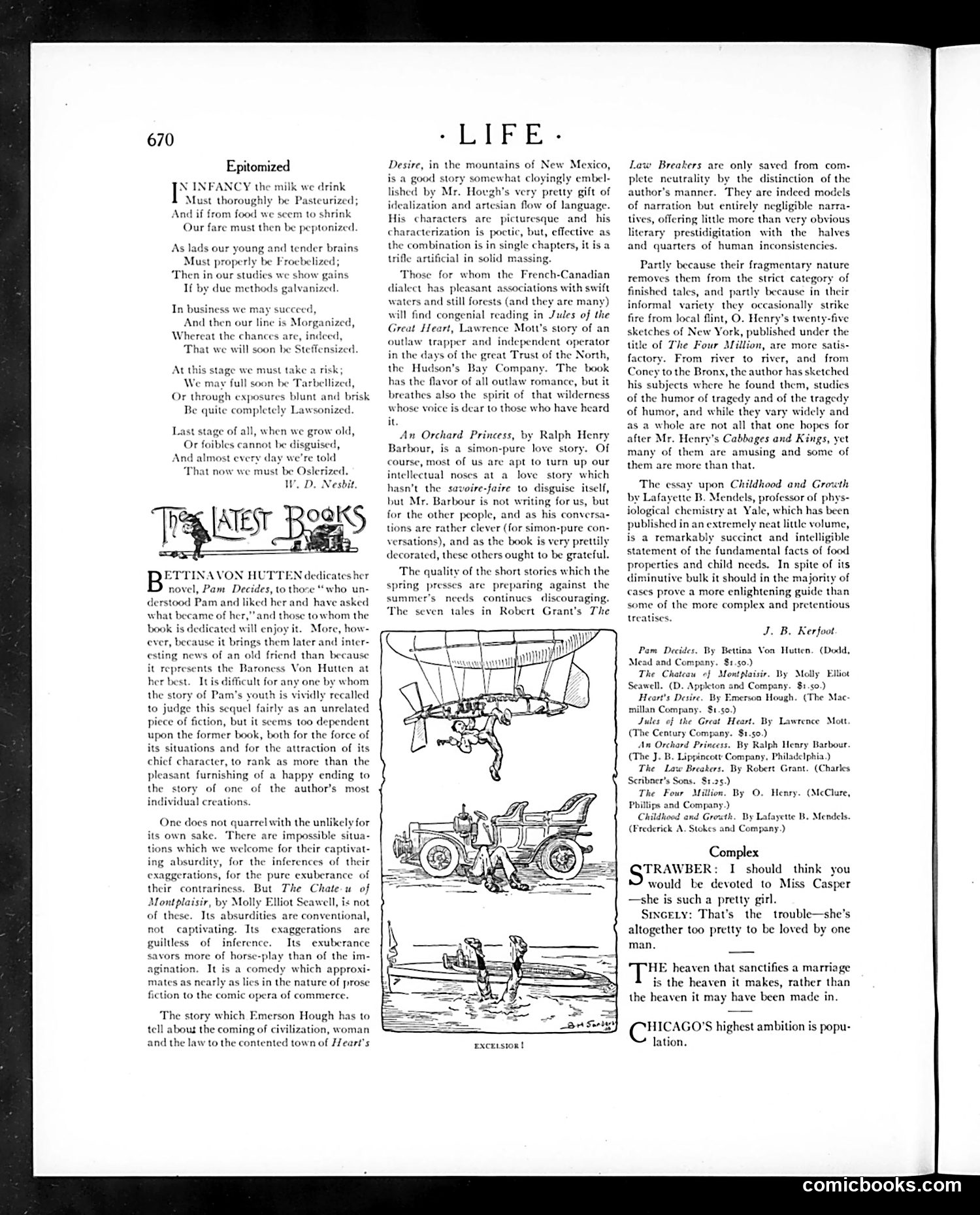
What you’re looking at
This poem by W. D. Nesbit mocks the early 20th-century obsession with scientific and expert-driven methods applied to every stage of life. Each stanza references contemporary figures who pioneered new "systems": - **Pasteur/Froebel/Morgan** represent scientific advances in food safety, education, and business organization - **Tarbell/Lawson** are muckraking journalists exposing corporate corruption - **Osler** was a famous physician advocating medical intervention in aging The satire's point: modern life has become over-systematized. From infancy ("Pasteurized") through old age ("Oslerized"), Americans are subjected to endless expert methods and reformist interventions—each naming a real figure whose work became trendy. The poem suggests this obsession with optimization and exposure of wrongdoing, while perhaps well-intentioned, has made existence exhaustingly methodical and vulnerable to constant scrutiny and "correction."
📄 Transcribed text from this page (OCR, searchable)
Machine-transcribed from the original scan — historical spelling and the odd misread are preserved.
670 Epitomized I INFANCY the milk we drink Must thoroughly be Pasteurized; And if m food we seem to shrink Our fare must then be peptonized. As lads our young and tender brains Must properly be Froebelized; ‘Then in our studies we show gains If by due methods galvanized. In business we may succeed, And then our line is Morganized, Whereat the chances are, indeed, That we will soon be Steffensized At this stage we must take a risk; We may full soon be Tarbellized, Or through exposures blunt and brisk Be quite completely Lawsonized. st stage of all, when we grow old, Or foibles cannot be disguised, And almost every day we're told That now we must be Oslerized. W. D. Nesbit. B PINAVON HUTTEN dedicates her novel, Pam Decides, to thoce “who un- derstood Pam and liked her and have asked what became of her,""and those to whom the book is dedicated will enjoy it ever, because it brings them later and inter- esting news of an old friend than because it represents the Baroness Von Hutten at her best. It is difficult for any one by whom the story of Pam’s youth is vividly recalled to judge this sequel fairly as an unrelated piece of fiction, but it scems too dependent upon the former book, both for the force of its situations and for the attraction of its chicf character, to rank as more than the pleasant furnishing of a happy ending to the story of one of the author's individual creations. More, how- most One does not quarrel with the unlikely for its own sake. There are impossible situa- tions which we welcome for their captivat- ing absurdity, for the inferences of their exaggerations, for the pure exuberance of their contrariness. But The Chate-u of Montplaisir, by Molly Elliot Seawell, is not of these. Its absurdities are conventional, not captivating. Its exaggerations are guiltless of inference. Its exuberance savors more of horse-play than of the im- agination. It is a comedy which approxi- mates as nearly as lies in the nature of prose fiction to the comic opera of commerce. ‘The story which Emerson Hough has to tell abous the coming of civilization, woman and the law to the contented town of Heart's -LIFE.- Desire, in the mountains of New Mexico, is a good story somewhat cloyingly embel- lished by Mr. Hovgh’s very pretty gift of idealization and artesian flow of languaj His characters are picturesque and_ his characterization is poctic, but, effective as the combination is in single chapters, it is a trifle artificial in solid massing. Those for whom the French-Canadian dialect has pleasant associations with swift waters and still forests (and they are many) will find congenial reading in Jules of the Great Heart, Lawrence Mott's story of an outlaw trapper and independent operator in the days of the great Trust of the North, the Hudson's Bay Company. The book has the flavor of all outlaw romance, but it breathes also the spirit of that wilderness whose voice is dear to those who have heard it An Orchard Princess, by Ralph Henry Barbour, is a simon-pure love story. Of course, most of us are apt to turn up our intellectual noses at a story which hasn’t the savoire-faire to disguise itself, but Mr. Barbour is not writing for us, but for the other people, and as his conversa- tions 3 versations), and as the book is very prettily decorated, these others ought to be grateful. The quality of the short stories which the spring presses are preparing against the summer's needs continues discouraging. The seven tales in Robert Grant's The love e rather clever (for simon-pure con- Excrtsior! Law Breakers are only saved from com- plete neutrality by the distinction of the author's manner. They are indeed models of narration but entirely negligible narra- tives, offering little more than very obvious literary prestidigitation with the halves and quarters of human inconsistencies. Partly because their fragmentary nature removes them from the strict category of finished tales, and partly because in their informal variety they occasionally strike fire from local flint, O. Henry’s twenty-five sketches of New York, published under the ¢ of The Four Million, are more satis- factor From river to river, and from Coney to the Bronx, the author has sketched his subjects where he found them, studies of the humor of tragedy and of the tragedy of humor, and while they vary widely and as a whole are not all that one hopes for after Mr. Henry's Cabbages and Kings, yet many of them are amusing and some of them are more than that. The essay upon Childhood and Growth by Lafayette B. Mendels, professor of phys- iological chemistry at Yale, which has been published in an extremely neat little volume, is a remarkably succinct and intelligible statement of the fundamental facts of food properties and child needs. In spite of its diminutive bulk it should in the majority of cases prove a more enlightening guide than some of the more complex and pretentious treatises. J.B. Kerfoot Pam Decides. By Bettina Von Hutten. (Dodd, Mead and Company. $1.50.) The Chateau of Montplaisir. By Molly El Seawell. (D. Appleton and Company. 81.50.) Heart's Desire. By Emerson Hough. (The M. millan Company. $1.50.) Jules of the Great Heart. By Lawrence Mott (The Century Company. $1.50.) An Orchard Princess. By Ralph Henry Barbour. (The J. B. Lippincott Company, Philadelphia.) The Lave Breakers. By Robert Grant. (Charles Scribner's Sons. $1.25.) he Four Million. By O, Henry. (McClure, Phillips and Company.) Childhood and Growth. By Lafayette B. Mendels (Frederick A. Stokes and Company.) Complex TRAWBER: I should think you would be devoted to Miss Casper —she is such a pretty girl. Sincety: That's the trouble—she altogether too pretty to be loved by one man. 'HE heaven that sanctifies a marriage is the heaven it makes, rather than the heaven it may have been made in. HICAGO’S highest ambition is popu- lation. comicbooks.com