
A complete issue · 24 pages · 1906
Life — March 29, 1906
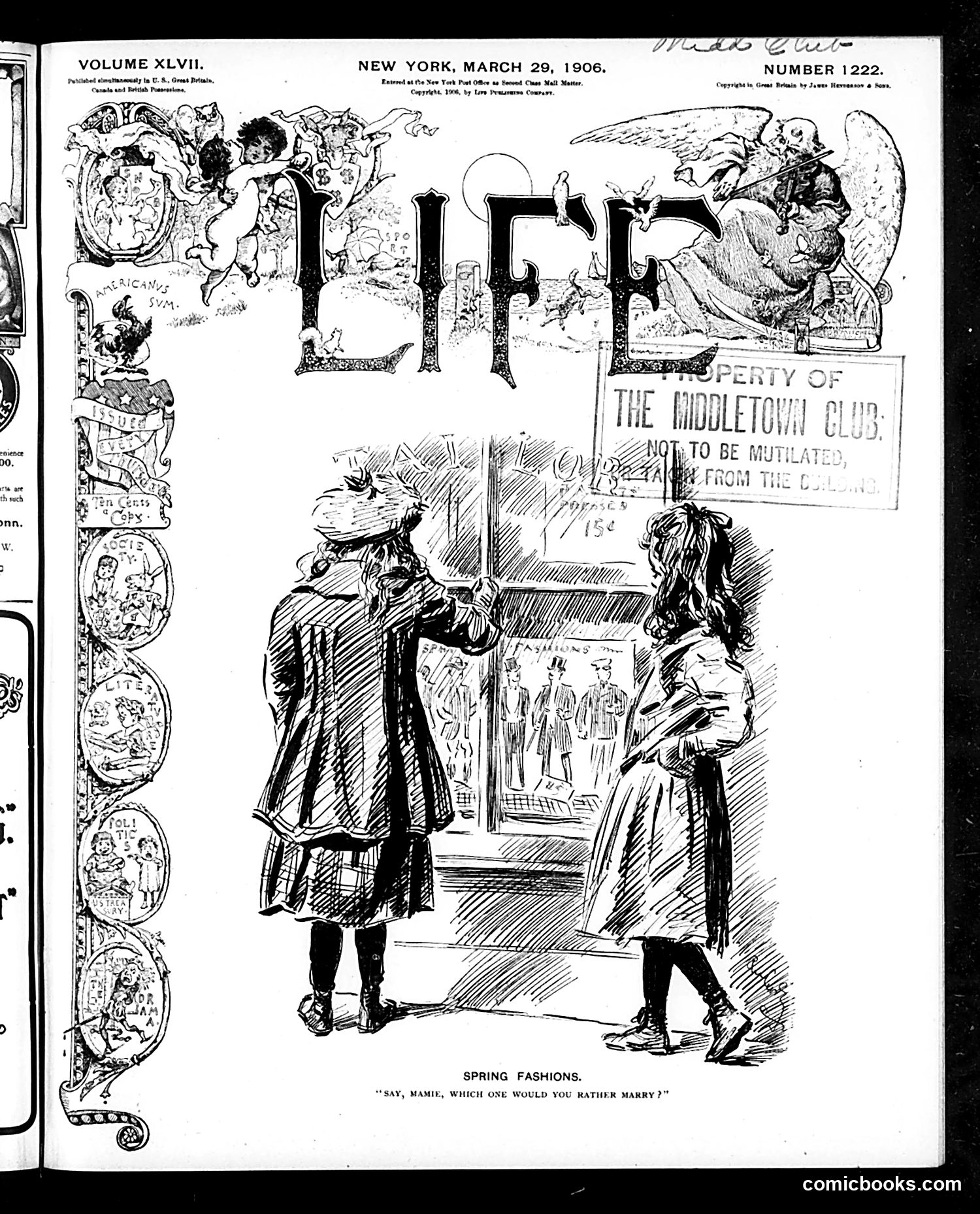
This page contains a satirical cartoon titled "Spring Fashions" with the caption "Say, Mamie, Which One Would You Rather Marry?" The cartoon depicts two young women viewing a shop window display of spring fashion illustrations. The satire appears to target the absurdity of women's spring fashions by presenting stylized male figures in exaggerated poses alongside the clothing displays. The joke plays on the visual comparison—suggesting that viewing fashionable men and fashionable clothing as equally superficial choices is equally ridiculous. The ornate decorative border on the left side is typical of Life's design aesthetic. The stamp indicating "Property of the Middletown Club" suggests this was a library or club copy. The humor relies on early-twentieth-century social commentary about courtship, fashion obsession, and gender dynamics.
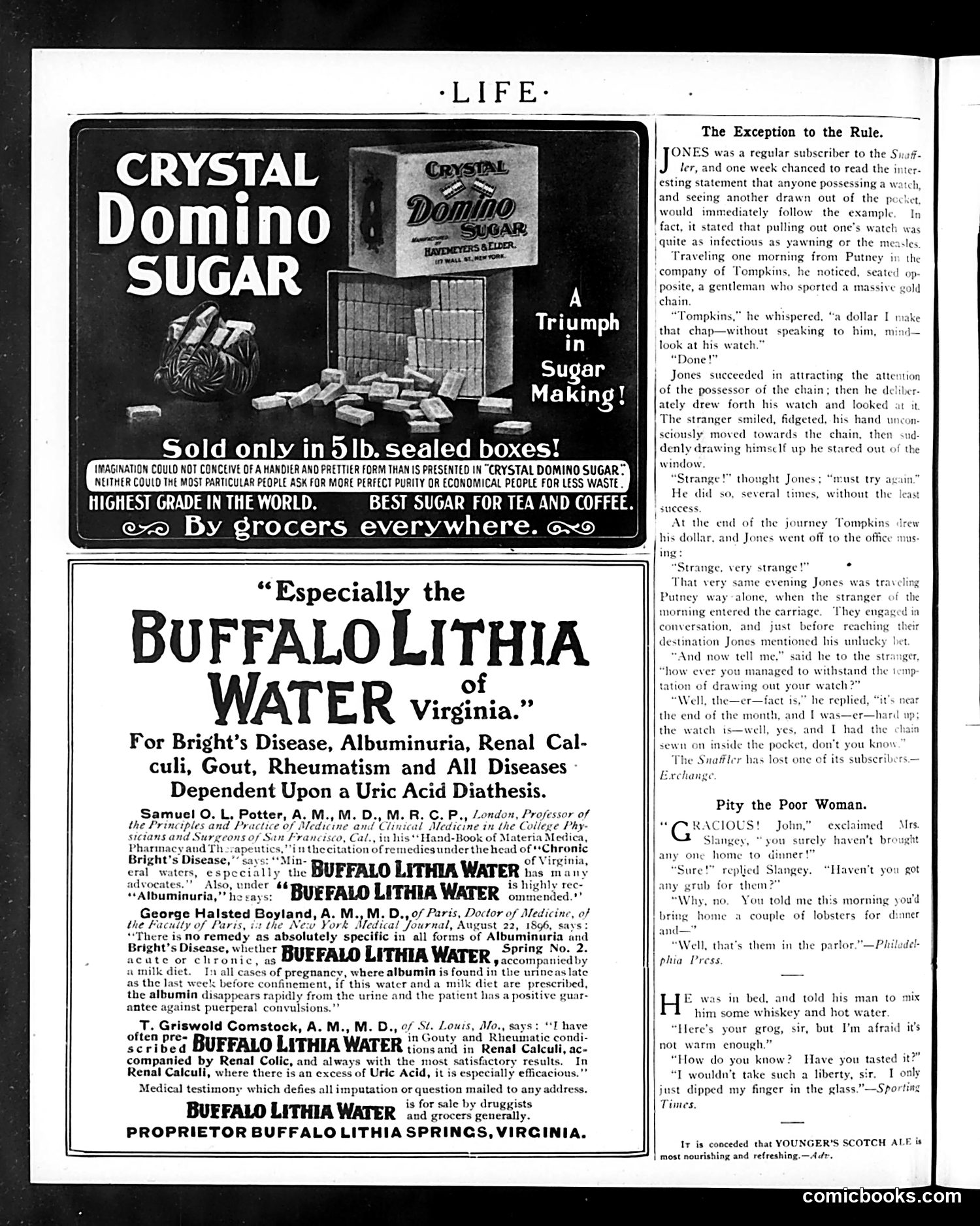
This page is **primarily advertisements** (Crystal Domino Sugar and Buffalo Lithia Water) interspersed with three short satirical fiction pieces. The cartoons/stories have no identifiable political figures. Instead, they're humorous anecdotes about ordinary people: 1. **"The Exception to the Rule"** - A man's watch-pulling trick impresses a stranger wearing a gold chain, establishing a con. 2. **"Pity the Poor Woman"** - A domestic dispute over grocery shopping. 3. **"He was in bed..."** - A man too ill to drink whiskey properly. These are gentle, domestic humor pieces typical of early Life magazine's satirical commentary on middle-class life rather than political cartoons. The humor relies on relatable everyday situations and character types rather than current events.
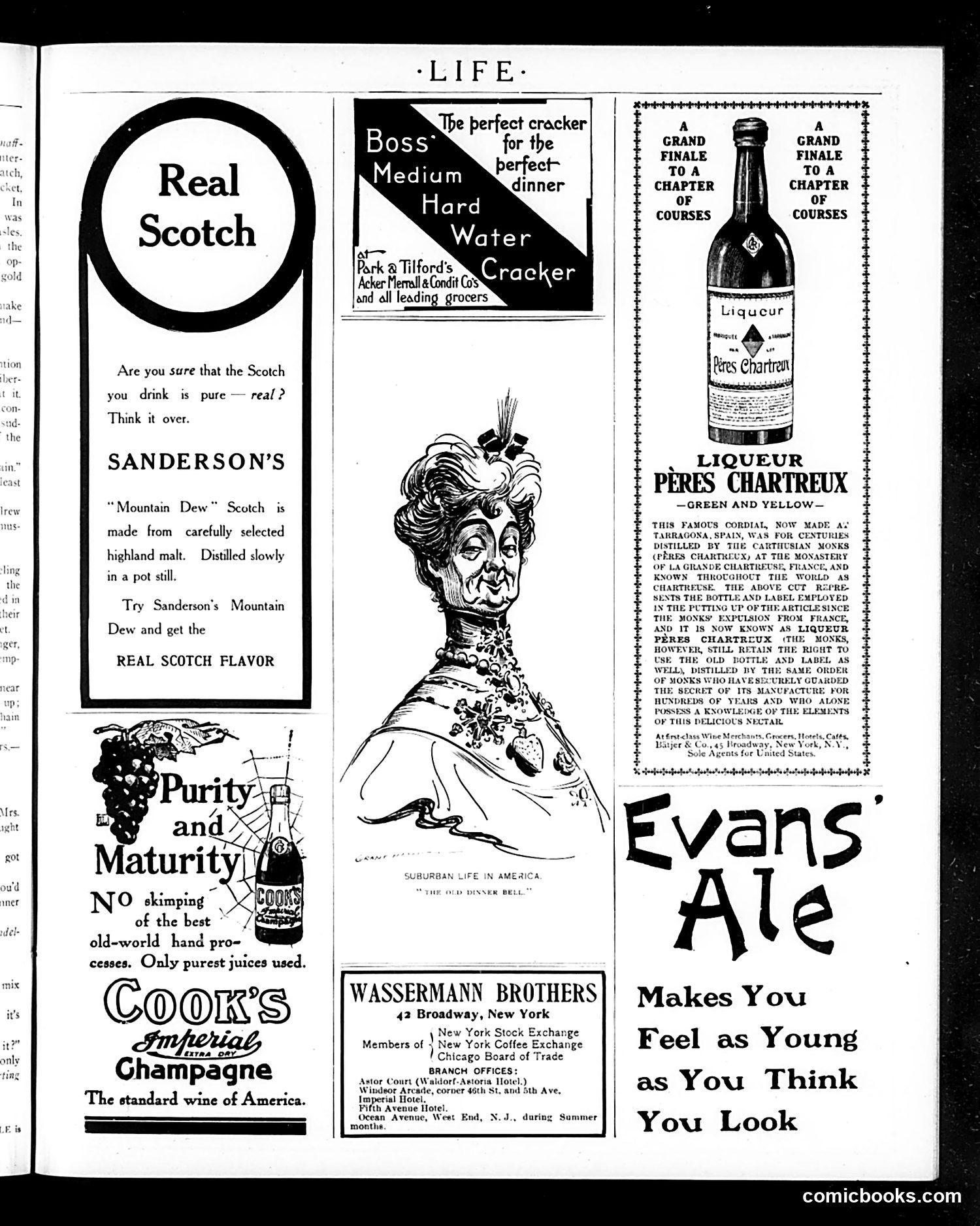
This page is primarily **advertising**, not satire or political commentary. It contains five liquor and beverage advertisements from the Prohibition era (likely 1920s): 1. **Sanderson's "Mountain Dew" Scotch** — emphasizing purity and real Scotch flavor 2. **Boss Cracker** — a product for serving with drinks 3. **Liqueur Père Chartreux** — a French liqueur with detailed historical description 4. **Cook's Imperial Champagne** — marketed as "the standard wine of America" 5. **Evans Ale** — claiming to make you "feel as young as you think you look" The central illustration labeled "Suburban Life in America: The Old Dinner Bell" appears to be a humorous vignette about entertaining, unrelated to the ads. These advertisements are notable for openly marketing alcohol during Prohibition, suggesting *Life* magazine either predates strict enforcement or operated in a grey area regarding alcohol advertising.
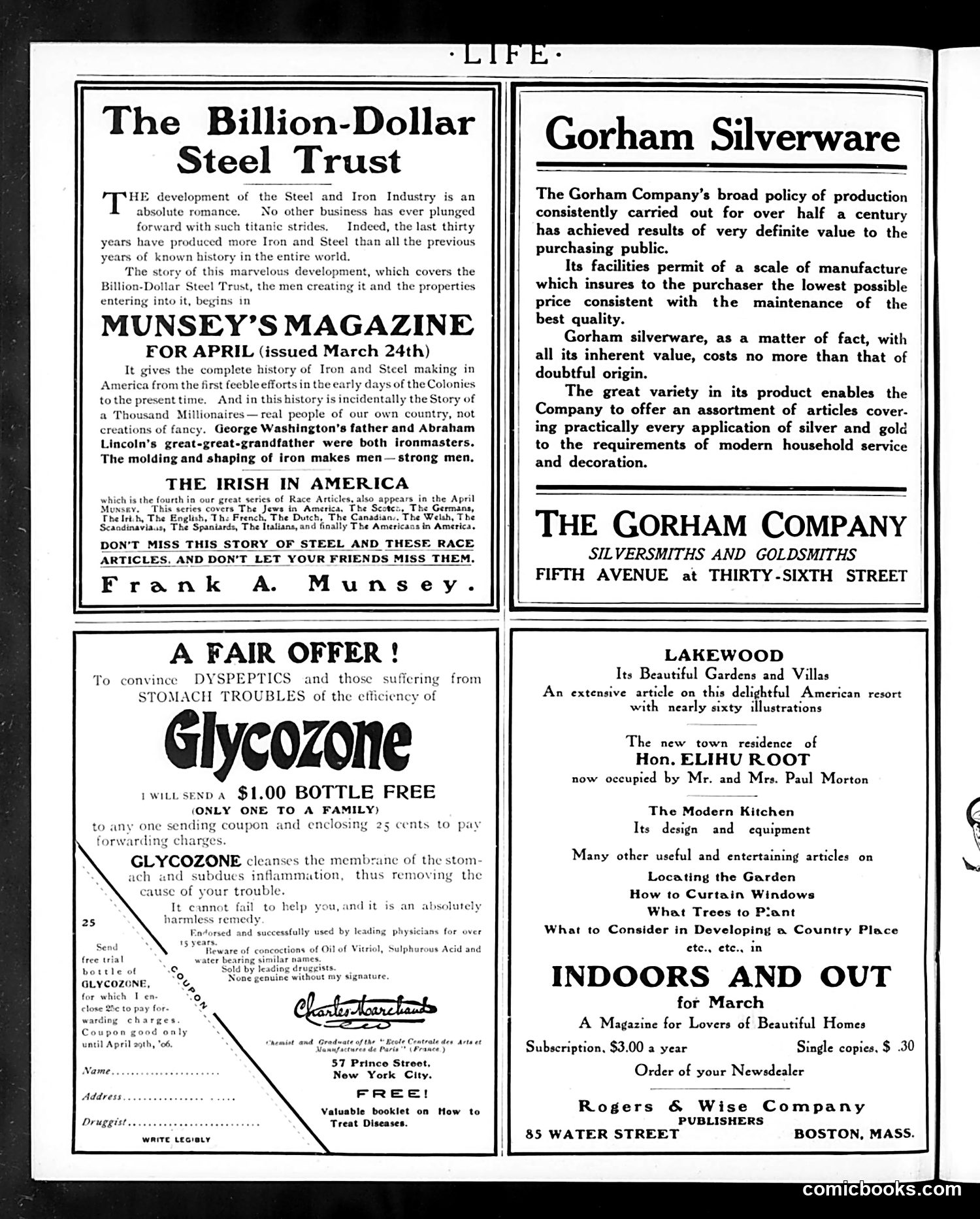
This page contains **no political cartoons or satirical imagery**. It is primarily **advertising and promotional content** from an early 20th-century Life magazine issue (March 24th). The main items are: 1. **Frank A. Munsey's advertisement** promoting his magazine's April issue, featuring articles on steel industry history and "The Irish in America" (part of a race-focused series) 2. **Glycozone medicine ad** offering a free $1 bottle to treat stomach troubles 3. **Gorham Silverware company advertisement** promoting their manufacturing quality 4. **Indoors and Out magazine promotion** for home and garden content The page reflects period advertising practices and consumer product marketing rather than political satire or commentary.
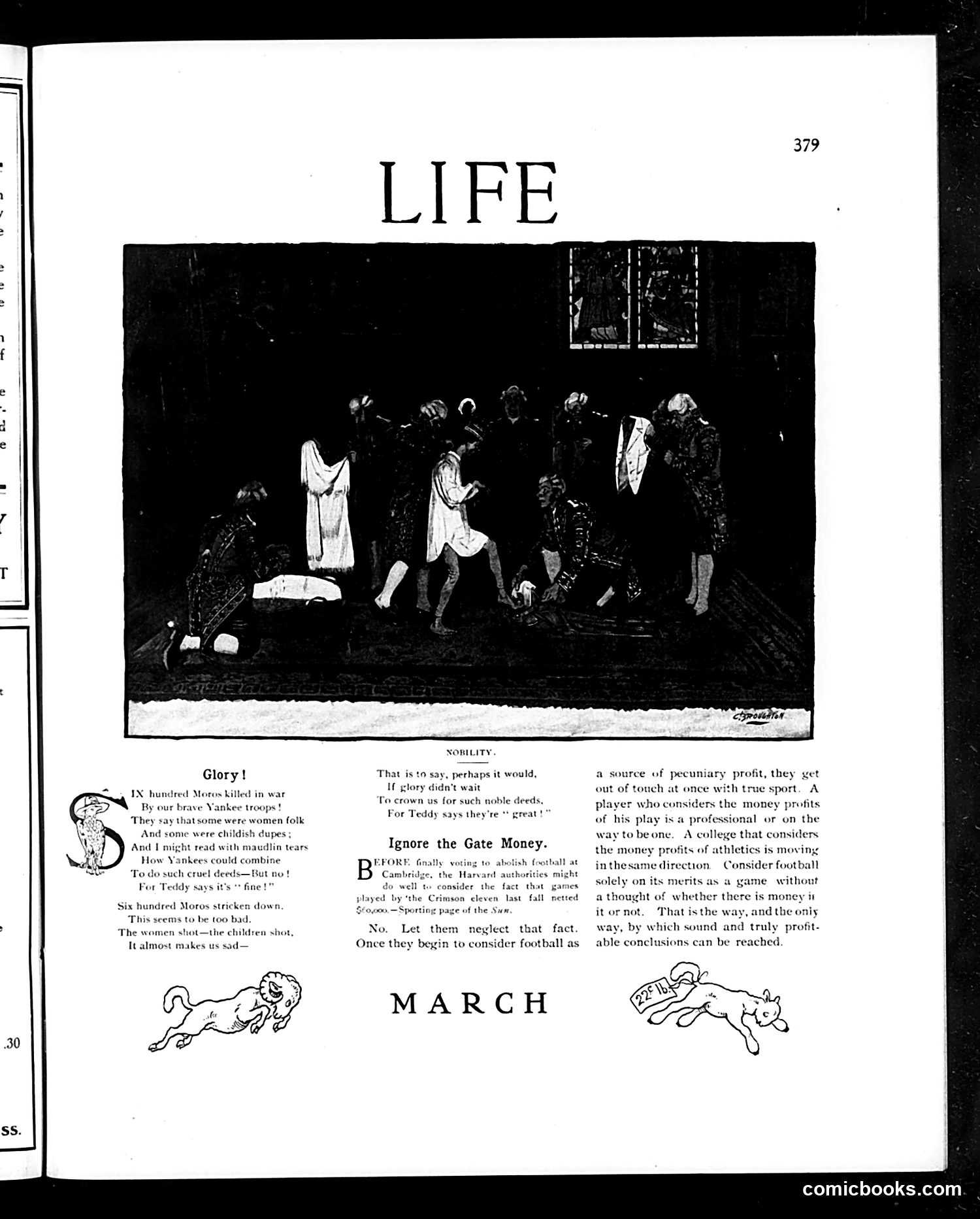
This page from *Life* magazine (page 379) contains two separate pieces of satirical commentary: **"Glory!"** (left): A poem mocking the romanticization of war, specifically referencing the massive casualties of World War I ("Nine hundred Moros killed in war"). The satire critiques how society celebrates military sacrifice while ignoring its human cost. **"Ignore the Gate Money"** (center-right): Commentary on Harvard football, specifically addressing efforts to abolish the sport. The piece argues against abandoning football solely based on financial concerns, asserting that the game's value should be judged on merit rather than profit. It references Cambridge and the Harvard Crimson team, suggesting this responds to contemporary debates about college athletics' commercialization. Both pieces use satire to challenge popular assumptions about war and commercialized sports.
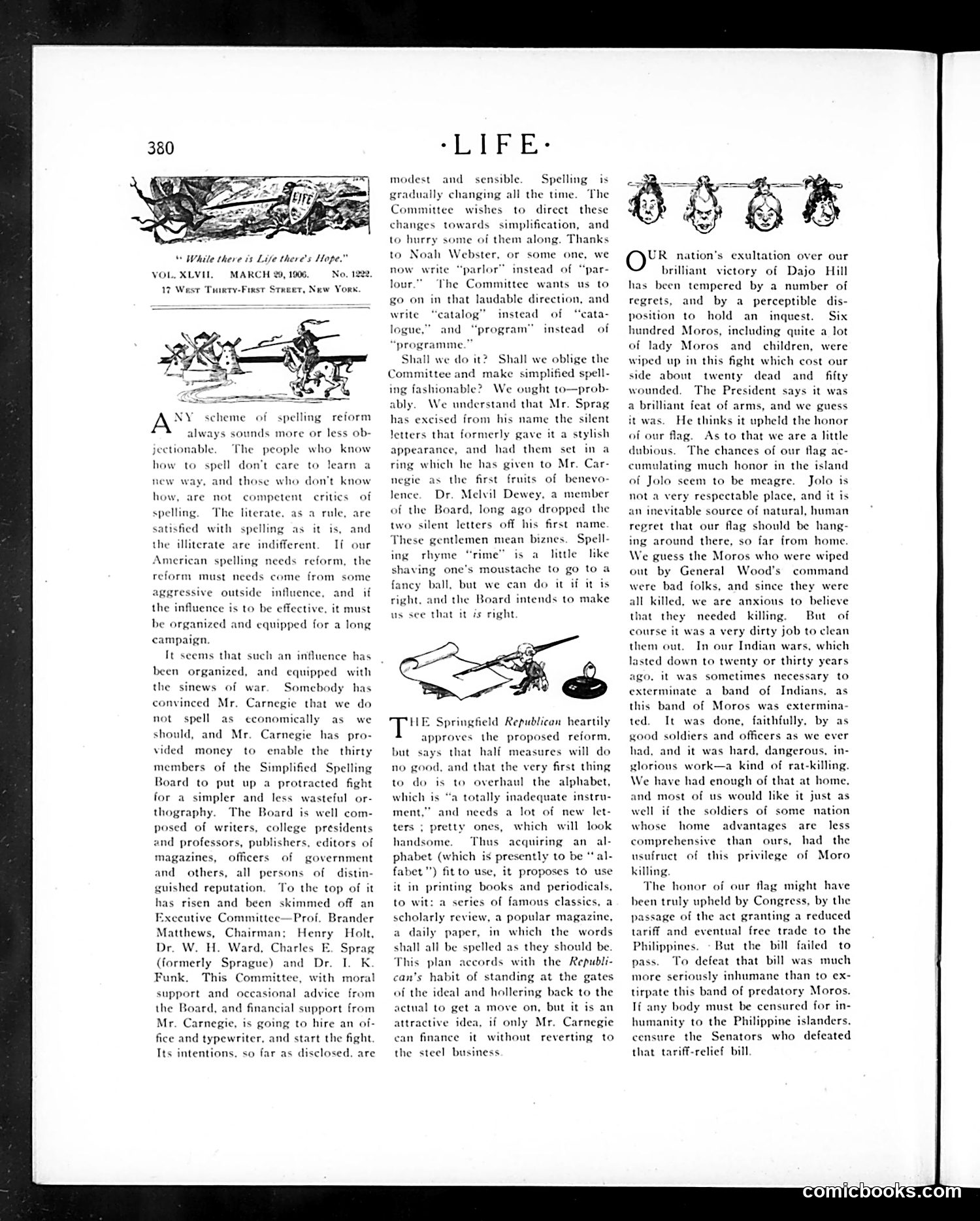
This page contains two distinct sections: **Left Column:** Discusses spelling reform, mentioning Mr. Sprag, Dr. Melville Dewey, and a Simplified Spelling Board. The text satirizes efforts to reform English orthography, noting that Andrew Carnegie funded efforts to simplify spelling but the initiative faced resistance. **Right Column:** Addresses American military action against the Moro people in the Philippines. The author defends the campaign as necessary and honorable, comparing it to previous Indian Wars. The piece argues that eliminating the "band of Moros" was justified military work, though acknowledges it was a "dirty job." **The Cartoons:** Small illustrations accompany both sections but are difficult to interpret clearly from the image quality provided. The page reflects early 1900s American attitudes toward linguistic reform and colonial military operations.
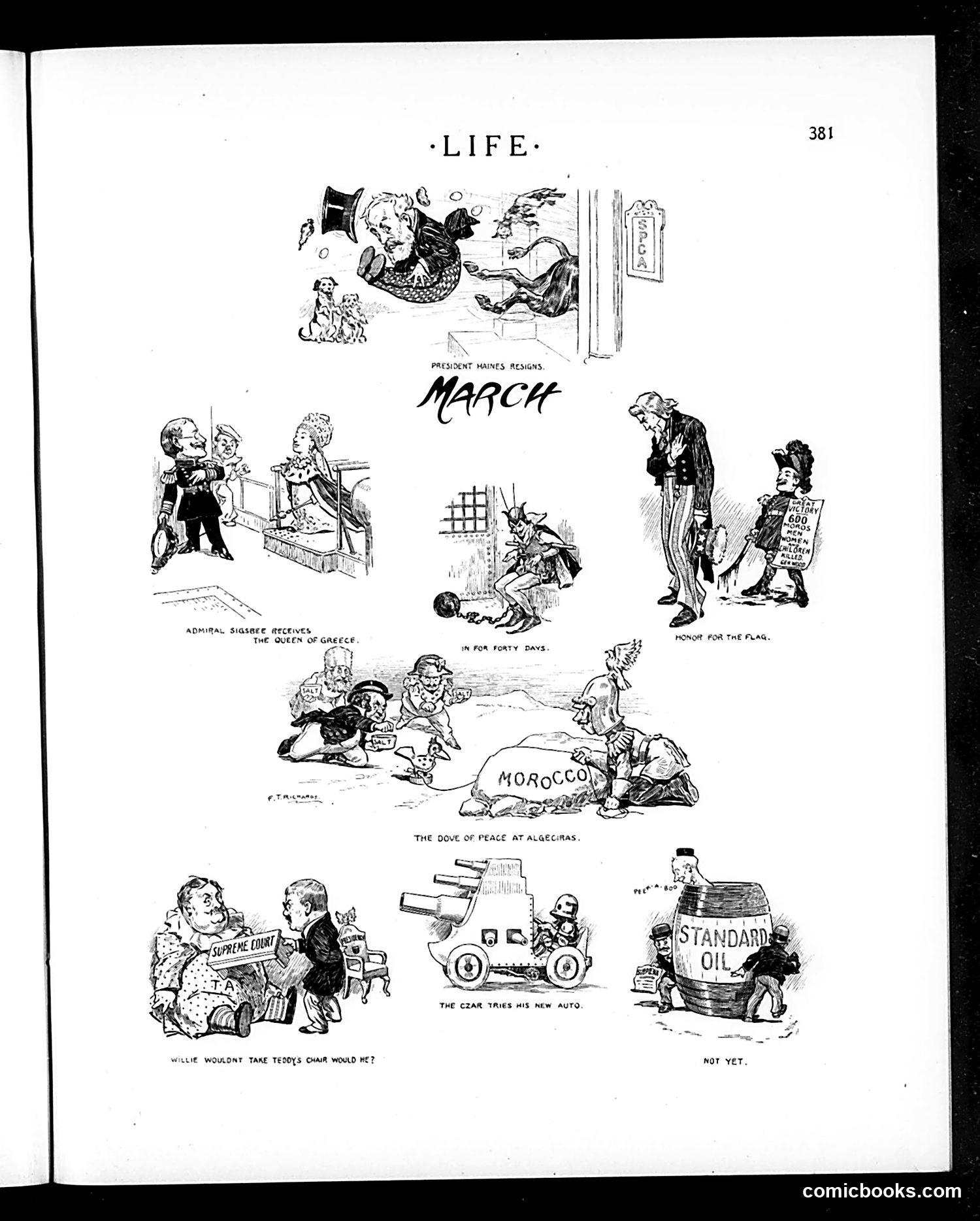
This page contains several political cartoons mocking events from March during President Haines's administration. The top cartoon shows Haines being ejected from office. Key satires include: - **"Admiral Sisbee Receives the Queen of Greece"** - likely mocking diplomatic protocols - **"Honor for the Flag"** - appears to satirize patriotic posturing - **"The Dove of Peace at Algeciras"** - references the 1906 Algeciras Conference, satirizing failed peace efforts, with a figure labeled "Morocco" - **"Willie Wouldn't Take Teddy's Chair, Would He?"** - appears to reference Theodore Roosevelt and succession politics - **"The Czar Tries His New Auto"** and **"Standard Oil - Not Yet"** - mock the Russian Czar and Standard Oil monopoly concerns The cartoons use exaggerated caricature and visual metaphor typical of early-1900s political satire.
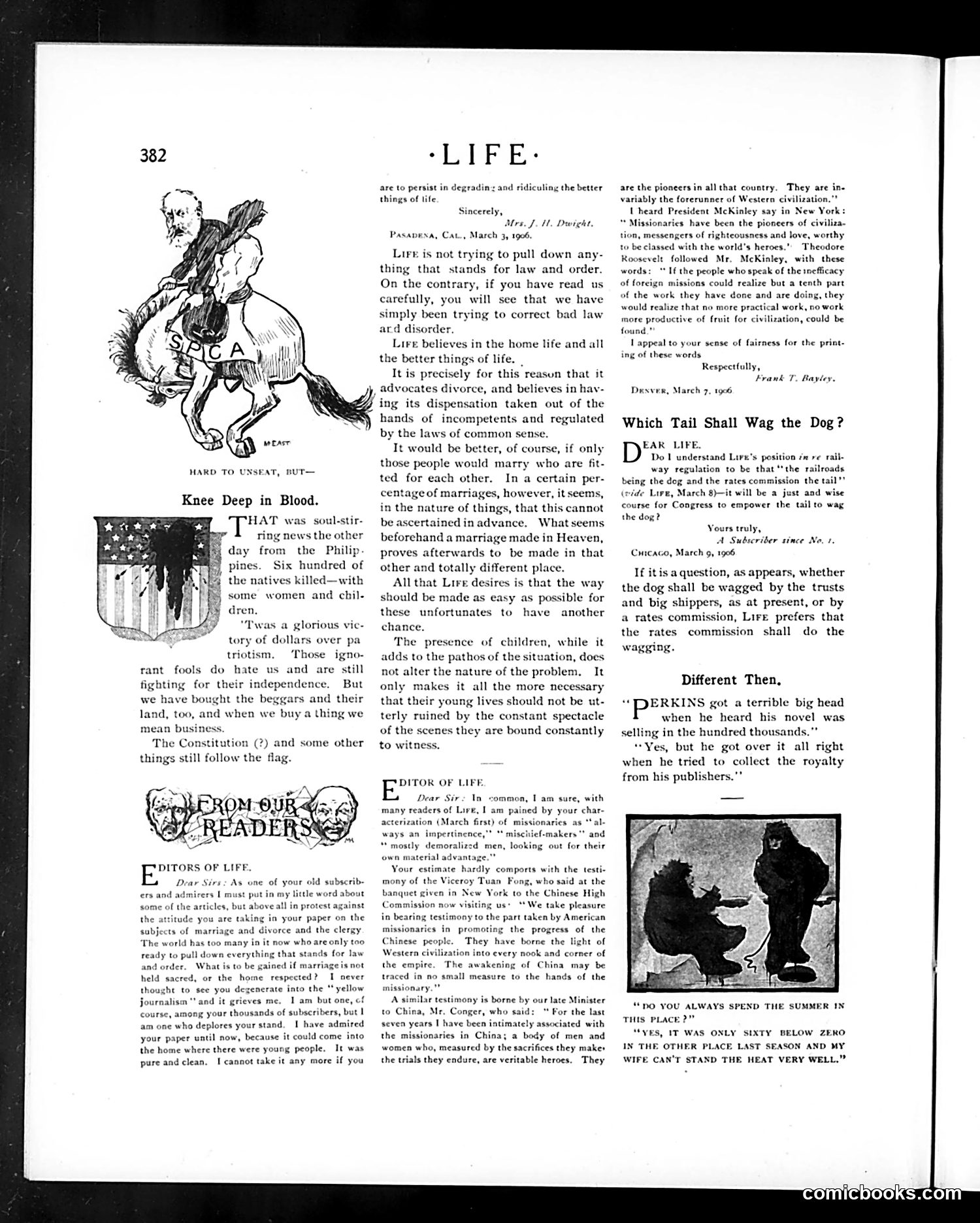
The cartoon depicts a figure labeled "AFRICA" being ridden by a caricatured European colonizer. The satire criticizes Western imperial expansion in Africa during the late 19th/early 20th century. The "knee deep in blood" caption references the violence and exploitation inherent in colonization—the human cost of European imperialism disguised as civilizing missions. The accompanying editorial defends *Life's* previous criticism of colonial policies, arguing the magazine has advocated for correcting "bad law and disorder" rather than attacking law itself. The piece emphasizes *Life's* belief in home life and civilization, while implicitly critiquing the brutal realities of colonial subjugation that European powers euphemistically justified as bringing order and progress.
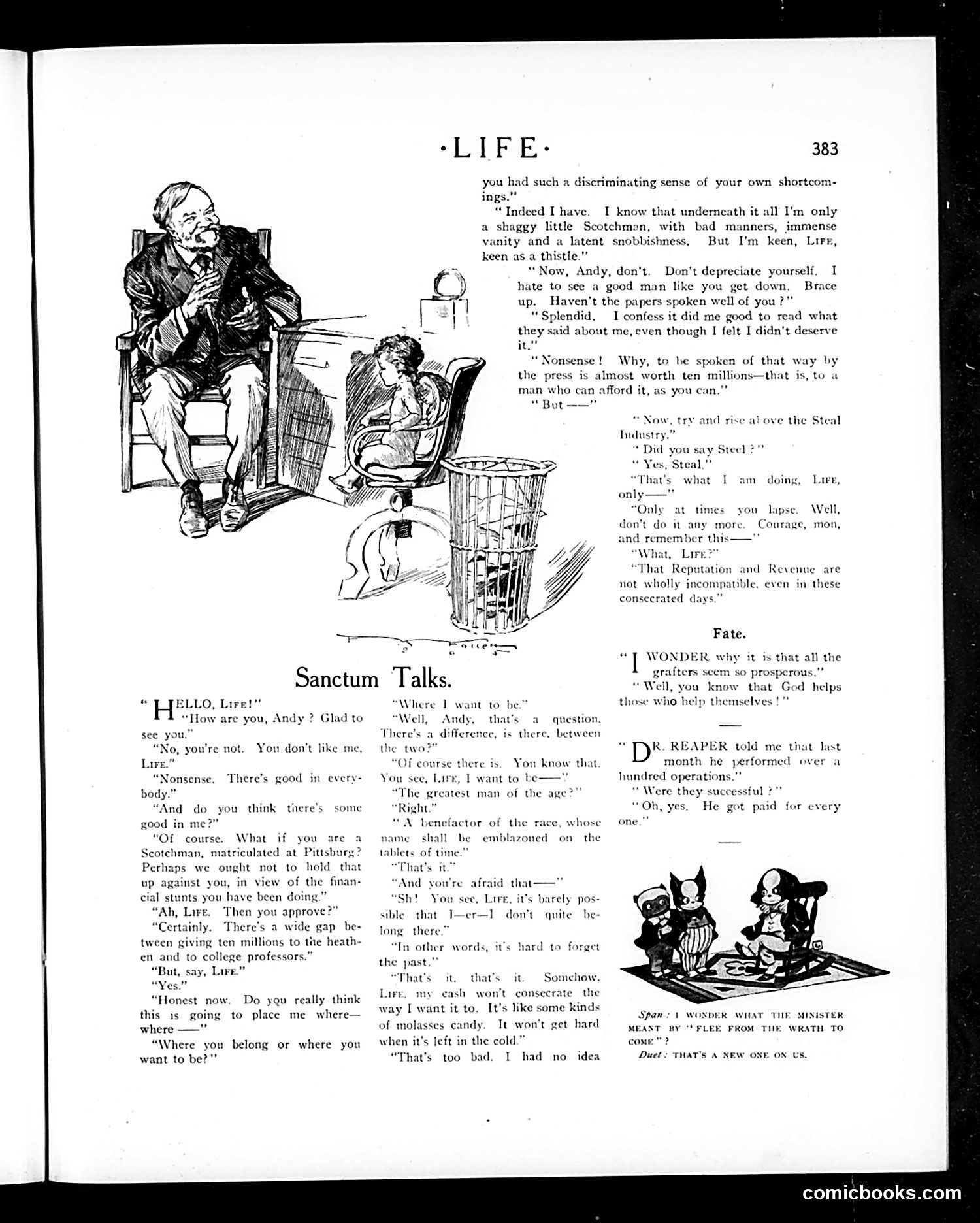
This page features a satirical dialogue between two figures labeled "LIFE" and "ANDY" (appearing to be the magazine's personified mascot and an unnamed character). The conversation concerns LIFE's ethical responsibilities regarding negative press coverage and its financial viability. ANDY criticizes LIFE for perceived snobbism and bad behavior. LIFE responds by defending itself against accusations in the papers, claiming the press's influence is worth ten million dollars—a fortune only a wealthy person could afford to ignore. The secondary section titled "Fate" contains unrelated anecdotes: one about grafters prospering, another about a Dr. Reaper's surgical success. The bottom illustration shows two figures in period costume, likely a separate joke or caption piece. This represents early 20th-century magazine humor addressing media ethics and social reputation.
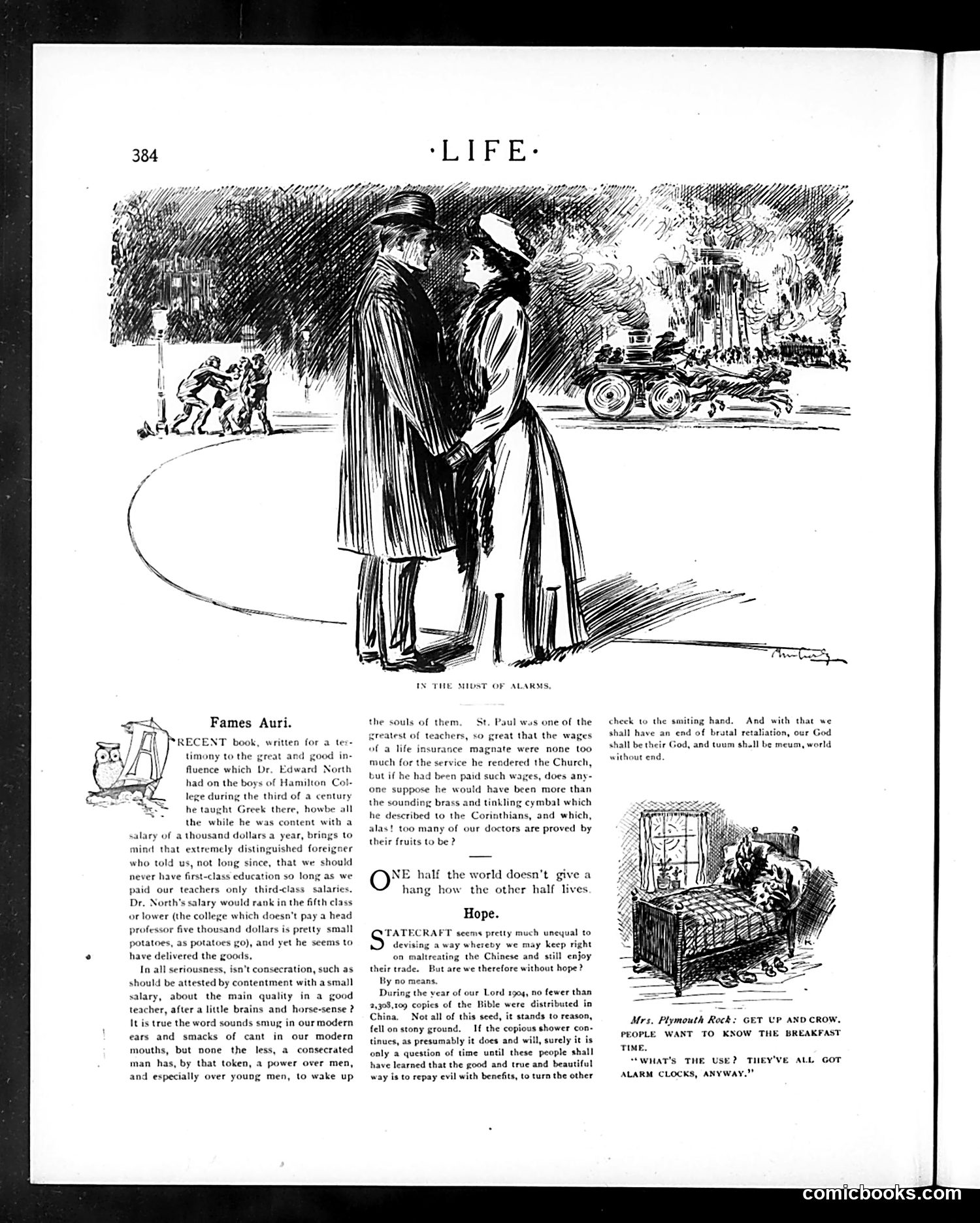
**Main Illustration**: Shows a couple (man in overcoat, woman in hat) standing together amid urban chaos—military vehicles, crowds, and destruction visible in the background. Caption reads "IN THE MIST OF ALARMS." **Article "Fames Auri"** discusses Dr. Noob's salary contentment despite modest pay, arguing that distinguished foreigners and educated professionals accept lower wages than Americans expect. **"Hope" Section** addresses missionary work in China during 1904, noting Bible distribution efforts and expressing confidence that Christian values will eventually benefit the Chinese population. **"Mrs. Plymouth Rock"** appears to be a humorous domestic vignette about alarm clocks. The page reflects early 1900s concerns: foreign missionary ambitions, class attitudes toward professional compensation, and domestic satire. The couple illustration likely comments on wartime anxieties or social upheaval of that era.
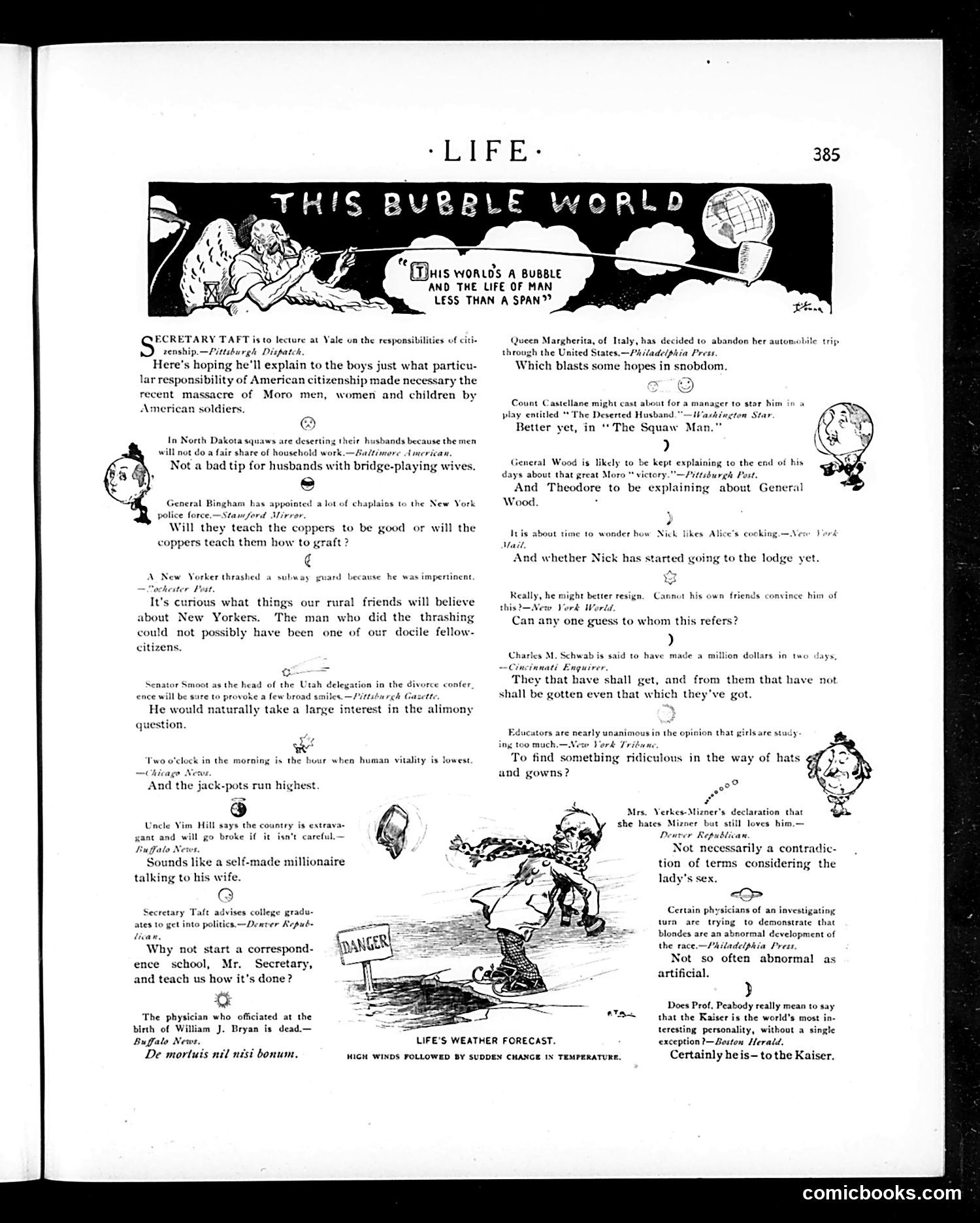
This page satirizes contemporary social and political figures through brief, barbed commentary. The main cartoon depicts a child on a precarious bubble labeled "DANGER," illustrating life's fragility—referenced in the header quote: "This world's a bubble and the life of man less than a span." The text mocks various public figures: Secretary Taft (William Howard Taft, U.S. President), General Wood (likely Leonard Wood), Count Castellane (European aristocrat), and others. Topics include the Moro massacre, marital disputes, wealth inequality, and fashion absurdities. The satire targets American political leadership, social hypocrisy, and upper-class excess. "Life's Weather Forecast" references sudden changes in fortune or scandal—the "high winds followed by sudden change in temperature" metaphor suggesting political upheaval.
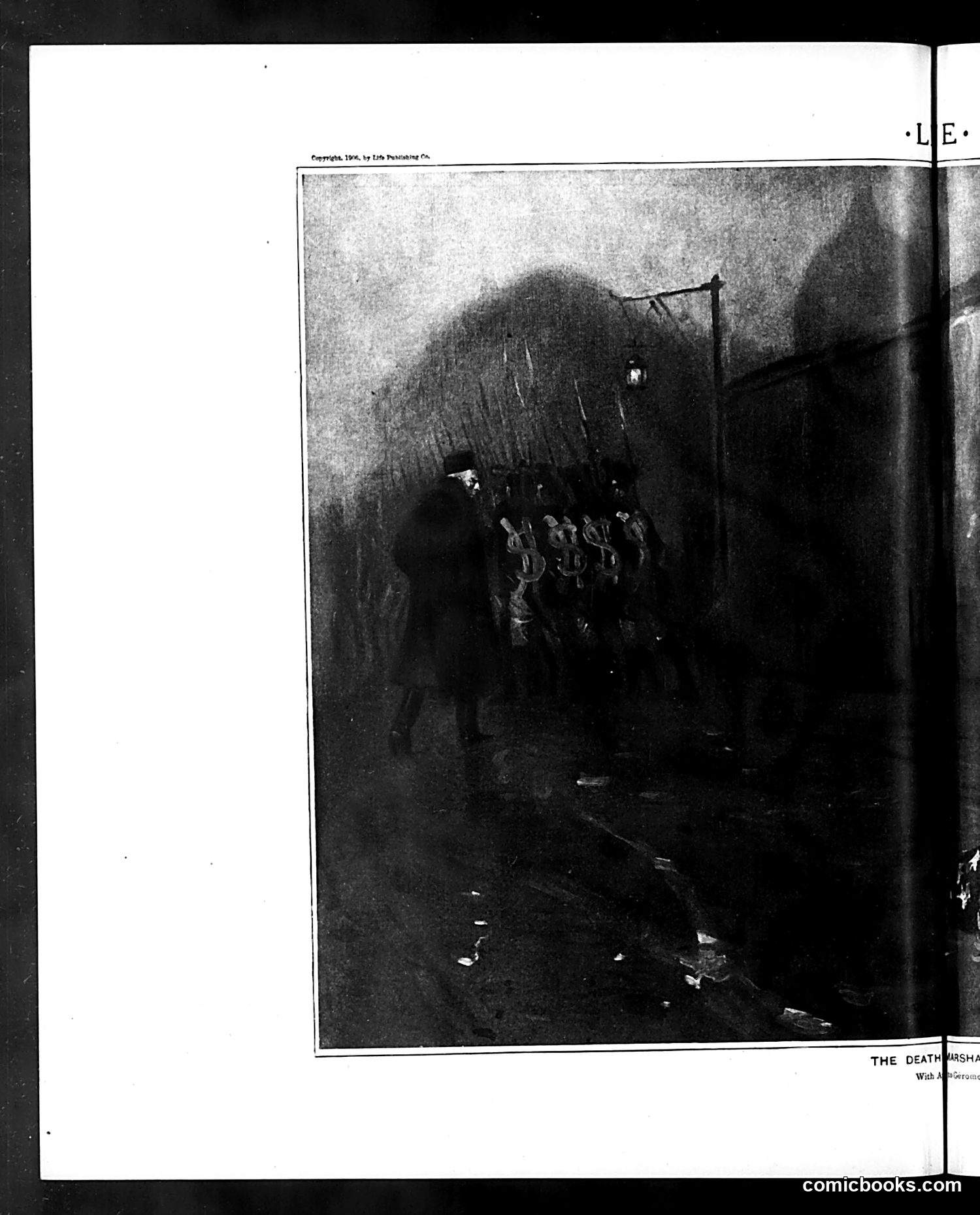
This appears to be a dramatic illustration titled "THE DEATH" (partially visible at bottom). The image shows a nighttime scene with multiple figures gathered around what appears to be a gallows or execution apparatus silhouetted against a light sky. The figures are rendered in dark, shadowy tones, creating an ominous atmosphere. Without being able to read the complete caption or surrounding text clearly, I cannot definitively identify which specific historical event this depicts or which political figures are referenced. The composition suggests this is satirical commentary on a significant political or social event, likely from the early 20th century based on Life magazine's style. To provide accurate interpretation of the satire's specific target and meaning, I would need clearer text identifying the subject matter.
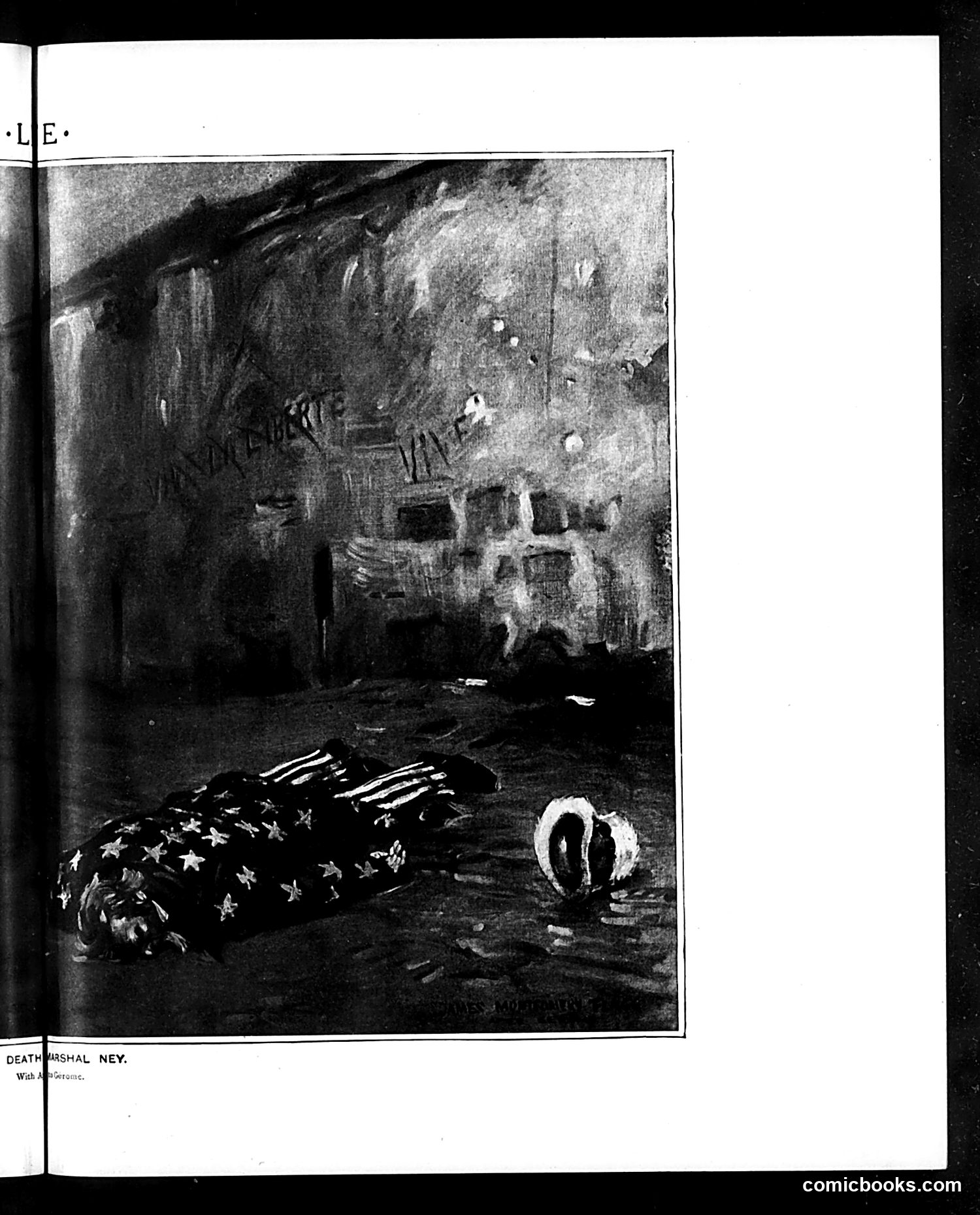
This page from *Life* magazine depicts what the caption identifies as "Death of Marshal Ney" — likely referencing the historical execution of French Marshal Michel Ney following the Napoleonic Wars. The image shows a body wrapped in a flag (appears to be the American flag, with stars visible) lying on the ground, with what appears to be a ceremonial or military scene in the background. There's a spherical object (possibly a cannonball or military equipment) on the right. The satirical intent appears to connect this historical military execution to contemporary American political or social commentary, though the specific modern reference requires additional context about when this *Life* issue was published. Without that date, the exact target of the satire remains unclear.
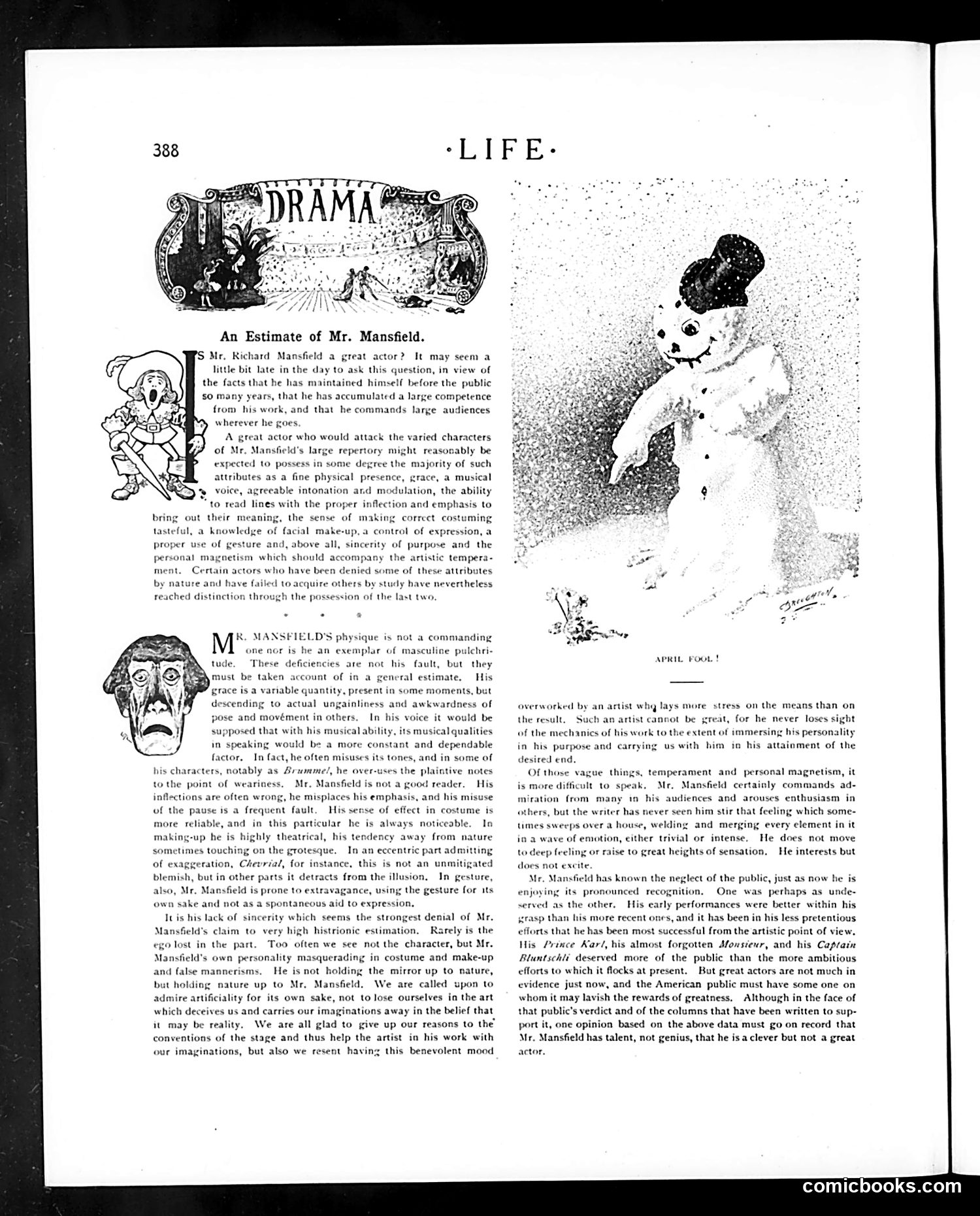
This is a theatrical critique of actor Richard Mansfield, published in Life magazine's "Drama" section. The article offers a detailed, often unflattering assessment of his abilities as a performer. **The Subject:** Richard Mansfield was a prominent late-19th-century American actor known for his large repertory of roles. **The Critique's Main Points:** While acknowledging Mansfield's commercial success and longevity, the writer systematically criticizes his physical presence, voice control, reading of lines, gestures, and costume sense as inconsistent. Most damaging: the article accuses him of prioritizing his own personality over character authenticity—performing "as Mansfield" rather than genuinely inhabiting roles. **The Satire:** The "April Fool!" caption (bottom right) suggests this scathing assessment may be partly tongue-in-cheek, typical of Life's satirical approach. **The Snowman Illustration:** The whimsical snow figure provides visual relief from the text but has no apparent connection to the critique.
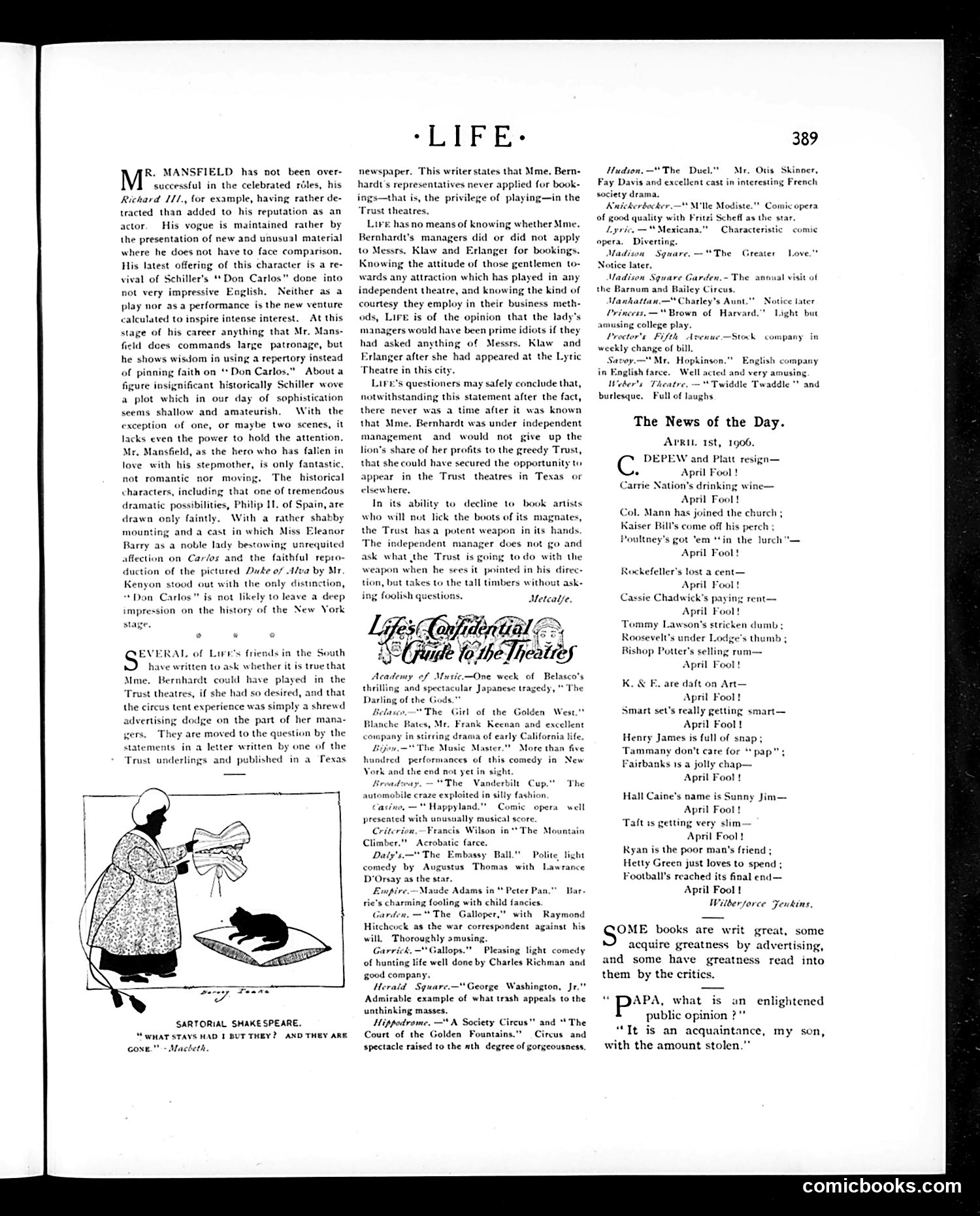
This page contains theater criticism and discusses the "Trust"—a monopolistic booking cartel (Klaw and Erlanger) that controlled American theater access in the early 1900s. **The cartoon** ("Sartorial Shakespeare") shows a figure in period costume sitting with a black cat, captioned with a Shakespeare quote about "hats." It's a visual pun satirizing costumes/props in theater productions. **The main article** discusses actor Richard Mansfield's revival of Schiller's *Don Carlos*, finding it uninspiring despite his celebrity drawing audiences. **The political content** addresses Sarah Bernhardt's circus tent performances outside Trust-controlled theaters. Life argues that Klaw and Erlanger's monopoly is so hostile to independent producers that Bernhardt's managers would have been "prime idiots" asking them for bookings after performing independently. The Trust maintains power by excluding artists who won't submit to their profit-sharing demands. This reflects Progressive Era anxieties about theatrical monopolies crushing artistic independence.
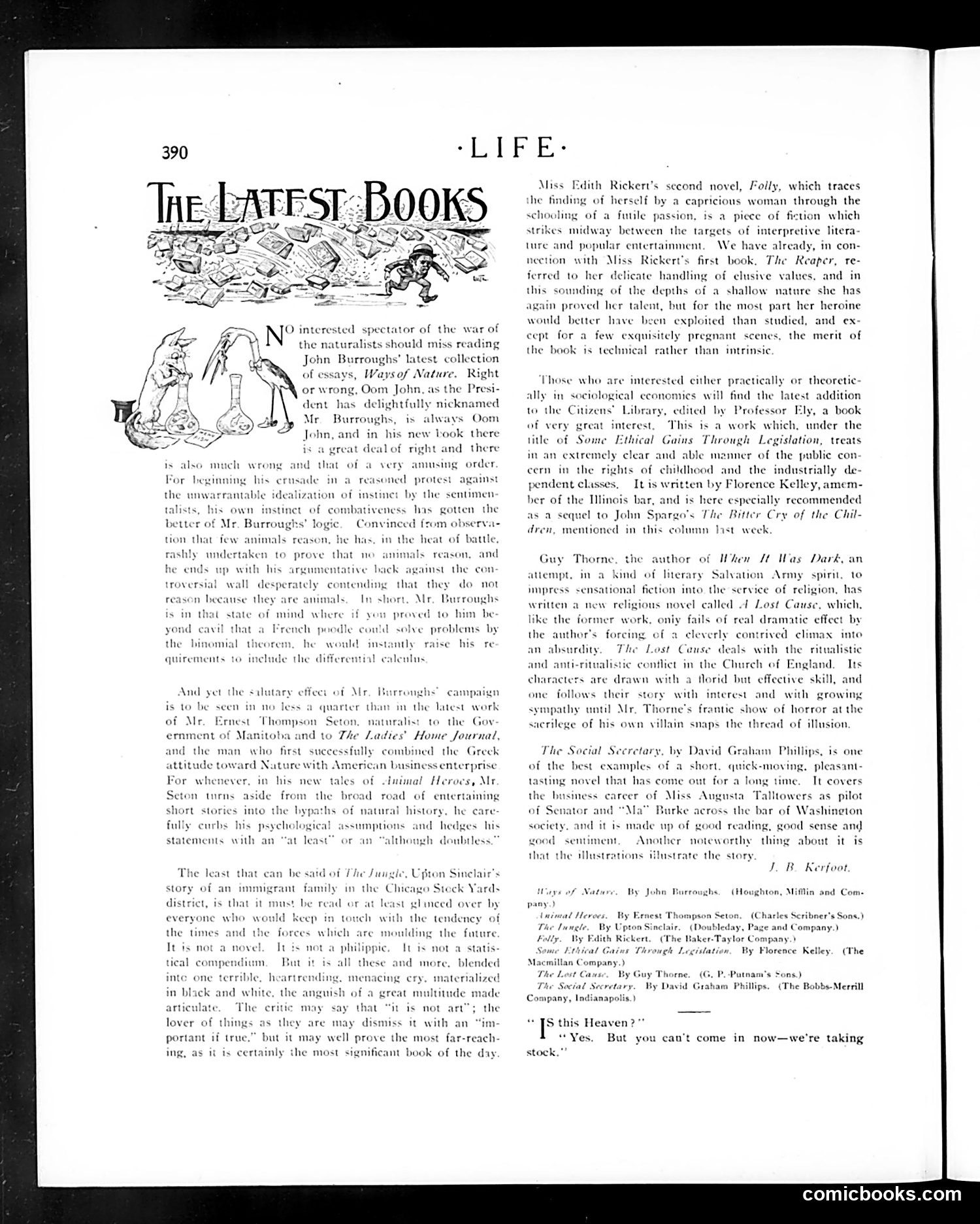
This page reviews recent books, primarily discussing naturalist John Burroughs and writer Upton Sinclair. The illustrated header "The Latest Books" features whimsical decorative figures. The text critiques Burroughs' essay collection *Ways of Nature*, noting that while he argues animals lack reason, he's become so combative in this crusade that he's contradicted himself—insisting animals cannot reason precisely *because* they're animals. The reviewer suggests Burroughs has lost logical balance in his zeal. The page praises Sinclair's *The Jungle* as the "most significant book of the day," acknowledging it transcends traditional categories (novel, polemic, statistical study) to become a powerful indictment of conditions in Chicago's meatpacking district. Other reviews cover Edith Rickert's *Folly* and Florence Kelley's *Some Ethical Gains Through Legislation*, a work on child labor and worker protections. The page represents Life's role as a venue for serious literary criticism alongside satire.
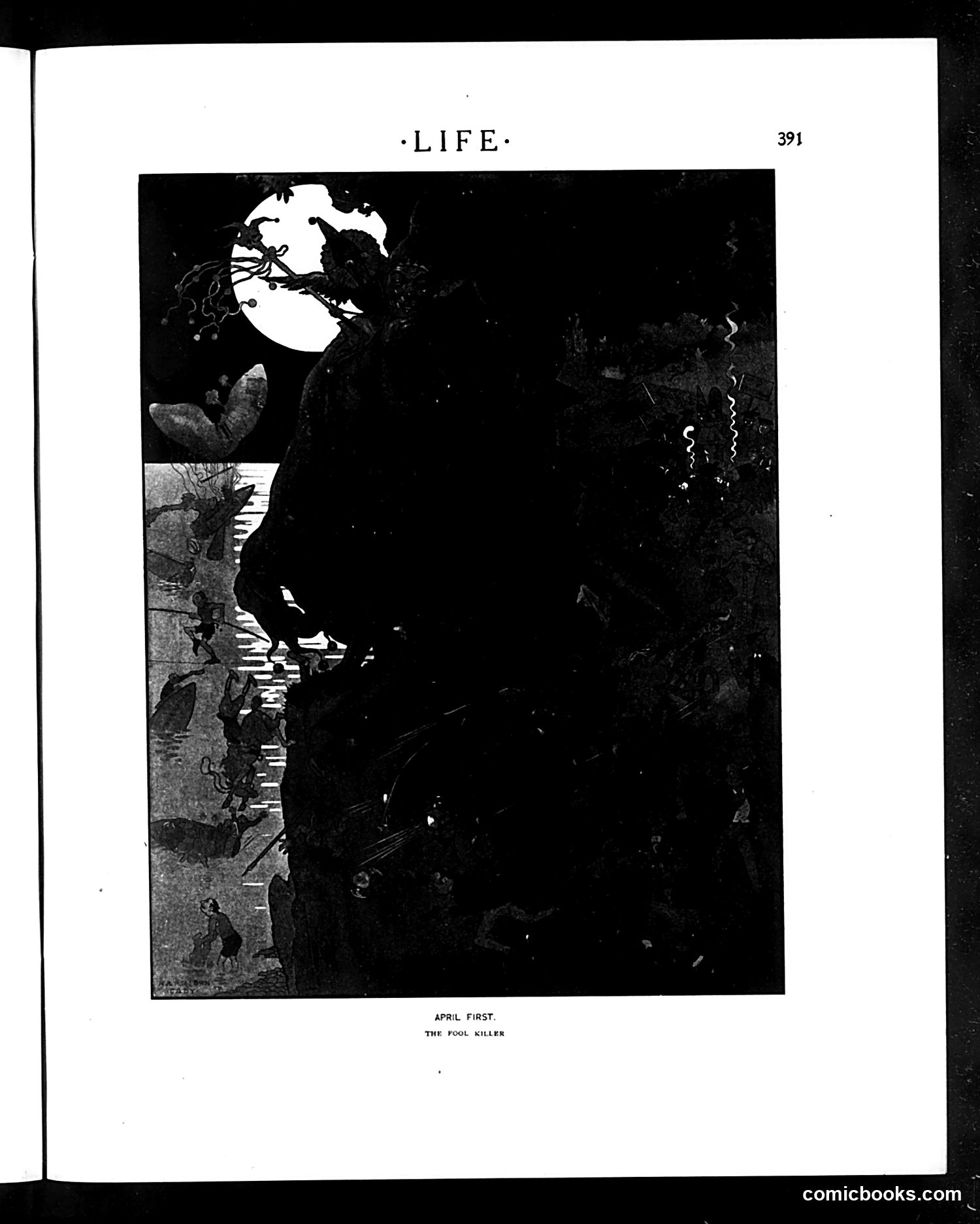
This is a darkly satirical cartoon appearing on page 391 of *Life* magazine. The title "April First" suggests an April Fools' Day theme, while "The Pool Killer" appears to reference someone or something that destroys pools—likely a social commentary on vandalism, neglect, or destructive behavior during that era. The stark black-and-white imagery shows a sinister figure near what appears to be a pool or water feature, surrounded by overgrown vegetation and decay. The illustration's ominous tone suggests the cartoon critiques destructive impulses or negligence affecting public recreational spaces. Without the publication date visible, the specific historical context remains unclear, though the satirical approach typical of *Life* magazine suggests social criticism of contemporary behavior or attitudes toward public property.
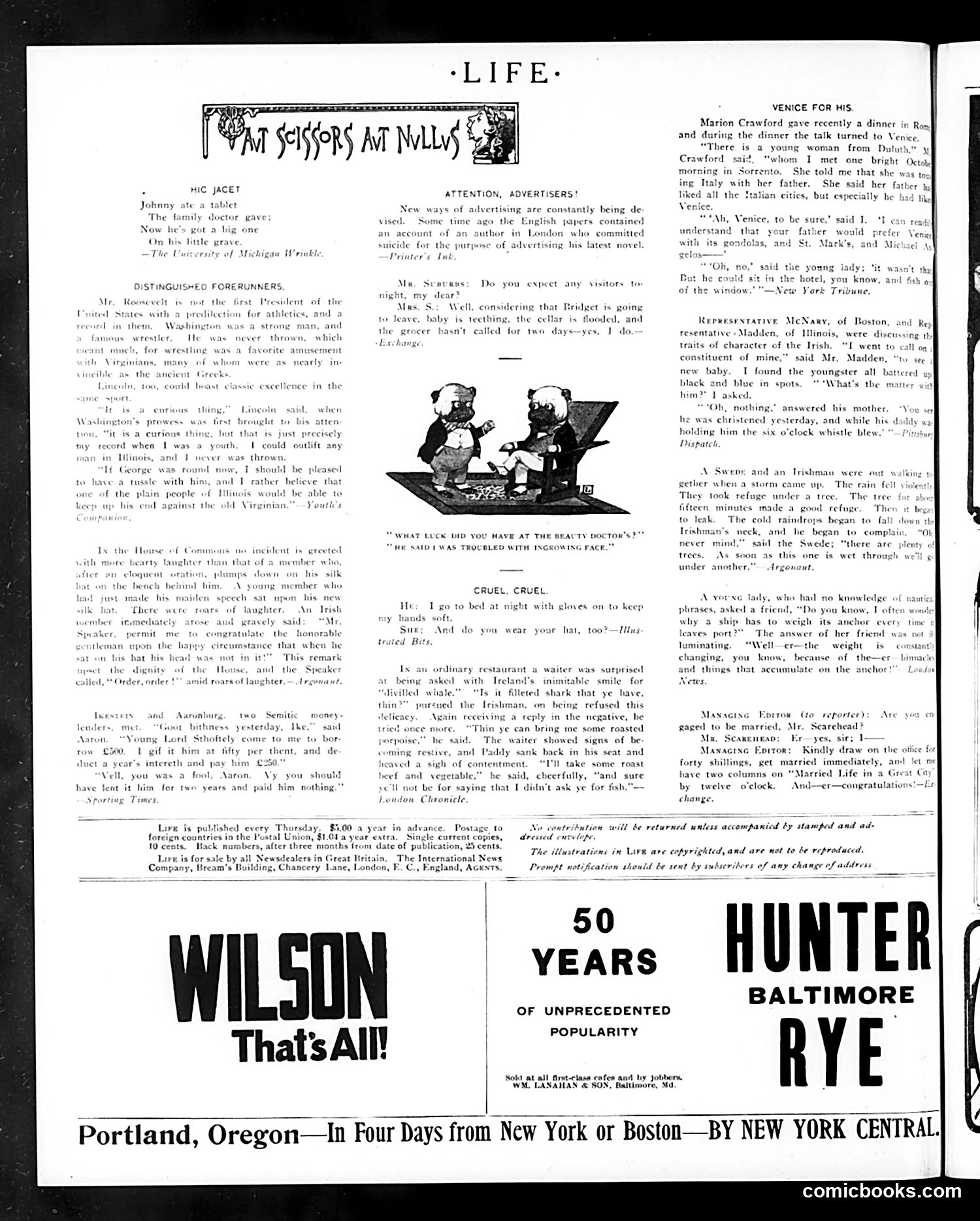
This is primarily a **humor and satire page** from Life magazine, featuring several disconnected jokes and anecdotes rather than a unified political cartoon. The main illustrated cartoon shows two figures at a "beauty doctor's" office, satirizing the emerging cosmetic surgery trend. One patient reports being told they have an "ingrowing face"—a absurdist joke mocking both vanity and dubious medical practices of the era. The text sections include satirical anecdotes about Irish characters, politicians (Representatives McNary and Madden discussing Irish traits), and upper-class social situations. The humor relies on ethnic stereotypes common to early 20th-century American satire. The page also advertises products (Wilson, Hunter Baltimore Rye) and travel (New York Central railroad to Portland). **For modern readers:** The comedy assumes familiarity with Irish-American stereotypes and contemporary medical quackery. The "beauty doctor" joke reflects anxieties about emerging cosmetic procedures and societal pressure regarding appearance—themes that remain relevant, though the ethnic humor now reads as dated.
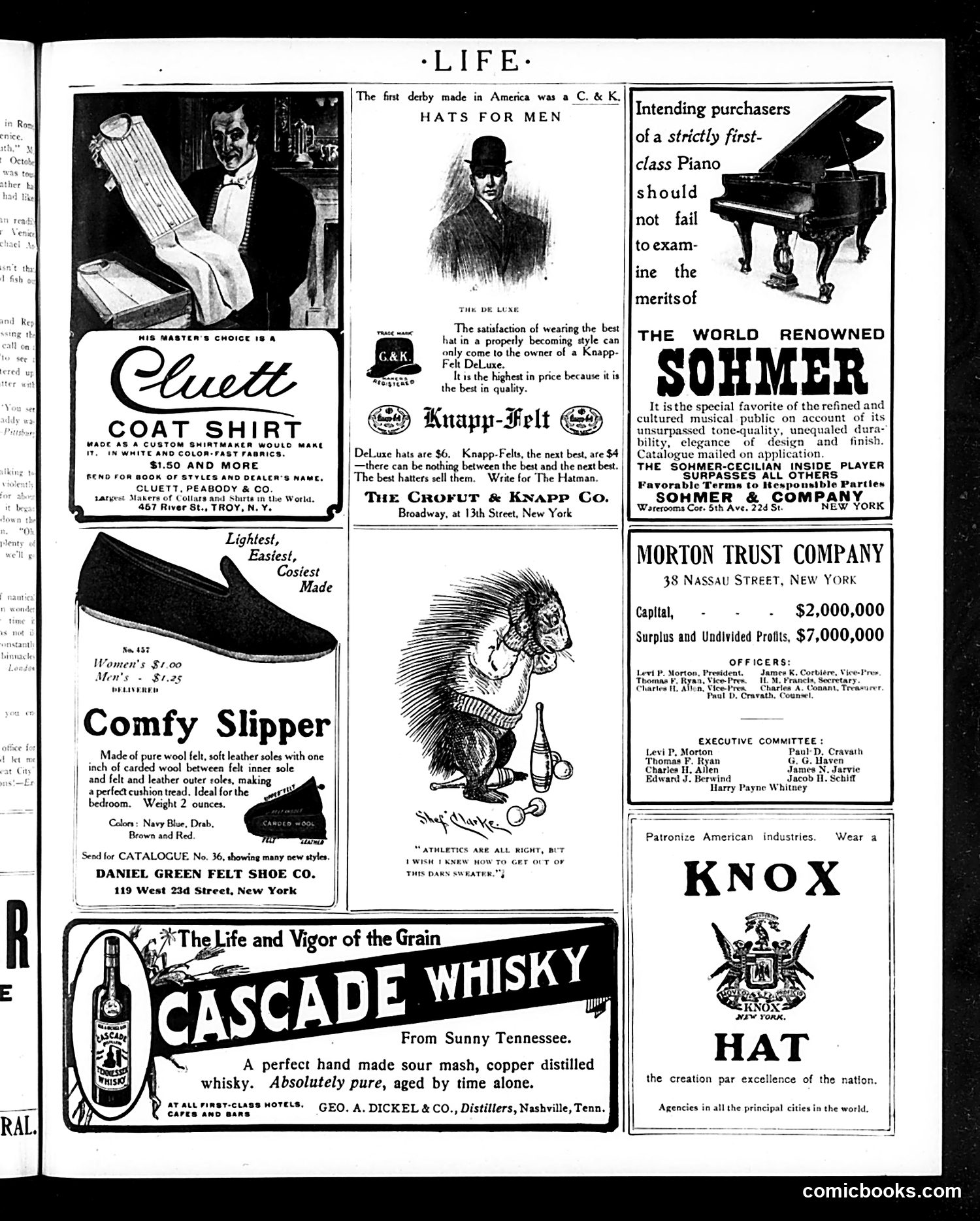
This is primarily an **advertising page** from an early 20th-century American magazine, with one small cartoon. The sole cartoon depicts an athlete complaining about sweat, captioned: *"Athletics are all right, but I wish I knew how to get out of this darn sweater."* This is straightforward humor—a visual pun playing on the double meaning of "sweater" (the garment and perspiration from exertion). The rest of the page consists of period advertisements for luxury goods: men's clothing (Cluett shirts, Knapp-Felt hats), footwear (Comfy Slippers), pianos (Sohmer), and whisky (Cascade). There's also a financial institution advertisement (Morton Trust Company). These ads reflect early 1900s consumer culture targeting affluent readers. No political satire or social commentary is evident on this particular page—it's straightforward commercial advertising typical of *Life* magazine's revenue model alongside its editorial content.
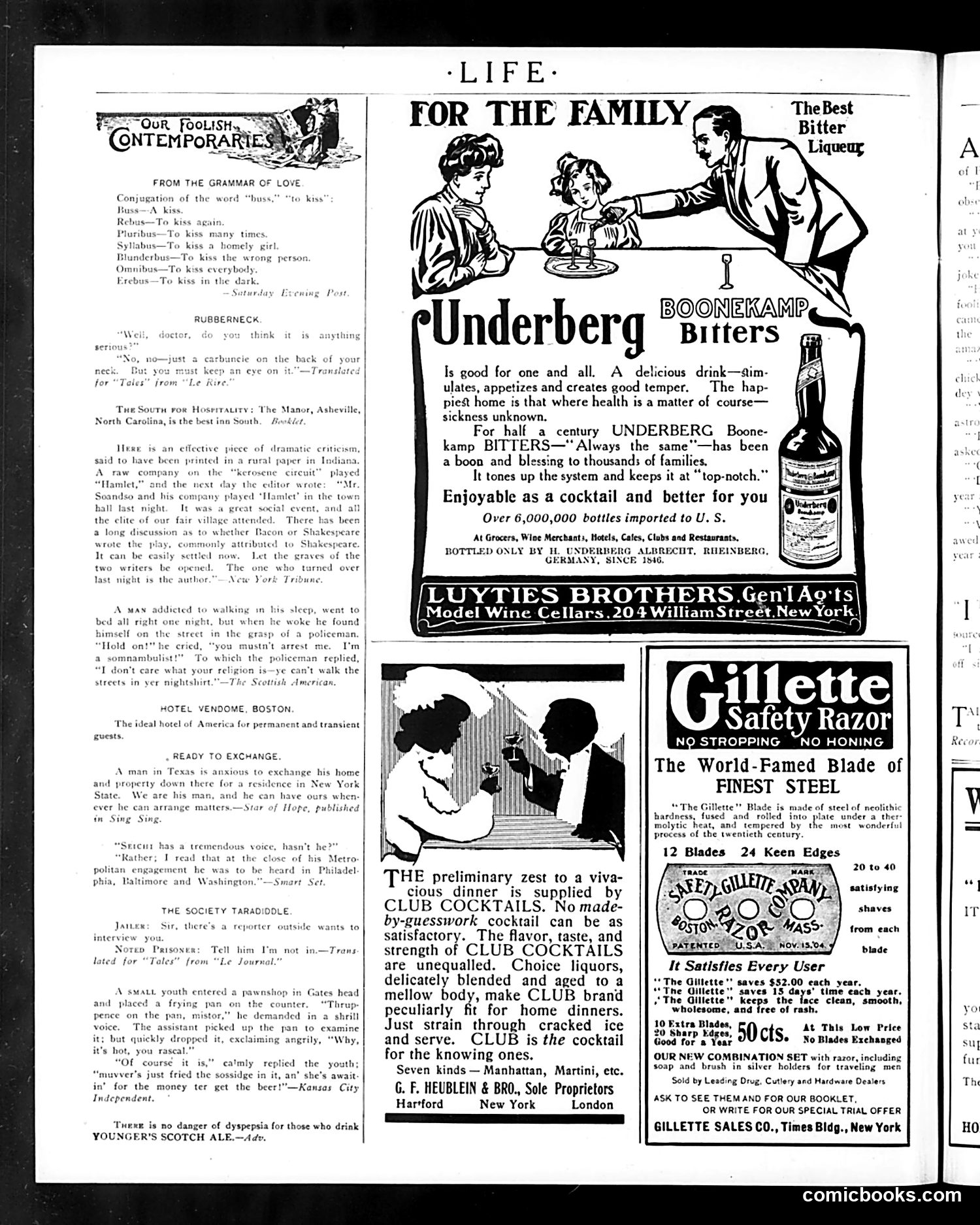
This page is **primarily advertising**, not political satire. It contains humorous sketches and anecdotes in the left column, but the dominant content is commercial. **Left column** includes short, light jokes about kissing ("Grammar of Love"), hotel recommendations, and amusing social anecdotes—typical *Life* magazine filler humor of the era. **Main illustrations** are product advertisements: - **Underberg Boonekamp Bitters**: An ad showing a family at dinner, claiming the German digestive liqueur promotes health and family happiness - **Gillette Safety Razor**: Emphasizing modern convenience ("no stropping, no honing") and cost savings - **Club Cocktails**: Marketing premixed cocktail ingredients for "knowing ones" - **Younger's Scotch Ale**: A brief advertisement The page reflects **early 20th-century consumer culture**, promoting convenience products and imported luxuries (German bitters, British ale) to middle-class American readers. No political figures or satirical commentary are present.
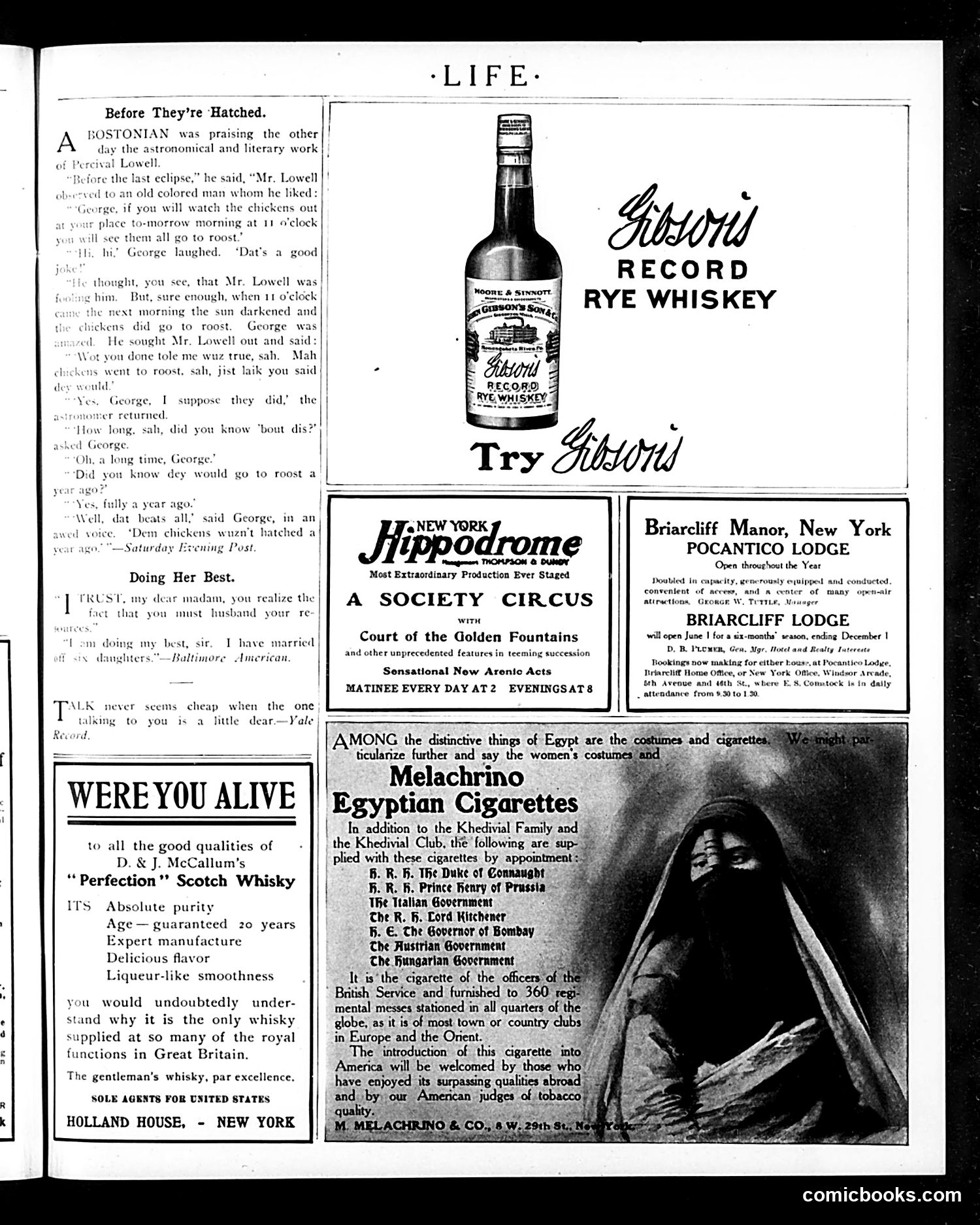
This page is primarily **advertisements and humor anecdotes**, not political satire. The main comic story, "Before They're Hatched," is a humorous anecdote about astronomer Percival Lowell. A Boston man praised Lowell's astronomical work; Lowell supposedly told an elderly Black man that chickens would roost when the sun darkened at the next eclipse. When this happened, the man was amazed—not realizing Lowell had *predicted* the eclipse scientifically. The joke mocks the man's misunderstanding: he thinks Lowell magically knew the chickens' behavior, when Lowell simply knew astronomy. The page also contains: - Whisky advertisements (Gibsons Record Rye, McCallum's Perfection Scotch) - A brief joke about a wife telling her husband she's "doing her best" by having many daughters - Ads for the Hippodrome circus, a New York lodge, and Egyptian cigarettes The content reflects early 20th-century attitudes, including casual racial stereotyping in the dialect humor.
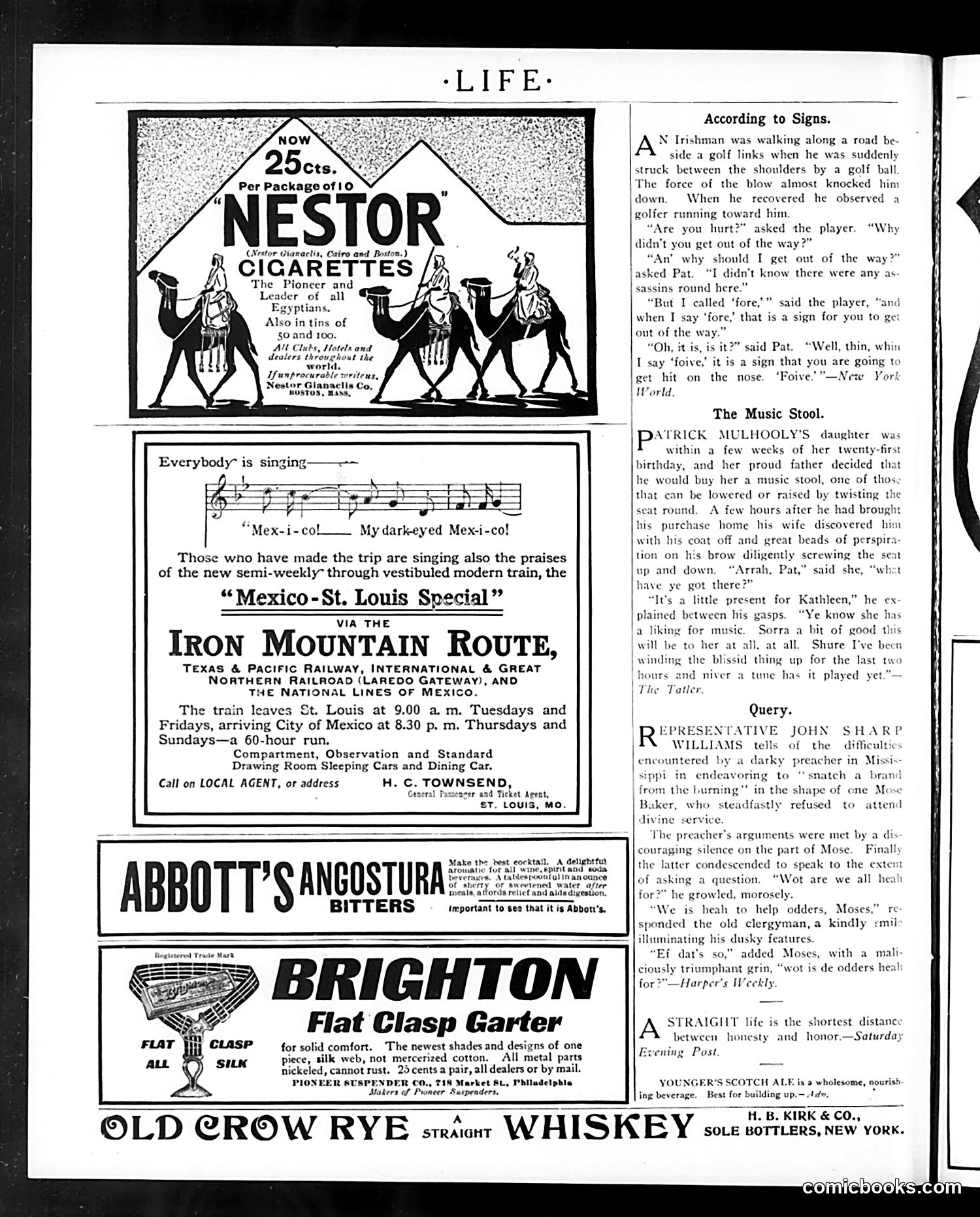
This is primarily an **advertising page** from Life magazine, with several short humorous anecdotes in the right column. The main advertisements include Nestor Cigarettes (featuring Egyptian imagery with camels and robed figures), a "Mexico-St. Louis Special" train service, and various consumer products (Abbott's Bitters, Brighton garters, Old Crow Whiskey). The brief stories use **ethnic humor common to the era**: - "According to Signs" presents an Irishman (Pat) misunderstanding the golf term "fore" as "foive," playing on Irish dialect and the stereotype of Irish immigrants unfamiliar with upper-class sports. - "The Music Stool" features Irish characters (Patrick and Kathleen Mulhooly) in a domestic comedy about misusing a music stool mechanism. - "Query" depicts a Black preacher attempting to convince a congregant named Mose to attend church, with Mose's sardonic response mocking the premise that people attend to help others. These represent **period-typical stereotypical humor** targeting Irish immigrants and African Americans—attitudes normalized in early 20th-century American publications but considered offensive today.
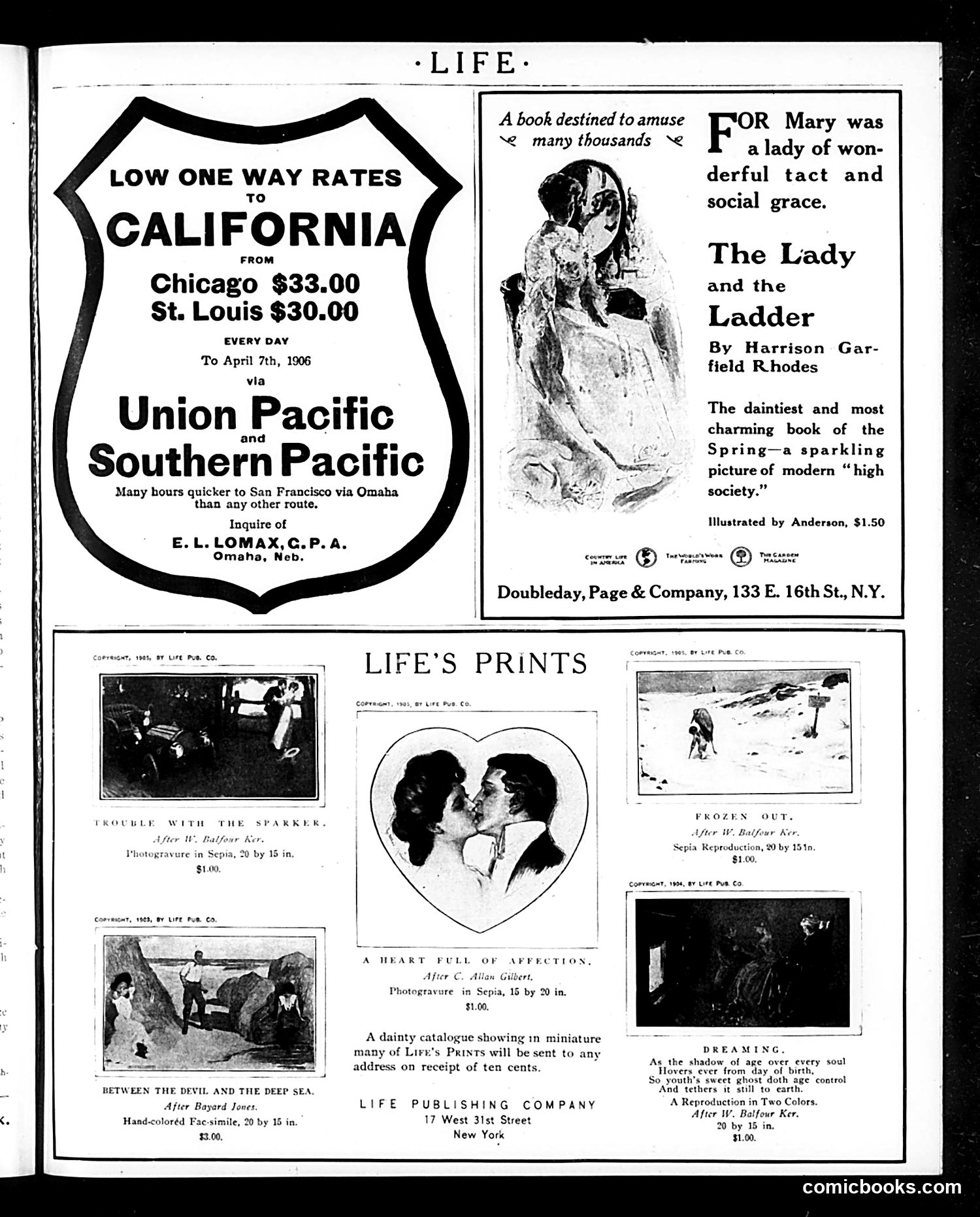
This is primarily an **advertising and merchandise page** from Life magazine, circa 1906. The main content includes: **Railroad Advertisement**: Union Pacific and Southern Pacific offer low one-way fares to California ($33 from Chicago, $30 from St. Louis), emphasizing speed to San Francisco. This appears timed to April 7, 1906—notably just days after the San Francisco earthquake (April 18), suggesting the ad may have been printed before that disaster occurred. **Book Advertisement**: "The Lady and the Ladder" by Harrison Garfield Rhodes, a satirical novel about high society, illustrated by Anderson. **Life's Prints Section**: The page showcases photogravure reproductions and hand-colored prints available for purchase, including sentimental and romantic scenes with titles like "A Heart Full of Affection," "Frozen Out," and "Dreaming"—typical of early 1900s popular art. The page demonstrates Life's business model: advertising, book promotion, and mail-order art sales alongside editorial content.
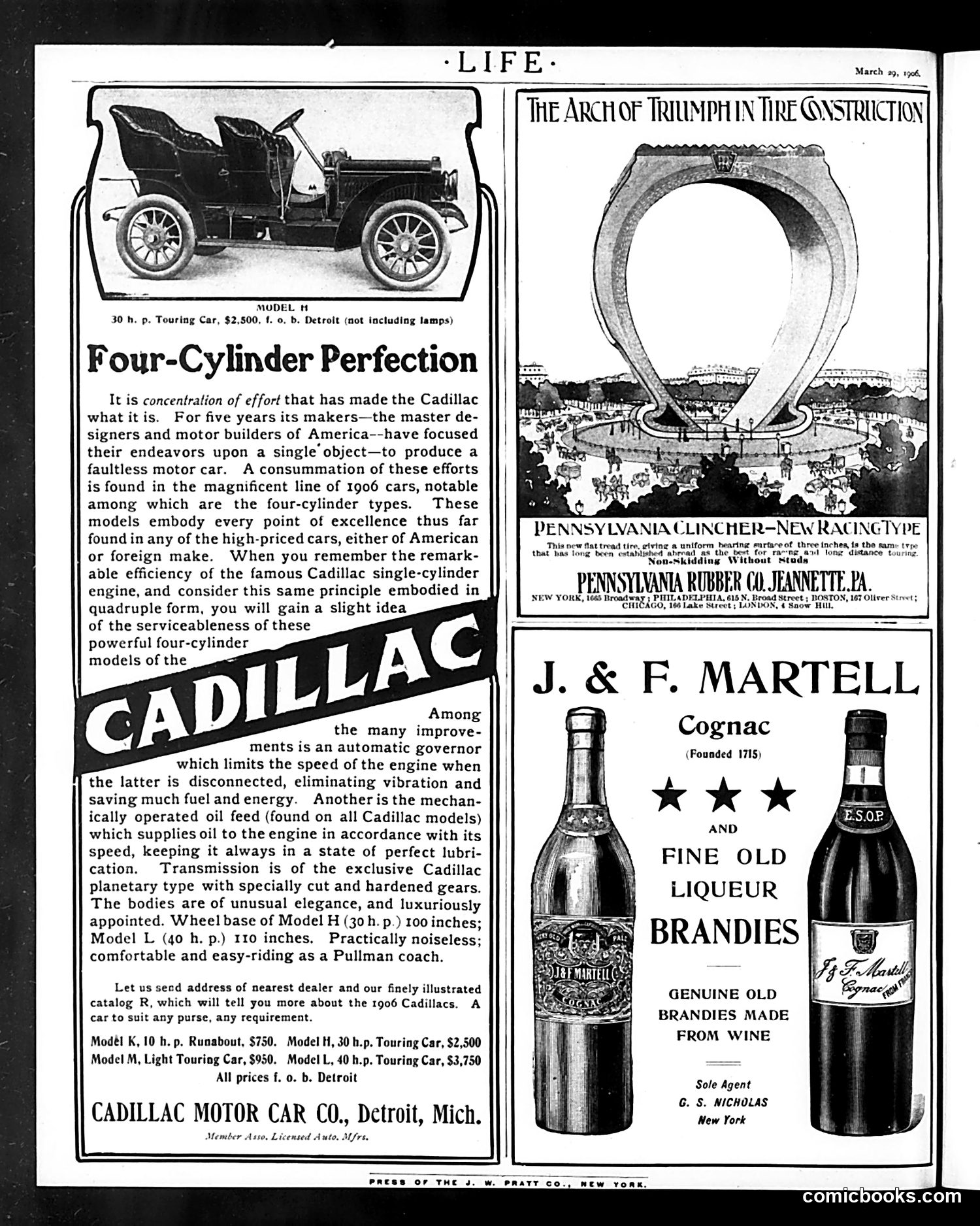
This page contains no political cartoons or satire. It is primarily **advertising**, featuring three commercial advertisements typical of early 1900s magazines: 1. **Cadillac Motor Car advertisement** (left): Promotes the 1906 Cadillac four-cylinder automobile, emphasizing engineering innovations like automatic governors and oil-feed systems. Prices range from $750–$3,750. 2. **Pennsylvania Clincher tire advertisement** (top right): Showcases a new tire tread design for uniform bearing. 3. **J. & F. Martell Cognac advertisement** (bottom right): Sells French brandy and liqueur, founded 1715, distributed by C.S. Nicholas in New York. The page reflects consumer culture of the Gilded Age, when Life magazine mixed satirical content with luxury goods advertising aimed at affluent readers. There is no political commentary or cartoon humor present.