
Life, 1906-03-29 · page 6 of 24
Life — March 29, 1906 — page 6: what you’re looking at
What you’re looking at
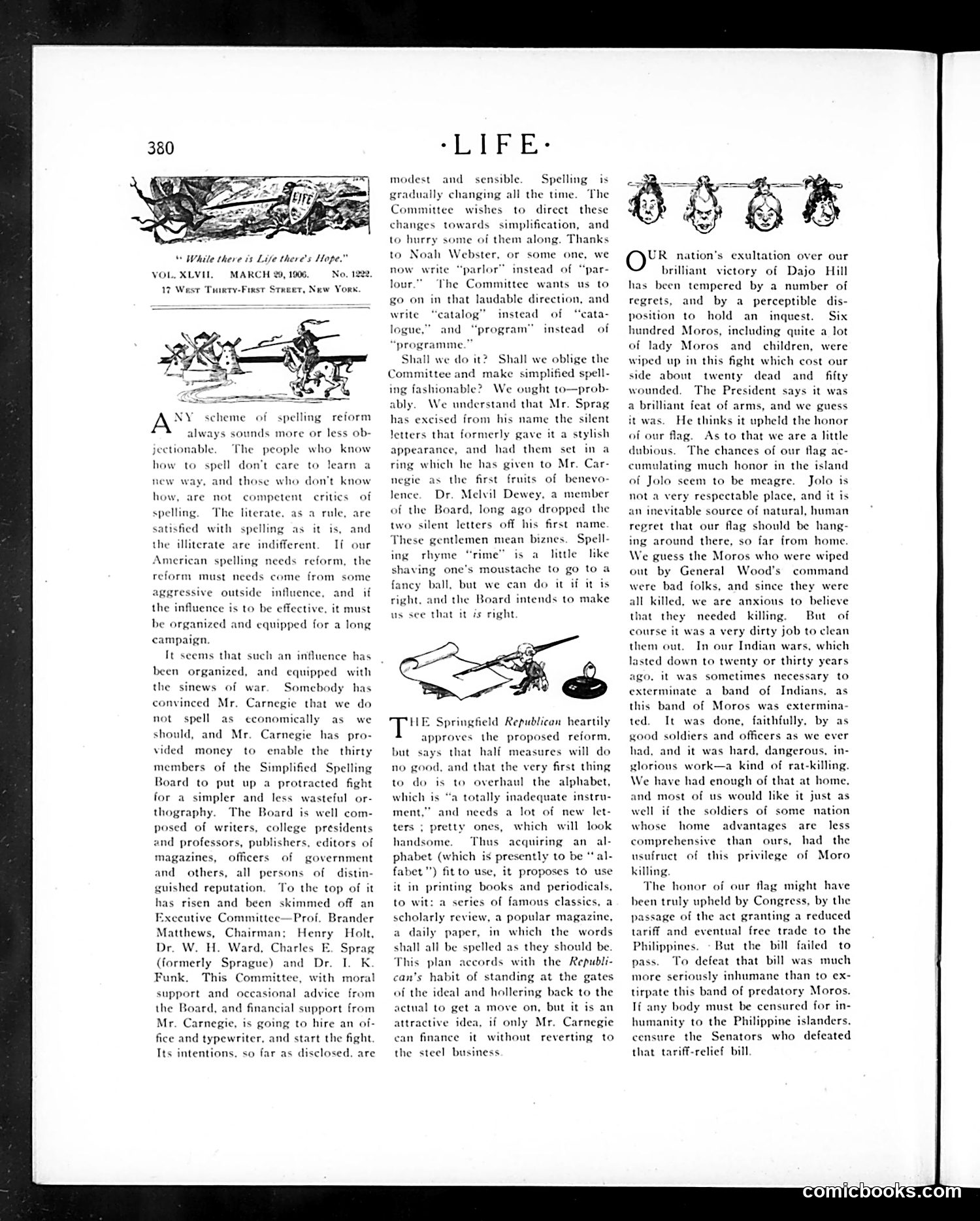
This page contains two distinct sections: **Left Column:** Discusses spelling reform, mentioning Mr. Sprag, Dr. Melville Dewey, and a Simplified Spelling Board. The text satirizes efforts to reform English orthography, noting that Andrew Carnegie funded efforts to simplify spelling but the initiative faced resistance. **Right Column:** Addresses American military action against the Moro people in the Philippines. The author defends the campaign as necessary and honorable, comparing it to previous Indian Wars. The piece argues that eliminating the "band of Moros" was justified military work, though acknowledges it was a "dirty job." **The Cartoons:** Small illustrations accompany both sections but are difficult to interpret clearly from the image quality provided. The page reflects early 1900s American attitudes toward linguistic reform and colonial military operations.
📄 Transcribed text from this page (OCR, searchable)
Machine-transcribed from the original scan — historical spelling and the odd misread are preserved.
“ While there is Life there's Hope.” VOL. XLVIL MARCH 9, 1906. 17 West Tiety-First Street, Naw YorX. scheme of spelling reform A*™ always sounds more or less ob- jectionable. The people who know he to spell don’t care to learn a new way, and those who don't know critics of how, are not competent spelling. The literate, as a rule, are satisfied with spelling as it is, and the illiterate are indifferent. If our American spelling needs reform, the reform must needs come from some influence, aggressive outside and if the influence is to be effective, it must be organized and equipped for a long campaign. It seems that such an influence has been organized, and equipped with the sinews of war. Somebody has convinced Mr. Carnegie that we do spell. as economically as we should, and Mr. Carnegie has pro- vided thirty members of the Simplified Spelling Board to put up a protracted fight for a simpler and less wasteful or- thography. The Board is well com- posed of writers, college presidents and professors, publishers, editors of magazines, officers of government others, all persons of distin- guished reputation. To the top of it has risen and been skimmed off an Exceutive Committee—Proi. Brander Matthews, Chairman; Henry Holt, Dr. W. H. Ward, Charles E. Sprag (formerly Sprague) and Dr. I. K Funk. This Committee, with moral support money to enable the and advice from the Board, and financial support from Mr. Carnegie, is going to hire an o fice and typewriter, and start the fight Its intentions, so far as disclosed, are and occasional No. 1282. *-LIFE: modest and sensible. Spelling is gradually changing all the time. The Committee direct these changes towards simplification, and to hurry some of them along. Thanks to Noah Webster, or some one, we wishes to now write “parlor” instead of “par- our.” The Committee wants us to go on in that laudable direction, and write talog” instead of logue.” and “program” “programme.” Shall we do it?) Shall we oblige the Committee and make simplified spell- ing fashionable? We ought to—prob- ably. We understand that Mr. Sprag has excised from his name the silent Jetters that formerly gave it a stylish appearance, and had them set in a ring which he has given to Mr. Car- negie as the first lence. Dr. Melvil Dewey, a member of the Board, long ago dropped the two silent letters off his first name These gentlemen mean biznes. Spell- ing rhyme “rime” is a little like shaving one’s moustache to go to a “cata- instead of fruits of benevo- fancy ball, but we can do it if it is right, and the Board intends to make us see that it is right HE Springfield Republican heartily approves the proposed reform. but says that half measures will do no good, and that the very first thing to do is to overhaul the alphabet, which is “a totally inadequate instru- ment,” and needs a lot of new let- ters ; pretty ones, which will loo handsome. Thus acquiring an al- phabet (which is presently to be “al- fabet"’) fitto use, it proposes to use it in printing books and periodicals, to wit: a series of famous classics, a scholarly re a daily paper, in which the words all all be spelled as they should be. This plan accords with the Republi- can’s habit of standing at the gates and hollering back to the actual to get a move on, but it is an attractive idea, if only Mr. Carnegie can finance it without reverting to the steel business. ew, a popular magazin of the idea JR nation’s exultation over our brilliant victory of Dajo Hill as been tempered by a number of regrets, and by a perceptible dis- position to hold an inquest. Six hundred Moros, including quite a lot of lady Moros and children, were wiped up in this fight which cost our side about twenty dead and fifty wounded. The President says it was a brilliant feat of arms, and we guess He thinks it upheld the honor of our flag. As to that we are a little dubious. The chances of our flag ac- cumulating much honor in the island of Jolo scem to be meagre. Jolo is not a very respectable place, and it is an inevitable source of natural, human regret that our flag should be hang- ing around there, so far from home. We guess the Moros who were wiped out by General Wood's command were bad folks, and since they were all killed, we are anxious to believe that they needed killing. But of course it was a very dirty job to clean them out. In our Indian wars, which lasted down to twenty or thirty years ago, it was sometimes necessary to xterminate a band of Indians, as this band of Moros was extermina- ted. It was done, faithfully, by as good soldiers and officers as we ever had, and it was hard, dangerous, in- glorious work—a kind of rat-killing. We ¢ had enough of that at home, and most of us would like it just as well if the soldiers of some home advantages are less comprehensive than ours, had the usufruct of this privilege of Moro killing. The honor of our flag might have been truly upheld by Congress, by the passage of the act granting a reduced tariff and eventual free trade to the Philippines. - But the bill failed to pass. To defeat that bill was much more seriously inhumane than to ex- tirpate this band of predatory Moros Ii any body must be censured for in- humanity to the Philippine islanders. censure the Senators who defeated that tariff-relief bill it was, nation whose