
Life, 1906-03-29 · page 16 of 24
Life — March 29, 1906 — page 16: what you’re looking at
What you’re looking at
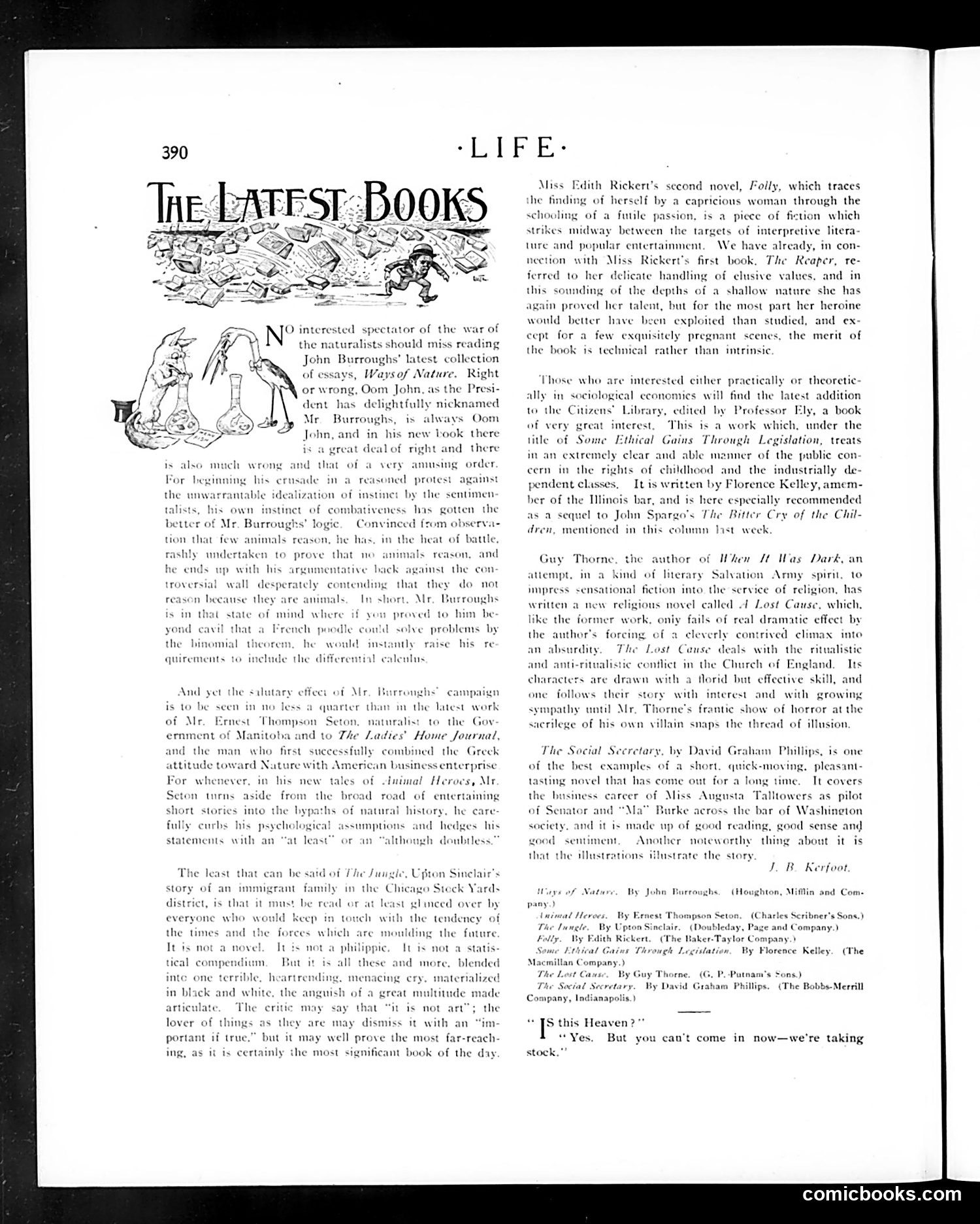
This page reviews recent books, primarily discussing naturalist John Burroughs and writer Upton Sinclair. The illustrated header "The Latest Books" features whimsical decorative figures. The text critiques Burroughs' essay collection *Ways of Nature*, noting that while he argues animals lack reason, he's become so combative in this crusade that he's contradicted himself—insisting animals cannot reason precisely *because* they're animals. The reviewer suggests Burroughs has lost logical balance in his zeal. The page praises Sinclair's *The Jungle* as the "most significant book of the day," acknowledging it transcends traditional categories (novel, polemic, statistical study) to become a powerful indictment of conditions in Chicago's meatpacking district. Other reviews cover Edith Rickert's *Folly* and Florence Kelley's *Some Ethical Gains Through Legislation*, a work on child labor and worker protections. The page represents Life's role as a venue for serious literary criticism alongside satire.
📄 Transcribed text from this page (OCR, searchable)
Machine-transcribed from the original scan — historical spelling and the odd misread are preserved.
-LIFE- O interested spectator of the war of the naturalists should miss reading John Burroughs’ latest collection of essays, Waysof Nature, Right or wrong, Oom John, as the Presi- dent has delightfully nicknamed Mr Burroughs, is always Oom John, and in his new book there is a great dealof right and there wrong and a very amusing order s crusade in a reasoned protest against the unwarrantable idealization of instinet by the sentimen talists, his own instinct of combativeness has gotten the better of Mr. Burroughs’ logic. Convinced from observ tion that few animals reason, he has, in the heat of battle, rashly undertaken he ends up his argumentative back against the con prove that no animals reason, and troversial wall desperately contending that they do not reason heeause they are animals, In short, Mr, Burroughs is in that state of mind where if you proved to him be yond cavil that a Freneh poodle could solve problems by the hinomial theorem, he would instantly raise his re quirements 10 include the differential calentus And yet the salutary effect of Mr. i to be seen in no less of Mr. Ernest ernment of Ma quarter than in the latest work Thompson Seton, naturalist to the Gov toba and to The Ladies’ Home Journal, who first successfully combined the Greek attitude toward Nature with American business enterprise and the mar For whenever, in his new tales of sInimal Heroes, Mr Scton tens aside from the broad road of entertaining short stories into the bypaths of natural history, he care fully curbs his psychological assumptions and hedges his statements with an “a cast” n “although doubtless.” e least that can be said of The Jungle, Upton Sinclair's story of an immigrant family in the Chicago Steck Yards district, is that it must be read or at Ie iced over by everyone who wou} the times keep in tonch with the tendency of and the forces which are moulding the future It is not a novel. Tt is not a philippic. It is not a stati tical compendium. But it is all these and more, blende inte one terrible heartrending, menacing ery, materialized in black and white, the anguis of a great multitude made art The critic may say that “it is not art™ lover of hings as they are may dismiss it with an “im- portant if true.” but it may well prove the most far-reach- ing, as it is certainly the most significant book of the day Miss Edith Rickert’s second novel, Folly, which traces he finding of herself by a capricious woman through the ling of a futile passion, is a picce of fiction which strikes midway between the targets of interpretive litera- ture and popular entertainment. We have already, in con- nection with Miss Rickert’s first book, The Reaper, re- ferred to her delicate handling of elusive values, and in schoo! this sounding of the depths of a shallow nature she has again proved her talent, but for the most part her heroine would better have been exploited than studied, and ex cept for a few exquisitely pregnant scenes, the merit of the book is technical rather than intrinsic. Those who are interested cither practically or theoretie- ally in sociological economics will find the latest addition to the Citizens’ Library, edited by Professor Ely, a book of very great interest. This is a work which, under the litle of Some Ethical Gains Through Legislation, treats in an extremely clear and able manner of the public con cern in the rights of childhoc pendent classes. and the industrially de- It is written by Florence Kelley, amem- her of the Illinois bar, and is here especially recommended 1 to John Spargo’s The Bitter Cry of the Chil- fren, mentioned in this column last week AS a seq Guy Thorne, the author of When /t Was Dark, an atiempt, in a kind of literary Salvation Army: spirit, to impress sensational fiction into the service of religion, has written a new religions novel called 1 Lost Cause, which, like the former work, only fails of real dramatic effect: by the author's forcing of a cleverly contrived climax int an absurdity. The Lost Canse deals with the ritnalistic and anti-ritualistic conflict in the Church of England. Its characters are drawn with a florid but effective skill, and one follows their story with interest and with growing sympathy until Mr, Thorne’s frantic show of horror at the sacrilege of his own villain snaps the thread of illusion The Social Secretary, by David of the best examples of sham Phillips, is one short. quick-moving. pleasant- tasting novel that has come out for a long time. Tt covers the business carcer of Miss Augusta Talltowers as. pilot of Senator and “Ma” Burke across the bar of Washineton society, and it is made up of good reading, good sense and Another noteworthy thing about it is that the illustrations iilustrate the story good sentiment J. B. Kerfoot. Mays of Nature. By John Burroughs. (Houghton, Mifflin and C Ininal Heroes (Charles Scribner's Sons.) The Jungle, By Upton Sinclair. (Doubleday, Page and Company.) Folly. My Edith Rickert. (The Baker-Taylor Company.) Some Ethical Gains Through Legistation Macmillan Company.) ‘he Lest Cause. By Guy Thorne. (G, P.Patoam’s Sons.) The Social Secretary. By David Graham Phillips, (The Bobbs-Merrill pany, Indianapolis.) By Florence Kelley. (The “TS this Heaven?” es. But you can’t come in now—we're taking comicbooks.com