
Life, 1906-03-29 · page 14 of 24
Life — March 29, 1906 — page 14: what you’re looking at
What you’re looking at
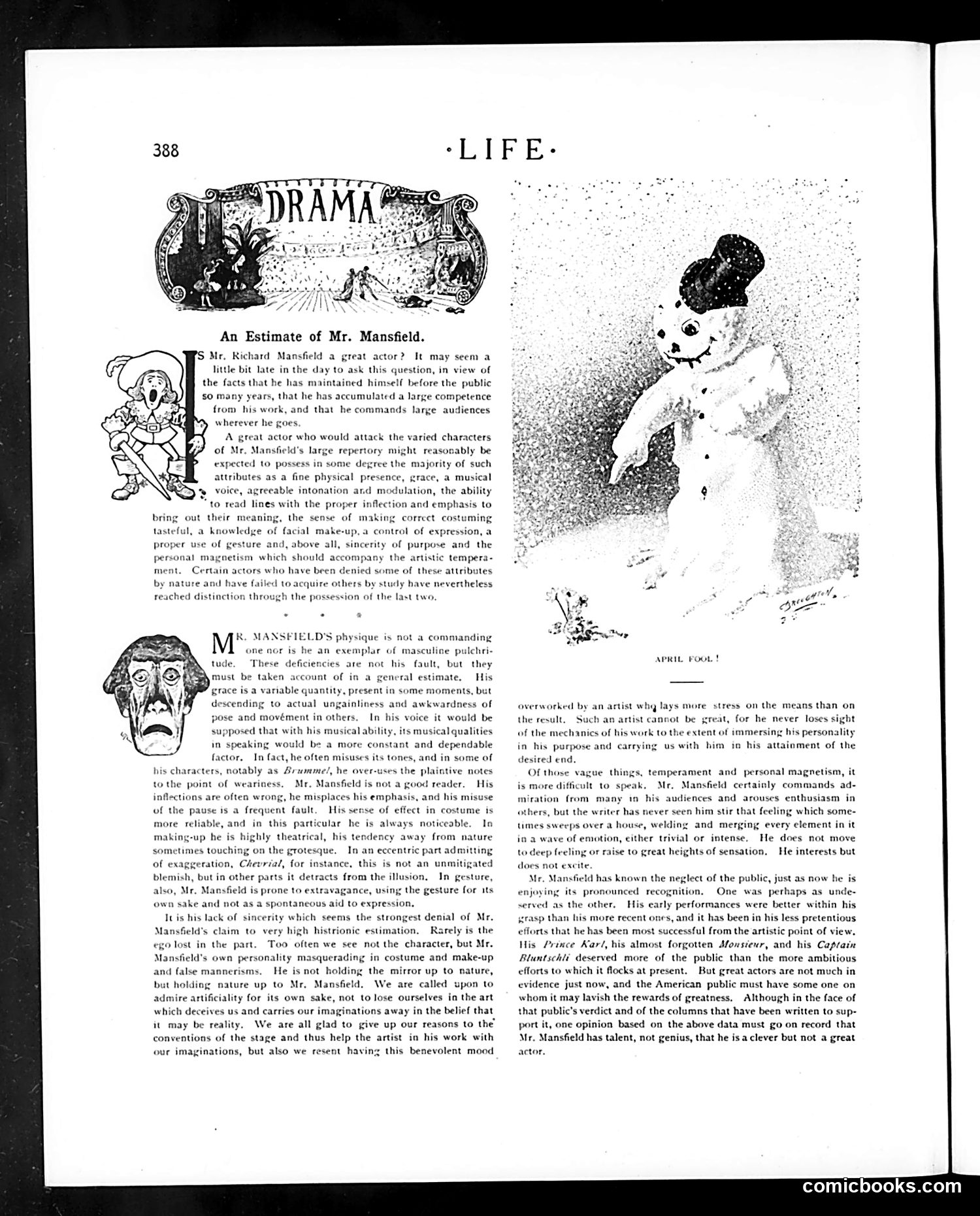
This is a theatrical critique of actor Richard Mansfield, published in Life magazine's "Drama" section. The article offers a detailed, often unflattering assessment of his abilities as a performer. **The Subject:** Richard Mansfield was a prominent late-19th-century American actor known for his large repertory of roles. **The Critique's Main Points:** While acknowledging Mansfield's commercial success and longevity, the writer systematically criticizes his physical presence, voice control, reading of lines, gestures, and costume sense as inconsistent. Most damaging: the article accuses him of prioritizing his own personality over character authenticity—performing "as Mansfield" rather than genuinely inhabiting roles. **The Satire:** The "April Fool!" caption (bottom right) suggests this scathing assessment may be partly tongue-in-cheek, typical of Life's satirical approach. **The Snowman Illustration:** The whimsical snow figure provides visual relief from the text but has no apparent connection to the critique.
📄 Transcribed text from this page (OCR, searchable)
Machine-transcribed from the original scan — historical spelling and the odd misread are preserved.
An Estimate of Mr. Mansfield. Mr, Richard Mansfield a great actor? It may seem a little bit late in the day to ask this question, in view of the facts that he has maintained himself before the public so many years, that he has accumulated a large competence from his work, and that he commands large audiences wherever he goes. A great actor who would attack the varied characters of Mr, Mansfield’s large repertory might reasonably be expected to possess in some degree the majority of such a musical voice, agreeable intonation and modulation, the ability to read lines with the proper inflection and emphasis to the sense of making correct costuming attributes as a fine physical presence, grac bring out their meaning tasteful, a knowledge of facial make-up, a control of expression, a proper use of gesture and, above all, sincerity of purpose and the personal magnetism which she ment. Id accompany the artistic tempera- Certain actors who have been denied some of these attributes by nature and have fai J to acquire others by study have nevertheless reached distinction through the possession of the last two. M* MANSEIELD'S physique is not a commanding one nor is he an exemplar of masculine pulchri- tude, These deficiencies are not his fault, but they must be taken account of in a general estimate, His grace is a variable quantity, present in some moments, but descending to actual ungainliness and awkwardness of pose and movément in others. In his voice it would be supposed that with his musical ability, its musical qualities in speaking would be a more constant and dependable factor. In fact, he often misuses its tones, and in some of his characters, notably as Brumme/, he over-uses the plaintive notes tothe point of weariness. Mr. Mansfield is not a good reader. His inflections are often wre he misplaces his emphasis, and his misuse of the pause is a frequent fault. His sense of effect in costume is more reliable, and in this particular he is always noticeable. In making-up he is highly theatrical, his tendency away from nature sometimes touching on the grotesque. of exaggeration, C blemish, bi also, Mr, Ma own sake and not as a spontaneous aid to expression, In an eccentric part admitting vrial, for instance, this is not an unmitigate in other parts it detracts from the illusion, In gesture, eld is prone to extravagance, using the gesture for its It is his lack of sincerity which seems the strongest denial of Mr. Rarely is the Too often we see not the character, but Mr. Mansfield’s claim to very high histrionic estimation. ego lost in the part. Mansfield’s own personality masquerading in costume and make-up He is not holding the mirror up to nature, but holding nature up to Mr, Mansfield, We are called upon to admire artificiality for its own sake, not to lose ourselves in the art which deceives us and carries our imaginations away in the belief that it’ may be reality, We are all glad to give up our reasons to the conventions of the stage and thus help the artist in his work with our imaginations, but also we resent having this benevolent mood and false mannerisms, APRIL FOOL ! verworked by an artist whq lays more stress on the means than on the result. Such an artist cannot be great, for he never loses sight of the mechanics of his work to the extent of immersing his personality in his purpose and carrying us with him in his attainment of the desired end. Of those vague things, temperament and personal magnetism, it is more difficult to speak, Mr, Mansfield certainly commands ad- miration from many in his audiences and arouses enthusiasm ers, but the writer has never seen him stir that feeling which some- times sweeps over a house, welding and merging every element in it He does not move to deep feeling of raise to great heights of sensation, in a wave of emotion, either trivial or intense, He interests but does not excite, Mr, Mansfield has known the neglect of the public, just as now he is enjoying its pronounced recognition, One was perhaps as unde- His early performances were better within his xrasp than his more recent ones, and it has been in his less pretentious efforts that he has been most successful from the artistic point of vie His Prince Karl, his almost forgotten Monsieur, and his Captain Bluntschli deserved more of the public than the more ambitious efforts to which it flocks at present. But great actors are not much in evidence just now, and the American public must have some one on whom it may lavish the rewards of greatness, Although in the face of that public's verdict and of the columns that have been written to sup- port it, one opinion based on the above data must go on record that Mr. Mansfield has talent, not genius, that he isa clever but not a great actor. served as the other, comicbooks.com