
A complete issue · 32 pages · 1906
Life — March 8, 1906
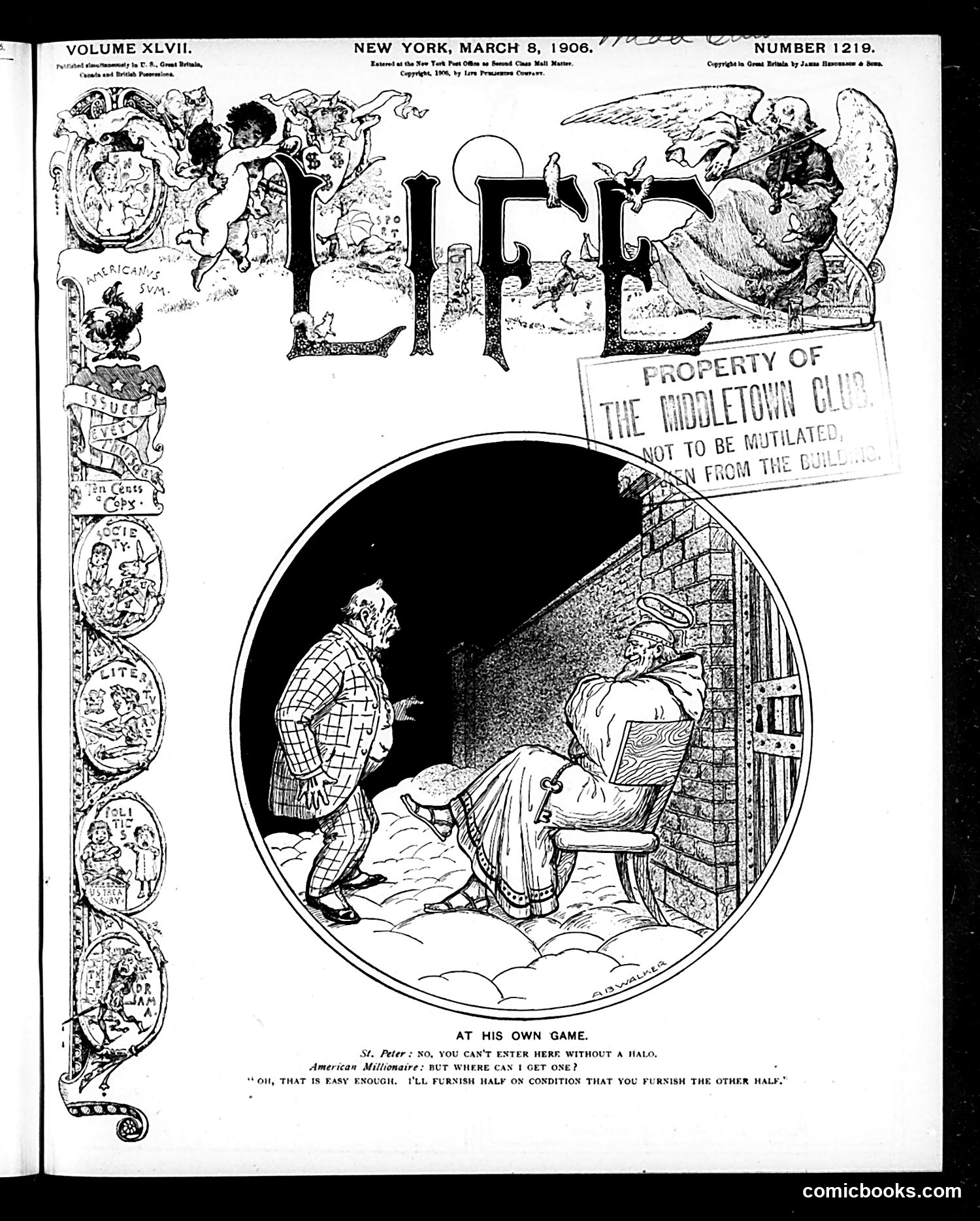
The main cartoon depicts a wealthy American millionaire attempting to enter what appears to be the gates of Heaven or an exclusive club, but being stopped by St. Peter. The millionaire argues he should be admitted, while St. Peter responds that entry requires a halo—which the millionaire lacks. The millionaire then offers a cynical bargain: he'll provide half a halo if St. Peter furnishes the other half, suggesting he can buy his way into heaven through deals and bribes, just as he conducts business on Earth. This is social satire mocking wealthy industrialists of the Gilded Age era, criticizing their assumption that money can purchase moral redemption or entrance into exclusive spaces—even divine ones. The joke suggests such materialistic approach to spirituality is fundamentally corrupt.
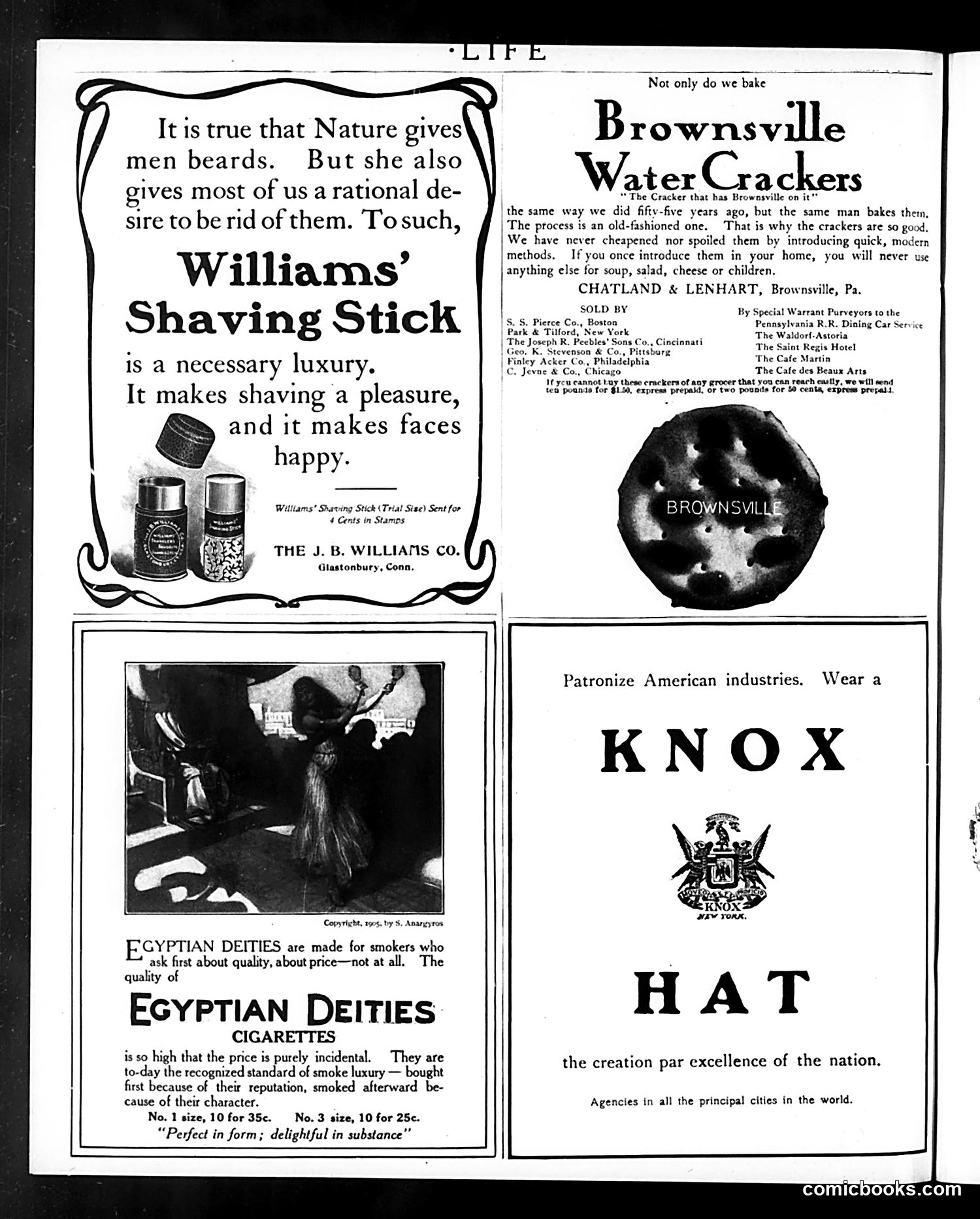
This page is primarily **advertisements rather than satirical content**. The ads include: - **Williams' Shaving Stick** (top left): A straightforward pitch claiming the product makes shaving pleasurable and "makes faces happy" - **Brownsville Water Crackers** (top right): Marketed as an old-fashioned product, with image of a cracker - **Egyptian Deities Cigarettes** (bottom left): Emphasizes quality and luxury, positioning the brand as the "recognized standard of smoke luxury" - **Knox Hat** (bottom right): Describes the product as "the creation par excellence of the nation," appealing to patriotic consumers There is **no discernible political cartoon or satire** on this page. It represents typical early 20th-century magazine advertising, with products marketed through appeals to quality, tradition, patriotism, and lifestyle enhancement. The layout and typography are characteristic of the era's commercial design.
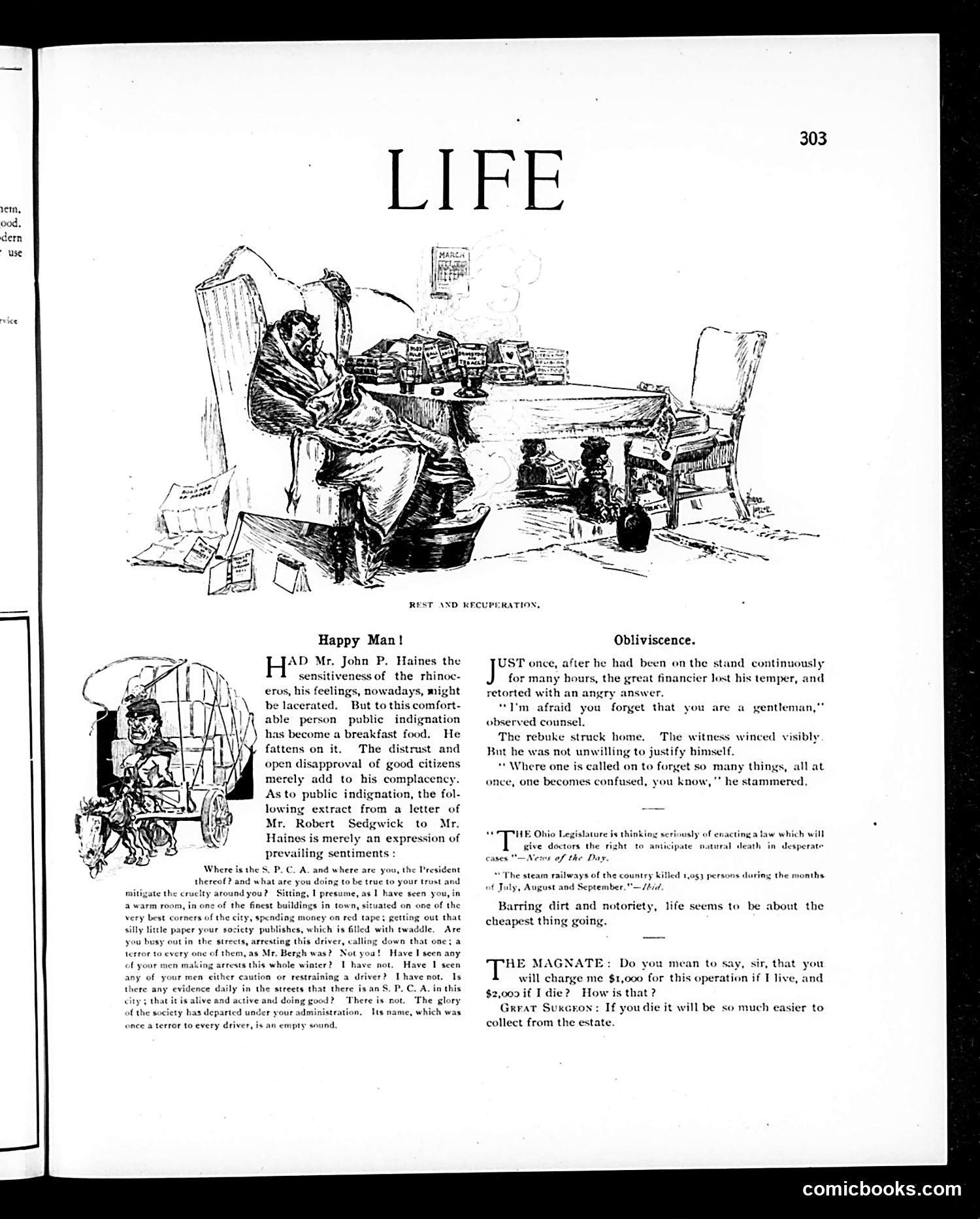
This page contains two satirical pieces critiquing American social institutions: **"Happy Man!"** (left cartoon) mocks the SPCA (Society for the Prevention of Cruelty to Animals). The illustration shows a carriage driver being scolded by society members while animals suffer. The text sarcastically questions why the SPCA aggressively pursues minor infractions against drivers but ignores broader animal cruelty and neglect in the city—suggesting selective, performative activism that prioritizes public shaming over substantive reform. **"Obliviscence"** (right column) depicts a conversation between a financier and his counsel about professional ethics. After losing his temper publicly, the financier is reminded he should behave as a gentleman. The exchange suggests wealthy businessmen prioritize reputation management over genuine moral conduct. Both pieces critique hypocrisy: social organizations and the wealthy selectively enforce standards while ignoring systemic problems.
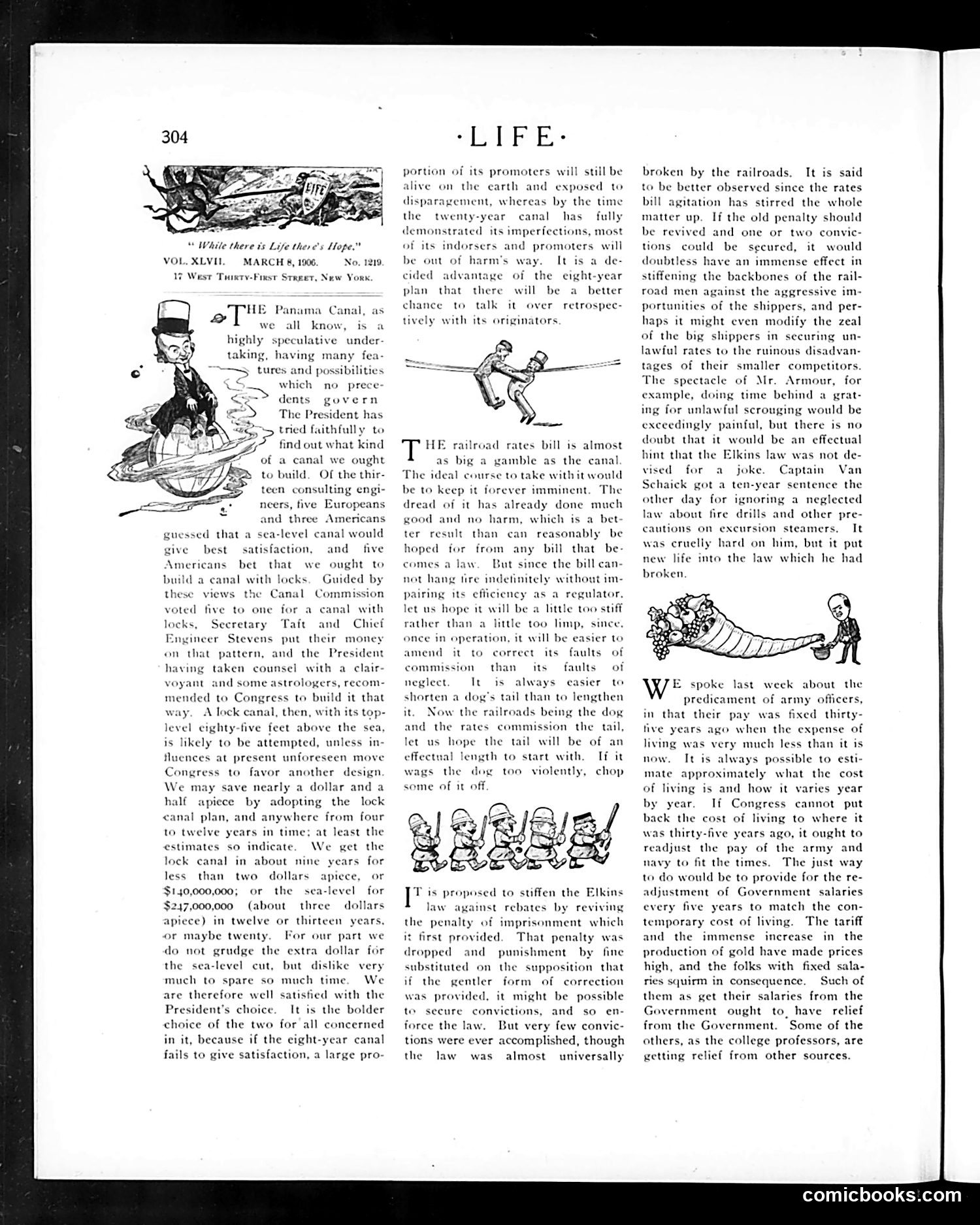
This page discusses the Panama Canal's construction and related political debates. The left column features a caricatured figure labeled "While there is Life there's Hope," representing the canal project itself as a precarious enterprise. The main text debates canal lock design and construction costs—whether to build it with or without locks, a significant engineering controversy of the era. The article references Secretary Taft and Chief Engineer Stevens, real figures involved in the canal's management. The bottom section discusses a separate issue: reviving penalties for military desertion and adjusting army officer salaries to account for inflation and cost-of-living increases since 1881. The satirical tone mocks both the canal's uncertain prospects and bureaucratic complications surrounding military compensation—typical Progressive-era critiques of government inefficiency.
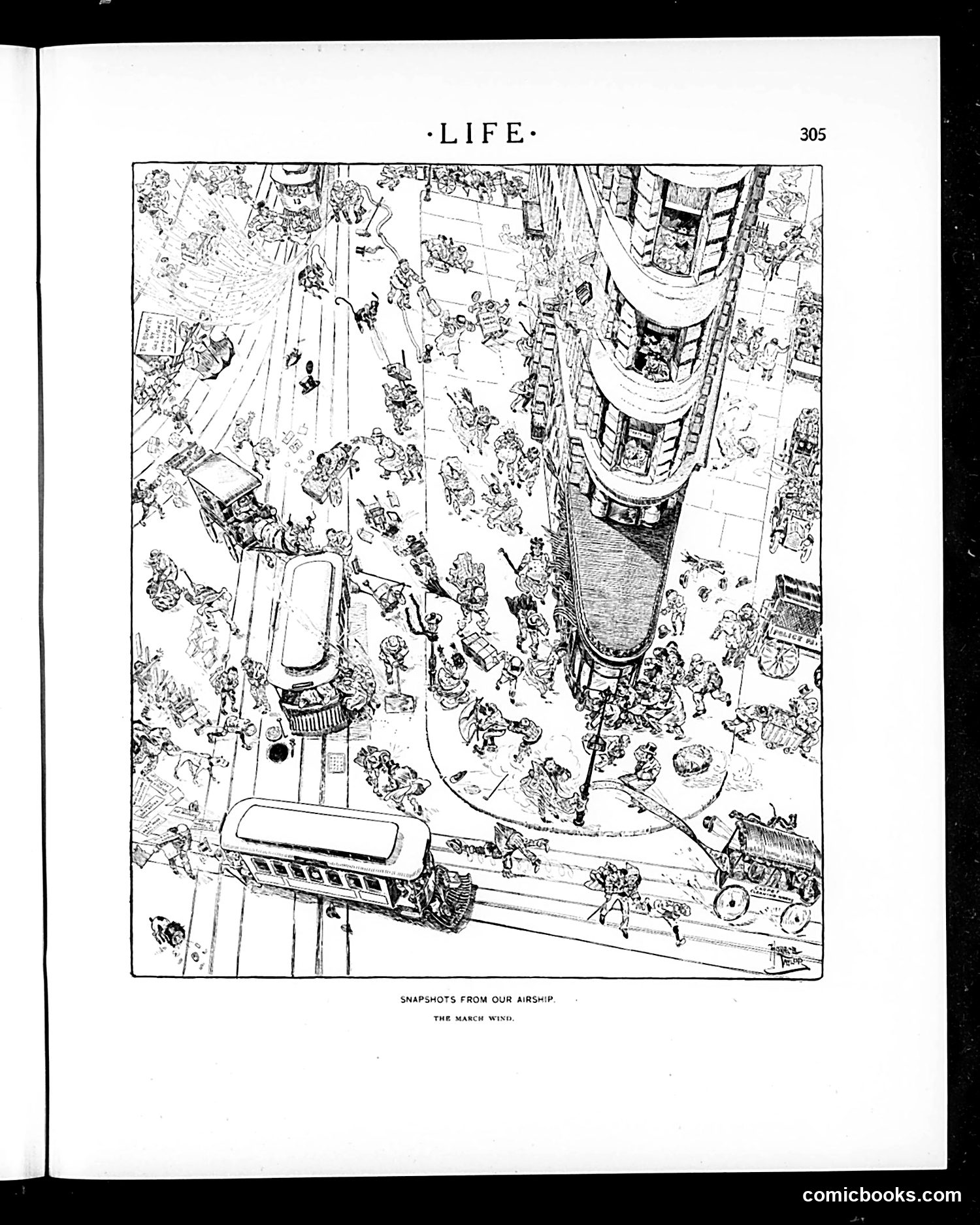
This is an aerial perspective cartoon titled "Snapshots from Our Airship: The March Wind." It depicts a city street scene viewed from above, showing the chaos caused by strong wind. The satire targets the disruptive effects of March weather on urban life. We see pedestrians struggling against wind gusts, hats and clothing being blown away, vehicles tilted precariously, and general disorder throughout the street. Lamp posts, awnings, and other structures appear affected. The "airship" perspective—a novelty viewing angle for the era—emphasizes how the wind dramatically transforms an ordinary city landscape into comedic pandemonium. The joke lies in exaggerating the March wind's power to create widespread havoc among pedestrians, vehicles, and street infrastructure, treating a seasonal weather phenomenon as if it's a destructive force worth documenting from above.
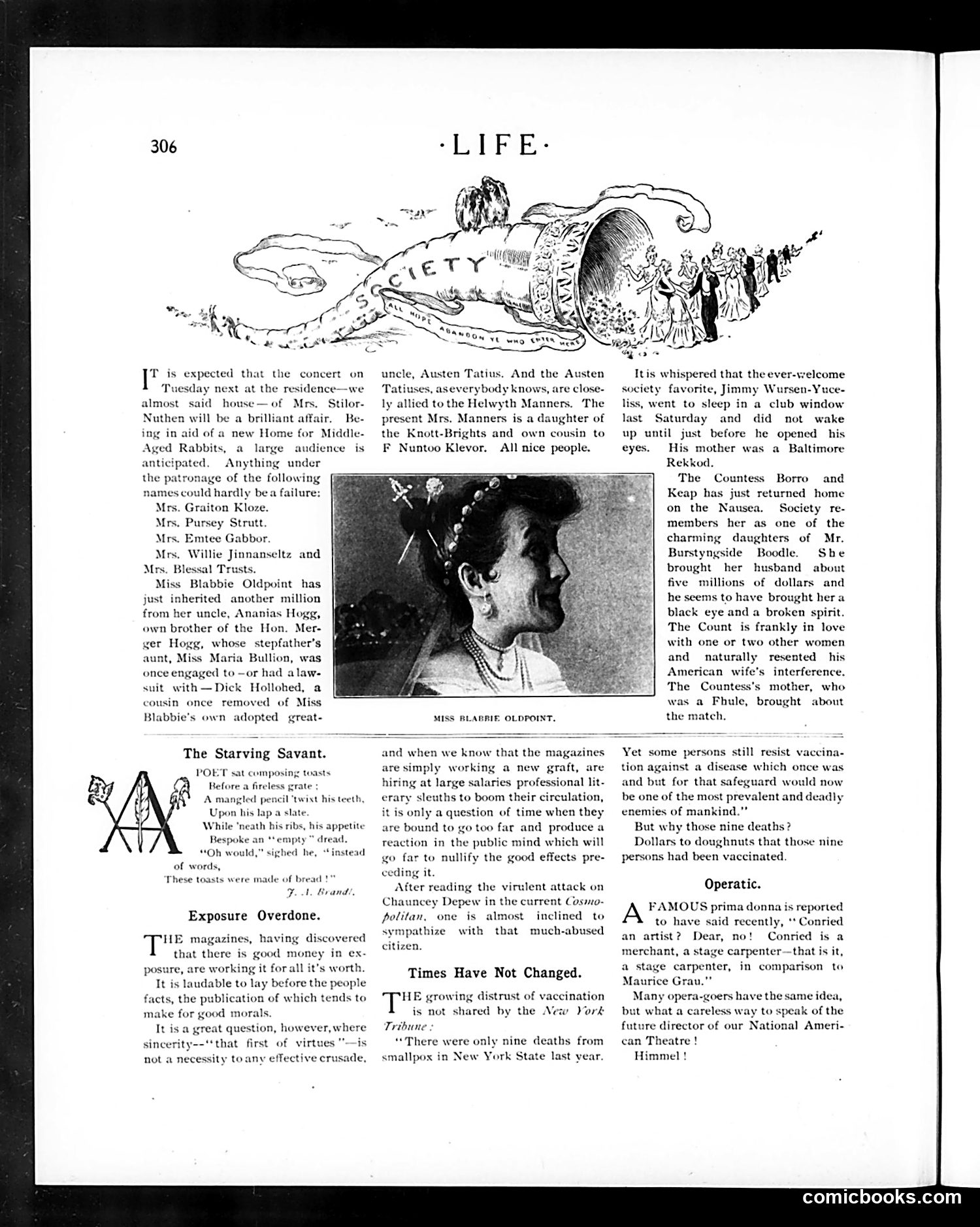
The masthead illustration depicts "Society" as a reclining classical figure, with a cornucopia spilling out people and activities—a standard turn-of-century allegorical representation of high society's abundance. The main content consists of society gossip and commentary rather than political cartoons. It includes reports on socialite activities (a concert by Mrs. Stilor-Nuthen, inheritance news about Miss Blabbie Oldpoint) and social scandal (the Countess Borro's troubled marriage). The text sections titled "The Starving Savant," "Exposure Overdone," and "Times Have Not Changed" are satirical commentary on contemporary issues: magazine sensationalism, public health debates over vaccination, and social hypocrisy. The page exemplifies *Life*'s role as satirist of American upper-class manners and public discourse.
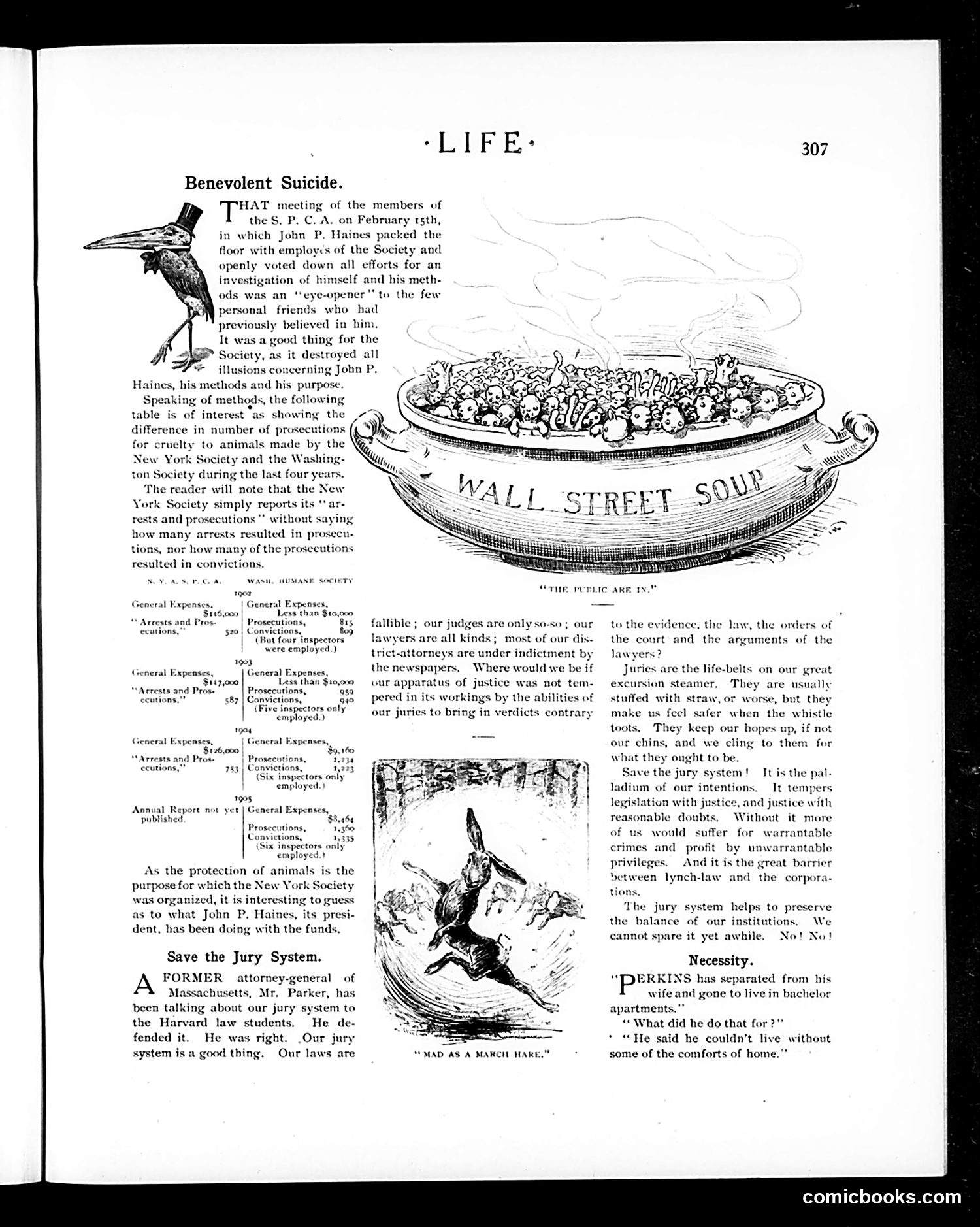
The central cartoon depicts a massive tureen labeled "WALL STREET SOUP" overflowing with what appears to be human figures or victims, with a stork or crane standing above it. This is a satirical critique of Wall Street financiers and big business monopolies consuming ordinary people as ingredients in their enrichment schemes. The surrounding text discusses John P. Haines and the S.P.C.A. (Society for the Prevention of Cruelty to Animals) meeting, suggesting an ironic parallel: if society protects animals from cruelty, why doesn't it protect workers and citizens from the "cruelty" of unscrupulous financiers? The page thus mocks the perceived indifference to human suffering caused by monopolistic capitalism, contrasting it with concern for animal welfare.
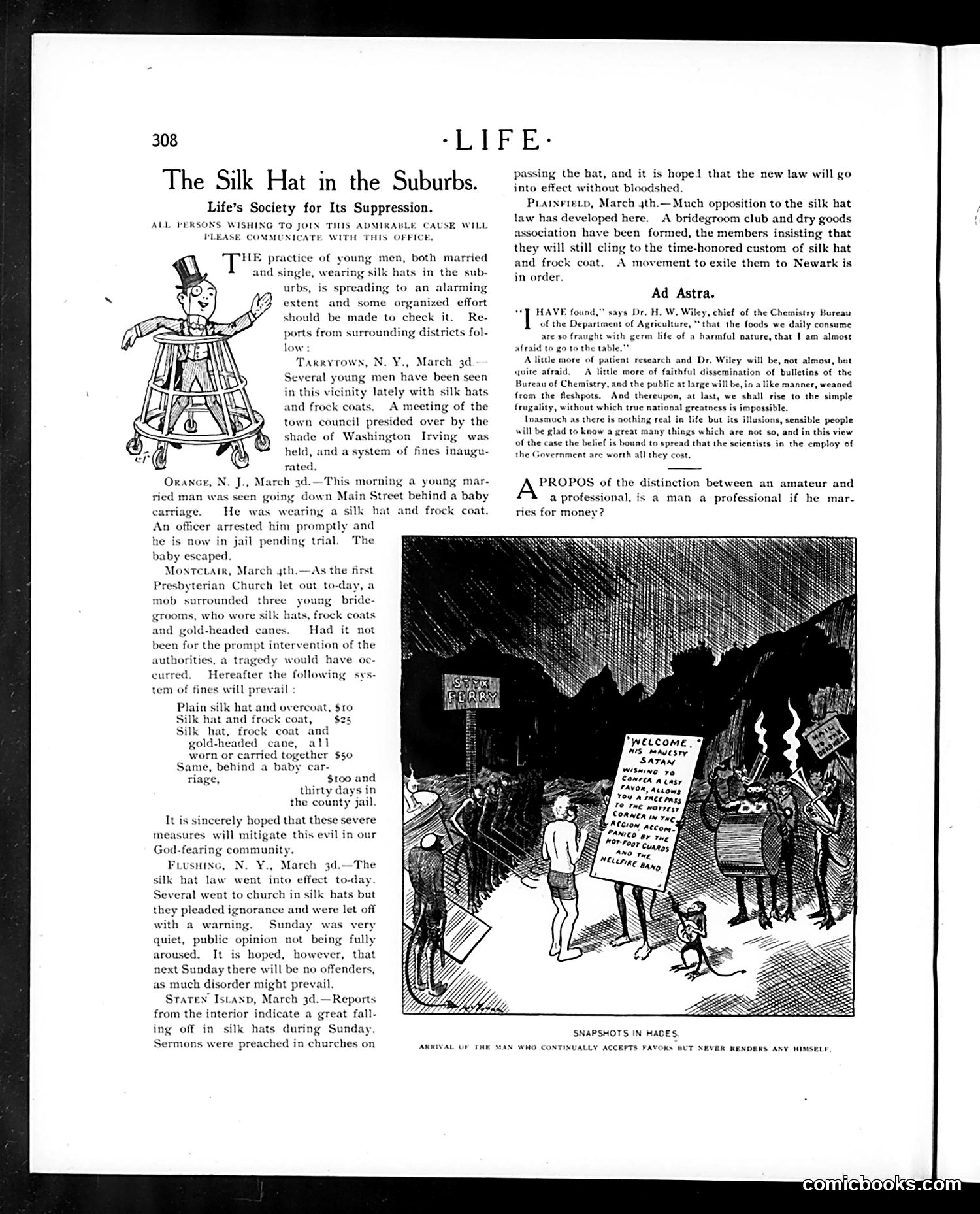
This page satirizes a moral panic over young men wearing silk hats and frock coats in suburban areas. The left column reports various incidents from towns like Tarrytown, Orange, and Montclair, where silk hat-wearing young men allegedly caused disturbances—one arrested after pushing a baby carriage, others drawing church mobs. The cartoon (bottom right) depicts a man holding a sign welcoming "Satan" to Hell, with flames and demons, ironically suggesting silk hats represent evil incarnate to suburban moralists. The satire targets bourgeois anxiety about fashion and class markers. The outfit itself becomes the "crime," implying that suburbs were policing not actual criminal behavior but threatening displays of urban sophistication or different social status among young men.
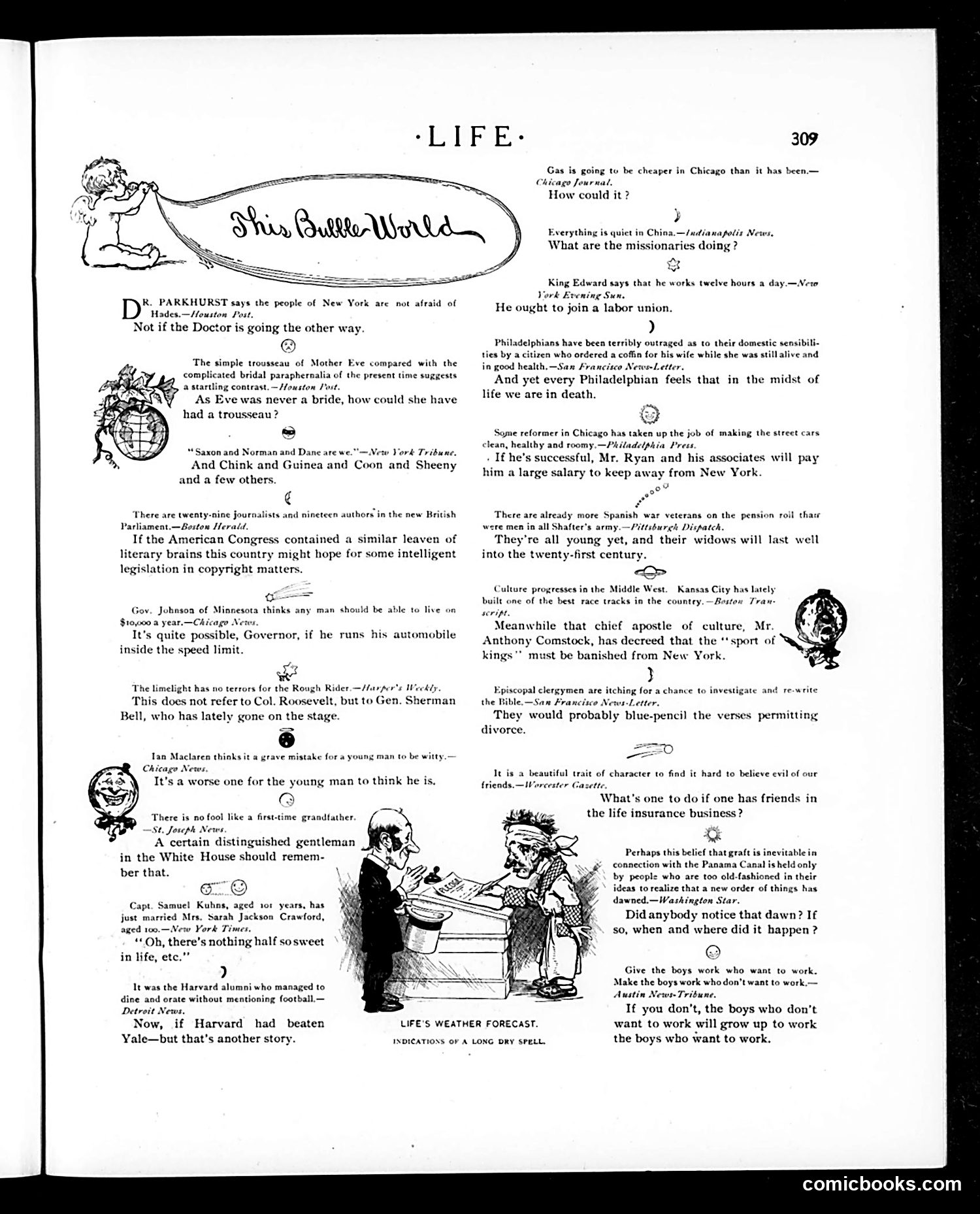
This page contains brief satirical snippets rather than unified cartoons. The commentary mocks contemporary figures and social issues: **Key references include:** - Chicago's rising gas prices - King Edward's labor practices (working twelve hours daily) - Philadelphia's domestic sensibilities and health standards - Spanish-American War veterans receiving pension benefits - Middle West railroad development - Episcopal clergy debating biblical interpretation on divorce - Life insurance industry corruption (graft accusations) **The cartoons** feature small illustrative vignettes alongside text—one showing "Life's Weather Forecast" depicting what appears to be financial/social predictions. The satire targets hypocrisy: reformers and clergy advocating moral positions while practical problems (labor, pensions, health) remain unaddressed. The tone is characteristic of early 1900s American satirical journalism—punchy, moralistic critique of public figures and institutions.
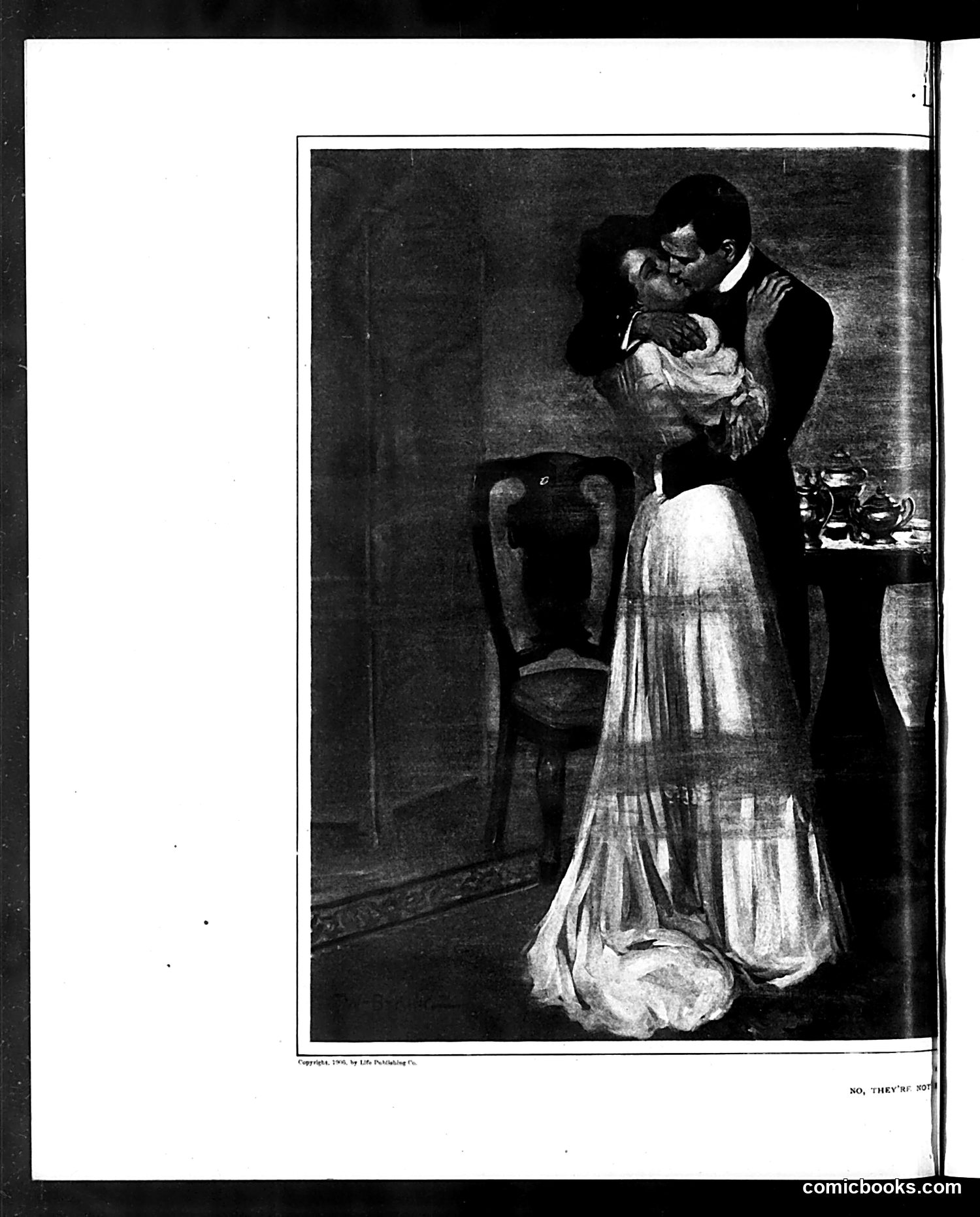
This appears to be a satirical illustration from *Life* magazine showing a domestic scene. A man in formal attire (tuxedo) holds a baby while a woman in an elegant, flowing gown stands nearby. A chair is visible in the interior setting. The caption reads "NO, 'THEY'RE' NOT"—suggesting commentary on assumptions or claims about the figures depicted. Without additional context or visible text identifying the subjects, I cannot definitively state who these figures represent or what specific social/political issue the satire addresses. The formal dress and intimate domestic moment suggest the cartoon may be commenting on social expectations, relationships, or possibly paternity claims—a topic *Life* frequently satirized during the early-to-mid twentieth century.
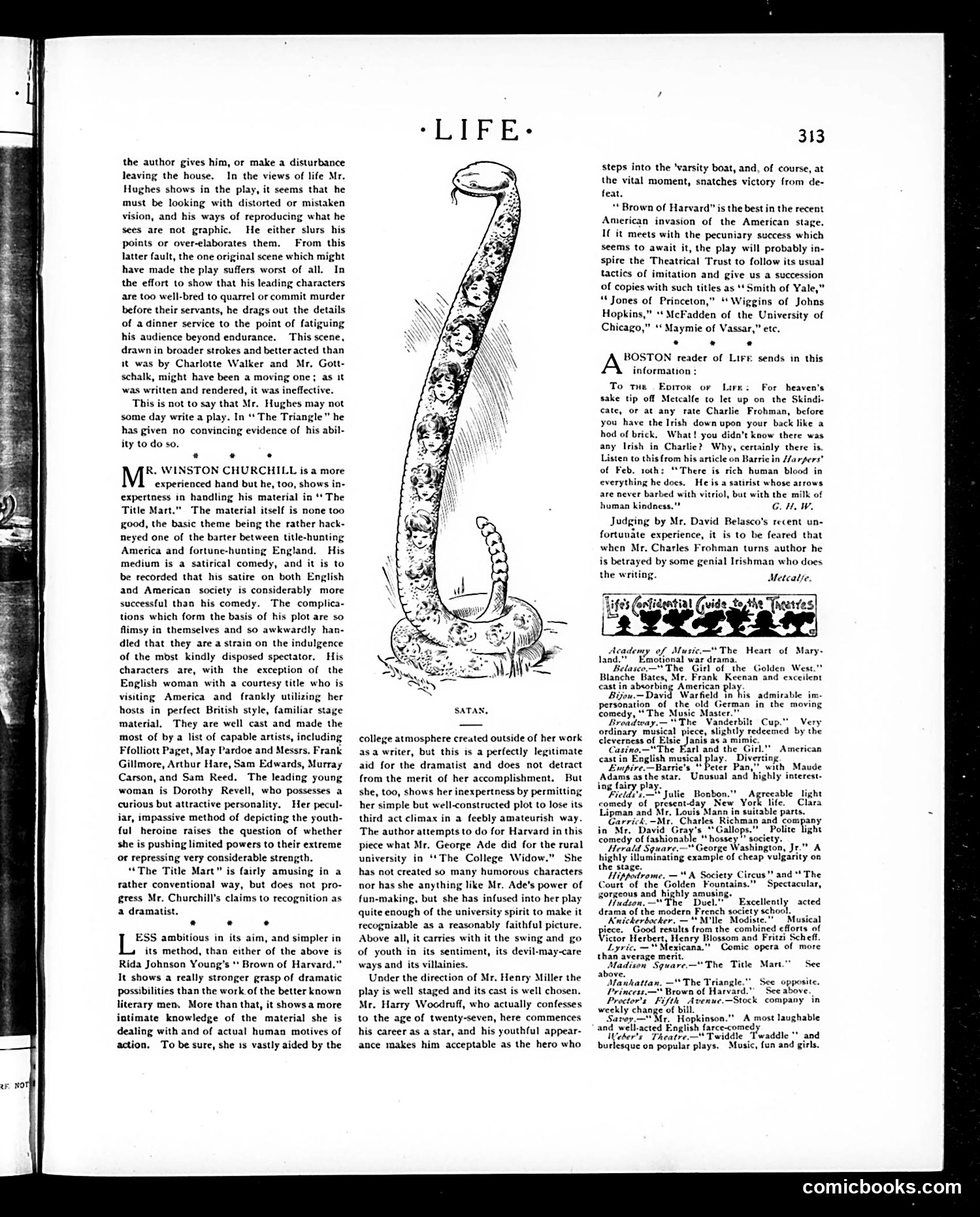
This page contains theatrical reviews from *Life* magazine. The main illustration depicts a **snake** (labeled "SATAN"), which serves as a visual metaphor for the page's discussion of dramatic works. The text critiques several contemporary plays, including "The Title Mart" by Churchill, "The Triangle" (involving Harvard), and others. The reviews discuss how these plays handle character development and social commentary—particularly noting which works succeed or fail in depicting English and American society authentically. The snake imagery likely represents the satirical "evil" or moral challenges depicted in these theatrical productions, fitting *Life*'s tradition of using pointed visual metaphors to frame cultural criticism. The reviews themselves focus on whether playwrights convincingly portray human motivation and social dynamics rather than relying on shallow stereotypes.
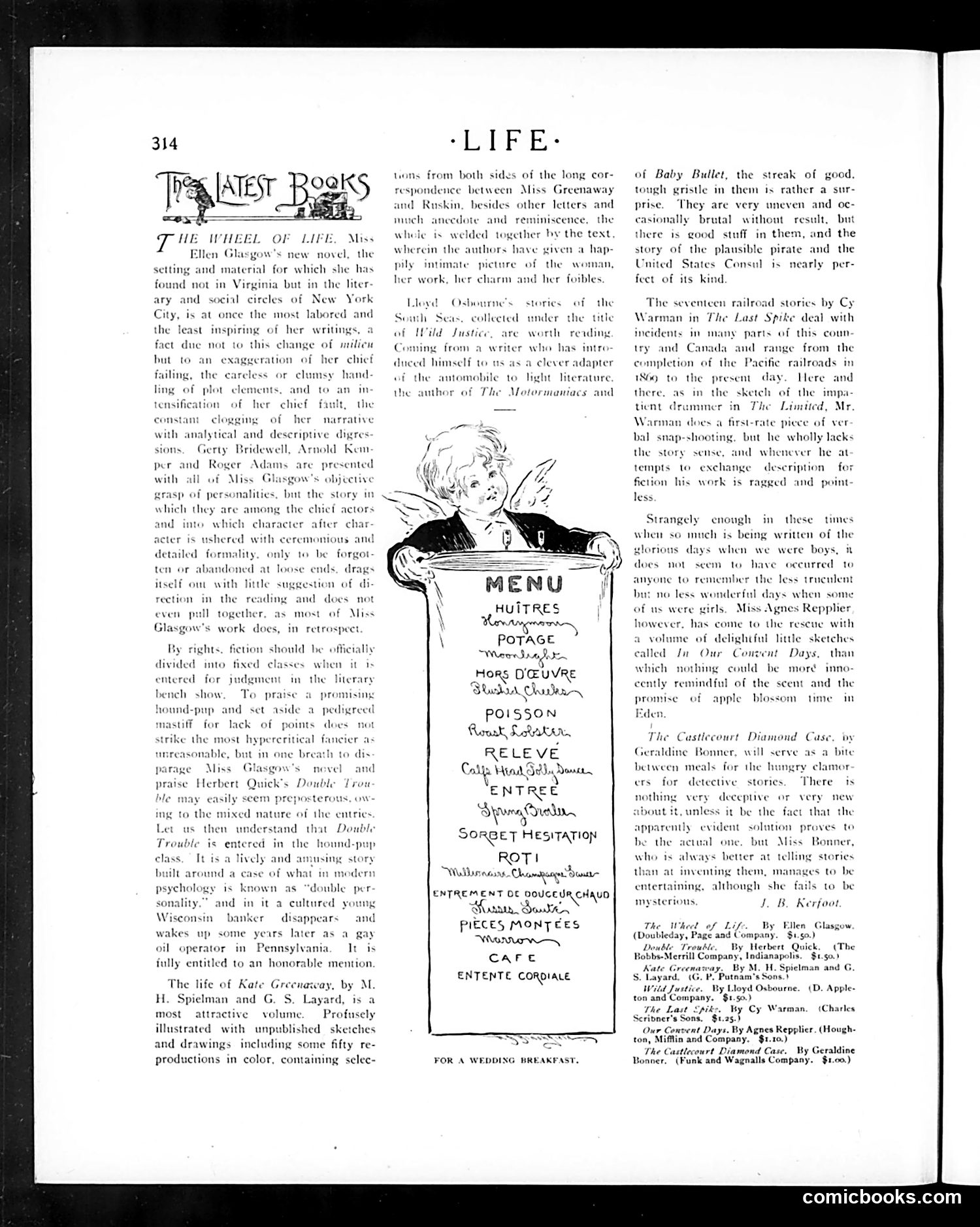
This is a book review column from *Life* magazine (page 314), not a political cartoon. The illustration shows a cherub or cupid figure holding a large menu card, captioned "FOR A WEDDING BREAKFAST." The menu is humorously written in French culinary style, listing dishes like "Huitres" (oysters), "Potage" (soup), and "Poisson" (fish). This appears to be satirizing the pretentious formality of high-society wedding menus—the joke being that even a wedding breakfast is presented with elaborate French terminology. The page reviews several contemporary books, including Ellen Glasgow's *The Wheel of Life* and Kate Greenaway's biography. The content is literary criticism rather than political satire.
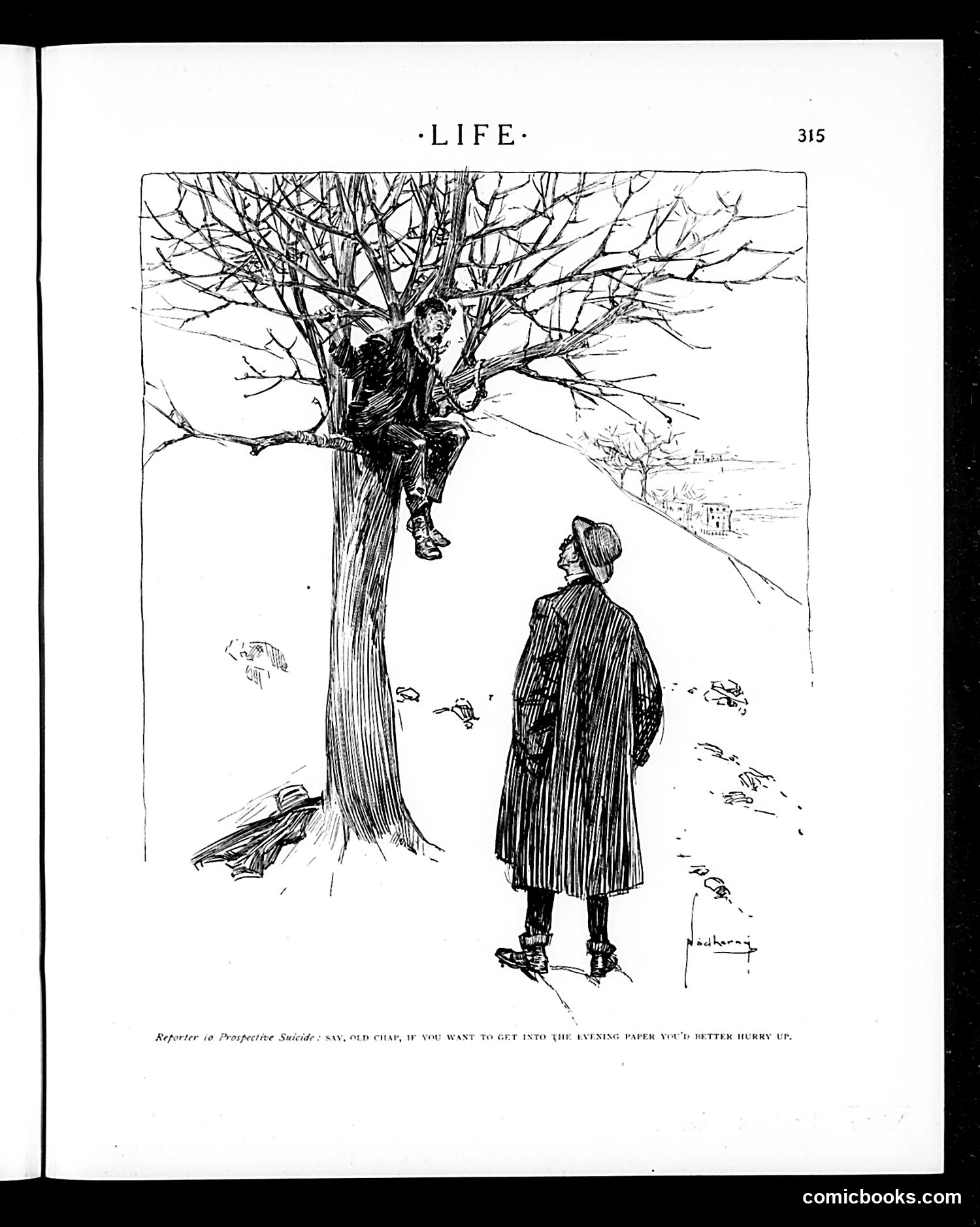
This is a single-panel cartoon from *Life* magazine (page 315) depicting a man sitting in a bare tree while a woman in a coat stands below looking up at him. The caption reads: "Reporter in Prospective Suicide: 'Say, Old Chap, If You Want to Get into the Evening Paper You'd Better Hurry Up.'" The satire targets sensationalist journalism and the public's morbid fascination with suicide stories. The cartoon mocks both the desperate man (implied to be contemplating suicide) and the reporter eager to exploit his tragedy for a headline. The joke's dark humor exposes how newspapers competed for dramatic stories, treating human suffering as mere copy. The woman's casual, businesslike demeanor emphasizes journalism's callousness toward the subject's despair, prioritizing circulation over human dignity.
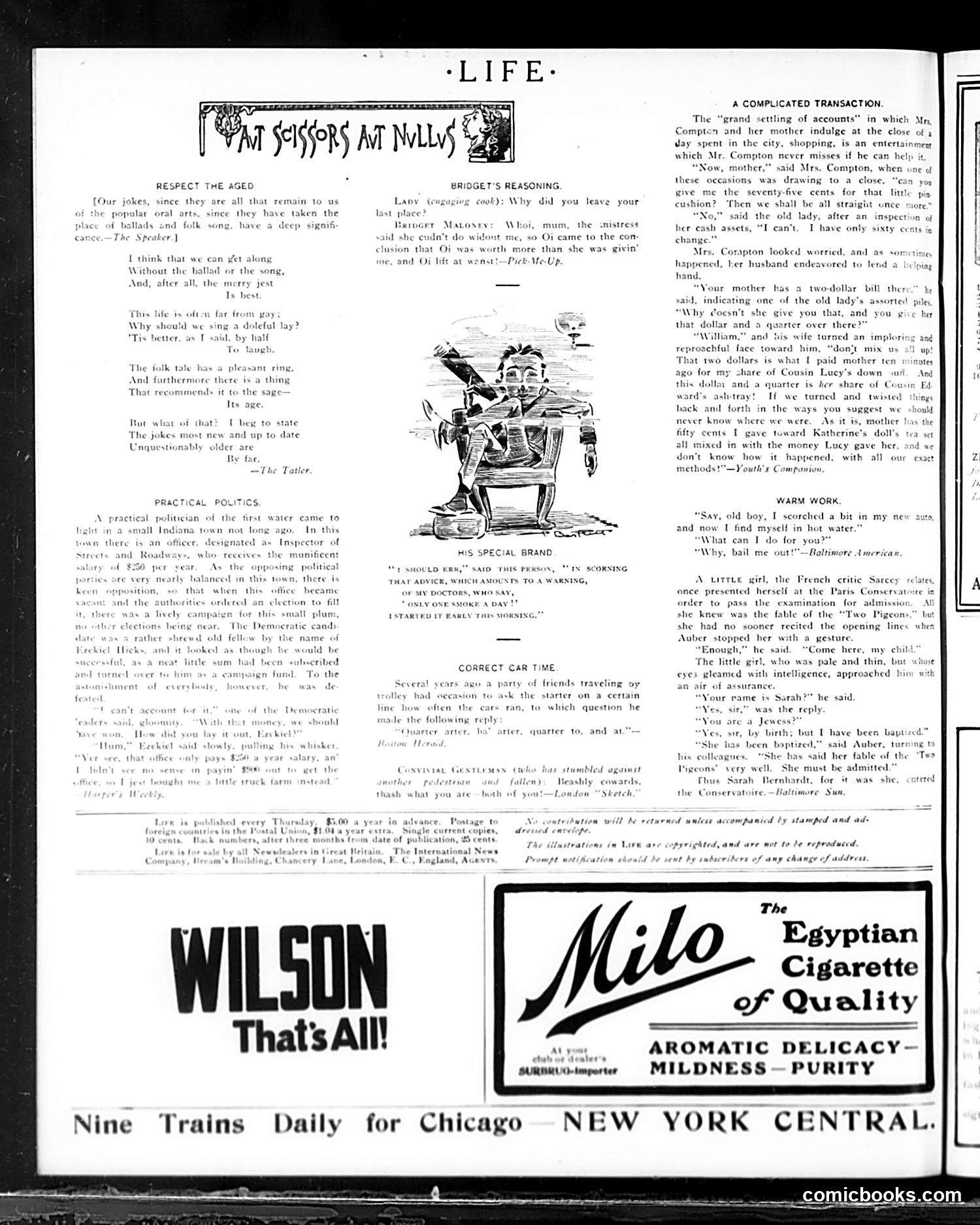
This page contains several satirical pieces typical of Life's humor: **"Respect the Aged"** and **"Practical Politics"** are verse-based humor columns mocking social pretensions and political corruption in small-town America—the Inspector of Streets position and its salary are portrayed as a prize worth campaigning over. **"A Complicated Transaction"** satirizes middle-class domestic accounting: Mr. and Mrs. Compton obsessively track every penny spent during a shopping trip, creating elaborate mental ledgers. The humor lies in their inability to reconcile accounts, discovering their careful bookkeeping has tangled everything into confusion—a jab at bourgeois penny-pinching and false precision. **"Correct Car Time"** jokes about cars breaking down in the newly motorized era. The page also includes advertisements (Wilson, Milo cigarettes, New York Central railroad) typical of period magazines, and a servant-interview sketch mocking working-class employment disputes. The overall tone satirizes American middle-class anxiety about money, status, and modern technology circa 1900s.
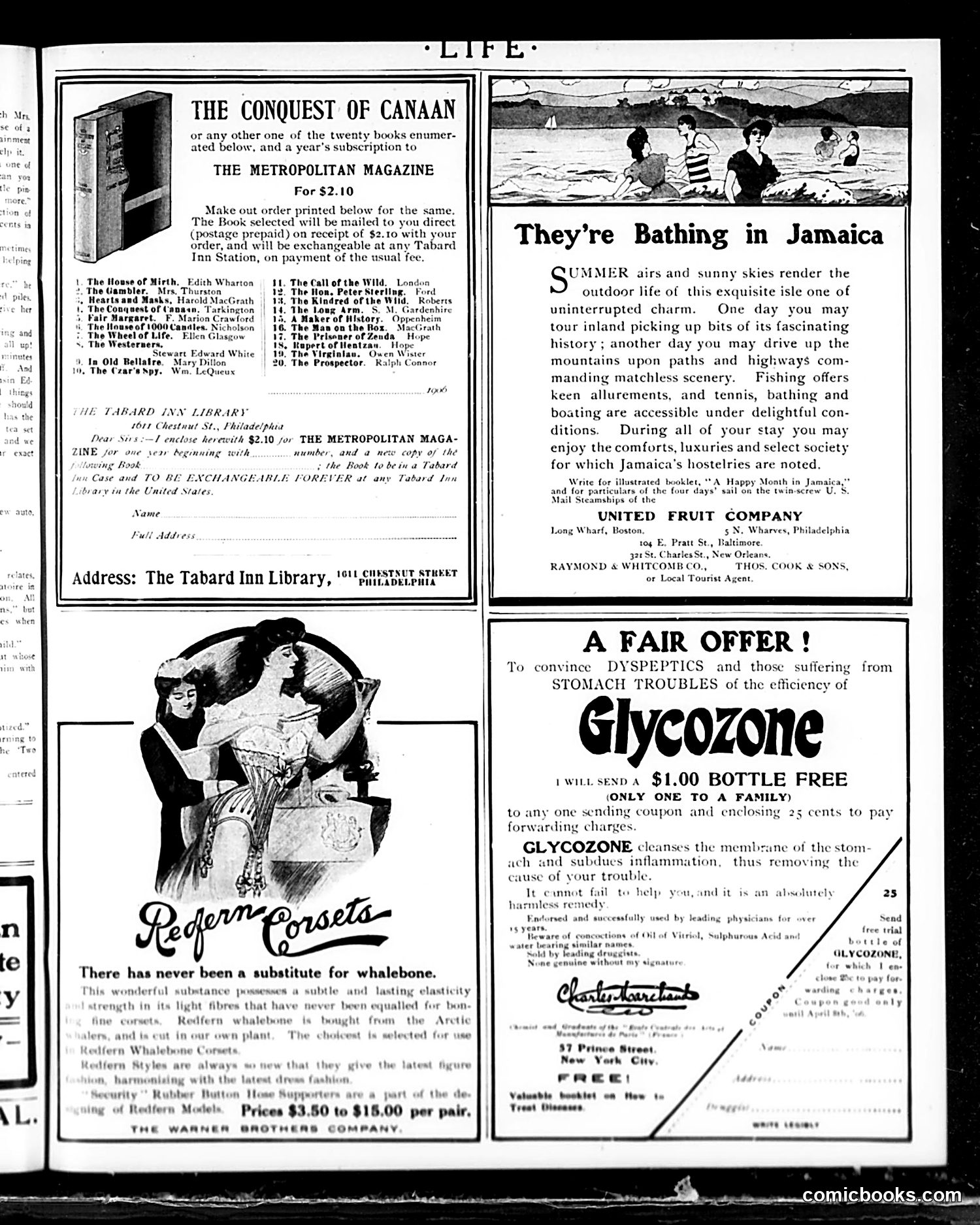
This is primarily an **advertising page**, not a satirical cartoon. The page contains four commercial advertisements from approximately the early 1900s: 1. **Tabard Inn Library**: A book subscription service offering "The Conquest of Canaan" and other titles bundled with *Metropolitan Magazine* for $2.10. 2. **Jamaica Tourism**: United Fruit Company promoting luxury travel to Jamaica, emphasizing leisure activities (bathing, tennis, boating) and "select society" — reflecting the era's colonial-era tourism marketing to affluent Americans. 3. **Redfern Corsets**: Warner Brothers advertising whalebone corsets with claims about elasticity and figure control, typical of Edwardian women's fashion advertising. 4. **Glycozone**: A patent medicine claiming to cure dyspepsia and stomach troubles, offering a free $1.00 bottle for 25 cents postage — characteristic of the unregulated pharmaceutical marketing of the period. No political satire or caricature appears on this page.
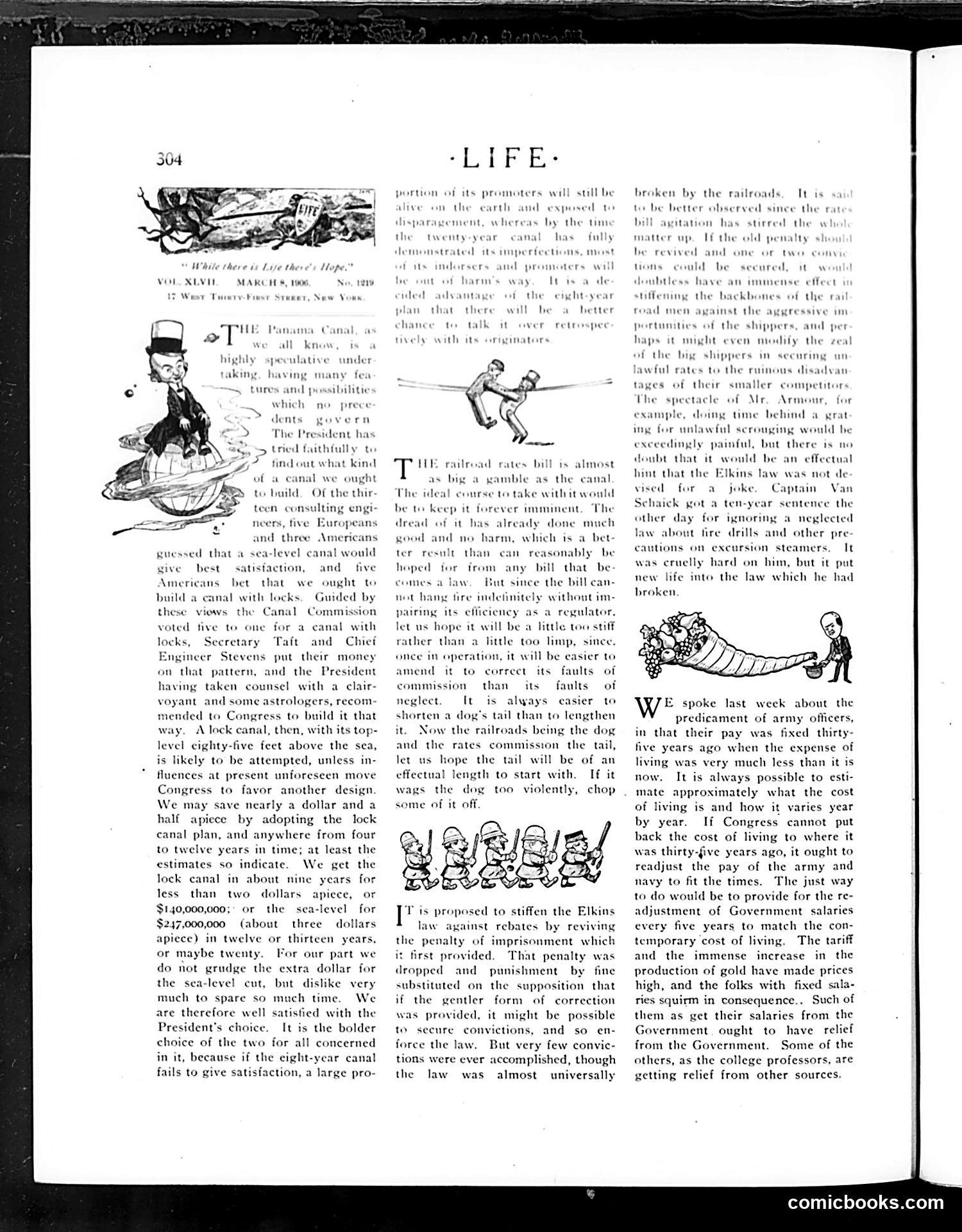
This page satirizes President Theodore Roosevelt's administration's major policy debates. The top cartoon depicts Roosevelt as a figure navigating uncertain choices about the Panama Canal's design—whether to build a sea-level canal (expensive, time-consuming) or a lock canal (cheaper, faster). The satire mocks Roosevelt's reliance on "clairvoyants and astrologers" to decide, suggesting the President's choice lacks rational basis. The text discusses railroad rate regulation, comparing rate-fixing to a dog's tail: if the tail (rates) wags the dog (railroads) too violently, "chop some of it off." This mocks government attempts to control railroad monopolies through the Elkins Law. The satire suggests that threatening railroad executives with imprisonment (rather than just fines) for rebates might finally enforce compliance—implying such laws had been "almost universally broken." The cartoons ridicule government's fumbling attempts to manage major infrastructure and corporate power.
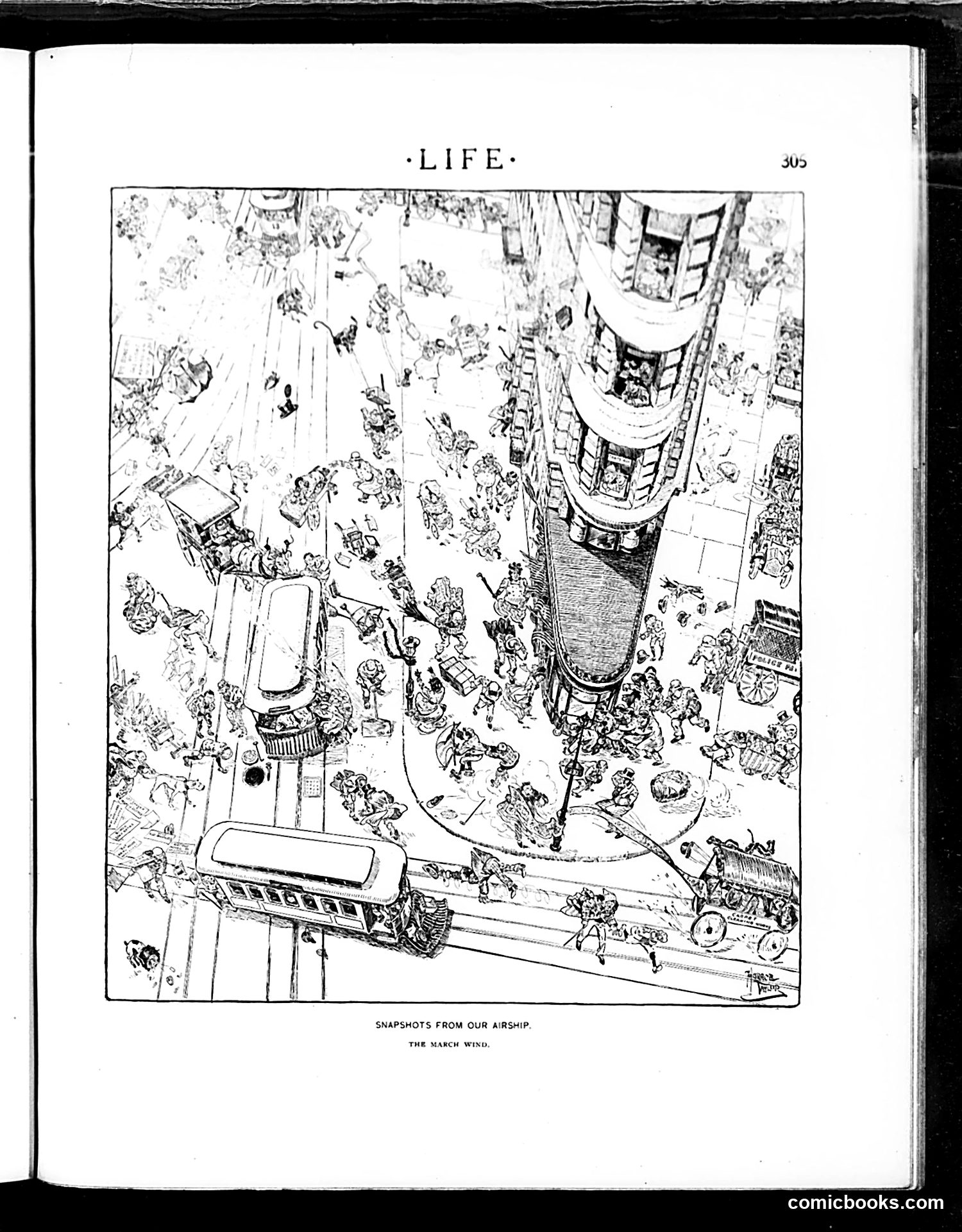
This is an aerial perspective cartoon titled "Snapshots from Our Airship: The March Wind." The illustration depicts a bird's-eye view of a city street where a powerful wind is causing chaos below. The satire plays on the expression "March comes in like a lion"—here visualized literally as destructive wind effects. Pedestrians are being blown about, hats are flying, and vehicles (including what appears to be a streetcar and wagon) are being buffeted. The high vantage point emphasizes the wind's pervasive, uncontrollable force affecting everyone equally across the urban landscape. This is a gentle, observational humor piece about seasonal weather rather than political satire, relying on the visual comedy of everyday people struggling against natural forces they cannot control.
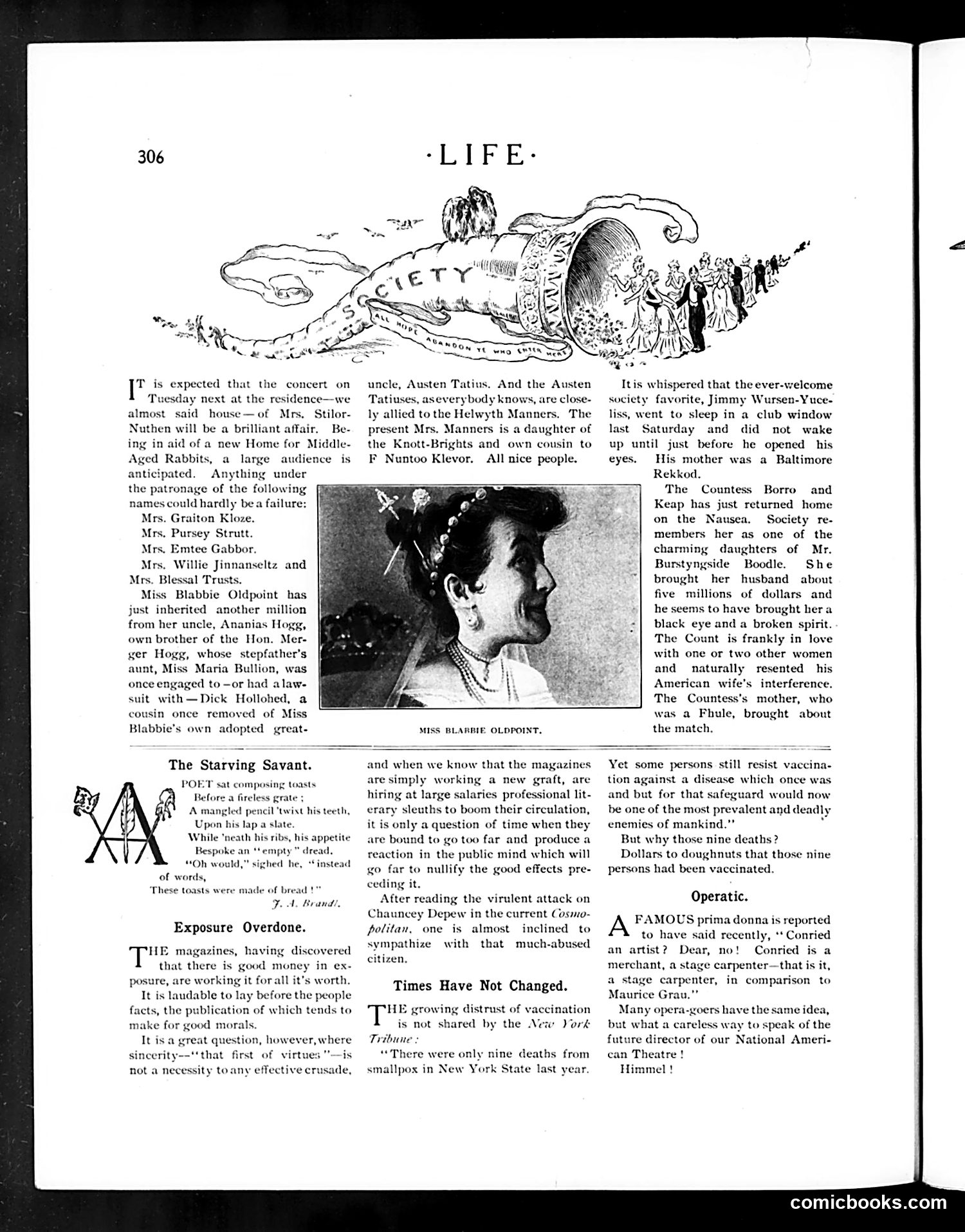
This page satirizes high society's pretensions through mock gossip and social commentary. The central cartoon depicts **Miss Blabbie Oldpoint**, a wealthy heiress inheriting millions—the text absurdly traces her lineage through absurd names (Ananias Hogg, Merger Hogg) to mock aristocratic genealogy obsession. The society notes mock-celebrate ridiculous marriages, including a Countess who brought "five millions of dollars" only to receive "a black eye and a broken spirit" from her unfaithful European husband—satirizing the era's transatlantic marriages where American wealth married European titles. Secondary pieces attack "Exposure Overdone" (magazines exploiting reform crusades for circulation), vaccination skepticism, and operatic pretension. The poet cartoon humorously depicts starving artists composing toasts while hungry. Throughout, Life ridicules Gilded Age excess: inherited wealth, social climbing, shallow celebrity culture, and the gap between professed morality and actual behavior—all hallmarks of turn-of-the-century American satire.
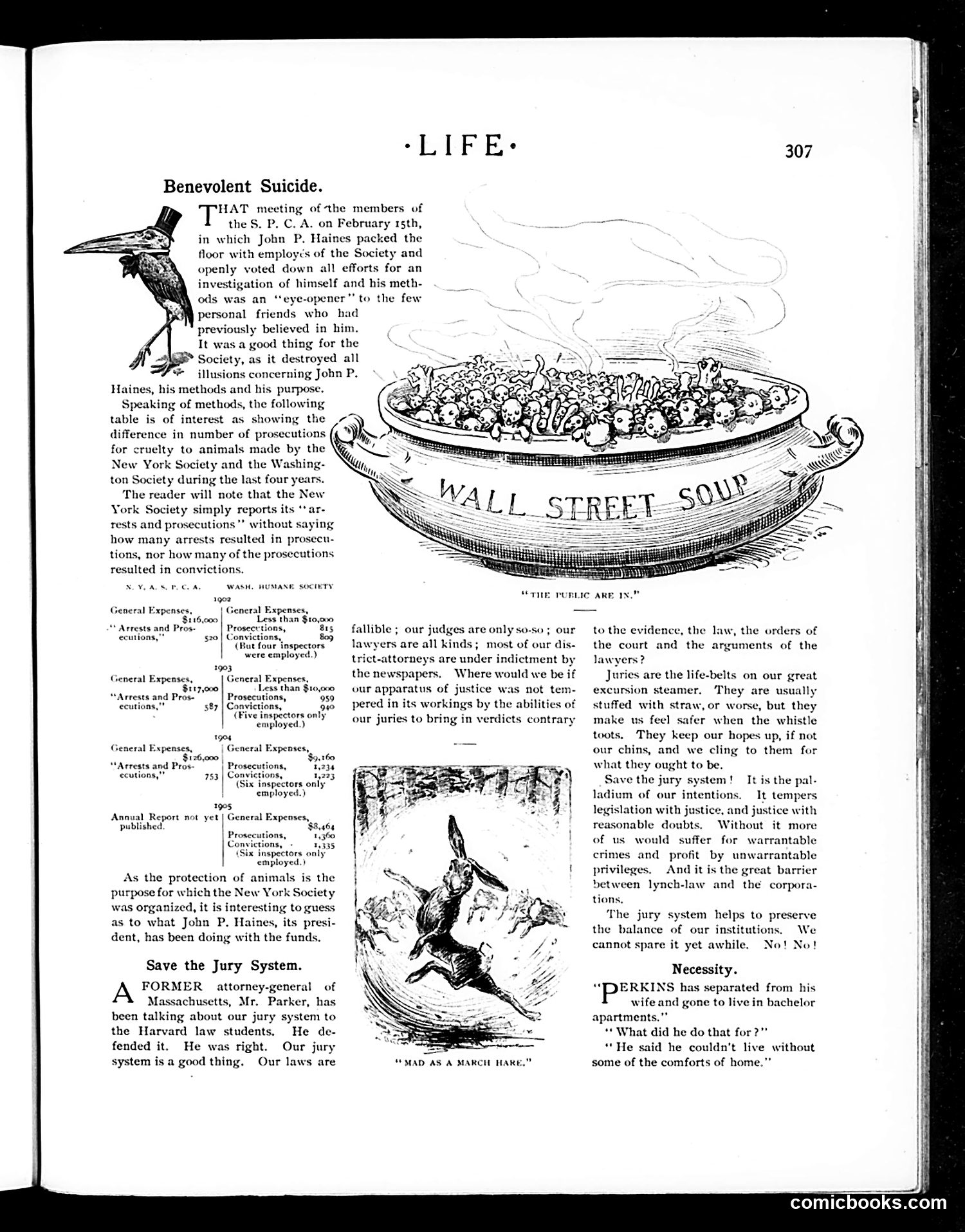
This page contains three satirical pieces: **Top: "Wall Street Soup"** — A caricatured bird (top-left) introduces a grotesque illustration of a bubbling cauldron labeled "Wall Street Soup," satirizing the 1904-1905 financial/corporate corruption and the messy state of Wall Street dealings. **Middle: "Save the Jury System"** — The text defends juries against a Harvard law professor's criticism, arguing they're essential "life-belts" protecting citizens. The accompanying cartoon of a "Mad as a March Hare" rabbit likely critiques the irrationality or unpredictability juries can introduce—they may ignore evidence and law, but serve as a check against judicial corruption and corporate power. **Bottom: "Benevolent Suicide"** — This critiques John P. Haines, president of the New York SPCA. The accompanying data table exposes his mismanagement: despite massive budgets, the organization reports far fewer prosecutions/convictions than the Washington Humane Society, suggesting funds were misappropriated rather than used for animal protection. The headline implies the SPCA's credibility died through his leadership.
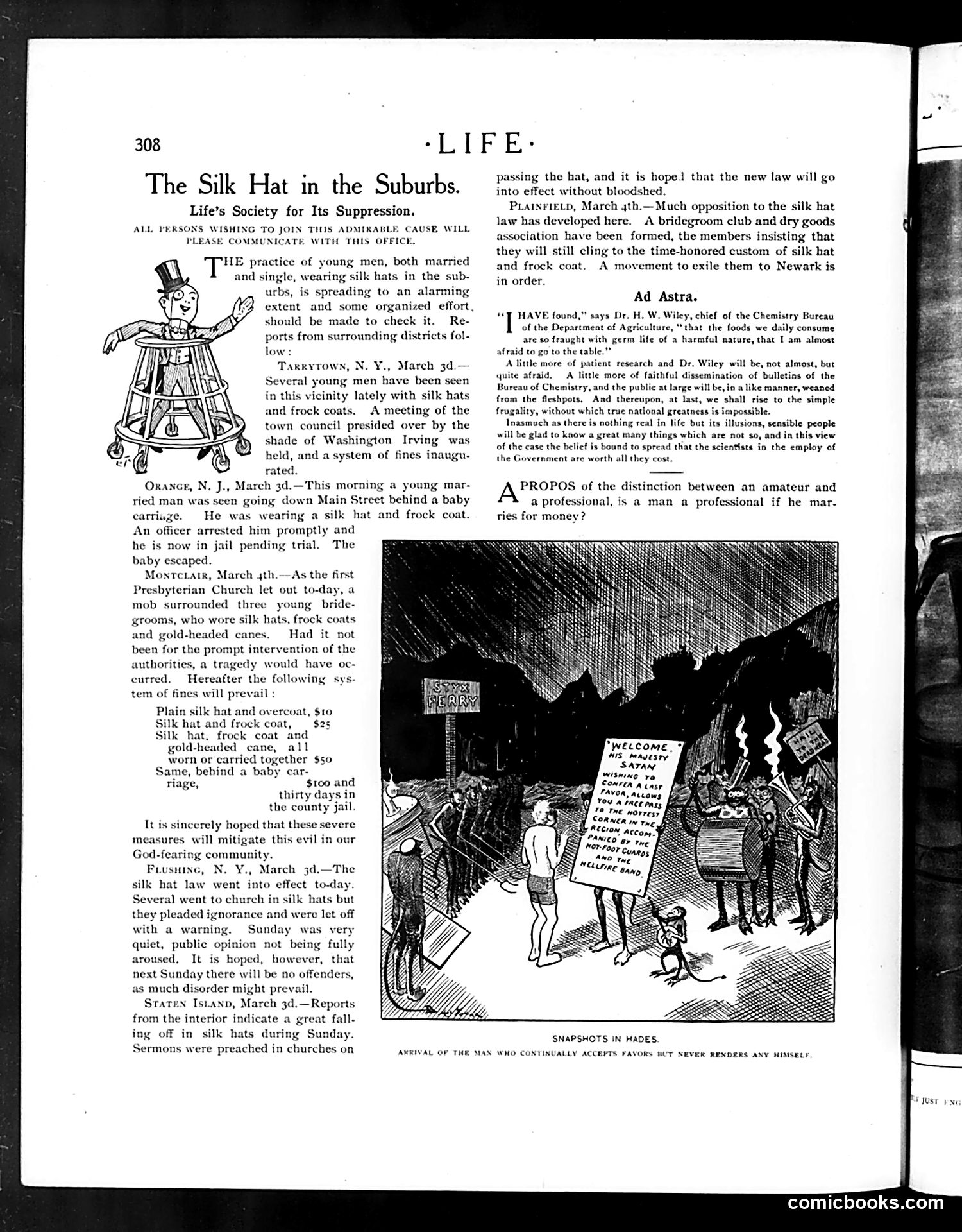
This satirical piece mocks the pretensions of suburban young men wearing formal silk hats and frock coats—clothing associated with upper-class city fashion—in suburban settings where such dress is considered absurdly overdressed and inappropriate. The article presents humorous reports from various New Jersey and New York towns where authorities have supposedly instituted fines for this fashion transgression, escalating from $10 for a plain silk hat to $100 and jail time for wearing one with a baby carriage (suggesting pompous fathers showing off). The implied joke: suburban aspirants aping urban high society, creating mock-serious community backlash against this pretentious behavior. The accompanying cartoon ("Snapshots in Hades") depicts Satan welcoming a man who continually accepts favors but never reciprocates—a separate commentary on social parasitism, not directly related to the silk hat satire.
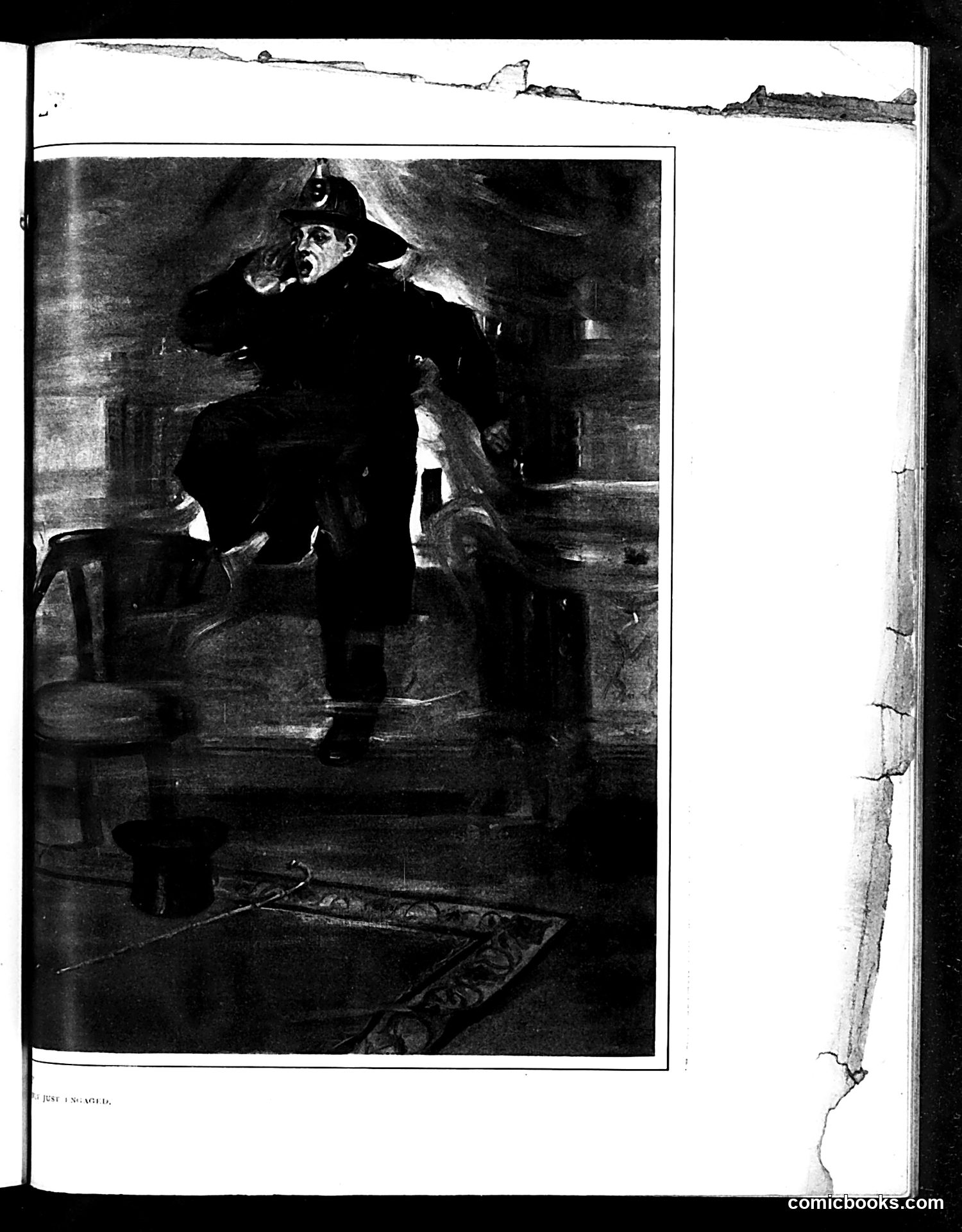
This appears to be a satirical illustration from *Life* magazine, though the OCR text provides minimal context. The image shows a darkly-rendered interior scene with a figure in period clothing (appearing to wear a tricorn hat and coat) in what looks like a cellar or dungeon setting. Various objects are scattered about, including what may be barrels or containers. Without clear text identifying the specific political or social reference, I cannot definitively state what this cartoon satirizes. The dramatic lighting and gothic atmosphere suggest it may reference a historical event, literary work, or contemporary scandal, but I cannot assert the specific meaning or identify the figure with certainty based solely on the image provided.
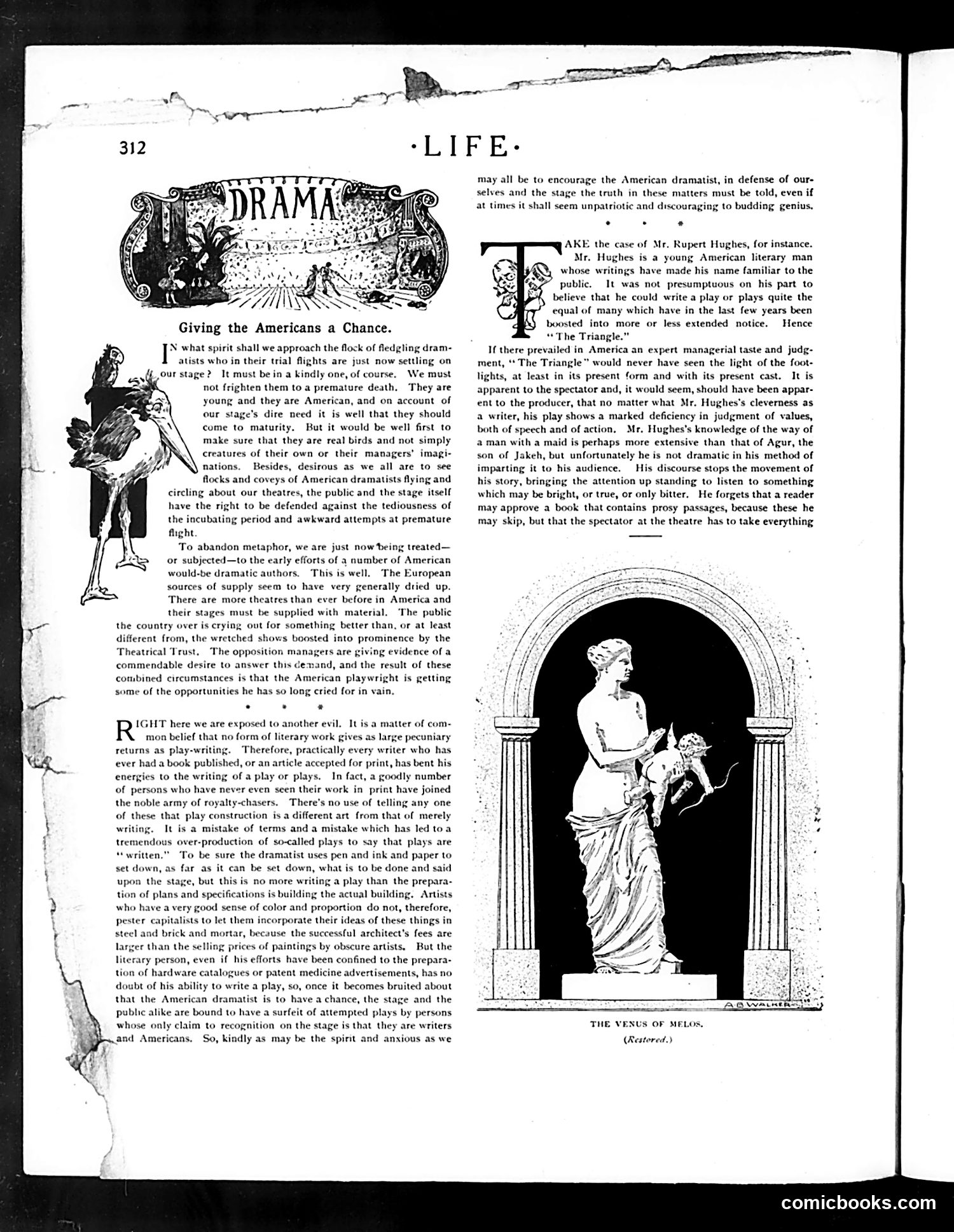
This editorial page discusses American playwrights getting stage opportunities. The text argues for cautious support of new American dramatists while warning against low-quality work flooding theaters. The key satire: the author mocks the flood of would-be playwrights—anyone who's published anything now thinks they can write plays. The editorial distinguishes between "writing" (putting words on paper) and actual dramatic construction, comparing it to how an architect's sketches aren't the same as building. The cartoon (left) shows a theatrical figure in classical dress, likely representing Drama or Theater itself, assessing these new writers—depicted as fledgling birds needing careful nurturing rather than harsh criticism that would "frighten them to premature death." The illustration captioned "The Venus of Helos" (right) appears decorative rather than directly satirical. The underlying point: America needs native drama, but not every writer deserves a stage. Quality matters.
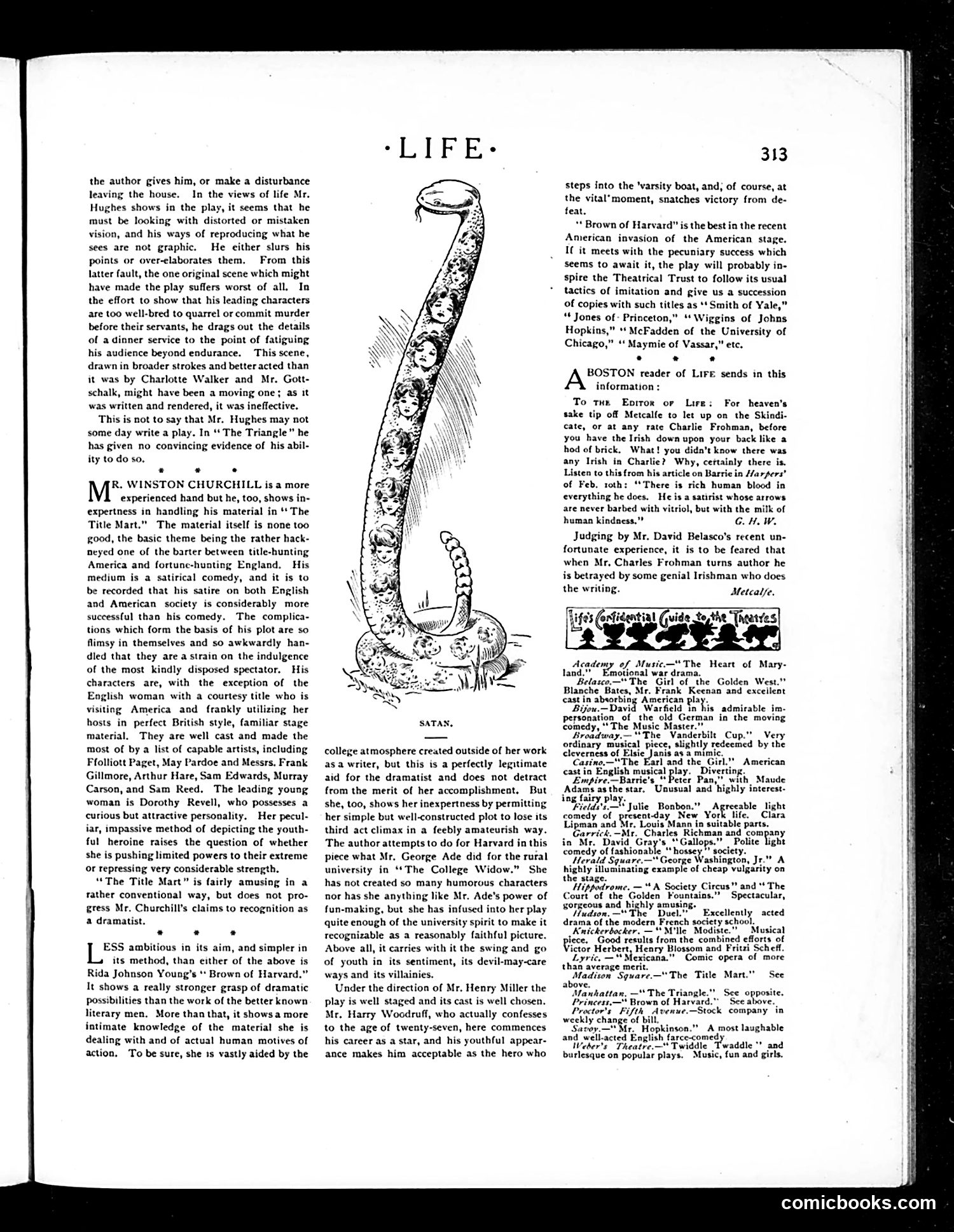
This page contains theater criticism reviewing three Broadway plays. The central illustration shows a snake labeled "SATAN"—likely symbolizing temptation or moral corruption in drama. The reviews critique plays by Mr. Hughes ("The Triangle"), R. Winston Churchill ("The Title Mart"), and Rida Johnson Young ("Brown of Harvard"). The critics find Hughes's work unclear and over-elaborate, Churchill's satirical but weakly plotted, and Young's the most dramatically competent despite amateur flaws. "Brown of Harvard" receives qualified praise for authentically depicting college life—the reviewer compares Young's achievement to George Ade's success with "The College Widow." The Satan image likely reflects contemporary concerns about theater's moral influence, a persistent debate in early 20th-century American culture.
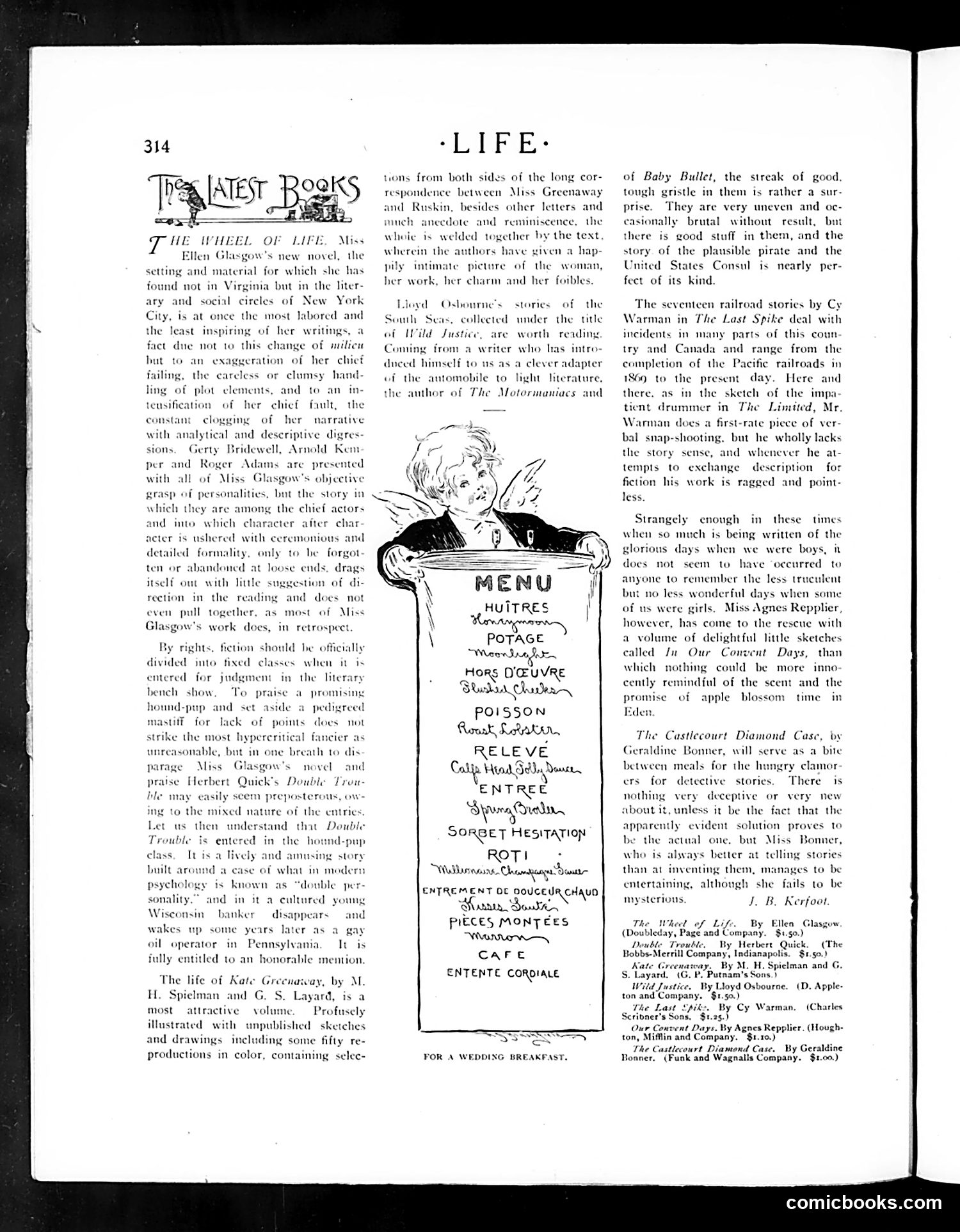
This page from *Life* magazine consists primarily of book reviews rather than political cartoons. The central illustration shows a cherub or cupid holding a handwritten French menu "FOR A WEDDING BREAKFAST"—a decorative element accompanying reviews of recent literary works. The reviews discuss novels by Ellen Glasgow, Lloyd Osbourne, and Cy Warman, along with a biography of illustrator Kate Greenaway. The critic praises Glasgow's character development but faults her plot construction and narrative clutter. Osbourne's South Seas stories receive mixed reviews for unevenness, while Warman's railroad stories are criticized for lacking narrative coherence despite occasional strong passages. The menu illustration is purely decorative, reflecting the magazine's satirical, leisurely tone rather than conveying specific political or social satire. This is essentially a literary criticism page with period-appropriate ornamentation.
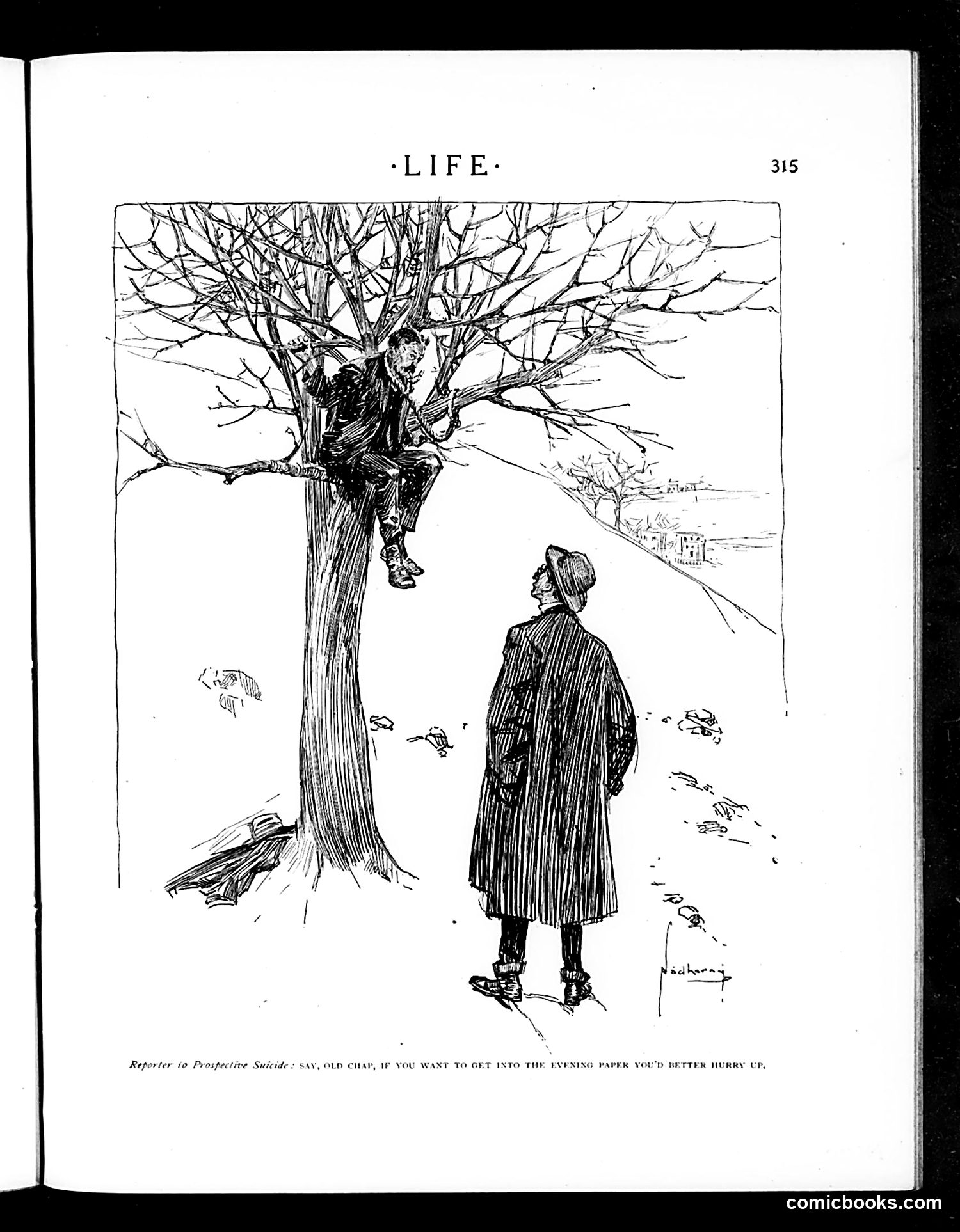
This is a single-panel cartoon from *Life* magazine (page 315) titled "Reporter to Prospective Suicide." The illustration shows two figures: a man sitting in a bare tree and a woman standing below, looking up at him. The caption reads: "Say, old chap, if you want to get into the evening paper you'd better hurry up." The satire targets sensationalist journalism of the era. A reporter is essentially encouraging a potential suicide victim to expedite his death so the story makes the evening edition's deadline. The joke darkly mocks how newspapers prioritized dramatic stories over human welfare, and how journalists pursued stories for competitive advantage regardless of ethical concerns. The cartoon critiques the callousness of press culture during this period.
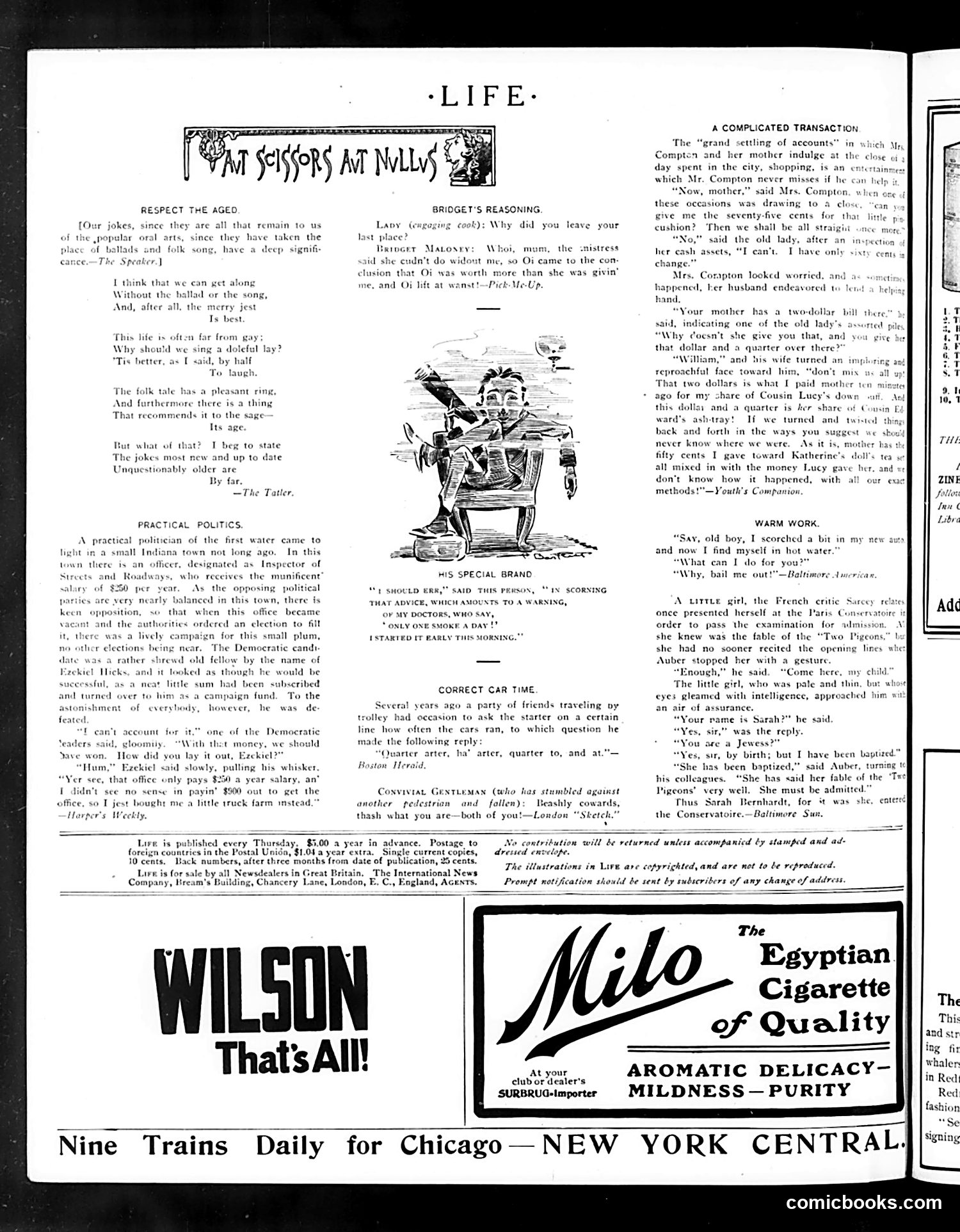
This page contains multiple humorous vignettes satirizing American domestic and social life, rather than political cartoons. **"A Complicated Transaction"** depicts a wife meticulously accounting for household money to her bewildered husband—satirizing both Victorian-era domestic financial management and marital miscommunication about trivial expenditures. **"Respect the Aged"** and **"Bridget's Reasoning"** are brief jokes about servants and aging, reflecting period attitudes toward household staff and elderly relatives. **"Practical Politics"** mocks small-town American electoral campaigns, describing an election for a minor $250/year position where significant campaign funds were nonetheless deployed—satirizing the absurdity of local political maneuvering. **"Correct Car Time"** and **"Warm Work"** are brief anecdotes about everyday confusion and casual speech. The page also includes advertisements for Wilson tobacco and Milo Egyptian cigarettes, typical of the era. These were not satirical but genuine commercial messages.
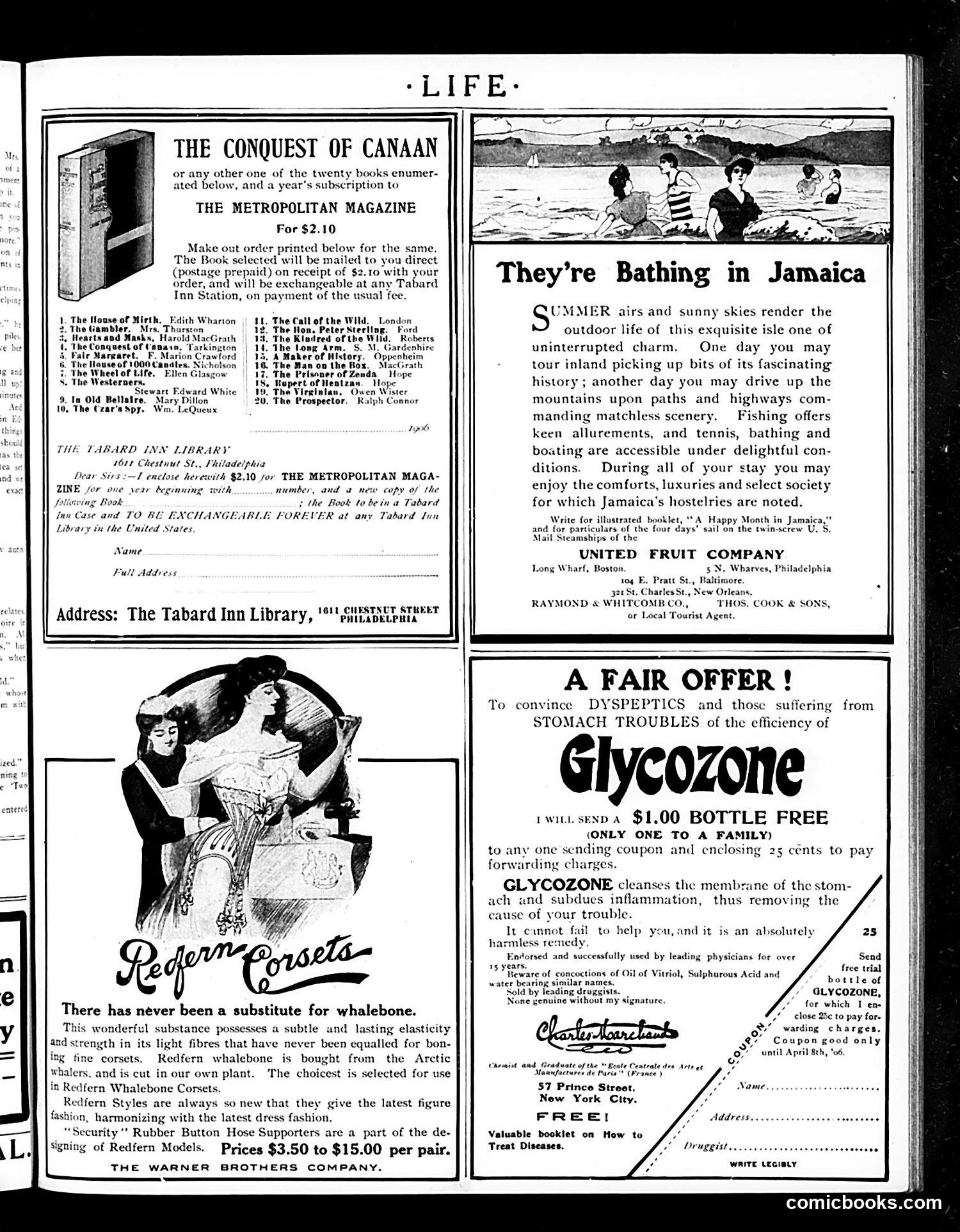
This page is primarily **advertising**, not satirical content. It contains four distinct advertisements typical of early 1900s magazines: 1. **Tabard Inn Library** (top left): A book subscription service offering "The Conquest of Canaan" and 19 other titles bundled with *Metropolitan Magazine* for $2.10. 2. **Jamaica Tourism** (top right): United Fruit Company promoting luxury steamship vacations to Jamaica, emphasizing leisure activities and "select society." 3. **Redfern Corsets** (center left): Marketing whalebone corsets with claims about elasticity and fashion, priced $3.50-$15.00. The accompanying illustration depicts a woman being fitted. 4. **Glycozone** (bottom right): A patent medicine claiming to cure "stomach troubles" and dyspepsia, offering a free $1.00 bottle for 25 cents postage—a common marketing tactic of the era. The page reflects early 20th-century consumer culture and medical pseudoscience. No political satire or caricature is present; these are straightforward period advertisements.
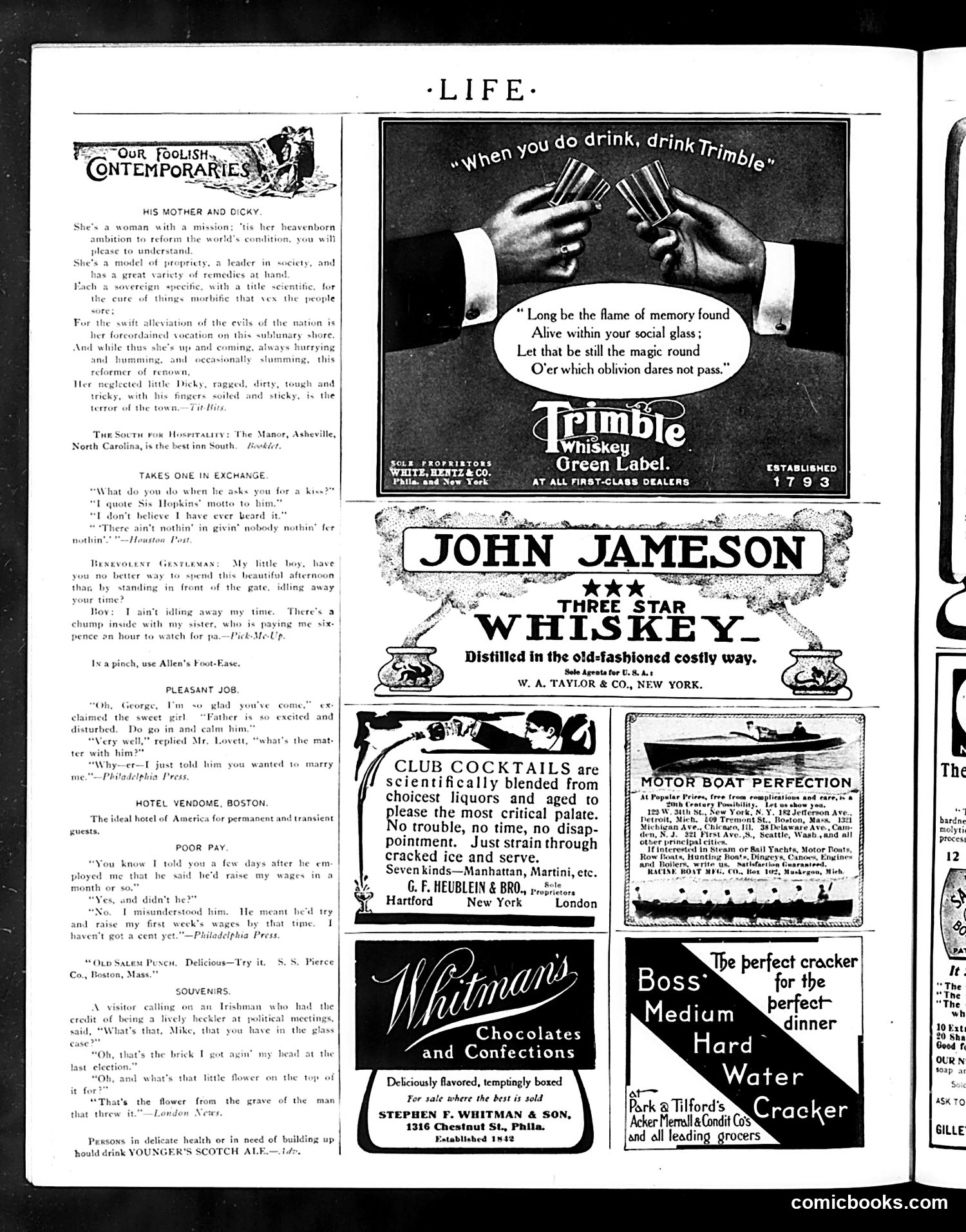
This page is **primarily advertising**, not political satire. It contains humor pieces typical of early 20th-century Life magazine (a satirical weekly), but the dominant content is liquor and food advertisements. The small humorous sections—titled "Our Foolish Contemporaries," "Takes One in Exchange," "Pleasant Job," and "Poor Pay"—are brief anecdotal jokes about social situations: a mother reformer, a boy paid to watch for his father, a marriage proposal, and wage negotiations. These are gentle domestic humor without political targets. The advertisements dominate: whiskey brands (Trimble, John Jameson, Whitman's Chocolates), cocktail mixers, motor boats, and crackers. The Trimble Whiskey ad uses sentimental poetry about memory and social drinking—typical marketing rhetoric for the era. **Context for modern readers**: This reflects a pre-Prohibition America (established 1920) where liquor advertising was prominent in mainstream magazines. The humor is domestic/class-based rather than political.
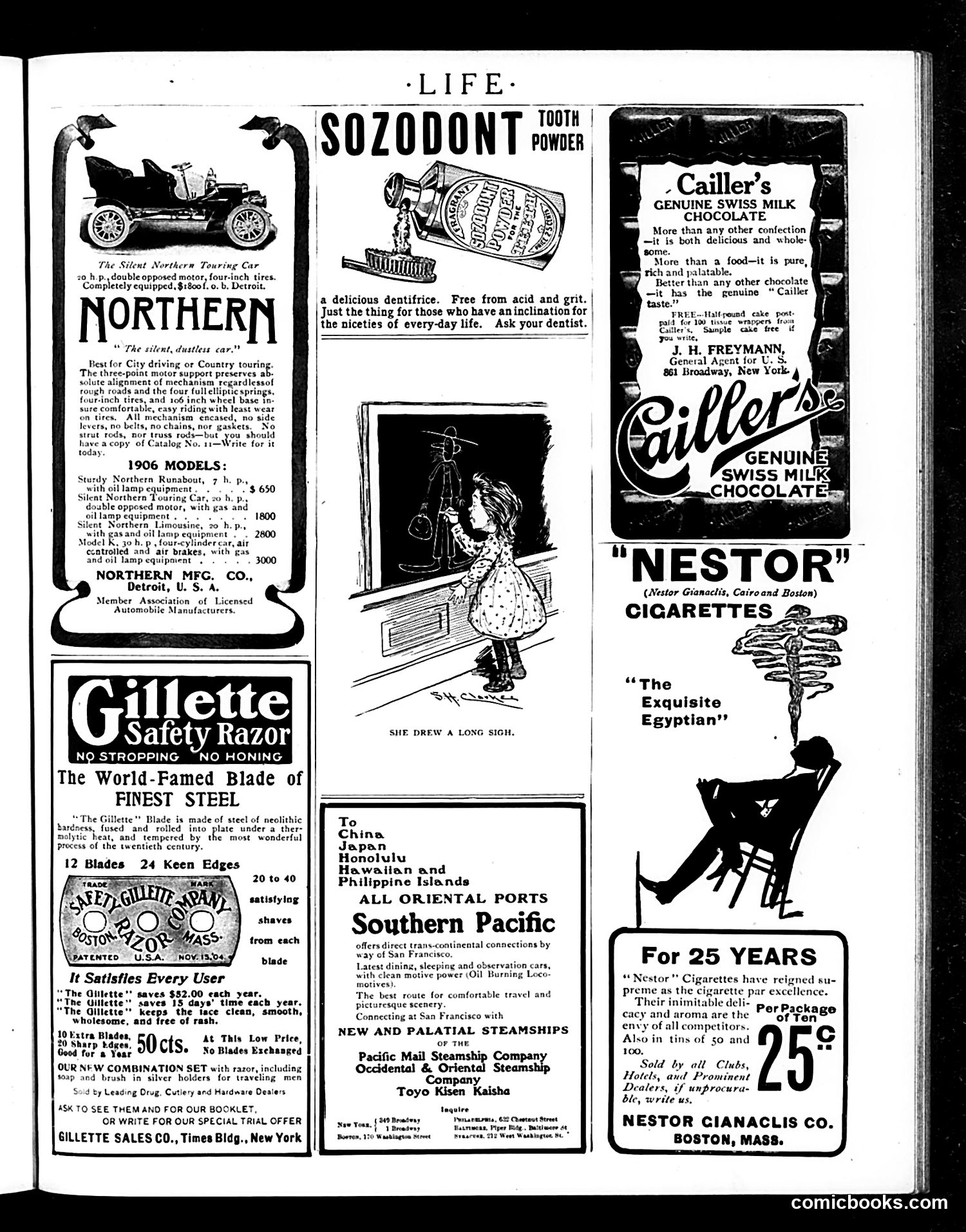
This is primarily an **advertising page** from Life magazine, circa 1906, containing no political cartoons or satire. The only illustration with narrative content is a small sketch titled "She Drew a Long Sigh"—showing a woman gazing wistfully from a window, likely advertising Cailler's Swiss chocolate by evoking romantic sentiment. The page features early 1900s **consumer product advertisements**: automobiles (Northern brand), safety razors (Gillette), toothpowder (Sozodon), chocolate, cigarettes (Nestor), and steamship travel to Oriental ports. These ads reflect Edwardian consumer culture and period marketing strategies—emphasizing technological innovation (the "silent" car), hygiene (the razor saves time and prevents rash), luxury goods, and international travel. The small cartoon functions purely as sentimental product placement rather than satire or social commentary.
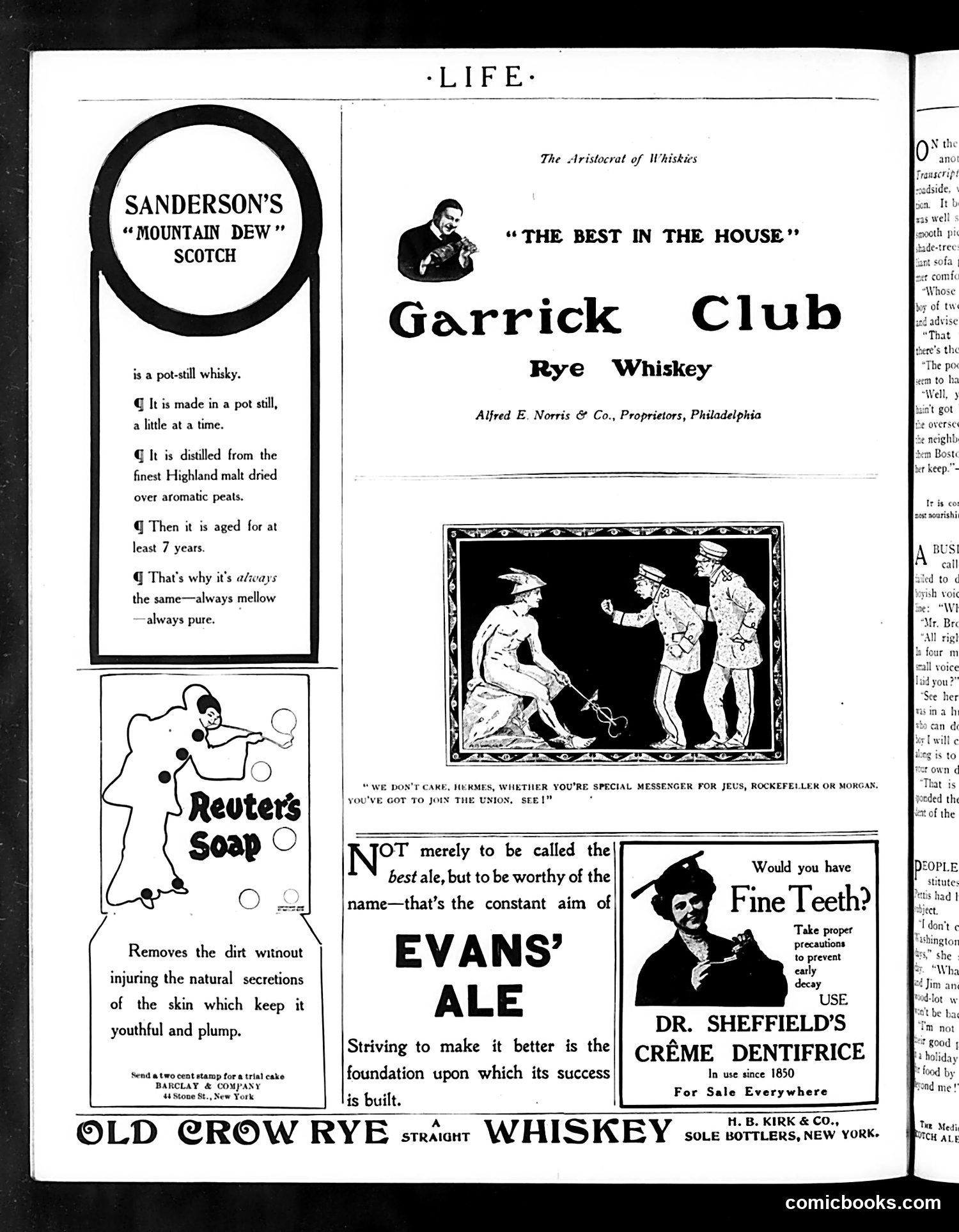
This is primarily an **advertising page** from Life magazine, featuring multiple product advertisements rather than editorial cartoons. The one visual cartoon shows figures labeled "Hermes" (Greek messenger god) alongside references to Jesus, Rockefeller, and Morgan—suggesting that regardless of who you are or your social status, you must "join the union." This appears to be satirizing labor organizing efforts, implying that even the wealthy and powerful cannot escape unionization. The page is otherwise dominated by whiskey, ale, soap, and toothpaste ads typical of early 20th-century publications. These advertisements reflect period concerns: Reuter's Soap emphasized "natural secretions" to keep skin youthful; Dr. Sheffield's Crème Dentifrice promoted tooth decay prevention. The whiskey ads emphasize age, purity, and aristocratic quality—selling luxury products during the pre-Prohibition era. The satirical union cartoon is the only editorial content visible on this otherwise commercial page.
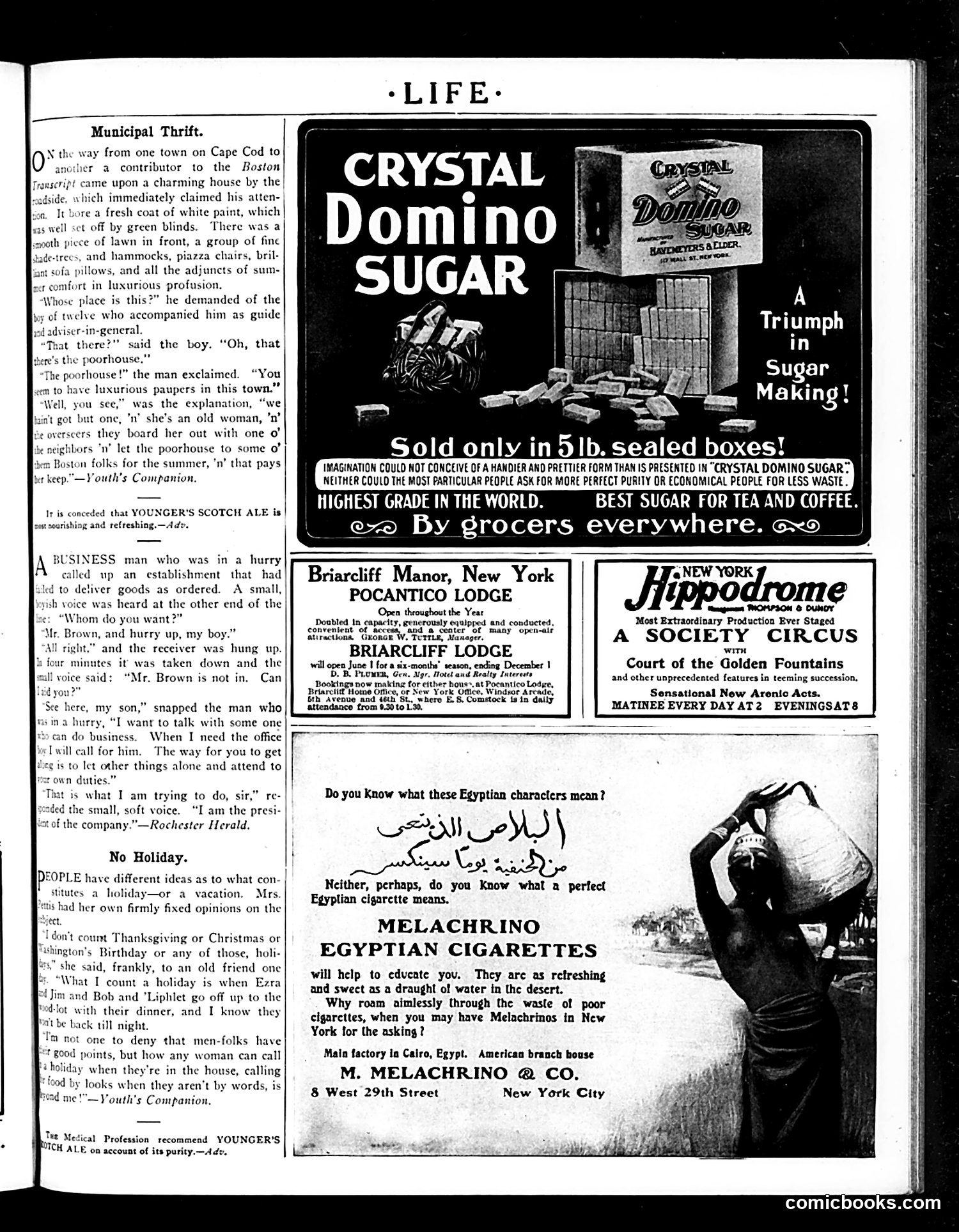
This page consists primarily of **humorous anecdotes** rather than political cartoons. The main content includes three short stories from *Youth's Companion*: 1. **"Municipal Thrift"**: A visitor is surprised to discover an elegant, well-maintained building is actually the town's poorhouse. The satire targets practical penny-pinching: the town rents the poorhouse to wealthy Boston summer visitors to generate revenue, offsetting poor-relief costs—making municipal efficiency darkly comic. 2. **"A Business Man in a Hurry"**: A man dismisses a small-voiced employee, only to discover he's the company president. The joke mocks assumptions based on voice/age and satirizes workplace hierarchy. 3. **"No Holiday"**: A wife defines a holiday as when men are away from home. Domestic satire mocking male presence as burdensome. The page also contains period **advertisements** (Crystal Domino Sugar, Briarcliff Lodge, Melachrino Egyptian Cigarettes) and a theater notice for a "Society Circus" production. No specific political figures or events are caricatured; the humor is social and domestic.
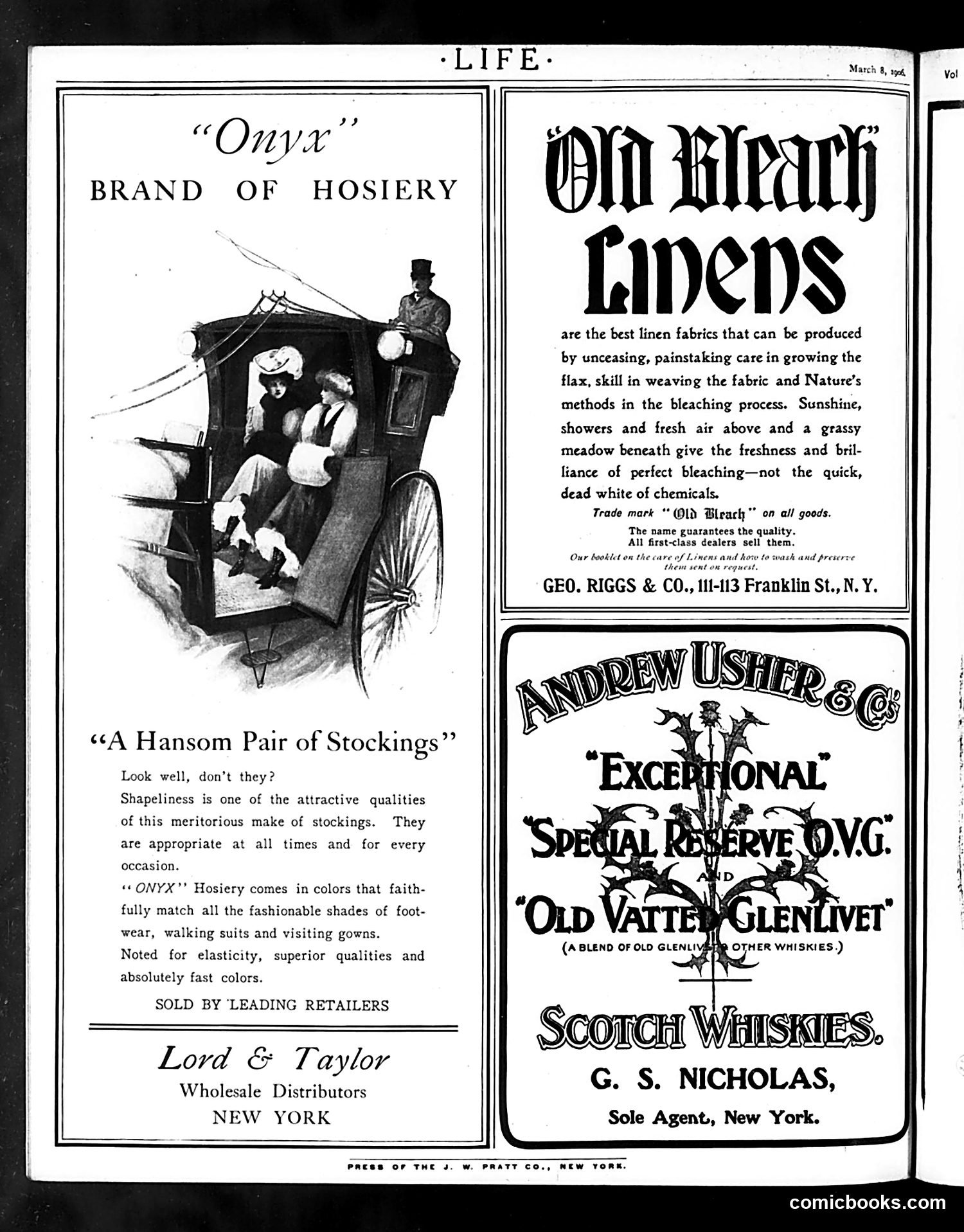
This page is **primarily advertising**, not political satire. It contains three product advertisements from the 1920s era: 1. **"Onyx" Brand Hosiery** (left): Features a illustration of a well-dressed couple in a hansom cab, promoting women's stockings. The ad emphasizes "shapeliness" and color-matching to fashionable footwear—reflecting 1920s concerns with appearance and the newly visible female leg. 2. **"Old Bleach" Linens** (top right): Markets bleached linen fabric, contrasting natural bleaching (sun, rain, grass) against "quick, dead white of chemicals." This reflects early 20th-century marketing emphasizing "natural" processes. 3. **Andrew Usher Scotch Whiskies** (bottom right): Advertises Scottish whisky during Prohibition (1920-1933), when alcohol sales were technically illegal—suggesting either pre-Prohibition stock or overseas distribution. The "hansom pair" pun in the hosiery ad is the only attempted humor. No political cartoons or satire appear on this page.