
Life, 1906-03-08 · page 23 of 32
Life — March 8, 1906 — page 23: what you’re looking at
What you’re looking at
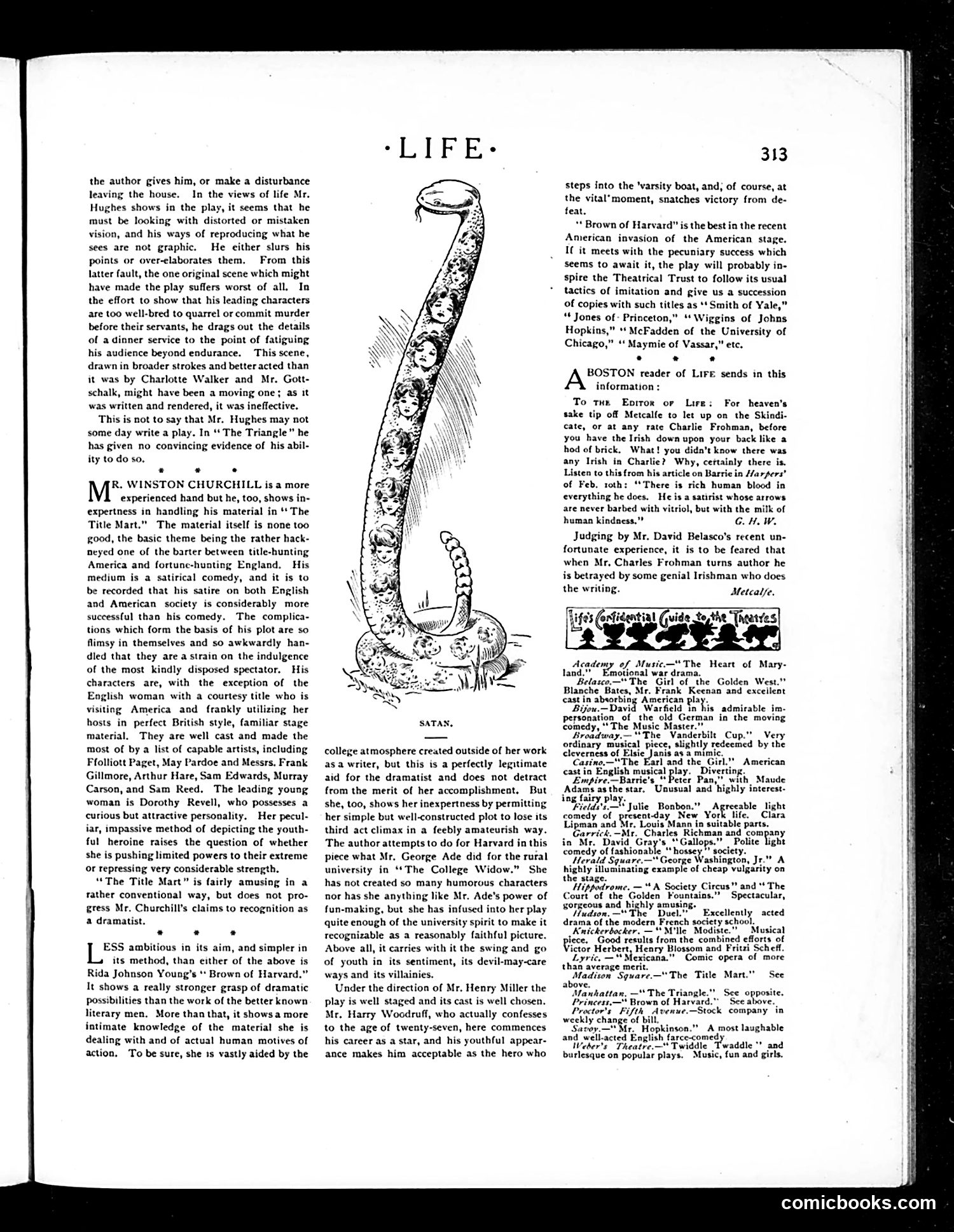
This page contains theater criticism reviewing three Broadway plays. The central illustration shows a snake labeled "SATAN"—likely symbolizing temptation or moral corruption in drama. The reviews critique plays by Mr. Hughes ("The Triangle"), R. Winston Churchill ("The Title Mart"), and Rida Johnson Young ("Brown of Harvard"). The critics find Hughes's work unclear and over-elaborate, Churchill's satirical but weakly plotted, and Young's the most dramatically competent despite amateur flaws. "Brown of Harvard" receives qualified praise for authentically depicting college life—the reviewer compares Young's achievement to George Ade's success with "The College Widow." The Satan image likely reflects contemporary concerns about theater's moral influence, a persistent debate in early 20th-century American culture.
📄 Transcribed text from this page (OCR, searchable)
Machine-transcribed from the original scan — historical spelling and the odd misread are preserved.
the author gives him, or make a disturbance leaving the house. In the views of life Mr. Hughes shows in the play, it seems that he must be looking with distorted or mistaken vision, and his ways of reproducing what he sees are not graphic. He either slurs his points or over-elaborates them. From this latter fault, the one original scene which might have made the play suffers worst of all, In the effort to show that his leading characters are too well-bred to quarrel or commit murder before their servants, he drags out the details of adinner service to the point of fatiguing his audience beyond endurance. This scene, drawn in broader strokes and better acted than it was by Charlotte Walker and Mr. Gott- schalk, might have been a moving one; as it was written and rendered, it was ineffective. This is not to say that Mr, Hughes may not some day write a play. In “ The Triangle” he has given no convincing evidence of his abil- ity to do so. * . ° R. WINSTON CHURCHILL is a more experienced hand but he, too, shows in- expertness in handling his material in The Title Mart." The material itself is none too good, the basic theme being the rather hack- neyed one of the barter between title-hunting America and fortune-hunting England, His medium is a satirical comedy, and it is to be recorded that his satire on both English and American society is considerably more successful than his comedy. The complica- tions which form the basis of his plot are so flimsy in themselves and so awkwardly han- dled that they area strain on the indulgence of the most kindly disposed spectator. His characters are, with the exception of the English woman with a courtesy title who is visiting America and frankly utilizing her hosts in perfect British style, familiar stage material. They are well cast and made the most of by a list of capable artists, including Ffolliott Paget, May Pardoe and Messrs, Frank Gilmore, Arthur Hare, Sam Edwards, Murray Carson, and Sam Reed. The leading young woman is Dorothy Revell, who possesses a curious but attractive personality. Her pecul- iar, impassive method of depicting the youth- ful heroine raises the question of whether she is pushing limited powers to their extreme or repressing very considerable strength. “The Title Mart” is fairly amusing in a rather conventional way, but does not pro- gress Mr. Churchill's claims to recognition as a dramatist. . * * ESS ambitious in its aim, and simpler in its method, than either of the above is Rida Johnson Young’s “ Brown of Harvard.” It shows a really stronger grasp of dramatic Possibilities than the work of the better known literary men. More than that, it shows a more intimate knowledge of the material she is dealing with and of actual human motives of action. To be sure, she 1s vastly aided by the college atmosphere created outside of her work asa writer, but this is a perfectly legitimate aid for the dramatist and does not detract from the merit of her accomplishment, But she, too, shows her inexpertness by permitting her simple but well-constructed plot to lose its third act climax in a feebly amateurish way. The author attempts to do for Harvard in this piece what Mr, George Ade did for the rural university in “The College Widow.” She has not created so many humorous characters nor has she anything like Mr. Ade’s power of fun-making, but she has infused into her play quite enough of the university spirit to make it recognizable as a reasonably faithful picture. Above all, it carries with it the swing and go of youth in its sentiment, its devil-may-care ways and its villainies. Under the direction of Mr. Henry Miller the play is well staged and its cast is well chosen, Mr. Harry Woodruff, who actually confesses to the age of twenty-seven, here commences his career as a star, and his youthful appear- ance makes him acceptable as the hero who 313 steps into the ‘varsity boat, and, of course, at the vital’moment, snatches victory from de- feat. ** Brown of Harvard" is the best in the recent American invasion of the American stage. IC it meets with the pecuniary success which seems to await it, the play will probably in- spire the Theatrical Trust to follow its usual tactics of imitation and give us a succession of copies with such titles as ** Smith of Yale,” “ Jones of: Princeton,” “ Wiggins of Johns Hopkins,” * McFadden of the University of Chicago,” ‘ Maymie of Vassar,” etc. . * * BOSTON reader of Lire sends in this information : To tHe Eptrox or Lire: For heaven's sake tip off Metcalfe to let up on the Skindi- cate, or at any rate Charlie Frohman, before you have the Irish down upon your back like a hod of brick. What! you didn't know there was any Irish in Charlie? Why, ceftainly there is. Listen to this from his article on Barrie in Harpers’ of Feb. roth: “There is rich human blood in everything he does. He is a satirist whose arrows are never barbed with vitriol, but with the milk of human kindness.” G. HOW. Judging by Mr. David Belasco’s recent un- fortunate experience, it is to be feared that when Mr, Charles Frohman turns author he is betrayed by some genial Irishman who does the writing. Metcalfe. [fige’s Confidential & Academy of Music—*The Heart of Mary- land.” Emotional war drama. Belasco.—" The Girl of the Golden West.” Blanche Bates, Mr. Frank Keenan and excellent cast in absorbing American pla Bijou.—David Warfield. ta his admirable im- personation of the old German in the moving comedy, “The Music Master.” Broadway.—"*The Vanderbilt Cup." Very ordinary musical piece, slightly redeemed by the cleverness of Elsie Janis as a mimic. Casino,—"The rl and the Girl cast in English musical play. Diverting, Empire.—Barrie's ‘Peter Pan,” with Maude Adams asthe star, Unusual and ‘highly interest- ing fairy pl ° : Fields's.—" Julie Bonbon.” | Agreeable light comedy of present-day New York life, | Clara Lipman and Mr, Louis Mann in suitable parts. Garrick.—Mr. Charles Richman and company in Mr. David: Gray's, *\Gallops.” | Polite light comedy of fashionable "hossey'” society. Herald Square.—" George Washington, Jr." A highly illuminating example of cheap vulgarity on the stage. . . Hippodrome. —“* A Society Circus" and“ The Court of the Golden Fountains.” Spectacular, gorgeous and highly amusing. Hudson.—"The Duel.” Excellently acted drama of the modern French society school, Knickerbocker. —" M'lle Modiste." Musical jiece. Good results from the combined efforts of Victce Herbert, Henry Blossom and Fritsi Scheff, Lyric. —" Mexicana.” Comic opera of more than average merit. “The Title Mart." See The Triangle." See opposite. rown of Harvard." See above. Proctor’s Fifth Avenue.—Stock company in weekly change of bill. y "Mr. Hopkinson.” A most laughable English farce-comedy Twiddle Twaddle"? and burlesque on popular plays. Music, fun and girls. comicbooks.com