
Life, 1906-03-08 · page 16 of 32
Life — March 8, 1906 — page 16: what you’re looking at
What you’re looking at
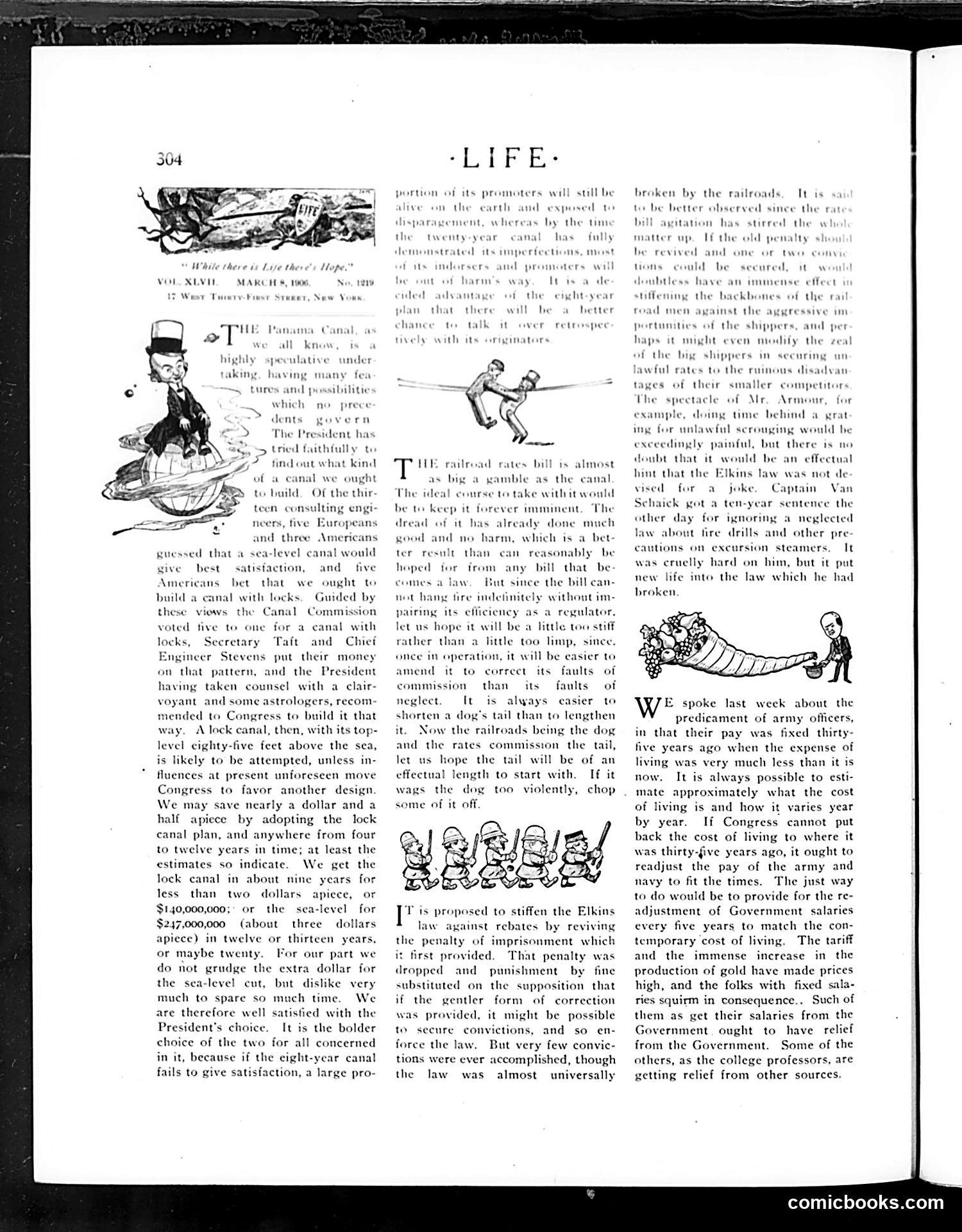
This page satirizes President Theodore Roosevelt's administration's major policy debates. The top cartoon depicts Roosevelt as a figure navigating uncertain choices about the Panama Canal's design—whether to build a sea-level canal (expensive, time-consuming) or a lock canal (cheaper, faster). The satire mocks Roosevelt's reliance on "clairvoyants and astrologers" to decide, suggesting the President's choice lacks rational basis. The text discusses railroad rate regulation, comparing rate-fixing to a dog's tail: if the tail (rates) wags the dog (railroads) too violently, "chop some of it off." This mocks government attempts to control railroad monopolies through the Elkins Law. The satire suggests that threatening railroad executives with imprisonment (rather than just fines) for rebates might finally enforce compliance—implying such laws had been "almost universally broken." The cartoons ridicule government's fumbling attempts to manage major infrastructure and corporate power.
📄 Transcribed text from this page (OCR, searchable)
Machine-transcribed from the original scan — historical spelling and the odd misread are preserved.
VOLOXEVIL MARCH 8, 1908 7 Weey T ama wl okn ulative under taking, having many fea ~ tures and possibilitic which no prece dents govern The President has > tried faithfully t tind out what kind ee of « canal we ought = 7S to build. Of the thir teen consulting engi- q neers, five Europeans = and three Americans guessed that a sea-level canal would give best satisiaction, Americans bet that we build a canal with locks. these views the Canal and ought to Guided by Commission five voted five to one for canal with locks, Secretary Taft and Chieé Engineer Stevens put their money on that and the having taken counsel with a clair- pattern, President voyant and some astrologers, recom- mended to Congress to build it that A lock canal, then, with its top- cl cighty-five feet above the sea, is likely to be attempted, unless in- fluences at present unforeseen move Congress to favor another design We may save nearly a dollar and a half apiece by adopting the lock canal plan, and anywhere from four to twelve years in time; at least the estimates so indicate. We get the lock canal in about nine years for less than two dollars apiece, or $140,000,000;° or the sea-level for $247,000,000 (about three dollars apiece) in twelve or thirteen years, or maybe twenty. r our part we do not grudge the extra dollar for cut, but dislik much to spare so much time. are therefore well satistied with the President's choice. It is the bolder choice of the two for all concerned in it, because if the eight-year canal fails to give satisfaction, a large pro- the sea-level “LIFE: portion of its promoters will still be dive on the earth and exposed te disparagement, whereas by the tim the twenty-year tohas fully lemonstrated its imperfections, most ndorsers and promoters will slvantay i the eight-year there will be a. better vlan that lance te talk it over retrospec vith its originators rates bill ts almost as the course to take with it would railroad TI The id be to keep it forever imminent. The dread of it has already done much s big a gamble canal good and no harm, whieh is a bet ter result than can reasonably be hoped for irom any bill that’ be But since the bill can- not hang fire indetinitely without im- comes a law pairing its efficiency as a regulator. let us hope it will be a little too stiff rather than once in operation, it will be easier t amend it to commission a little too limp, since. correct its alts of than its ults of neglect It is always sier to shorten a dog’s tail than to lengthen it. Now the railroads being the dog and the rates the tail, let us hope the tail will be of an effectual length to start with. If it wags the dog too violently, chop some of it off. commission i is proposed to stiffen the El law against rebates by reviving the penalty of imprisonment which it first provided. That penalty was dropped and punishment. by fine substituted on the supposition that if the gentler form of correction was provided, it might be possible convictions, and so en- foree the law. But very few convi tions were ever accomplished, though the law was almost universally to secure broken by the te be railroads is sa better observed since the rat Dill agitation has stirred the « matter up. Hf the old penalty s be revived and one or two cony tions could be secured, it ow mibtless have an immense effect backb t the stiffening the sof the rai portunities of the shippers, and per haps it might even modify the of the big: shippers in securing un awful rates to the ruinous disadvan tages of their smaller competitors The spectack Mr. Armour behind ing for unlawful scrouging w example, doing time wrat wld be exceedingly painful, but there is no foubt that it would be an effectual hint that the Elkins law was not de joke Van Schaick got a ten-year sentence the other day Jaw about fire drills and other pre vised for a Captain for ignoring a neglected cautions on excursion steamers, It was cruelly hard on him, but it put new life into the law which he had broken WE spoke last week about the predicament of army officers, in that their pay was fixed thirty- five years ago when the expense of living was very much less than it is now. It is always possible to esti- mate approximately what the cost of living is and how it varies year by year. If Congress cannot put back the cost of living to where it was thirty-five years ago, it ought to readjust the pay of the army and navy to fit the times. The just way to do would be to provide for the re- adjustment of Government salaries every five years to match the con- temporary ‘cost of living. The tariff and the immense increase in the production of gold have made prices high, and the folks with fixed sala- ries squirm in consequence.. Such of them as get their salaries from the Government. ought to have relief from the Government. Some of the others, as the college professors, are getting relief from other sources. comicbooks.com