
Life, 1906-03-08 · page 24 of 32
Life — March 8, 1906 — page 24: what you’re looking at
What you’re looking at
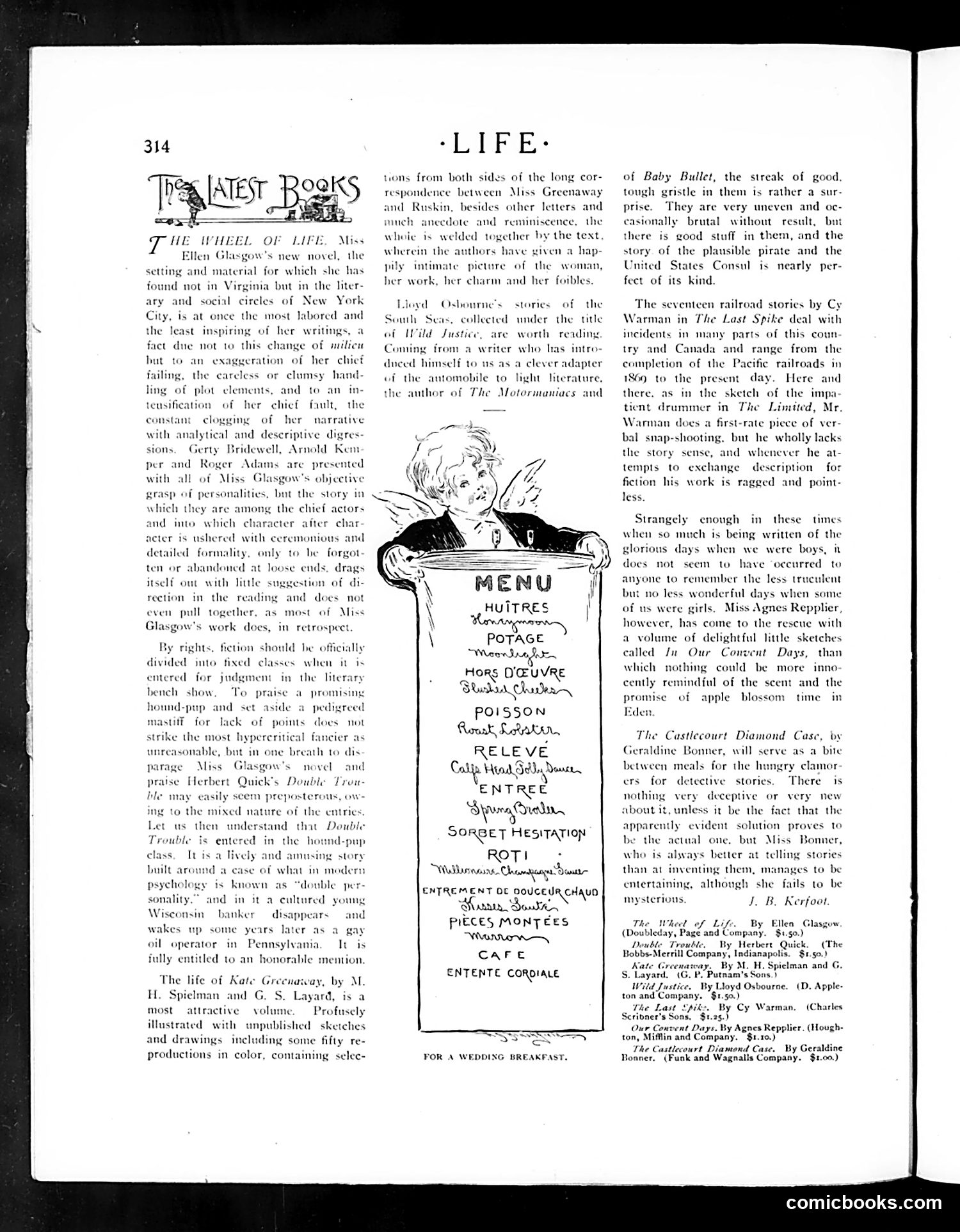
This page from *Life* magazine consists primarily of book reviews rather than political cartoons. The central illustration shows a cherub or cupid holding a handwritten French menu "FOR A WEDDING BREAKFAST"—a decorative element accompanying reviews of recent literary works. The reviews discuss novels by Ellen Glasgow, Lloyd Osbourne, and Cy Warman, along with a biography of illustrator Kate Greenaway. The critic praises Glasgow's character development but faults her plot construction and narrative clutter. Osbourne's South Seas stories receive mixed reviews for unevenness, while Warman's railroad stories are criticized for lacking narrative coherence despite occasional strong passages. The menu illustration is purely decorative, reflecting the magazine's satirical, leisurely tone rather than conveying specific political or social satire. This is essentially a literary criticism page with period-appropriate ornamentation.
📄 Transcribed text from this page (OCR, searchable)
Machine-transcribed from the original scan — historical spelling and the odd misread are preserved.
LIFE. Miss novel, the T ME WHEEL OF “Hen Glasgow's new setting and material for which she has found not in Virginia but in the liter- New York , is at once the most Jabored and ary and social circles of the least inspiring of her writings, a of milion but to an exaggeration of her chieé failing, the careless or clumsy hand- ling of plot elements, and to an in- fault, the narrative fact due not to this chan teusification of her chief constant clogging of her with analytical and descriptive digres Gerty Bridewell, Arnold Ke per and Roger Adams are presented with all of Miss Glasgow's objective grasp of person; which th and into sions but the story in are among the chief actors which character after char acter is ushered with ceremonious and forgot formality, only to he detailed ten or abandoned loose ends. drags itself out with lit rection even pull together, as most of M suggestion of di- in the reading and does ne Glasgow's work does, in retrospect. By rights, f divided tion should he officially into fixed classes when itis entered for judgment in the literary bench show, To praise a promising hound-pup and set aside a mastitf for lack of strike the most hypereritical fancier as pedigreed points does not unreasonable, but in one breath to dis parage Miss W's praise Herbert Quick's Double Tron- h seem pre} novel and isterous, ow- ¢ of the entries Dow nd-pup ing to the mixed nai then understand that Trouble is entered in the hy ively and ami nd a case of w Let us class. Itisa built ar psychology ing story ut in modern is known as “double per- sonality.” and in it a cultured young Wisconsin banker wakes disappears and up some years later as a gay It is led to an honorable mention. oil operator in Pennsylvania ly ex The life of Kate Greenaway, by M. H. Spielman and G. S. most attractive Profusely illustrated with unpublished sketches and drawings including some fifty re- productions in color, containing selee- Layard, is a volume ‘LIFE: tions from both sides of the long cor- respondence between Miss Greenaway and Ruskin, besides other letters and anecdote and reminiscence, the whoie welded together by the text. wherein the authors have given a hap- mine pily intimate picture of the woman, her work, her charm and her foibles. joyd Osbourne’s stories of the South Seas, of Wild collected under the title Justice, are worth reading Coming from a writer who las intro- duced himself to us as a clever adapter Night lite of the automobile to ALEC, author of The Motormaniacs and Weenie Se, Hors D'UVRE Suda Chudea POISSON RELEVE G He Head Se), Dower. ENTREE ‘Spray SORBET HESITATION ENTREMENT DC COUCEUR CHAUD x jain. Douke. Pleces MONT EES Niwannew CAFE ENTENTE COROIALE FOR A WEDDING BREAKFAST. of Baby Bullet, the streak of good. tough gristle in them is rather a sur- prise. They are very uneven and oc- casionally brutal without result, but there is good stuff in them, and the story of the plausible pirate and the United States Consul is nearly per- fect of its kind. The seventeen railroad stories by Cy Warman in The Last Spike deal with incidents in many parts of this coun try and Canada and range from the completion of the Pacific railroads in 1869 to the day. Here and there, as in the sketch of the impa tient drummer in The Limited, Mr. present Warman does a first-rate piece of ver- bal snap-shooting, but he wholly lacks the story sense, and whenever he at- tempts to exchange description for fiction his work is ragged and_point- less. Strangely enough in these times when so much is being written of the glorious days when we were boys, it seem to occurred to anyone to remember the less truculent does not have but no less wonderful days when some of us were girls. Miss Agnes Repplier, however, has come to the rescue with a volume of delightful little sketches. called Ji Our Convent Days, than which nothing could be more inno cently remindful of the scent and the promise of apple blossom time in Eden The Castlecourt Diamond Case, by Geraldine Bonner, will serve as a bite between meals for the hungry clamor ers for detective stories. nothing very deceptive or very new about it, unless it be the fact that the solution There is apparently evident proves to be the actual one, but Miss who is always better at telling stories than at inventing them, manages to be entertaining, although she fails to be J. B. Kerfoot. The Wheel of Life. By Ellen Glasgow (Doubleday, Page and Company. $1.50.) Double Trouble, Wy Werbert Quick. (The Bobbs-Merrill Company, Indianapolis. $1.59.) Kate Greenaway, By M. H. Spielman and G. S. Layard. (G. P. Putnam's Sons.) Wild Justice. My Lloyd Osbourne. ton and’Company. $1.50.) The Last Spike. By Cy Warman, (Charles Scribner's Sons, i Our Convent Days, By Agnes Repplier. (Hough- ton, Mifflin and Company, $1.10.) The Castlecourt Diamond Case. By Geraldine Bonner. (Funk and Wagnalls Company. $1.00.) Bonner, mysterious. (D. Apple- comicbooks.com