
Life, 1906-03-08 · page 22 of 32
Life — March 8, 1906 — page 22: what you’re looking at
What you’re looking at
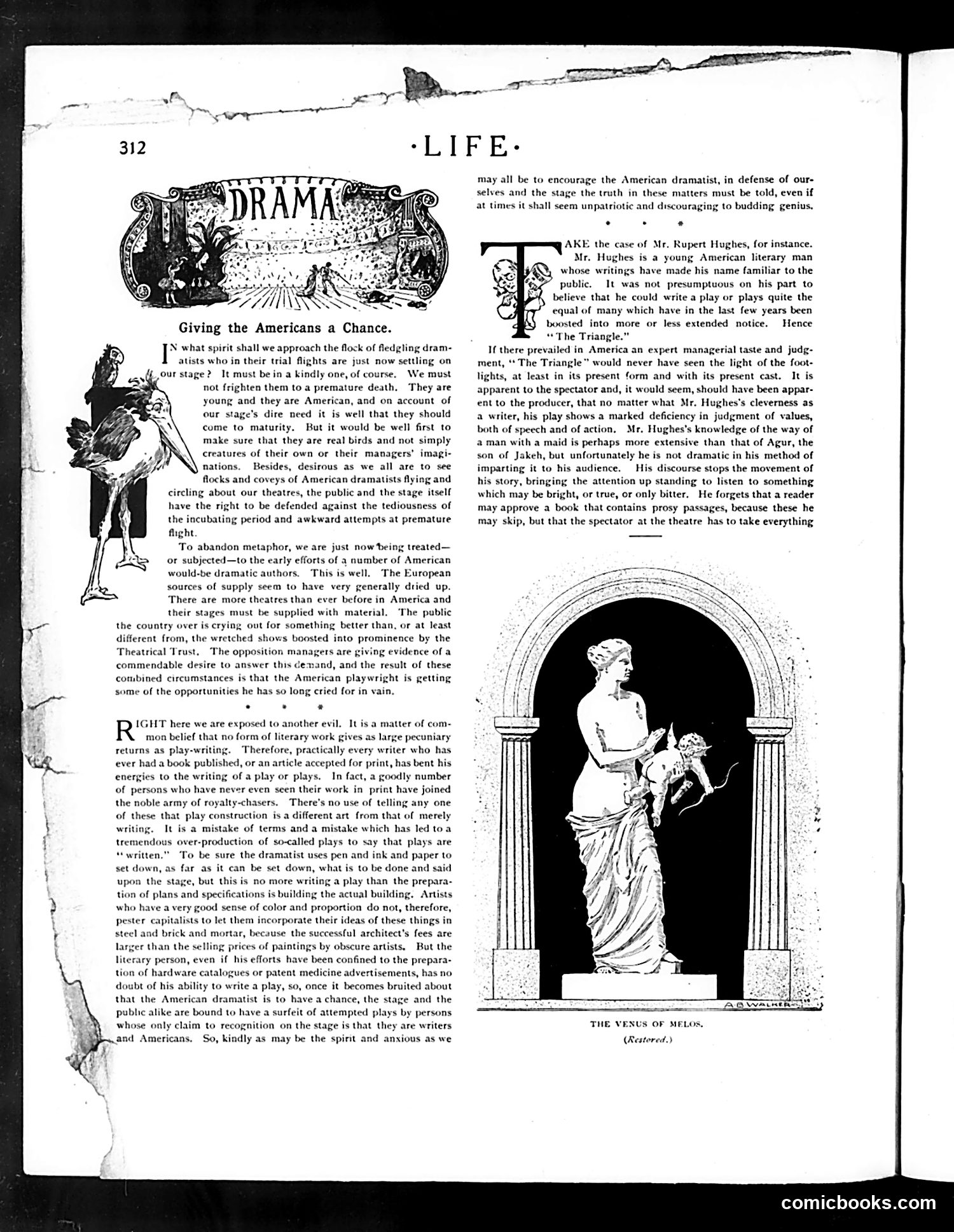
This editorial page discusses American playwrights getting stage opportunities. The text argues for cautious support of new American dramatists while warning against low-quality work flooding theaters. The key satire: the author mocks the flood of would-be playwrights—anyone who's published anything now thinks they can write plays. The editorial distinguishes between "writing" (putting words on paper) and actual dramatic construction, comparing it to how an architect's sketches aren't the same as building. The cartoon (left) shows a theatrical figure in classical dress, likely representing Drama or Theater itself, assessing these new writers—depicted as fledgling birds needing careful nurturing rather than harsh criticism that would "frighten them to premature death." The illustration captioned "The Venus of Helos" (right) appears decorative rather than directly satirical. The underlying point: America needs native drama, but not every writer deserves a stage. Quality matters.
📄 Transcribed text from this page (OCR, searchable)
Machine-transcribed from the original scan — historical spelling and the odd misread are preserved.
PONT | ” anes, semen ‘LIFE: Giving the Americans a Chance. N what spirit shall we approach the flock of fledgling dram- atists who in their trial lights are just now settling on our stage? It must be in a kindly one, of course. We must not frighten them to a premature death, They are young and they are American, and on account of our stage’s dire need it is well that they should But it would be well first to make sure that they are real birds and not simply creatures of their own or their managers’ imagi nations. Besides, desirous as we all are to see flocks and coveys of American dramatists flying and circling about our theatres, the public and the stage itself have the right to be defended against the tediousness of the incubating period and awkward attempts at premature flight To abandon metaphor, we are just now being treated— or subjected—to the early efforts of a number of American would-be dramatic authors. This is well, ‘The European sources of supply seem to have very generally dried up. There are more theatres than ever before in America and their stages must be supplied with material, ‘The public the country over is crying out for something better than, or at least different from, the wretched shows boosted into prominence by the Theatrical Trust, The opposition managers are giving evidence of a commendable desire to answer this demand, and the result of these combined circumstances is that the American playwright is getting some of the opportunities he has so long cried for in vain. come to maturity. IGHT here we are exposed to another evil. It is a matter of com- mon belief that no form of literary work gives as large pecuniary returns as play-writing. Therefore, practically every writer who has ever had a book published, or an article accepted for print, has bent his energies to the writing of a play or plays, In fact, a goodly number of persons who have never even seen their work in print have joined the noble army of royalty-chasers, There's no use of telling any one of these that play construction isa different art from that of merely It is a mistake of terms anda mistake which has led toa tremendous over-production of so-called plays to say that plays are “written.” To be sure the dramatist uses pen and ink and paper to set down, as far as it can be set down, what is to be done and said upon the stage, but this is no more writing a play than the prepara- tion of plans and specifications is building the actual building, Artists who have a very good sense of color and proportion do not, therefore, pester capitalists to let them incorporate their ideas of these things in steel and brick and mortar, because the successful architect's fees are larger than the selling prices of paintings by obscure artists, But the literary person, even if his efforts have been confined to the prepara- tion of hardware catalogues or patent medicine advertisements, has no doubt of his ability to write a play, so, once it becomes bruited about that the American dramatist is to have a chance, the stage and the public alike are bound to have a surfeit of attempted plays by persons writing. whose only claim to recognition on the stage is that they are writers and Americans. So, kindly as may be the spirit and anxious as we may all be to encourage the American dramatist, in defense of our- selves and the stage the truth in these matters must be told, even if at times it shall seem unpatriotic and discouraging to budding genius, . . . AKE the case of Mr. Rupert Hughes, for instance. Mr. Hughes is a young American literary man whose writings have made his name familiar to the public, It was not presumptuous on his part to believe that he could write a play or plays quite the equal of many which have in the last few years been boosted into more or less extended notice. Hence “The Triangle.” If there prevailed in America an expert managerial taste and judg- ment, “The Triangle” would never have seen the light of the foot- lights, at least in its present form and with its present cast. It is apparent to the spectator and, it would seem, should have been appar- ent to the producer, that no matter what Mr. Hughes's cleverness as a writer, his play shows a marked deficiency in judgment of values, both of speech and of action, Mr. Hughes's knowledge of the way of a man with a maid is perhaps more extensive than that of Agur, the son of Jakeh, but unfortunately he is not dramatic in his method of imparting it to his audience. His discourse stops the movement of his story, bringing the attention up standing to listen to something which may be bright, or true, or only bitter. He forgets that a reader may approve a book that contains prosy passages, because these he may skip, but that the spectator at the theatre has to take everything ENUS OF MELOS, comicbooks.com