
A complete issue · 24 pages · 1905
Life — December 14, 1905
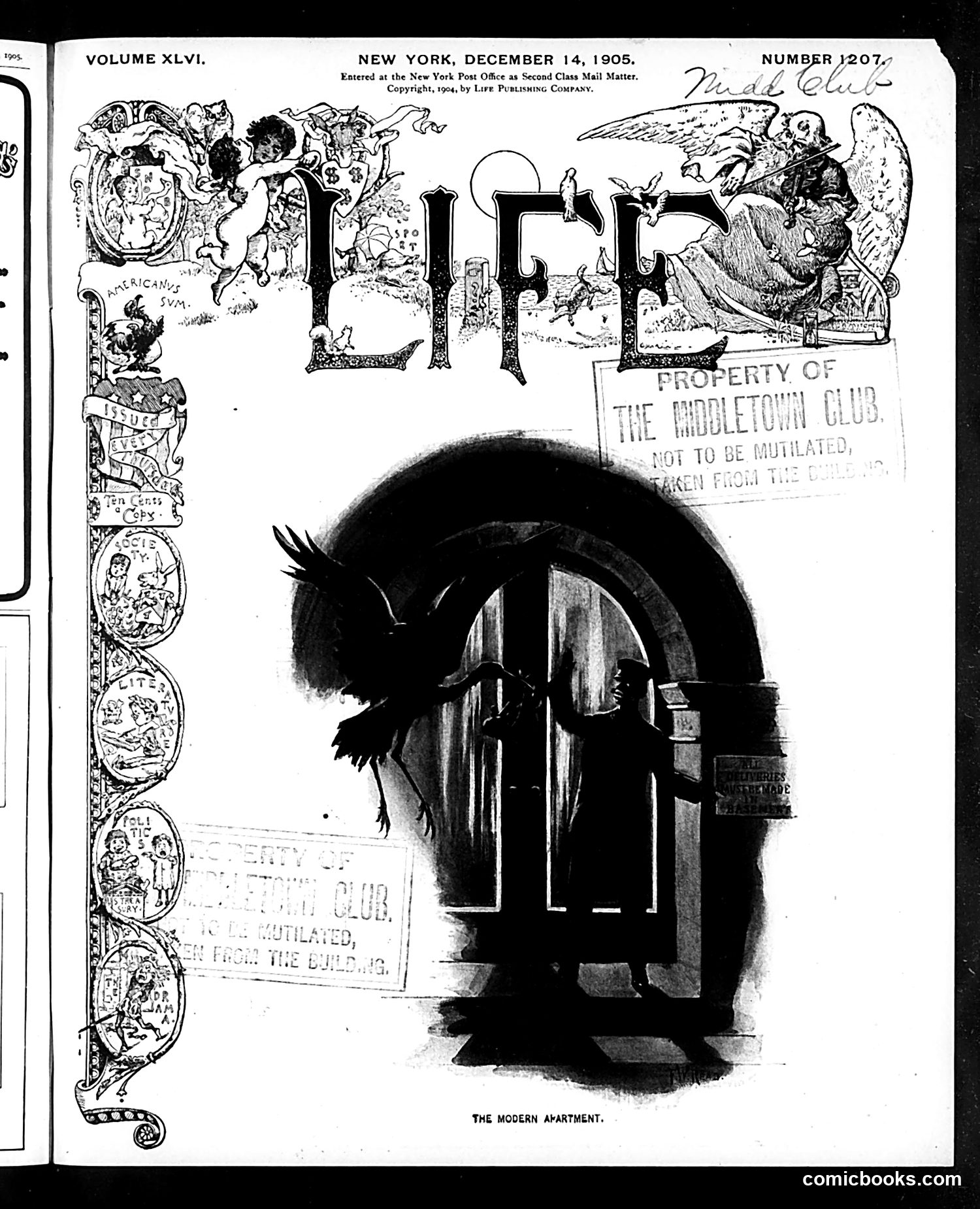
The main illustration titled "The Modern Apartment" depicts a silhouetted figure peering through a keyhole into a neighbor's residence. This is a satirical commentary on the close quarters and lack of privacy in modern urban apartment living—a social anxiety of early 1900s city dwellers as apartment buildings became increasingly common. The decorative border on the left contains classical medallions representing various aspects of American life and culture. The elaborate ornamental framing was typical of Life's design aesthetic during this period. The overall satire suggests that "modern" apartment living sacrifices privacy and personal space, forcing residents into uncomfortable proximity with neighbors—a critique of urbanization and contemporary housing standards.
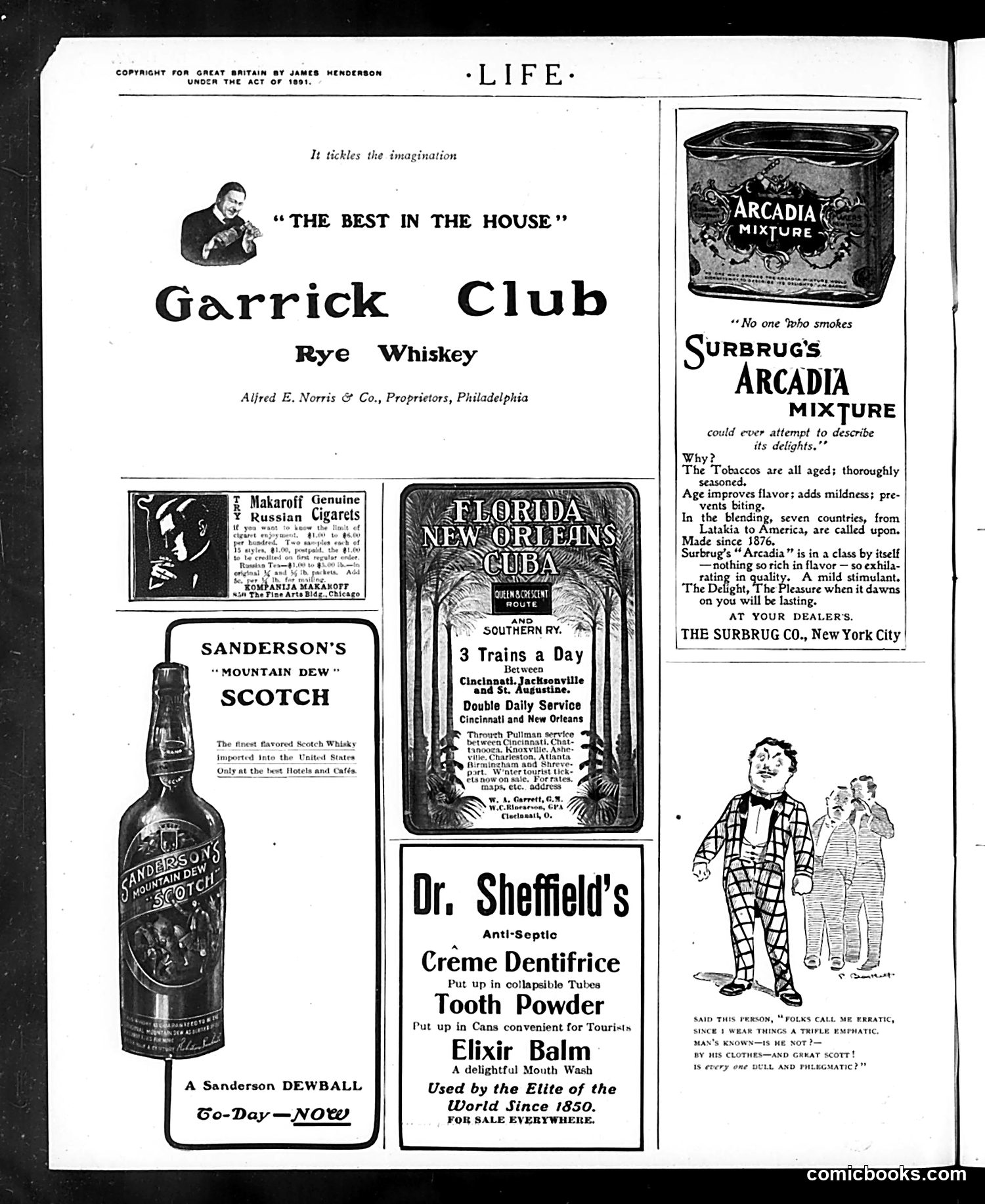
This page is primarily **advertising content** with one cartoon element. The advertisements promote various products typical of the era: whiskey (Garrick Club Rye), Scotch (Sanderson's), cigars (Makaroff), tobacco (Surburg's Arcadia Mixture), train travel (Florida New Orleans Cuba route), and dental products (Dr. Sheffield's). The single cartoon at bottom right depicts a man in a checkered suit with two other figures, accompanied by text about his clothes and "great Scott." The exact satirical point is unclear from context alone, though it appears to mock someone's fashion sense or social pretensions, possibly suggesting his clothing choice is absurdly patriotic or conspicuous rather than genuinely Scottish—a play on the preponderance of "Scottish" products advertised on the page.
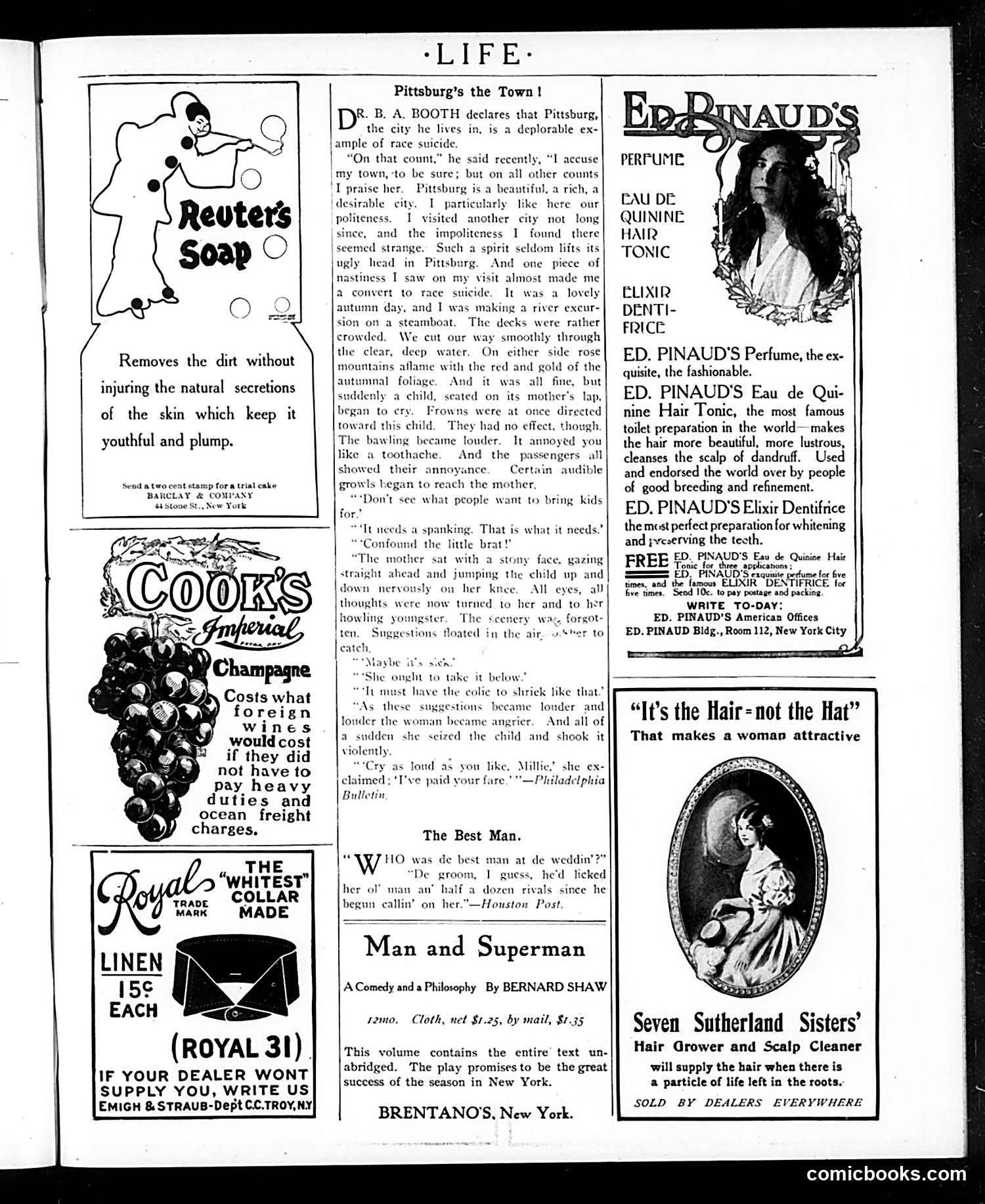
This page is predominantly **advertisements** for period products (Reuters Soap, Cook's Champagne, Royal Collars, Ed. Pinaud's toiletries, and Seven Sutherland Sisters' Hair products), interspersed with brief satirical content. The main satirical piece, "Pittsburgh's the Town!", features **Dr. C.A. Booth's critical commentary** on Pittsburgh as a "deplorable example of race suicide." He describes witnessing a mother unable to control her noisy child on a riverboat excursion, interpreting this parenting failure as symptomatic of broader social decline. The humor targets **urban parenting standards and social decay** rather than specific political figures. Two brief jokes follow: "The Best Man" (about wedding infidelity) and "Man and Superman" (promoting Bernard Shaw's play). The page reflects early-20th-century anxieties about social propriety and "race" (meaning civilization/refinement) rather than race in modern terms.
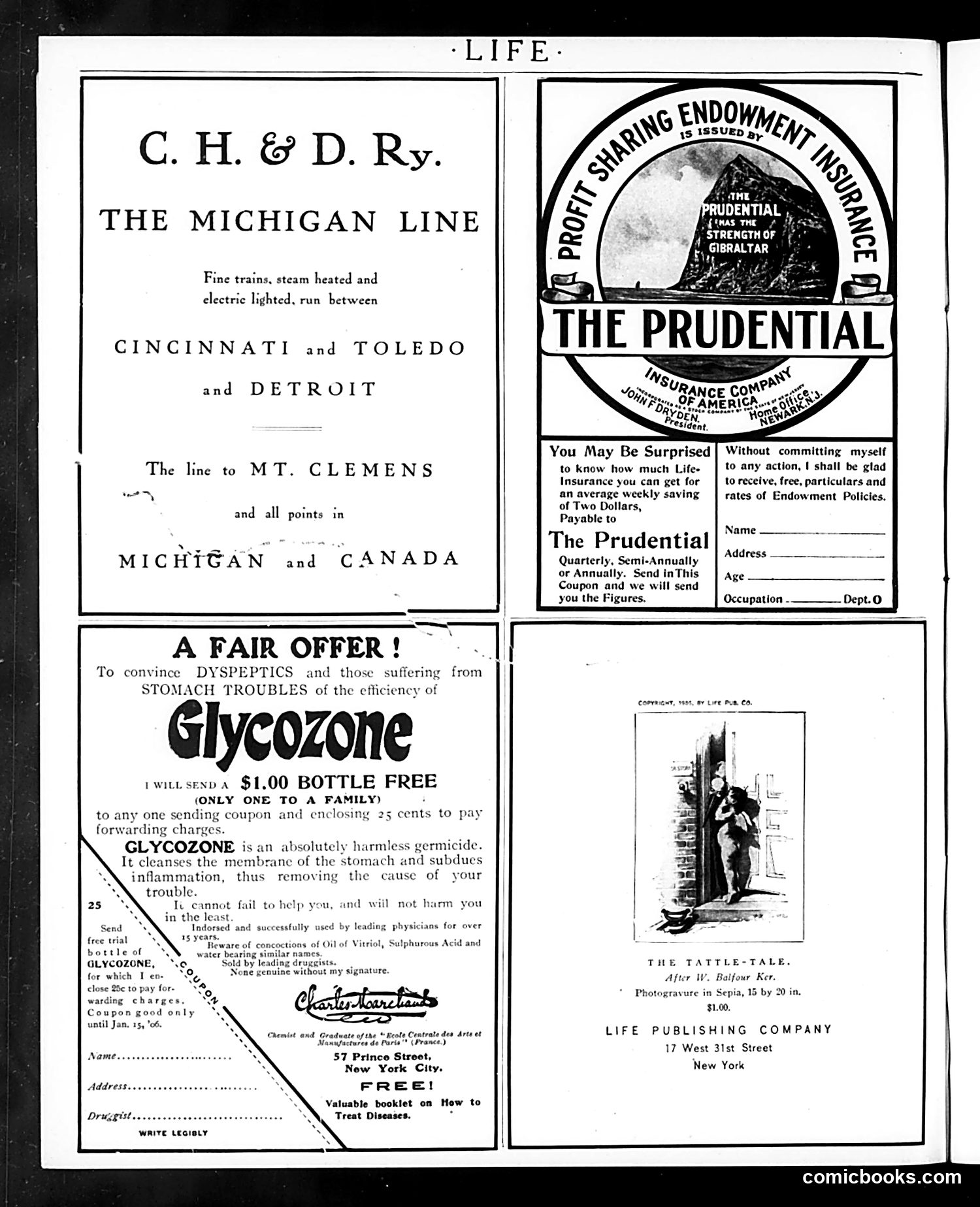
This page is primarily **advertising, not satire or political commentary**. It contains four advertisements from what appears to be an early 20th-century Life magazine: 1. **C.H. & D. Railway**: Promotes train service between Cincinnati, Toledo, and Detroit 2. **The Prudential Insurance**: An endowment insurance offer with a coupon to request information 3. **Glycozone**: A patent medicine claiming to treat stomach troubles and dyspepsia, offering a free $1.00 bottle 4. **The Tattle-Tale**: A photogravure artwork available for purchase from Life Publishing Company The Glycozone ad is notable for making health claims typical of early 20th-century pharmaceutical advertising—before modern FDA regulation—claiming the product "cleanses the membrane of the stomach" and is "harmless" and "used by leading physicians." There are no political cartoons or satirical content visible on this page.
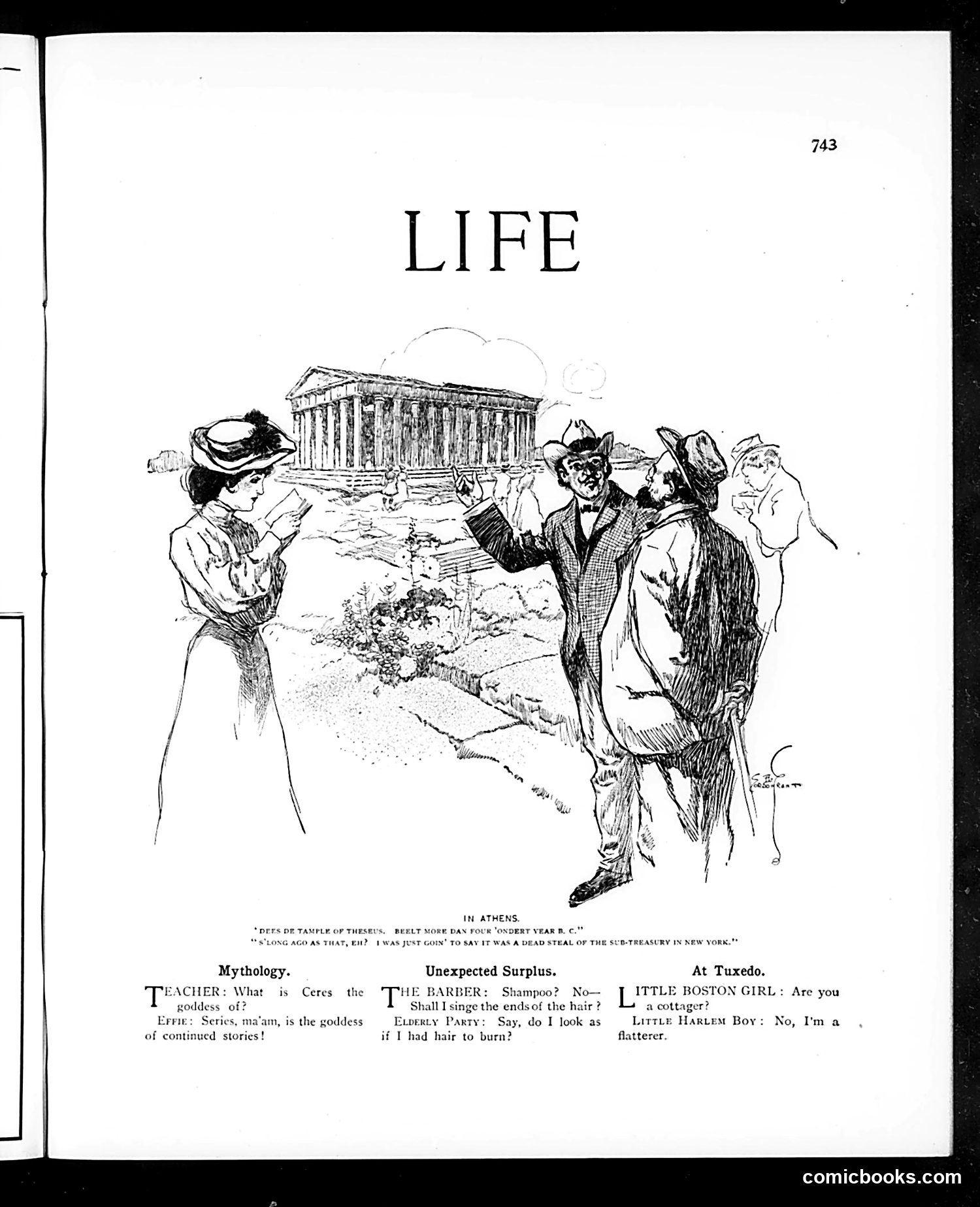
This page contains three unrelated humorous sketches typical of early 20th-century satirical magazines: **"In Athens"** depicts tourists at the Parthenon. The caption quotes someone mocking classical antiquity—"Keeps of Temple of Theseus... built more dan four hundred year B.C." and "I was just goin' to say it was a dead steal of the sub-treasury in New York"—satirizing American provincial ignorance and boastfulness. **"Mythology"** jokes about classical education: a teacher asks what Ceres is; a student replies she's "the goddess of continued stories" (confusing her with serialized fiction). **"Unexpected Surplus"** and **"At Tuxedo"** are brief comic exchanges about hair-burning and social pretension. These sketches target American cultural illiteracy and class pretensions rather than specific political figures or events.
This page contains editorial commentary about **Harvard University and Yale University**, focusing on a controversy involving the *Harvard Graduates' Magazine*. The central issue concerns an article critical of Yale that appeared in the magazine. The editors argue that while Yale's methods may be rough, Harvard's response violated professional standards. They defend Yale as "a very important institution" and suggest that publicly attacking it serves no constructive purpose. The piece also criticizes **Mr. Jerome's recent remarks about New York State Supreme Court judges**, calling his comments disrespectful. The editors argue that judges deserve respect regardless of appointment method. The page primarily features **political/institutional satire** rather than visual cartoons, critiquing elite university relations and judicial accountability through argumentative text with decorative illustrations.
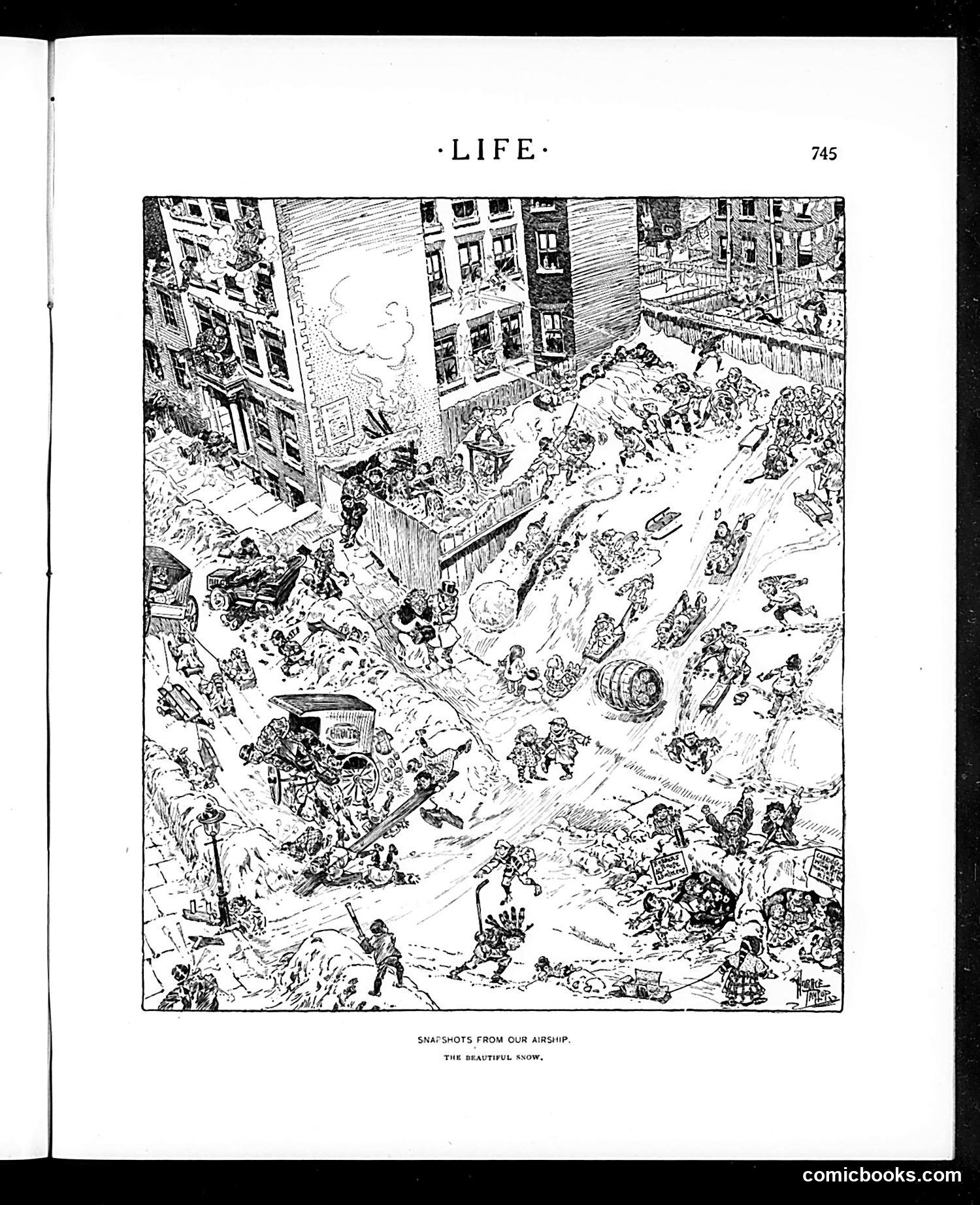
This is a densely-packed aerial illustration from *Life* magazine showing a snow-covered urban landscape viewed from above—literally "snapshots from our airship," as the caption indicates. The bird's-eye perspective was a novelty in early 20th-century illustration, made possible by recent aviation advances. The cartoon satirizes city life during winter: crowds of people enjoy sledding, playing, and socializing in snow-filled streets and parks. Buildings, vehicles, and pedestrians fill the composition. The satire appears gentle—celebrating winter recreation and urban vitality rather than mocking specific figures or policies. The humor lies in the chaotic, teeming detail and the whimsical perspective of observing everyday city life from above.
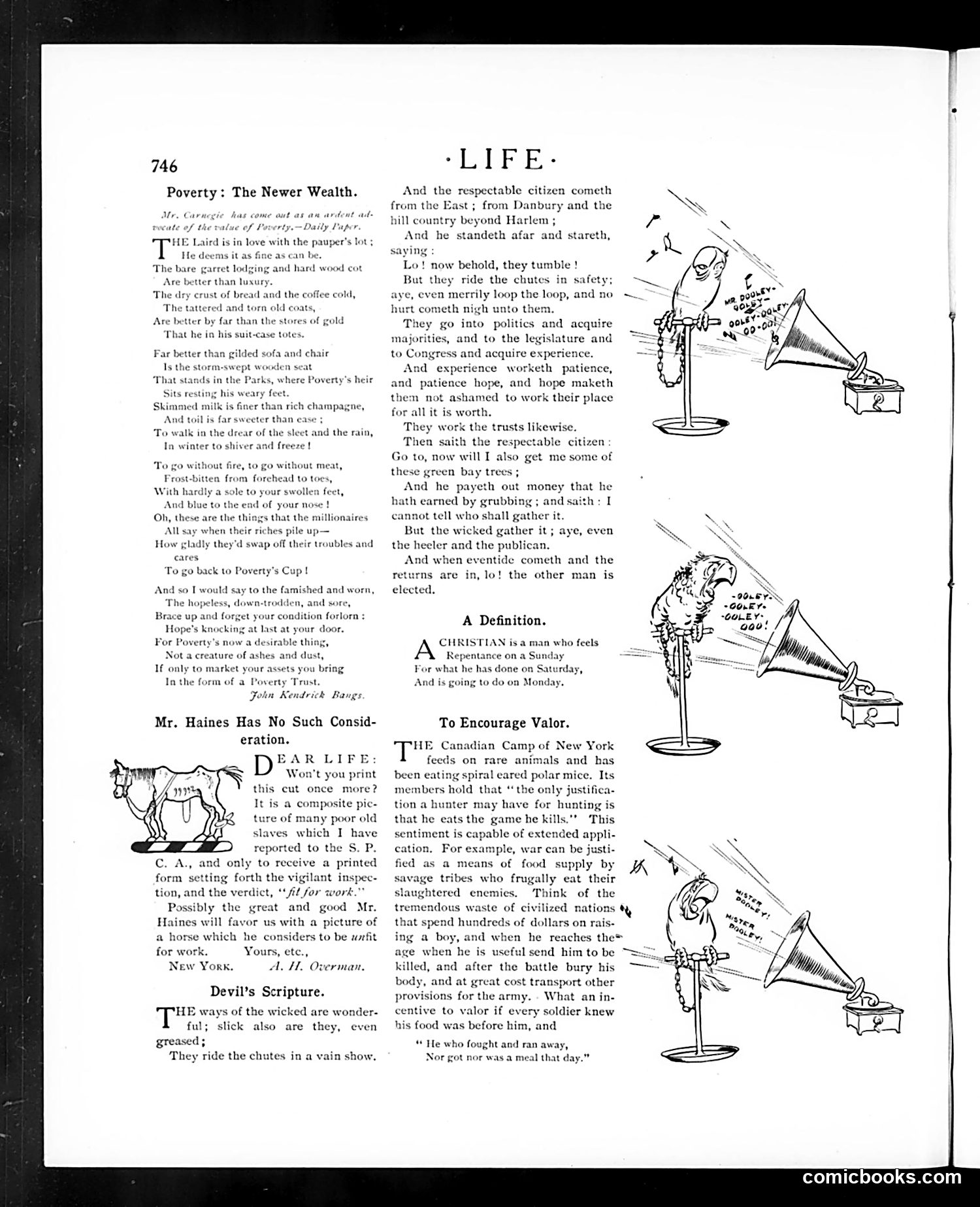
This page contains several satirical pieces on poverty and social commentary. The main cartoon section "Mr. Haines Has No Such Consideration" features a crude drawing of a cow, appearing to mock someone named Haines regarding poor treatment or exploitation of the impoverished. The illustrated sections on the right show mechanical devices (appearing to be gramophone horns or similar contraptions) with human figures, likely satirizing the dehumanizing effects of industrial labor or economic systems on workers. The text pieces critique wealth inequality and social mobility, with titles like "Devil's Scripture" and "A Definition" (defining a Christian cynically). The overall theme appears to be **late 19th or early 20th century social critique of capitalism's harshness toward the poor**, though specific contemporary references to "Mr. Haines" or the Canadian Camp referenced are unclear without additional historical context.
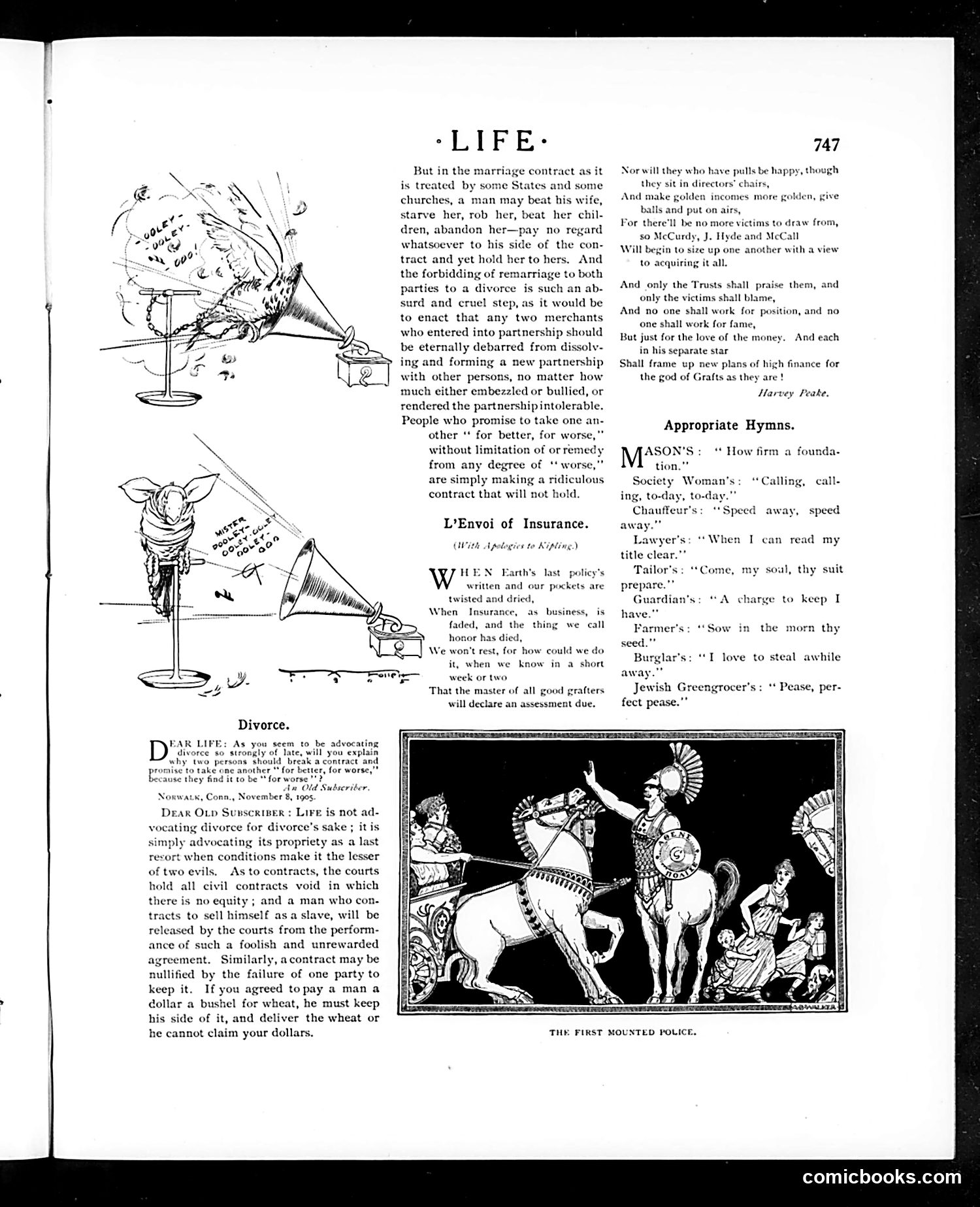
This page contains three distinct sections of social commentary: **Top Section:** A letter from "Harvey Peake" critiques marriage contracts, arguing that people who vow "for better, for worse" without legal remedies are making foolish, unenforceable agreements. The satire targets naive romantics who ignore practical legal protections. **Middle Section:** "L'Envoi of Insurance" mocks the insurance industry's failure when needed most, using death as the punchline—clients pay premiums only to find claims denied. **Bottom Section:** A response letter defends divorce as property law, not moral advocacy, arguing contracts should be enforceable or voidable by courts, like business agreements. **Illustration:** "The First Mounted Police" appears to be a classical or historical scene, likely unrelated satirical content. The page overall satirizes marriage, insurance, and legal systems through 1900s-era arguments about contractual obligations and enforcement.
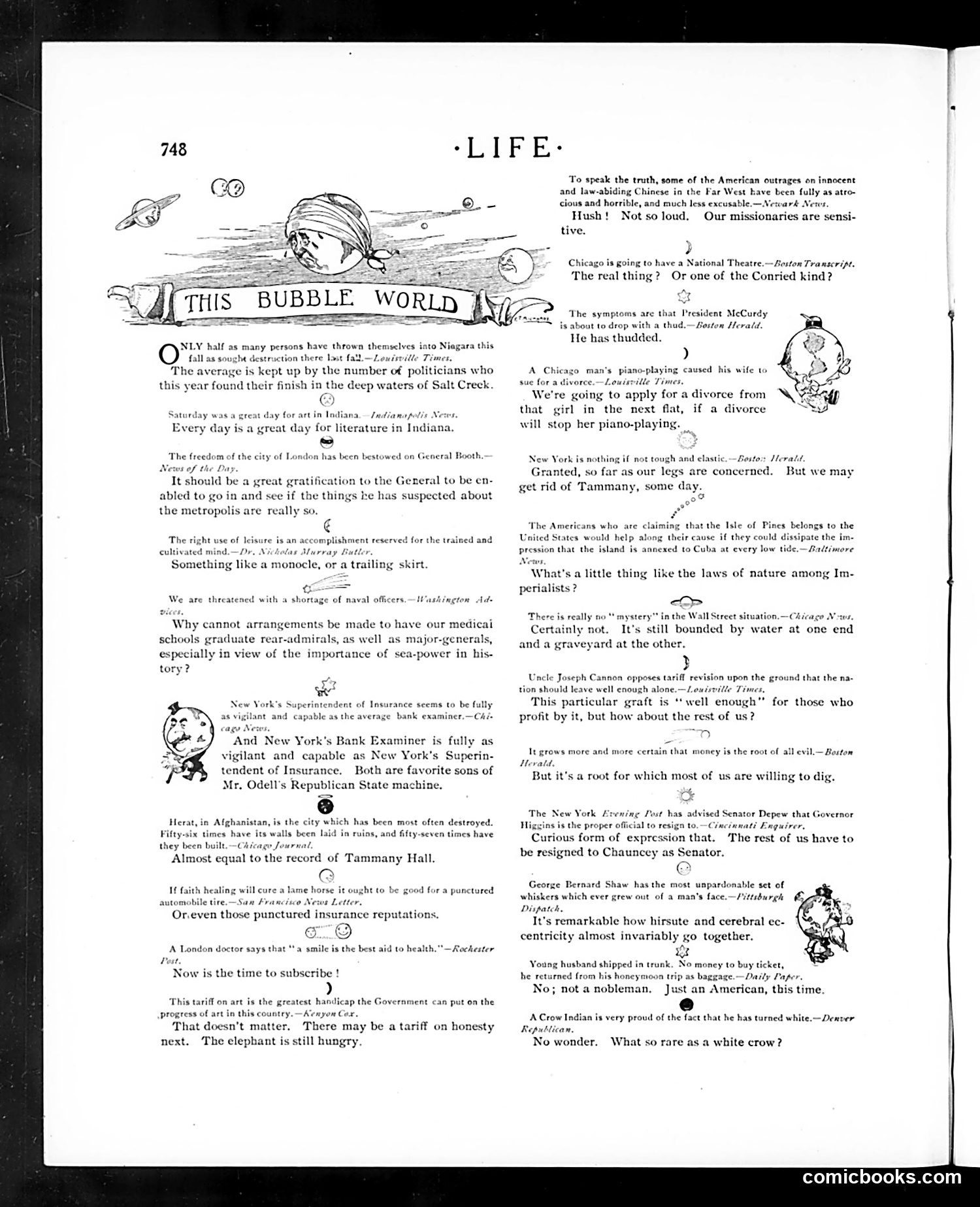
This page contains satirical commentary and jokes rather than a single coherent cartoon. The illustrations are small vignettes accompanying brief editorial quips about contemporary issues. Topics include criticism of: - American military interventions ("Isle of Pines belongs to the United States") - Political corruption and Tammany Hall grafting - Naval officer shortages - Medical school standards - Bank examiner competence - A tariff on art as government handicap - Insurance industry practices References to "President McCurdy" and "Tammany Hall" indicate early-1900s political corruption concerns. One joke contrasts American and aristocratic values regarding rank. The overall tone mocks government inefficiency, corporate malfeasance, and imperialist ambitions through brief, pointed jabs rather than elaborate visual satire.
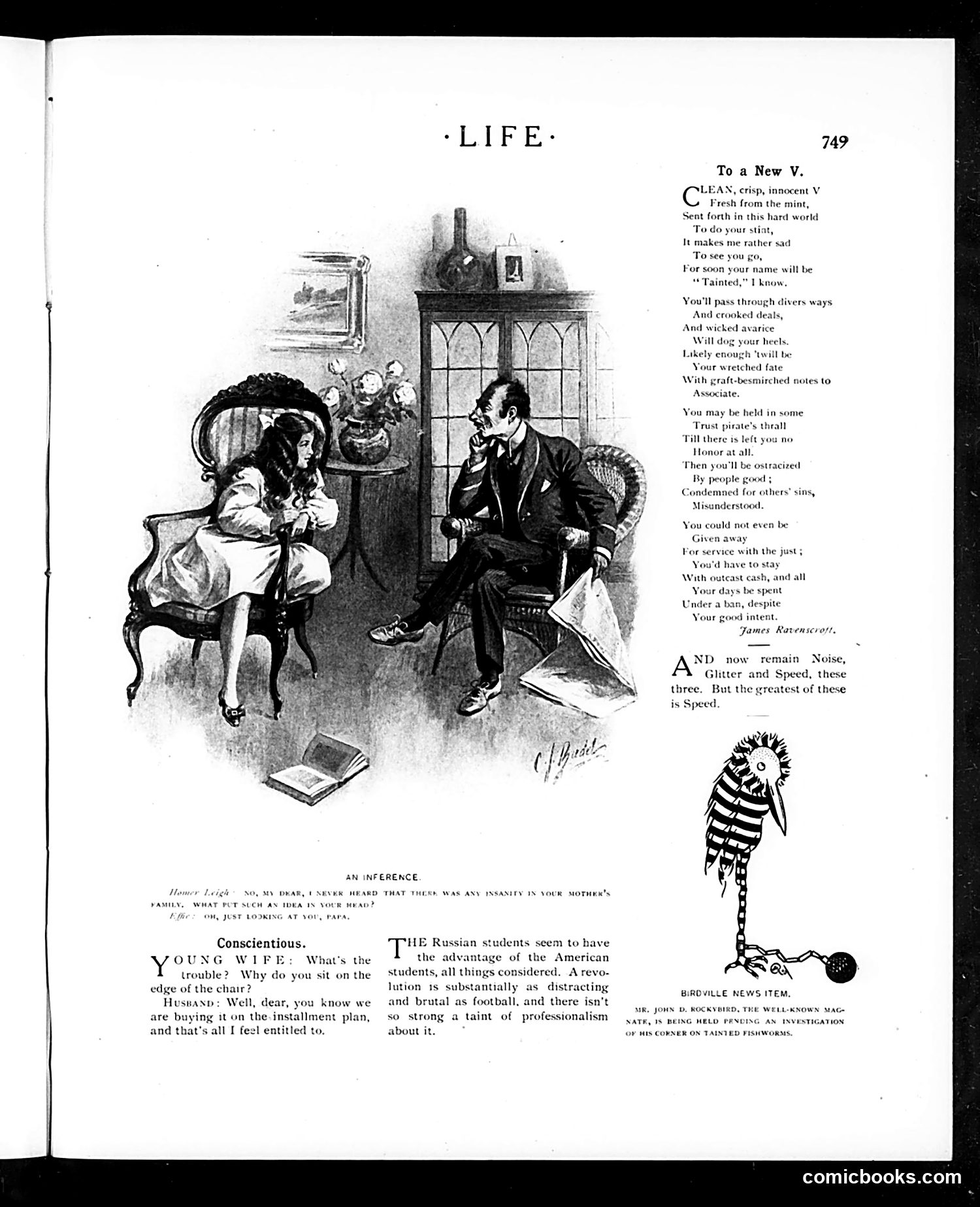
**Main Cartoon ("An Inference"):** A woman and man sit conversing in a parlor. The caption attributes a quote to "Henry Leigh" about insanity in the mother's family, with the husband responding dismissively: "Oh, JUST KIDDING, DEAR. PAPA." The satire targets domestic relations—specifically, a husband making a cruel "joke" about his wife's family mental health while she reacts with apparent hurt. This mocks casual cruelty masquerading as humor between spouses. **"To a New V" (Poem):** A satirical verse warning a newcomer ("V"—likely referring to a debutante or new society woman) about inevitable social ruin: she'll be "tainted," face crooked dealings, and end up "ostracized" and poor. It's cynical social commentary on how respectable society discards its members. **"Conscientiousness" (Dialogue):** Brief marital humor about a wife questioning an installment-plan furniture purchase—suggesting financial anxiety in middle-class households.
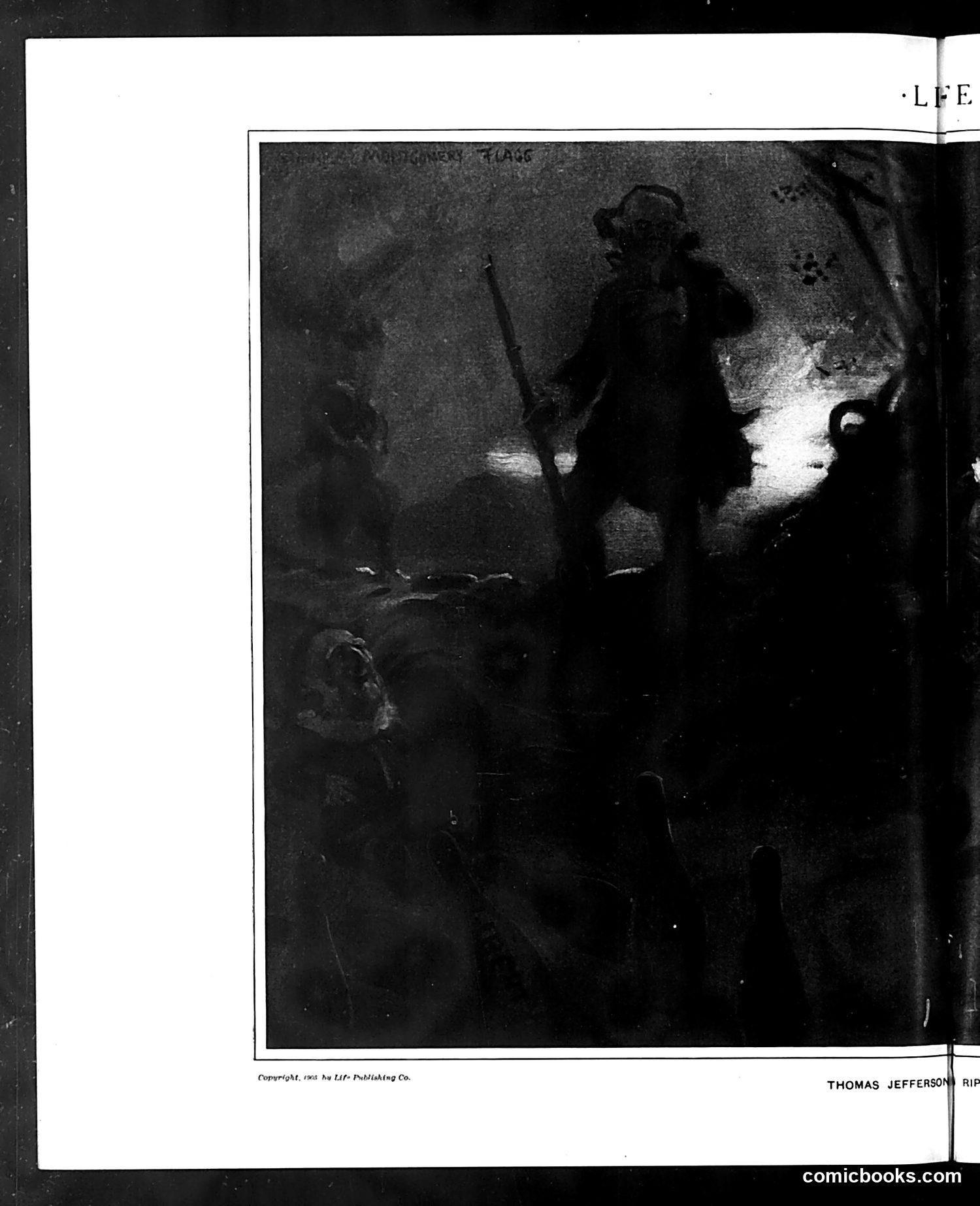
This appears to be a theatrical or dramatic illustration from *Life* magazine, showing a silhouetted figure holding a staff or walking stick in a darkened setting. The caption identifies this as "THOMAS JEFFERSON RIP" (likely "THOMAS JEFFERSON" with text cut off). The image likely satirizes or references Thomas Jefferson through dramatic theatrical staging—the dark, shadowy quality and posed figure suggest either a stage performance or a commentary on Jefferson's legacy or reputation. The "RIP" (rest in peace) caption suggests critique or commentary on his passing or the end of an era associated with him. However, without the complete text or surrounding context on the page, the specific satirical point—whether mocking his politics, character, or historical reputation—remains unclear from this image alone.
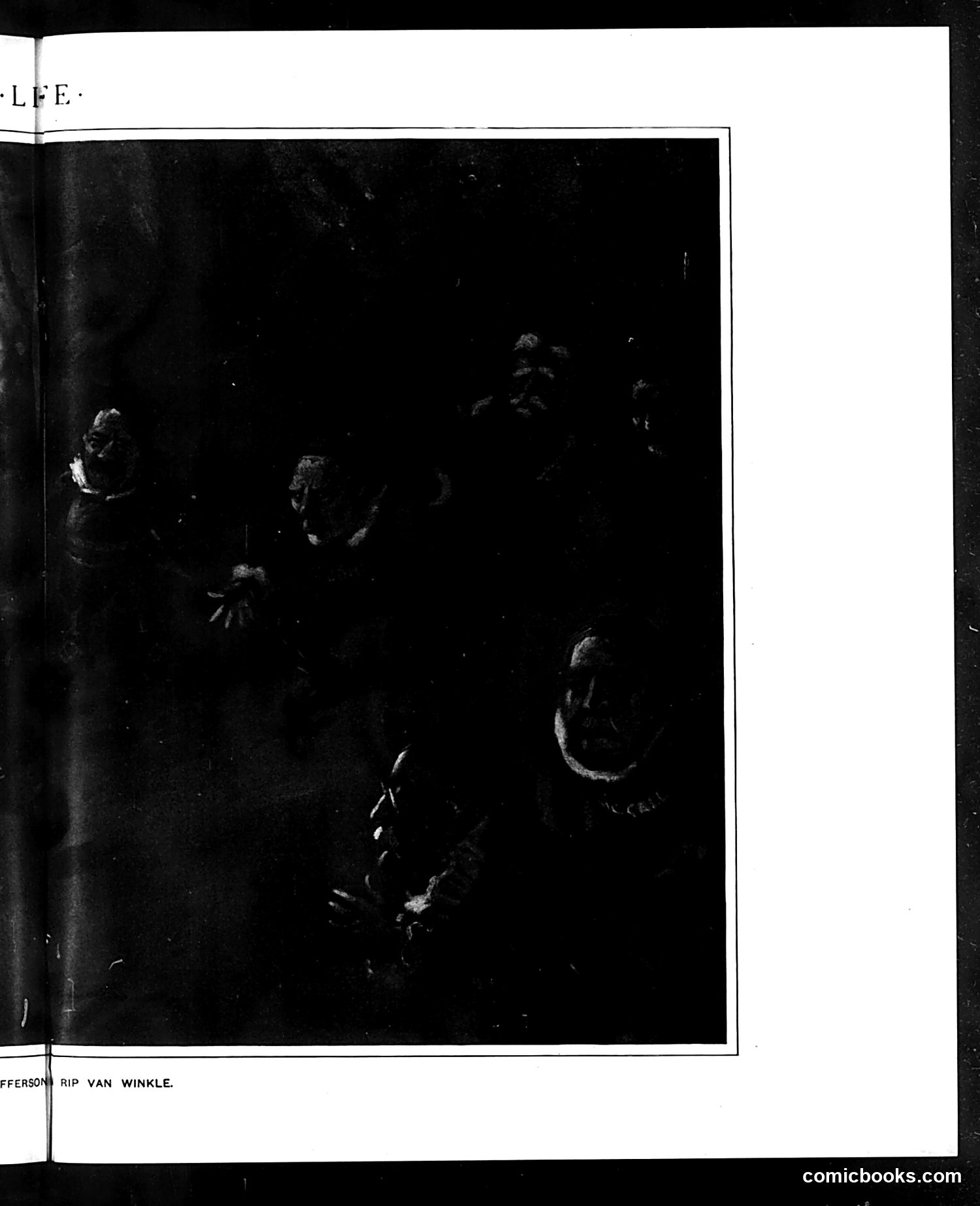
This page illustrates Washington Irving's classic 1819 story "Rip Van Winkle." The image shows the legendary character who fell asleep in the Catskill Mountains and awoke decades later to find America transformed—the colonial period had ended and the Revolutionary War had occurred. The heavily shadowed, dark illustration depicts figures in the scene, likely showing Rip's confusion upon awakening or his encounter with the changed community. The story was frequently adapted in 19th-century American culture as a parable about time's passage, social change, and displacement. Life magazine used literary illustrations like this to provide cultural content for educated readers, blending entertainment with classical American literature references.
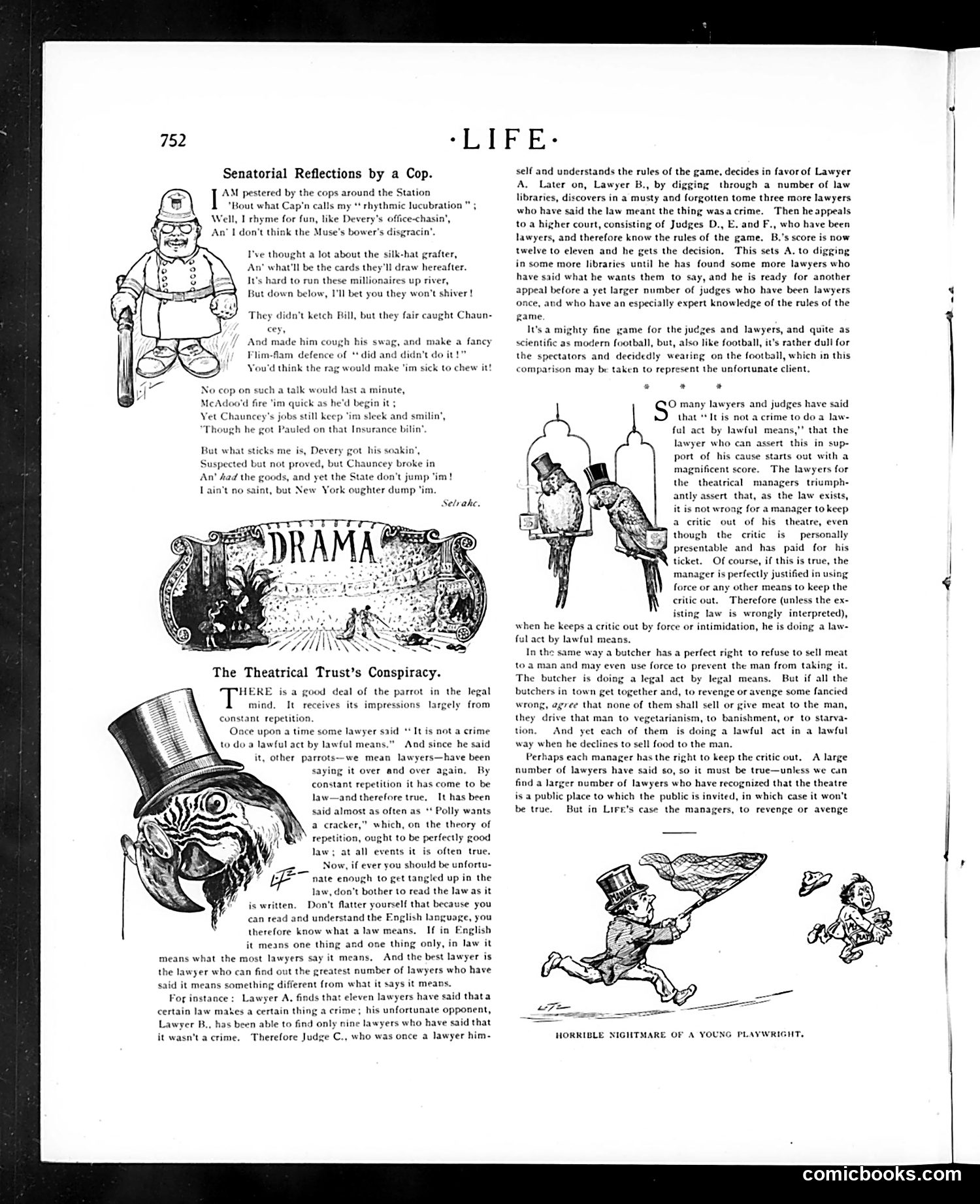
## "Senatorial Reflections by a Cop" A police officer reflects sarcastically on prosecuting wealthy offenders versus the poor. The poem references "Bill" (apparently unprosecuted) and "Chauncey" (caught and forced to confess). The cop criticizes that wealthy "silk-hat grafters" escape justice while poor offenders face conviction—a critique of class-based inequality in law enforcement. ## "The Theatrical Trust's Conspiracy" This satirizes the legal system's absurdity: law's meaning depends not on written text but on how many lawyers have previously interpreted it. The article mocks judges (themselves former lawyers) who decide cases by counting legal precedents rather than reading statutes directly. A joke about two competing lawyers finding contradictory precedents illustrates how "might makes right" in law. The "unfortunate client" is the real victim of this self-serving system designed by and for lawyers and judges protecting their professional interests.
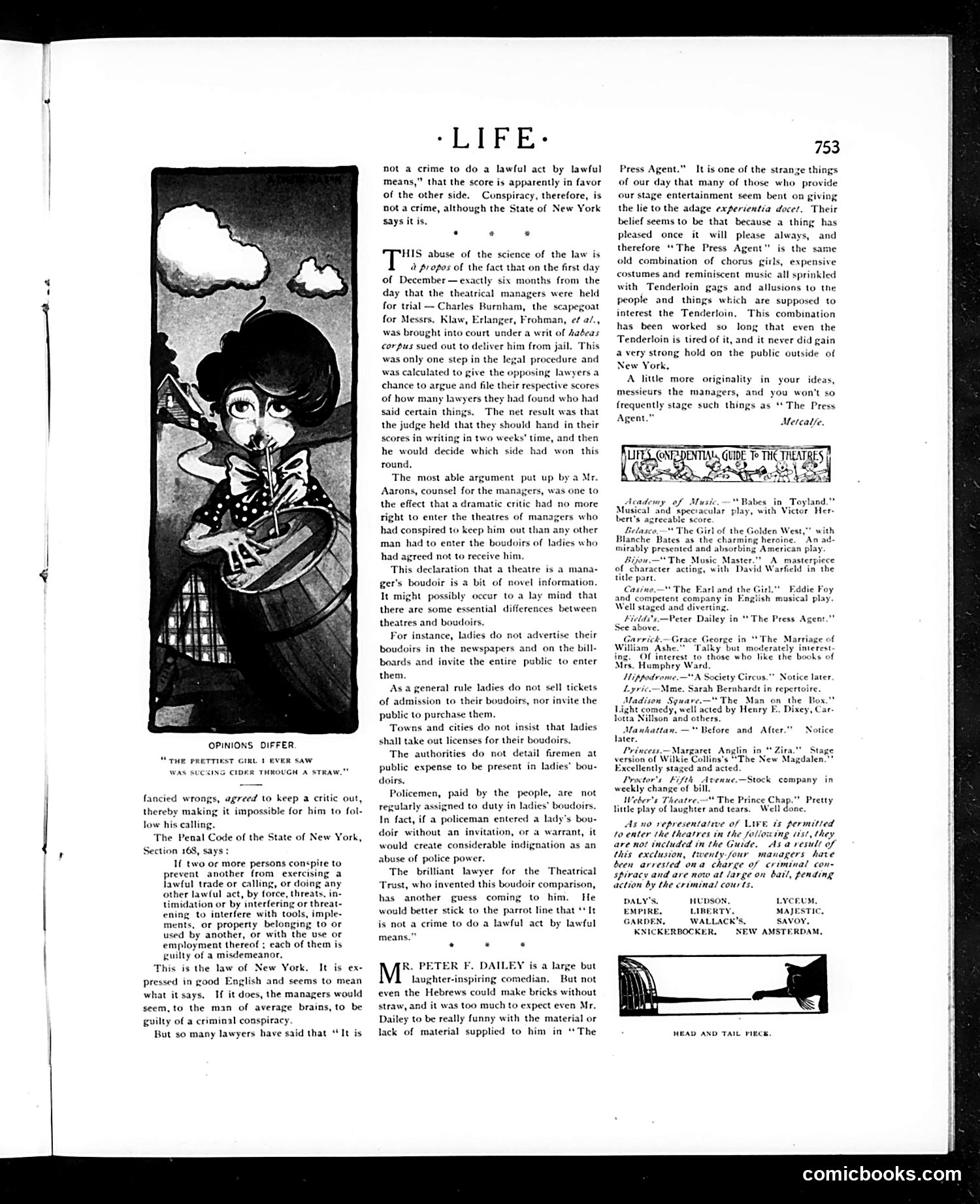
This page discusses a **real legal dispute between theater critics and the Theatrical Trust** (a monopoly controlling major theaters). The cartoon labeled "OPINIONS DIFFER" satirizes the absurdity of the managers' legal arguments. **The Context:** Theater managers Klaw, Erlanger, and Frohman conspired to exclude a critic from their theaters. Their lawyer argued a theater is like a lady's private "boudoir"—a private space they can restrict entry to. Life ridicules this comparison by listing obvious differences: theaters advertise publicly, sell tickets, require licenses, have police protection. A boudoir is genuinely private; a theater is a public business. **The Satire's Point:** The managers use technically clever legal arguments ("it's not a crime to do lawful acts by lawful means") to evade conspiracy charges. Life mocks how lawyers twist language to serve power while ignoring common sense—the real issue is whether public businesses can collude to silence critics. The illustration shows a fashionable woman, likely representing the "boudoir" comparison being ridiculed.
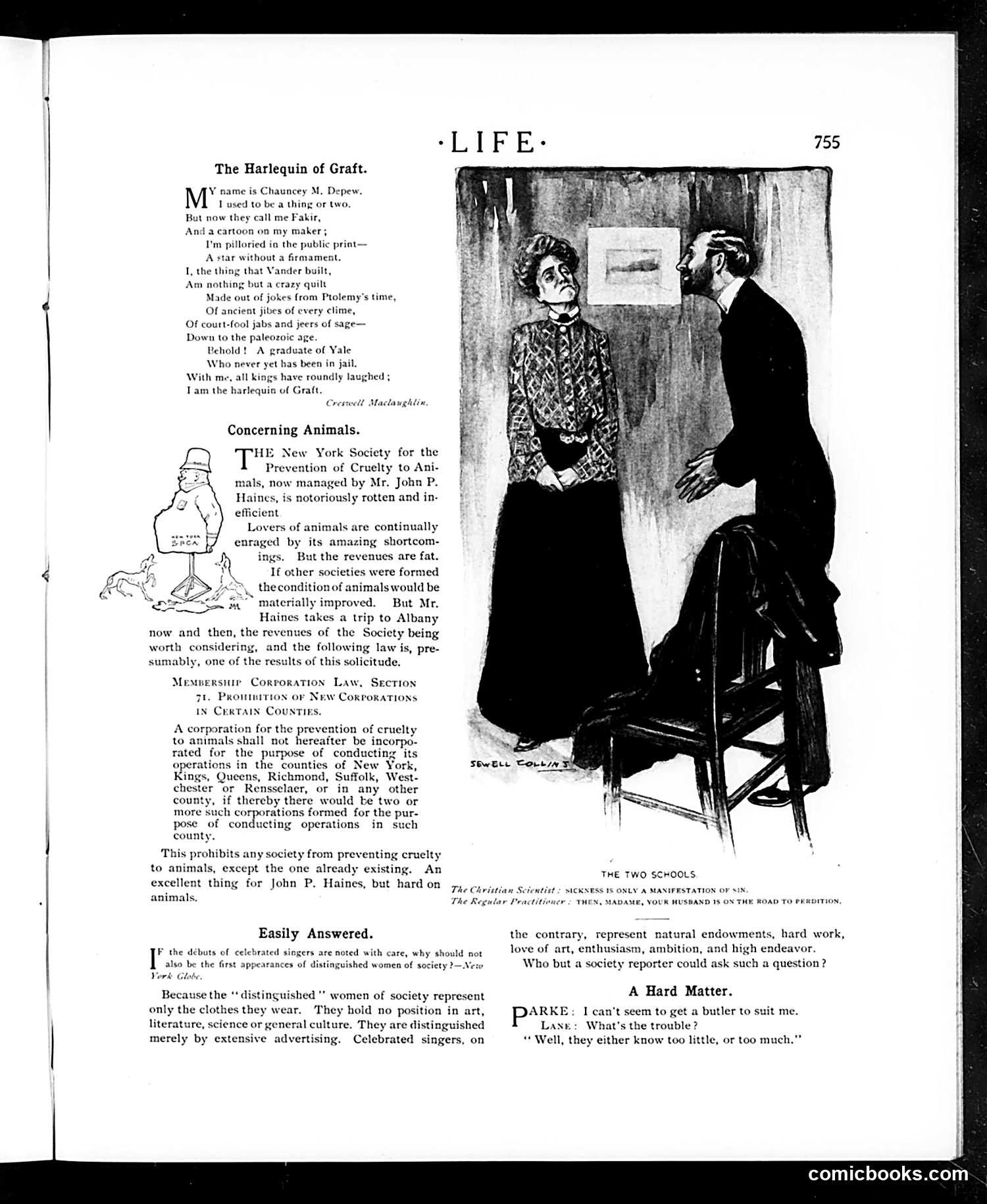
This Life magazine page (page 755) contains several distinct satirical pieces: **"The Harlequin of Graft"**: A poem attacking someone named Chauncey M.D. (likely a public figure of the era), presenting him as a fraud—a Yale graduate posing as legitimate while being "nothing but a crazy quilt" of borrowed jokes and schemes. The title suggests he profits through dishonest means ("graft"). **Animal Cruelty Section**: Attacks John P. Haines, manager of the New York Society for the Prevention of Cruelty to Animals, accusing him of corruption and inefficiency. The text reveals that Haines lobbied for a law preventing rival animal-welfare organizations from forming in certain counties—protecting his monopoly and revenue stream while harming animals. **"The Two Schools"**: A cartoon contrasting two medical philosophies: one spiritual (claiming sickness is sin), one practical. **"Easily Answered" and "A Hard Matter"**: Brief satirical quips mocking society women's shallowness and wealthy men's difficulty finding competent servants. The page's theme is institutional hypocrisy and corruption masked by respectability.
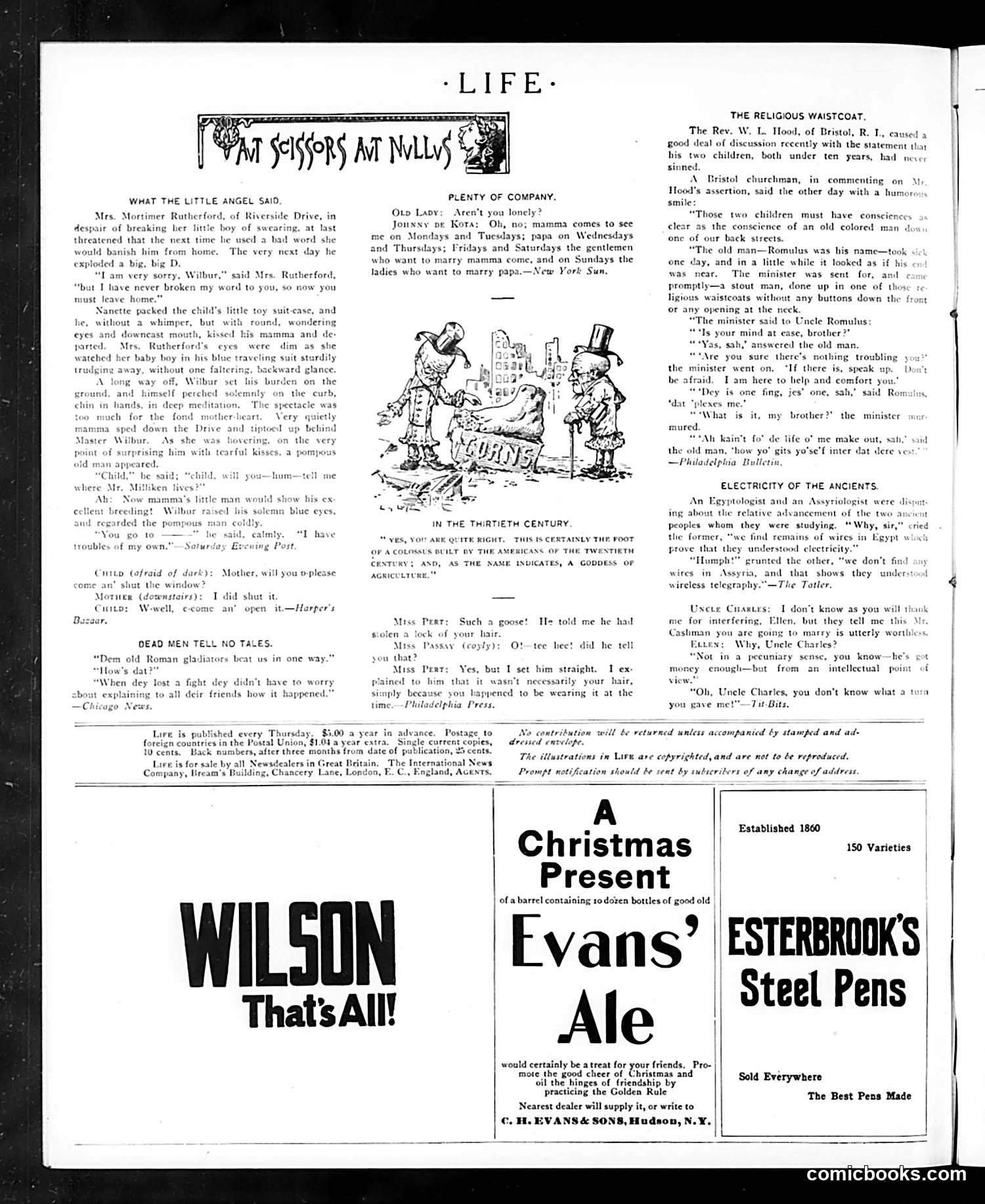
This page features two distinct satirical pieces: **"What the Little Angel Said"** depicts a moral lesson story about a child (Wilbur) banished from home for swearing. A pompous gentleman encountering the exiled boy is shocked when the child tells him to go to hell—the irony being that despite his "angelic" reputation, Wilbur still swears. The satire mocks both the strictness of Victorian child-rearing and the hypocrisy of moral posturing. **"In the Thirtieth Century"** imagines future archaeologists debating ancient technology, with one claiming Americans possessed wireless telegraphy based on Egyptian artifacts. The joke satirizes pseudo-scientific claims and archaeological overreach—people inventing explanations for artifacts they don't understand. The page also includes brief humorous dialogues mocking courtship customs, religious pretension ("The Religious Waistcoat"), and includes period advertisements. The overall tone is typical of *Life's* early-20th-century satirical humor targeting social conventions and human folly.
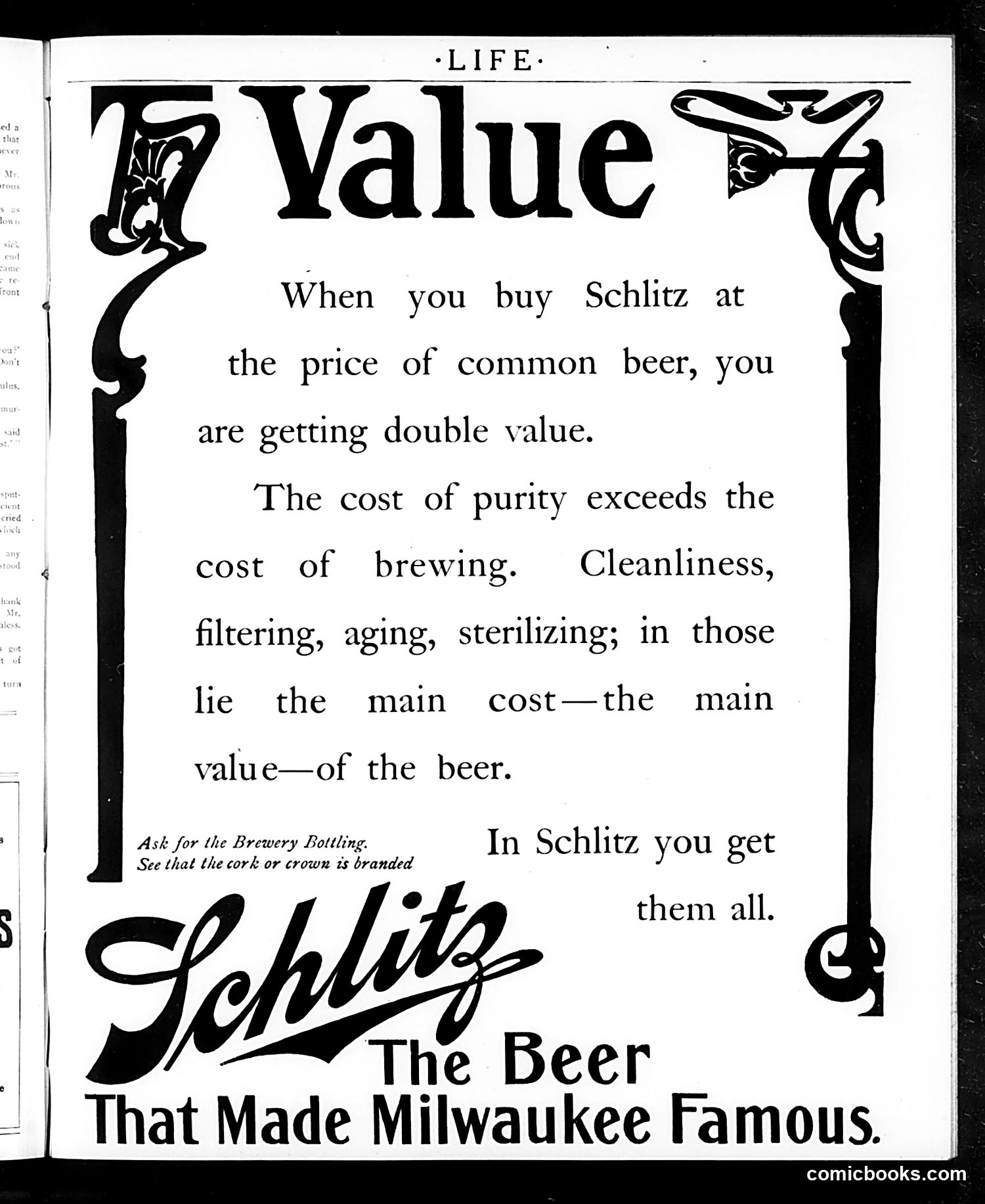
This is a **beer advertisement**, not a political cartoon. It's a Schlitz brewery ad promoting their product's value proposition to readers of *Life* magazine. The ad argues that Schlitz beer offers superior value despite costing the same as cheaper competitors. The key selling point emphasizes **purity and quality control**—cleanliness, filtering, aging, and sterilization—rather than just brewing costs. The decorative art-nouveau border frames the text professionally. The tagline "The Beer That Made Milwaukee Famous" references Milwaukee's historical reputation as a major American brewing center. The instruction to "ask for the Brewery Bottling" and verify the branded cork/crown suggests concerns about counterfeiting or inferior imitations—a common problem in early 20th-century beer distribution before modern regulations. This reflects pre-Prohibition advertising emphasizing quality and purity as competitive advantages.
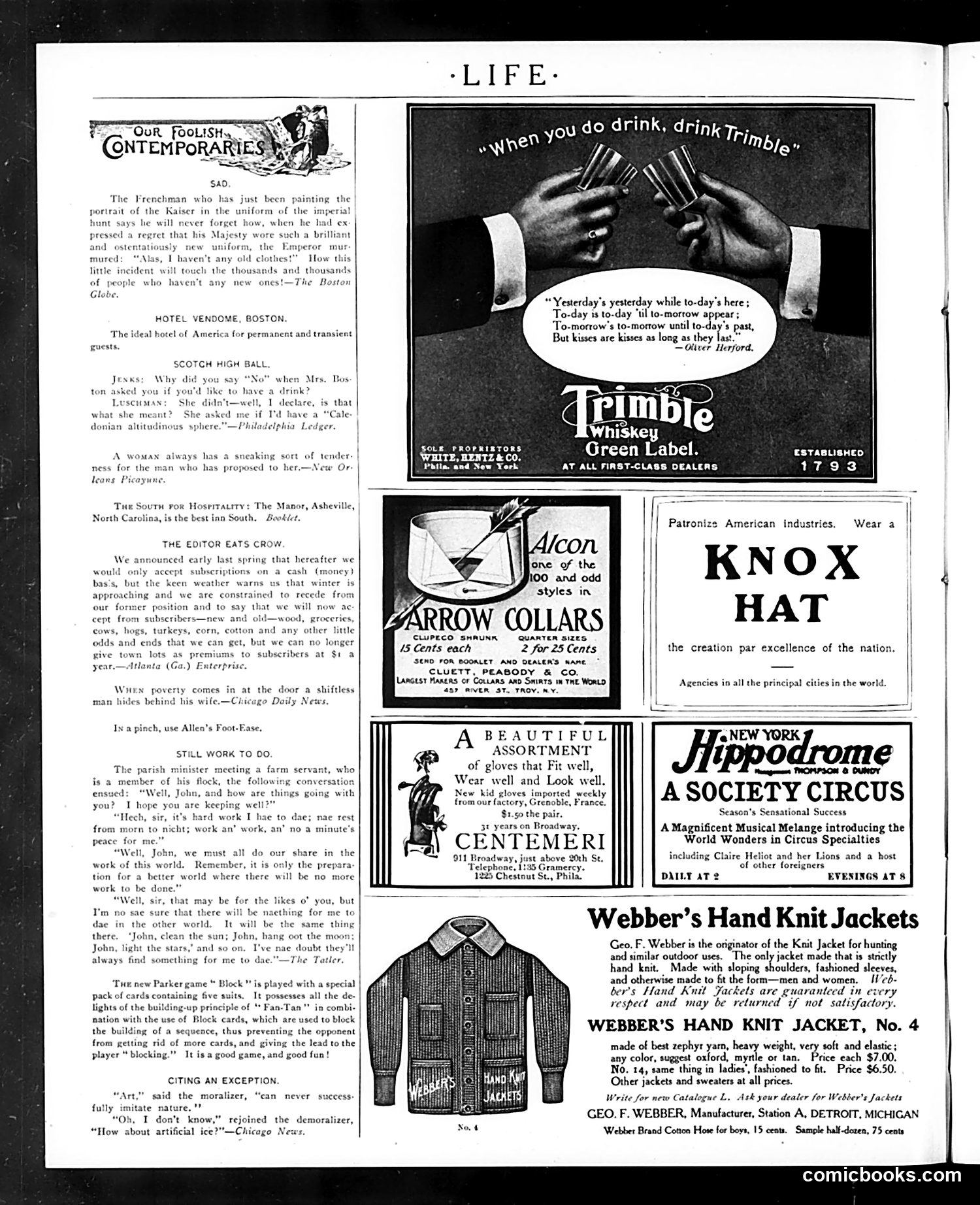
This page is primarily **advertising** interspersed with brief humorous anecdotes in Life's typical satirical style. The main cartoon is a **Trimble Whiskey advertisement** featuring a man in formal dress holding drinks, with a romantic quote about kisses by Oliver Herford. The tagline "When you do drink, drink Trimble" promotes the product. The text snippets are comedic observations on contemporary life: a story about a French painter's portrait of the Kaiser in new imperial uniform (likely referencing pre-WWI tensions), jokes about marriage and poverty, and a parish minister's musings on work and the afterlife—typical turn-of-century American humor emphasizing domestic situations and social pretense. Other advertisements include **Knox Hats**, **Arrow Collars**, **Centemeri gloves**, the **Hippodrome circus**, and **Webber's hand-knit jackets**—reflecting early 1900s consumer goods marketed to middle-class readers. The page serves as a snapshot of Life's mixed content: satirical commentary on class and behavior alongside commercial promotion.
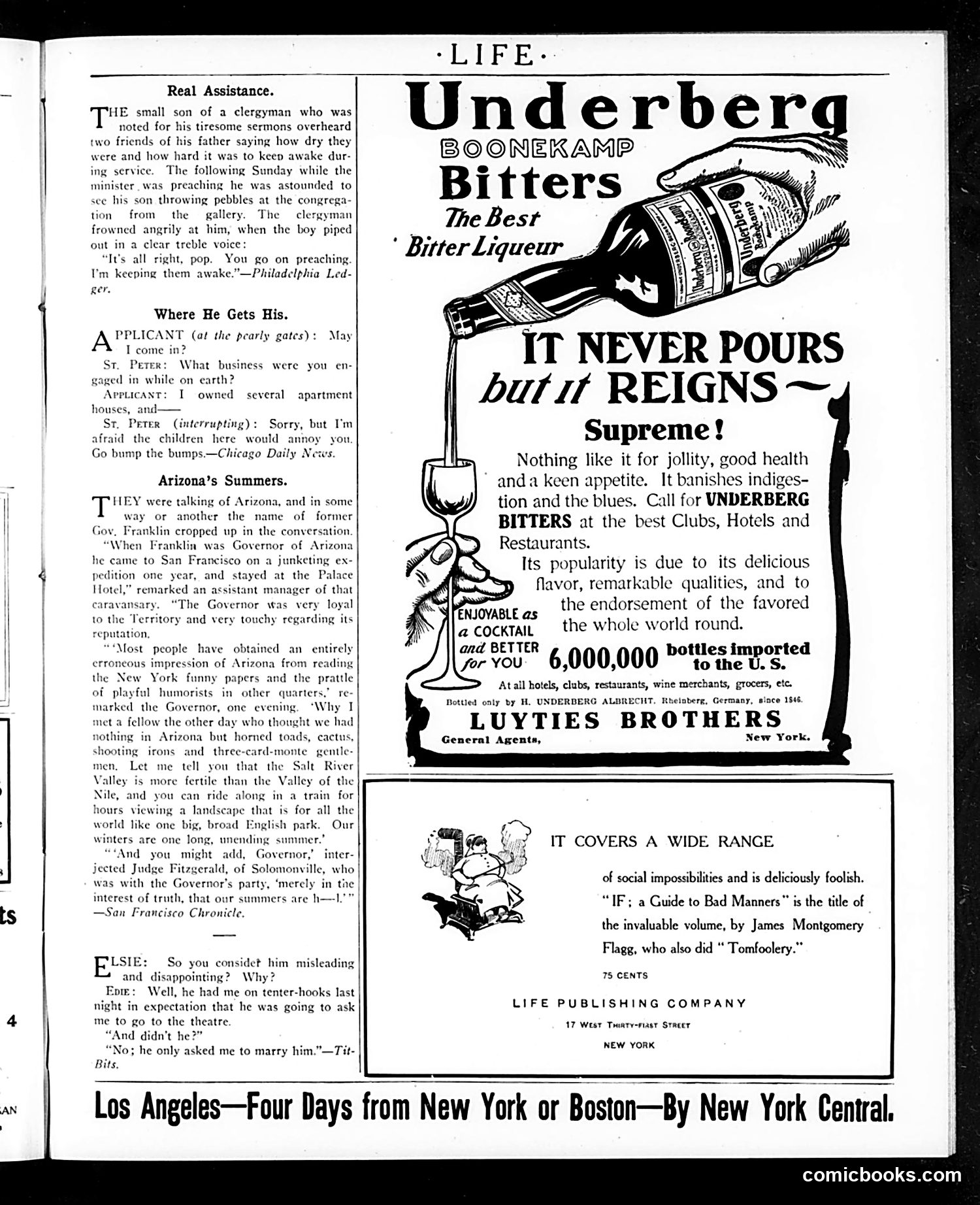
This page contains three short humorous anecdotes plus advertising, typical of Life's early satirical format. **The Cartoons/Jokes:** 1. **"Real Assistance"**: A clergyman's son throws pebbles at sleeping congregants during a boring sermon, claiming he's "keeping them awake." The satire targets tedious religious preaching. 2. **"Where He Gets His"**: A landlord applicant is rejected from heaven because children would annoy him—satirizing how property owners are stereotyped as anti-social. 3. **"Arizona's Summers"**: A former Arizona governor boasts Arizona is fertile and beautiful like an English park, not the desert wasteland depicted in Eastern newspapers. A judge adds that summers are long (implying unbearable heat)—the joke being the governor's promotional speech is undercut by the obvious implication he's actually proving the critics right. **The Advertisement**: The large Underberg Bitters ad dominates the right side, marketing a German digestive liqueur as a cure for indigestion and low spirits.
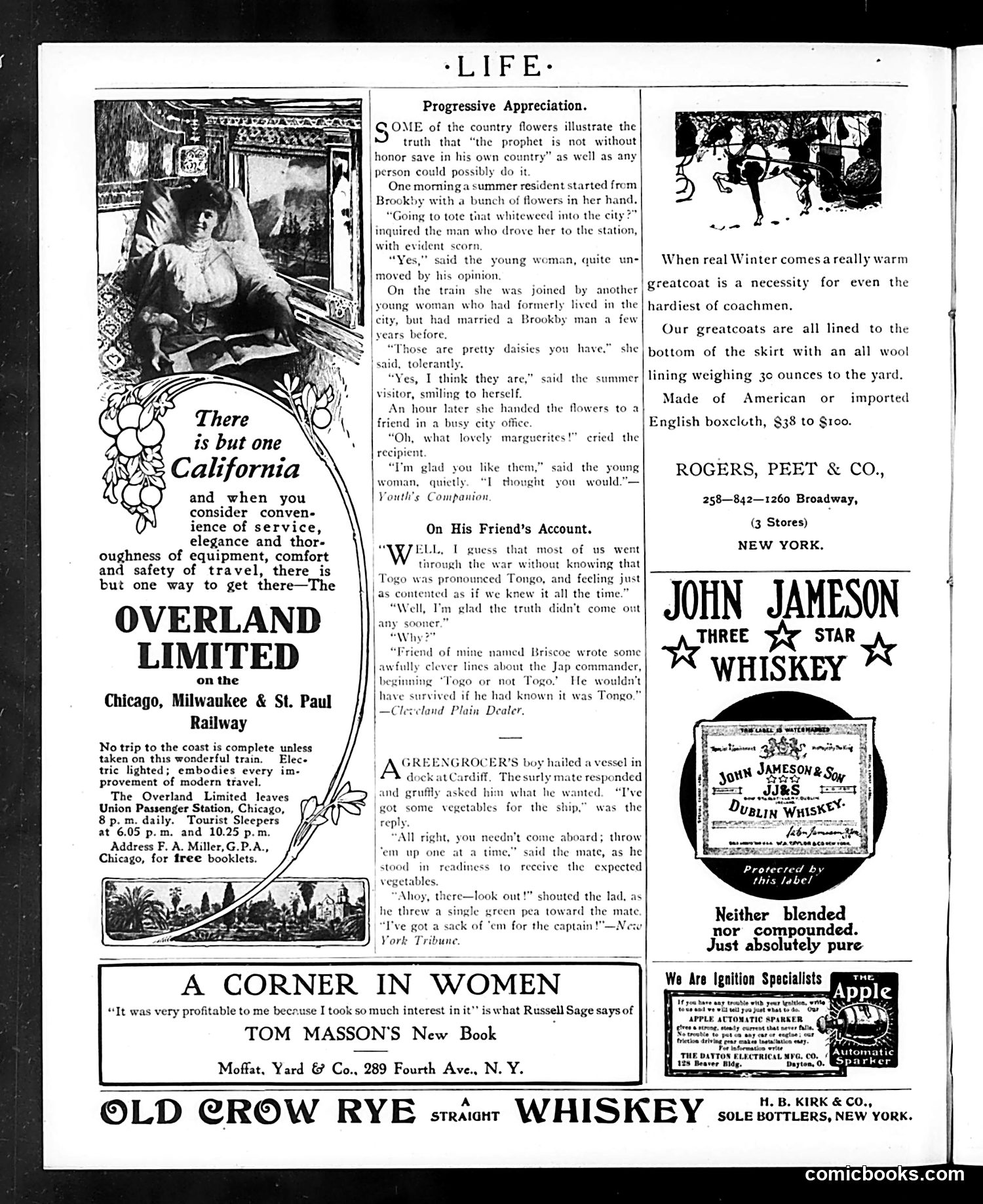
This brief satirical piece mocks city dwellers' condescension toward rural America. A country woman picks wildflowers (called "whiteweed" dismissively by locals) to bring to the city. On the train, a formerly rural woman—now married to a city man—encounters her and patronizingly praises the same flowers as "pretty daisies," then later as "lovely marguerites" when giving them to a city office worker who exclaims over them as exotic "marguerites." The joke: city people find rural wildflowers beautiful only when rebranded with French names and urban context. The rural woman understands this pretension ("I thought you would"), exposing how urban sophistication is merely performative snobbery toward the same humble countryside. The piece satirizes early 20th-century class anxiety and urbanization—specifically how industrial Americans adopted European aesthetics to distance themselves from rural origins they'd recently left.
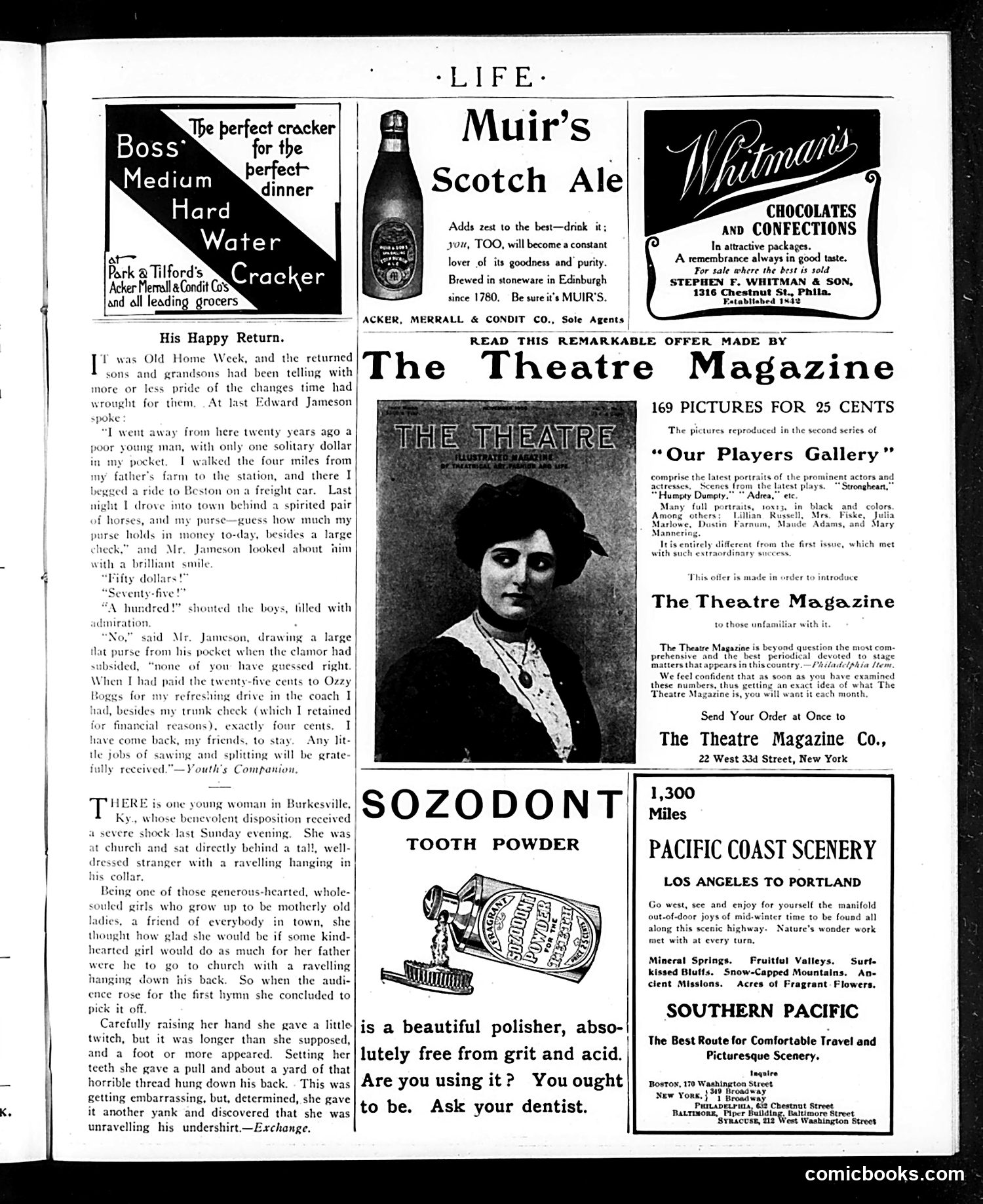
This page contains primarily **advertisements and humorous anecdotes**, not political cartoons. The two featured stories are: 1. **"His Happy Return"**: A joke about a man returning to his hometown after 20 years. He builds suspense about his financial success—initially hinting at substantial wealth—only to reveal he has exactly fifty dollars (having spent twenty-five cents on a coach ride and four cents elsewhere). The humor derives from the deflated expectations. 2. **"Church Etiquette Gone Wrong"**: An anecdote about a well-meaning young woman in Burkesville, Kentucky who attempts to remove a loose thread from a stranger's collar during church, only to discover she's unraveling his entire undershirt. The comedy stems from her increasingly embarrassing predicament and social awkwardness. The remaining content is **commercial advertising** for products (Muir's Scotch Ale, Whitman's Chocolates, Sozodont Tooth Powder) and services (The Theatre Magazine, Southern Pacific railway). There is **no political satire or social commentary** on this particular page.
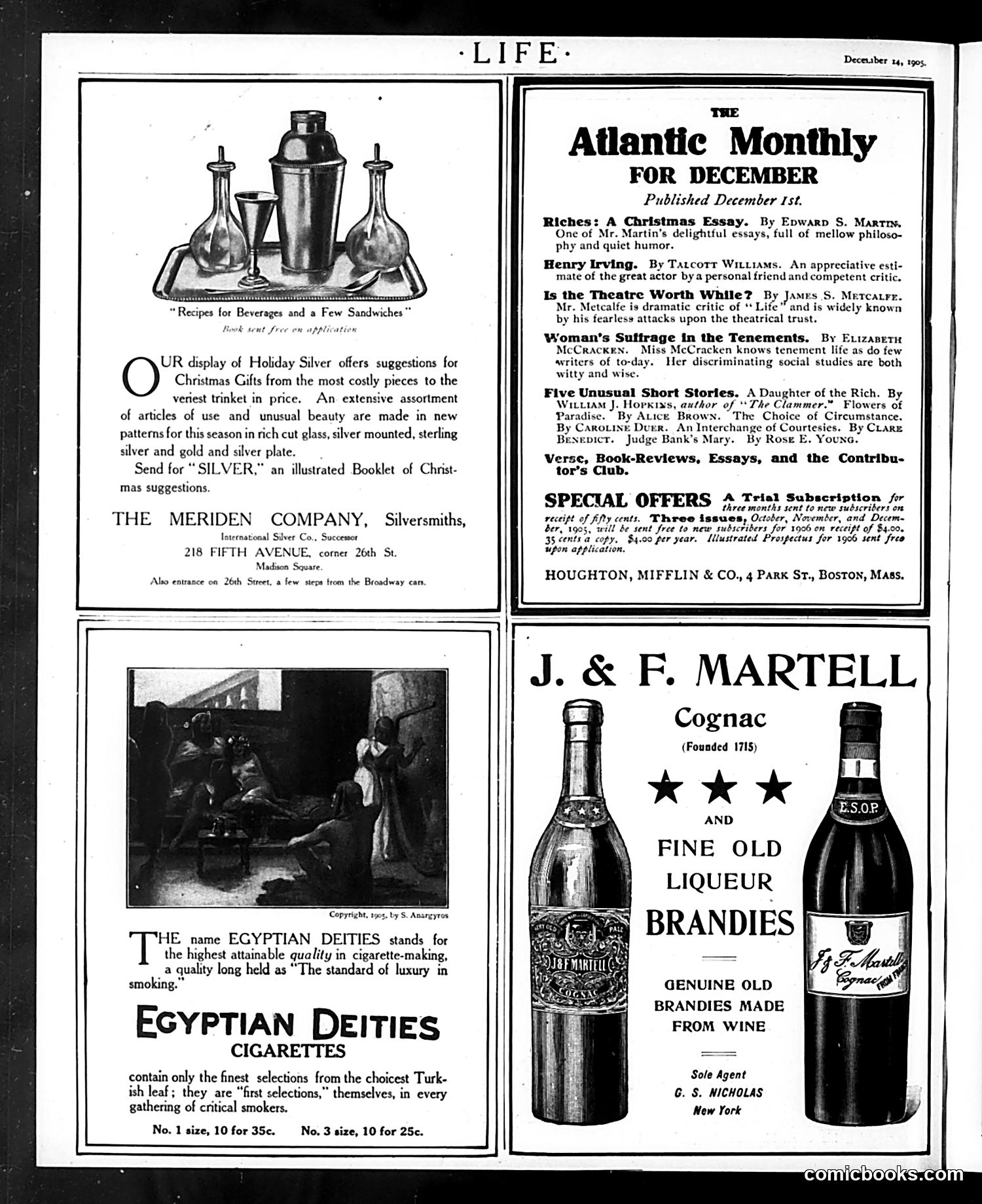
This is primarily an advertising page from *Life* magazine (December 14, 1905), not a political cartoon. The page contains four advertisements and a table of contents for *The Atlantic Monthly*: 1. **The Meriden Company** advertises holiday silverware, offering gift suggestions in various price ranges. 2. **Egyptian Deities Cigarettes** emphasizes luxury tobacco quality, specifically Turkish leaf, sold in two sizes at 35¢ and 25¢ per box. 3. **J. & F. Martell Cognac** promotes fine brandy and liqueur, founded 1715, available through a New York agent. 4. **The Atlantic Monthly** advertises its December issue, featuring essays on wealth, the theater, and women's suffrage in tenements, plus short stories and reviews. The advertisements reflect upper-class consumer goods and leisure pursuits typical of the era—silverware, imported spirits, and literary magazines.