
Life, 1905-12-14 · page 16 of 24
Life — December 14, 1905 — page 16: what you’re looking at
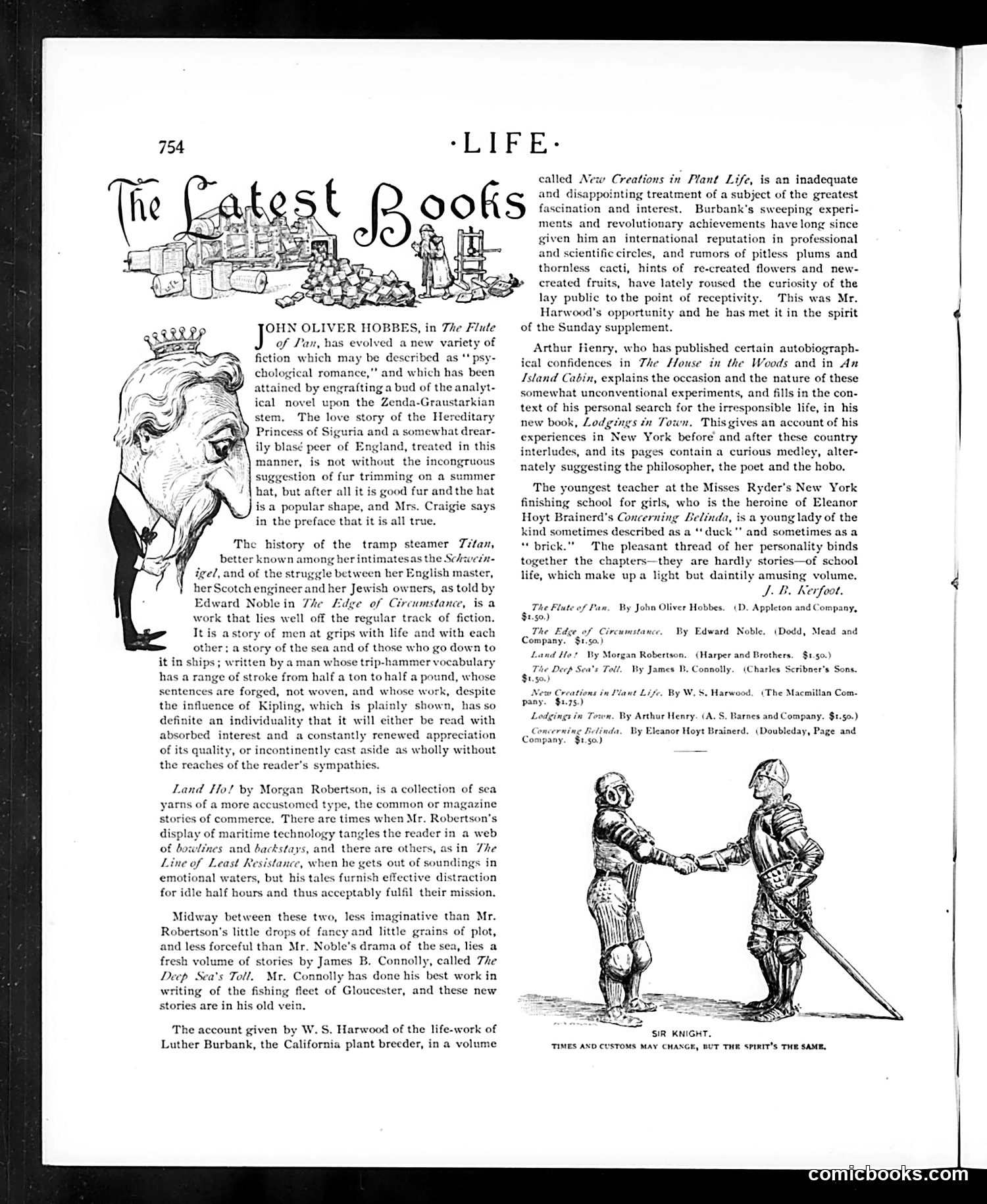
A restored page from Life, 1905-12-14. Page through the whole issue in the reader above.
📄 Transcribed text from this page (OCR, searchable)
Machine-transcribed from the original scan — historical spelling and the odd misread are preserved.
OHN OLIVER HOBBES, in The Flute of Pan, has evolved a new variety of fiction which may be described as “' psy. chological romance,” and which has been attained by engrafting a bud of the analyt- ical novel upon the Zenda-Graustarkian stem, The love story of the H ‘i Princess of Siguria and a so ily blasé peer of England, treated in this manner, is not without the incongruous suggestion of fur trimming on a summer at, but after all it is good fur and the hat is a popular shape, and Mrs. Craigie says in the preface that it is all true. The history of the tramp steamer Trtan, better known among herintimatesas the Schwein- ige/, and of the struggle between her English master, her Scotch engineer and her Jewish owners, as told by Edward Noble in 7he Edge of Circumstance, is a work that lies well off the regular track of fiction. It is astory of men at grips with life and with each other; a story of the sea and of those who go down to it in ships; written by a man whose trip-hammer vocabulary has a range of stroke from half a ton to half a pound, whose sentences are forged, not woven, and whose w despite the influence of Kipling, which is plainly shown, has so definite an individuality that it will either be read w absorbed interest and a constantly renewed appreciation of its quality, or incontinently cast aside as wholly without the reaches of the reader's sympathies. Land Ho! by Morgan Robertson, is a collectior yarns of a more accustomed type, the common or mag: stories of commerce. There are times when Mr. Robertson's display of maritime technology tangles the reader ir of bowlines and backstays, 1 there are others, Line of Least Resistance, when he gets out of soundings in emotional waters, but his tales furnish effective distraction for idle half hours and thus acceptably fulfil their mission. Midway between these two, less imaginative than Mr. Robertson's little drops of f 1 little grains of plot, and less forceful than Mr. Noble's drama of the sea, lies a fresh volume of stories by James B, Connolly, called The Deep Sea's Toll. Mr. Connolly has done his best work in writing of the fishing fleet of Gloucester, and these new stories are in his old vein. The account given by W. Harwood of the life-work of Luther Burbank, the ifornia plant breeder, in a volume w Creations in Plant Life, is an inadequate and disappointing treatment of a subject of the greatest fascination and interest. Burbank's sweeping experi- ments and revolutionary achievements have long since given him an international reputation in professional and scientific circles, and rumors of pitless plums and thornless cacti, hints of re-created flowers and new- created fruits, have lately roused the curiosity of the lay public tothe point of receptivity. This was Mr. Harwood's opportunity and he has met it in the spirit of the Sunday supplement. Arthur Henry s published certain autobiograph- ical confidences ¢ House in the Woods and in An Island Caéin, explains the occasion and the nature of these somewhat unconventional experiments, and fills in the con- text of his personal search for the irresponsible life, in his. new book, Lodgings in Town, gives an account of his experiences in New York before and after these country interludes, and its pages contain a curious medley, alter- nately suggesting the philosopher, the poet and the hobo. ‘The youngest teacher at the Misses Ryder's New York finishing school for girls, who is the heroine of Eleanor Hoyt Brainerd’s Concerning Belinda, is a young lady of the kind sometimes described as a ‘duck " and sometimes as a “brick.” The pleasant thread of her personality binds her the chapters—they are hardly stories—of school , which make upa light but daintily amusing volume. J.B. Kerfoot. (D. Appleton and Company, The Flute of Pan. By John Oliver Hobbes. $2.50.) The Edge of Circumstance. Wy Edward Noble, (Dodd, Mead and Company. $1.50.) Land Ho? My Morgan Robertson. (Harper and Brothers. $1.50.) The Decp Seas Tolt. Vy James i, Connolly. (Charles Scribner's Sons. $1.50.) New Creations in Plant Life, By W,S, Harwood. (The Macmillan Com. pany. $1.75.) Lodgings in Town. By Arthur Henry. (A. S, Barnes and Company. $1.50.) jeanor Hoyt Brainerd. (Doubleday, Page and SIR KNIGHT. TIMES AND CUSTOMS MAY CHANGE, BUT THR SPIRIT’S THE SAME,