
Life, 1905-12-14 · page 14 of 24
Life — December 14, 1905 — page 14: what you’re looking at
What you’re looking at
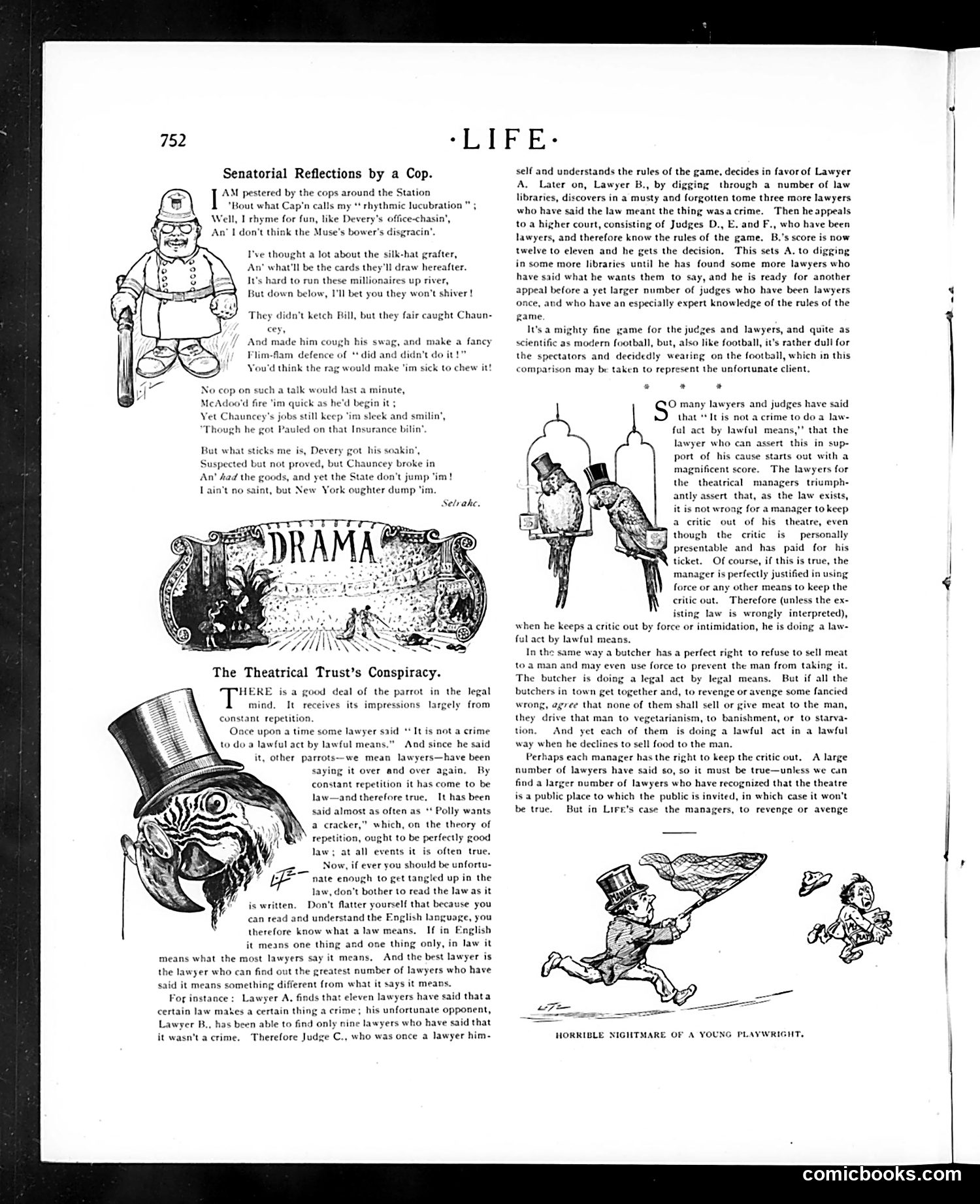
## "Senatorial Reflections by a Cop" A police officer reflects sarcastically on prosecuting wealthy offenders versus the poor. The poem references "Bill" (apparently unprosecuted) and "Chauncey" (caught and forced to confess). The cop criticizes that wealthy "silk-hat grafters" escape justice while poor offenders face conviction—a critique of class-based inequality in law enforcement. ## "The Theatrical Trust's Conspiracy" This satirizes the legal system's absurdity: law's meaning depends not on written text but on how many lawyers have previously interpreted it. The article mocks judges (themselves former lawyers) who decide cases by counting legal precedents rather than reading statutes directly. A joke about two competing lawyers finding contradictory precedents illustrates how "might makes right" in law. The "unfortunate client" is the real victim of this self-serving system designed by and for lawyers and judges protecting their professional interests.
📄 Transcribed text from this page (OCR, searchable)
Machine-transcribed from the original scan — historical spelling and the odd misread are preserved.
Senatorial Reflections by a Cop. ] AM pestered by the cops around the Station "Bout what Cap'n calls my * rhythmic lucubration ” ; Well, I rhym An’ I don't think the Muse's bower's disgracin’, for fun, like Devery’s office-chasin’, I've thought a lot about the silk-hat grafter, A It's hard to run these millionaires up river, But down below, I'll bet you they won't shiver ! what'll be the cards they'll draw hereafter. They didn’t ketch Bill, but they fair caught Chaun- cey, And made him cough bis swag, and make a fancy Flim-flam defence of ** did and didn’t do it!" You'd think the rag would make ‘im sick to chew it! No cop on such a talk would last a minute, MeAdox in it; Yet Chauncey’s jobs still keep ‘i and si got Pauled on that Insurance bilin’ | fire ‘im quick as he'd be; Though he But what sticks me is, Devery got his soakin’ Suspected but not proved, but Chauncey broke in An’ had the goods, and yet the State don't jump Lain’t no saint, but New York oughter dump ‘im. n! Selrahe. The Theatrical Trust’s Conspiracy. T" ZRE is a good deal of the parrot in the legal mir nd. It receives its impressions largely from constant repetition. Once upon a time some lawyer said “It is not a crime to do a lawful act by lawful means.” And since he said it, other parrots—we mean lawyers—have been saying it over and over again. By constant repetition it has come to be law—and therefore true, It has been said almost as often as * Polly wants a cracker,” which, on the theory of repetition, ought to be perfectly good law; at all events it is often true. r Now, if ever you should be unfortu- ae nate enough to get tangled up in the law, don’t bother to read the law as it is written. Don’t flatter yourself that because you can read and understand the English language, you therefore know what a law means, If in English it means one thing and one thing only, in law it means what the most lawyers say it means, And the best lawyer is the lawyer who can find out the greatest number of lawyers who have said it means something different {rom what it says it means. For instance: Lawyer A, finds that eleven lawyers have said thata certain law makes a certain thing a crime; his unfortunate opponent, Lawyer B., has been able to find only nine lawyers who have said that Therefore Judge C., who was once a lawyer him- it wasn't a crime. *-LIFE: self and understands the rules of the game, decides in favor of Lawyer A. Later on, Lawyer B., by digging through a number of law libraries, discovers in a musty and forgotten tome three more lawyers who have said the law meant the thing wasa crime. Then he appeals toa higher court, consisting of Judges D., E. and F., who have been lawyers, and therefore know the rules of the game. B.’s score is now twelve to eleven and he gets the decision. This sets A. to digging in some more libraries until he has found some more lawyers who have said what he wants them to say, and he is ready for another appeal before a yet larger number of judges who have been lawyers once, and who have an especially expert knowledge of the rules of the game. It'sa mighty fine game for the judges and lawyers, and quite as scientific as modern football, but, also like football, it’s rather dull for the spectators and decidedly wearing on the football, which in this on may be taken to represent the unfortunate client. compatis * * * O many lawyers and judges have said that “It is not a crime to do a law. ful act by lawful means," that the lawyer who can assert this in sup- port of his cause starts out with a magnificent score. The lawyers for the theatrical managers. triumph- antly assert that, as the law exists, it is not wrong for a manager to keep a critic out of his theatre, even though the critic is — personally presentable and has paid for his ticket. Of course, if this is true, the manager is perfectly justified in using force or any other means to keep the critic out. Therefore (unless the ex- isting law is wrongly interpreted), when he keeps a critic out by force or intimidation, he is do’ ful act by lawful means. ga law. In the same way a butcher has a perfect right to refuse to sell meat toa man and may even use force to prevent the man from taking it. al act by legal means, But if all the butchers in town get together and, to revenge or avenge some fancied The butcher is doing ak wrong, agree that none of them shall sell or give meat to the man, they drive that man to vegetarianism, to banishment, or to starva- tion. And yet each of them is doing a lawful act in a lawful way when he declines to sell food to the man, Perhaps each manager has the right to keep the critic out. A large number of lawyers have said $0, so it must be true—unless we can find a larger number of lawyers who have recognized that the theatre isa public place to which the public is invited, in which case it won't be true. But in Lire’s case the managers, to revenge or avenge HORRIBLE NIGHTMARE OF A YOUNG PLAYWRIGHT, comicbooks.com