
Life, 1905-12-14 · page 15 of 24
Life — December 14, 1905 — page 15: what you’re looking at
What you’re looking at
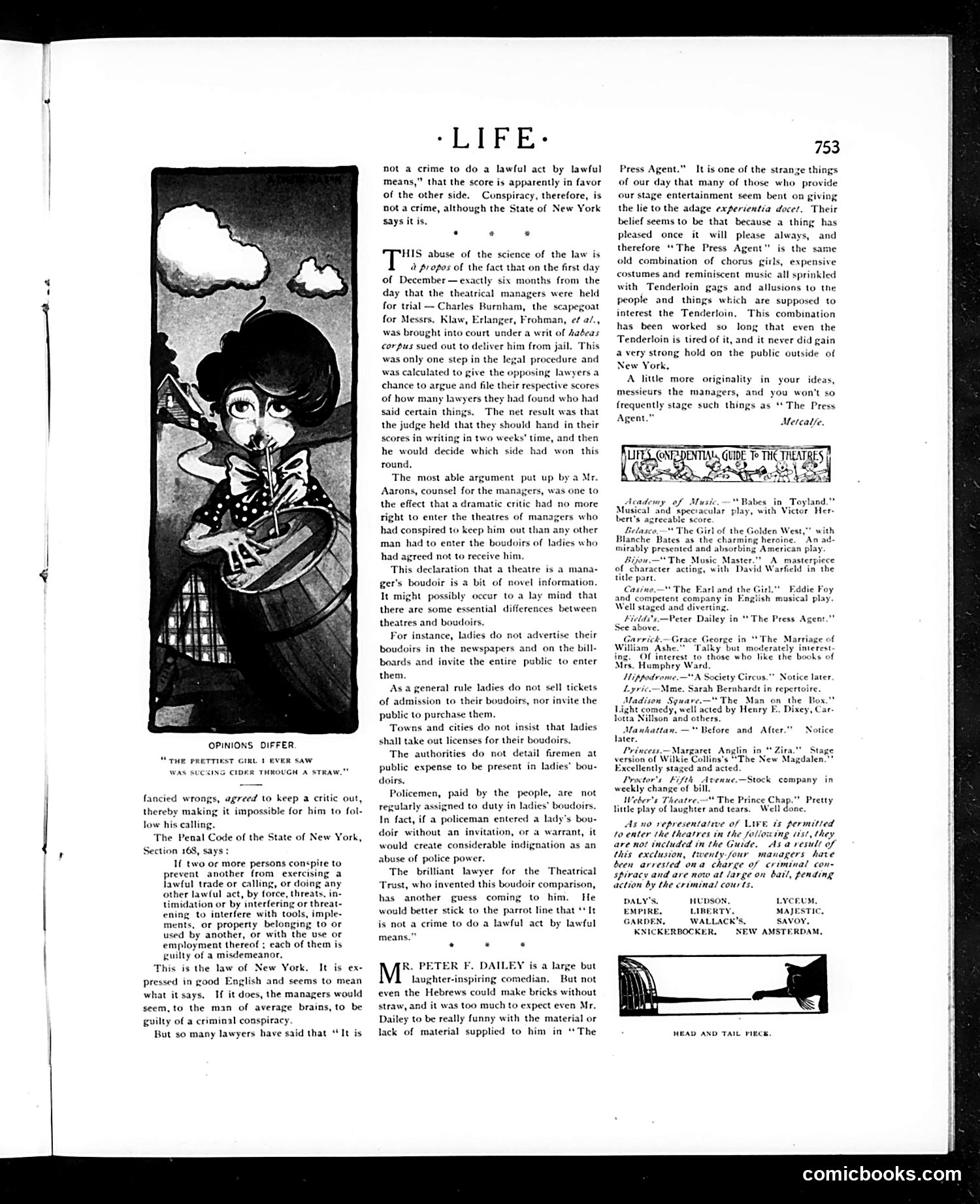
This page discusses a **real legal dispute between theater critics and the Theatrical Trust** (a monopoly controlling major theaters). The cartoon labeled "OPINIONS DIFFER" satirizes the absurdity of the managers' legal arguments. **The Context:** Theater managers Klaw, Erlanger, and Frohman conspired to exclude a critic from their theaters. Their lawyer argued a theater is like a lady's private "boudoir"—a private space they can restrict entry to. Life ridicules this comparison by listing obvious differences: theaters advertise publicly, sell tickets, require licenses, have police protection. A boudoir is genuinely private; a theater is a public business. **The Satire's Point:** The managers use technically clever legal arguments ("it's not a crime to do lawful acts by lawful means") to evade conspiracy charges. Life mocks how lawyers twist language to serve power while ignoring common sense—the real issue is whether public businesses can collude to silence critics. The illustration shows a fashionable woman, likely representing the "boudoir" comparison being ridiculed.
📄 Transcribed text from this page (OCR, searchable)
Machine-transcribed from the original scan — historical spelling and the odd misread are preserved.
cram it i <a ® = “THE PRETTIEST GIRL 1 EVER SAW CIDER THROUGH A STRAW.” OPINIONS DIFFER WAS SUCXIN. fancied wrongs, agreed to keep a critic out, thereby making it impossible for him to fol- low his calling. The Penal Code of the State of New York, Section 168, says : If two of more persons conspire to prevent another from exercising a lawful trade or calling, or doing any other law(ul act, by force, threats, in- timidation or by interfering or threat- ening to interfere with tools, imple- ments, or property belonging to or used by another, or with the use or employment thereof ; each of them is guilty of a misdemeanor, This is the law of New York. It is ex- pressed in good English and seems to mean what it says, If it does, the managers would seem, to the man of average brains, to be guilty of a criminal conspiracy But so many lawyers have said that “It is -LIFE- not a crime to do a lawful act by lawful means,” that the score is apparently in favor of the other side. Conspiracy, therefore, is not a crime, although the State of New York says itis. . * * HIS abuse of the science of the law is 4 propos of the fact that on the first day of December —exactly six months from the day that the theatrical managers were held for trial — Charles Burnham, the scapegoat for Messrs, Klaw, Erlanger, Frohman, ef a/., was brought into court under a writ of habeas corpus sued out to deliver him from jail. This was only one step in the legal procedure and was calculated to give the opposing lawyers a chance to argue and file their respective scores of how many lawyers they had found who had said certain things. The net result was that the judge held that they should hand in their scores in writing in two weeks’ time, and then he would decide which side had won this round. The most able argument put up by a Mr. Aarons, counsel for the managers, was one to the effect that a dramatic critic had no more right to enter the theatres of managers who had conspired to keep him out than any other man had to enter the boudoirs of ladies who had agreed not to receive him This declaration that a theatre is a mana- get's boudoir is a bit of novel information. It might possibly occur to a lay mind that there are some essential differences between theatres and boudoirs. es do not advertise their For instance, lad boudoirs in the newspapers and on the bill- boards and invite the entire public to enter them. Asa general rule ladies do not sell tickets of admission to their boudoirs, nor invite the public to purchase them. Towns and cities do not insist that ladies shall take out licenses for their boudoirs. The authorities do not detail firemen at public expense to be present in ladies’ bou- doirs Policemen, paid by the people, are not regularly assigned to duty in ladies’ boudoirs. In fact, if a policeman entered a lady's bou- doir without an invitation, or a warrant, it would create considerable indignation as an abuse of police power. The brilliant lawyer for the Theatrical Trust, who invented this boudoir comparison, has another guess coming to him. He would better stick to the parrot line that ‘It is not a crime to do a lawful act by lawful means, R. PETER F. DAILEY is a large M laughter-inspiring comedian. But not even the Hebrews could make bricks without straw, and it was too much to expect even Mr. Dailey to be really funny with the material or lack of material supplied to him in “The 753 Press Agent.” It is one of the strange things of our day that many of those who provide our stage entertainment seem bent on giving the lie to the adage experientia docet. Their belief seems to be that because a thing has pleased once it will please always, and therefore “The Press Agent” is the same old combination of chorus girls, expensive costumes and reminiscent music all sprinkled with Tenderloin gags and allusions to the people and things which are supposed to interest the Tenderloin, This combination has been worked so long that even the Tenderloin is tired of it, and it never did gain a very strong hold on the public outside of New York, A little more originality in your ideas, messieurs the managers, and you won't so frequently stage such things as * The Press Agent.” Metcalfe. f (Co eee To THE JTRS i Neha “Babes in, Toyland.” and speciacular play, with Victor Her- bert’s agreeable score Belasco." The Girl of the Golden West,"* with Blanche Bates as the charming heroine. ‘An ad- rably presented and absorbing American play The Music Master." A masterpiece with David Warfield in the and the G Eddie Foy ish’ musical pl Fietds's.—Peter Dailey in The Press Agent See above. Garrick —( William’ Ashe.” ing. Of interest Mrs. Humphry Ward. Hippodrome.—*A Society Circus.” Notice later, Lyric.—Mme. Sarah Bernhardt in repert Madison Square.—" The Man on the Box.” Light comedy, well acted by Henry F. Dixey, Car- lotta Nillson and others. Manhattan, —"* Before and After.” Notice later. Princess Margaret Anglio in **Zira.” Stage version of Wilkie Collins's “The New Magdalen.” Excellently staged and acted. Protor’s Fifth Avenue.—Stock company in weekly change of bill, Weber's Theatre.—"* The Prince Chap.” Pretty little play of laughter and tears. Well done. “The Marriage of Talky but moderately imerest 10 those who like the books of As no representative of Live ts permitted to enter the theatres in the following list, they are not included in the Guide, AS a resull of this exclusion, ttenty jour managers have been arrested ona charge of criminal con~ spiracy and are now at large on batl, pending action by the criminal courts, DALY'S. HeUpson, LYCEUM, EMPIRE, LIBERTY. MAJESTIC. WALLAC! SAVOY. NEW AMSTERDAM, MEAD AND TAIL PIECE. comicbooks.com