
Life, 1905-12-14 · page 6 of 24
Life — December 14, 1905 — page 6: what you’re looking at
What you’re looking at
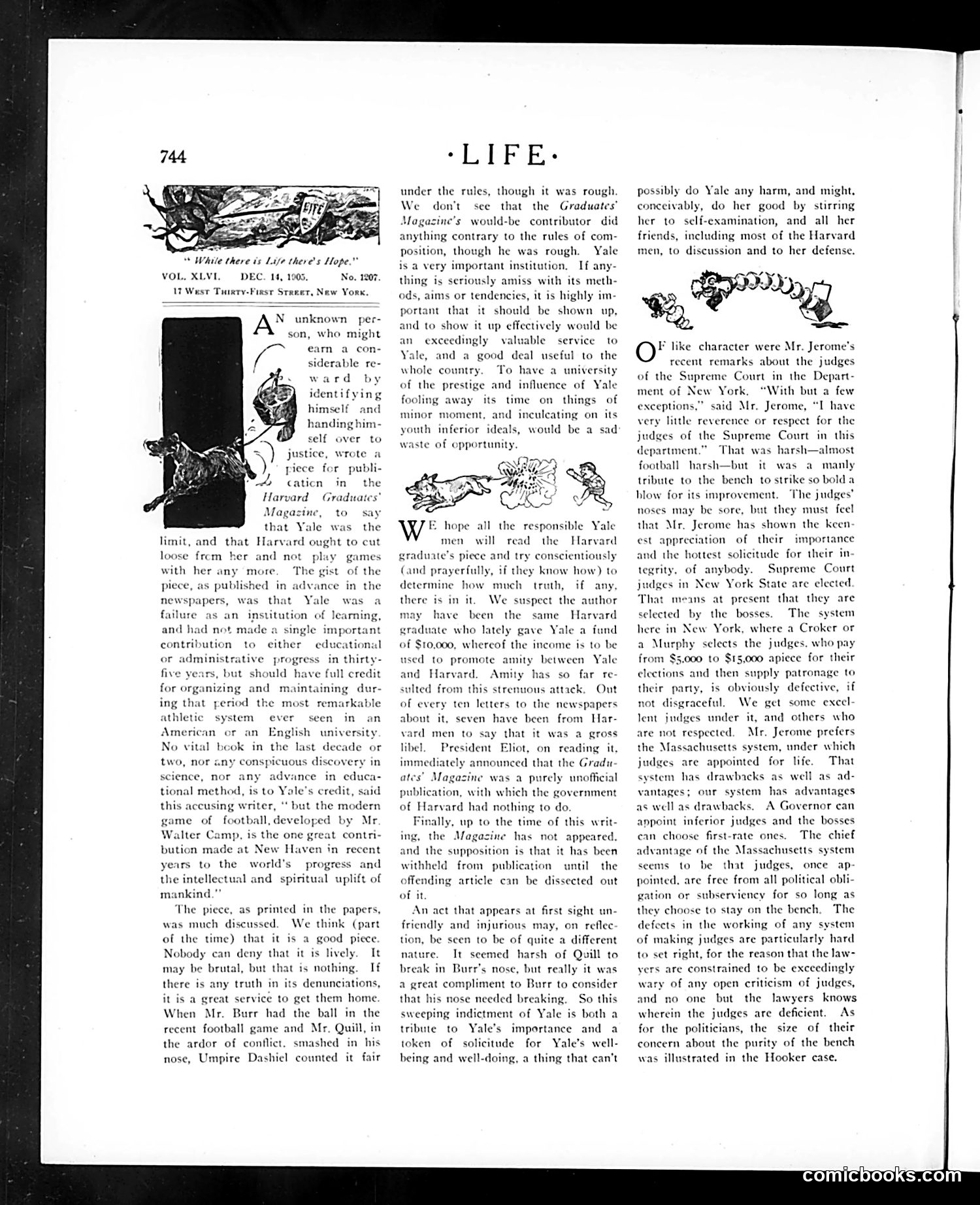
This page contains editorial commentary about **Harvard University and Yale University**, focusing on a controversy involving the *Harvard Graduates' Magazine*. The central issue concerns an article critical of Yale that appeared in the magazine. The editors argue that while Yale's methods may be rough, Harvard's response violated professional standards. They defend Yale as "a very important institution" and suggest that publicly attacking it serves no constructive purpose. The piece also criticizes **Mr. Jerome's recent remarks about New York State Supreme Court judges**, calling his comments disrespectful. The editors argue that judges deserve respect regardless of appointment method. The page primarily features **political/institutional satire** rather than visual cartoons, critiquing elite university relations and judicial accountability through argumentative text with decorative illustrations.
📄 Transcribed text from this page (OCR, searchable)
Machine-transcribed from the original scan — historical spelling and the odd misread are preserved.
“ While there is Life there's Hope.” VOL. XLVI. DEC. 14, 1905. No, 120; 17 West Tiiety-Fiesr Street, New Yore. unknown per- son, who might eam a con- siderable re- ward by identifying himself and handing him- self over to justice, wrote a piece for publi- 6 caticn in thi Harvard Gi Magazine, ) that Yale was the limit, and that Harvard oug’ loose frem her and not with her any more play games The gist of the piece, as published in advance in the that Yale was 1s an institution of learning, newspapers, failure was and had not made a single important contribution to either educational or administrative progress in thirty- five years, but should have full credit for organizing and maintaining du ing that period the most remarkable athletic system ever American or an No vital book two, nor any conspicuous discovery in seen in an English university in the last decade or enee, nor any advance in educa- tional method, is to Yale's credit, said this accusing writer, “ but the modern game of football,developed by Mr Walter Camp, is the one great contri- bution made at New Haven in recent years to the world's progress and the intellectual and spiritual uplift of mankind The piece, as printed in the papers, was much discussed. We think (part of the time) that it is a good piece. Nobody can deny that it is lively. It may be brutal, but that is nothing. If there is any truth in its denunciations, it is a great service to get them home. When Mr. Burr had the ball in the recent football game and Mr. Quill, in the ardor of conflict. smashed in his nose, Umpire Dashiel counted it fair ‘LIFE: under the rules, though it was rough. We don't see that the Graduates’ Magazine’s would-be contributor did anything contrary to the rules of com- position, though he was rough. Yale is a very important institution, If any- thing is seriously amiss with its meth- ods, aims or tendencies, it is highly im- portant that it should be shown up, and to show it up effectively would be edingly valuable service to Yale, and a good deal useful to the whole country ne To have a university of the prestige and influence of Yale things of minor moment, and inculcating on its youth inferior ideals, would be a sad fooling away its time on waste of opportunity. hope all the responsible Yale men will read the Harvard graduate’s piece and try conscientiously (and prayerfully, if they know how) to determine how much truth, if any, We suspect the author been the Harvard graduate who lately gave Yale a fund of $10,000, whereof the income is to be there is in it may have same used between Yale and Amity has so. far re- sulted from this strenuous attack, Out to prom Harvard. © amity of every ten letters to the newspapers Har- gross it, seven have been from vard men to say that it was a libel. President Eliot, on reading it. immediately announced that the Gradu ates’ Magazine w purely unofficial publication, with which the government of Harvard had nothing to do. Finally, up to the time of this writ- ing, the Magazine has not appeared. and the supposition is that it has been withheld from publication until the offending article can be dissected out of it. An act that appears at first sight un- friendly and injurious may, on reflec tion, be seen to be of quite a different nature. It seemed harsh of Quill to k in Burr's nose, but really it was a great compliment to Burr to consider that his nose needed breaking. So this sweeping indictment of Yale is both a tribute to Yale’s importance and a token of solicitude for Yale’s well- being and well-doing, a thing that can’t about possibly do Yale any harm, and might, conceivably, do her good by. stirring her to. self-examination, and all her friends, including most of the Harvard men, to discussion and to her defense. ou like character were Mr. Jerome's recent remarks about the judges of the Supreme Court in the Depart- ment of New York, “With but a few exceptions,” said Mr. Jerome, “I have very little reverence or respect for the judges of the Supreme Court in this department.” That was harsh—almost football harsh—but it was a manly tribute to the bench to strike so bold a The judges’ noses may be sore, but they must feel that Mr, Jerome has shown the keen est appreciation of their importance and the hottest solicitude for their in. tegrity, of anybody. Supreme Court udges in New York State are elected. That means at present that they are selected by the bosses. The system here in New York, where a Croker or a Murphy selects the judges. who pay from $3,000 to $15,000 apiece for their elections and then supply patronage to their party, is obviously defective, if not disgraceful. We get some excel lent judges under it, and others who are not respected. Mr, Jerome prefers the Massachusetts system, under which judges are appointed for life. That system has drawbacks as well as ad- blow for its improvement. vantages; our system has advantages as well as drawbacks. A Governor can appoint inferior judges and the bosses can choose first-rate ones. The chief advantage of the Massachusetts system seems to be that judges, once ap- pointed, are free from all political obli- gation or subserviency for so long as they choose to stay on the bench, The defects in the working of any system of making judges are particularly hard to set right, for the reason that the law- yers are constrained to be exceedingly wary of any open criticism of judges, and no one but the lawyers knows wherein the judges are deficient. As for the politicians, the size of their concern about the purity of the bench was illustrated in the Hooker case.