
A complete issue · 26 pages · 1905
Life — July 13, 1905
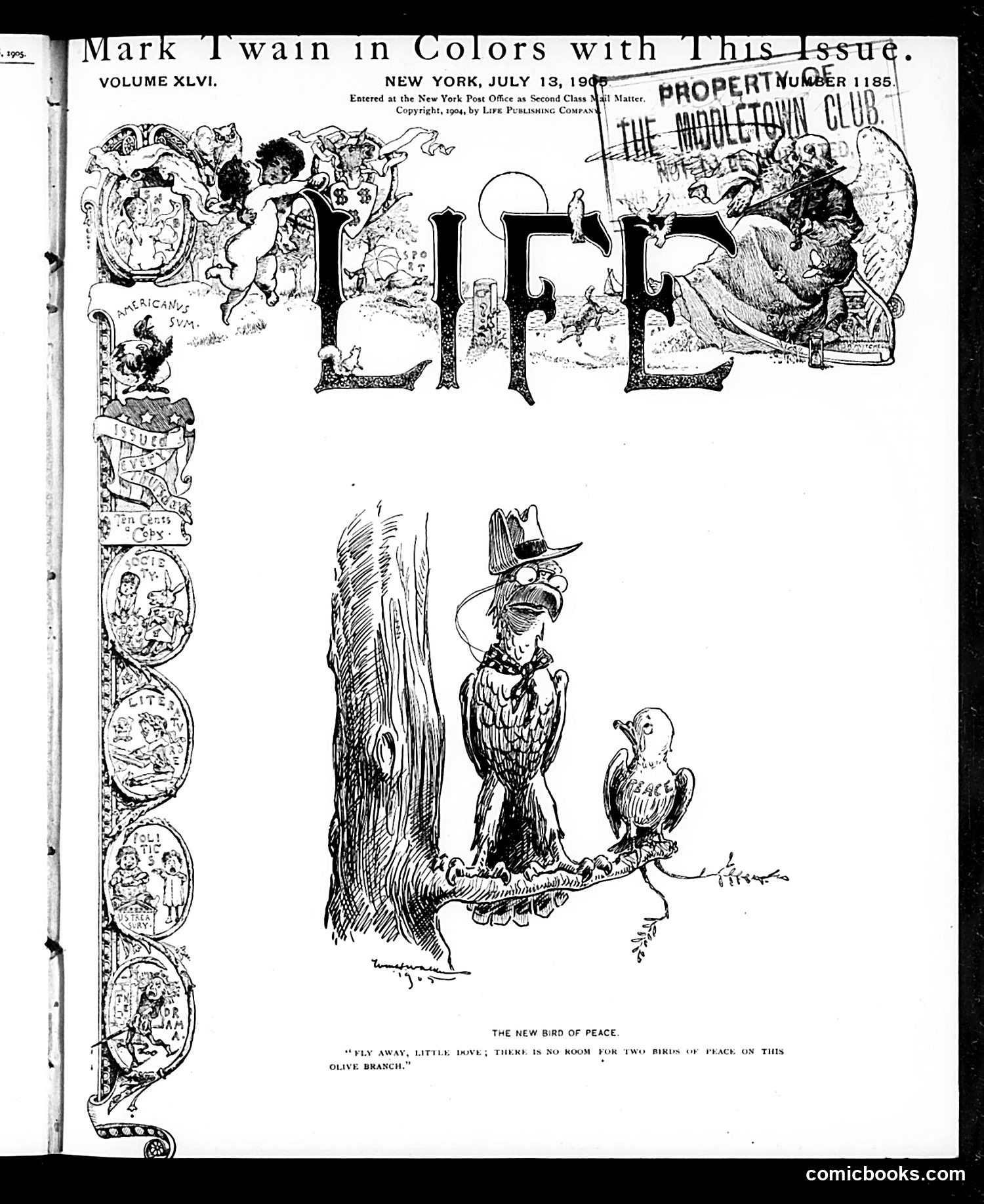
This 1906 *Life* magazine cartoon satirizes peace efforts through an anthropomorphic bird allegory. The illustration shows a large bird wearing a formal hat perched on an olive branch, with a smaller bird beside it. The caption reads: "Fly away, little love; there is no room for two birds of peace on this olive branch." The cartoon appears to mock the difficulty of achieving lasting peace, suggesting that peaceful coexistence is inherently unstable or impossible—two parties cannot peacefully share the same space. This likely references contemporary diplomatic tensions or failed peace negotiations of the Edwardian era, though the specific historical event is unclear from the image alone. The ornate decorative border contains classical vignettes typical of *Life's* design.
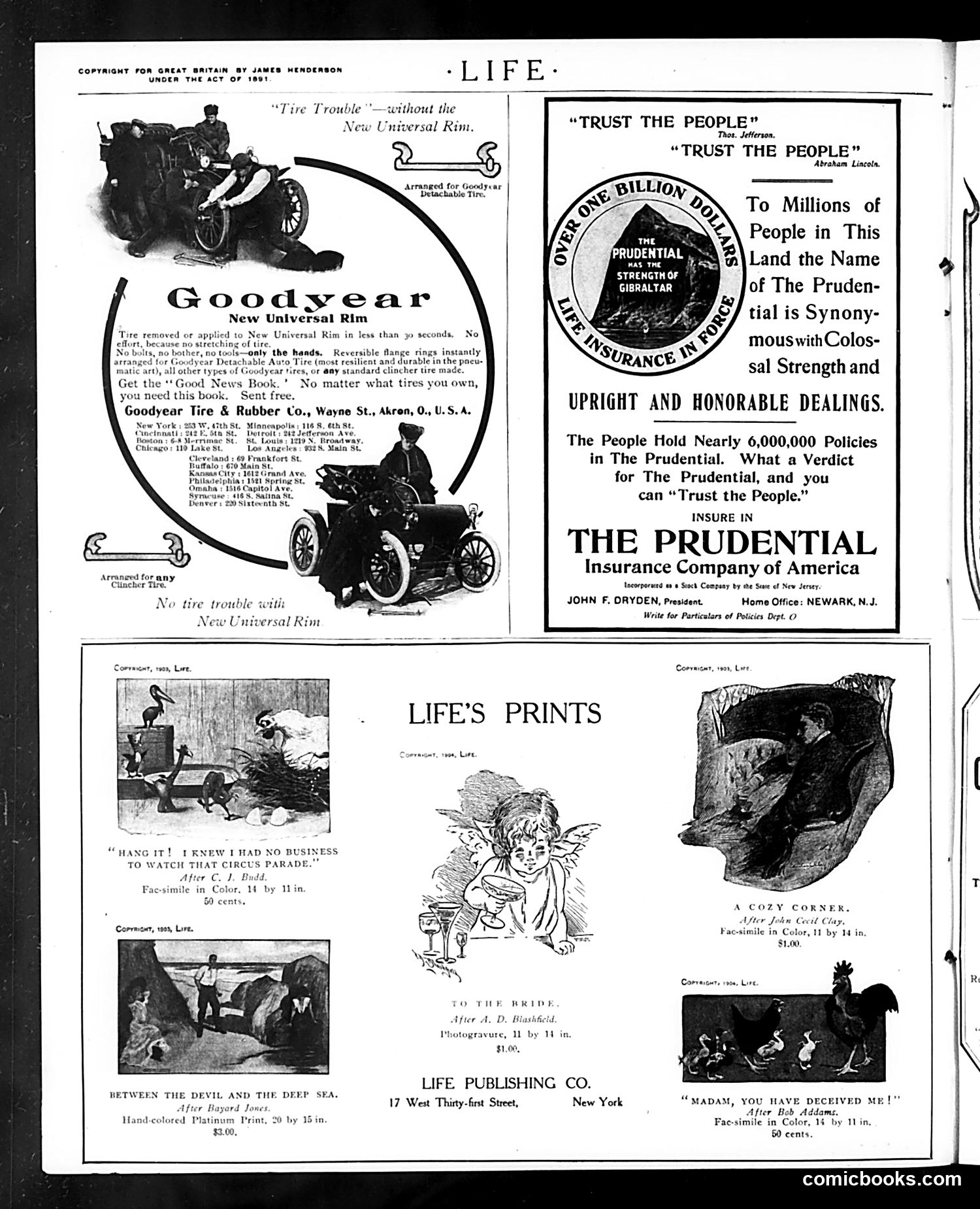
This page is primarily **advertising rather than political satire**. The top left features a **Goodyear tire advertisement** showing early automobiles with claims of "no tire trouble" using their "New Universal Rim." The right side contains a **Prudential Insurance advertisement** emphasizing "Trust the People," citing 6 million policyholders and quoting Thomas Jefferson and Abraham Lincoln about trusting citizens. The bottom section, "Life's Prints," showcases **decorative artwork and illustrations** available for purchase from Life Publishing Co., including works after various artists featuring domestic scenes and children—typical of early 20th-century commercial art reproduction. The page reflects the magazine's business model: combining light editorial content with paid advertisements and merchandise sales to readers.
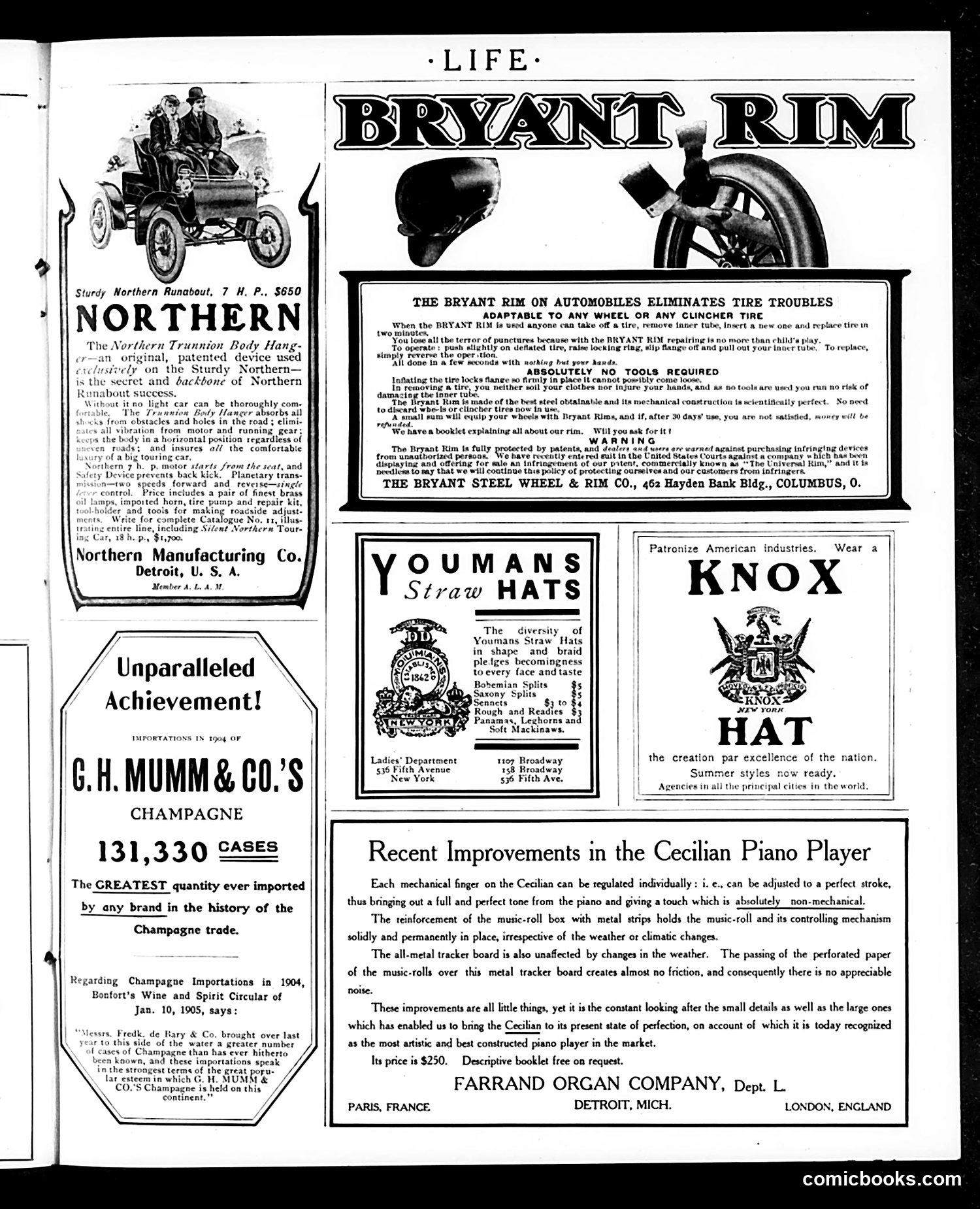
This page is **primarily advertising**, not satirical content. It contains five commercial advertisements from the early 1900s: 1. **Northern automobile** - promoting a runabout with innovative body design 2. **Bryant Rim** - automobile tire repair product claiming "absolutely no tools required" 3. **G.H. Mumm & Co.'s Champagne** - boasting record importation quantities in 1904 4. **Youmans Straw Hats** - ladies' department advertisement 5. **Knox Hat** - promoting American-made hats as patriotic choice 6. **Cecilian Piano Player** - mechanical piano improvements The ads reflect early 20th-century consumer culture, emphasizing technological innovation (automobiles, mechanical pianos) and aspirational goods (champagne, quality hats). There is no political cartoon or satire visible on this page—it's a straightforward commercial product showcase typical of Life magazine's revenue model.
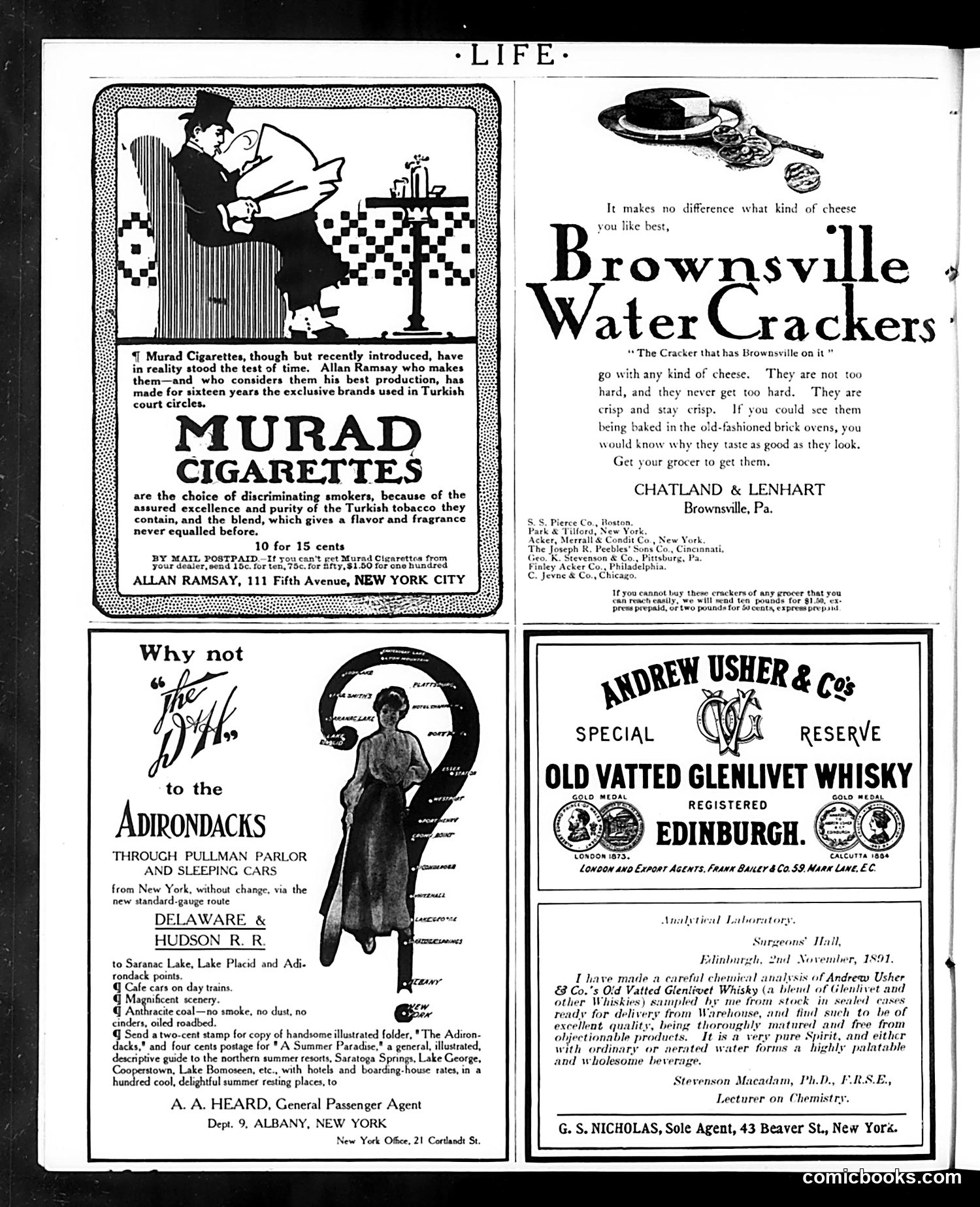
This page is primarily **advertising**, not satire or political commentary. It contains four distinct advertisements from the early 1900s: 1. **Murad Cigarettes** - promotes Turkish tobacco, featuring a man smoking 2. **Brownsville Water Crackers** - highlights a food product's versatility with cheese 3. **Delaware & Hudson Railroad** - advertises travel to the Adirondacks via Pullman cars 4. **Andrew Usher & Co's Whisky** - promotes Scottish "Old Vatted Glenlivet" with analytical certification The page reflects period consumer culture: luxury imports (Turkish cigarettes, Scottish whisky), leisure travel to mountain resorts, and packaged foods. No political cartoon or satire is evident. The content demonstrates what Life magazine's advertising market looked like—targeting affluent readers interested in quality goods and tourism.
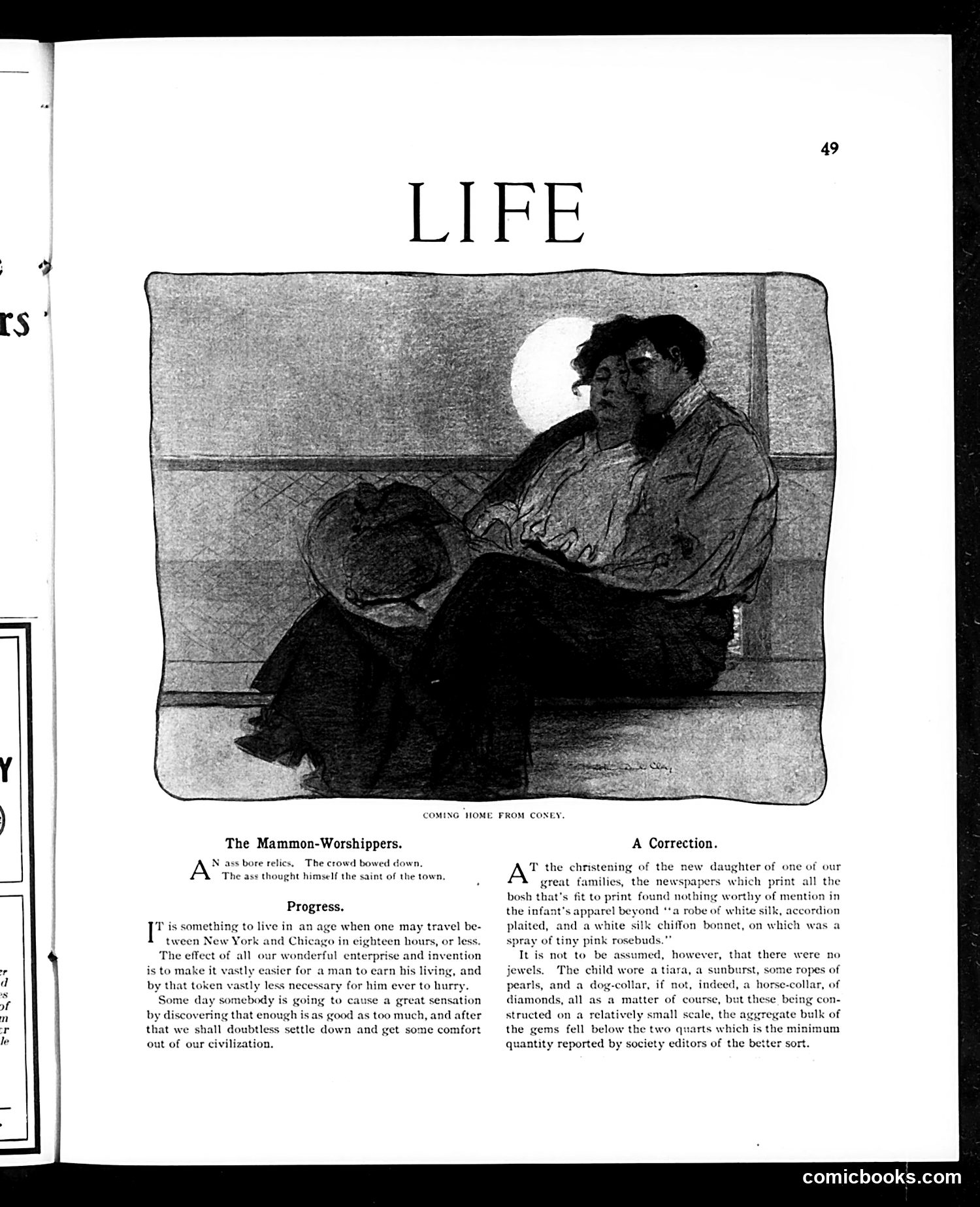
The main illustration shows two figures sitting on a bench beneath a full moon, captioned "Coming Home from Coney" (Coney Island, a popular seaside amusement area). **"The Mammon-Worshippers"** appears to be satirizing materialism and social pretense, suggesting the crowd at Coney Island values worldly goods over spiritual matters. **"A Correction"** is a brief editorial note addressing a christening announcement for a wealthy family's daughter. The piece sarcastically catalogs the infant's supposedly luxurious possessions (silks, jewels, pearls, dog-collar) while noting the actual reported value fell far below what society editors typically exaggerate in such announcements—a direct jab at both wealthy excess and media dishonesty in covering high society. The satire critiques both materialism and press sensationalism.
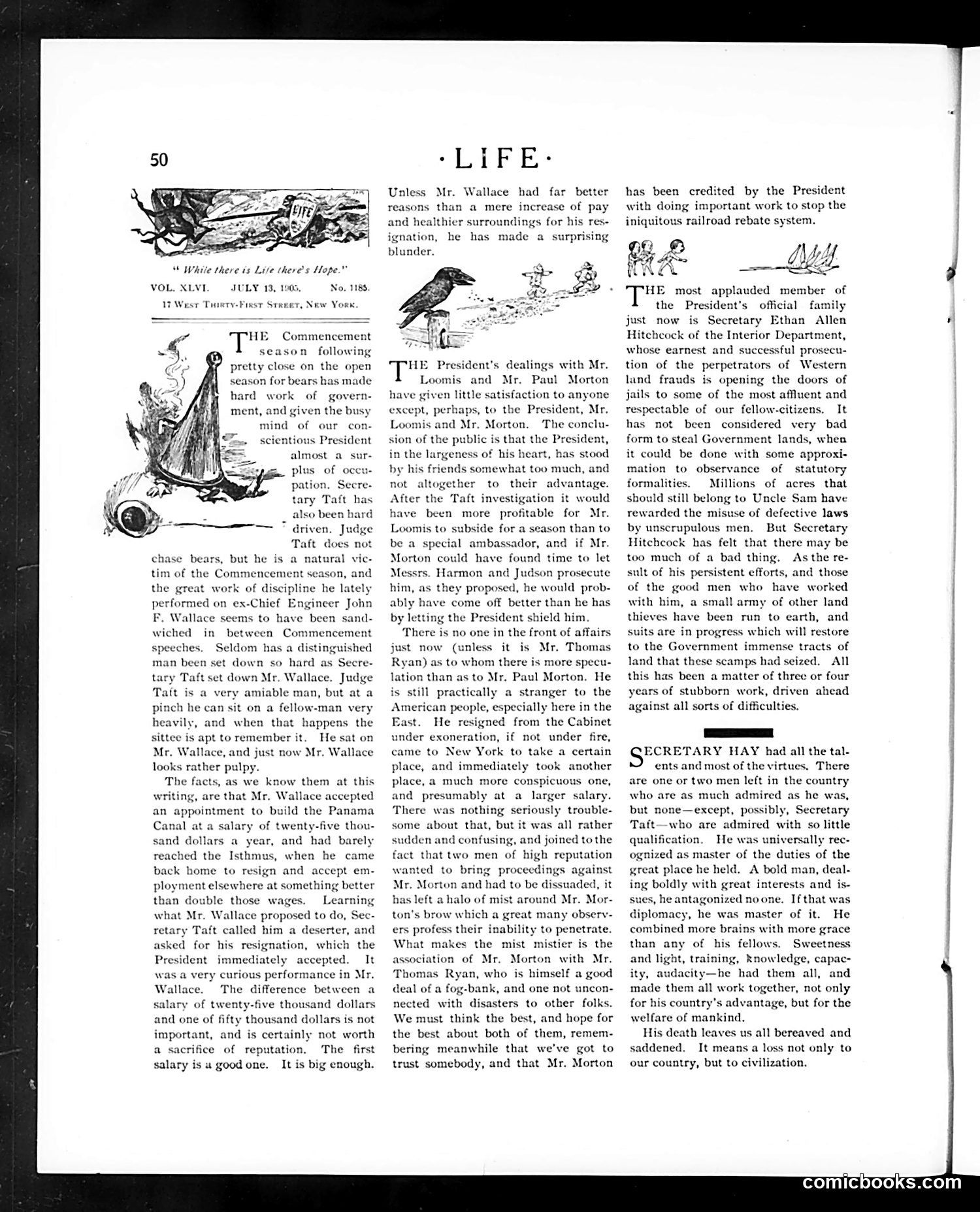
The page critiques President Theodore Roosevelt's handling of Cabinet resignations. The text discusses Mr. Wallace's departure and, more significantly, Secretary of Interior Ethan Allen Hitchcock's role in prosecuting Western land fraud cases. The central issue involves Paul Morton and Mr. Loomis, whose resignations created public confusion. The article suggests Roosevelt was too sympathetic to these figures and their associates, particularly regarding railroad rebate disputes. The author criticizes the President for not sufficiently supporting Hitchcock's anti-fraud efforts—suggesting Roosevelt "shielded" corrupt officials rather than backing prosecution of land thieves operating on public lands. The cartoon (top left, showing bears) likely satirizes the administration's inconsistent stance on corporate wrongdoing and conservation issues.
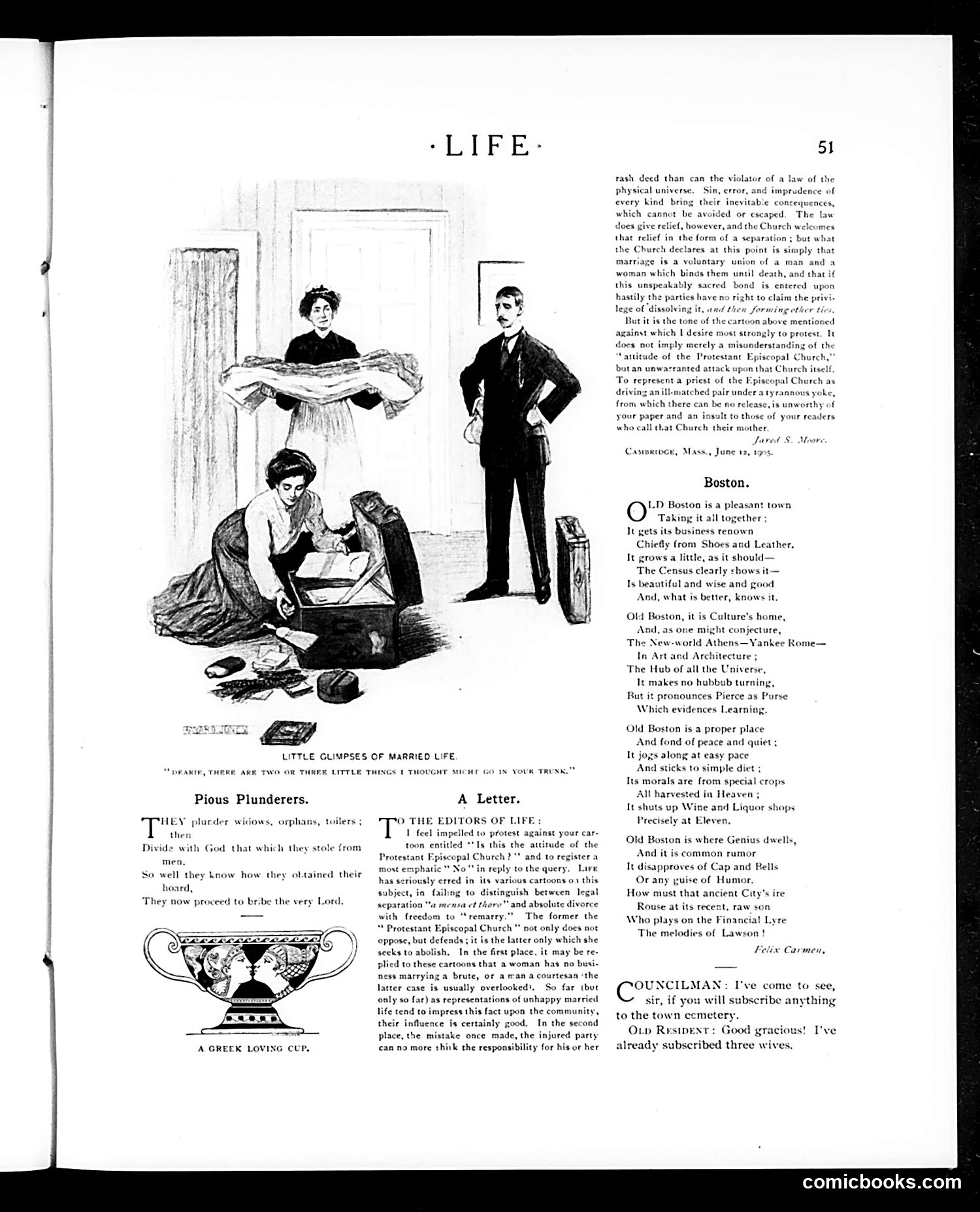
The main cartoon, "Little Glimpses of Married Life," depicts a domestic scene satirizing marriage: a woman holds a baby while sitting amid scattered household items and papers, a man in formal dress stands apart looking stern, and another woman (possibly a servant) stands in the background. The caption reads: "Dearie, there are two of the little things I thought you'd go in your trunk." This appears to mock the realities of married life—specifically the burden of domestic responsibilities and children that contradict romantic expectations. The "little things" reference suggests sarcasm about offspring or household duties. The accompanying articles address marriage, divorce, and the Episcopal Church's stance on these matters, indicating this was a period of social debate about family institutions and moral authority.
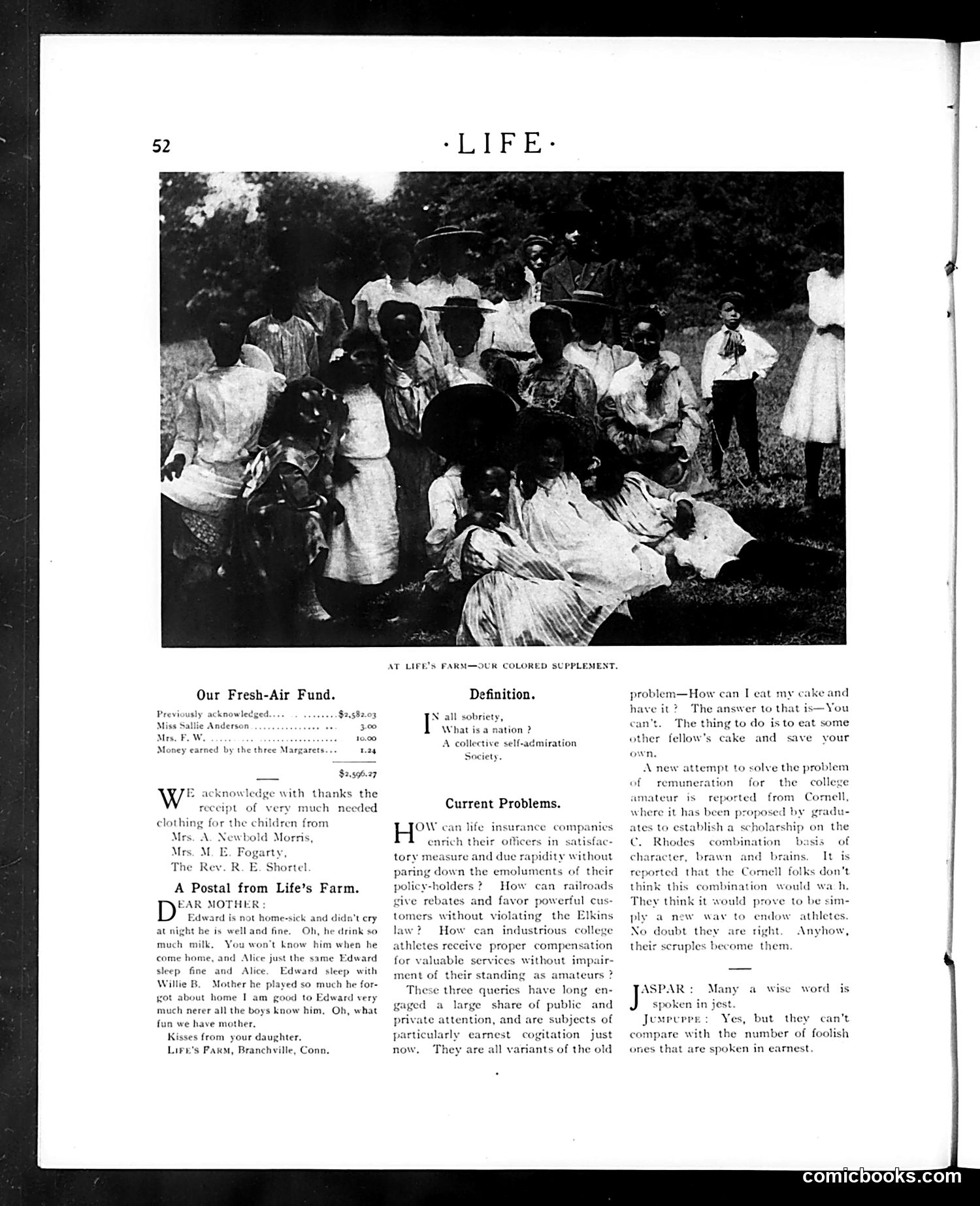
The page contains no political cartoon. Instead, it features a **photograph labeled "At Life's Farm—Our Colored Supplement"** showing a group of people (appears to be a mixed-race gathering) at what's described as Life's Farm in Branchville, Connecticut. The text discusses a fundraising initiative called "Our Fresh-Air Fund" and includes sections on "Definition," "Current Problems," and a dialogue between characters named Jaspar and Jumper about wise words versus foolish speech. The "Current Problems" section poses three rhetorical questions about life insurance, railroads, and college athletes—all variants on themes of fairness and compensation. **Note:** The racial terminology in the image caption reflects period language (early 1900s) and carries historical significance regarding segregation-era publications.
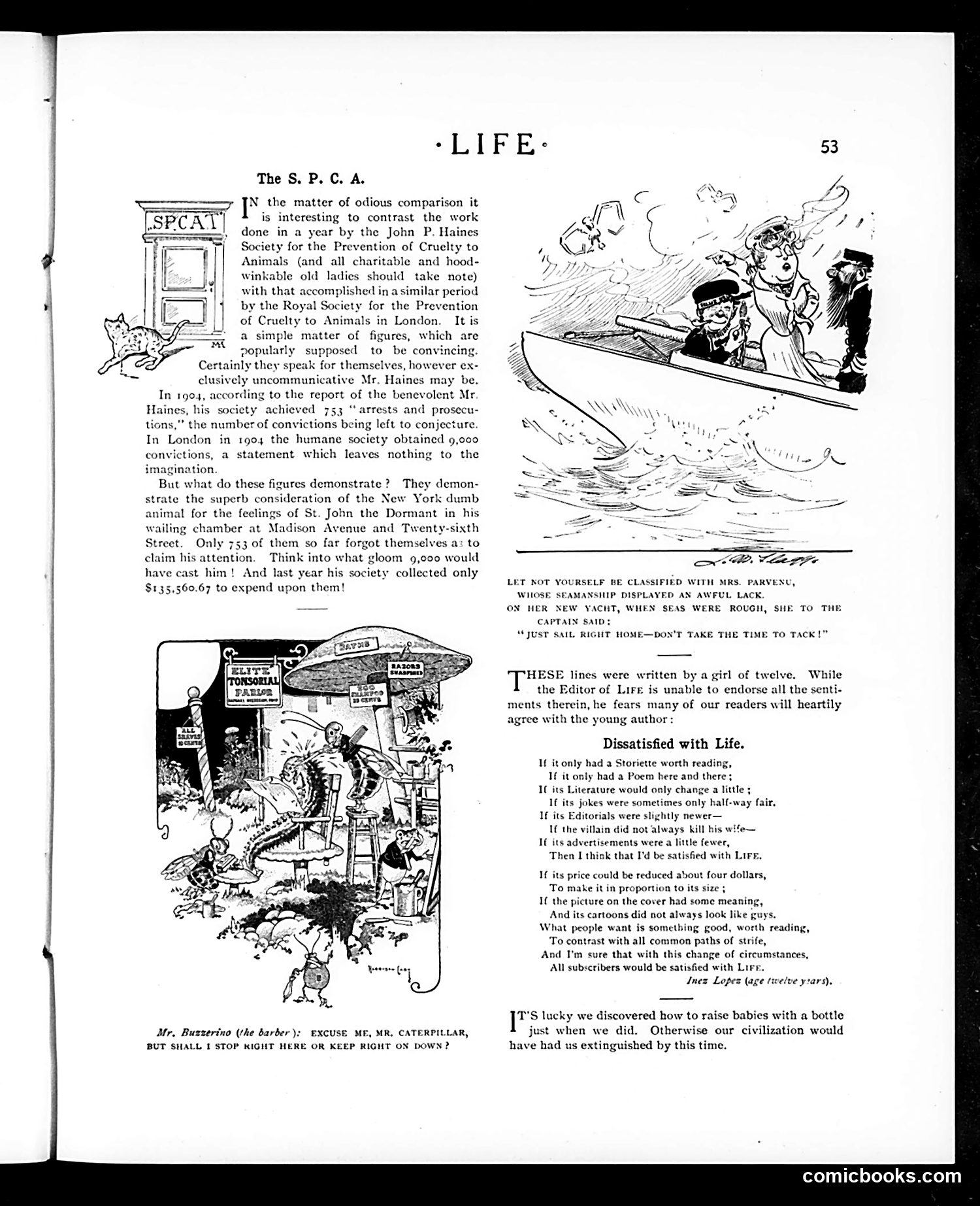
This page satirizes the S.P.C.A. (Society for the Prevention of Cruelty to Animals) by contrasting its work with the John P. Haines Society's efforts. The text argues the S.P.C.A. achieves impressive conviction numbers (9,000 in London in 1894) but questions their actual impact—noting that only 753 cases resulted in sufficient attention from wealthy New Yorkers like "St. John the Dormant." The top cartoon depicts a boating mishap where a woman displays poor seamanship, captioned with the Captain's dismissive response: "Just sail right home—don't take the time to tack!" Below is a poem titled "Dissatisfied with Life" by a twelve-year-old girl critiquing *Life* magazine itself—its content, prices, and illustrations. The page uses humor to question charitable organizations' real-world effectiveness while also playfully self-critiquing the magazine.
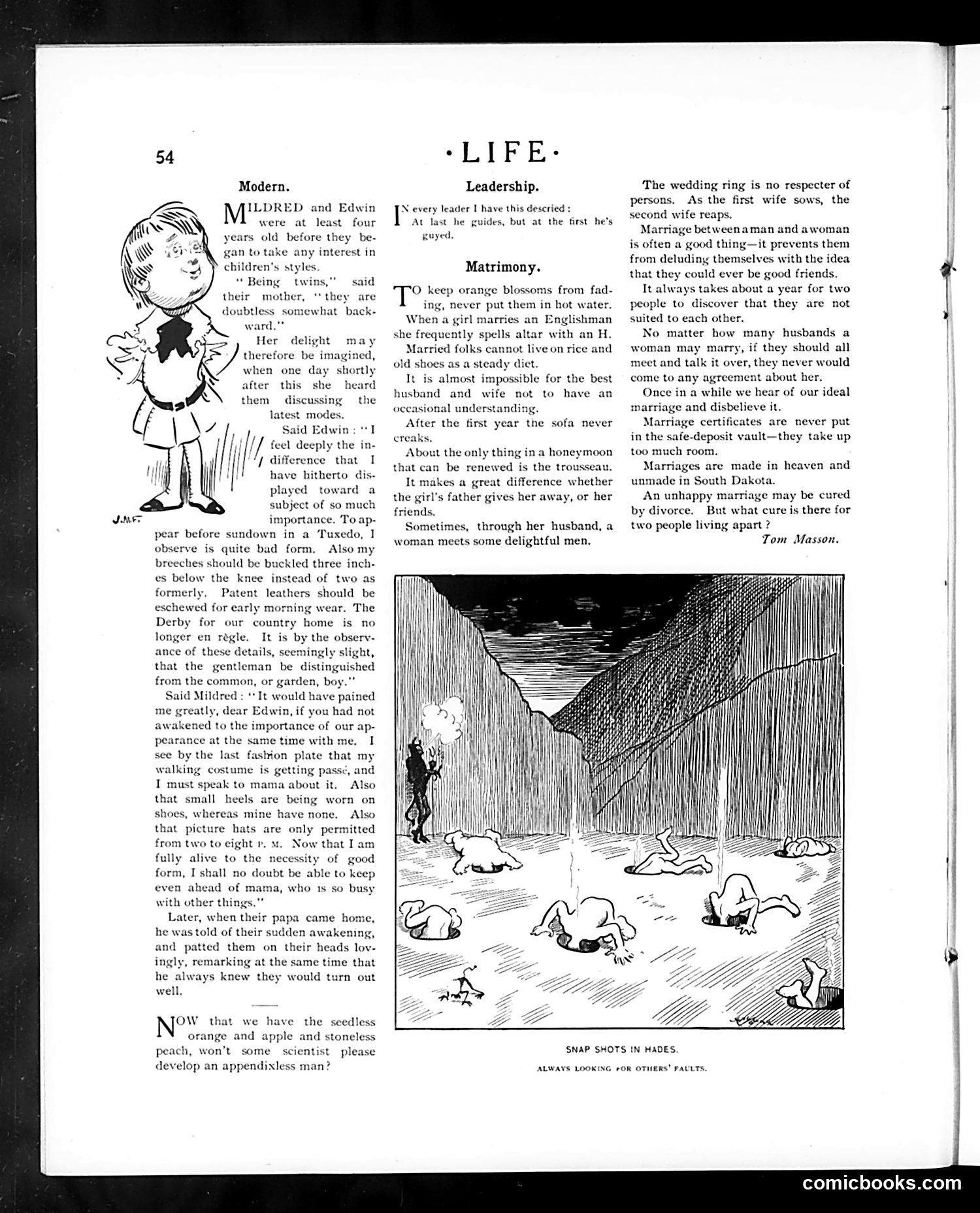
This page contains three distinct pieces of social commentary: 1. **"Modern" illustration**: A young girl named Mildred discusses fashion with her twin brother Edwin. The satire mocks excessive attention to appearance—Mildred worries about hem lengths, buckles, patent leather, and the Derby hat, while their mother suggests such details distinguish gentlemen from "the common, or garden, boy." 2. **"Leadership" and "Matrimony" columns**: Brief witty observations on marriage, noting that wedding rings don't respect persons, that marriages often fail due to incompatibility, and questioning why divorce exists for unhappy couples. 3. **"Snap Shots in Hades"**: A cartoon depicting multiple figures in Hell, all crouching and examining the ground, captioned "Always looking for others' faults." This satirizes human hypocrisy and judgment. The page collectively critiques vanity, marital discord, and moral self-righteousness.
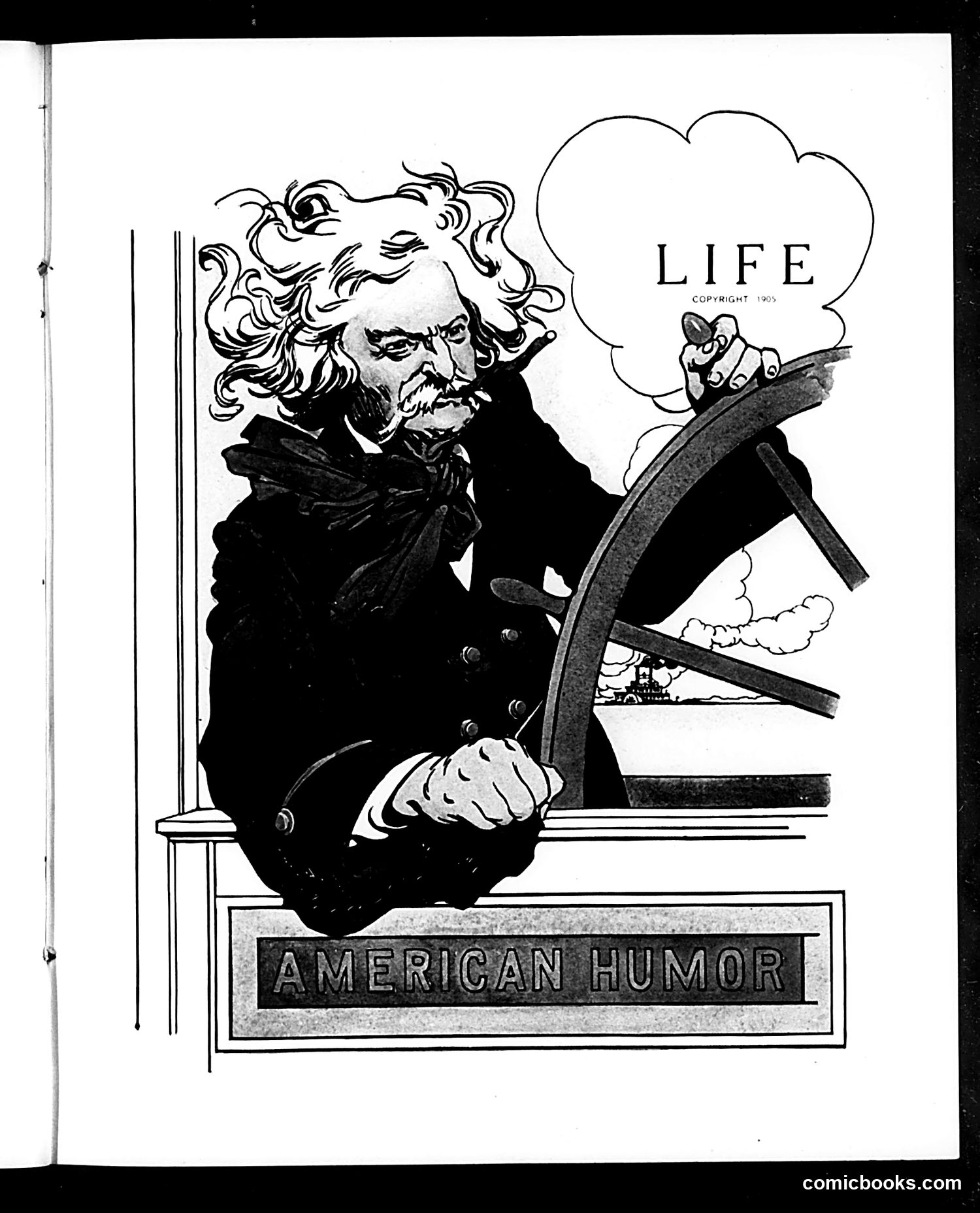
This is a title page from *Life* magazine (copyright 1905) for a section called "American Humor." The illustration depicts a disheveled, wild-haired man in Victorian dress operating what appears to be a large mechanical device or printing press, with the word "LIFE" emerging from it in a thought bubble. The figure's exaggerated facial features and chaotic hair suggest he represents the personification of American humor itself—depicted as somewhat unrefined, energetic, and mechanical in its production. The printing apparatus suggests humor as a manufactured commodity. The satirical point appears to be commentary on how American humor was mass-produced and commercialized in the early 20th century, possibly suggesting it was crude or artificially generated rather than naturally witty.

I'm unable to read any text clearly on this page from the image provided. The page appears to be almost entirely blank or white, with only a dark binding edge visible on the left side and what appears to be a page break or fold mark on the right side. Without legible OCR text or visible cartoon imagery, I cannot identify specific figures, political references, or explain the satire intended. If this is meant to be a content page from *Life* magazine, the image quality or reproduction may be preventing visibility of the actual material. To properly analyze this page's historical and satirical significance, I would need either a clearer image or confirmation of the text content.
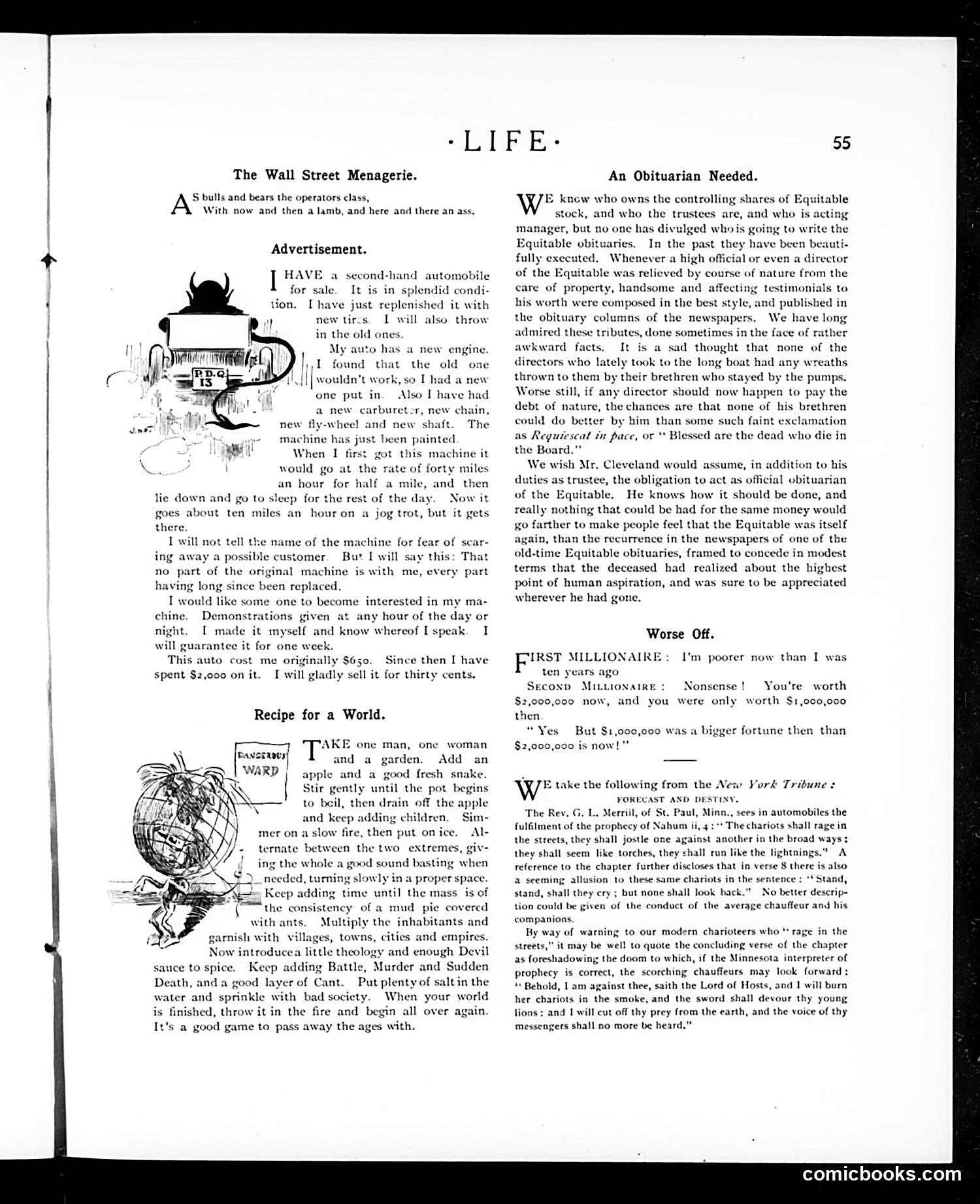
This page contains three satirical pieces typical of *Life* magazine's social commentary: **"The Wall Street Menagerie"** (header): A brief, cutting observation that Wall Street traders consist of "bulls and bears" (speculators), occasionally a "lamb" (naive investor), and frequently an "ass"—mocking the moral character of financial operators. **The automobile advertisement parody**: A humorous fake ad selling a car that's been so extensively rebuilt ($2,000 spent on a $650 original) that no original parts remain. It satirizes both consumer gullibility and shoddy goods marketed as "new." **"Recipe for a World"**: A darkly cynical recipe mixing one man, woman, garden, snake, and children, then adding theology, violence ("Battle, Murder and Sudden Death"), and hypocrisy ("Cant")—suggesting human civilization is fundamentally corrupt and cyclical. **"An Obituarian Needed"**: Mocks the Equitable Life Insurance Company's leadership, suggesting they need someone to write flattering obituaries for deceased directors, implying corporate corruption and the glossing-over of scandal through PR. The page reflects *Life's* Progressive-era skepticism toward corporate America and Wall Street.
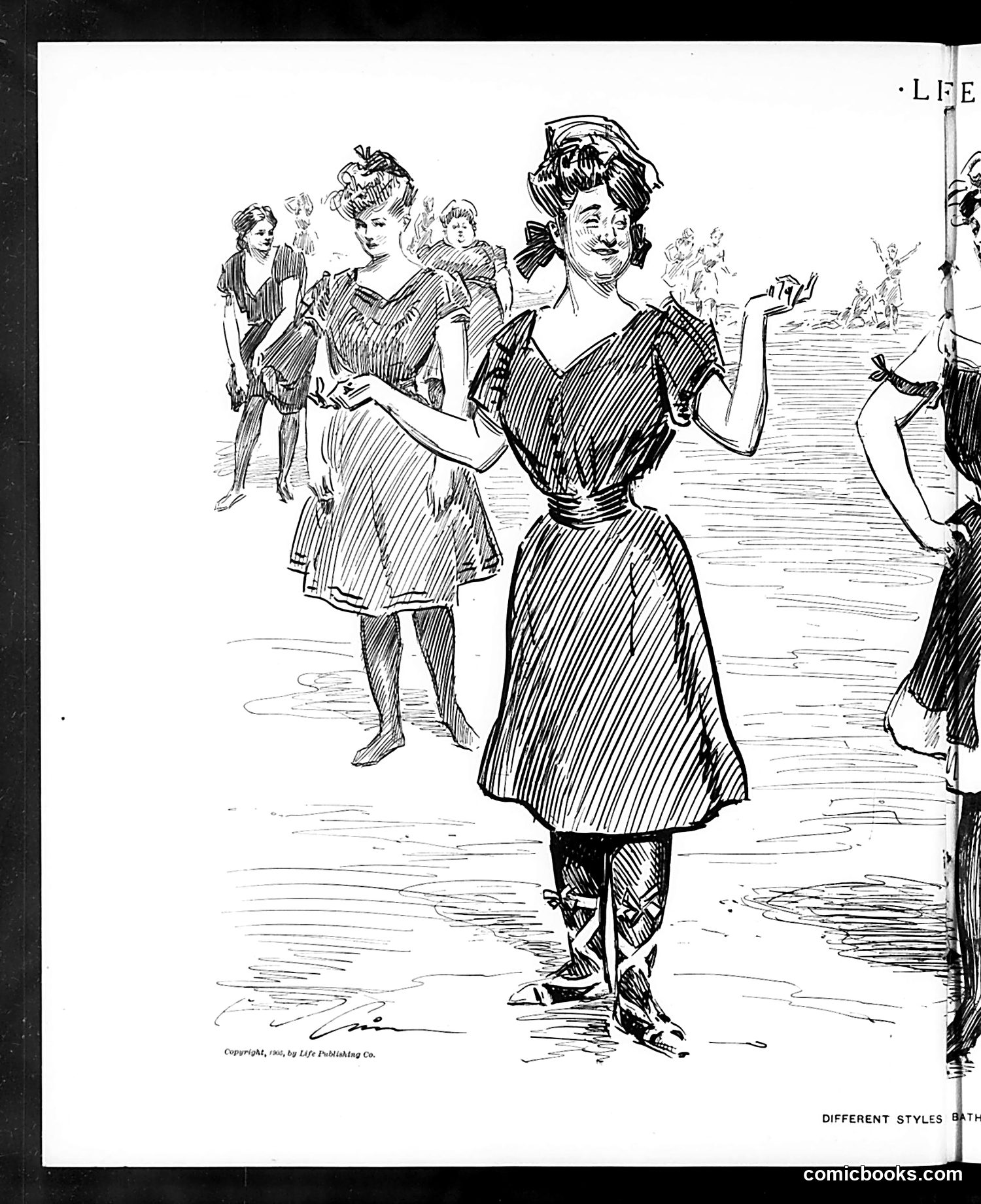
This page from *Life* magazine (copyright 1902) depicts a beach scene titled "Different Styles Bath." The illustration shows women in various bathing costumes at the seaside, with the central figure prominently displaying her bathing attire. The satire likely mocks the evolving and increasingly revealing women's swimwear fashions of the early 1900s. The composition presents different silhouettes and styles, suggesting social commentary on changing attitudes toward female modesty and fashion at beaches. The prominent central figure draws attention to how contemporary bathing costumes had become more abbreviated compared to earlier Victorian styles, which would have been a notable cultural shift worthy of satirical treatment in a humor magazine of that era.
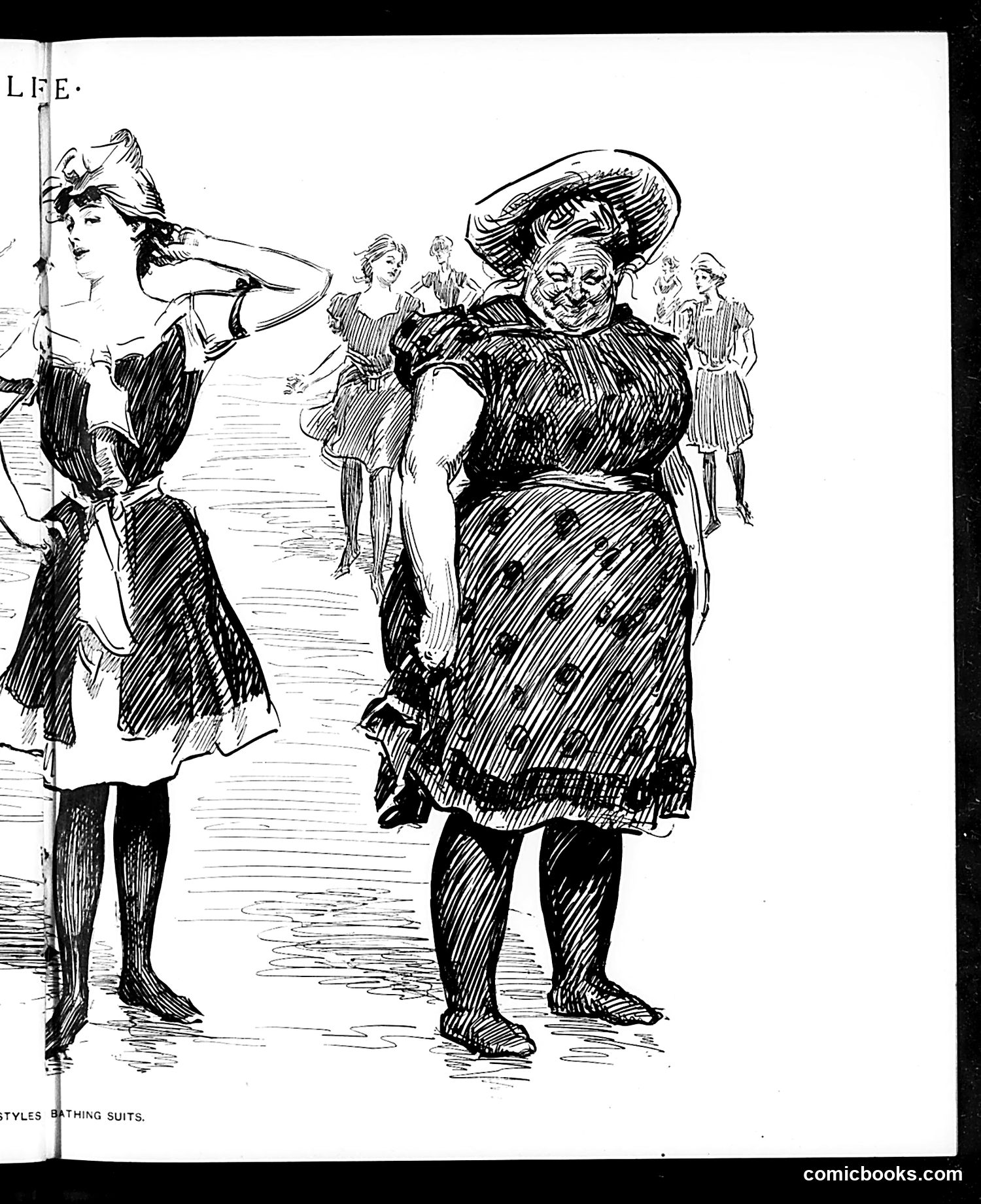
This appears to be a satirical illustration titled "STYLES BATHING SUITS" from *Life* magazine. The cartoon contrasts two figures in swimming attire: on the left, a stylish, elegant woman in a modern bathing costume with a cap, and on the right, a heavyset woman in an older-fashioned, more modest bathing dress and hat. The satire likely mocks the contrast between fashionable "new woman" styles of the era versus outdated or unflattering alternatives. The exaggerated caricature on the right—with a broader, less idealized physique—suggests commentary on how different body types or classes of women adopted bathing fashions. The onlookers in the background appear to react to this contrast, emphasizing the social spectacle of fashion.
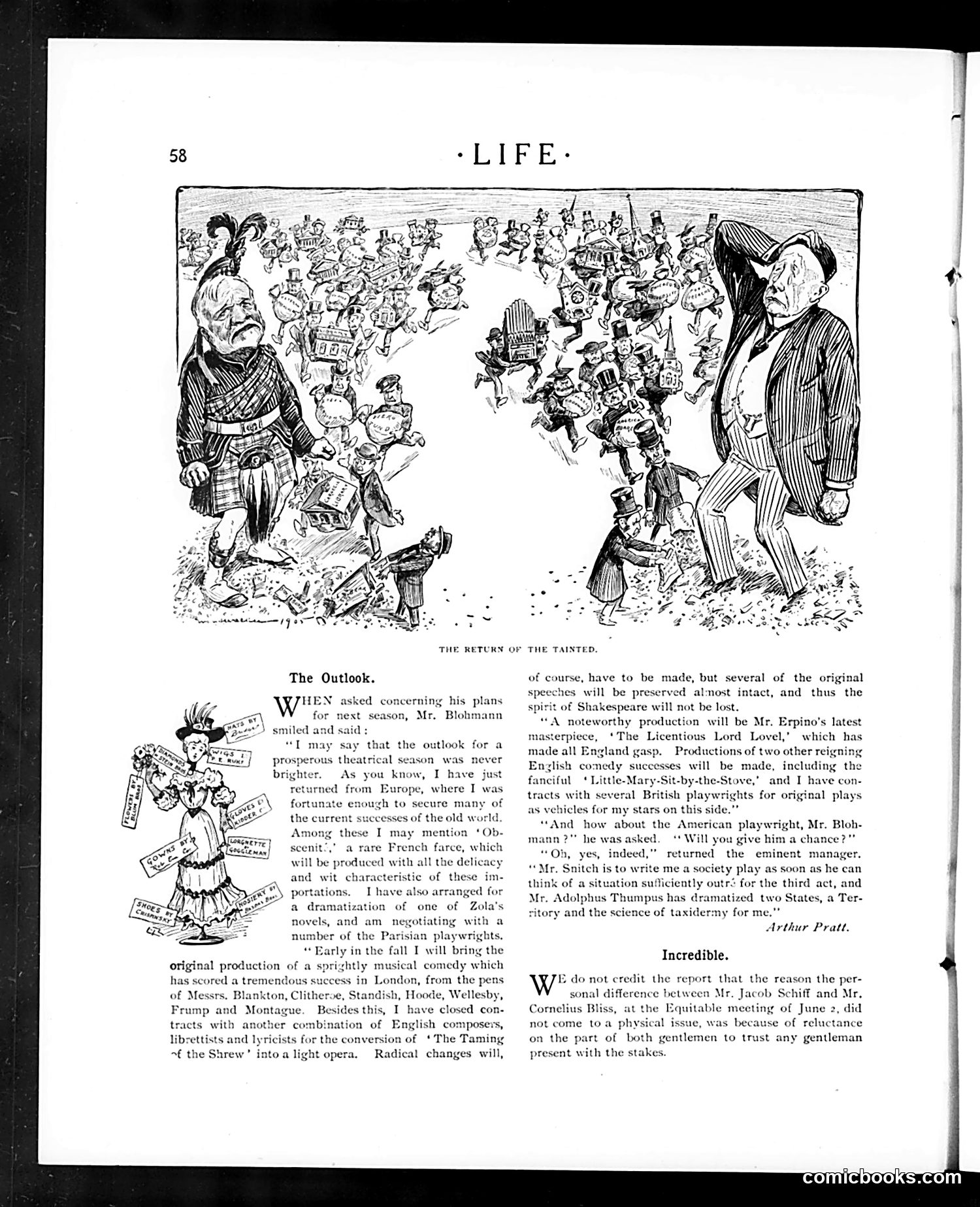
This page satirizes theatrical producer Mr. Blohmann's grandiose plans for the upcoming season. The top cartoon shows two caricatured figures (likely representing Blohmann and a colleague) surrounded by a chaotic crowd of theatrical performers and characters. The satire targets Blohmann's pretentious strategy: he imports cheap European "obscene" French farces and sensationalized Zola adaptations while claiming to preserve Shakespeare's dignity through a "Taming of the Shrew" operatic adaptation. The joke is his obvious hypocrisy—he dismisses American playwrights like "Mr. Snitch" (needing overly sensational plots) while importing tawdry continental productions. The second item, "Incredible," is a brief satirical aside about the Equitable Building meeting, suggesting wealthy gentlemen (Schiff and Bliss) wouldn't engage in physical violence over financial stakes—implying they're too refined or cowardly. The overall tone mocks theatrical pretension and the importing of foreign "trash" while claiming artistic merit.
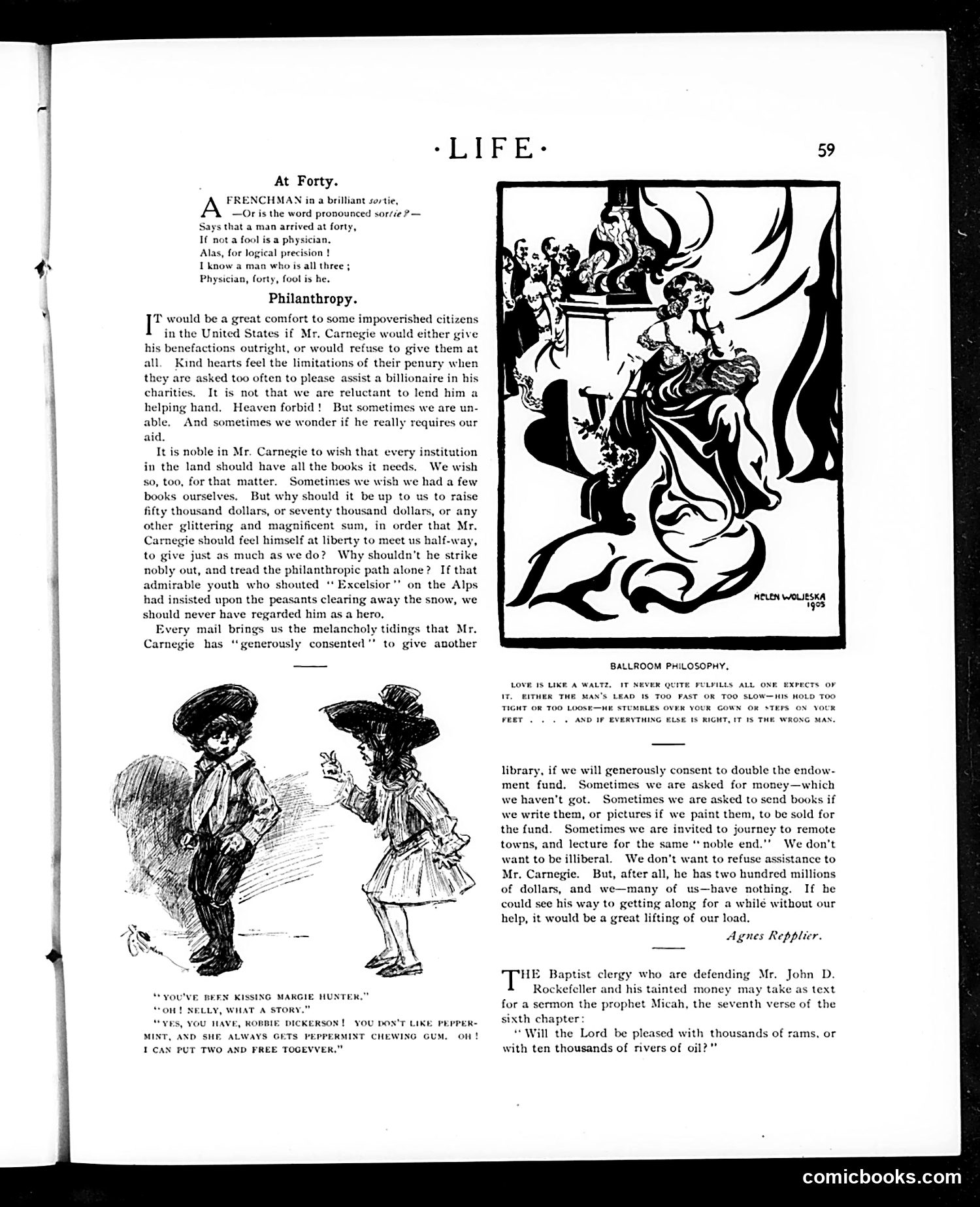
This page mocks wealthy industrialists' self-serving philanthropy through multiple pieces: **"Philanthropy"** (main article by Agnes Repplier): Satirizes Andrew Carnegie's conditional charitable giving. Carnegie offers to fund libraries *if* communities raise matching funds—essentially asking poor citizens to subsidize a billionaire's generosity. The article sarcastically suggests Carnegie should fund philanthropy alone rather than extracting labor and donations from those with far less wealth. **"Ballroom Philosophy"** (caption): A cynical metaphor comparing romantic relationships to waltzes—nothing meets expectations, someone always stumbles, and even when circumstances align, "it is the wrong man." This reflects period skepticism about life's promises. **Bottom section**: References John D. Rockefeller's "tainted money" (from exploitative business practices) and clergy defending him. It quotes the prophet Micah sarcastically—suggesting Rockefeller's money cannot buy divine favor. **Lower cartoon**: Shows two women gossiping, establishing social commentary through everyday dialogue. The page collectively critiques Gilded Age billionaires who demand public participation in their "generosity" while retaining massive fortunes.
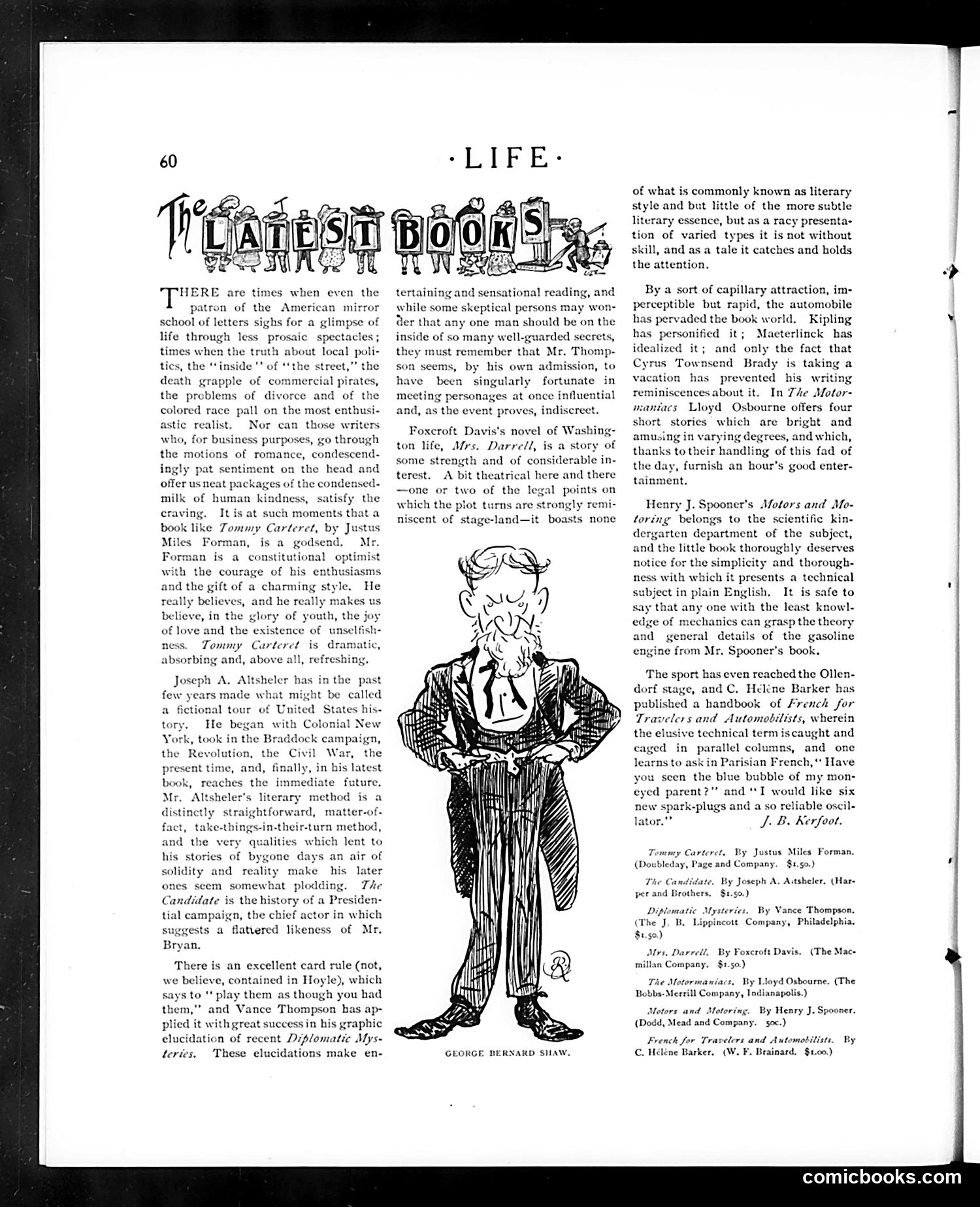
This is a book review section from Life magazine featuring George Bernard Shaw as the illustrated figure. The cartoon shows Shaw in his characteristic pose—an elderly bearded man in formal dress—likely chosen because he represents the literary establishment being discussed. The page reviews contemporary fiction emphasizing that American readers oscillate between realistic "mirror" literature (focusing on politics, commerce, divorce) and romantic escapism. It discusses novels by Justus Miles Forman, Joseph A. Altsheler (whose *The Candidate* apparently caricatures William Jennings Bryan), and others. Notably, the reviews track the automobile's cultural penetration into literature—books by Kipling, Maeterlinck, and Lloyd Osbourne now feature automobiles, reflecting this new technology's grip on public imagination circa 1905-1910. The tone is literary criticism mixed with gentle satire about contemporary publishing trends and reader tastes.
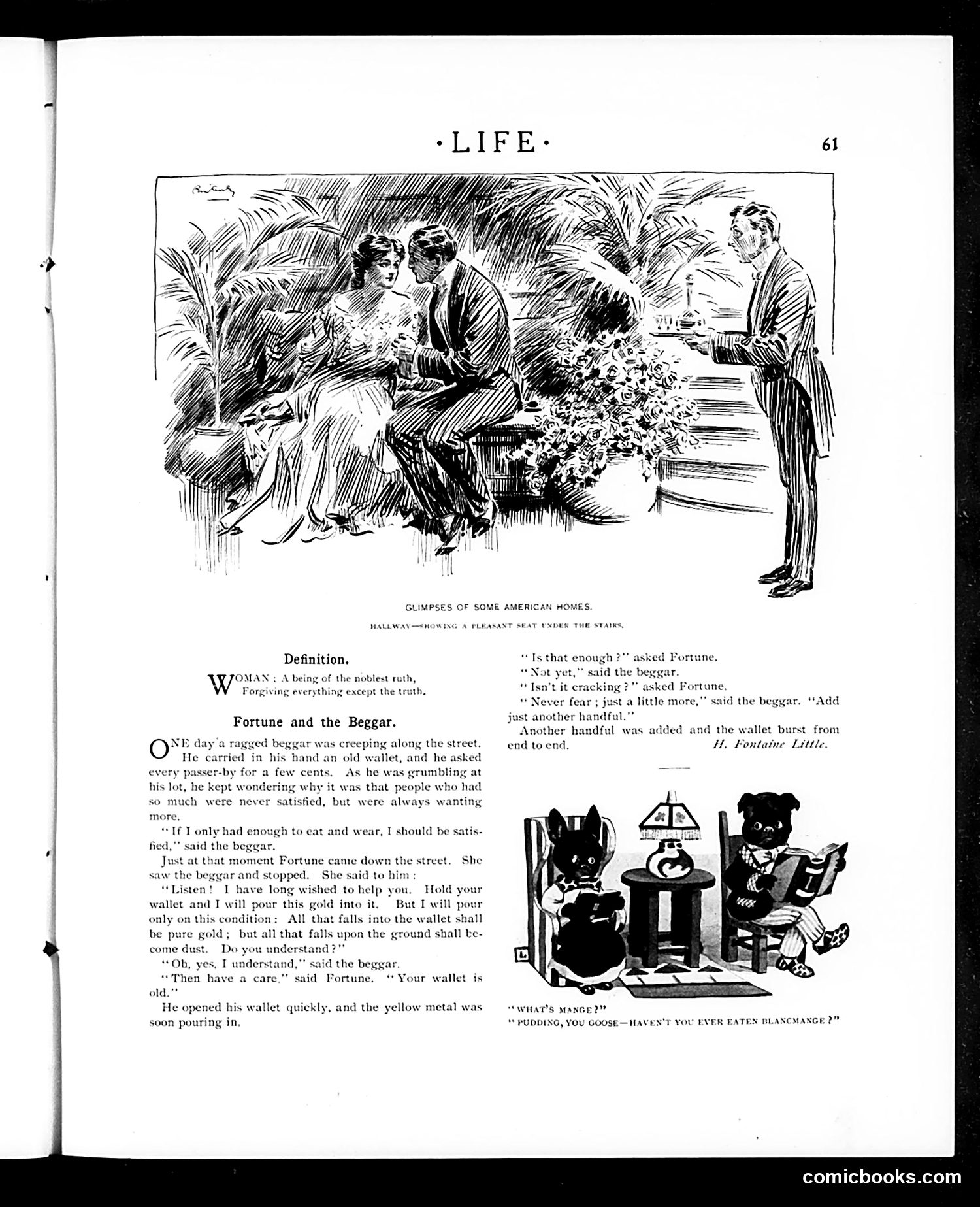
This page from *Life* magazine contains two distinct pieces: **Top illustration:** A sketch labeled "Glimpses of Some American Homes" showing a hallway with a couple conversing while a man stands apart—likely satirizing interior design trends or social etiquette of the era. **"Fortune and the Beggar":** A moral fable where a beggar encounters the personified goddess Fortune, who offers to pour gold into his wallet on one condition: only pure gold remains, impurities fall out. When greed overtakes him and he demands "just another handful," the wallet bursts—a cautionary tale about unchecked avarice and the folly of wanting more than one can hold. **Bottom cartoon:** Two anthropomorphic animals (appears to be cats or similar creatures) discussing "blancmange" (a dessert)—a light domestic humor piece playing on mispronunciation or unfamiliarity with the French culinary term, poking gentle fun at either pretension or ignorance about refined food. The page blends social satire, moral instruction, and whimsical humor typical of early 20th-century *Life* magazine content.
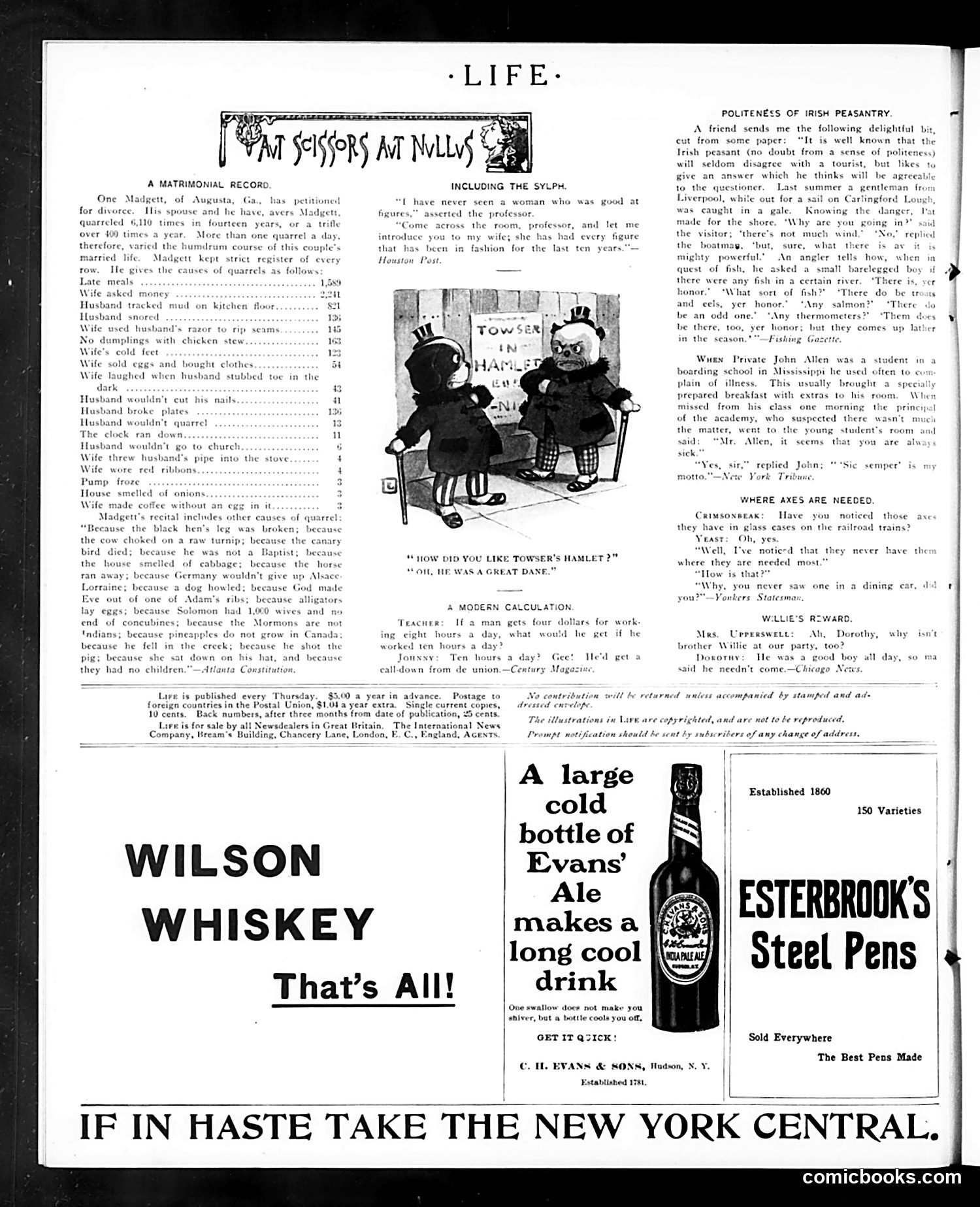
This page from the American satirical magazine *Life* contains several humor pieces and advertisements from the early 20th century. **Main Content:** The page features three distinct humor columns: 1. **"A Matrimonial Record"** — A satirical list cataloging reasons a Georgia man (Madgett) quarreled with his wife, including absurd complaints like "wife sold eggs and bought clothes" and "house smelled of cabbage." The joke mocks domestic disputes through exaggerated enumeration. 2. **"Politeness of Irish Peasantry"** — An anecdote depicting an Irish fisherman's overly polite responses to a tourist's questions. The satire plays on stereotypes of Irish deference and rural simplicity, common in early-20th-century humor. 3. **"Where Axes Are Needed"** — A brief joke about glass cases on railroad trains, suggesting they contain axes for emergencies. 4. **"A Modern Calculation"** — A short math joke about wages. The cartoon illustration shows a woman and man at a desk, likely depicting the "Towser's Hamlet" joke below it. The page includes period advertisements for Wilson Whiskey, Evans' Ale, and Esterbrook Steel Pens.
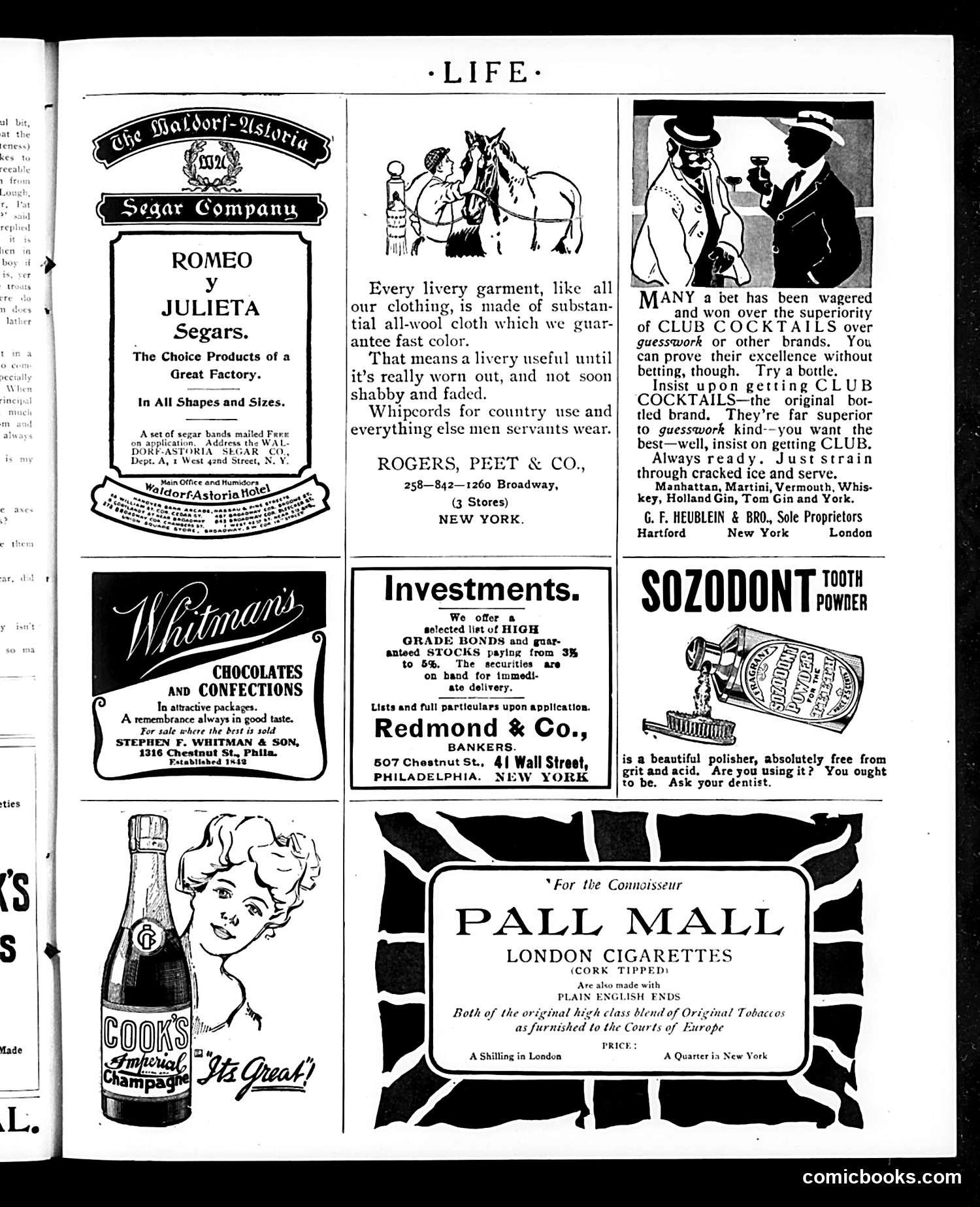
This is primarily an **advertising page**, not a satirical cartoon. It contains product advertisements typical of early 20th-century American magazines, with no political content or satire. The ads include: - **Romeo y Julieta cigars** and livery clothing (Rogers, Peet & Co.) - **Club Cocktails** — positioned as superior to generic "guesswork" brands, emphasizing quality and consistency - **Whitman's chocolates** and **Cook's champagne** - **Sozodont tooth powder** with a toothbrush illustration - **Pall Mall cigarettes** marketed as London-made for connoisseurs - **Investment offerings** from Redmond & Co. bankers The page reflects **consumer culture aspirations** of the era: luxury imports, branded spirits, genteel servant wear, and financial instruments. The "Club Cocktails" ad's emphasis on superiority over "guesswork" reveals early advertising's focus on brand reliability—a novel concept when mass production was still establishing consumer trust. There is **no political cartoon or satire** present on this page.
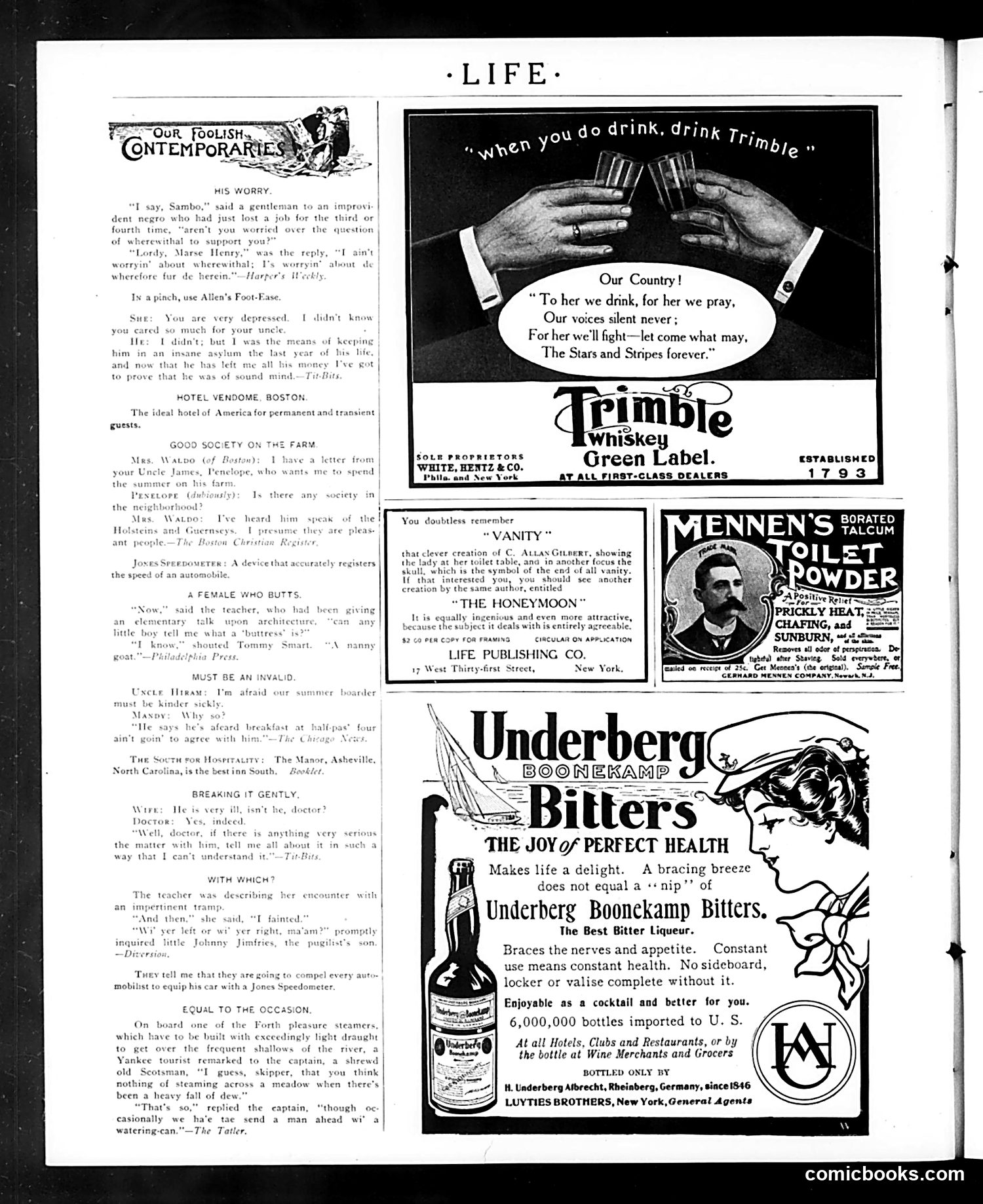
This page is primarily **advertising**, not political satire. It contains several vintage ads from approximately the World War I era: **The Trimble Whiskey ad** (top right) uses patriotic messaging—a toast "to our Country" with verses about fighting for America and the flag—to sell liquor. This reflects how alcohol was marketed using nationalist sentiment during wartime. **The other advertisements** promote Mennen's talcum powder, Underberg Bitters (a digestive liqueur), and a hotel, using period marketing claims about health and comfort. **The left column text** consists of humorous vignettes labeled "Our Foolish Contemporaries"—satirizing everyday social situations and pretensions, which was Life magazine's signature format. The page reflects early 20th-century advertising practices: making dubious health claims for products (bitters promised constant health), nationalist appeals to sell consumer goods, and the magazine's blend of satire and commerce. For modern readers, it's notable how openly alcohol was advertised with health benefits, now illegal.
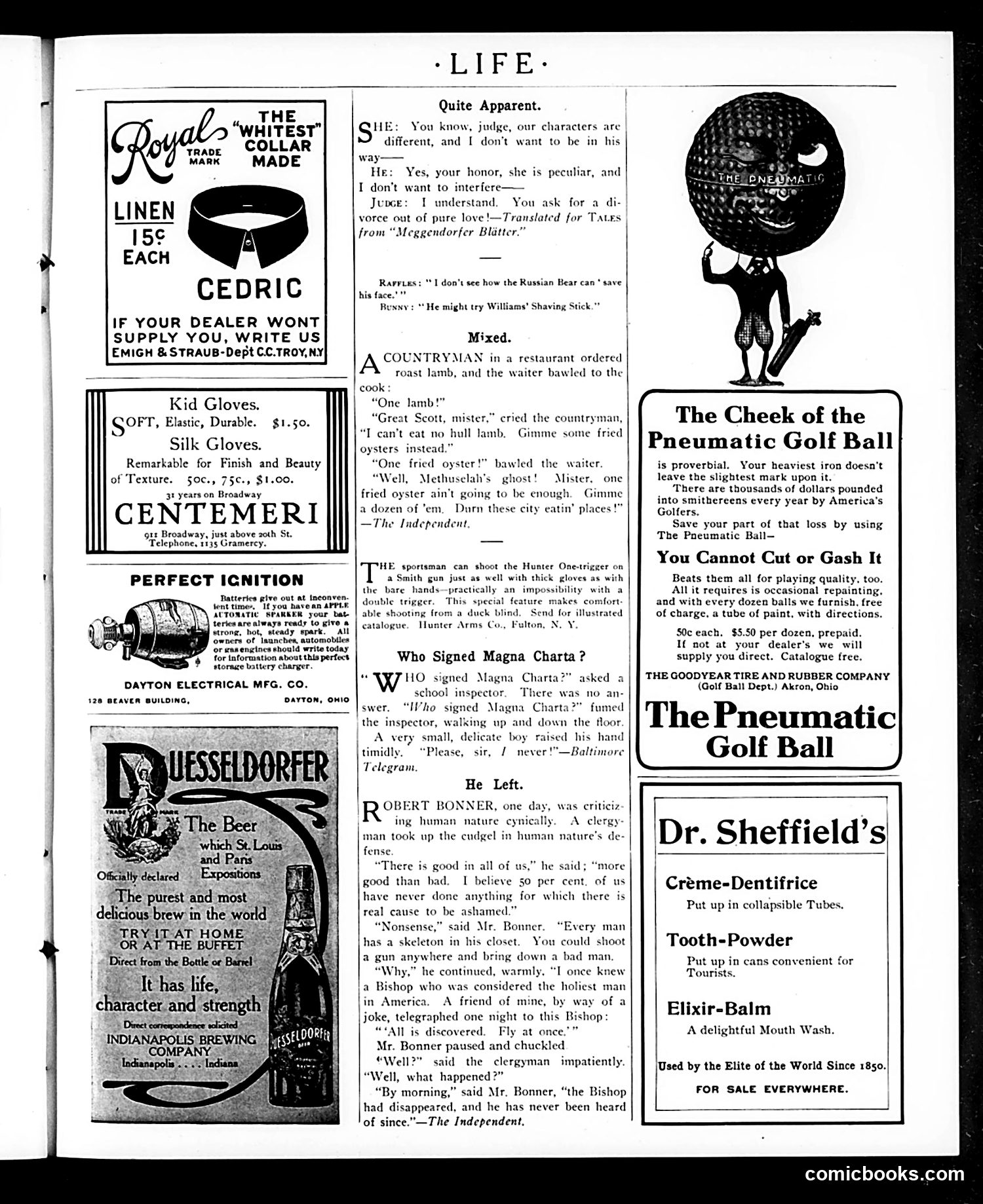
This page is primarily **advertising with humorous filler content**, typical of Life magazine's format. The main cartoon presents a divorce proceeding where both parties claim incompatibility out of "pure love"—satirizing the contradictory logic of divorce proceedings where mutual disaffection is dressed up as mutual respect. The judge's dry comment highlights the absurdity. Other humor pieces include: - A countryman ordering "roast lamb" but unable to eat a whole animal, requesting it be fried in pieces instead—mocking rustic ignorance of restaurant dining - A "Magna Charta" schoolroom joke about a timid boy unable to answer - An anecdote about a Bishop's hypocrisy: after receiving a fake telegram ("All is discovered"), he fled, suggesting hidden misconduct despite his reputation for holiness—undermining the clergyman's defense of human goodness **Advertisements dominate**: collars, gloves, beer, batteries, golf balls, and dental products. These pieces reflect early 1900s Life magazine's mix of satire, social humor, and commercial content.
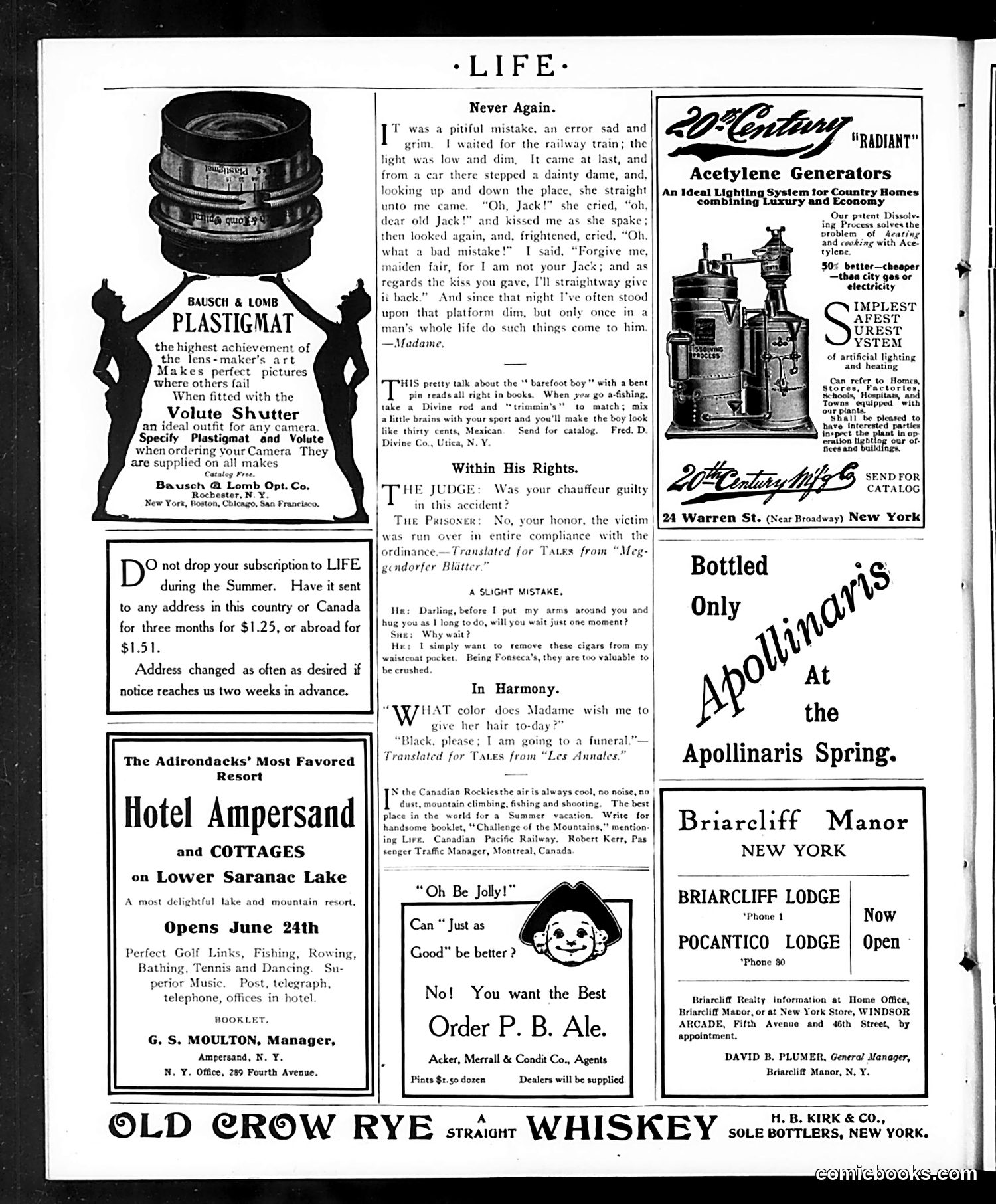
This page is primarily **advertisements and brief humorous anecdotes**—typical of *Life* magazine's format from the early 1900s. The humor pieces ("Never Again," "Within His Rights," "A Slight Mistake," "In Harmony") are short, sentimental or domestic jokes with a mild satirical edge—no political content. They poke gentle fun at romance and miscommunication. The "barefoot boy" reference cites a literary type familiar to contemporary readers but not requiring identification here. The main content is **advertising**: camera equipment (Bausch & Lomb), hotels and resorts (Hotel Ampersand, Briarcliff Manor), fishing equipment, automobile services, liquor (Old Crow Whiskey, P.B. Ale), and notably, **Apollinaris Spring Water** and **acetylene generators for home lighting**—technologies of interest to turn-of-the-century readers. There are no political cartoons or caricatures of named figures on this page. It's a standard issue displaying the magazine's mix of light humor and commercial pitches.
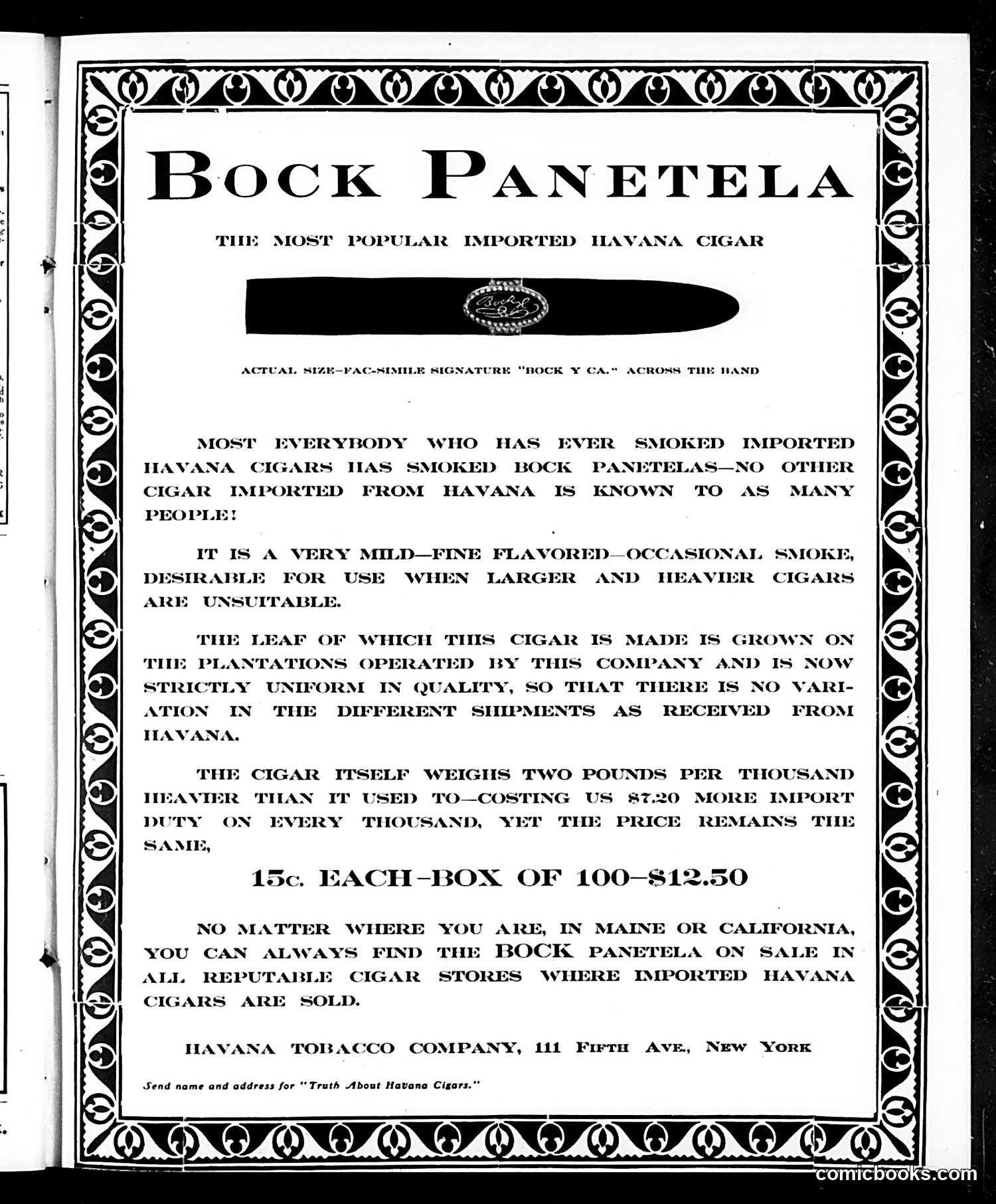
This is a straightforward product advertisement, not political satire. It promotes Bock Panetela cigars, imported Havana cigars sold by the Havana Tobacco Company. The ad emphasizes the brand's popularity and quality, claiming it's "the most popular imported Havana cigar" and widely available nationwide. The ad notably mentions that the cigars now weigh two pounds per thousand more than previously, increasing import duties by $7.20 per thousand units, yet the retail price remains unchanged at 15 cents each or $12.50 per box of 100. This appears designed to suggest the company absorbs costs to maintain consumer value—a marketing strategy during an era of tariff debates. The decorative border and formal layout are typical of early 20th-century magazine advertising design.
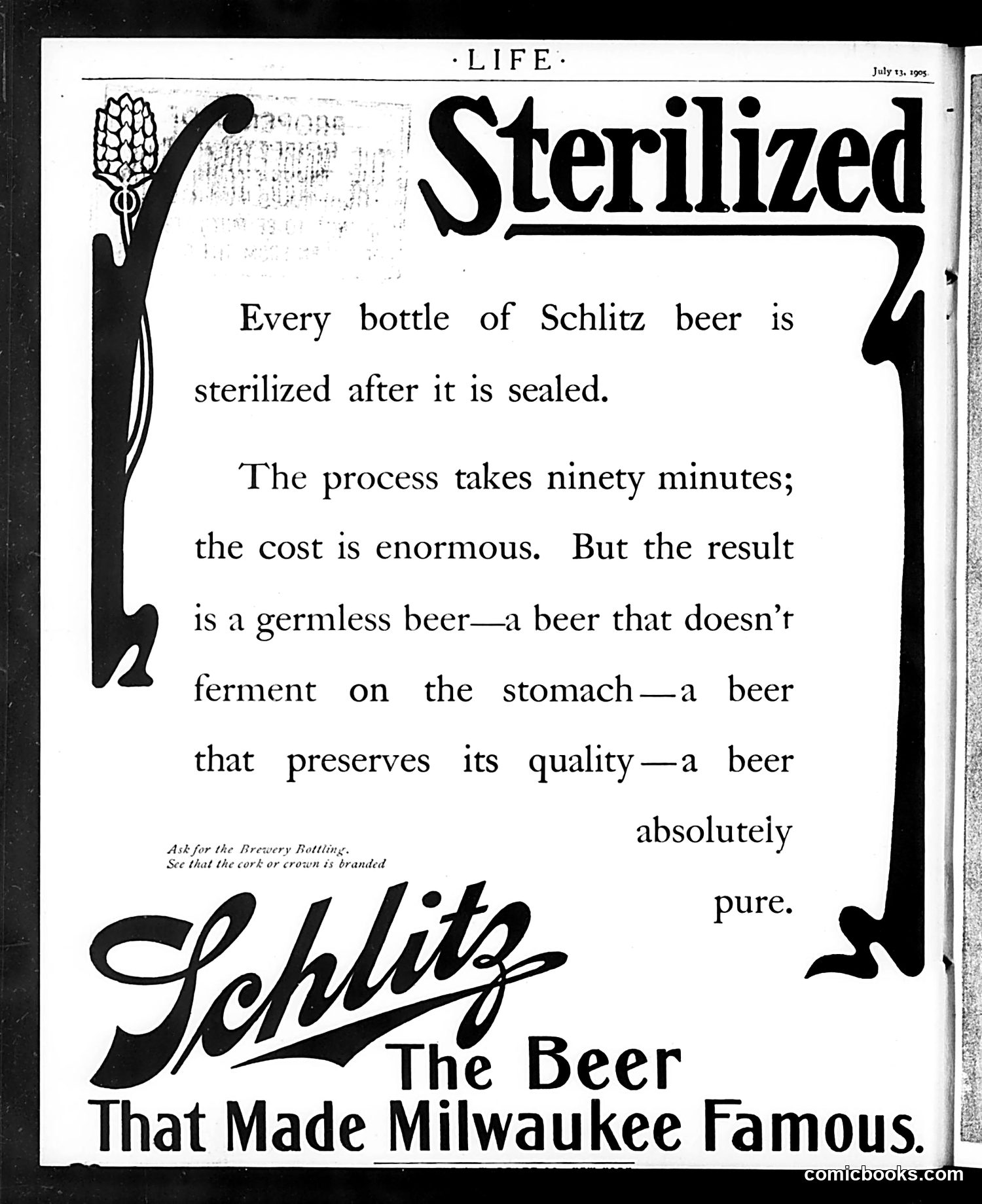
This is a full-page advertisement for Schlitz beer, not a political cartoon. The page promotes Schlitz's "sterilization" process—a 90-minute heating procedure applied after bottling—as a unique selling point. The ad claims this produces a "germless beer" that won't cause stomach fermentation and maintains quality and purity. The decorative Art Nouveau border frames the text, while the Schlitz signature and slogan "The Beer That Made Milwaukee Famous" anchor the bottom. This reflects early 20th-century advertising that emphasized scientific/sanitary methods as luxury features, appealing to consumers concerned about food and beverage safety during an era of growing awareness about germs and contamination.