
Life, 1905-07-13 · page 18 of 26
Life — July 13, 1905 — page 18: what you’re looking at
What you’re looking at
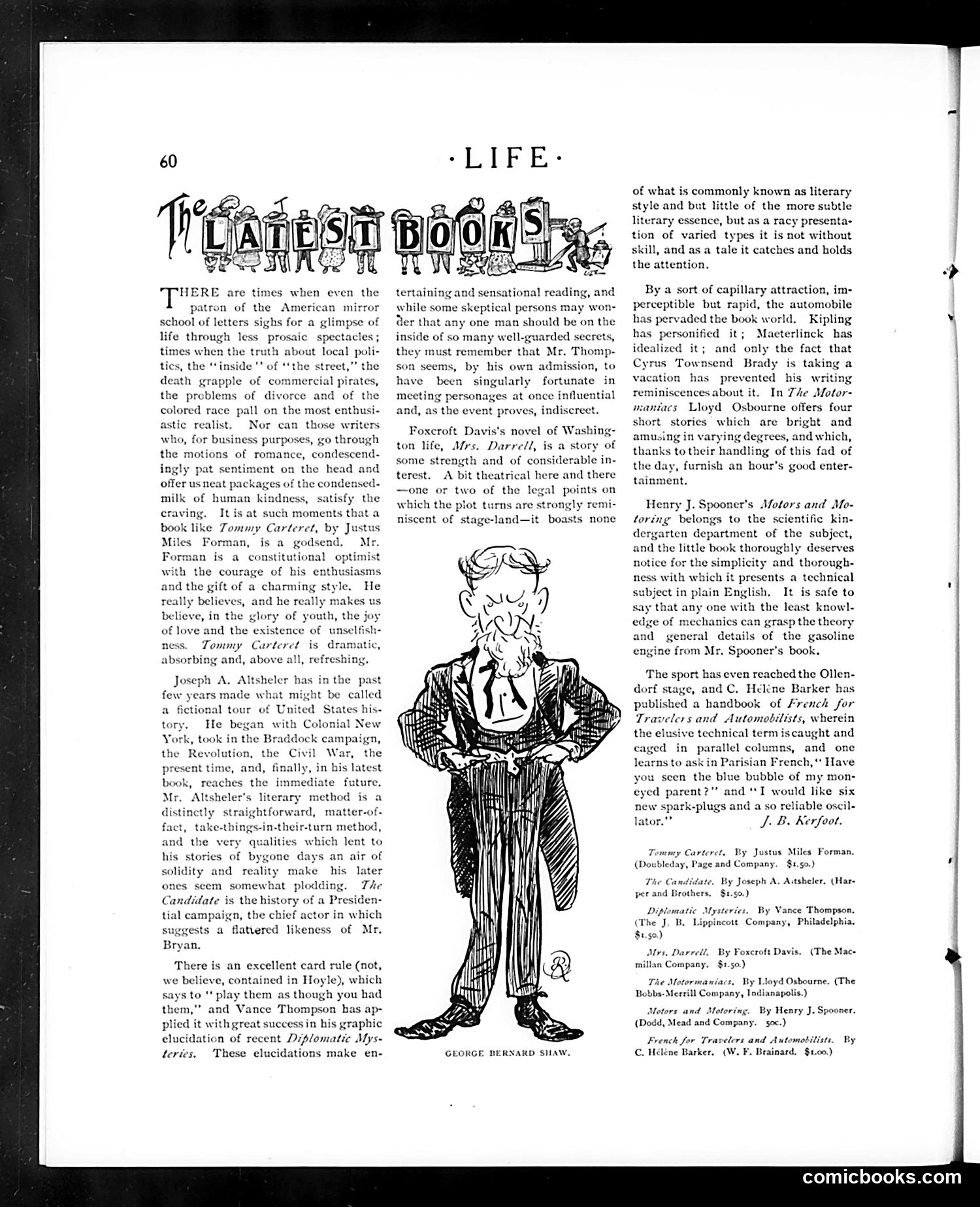
This is a book review section from Life magazine featuring George Bernard Shaw as the illustrated figure. The cartoon shows Shaw in his characteristic pose—an elderly bearded man in formal dress—likely chosen because he represents the literary establishment being discussed. The page reviews contemporary fiction emphasizing that American readers oscillate between realistic "mirror" literature (focusing on politics, commerce, divorce) and romantic escapism. It discusses novels by Justus Miles Forman, Joseph A. Altsheler (whose *The Candidate* apparently caricatures William Jennings Bryan), and others. Notably, the reviews track the automobile's cultural penetration into literature—books by Kipling, Maeterlinck, and Lloyd Osbourne now feature automobiles, reflecting this new technology's grip on public imagination circa 1905-1910. The tone is literary criticism mixed with gentle satire about contemporary publishing trends and reader tastes.
📄 Transcribed text from this page (OCR, searchable)
Machine-transcribed from the original scan — historical spelling and the odd misread are preserved.
Wi 3 THERE are times when even the patron of the American mirror school of letters sighs for a glimpse of life through less prosaic spectacles; times when the truth about local poli- tics, the ‘inside "’ of **thi the death grapple of commercial pirates, the problems of divorce and of the colored race pall on the most enthusi- astic realist. Nor can those writers street, who, for business purposes, go through the motions of romance, condescend- ingly pat sentiment on head and offer us neat packages of the condensed- milk of human kindness, satisfy the craving. It is at such moments that a book like Tommy Carteret, by Justus Miles Forman, is a godsend. Forman is a constitutional optimist with the courage of his e¢: really believes, and he really believe, in the glory of youth, the } love and the existence of unselfi ness. Tommy Carteret is dram absorbing and, above all, refreshing. Joseph A, Altsheler has in the past few years made what might be called ctional tour of United States his- York, took in the Br the Revolution, the Civil and, finally hes the immediate future, sheler's literary method is distinctly straightforward, ma fact, take-things-in-their-turn method, book, re solidity and reality make later ones scem somewhat plodding. 7/c Presiden- Candidate is the history 0} aign, the chief actor in which suggests flattered likeness of Mr. Bryan. There is an excellent card rule (not, we believe, contained in Hoyle), which says to “play them as though you had them, ance Thompson ha: plied it with great success in his graphic elucidation of recent Diplomatic Mys- teries, ‘These elucidations make en- while some skeptical persons may won- Ger that any one man should be on the inside of so many well-guarded secrets, they must remember t Mr. Thomp- son seems, by his own admission, to have been singularly fortunate in meeting personages at once influential and, as the event proves, indiscreet Foxcroft Davis's novel of Washing- ton life, Mrs. Darrell, is a story of some strength and of consid terest. A bit theatrical here and there two of the legal points on which the plot turns are strong]. niscent of stage-land—it boa ble in- —one ¢ remi- none be iy: Y i te: GEORGE DERNARD SHAW, of what is commonly known as literary style and but little of the more subtle literary essence, but as a racy presenta- tion of varied types it is not without skill, and as a tale it catches and holds the attention. By a sort of capillary attraction, im- perceptible but rapid, the automobile has pervaded the book world. Kipling has personified it; Macterlinck bas idealized i and only the fact that Cyrus Townsend B is taking a vacation has prev his writing reminiscences about it. In The Motor- maniacs Lloyd Osbourne offers four short stories which are bright and amusing in varying degrees, and which, thanks to their handling of this fad of the day, furnish an hour’s good enter- ta ent. Henry J. Spooner’s Motors and Mo- toring belongs to the scientific kin- dergarten department of the subject, and the little book thoroughly deserves notice for the simplicity and thorough- ness with which it presents a technical subject in plain English, It is safe to say that any one with the least knowl- edge of mechanics can grasp the theory and general details of the gasoline engine from Mr, Spooner's book. The sport has even reached the Ollen- dorf stage, and C, Heline Barker has published a handbook of French for Travelers and Automobilists, wherein the elusive technical term iscaught and aged in parallel columns, and one rns to ask in Parisian French, * Have you seen the blue bubble of my mon- eyed parent?" and ‘I would like six new spark-plugs and a so reliable oscil- lator.” J. B. Kerfoot. c 1 y Justus Miles Forman, jay, Page and Company. $1.50.) By Joseph A. Autsheler, (Hare ) Diplomatic Mysteries, By Vance Thompson. The J. B, Lippincott Company, Philadelphia, $1.50.) The Candida: per and Brothers. $1.5 Mrs. Darrell, By Foxcroft Davis, (The Mace millan Company. $1.50.) Motormaniacs, By Lloyd Osbourne. (The Bobbs- Merrill Company, Indianapolis.) Motors and Motoring. By Henry J. Spooner. (Dodd, Mead and Company. soc.) French for Travelers and Automotitists. By C. Héline Barker, (W, F. Brainard. $1.00.) comicbooks.com