
Life, 1905-07-13 · page 6 of 26
Life — July 13, 1905 — page 6: what you’re looking at
What you’re looking at
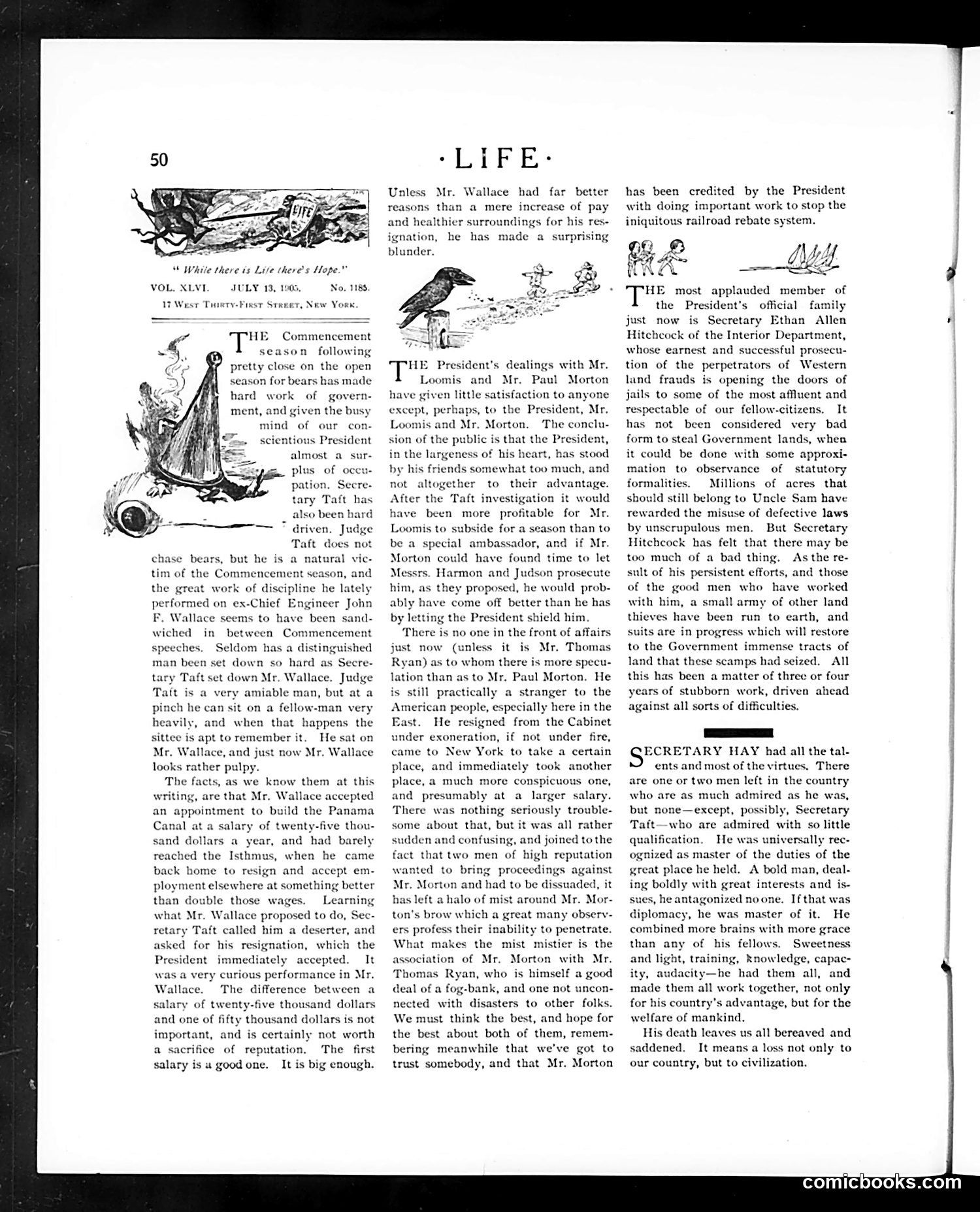
The page critiques President Theodore Roosevelt's handling of Cabinet resignations. The text discusses Mr. Wallace's departure and, more significantly, Secretary of Interior Ethan Allen Hitchcock's role in prosecuting Western land fraud cases. The central issue involves Paul Morton and Mr. Loomis, whose resignations created public confusion. The article suggests Roosevelt was too sympathetic to these figures and their associates, particularly regarding railroad rebate disputes. The author criticizes the President for not sufficiently supporting Hitchcock's anti-fraud efforts—suggesting Roosevelt "shielded" corrupt officials rather than backing prosecution of land thieves operating on public lands. The cartoon (top left, showing bears) likely satirizes the administration's inconsistent stance on corporate wrongdoing and conservation issues.
📄 Transcribed text from this page (OCR, searchable)
Machine-transcribed from the original scan — historical spelling and the odd misread are preserved.
“ White there ts Lite there's Hope.” VOL. XLVI JULY 13, 190 No. 1188, 17 West Tuiety-Fixst Street, New Yors HE Commencement season following pretty close on the open season for bears has made hard work of govern ment, and given the busy mind of our ce . scientious President almost a sur- plus of occu patio re. tary Taft ha also been hard driven. Judge Taft does not chase bears, but he is a natural vic- tim of the Commencement season, and the great work of discipline he lately performed on ex-Chief Engineer John Wallace seems to ha been sand- i in between Commencement Seldom has a distinguished speeches. man been set down so hard as Secre- tay aft set down Mr. Wallace, Judge Tait is av miable man, but at a pinch he can sit on a fellow-man very heavily, and when that happens the sittee is apt to remember it. He Mr. Wallace, and just now Mr. W looks rather pulpy. The facts, as we know them at this writing, are that Mr. Wallace accepted an appointment to build the Pa Canal at a salar sand dollars a y of twenty-five thou- year, and had barely ched the Isthmus, when he came back home to resign and accept em- ployment elsewhere at something better than double those wages. Learning what Mr. Wallace proposed to do, retary Taft called him a deserter, and asked for his resignation, which the President immedi. It was a very curious performance in Mr. Wallace. The difference between a salary of twenty-five thousand dollars and one of fifty thousand dollars is not important, and is certainly not worth a sacrifice of reputation. The first salary is a goodone. It is big enough. rea ec LIFE- Unless Mr. Wallace had far better reasons than a mere increase of pay and healthier surroundings for his res- gation, he has made a surprising blunder. HE President's dealings with Mr. Loomis and Mr. Paul Morton have given little satisfaction to anyone except, perhaps, to the President, Mr. Loomis and Mr. Morton. The conclu- sion of the public is that the President, in the largeness of his heart, has stood by his friends somewhat too much, and not altogether to their advantage. After the Taft investigation it would have been more profitable for Mr. Loomis to subside for a son than to be a special ambassador, and if Mr. Morton could have found time to let Messrs. Harmon and Judson prosecute him, as they proposed, he would prob- ably have come off better than be has by letting the President shield him. There is no one in the front of affairs just now (unless it is Mr. Thomas Ryan) as to whom there is more specu- pn than as to Mr. Paul Morton. He still practically a stranger to the American people, especially here in the East. He resigned from the Cabinet under exoneration, if not under fire, came to New York to take a certain place, and immediately took another place, a much more conspicuous one, and presumably at a larger salary. There was nothing seriously trouble- some about that, but it was all rather sudden and confusing, and joined tothe fact that two men of high reputation wanted to bring proceedings against Mr. Morton and had to be dissuaded, it has left a halo of mist around Mr. Mor- ton's brow which a great many observ- ers profess their inability to penetrate. What makes the mist mistier is the association of Mr. Morton with Mr. Thomas Ryan, who is himself a good deal of a fog-bank, and one not uncon- ed with disasters to other folks. We must think the best, and hope for the best about both of them, remem- bering meanwhile that we've got to trust somebody, and that Mr. Morton has been credited by the President with doing important work to stop the a railroad rebate system. tha HE most applauded member of the President's official family just now is Secretary Ethan Allen Hitchcock of the Interior Department, whose earnest and successful prosecu- tion of the perpetrators of Western land frauds is opening the doors of Is to some of the most affluent and respectable of our fellow-citizens, It has not been considered very bad form to steal Government lands, when it could be done with some approxi- ion to observance of statutory formalities. Millions of acres that should still belong to Uncle Sam have rewarded the misuse of defective laws by unscrupulous men. But Secretary Hitchcock has felt that there may be too much of a bad thing. As the re- sult of his persistent efforts, and those of the good men who have worked ith him, a small army of other land thieves have been run to earth, and suits are in progress which will restore to the Government immense tracts of land that these scamps had seized. All this has been a matter of thr years of stubborn work, driv against all sorts of difficulties. ECRETARY HAY had all the tal- ents and most of the virtues. There are one or two men left in the country who are as much admired as he w: but none—except, possibly, Secretary Taft—who are admired with so little qualification. He was universally rec- ognized as master of the duties of the great place he held. A bold man, deal- ing boldly with great interests and i: sues, he antagonized noone. If that was diplomacy, he was master of it. He combined more brains with more grace than any of his fellows. Sweetnes and light, training, knowledge, cap: ity, audacity—he had them all, and made them all work together, not only for his country’s advantage, but for the welfare of mankind. His death leaves us all bereaved and saddened. It means a our country, but to loss not only to comicbooks.com