
A complete issue · 28 pages · 1905
Life — April 20, 1905
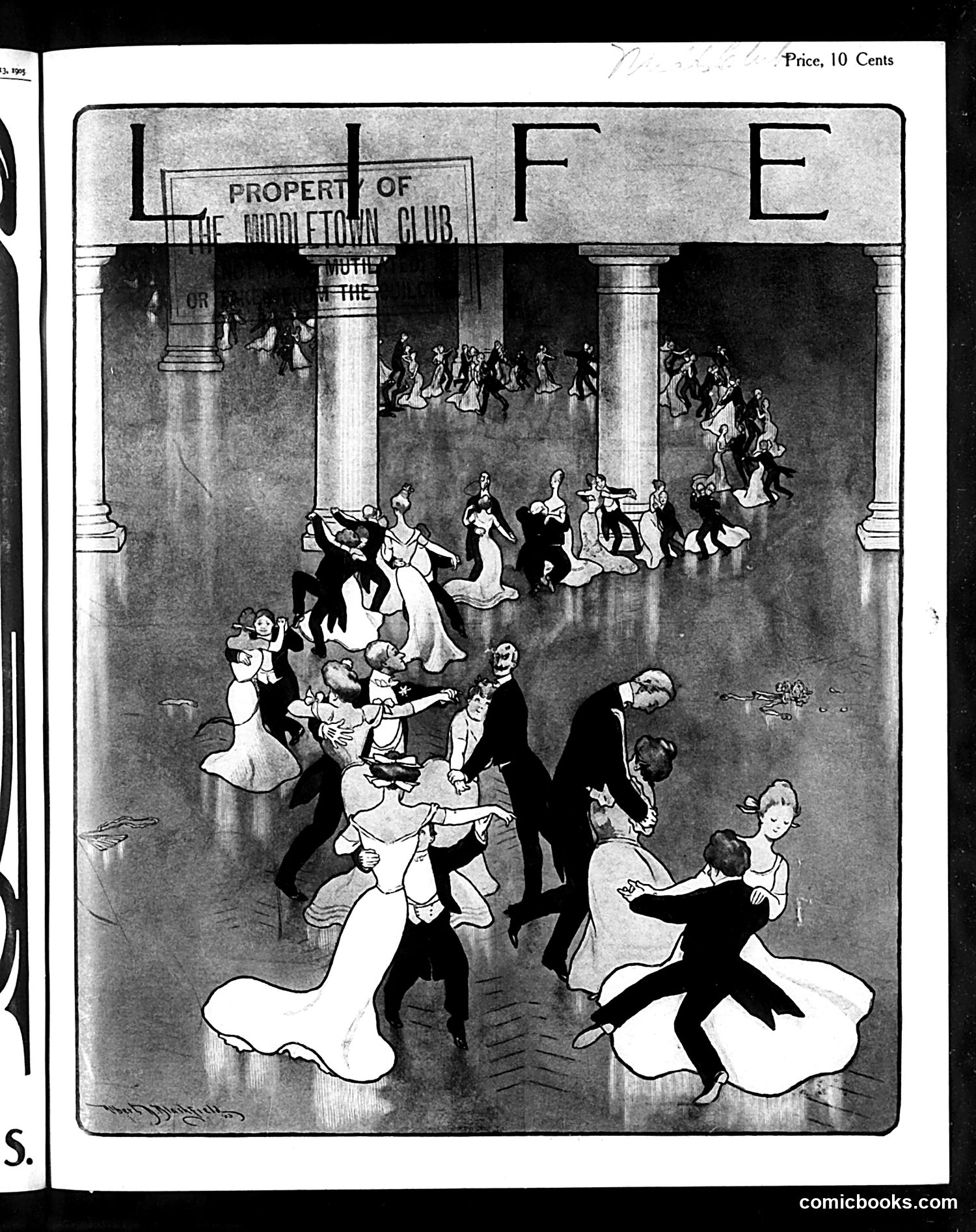
This appears to be a Life magazine cover (price 10 cents, suggesting early 20th century) depicting a formal dance or ball at "The Middletown Club," as indicated by the property stamp. The illustration shows elegantly dressed couples dancing in a grand hall with classical columns. The satire likely mocks high-society social events and the formal rituals of the wealthy upper class. The exaggerated, somewhat absurd poses and movements of the dancers suggest the cartoonist is gently ridiculing the pretension or stiffness of such formal gatherings. Without clearer text or specific historical markers, the exact social commentary remains general—poking fun at aristocratic or upper-class social conventions rather than targeting specific political figures or events.
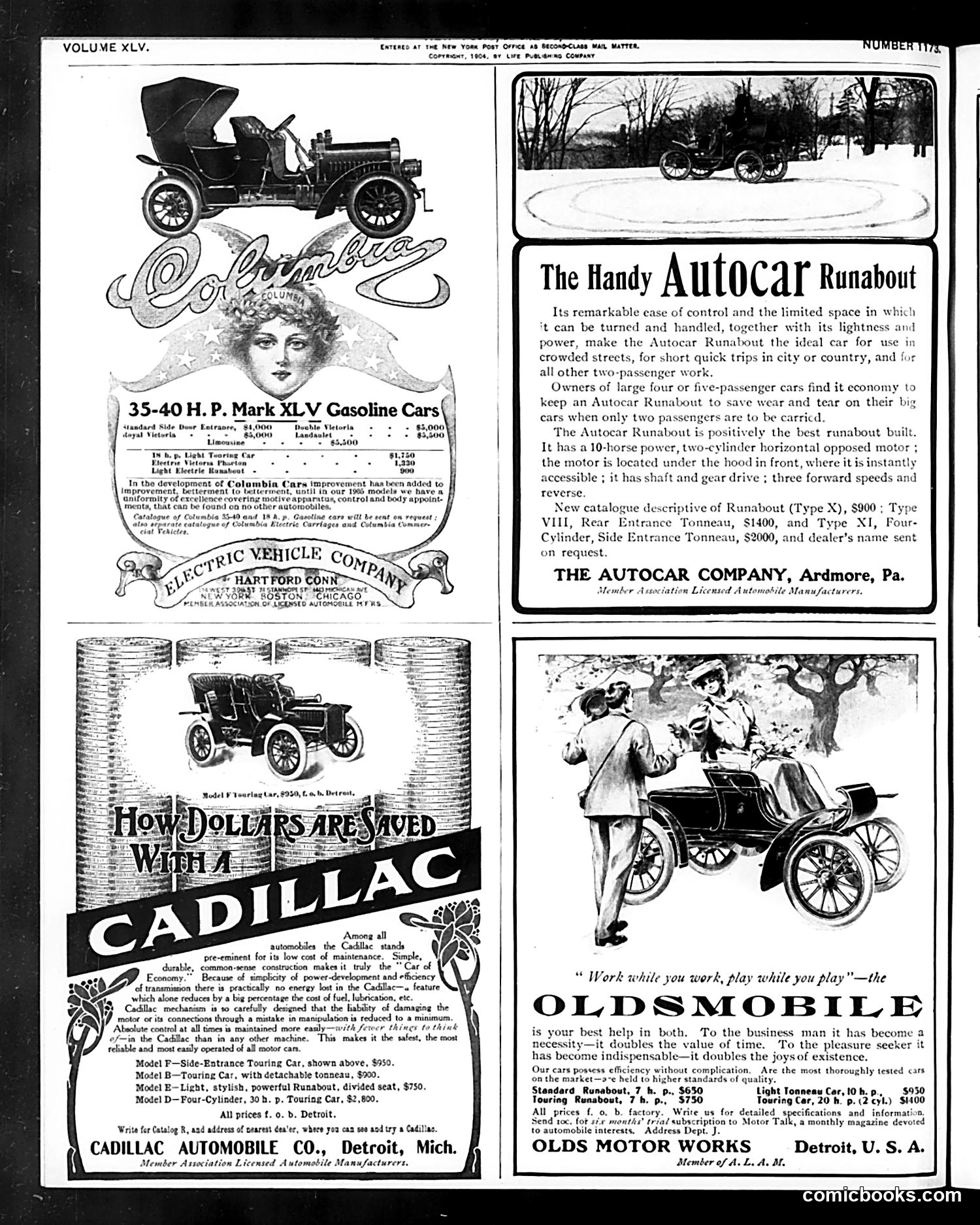
This page is **primarily advertising**, not satire or political commentary. It contains four automobile advertisements from circa 1910: 1. **Columbia** (top left): A 35-40 H.P. gasoline car made by the Electric Vehicle Company, featuring an ornate Art Nouveau design with a woman's face. 2. **Cadillac** (bottom left): Emphasizes low maintenance costs and simple construction, positioning it as economical and reliable. 3. **Autocar Runabout** (top right): Markets a small, nimble two-passenger car for city use and "quick trips." 4. **Oldsmobile** (bottom right): Uses the slogan "Work while you work, play while you play," promoting efficiency and pleasure. These ads reflect early automobile marketing strategies targeting different buyer demographics and use cases during the automotive industry's rapid expansion.
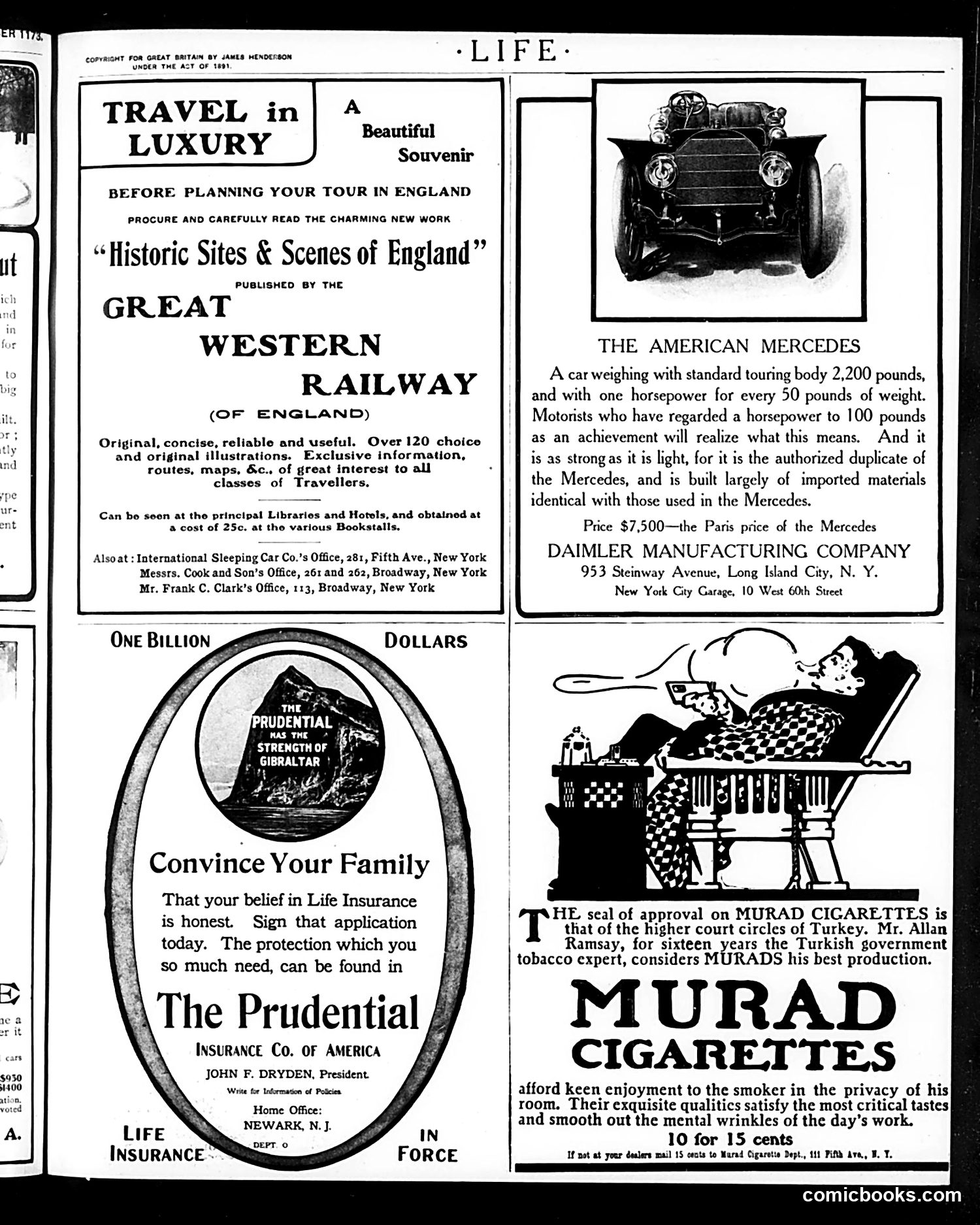
This page is primarily **advertising rather than satire or political commentary**. It contains four distinct ads: 1. **Great Western Railway** — promoting a travel guide to English historic sites 2. **American Mercedes** — a luxury automobile priced at $7,500, positioning itself as equivalent to imported German Mercedes 3. **Prudential Insurance** — using Gibraltar imagery to symbolize strength, encouraging life insurance applications 4. **Murad Cigarettes** — claiming approval from Turkish government tobacco experts, marketed as promoting relaxation and mental clarity There is no political cartoon or satirical content visible. The page reflects early-20th-century advertising practices: luxury goods marketed to wealthy readers, health claims for tobacco (now recognized as false), and appeals to aspiration and security. The Mercedes ad is notably nationalist, emphasizing American manufacturing of a European luxury brand.
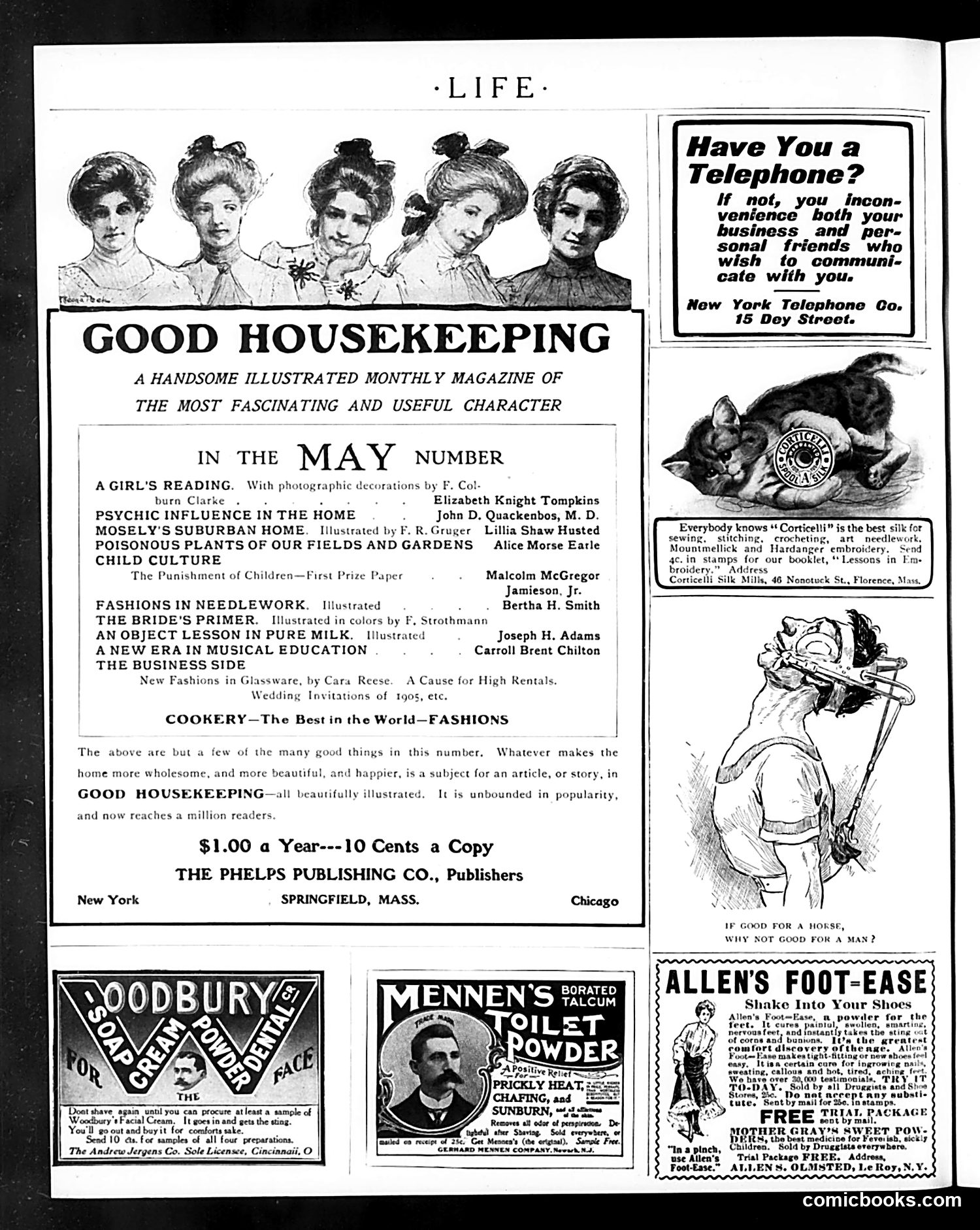
This page is primarily **advertising and magazine promotion**, not political satire. The central content advertises *Good Housekeeping* magazine's May issue, listing articles on topics like child-rearing, fashions, and cooking—reflecting early 20th-century domestic priorities. The right side contains product advertisements: a telephone service, Corticelli silk thread, and foot-care powders. The cartoon showing a man with a broom ("If Good for a Horse, Why Not Good for a Man?") appears to be humorous marketing for Allen's Foot-Ease powder, using absurdist logic rather than political commentary. There is **no discernible political satire** on this page. It represents typical magazine advertising practices of the era, targeting homemakers and reflecting period concerns about domestic life and personal hygiene products.
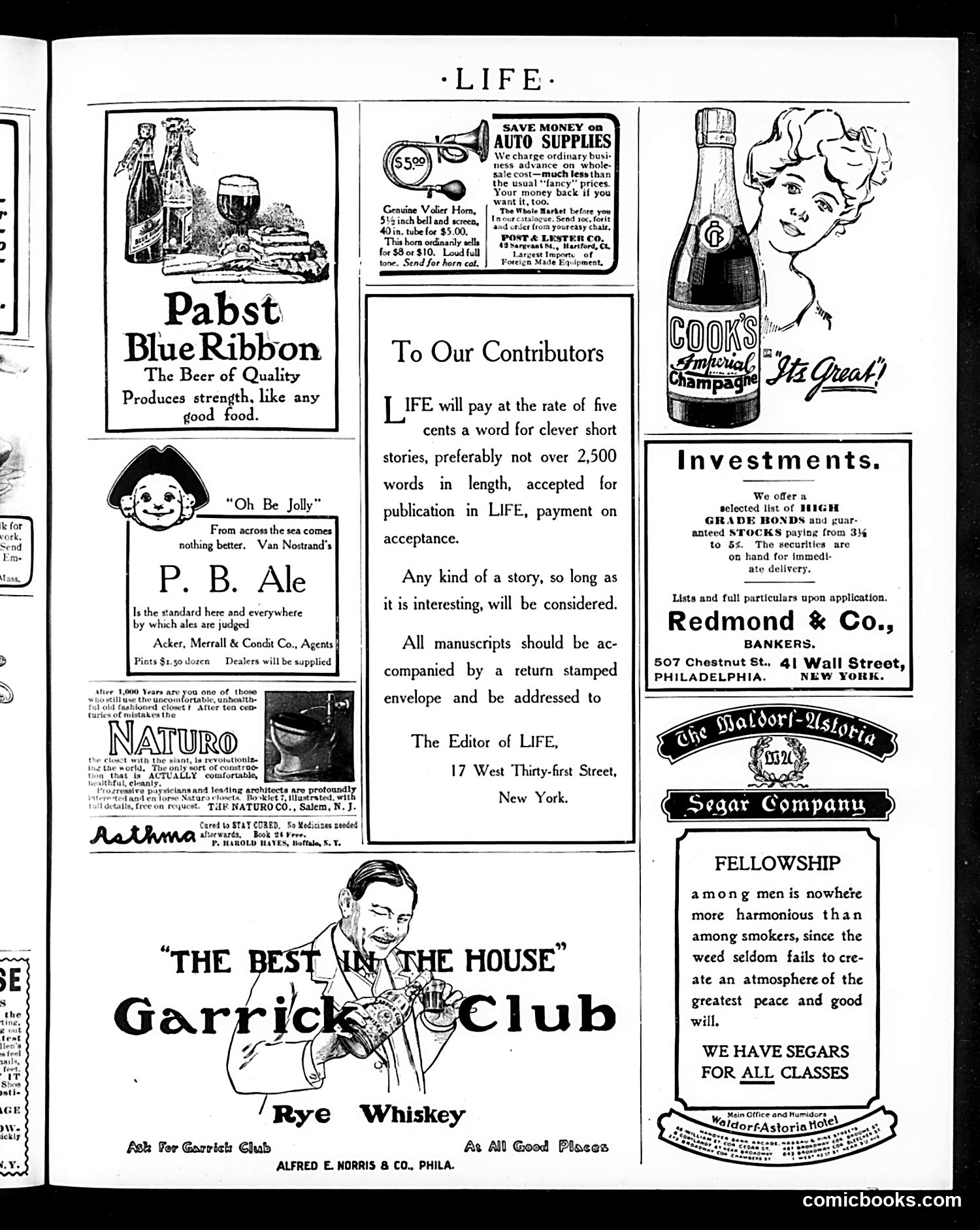
This page is primarily **advertising**, not satirical content. It contains vintage ads for alcohol and other products typical of early 20th-century Life magazine: - **Pabst Blue Ribbon beer** and **P.B. Ale** emphasize quality - **Cook's Imperial Champagne** features a glamorous woman - **Garrick Club Rye Whiskey** shows a satisfied gentleman - **The Waldorf-Astoria Sugar Company** advertises cigars, emphasizing "fellowship among smokers" - **Redmond & Co.** offers investment services The center section contains the magazine's contributor guidelines, stating they pay five cents per word for short stories up to 2,500 words. The ads reflect pre-Prohibition America (alcohol was legal and heavily advertised) and era-typical marketing targeting affluent, male audiences through appeals to quality, sophistication, and social status.
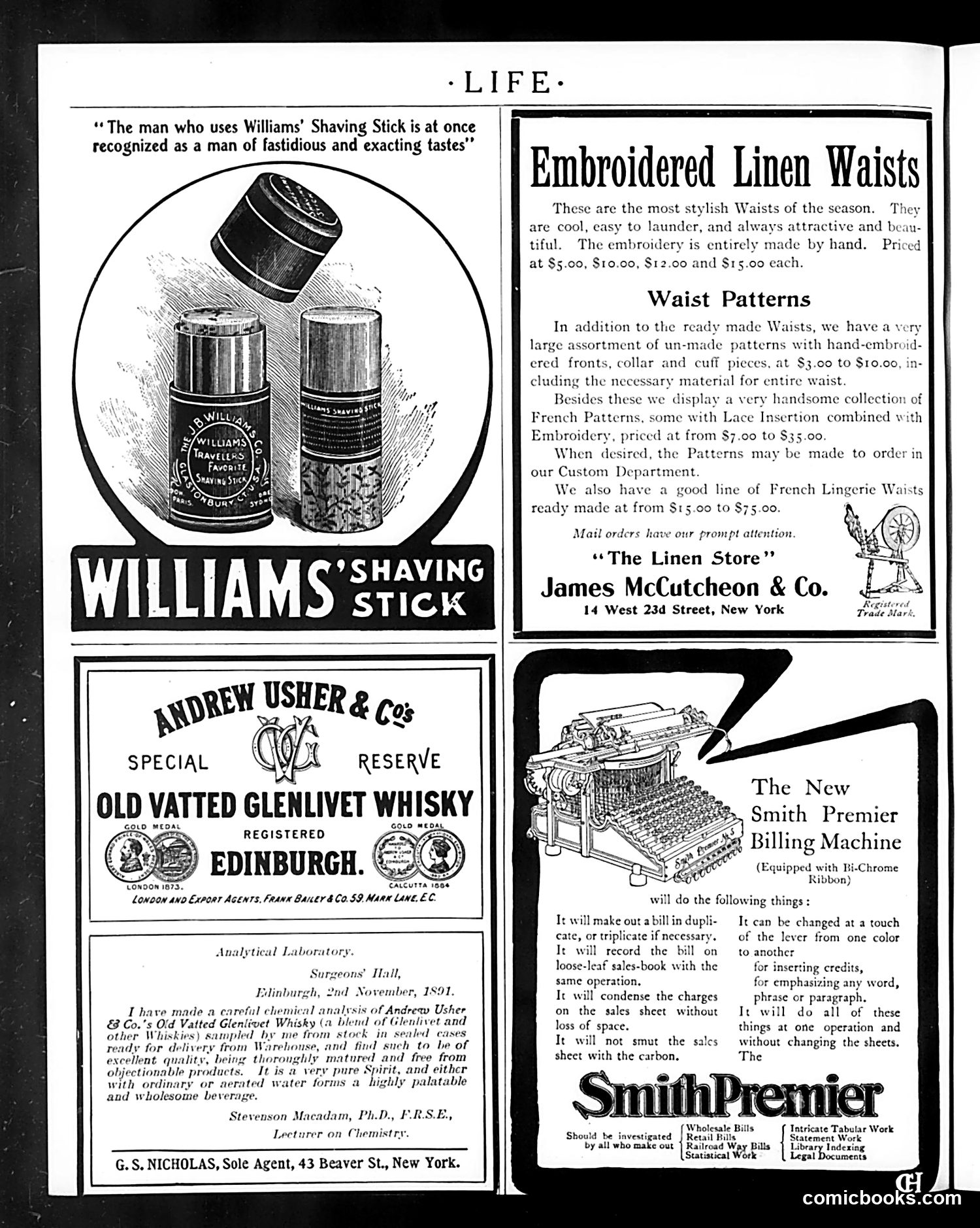
This page is **primarily advertising**, not satirical content. It contains four advertisements from what appears to be an early 1890s issue of *Life* magazine: 1. **Williams' Shaving Stick** — promotes grooming products with the tagline about "fastidious and exacting tastes" 2. **Embroidered Linen Waists** — James McCutcheon & Co. advertises women's clothing from their "Linen Store" in New York 3. **Andrew Usher Whisky** — includes a chemical analysis from Edinburgh dated 1891, lending scientific credibility to the product 4. **Smith Premier Billing Machine** — describes a typewriter-like device for business record-keeping The page reflects late-Victorian consumer culture and advertising practices, with no political satire evident. The scientific testimonial format was typical for period advertisements seeking to establish product legitimacy.
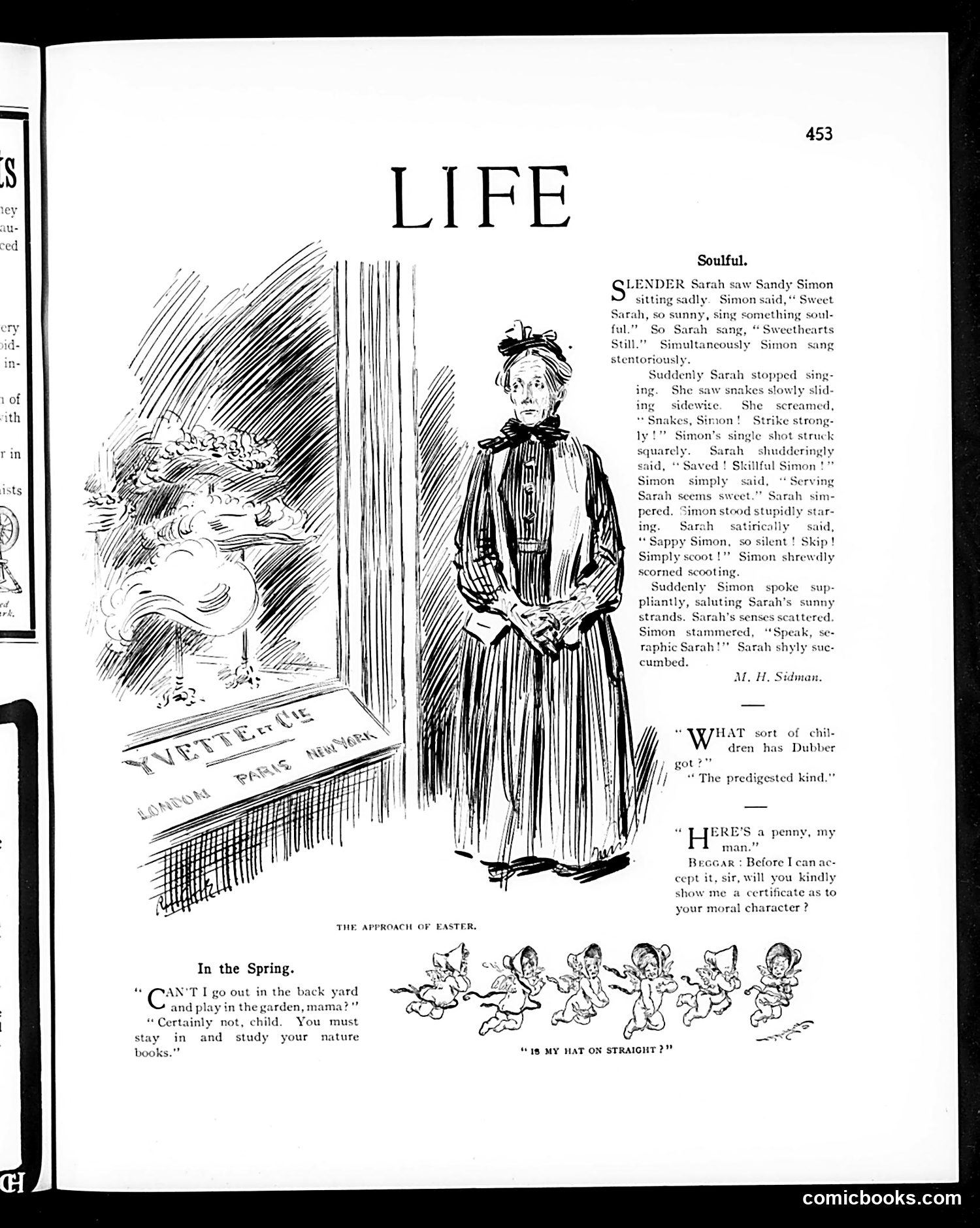
This page contains three distinct pieces of satirical content: **"Soulful"** depicts a dialogue between Sarah and Sandy Simon, where Sarah interrupts Simon's singing with warnings about snakes. The satire appears to mock romantic sentimentality—Simon's attempts at soulful performance are repeatedly disrupted by practical, mundane concerns, deflating the pretense of emotional depth. **"The Approach of Easter"** shows a fashionable woman viewing Easter bonnets in a shop window, satirizing the commercial materialism surrounding the holiday and women's obsession with fashionable headwear. **"In the Spring"** presents a child requesting to play outdoors while a parent insists on studying books, mocking rigid parental discipline that ignores children's natural instincts and seasonal desires. The beggar/penny dialogue at bottom appears to mock moral hypocrisy regarding charity.
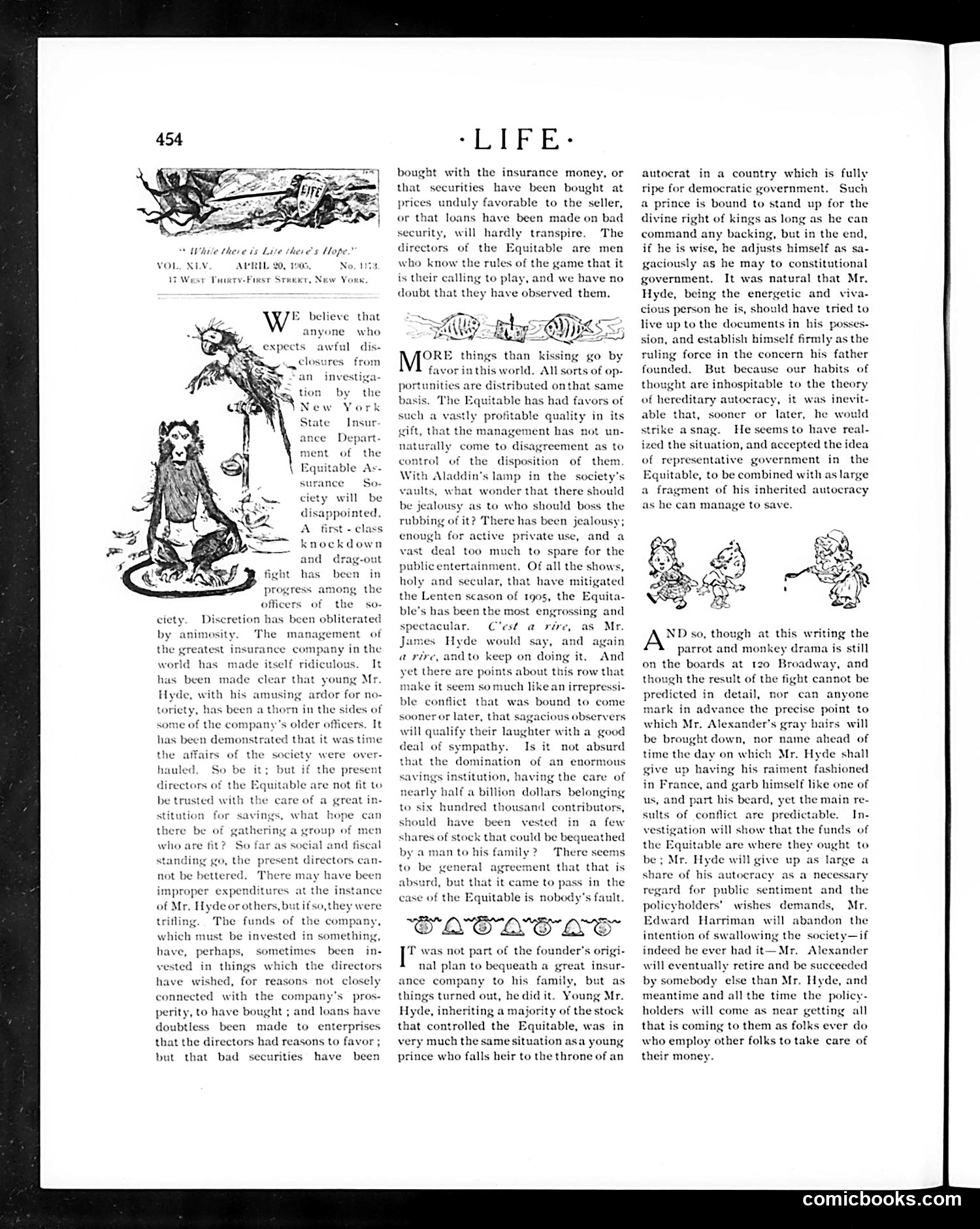
This page critiques the **Equitable Life Assurance Society**, a major insurance company. The left margin contains decorative political cartoons featuring anthropomorphized figures—including what appears to be a lion and other symbolic creatures representing institutional power or corruption. The article attacks the Equitable's management for mishandling funds and stock belonging to hundreds of thousands of policyholders. The satire suggests company directors prioritized personal enrichment over fiduciary responsibility, comparing Mr. Hyde (the company heir) to a prince unaccountable to democratic oversight. The piece questions whether such vast institutional wealth should remain concentrated in few hands, advocating transparency and suggesting policyholders deserve greater say in how their money is managed—reflecting Progressive-era concerns about corporate accountability and democratic control of financial institutions.
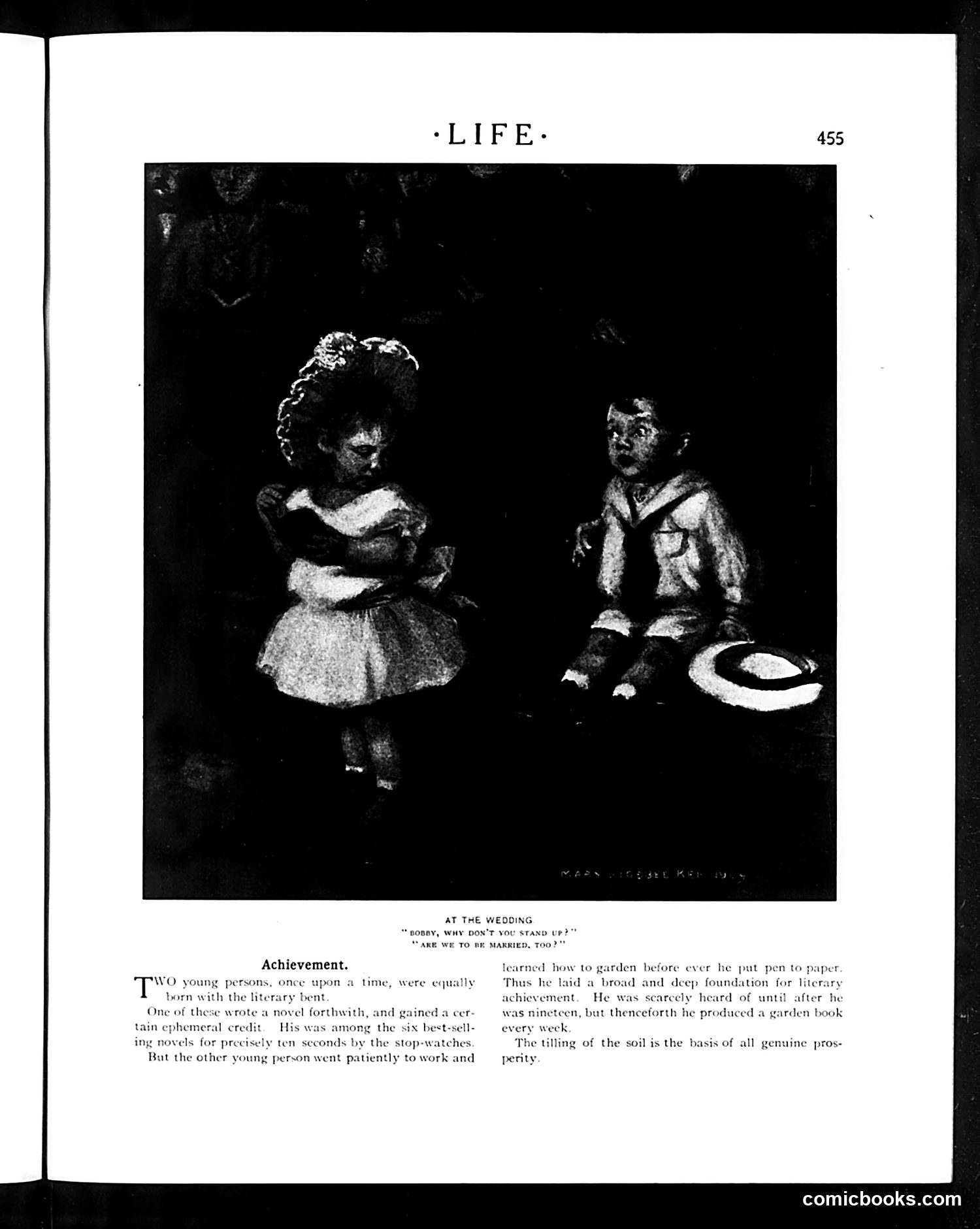
The image shows two young children in formal attire with the dialogue: "Bobby, why don't you stand up?" / "Are we to be married, too?" The accompanying text titled "Achievement" contrasts two young persons born with equal literary bent: one wrote a novel and gained "ephemeral credit," while the other "went patiently to work" and learned gardening, eventually producing a "garden book every week" by age nineteen. The cartoon satirizes childhood confusion about social rituals—the child misunderstands the formal wedding setting, assuming "standing up" means participating in marriage himself. The broader editorial message celebrates practical accomplishment (gardening/horticultural writing) over fleeting literary success, reflecting early 20th-century Life magazine's tendency toward moral instruction alongside humor.
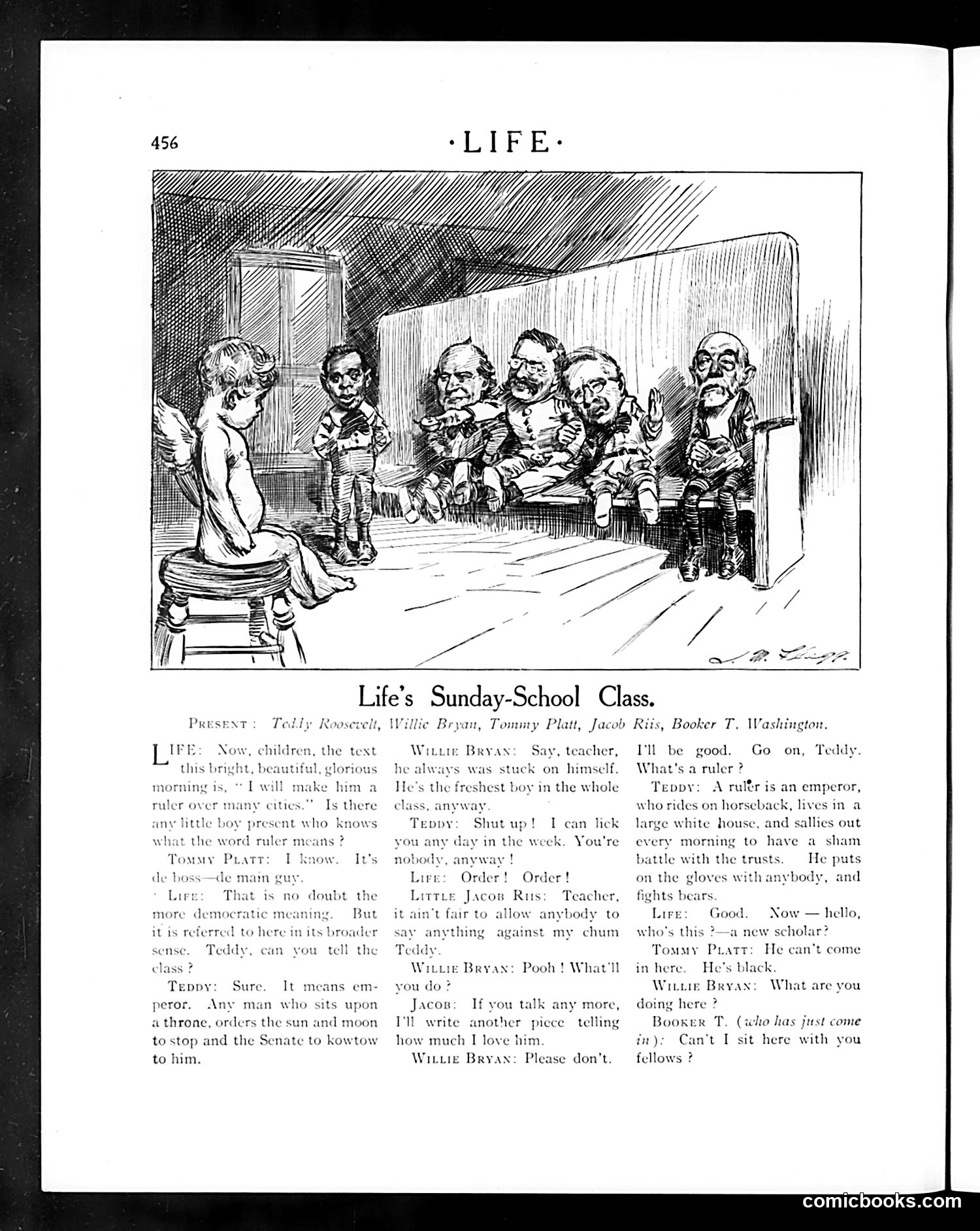
This satirical cartoon depicts a Sunday school lesson where a young teacher attempts to instruct a group of caricatured adult men (identified as Teddy Roosevelt, Willie Bryan, Tommy Platt, Jacob Riis, and Booker T. Washington) as if they were unruly children. The joke mocks these public figures by portraying them as childish and argumentative—bickering over classroom rules, insulting each other, and refusing to behave. The teacher struggles to maintain order while the "students" prioritize personal attacks over learning. This appears to satirize American political and social leaders of the early 1900s, suggesting their public behavior was petty and immature rather than dignified or statesmanlike. The cartoon uses the metaphor of a chaotic classroom to critique their conduct.
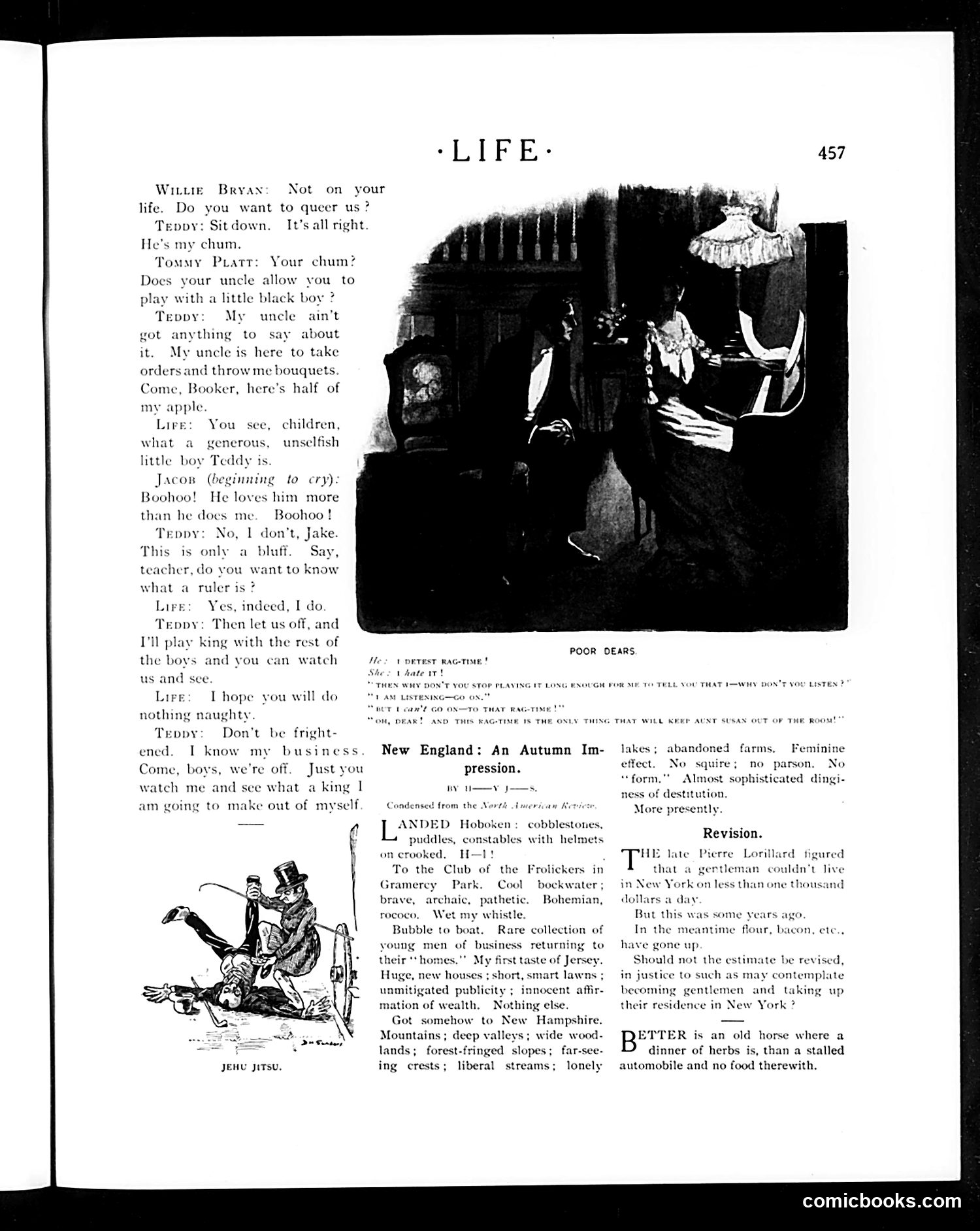
This page contains a comedic dialogue between characters named Willie Bryan, Teddy, Tommy Platt, and Jacob, discussing a "little black boy" named Teddy. The joke appears to mock racial attitudes and uncle-nephew relationships of the era, with Jacob's exaggerated "Boohoo!" reaction creating physical comedy. Below is a sketch labeled "JBIU JITSU" showing figures in combat, likely satirizing the Japanese martial art's then-novel popularity in America. The page also includes literary pieces titled "Poor Dears" and sections on "New England: An Autumn Impression" and "Revision," discussing real estate and genteel life. The racial language and characterizations reflect early 1900s attitudes, presenting content that modern readers would find offensive, though historically representative of Life's satirical approach.
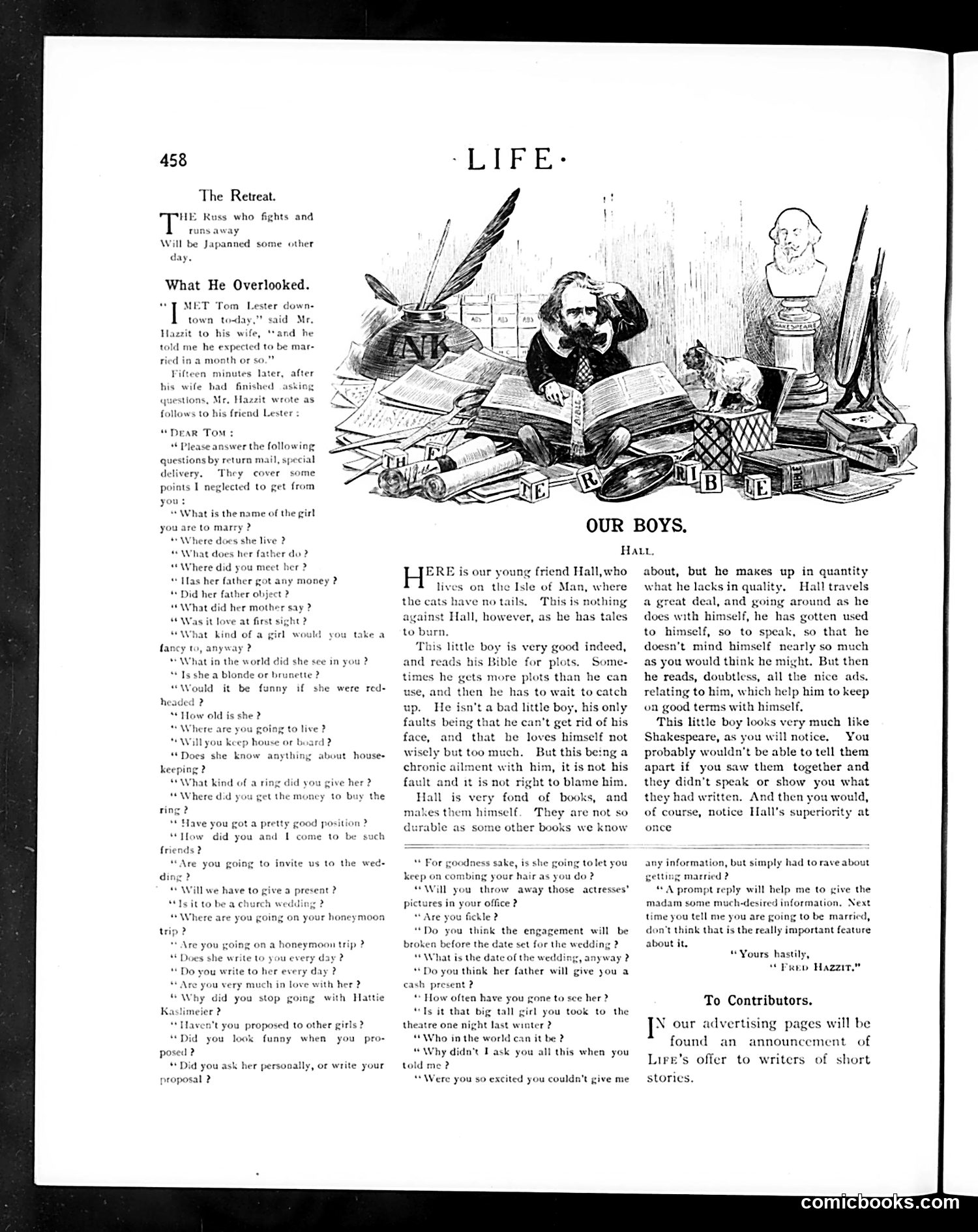
This page contains two distinct sections. "The Retreat" and "What He Overlooked" appear to be humorous short stories about romantic mishaps—one involves a man named Tom whose engagement plans go awry, the other a list of comedic questions a rejected suitor failed to ask. The main illustration shows a young boy surrounded by books and study materials, accompanying "Our Boys: Hall," a character sketch. Hall is portrayed as a vain, self-absorbed boy who reads extensively but retains little useful knowledge. The satire mocks his vanity and shallow nature despite his intellectual pretensions. The page concludes with a call for short story submissions to *Life*. The cartoons lack overtly political content, instead targeting social pretension and romantic comedy—typical fare for *Life*'s satirical humor.
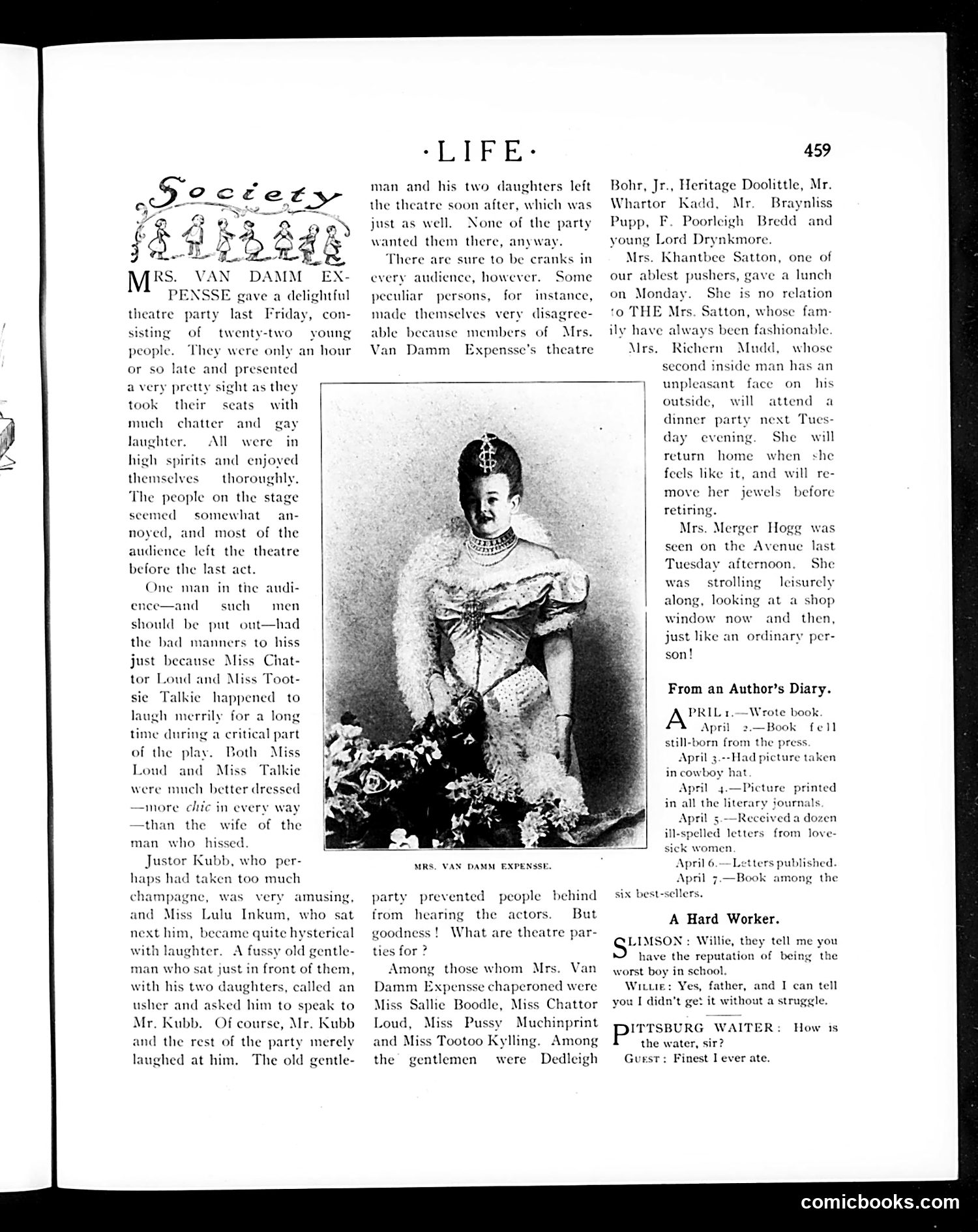
This page satirizes wealthy society's theatrical pretensions and bad behavior. The central image is **Mrs. Van Damm Expensse**, a society hostess whose exaggerated name itself mocks conspicuous consumption. The text describes her theater party where young socialites arrived late, disrupted the performance by laughing during serious scenes, and behaved rudely to other patrons—yet faced no consequences because of their social status. The satire's target: wealthy people who attend cultural events not to appreciate art but as social performance, treating theaters as venues for self-display while showing contempt for both performers and fellow audience members. The joke is that the *actors* seemed annoyed, and "most of the audience left"—yet the socialites remained unbothered, protected by their class position. The accompanying gossip column and "Hard Worker" cartoon continue mocking society's shallow values and poor behavior masked by wealth and fashion. The satire assumes readers recognize this type of aristocratic rudeness as contemptible.
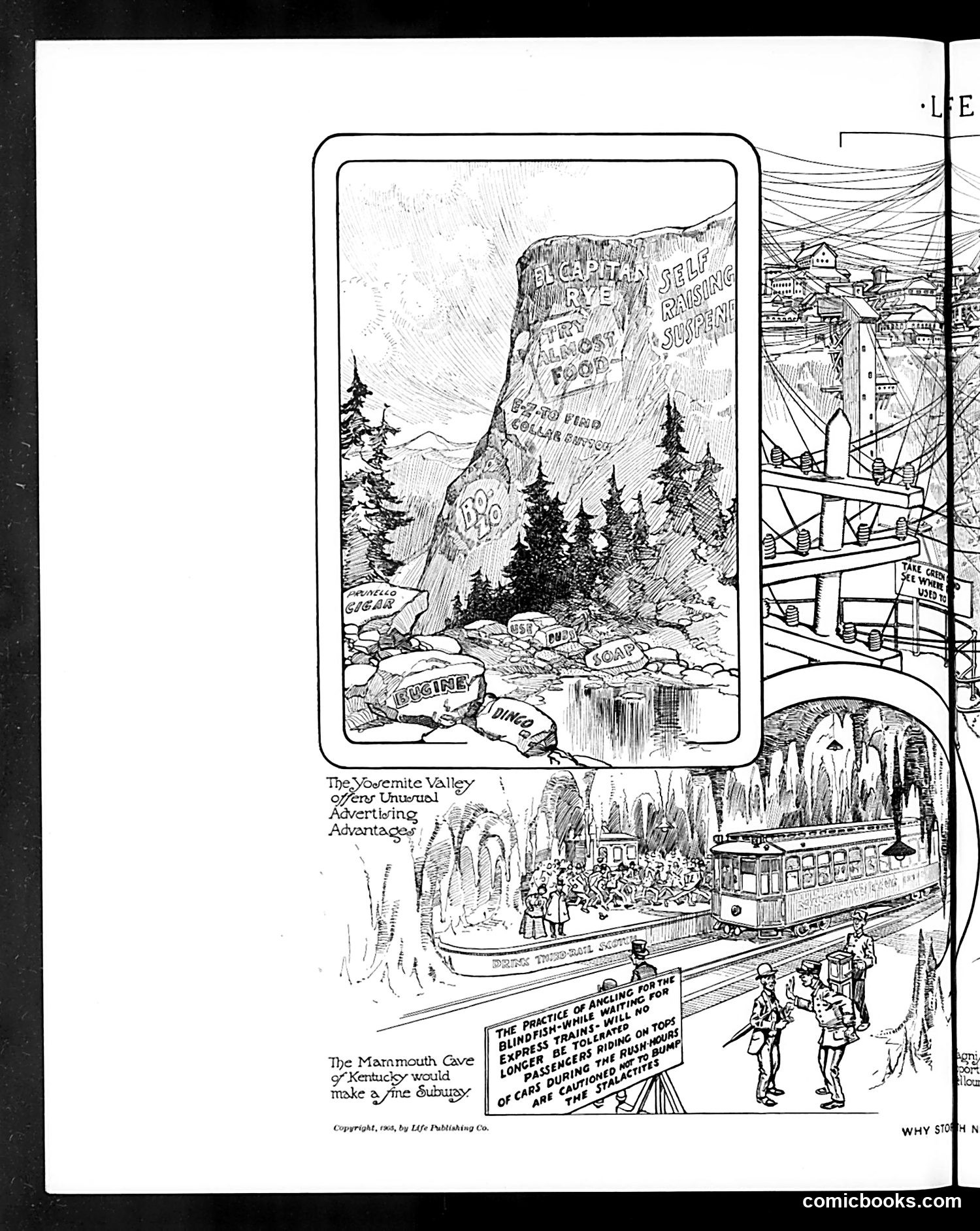
This page contains two separate satirical cartoons about American tourist attractions and their commercial potential. The top cartoon depicts El Capitan in Yosemite Valley covered with advertising text—"Self Raising Snowbent," "Dried Food," and other product names. It mocks how natural landmarks were being commercialized through aggressive advertising during the early 1900s. The bottom cartoon suggests Kentucky's Mammoth Cave would make "a fine subway," depicting a tourist railway and crowds. This appears to satirize the era's obsession with modernization and commercial development, even of natural wonders meant to be preserved in their original state. Both cartoons critique the tension between preserving natural beauty and the commercial impulse to exploit scenic areas for profit and tourism—a tension that remains relevant today.
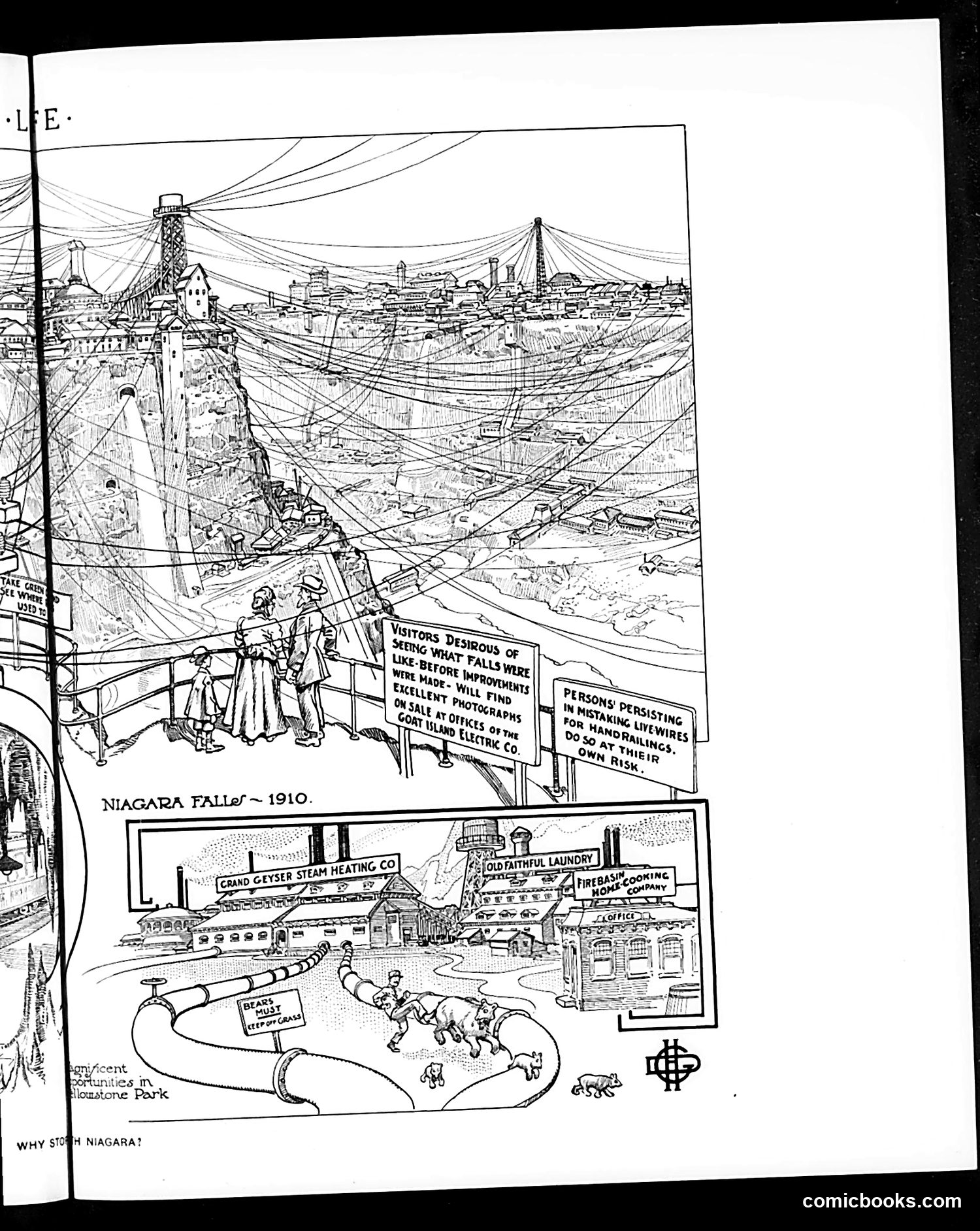
This page satirizes commercial exploitation at Niagara Falls. The top illustration shows tourists viewing the falls amid extensive power lines and industrial infrastructure—the "improvements" mentioned in the text boxes. The satire critiques how industrial development (power generation plants visible in the lower panel) has overtaken the natural wonder, with warnings about electrical hazards added to the scenic experience. The lower panel depicts "Efficient Fortunes in Hiolatone Park"—showing industrial buildings (Grand Geyser Steam Heating Co., laundry, cooking operations) crowding what should be natural landscape. The figure running through pipes suggests chaos replacing natural beauty. The headline "Why Stop in Niagara?" implies visitors should leave because commercialization has destroyed the falls' appeal. The satire targets how American industrial capitalism prioritizes profit over preserving natural attractions.
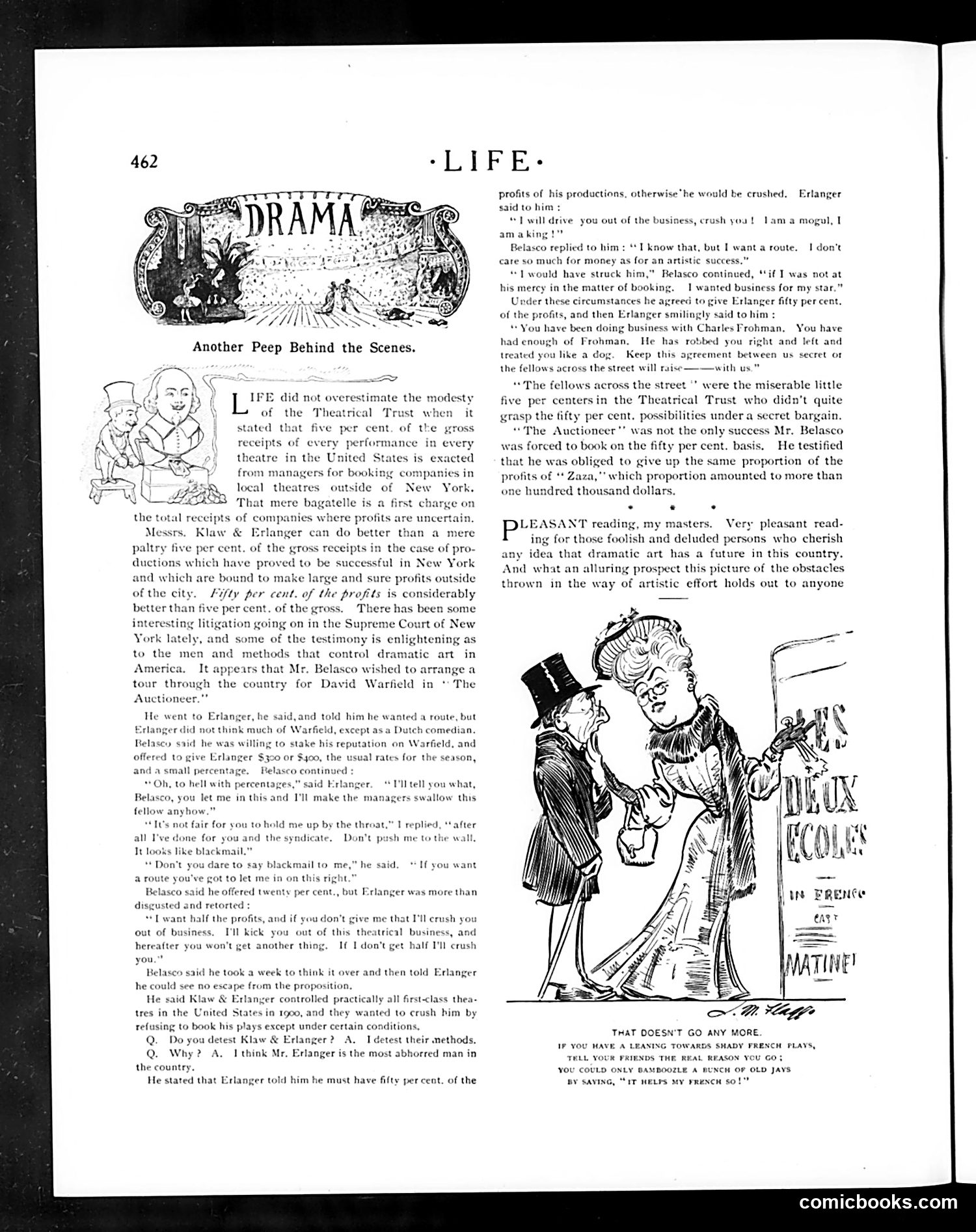
This article satirizes the brutal business practices of **Klaw & Erlanger**, theatrical producers who controlled most American theaters around 1900. The piece documents testimony from producer **David Belasco** in a Supreme Court case exposing their monopolistic methods. The core issue: Erlanger demanded 50% of profits from Belasco's productions (far exceeding the standard 5% booking fee) to distribute his plays through their theater chain. When Belasco resisted, Erlanger threatened to blacklist him entirely—"I'll crush you out of business." The accompanying cartoon (by D. Jim Hall) depicts this coercive dynamic: a well-dressed figure in a top hat aggressively grabs another man by the throat, labeled "THAT DOESN'T GO ANY MORE"—presumably Belasco's defiant response. The satire denounces Erlanger as tyrannical ("the most abhorred man in the country") and exposes how monopolistic control of venues enabled theatrical extortion, crushing artistic independence.
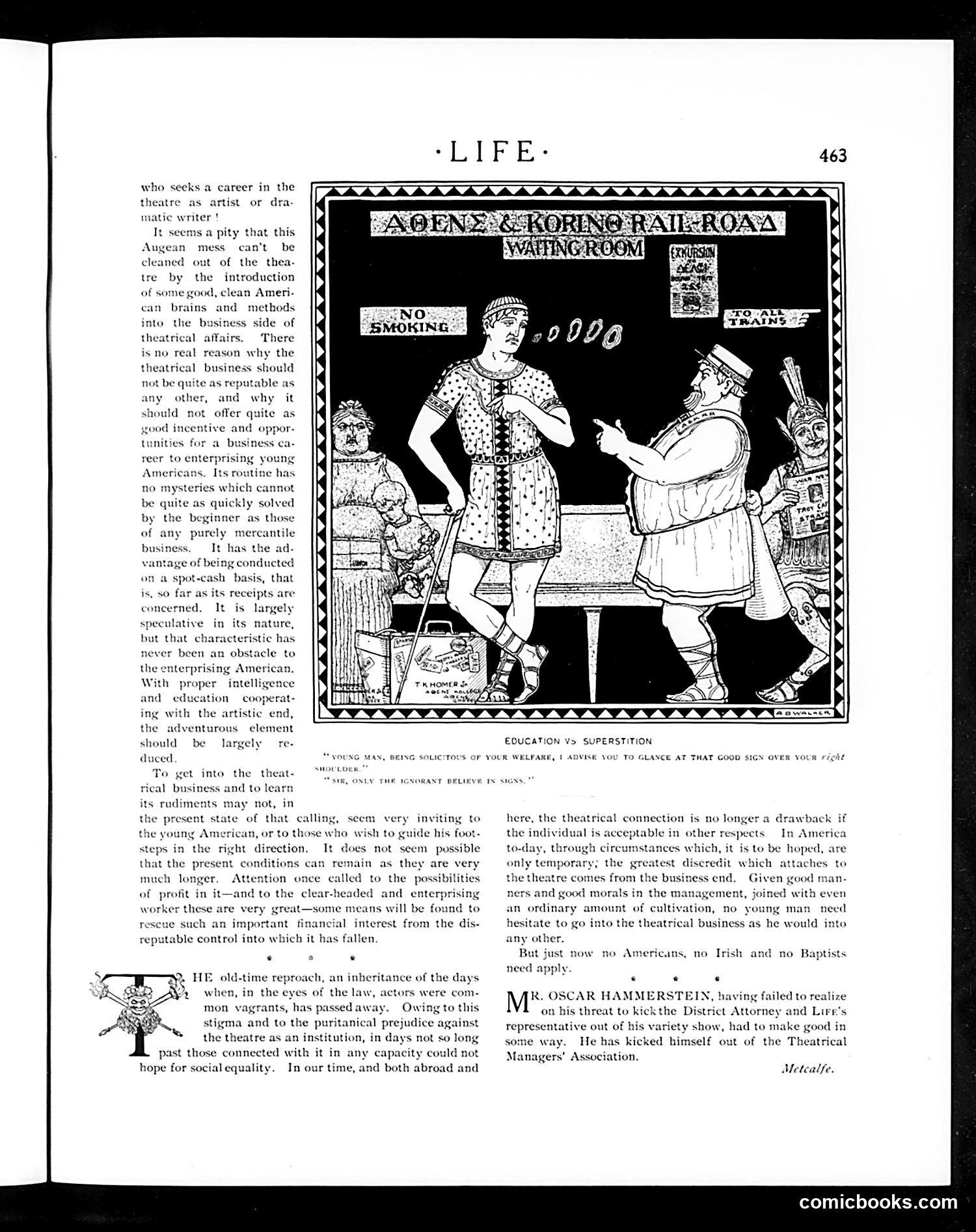
The main cartoon, titled "Education vs Superstition," depicts a woman in a waiting room confronted by a man pointing to a "No Smoking" sign. The satire contrasts rational, modern business practices (the sign representing education and regulation) against superstitious prejudice against theatre workers. The accompanying text argues that theatre should be respectable work like any other business, managed with "good manners and good morals." It criticizes the outdated stigma that historically made theatre workers—particularly Irish Catholics and Baptists—social pariahs treated as "vagrants." The final note about **Oscar Hammerstein** (appears to be a theatre manager) relates to a dispute with authorities over his variety show, suggesting he failed in threatening to expel district officials and was forced to comply with regulations. **The broader point**: The satire advocates modernizing theatrical business practices while mocking lingering American prejudices against theatre as a legitimate career for respectable people.
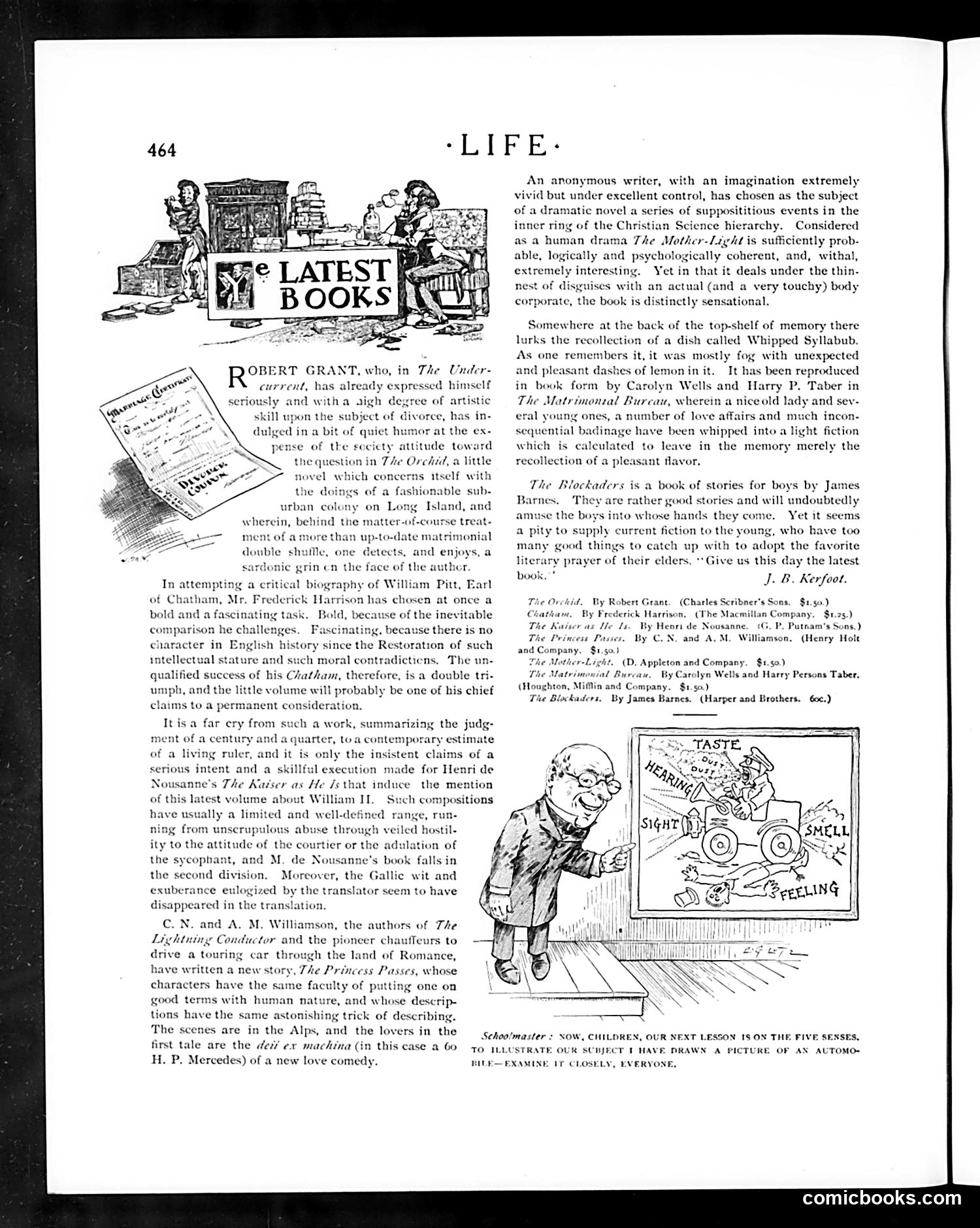
This is a **book review page** rather than political satire. The page discusses contemporary novels and biographical works, with decorative illustrations including a "Latest Books" masthead and a cartoon figure demonstrating the five senses. **Key reviews mentioned:** - Robert Grant's *The Orchid* (satirizing divorce among wealthy Long Island suburbanites) - Frederick Harrison's biography of William Pitt, Earl of Chatham - An anonymous novel called *The Mother-Light* about Christian Science hierarchy - *The Matrimonial Bureau* by Wells and Taber (a light romantic comedy) - *The Blockaders* by James Barnes (boys' adventure stories) The page emphasizes that *The Mother-Light*, though fictional, deals with a "very touchy" real institution—suggesting contemporary readers recognized the thinly-veiled Christian Science references as potentially controversial. The tone is literary criticism typical of early 20th-century magazines, not political commentary.
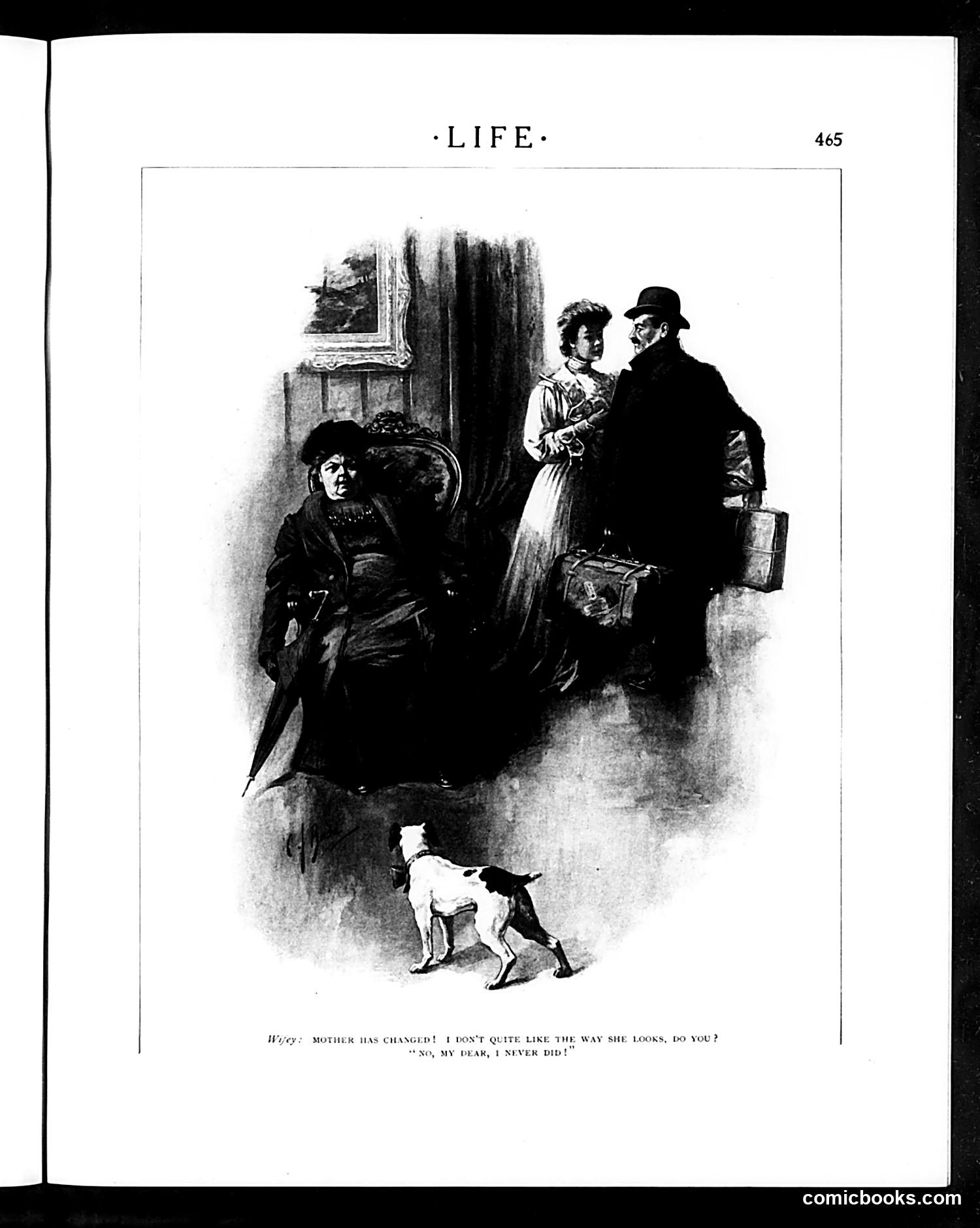
This cartoon satirizes the anxiety men experienced when women adopted new fashions and appearances. A military officer (seated left) and a gentleman with luggage (right) discuss a woman in modern dress, expressing disapproval of how she "looks" now compared to before. The joke plays on conservative male resistance to changing female fashion and independence—likely referencing the early 20th century when women's clothing became less restrictive and women gained more public visibility. The men's nostalgic preference for how women "never" looked before suggests satirical criticism of male rigidity and reluctance to accept women's evolving social roles and self-presentation. The small dog in the foreground may underscore this commentary through its innocence.
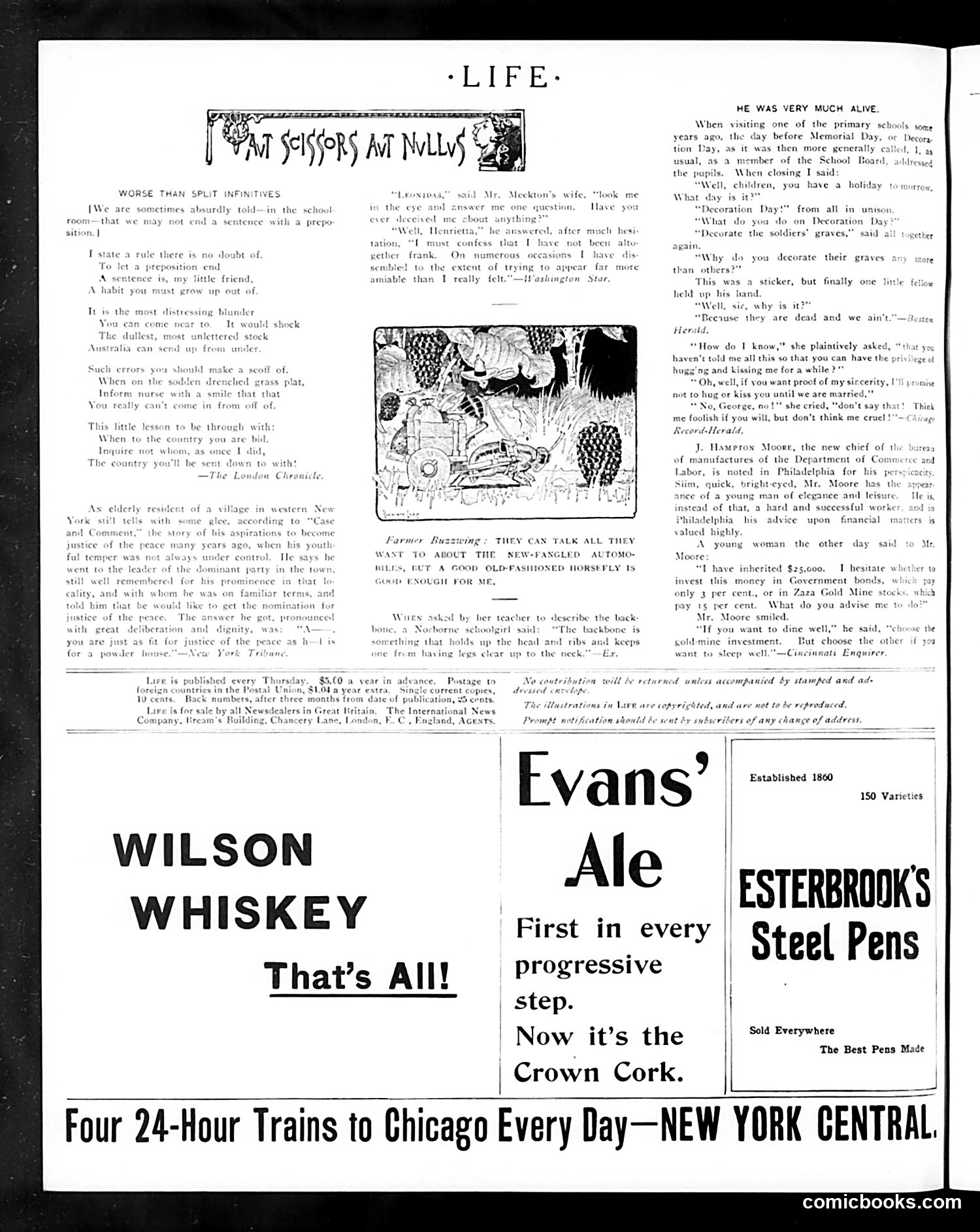
This page from *Life* magazine contains multiple elements: a **moral lesson poem** about avoiding grammatical errors in sentences; a **humorous anecdote** about a schoolchild who doesn't understand why we decorate soldiers' graves on Decoration Day (Memorial Day), with the punchline that the child thinks dead soldiers are irrelevant since "they are dead and we ain't"; and a **cartoon titled "Farmer Buzzing"** depicting rural characters discussing old-fashioned horse-drawn transport versus new automobiles—implying resistance to modern technology. The page also includes **period advertisements** for Wilson Whiskey, Evans' Ale, Esterbrook's Steel Pens, and New York Central Railroad trains. The humor targets **American social attitudes**: children's logical but tactless questions, rural conservatism regarding innovation, and genteel instruction in proper English usage. All reflect early 20th-century concerns about education, progress, and propriety.
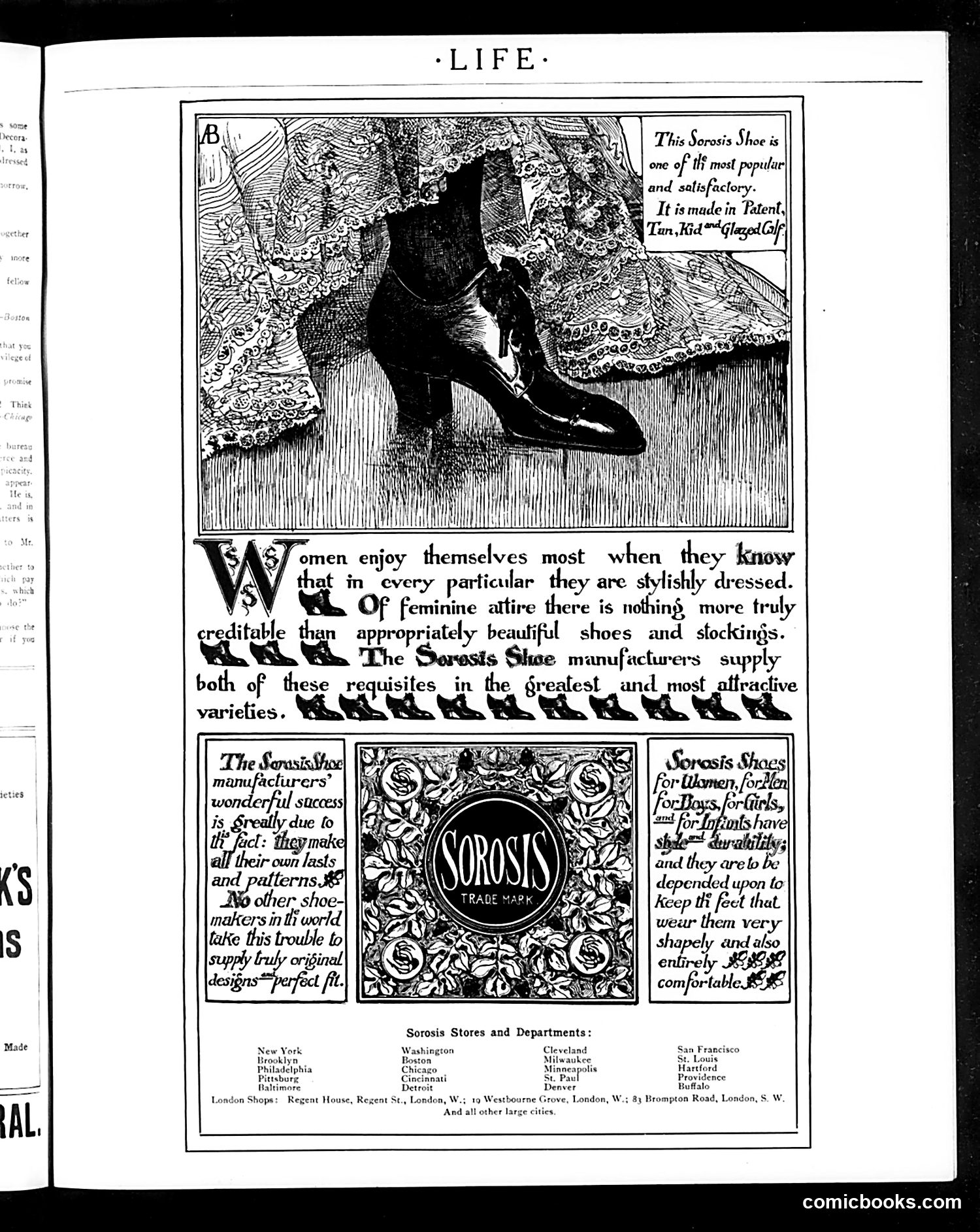
This is primarily an **advertisement**, not satire or political commentary. It promotes Sorosis brand shoes and stockings for women, children, boys, and infants. The page argues that women's enjoyment depends on being "stylishly dressed," emphasizing that "appropriately beautiful shoes and stockings" are essential to feminine appearance and credibility. The Sorosis company claims superior design, fit, and comfort compared to competitors. The illustration shows a woman in an elegant dress admiring her footwear—a visual that reinforces the advertisement's message linking shoe quality to feminine satisfaction and social presentation. The ad lists Sorosis retail locations across major American cities and London, indicating this was a nationally distributed, upscale brand. The elaborate decorative border and ornamental design reflect early 20th-century advertising aesthetics targeting affluent women consumers.
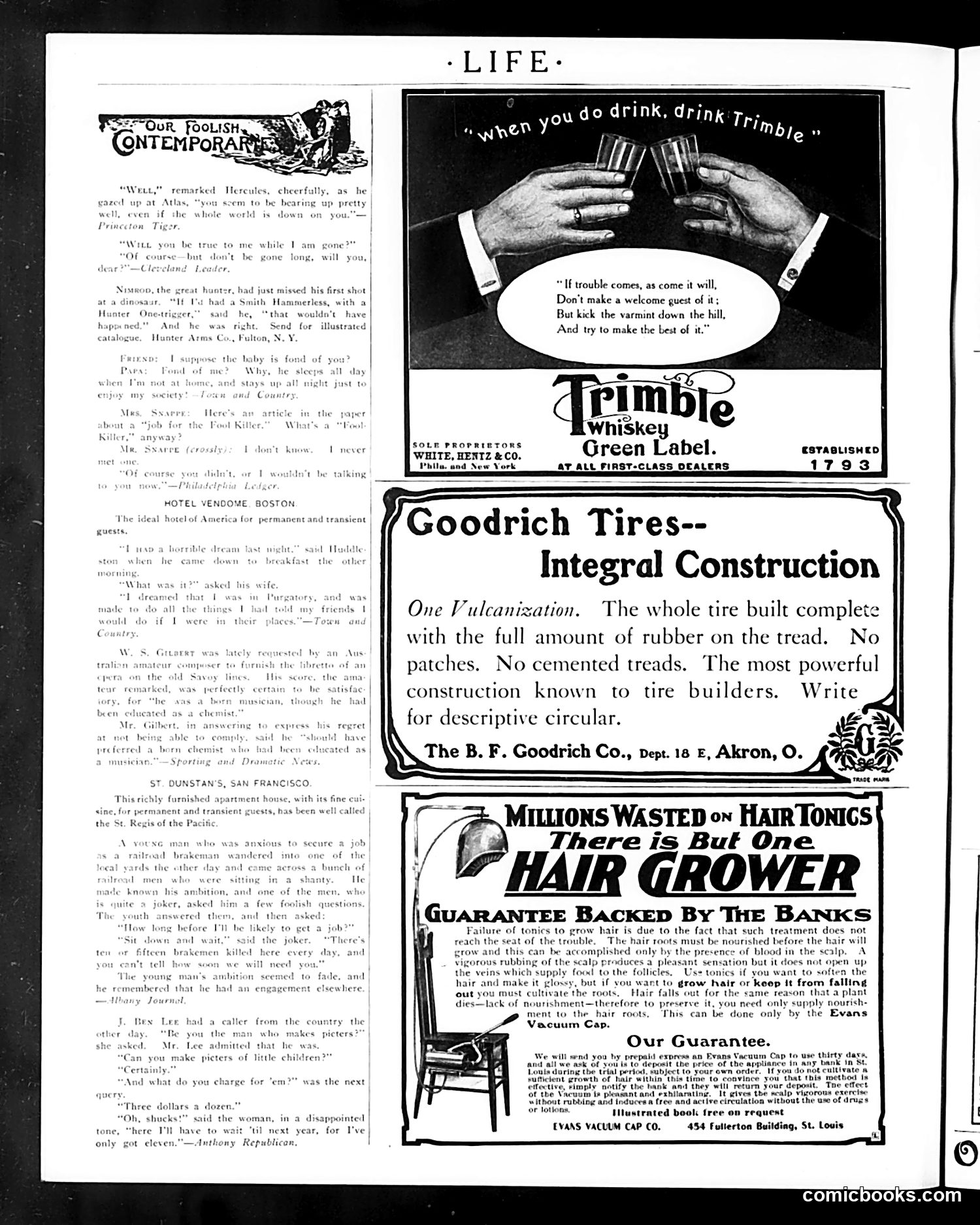
This page contains **no political cartoons**—it's primarily **advertisements and humorous anecdotes** from early 20th-century Life magazine. The left column features "Our Foolish Contemporaries," a regular satirical section mocking absurd statements by public figures through brief, comedic quotes (though the specific speakers aren't clearly identified in this excerpt). The advertisements promote: - **Trimble Whiskey** ("When you do drink, drink Trimble") - **Goodrich Tires** with "integral construction" technology - **Evans Vacuum Cap** for hair growth, guaranteeing results or money back The hair-growth ad is particularly noteworthy as period quackery—it promised to stimulate scalp circulation and prevent baldness, exemplifying the dubious medical claims common in early 1900s advertising that Life's satirical content likely mocked elsewhere. The tone reflects Life's role as a magazine satirizing contemporary American foolishness, from celebrity nonsense to commercial hucksterism.
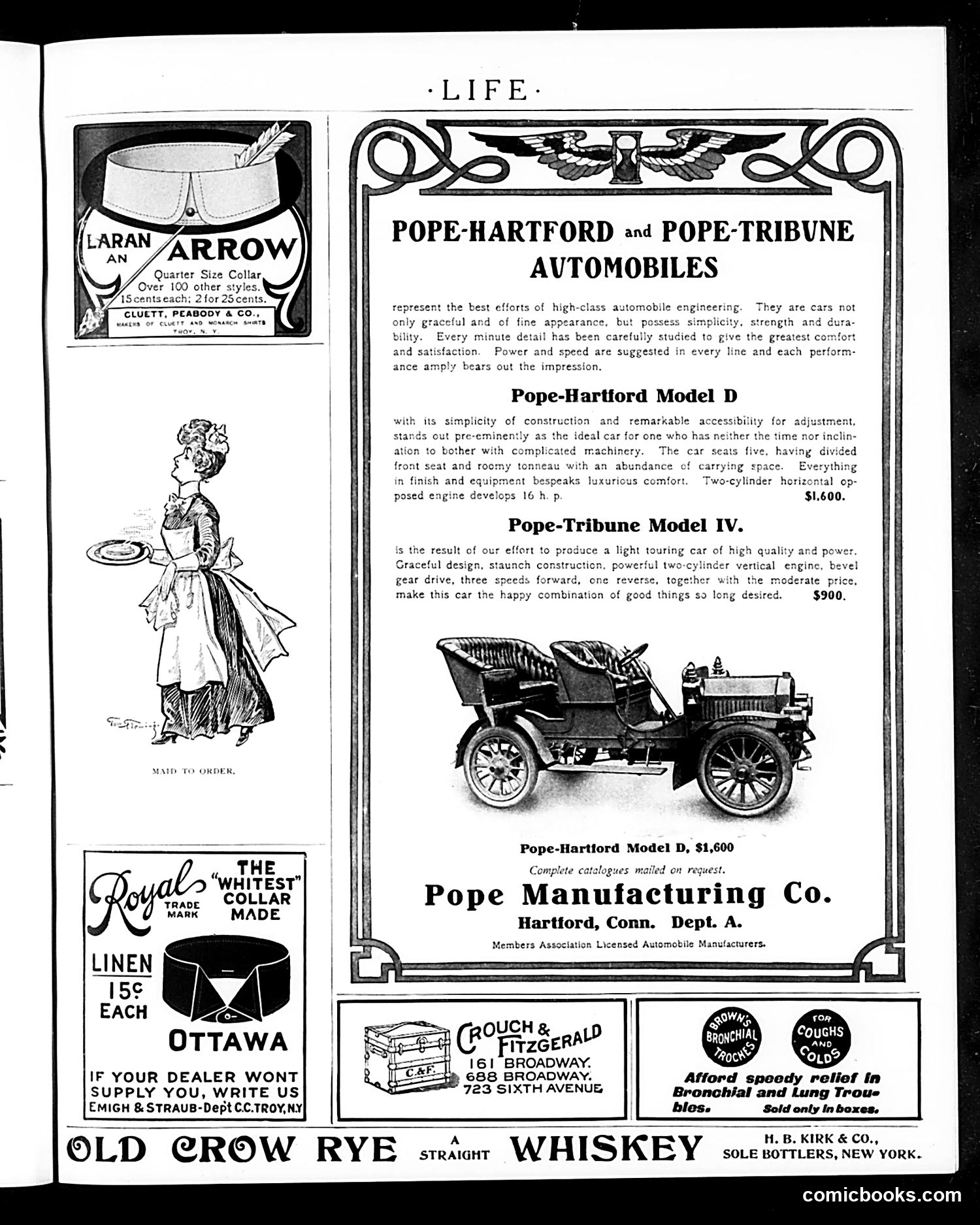
This is primarily an **advertising page** rather than satirical content. It features multiple commercial advertisements typical of early 1900s publications. The main advertisement promotes **Pope Manufacturing Company automobiles**—the Pope-Hartford Model D ($1,600) and Pope-Tribune Model IV ($900). These were legitimate competing car models marketed as high-quality, accessible vehicles with modern engineering features. Surrounding ads include: - **Laran Arrow collars** (men's fashion) - **Royal linen collars** (Ottawa) - **Crouch & Fitzgerald trunks** (luggage) - **Bronchial cough relief** (patent medicine) - **Old Crow Rye whiskey** The decorative illustration of a maid appears unrelated to automobiles—likely a generic "maid to order" design element common in period advertising. There is **no political satire evident** on this page. It represents straightforward commercial messaging from the early automotive and consumer goods era.
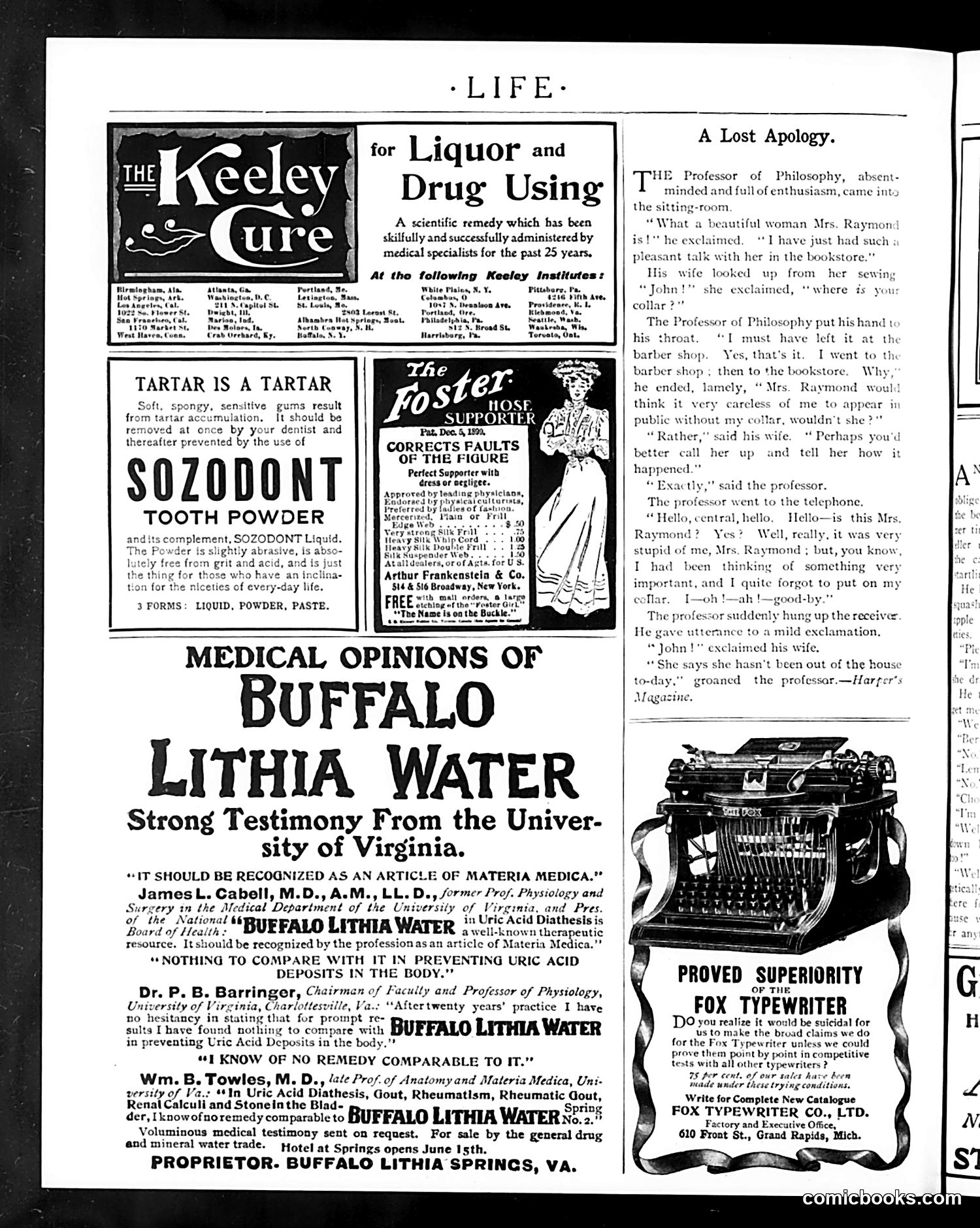
This page is primarily **advertising**, not political satire. It contains medical and consumer product advertisements typical of early 20th-century magazines. The only narrative content is "A Lost Apology," a short humorous story about a Philosophy Professor who absent-mindedly leaves his collar at a barber shop while distracted by conversation with an attractive woman. He calls his wife to confess, only to be told by the woman herself (Mrs. Raymond, calling back) that she hasn't left the house—implying his wife caught him in an embarrassing lie about his whereabouts. The advertisements include dubious medical remedies: the Keeley Cure (for alcohol/drug addiction), Sozodont Tooth Powder, Buffalo Lithia Water (promoted with fake medical endorsements), and corset supports. These ads reflect the era's unregulated patent medicine market, where exaggerated health claims were standard practice.
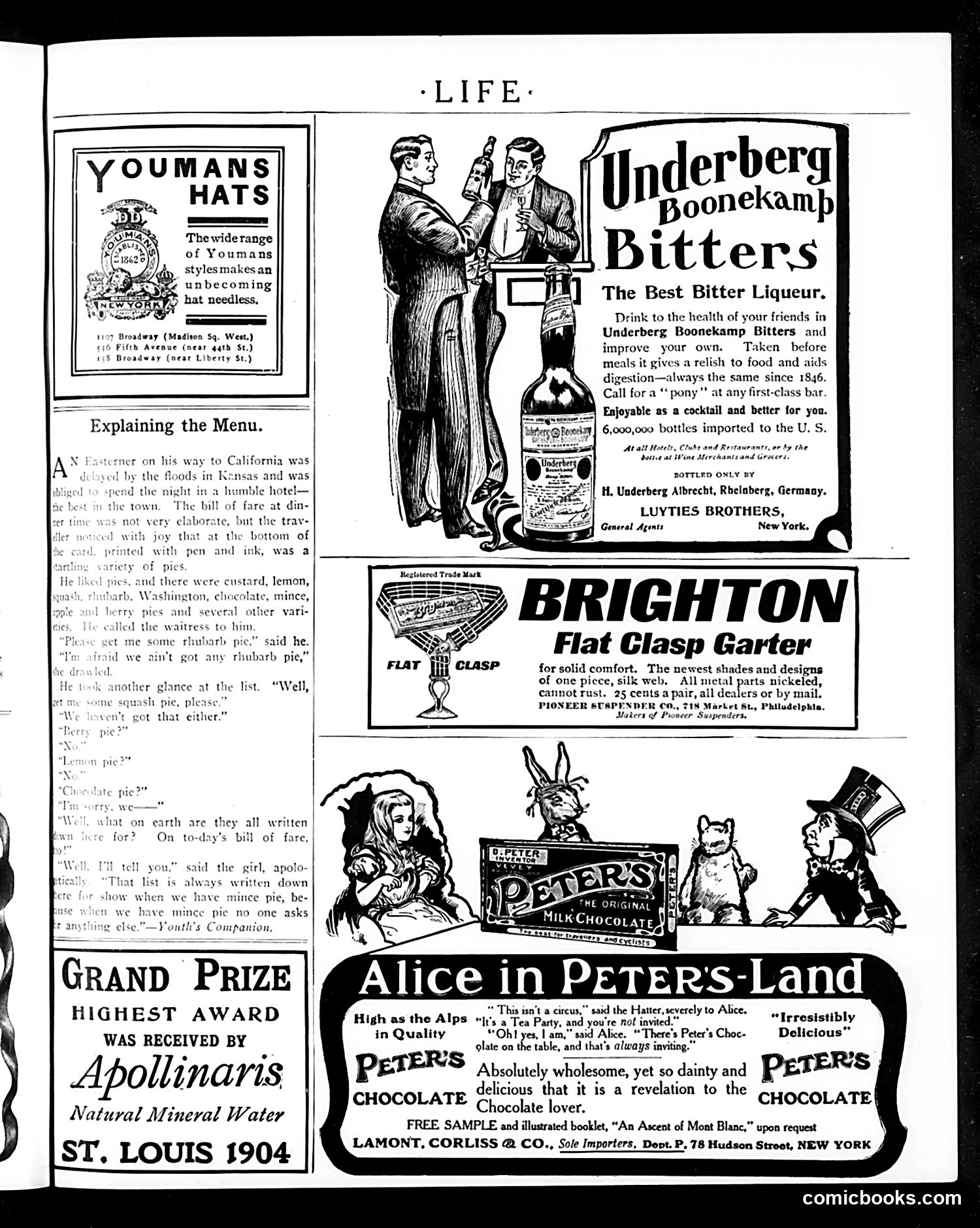
This page mixes a humorous short story with era-typical product advertisements. **The Main Story ("Explaining the Menu"):** A traveler stranded in a small Kansas town during floods orders dinner. He's confused by a menu listing only pie varieties—no main courses. The waitress explains these are *all* the pies available: custard, lemon, rhubarb, Washington, chocolate, mince, and others. When he asks what's written on the back of the menu, she reveals those are yesterday's pies, still listed but no longer offered. The joke is the absurdity of a restaurant serving *only* pies and the prairie-town lack of sophistication. **The Advertisements** occupy most space: Youmans Hats, Underberg Bitters (a digestive liqueur), Brighton garters, Peters Chocolate, and Apollinaris mineral water. These represent typical early-1900s consumer goods marketed through Life's pages. The "Alice in Peters-Land" advertisement playfully references *Alice in Wonderland* to promote chocolate as wholesome and delicious.
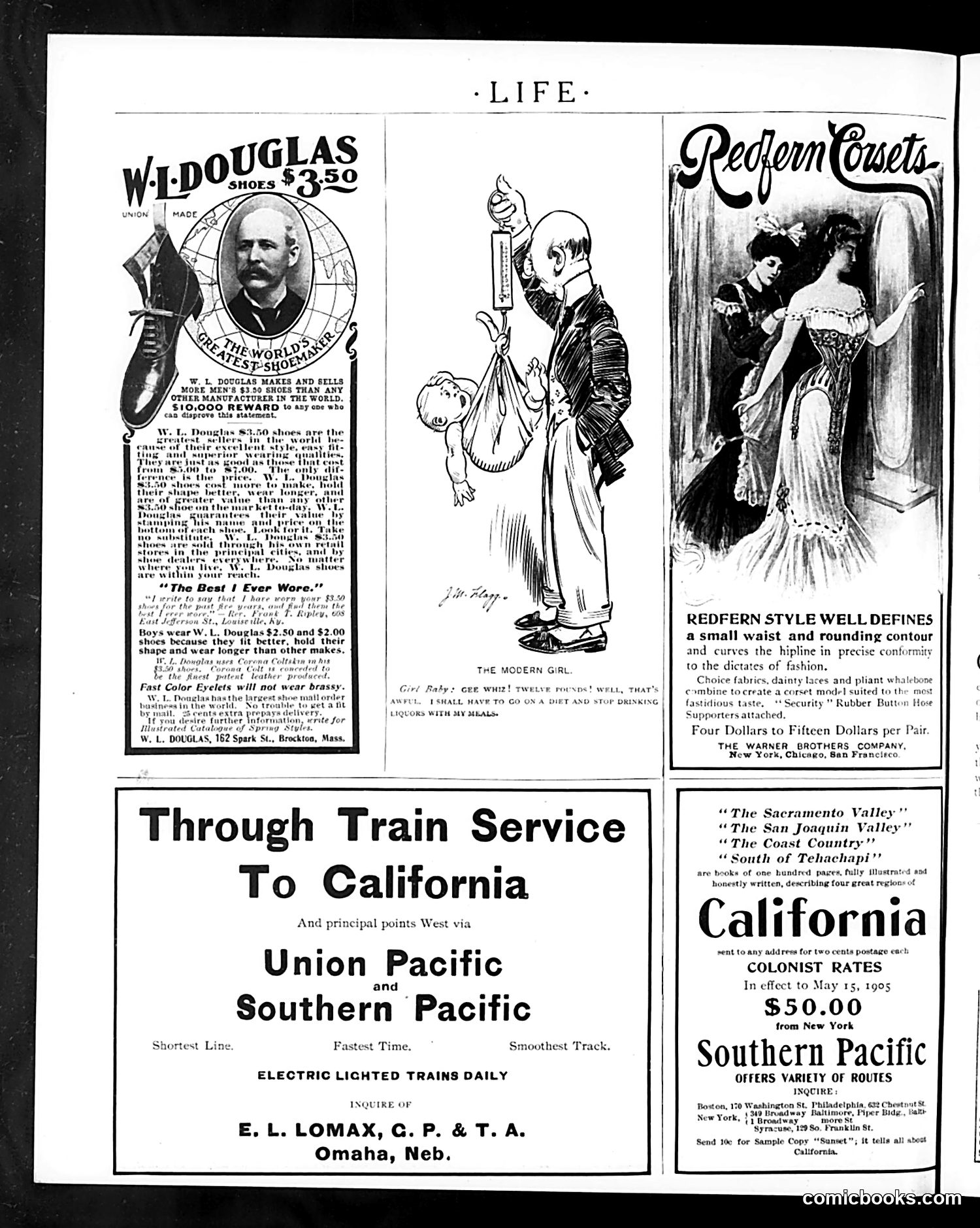
This page is primarily **advertising**, typical of early 1900s magazines. The notable content includes: **Central Cartoon:** "The Modern Girl" depicts a young woman in fashionable dress carrying a baby, addressing a man. Her caption satirizes contemporary women's fashion and social concerns: she complains about needing to diet and avoid liquor to maintain the desired silhouette—a corset-dependent "small waist" fashionable at the time. The joke mocks how restrictive beauty standards conflicted with motherhood and health. **Advertisements:** The page features shoe ads (W.L. Douglas), corset promotions (Redfern and Warner Brothers brands), and railroad service to California. These ads emphasize the *ideal* feminine form the cartoon simultaneously ridicules—the "small waist and rounding contour" mentioned in the Redfern copy directly parallels the cartoon's satirical point about women's fashion constraints. The satire highlights the tension between marketed ideals of femininity and practical reality for modern women.
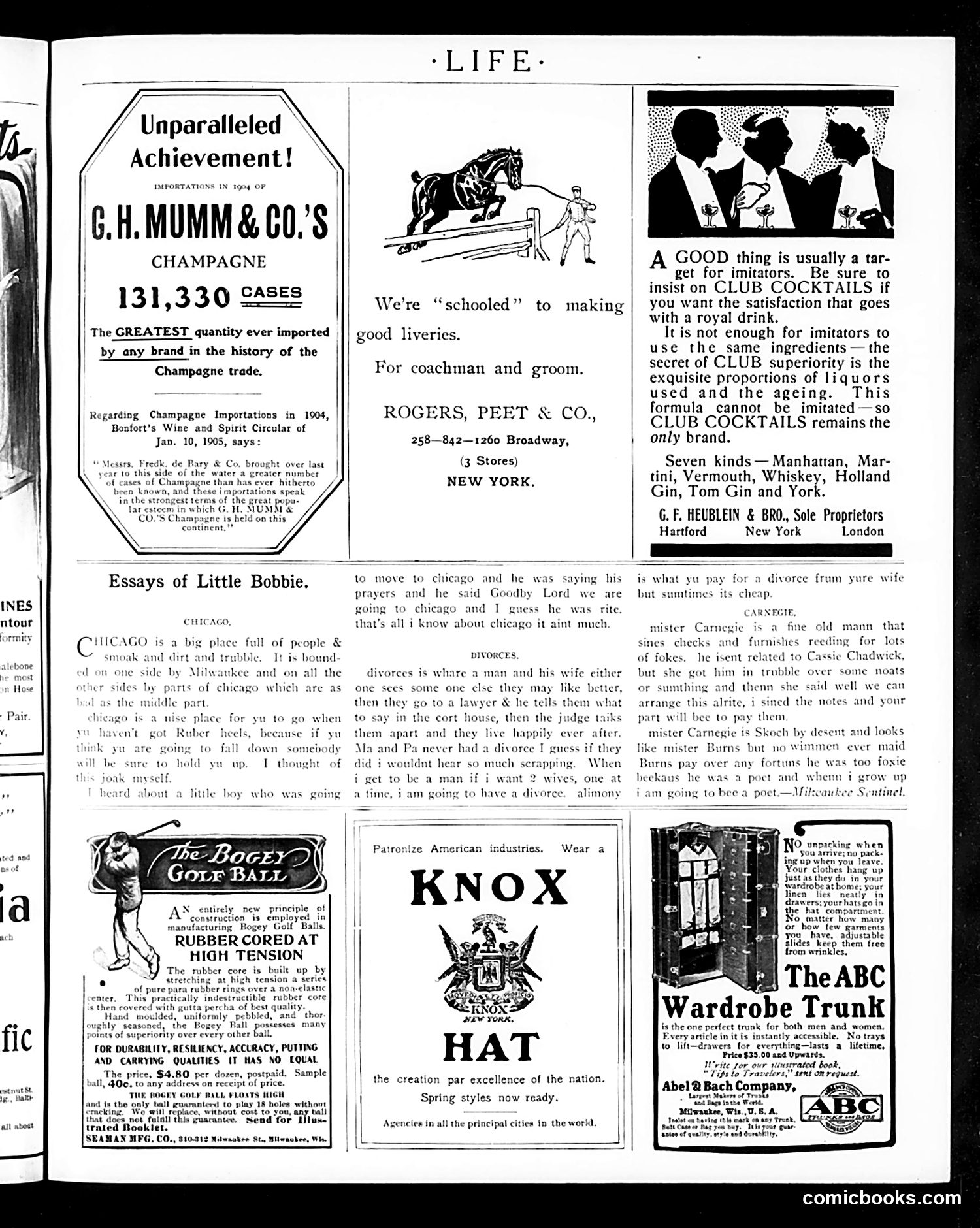
This page is primarily **advertising** with minimal editorial content. The major ads include: **G.H. Mumm Champagne** boasts record 1904 importation figures, asserting market dominance in the champagne trade. **"Essays of Little Bobbie"** is a humorous children's column from Chicago featuring naive observations about city life and divorce, written in deliberate misspelling to capture childlike perspective. **The Bogey Golf Ball** advertises a new rubber-core construction promising durability and performance. **Knox Hat** promotes spring styles as "the creation par excellence of the nation." **Club Cocktails** emphasizes brand authenticity against imitators, highlighting proprietary formulation and aging. The brief **Carnegie reference** appears to be satirical commentary on Andrew Carnegie's wealth and philanthropic reputation. The page captures early 1900s consumer culture: luxury goods (champagne, quality hats), emerging recreational products (golf balls), and brand-building rhetoric emphasizing superiority and exclusivity.
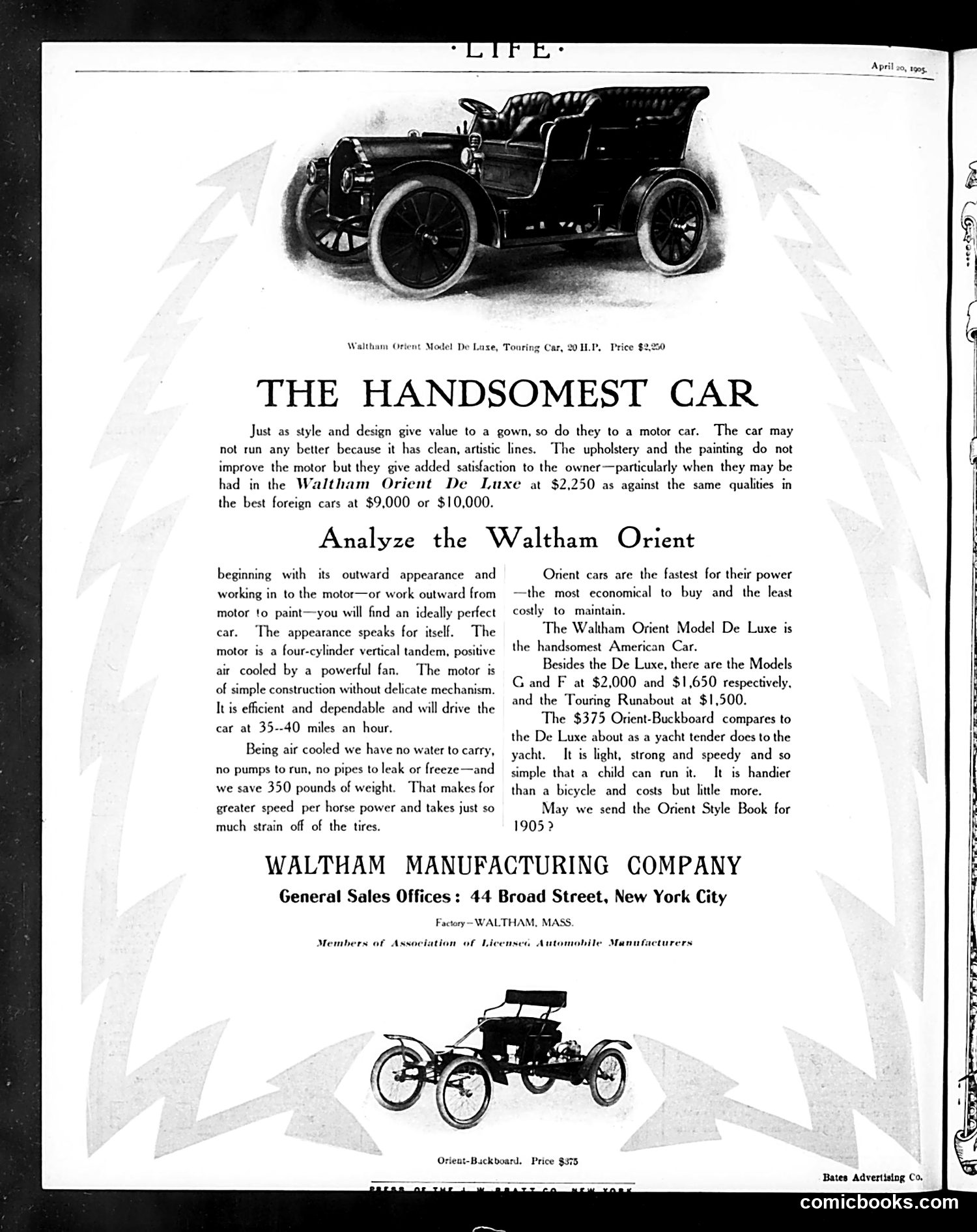
This is **not a cartoon or satire** — it's a straightforward automobile advertisement from Life magazine (April 29, 1905). The Waltham Manufacturing Company promotes the Waltham Orient Model De Luxe touring car, priced at $2,250. The ad's central claim is that aesthetic design and quality craftsmanship justify the price, comparing it favorably to foreign cars costing $9,000-$10,000. Key selling points emphasized: an air-cooled four-cylinder engine (eliminating water cooling complications), durability, simplicity, and 35-40 mph performance. The ad also promotes cheaper models ($375-$2,000) including the "Orient-Buckboard," humorously described as so simple "a child can run it." The page illustrates both the luxury touring car (top) and the stripped-down buckboard (bottom), contrasting the product line. This represents early automotive marketing emphasizing mechanical innovation and value proposition to potential buyers in an emerging car market.