
Life, 1905-04-20 · page 17 of 28
Life — April 20, 1905 — page 17: what you’re looking at
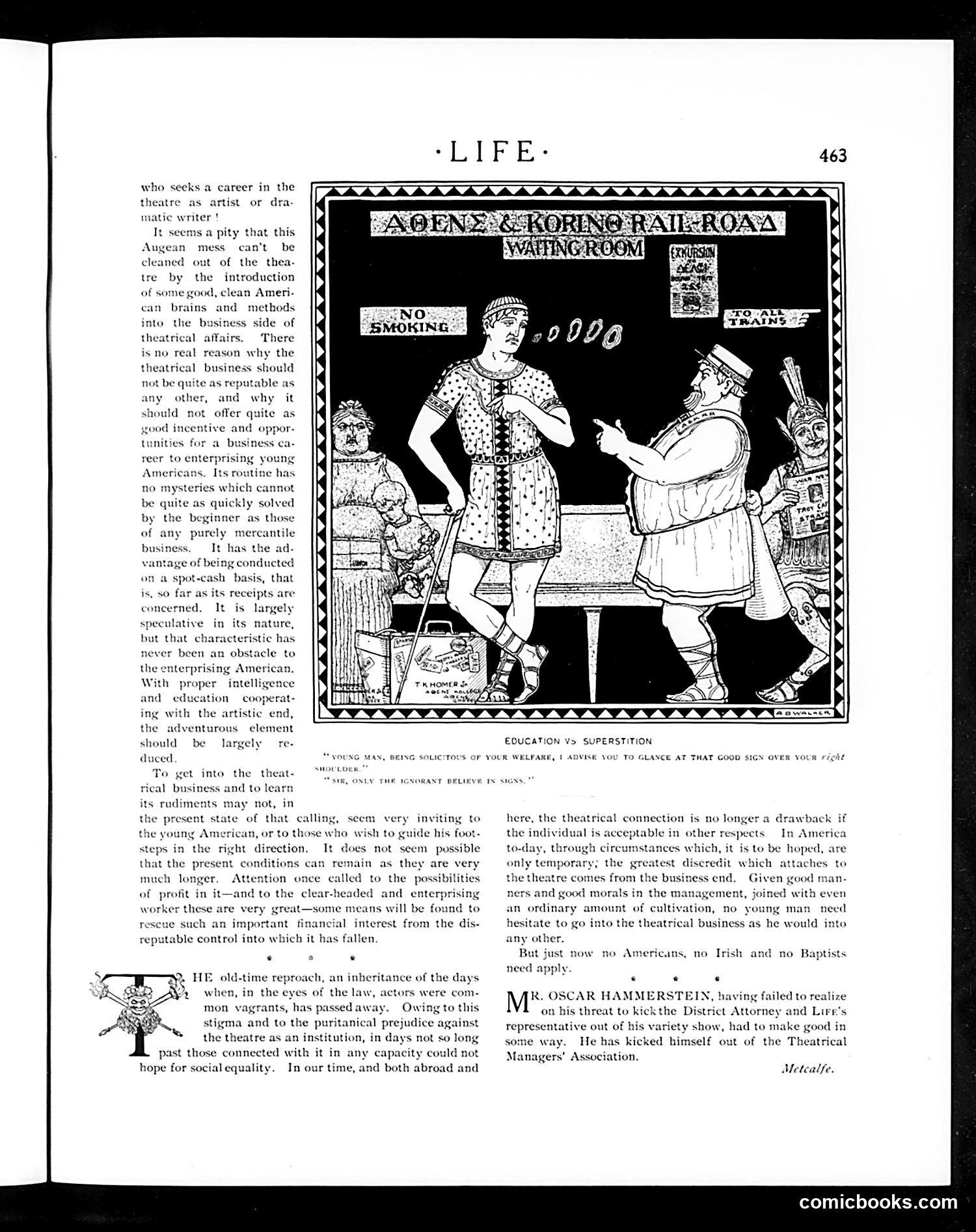
What you’re looking at
The main cartoon, titled "Education vs Superstition," depicts a woman in a waiting room confronted by a man pointing to a "No Smoking" sign. The satire contrasts rational, modern business practices (the sign representing education and regulation) against superstitious prejudice against theatre workers. The accompanying text argues that theatre should be respectable work like any other business, managed with "good manners and good morals." It criticizes the outdated stigma that historically made theatre workers—particularly Irish Catholics and Baptists—social pariahs treated as "vagrants." The final note about **Oscar Hammerstein** (appears to be a theatre manager) relates to a dispute with authorities over his variety show, suggesting he failed in threatening to expel district officials and was forced to comply with regulations. **The broader point**: The satire advocates modernizing theatrical business practices while mocking lingering American prejudices against theatre as a legitimate career for respectable people.
📄 Transcribed text from this page (OCR, searchable)
Machine-transcribed from the original scan — historical spelling and the odd misread are preserved.
who seeks a career in the theatre as artist or dra- matic writer ' pity that this Augean mess can't be cleaned out of the thea- tre by the introduction of some good, clean Ameri- can brains and methods into the ss side of theatrical affairs. There is no real reason why the ical business should not be quite as reputable as any other, and why it t offer quite as good incentive and oppor- tunities for a business ca- reer to enterprising young Ameri Its routine has no mysteries which cannot be quite as quickly solved by the beginner as those of any purely mercantile business. It has the ad- vantage of being conducted a spot-cash basis, that is, so far as its receipts are concerned. It is largely speculative in its nature, but that characteristic has never been an obstacle to terprising American. proper intelligence and education cooperat- ing with the artistic end, the adventurous element should be largely re- EDUCATION V5 SUPERSTITION duced “YOUNG MAN, BEING SOLICITOUS OF YOUR WELFARE, 1 ADVISE YOU TO GLANCE AT THAT GOOD SIGN OVER VouR richt To get into the theat- "rbees . rical business and to learn SN SST NEES IES its rudiments may not, in resent state of that calling, seem very inviting to here, the theatrical connection is no longer a drawback if ung American, or to those who wish to guide his fe the individual is ac : her respects. In America steps in the right direction. It does not seem possible to-day, through circumstances which, it is to be hoped, are that the present conditions can remain as they are very only temporary; the greatest edit which attaches to much longer. Attention o: alled to the possibilities the theatre comes from the business end. Given good man- of profit in it—and to the clear-headed and enterprising ners and good morals in the management, joined with even worker these are very great—some means will be found to an ordinary amount of cultivation, no young man_ need rescue such an impc interest from the dis- hesitate to go into the theatrical business as he would int reputable control into which it has fallen. any other. But just now no Americans, no Irish and no Baptists . , need apply. Ye HE old-time reproach, an inheritance of the days « « when, in the eyes of the] tors were com- R. OSCAR HAMMERSTEIN, having failed to realize mon vagrants, has passed away. Owing to this on his threat to kickthe District Attorney and Lire’s stigma and to the puritanical prejudice against representative out of his variety show, had to make good in the theatre as an institution, in days not so long PAVAP! HO UAS-KICKOAHIMSALE OUE.GE the Theatdieal past those connected with it in any capacity could not hope for social equality. In our time, and both abroad and Metcalfe. comicbooks.com