
Life, 1905-04-20 · page 18 of 28
Life — April 20, 1905 — page 18: what you’re looking at
What you’re looking at
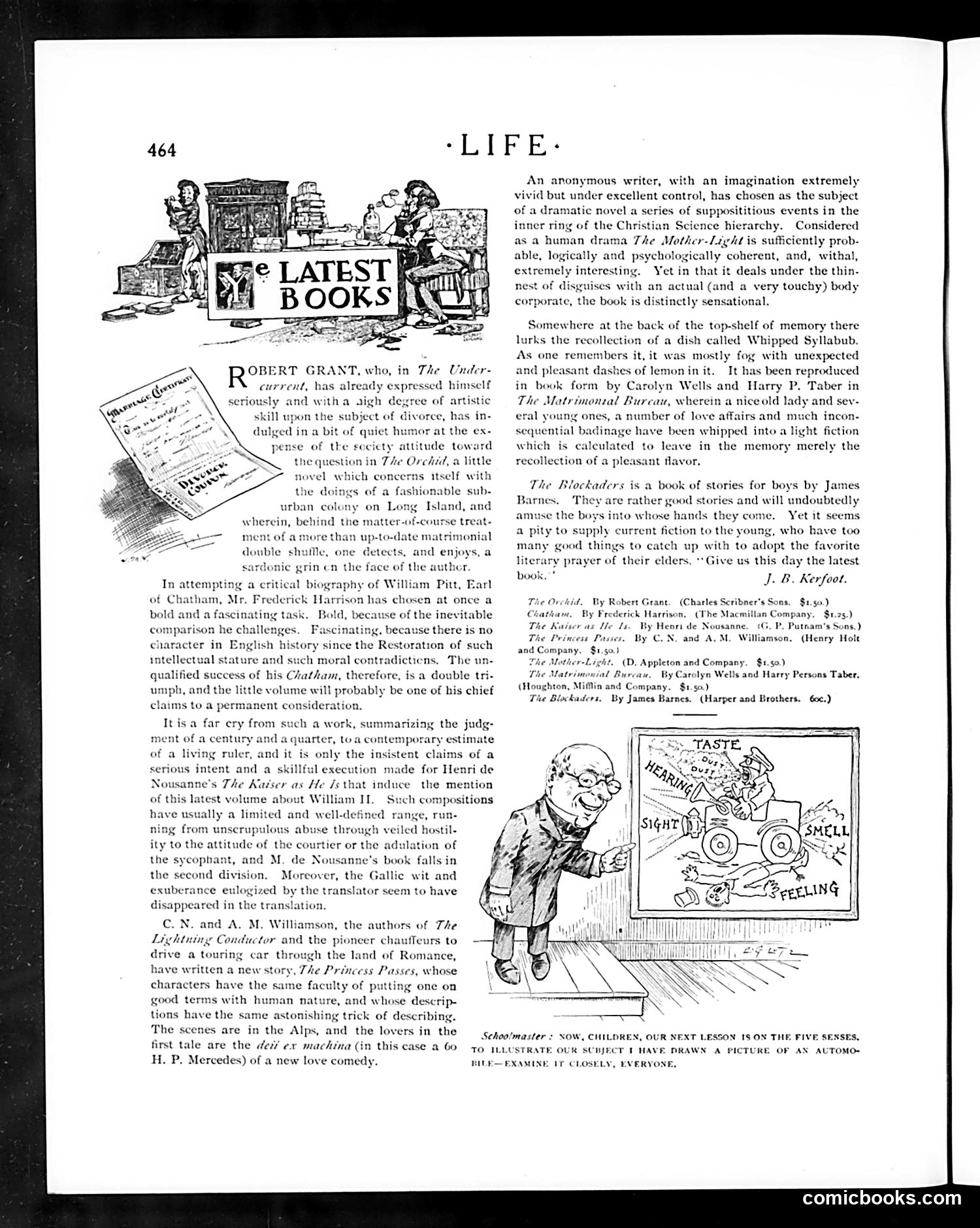
This is a **book review page** rather than political satire. The page discusses contemporary novels and biographical works, with decorative illustrations including a "Latest Books" masthead and a cartoon figure demonstrating the five senses. **Key reviews mentioned:** - Robert Grant's *The Orchid* (satirizing divorce among wealthy Long Island suburbanites) - Frederick Harrison's biography of William Pitt, Earl of Chatham - An anonymous novel called *The Mother-Light* about Christian Science hierarchy - *The Matrimonial Bureau* by Wells and Taber (a light romantic comedy) - *The Blockaders* by James Barnes (boys' adventure stories) The page emphasizes that *The Mother-Light*, though fictional, deals with a "very touchy" real institution—suggesting contemporary readers recognized the thinly-veiled Christian Science references as potentially controversial. The tone is literary criticism typical of early 20th-century magazines, not political commentary.
📄 Transcribed text from this page (OCR, searchable)
Machine-transcribed from the original scan — historical spelling and the odd misread are preserved.
‘LLP Ee OBERT GRANT, who, in The Under- current, has already expressed himself usly and witha aigh de; on the subject of divorce, has in- in a bit of quiet humor at the ex- ¢ of artistic attitude toward nin The Orchid, a little a fashionable sub- y on L Island, and hind the matter-of-course treat- han up-to-d: detects, urban colon e matrimonial double shuMe, ¢ and enjoys, a lonic grin cn the face of the au In attempting a critical biography of William Pitt, of Chatham, Mr. Frederick Harrison has chosen at once a bold and a fascinating task. Bold, because of the inevitable comparison he challenges. Fascinating, because there is no character in English history since the Restoration of such intellectual stature and such moral contradicticns. The un- qualified success of his Chatham, therefore, is a double tri- umph, and the little volume will probably be one of his chief claims to a permanent consideration. It isa far ery from ment o' ch a work, summarizing the judg- 1 century and a quarter, toa contemp of a living ruler, and it is only the insistent claims of a serious intent and a skillful execution made for Henri de Nousanne’s The Aaéser as He the mention of this latest volume abo ppositions have usually a limited and well-defined range, run- ning from unscrupulous abuse thr ed hostil- ity to the attitude of the court ion of and M. de Nousanne's boo! the second division. ry esti, at induce ch CC falls in Moreover, the Gallic wit and exuberance eulogized by the translator s disappeared in th C.N. and A. M. Williams the authors of The Lightning Conductor and the pioneer chauffeurs to m to have translation. An anonymous writer, with an imagination extremely vivid but under excellent control, has chosen as the subject of a dramatic novel a scries of supposititious events in the inner ring of the Christian Science hierarchy. Considered as a human drama The Mother-Light is sufficiently prob- able, logically and psychologically coherent, and, withal, extremely interesting. Yet in that it deals under the thin- nest of disguises with an actual (and a very touchy) body corporate, the book is distinctly sensational, Somewhere at the back of the top-shelf of memory there lurks the recollection of a dish called Whipped Sylabub. As one remembers it, it was mostly fog with unexpected and pleasant dashes of lemon in it. “It has been reproduced in book form by Carolyn Wells and Harry P, Taber in The Matrimonal Bureau, wherein a nice old lady and sev- eral young ones, a number of love affairs and much incon- sequential badinage have been whipped into a light fiction which is calculated to leave in the memory merely the recollection of a pleasant flavor. The Blockaders is a book of stories for boys by James Barnes. The: rather good stories and will undoubtedly amuse the b into whose hands they come. Yet it seems. a pity to supply current fiction to the y g, who have too many good things to catch up with to adopt the favorite literary prayer of their elders, Give us this day the latest book.’ J. B. Kerfoot. The Orchid. Wy Robert Grant. (Charles Scribner's Sons. Chatham, By Frederick Harrison, (The Macmill: The Kaiser as He Is. By Henri de Novsa The Princess Passes, By C.N. and ALM. and Company. The Moth 6 Matrim $1.50.) Company. $1.25.) P, Putnam's Sons.) iamson. (Henry Holt (D. Appleton and Company. $1.50.) jal Burcau, By Carolyn Wells and Harry Persons Taber, (Houghton, Mifflin and Company. $1.50.) The Blockaders, By James Barnes, (Harper and Brothers. 60c.) drive a touring car through the land of Romance, have written a new story, The Préncess Passes, whose characters have the s good terms with hu tions have the me faculty of putt one on un nature, and whose descrip- ame astonishing trick of describing. The scenes are in the Alps, and the lovers in the first tale are the dev# ex machina (in this case a 60 H. P. Mercedes) of a new love comedy. Schoolmaster : NOW, CHILDREN, OUR NEXT LESSON 18 ON THE FIVE SENSES. TO ILLUSTRATE OUR SCIJECT 1 HAVE DRAWN A PICTURE OF AN AUTOMO= BILE EXAMINE TP CLOSELY, EVERYONE, comicbooks.com