
Life, 1905-04-20 · page 8 of 28
Life — April 20, 1905 — page 8: what you’re looking at
What you’re looking at
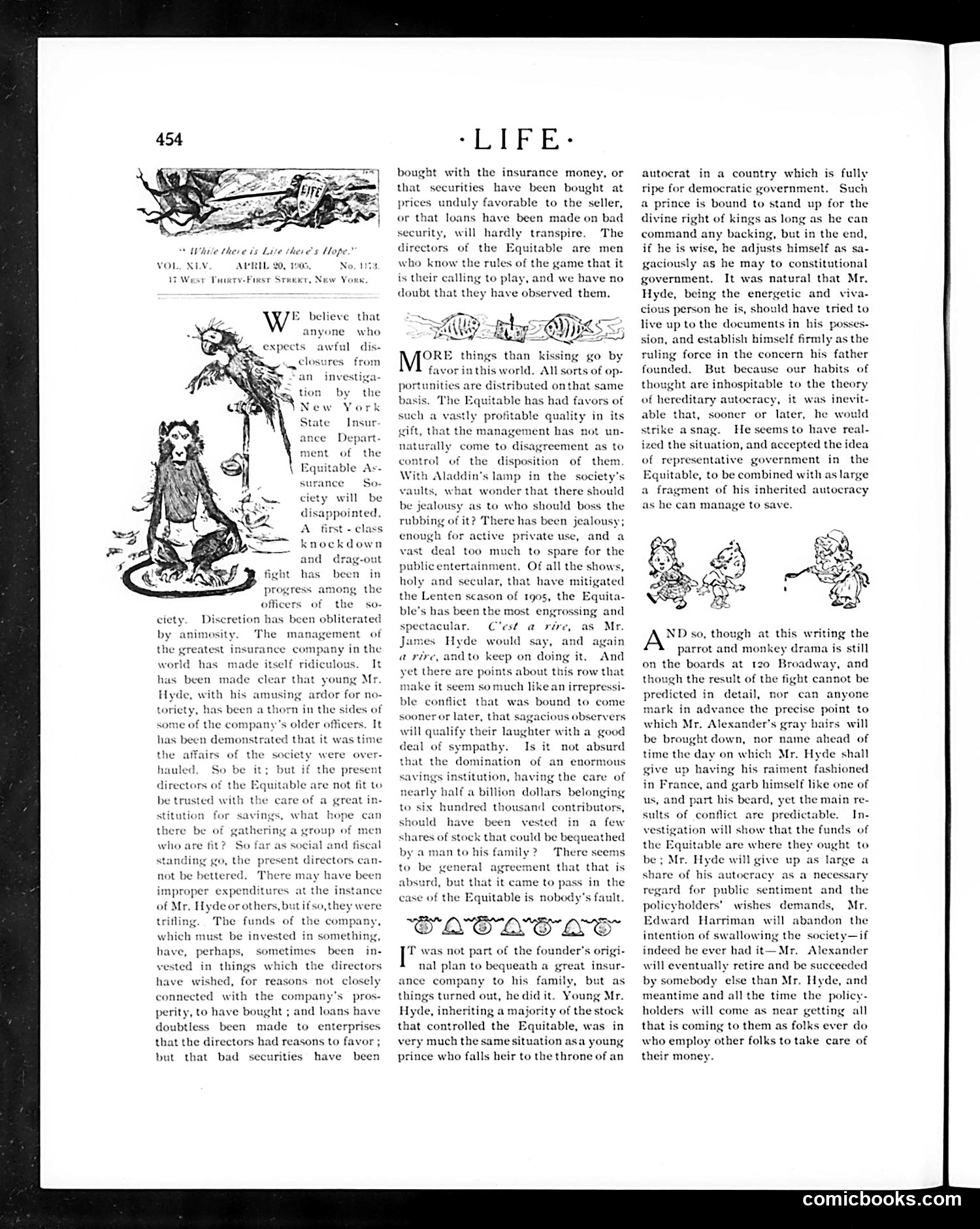
This page critiques the **Equitable Life Assurance Society**, a major insurance company. The left margin contains decorative political cartoons featuring anthropomorphized figures—including what appears to be a lion and other symbolic creatures representing institutional power or corruption. The article attacks the Equitable's management for mishandling funds and stock belonging to hundreds of thousands of policyholders. The satire suggests company directors prioritized personal enrichment over fiduciary responsibility, comparing Mr. Hyde (the company heir) to a prince unaccountable to democratic oversight. The piece questions whether such vast institutional wealth should remain concentrated in few hands, advocating transparency and suggesting policyholders deserve greater say in how their money is managed—reflecting Progressive-era concerns about corporate accountability and democratic control of financial institutions.
📄 Transcribed text from this page (OCR, searchable)
Machine-transcribed from the original scan — historical spelling and the odd misread are preserved.
“While there is Live there's Hope.” VOL. XLV APRIL No. 173 17 West Teiery-Fiest Street, New Yorx, believe that ne who awful closures dis- from an investiga tion by the PS New York State — Insur. ance Depart ment of the Equitable Av- surance So- ciety will be disappointed. A. first - class knockdown and fight has been in progress a officers of ciety The nsurance company in the by animosity. manageme: the greatest has has been made itself ridiculous. It young Mr. world made clear thi Hyde, with his amusing ardor for no- toriety, has been a thorn in the sides of some of the company’s older officers. It has been demonstrated that it was time the affairs of the society were over- hauled be it; but if the present directors of the Equitable are not fit to be trusted with the care of a great in- stitution for savings, what hope can there be of gathering a group of men who are fit? So far as social and fiscal standing the pres directors can- not be bettered. There may have be improper expenditures at the instance of Mr. Hyde or others, but ifso, they were The funds of the company, which must be invested in something have, perhaps, sometimes been in- vested in things which the directors have wished, for reasons not closely trifling connected with the company’s pros- perity, to have bought ; and loans have doubtless been enterprises that the directors had reasons to favor ; but that bad securities have been made to * LAP Ee bought with the insurance money, or that securities have been bought at prices unduly favorable to the seller, or that loans have been made on bad security, will hardly transpire. The directors of the Eq ble are men who know the rules of the game that it is their calling to play, and we have no doubt that they have observed them, Bitey ORE things than kissing go by favor inthis world. All sorts of op- inities are distributed on por! at same basis. The Equitable has had favors of table quality in its ift, that the management has not un- naturally come to disagreement as to the disposition of With Aladdin's lamp in the socie! vaults, what wonder that there should such a vastly pre control « be jealousy as to who should boss the rubbing of it? There has been jealousy; and vast deal too much to spare for the public entertainment. Of all the shows, holy and secular, that have mitigated the Lenten scason of 1905, the Equita- ble’s has been the most engrossing and C'est a Mr. James Hyde would say, and again a@ rire, and to keep on doing it. And yet there are points about this row that enough for active private use, spectacular. rire, as ake it seem so much likean irrepressi- ble conflict that was bound to come soon or later, t will q deal of sy sagacious observers aughter with a good not absurd ation of an enormous itution, having the care of that the domi savings in nearly he to six hundred thousand contributors, been vested in shares of stock that could be bequeathed amily? ‘There seems ent that that is ame to pass in the fa billion dollars belonging should have a few by a man to his to be general agreen absurd, but that it case of the Equitable is nobody's fault. CSLSOS LOS T was not part of the founder's origi- nal plan to bequeath a great insur- ance company to his family, but as things turned out, he did it. Young Mr. Hyde, inheriting a majority of the stock that controlled the Equitable, was in very much the same situation asa young prince who falls heir to the throne of an autocrat in a country which is fully ripe for democratic government. Such a prince is bound to stand up for the divine right of kings as long as he can command any backing, but in the end, if he is wise, he adjusts himself as sa- gaciously as he may to constitutional government, It was natural that Mr, Hyde, being the energetic and viva cious person he should have tried to live up to the documents in his posses- sion, and establish himself firmly as the ruling force in the concern his father founded. But because our habits of thought are inhospitable to the theory of hereditary autocracy, it was inevit- able that, sooner or later, he would He seems to have real- ized the situation, and accepted the idea of representative government in the Equitable, to be combined with as large a fragment of his inherited autocracy n manage to save. strike a snag. VD so, though at this writing the parrot and monkey drama is still on the boards at 120 Broadway, and though the result of the fight cannot be predicted mark in advance the precise point to which Mr. Alexander's gray hairs will be brought down, nor name ahead of Mr. Hyde shall give up having his raiment fashioned in France, and garb himself like one of us, and part his beard, yet the main re- sults of conflict are predictable. In- ation will show that the funds of the Equitable are where they ought to be; Mr. Hyde will give up as large a share of his autocracy as a necessary regard for public sentiment and the policyholders’ wishes demands, Mr. Edward Harriman will abandon the intention of swallowing the society—if indeed he ever had it—Mr. Alexander will eventually retire and be succeeded by somebody else than Mr, Hyde, and meantime and all the time the policy holders will come as near getting all that is coming to them as folks ever do who employ other folks to take care of their money. detail, nor can anyone time the day on whic! vesti; comicbooks.com