
A complete issue · 44 pages · 1905
Life — March 2, 1905
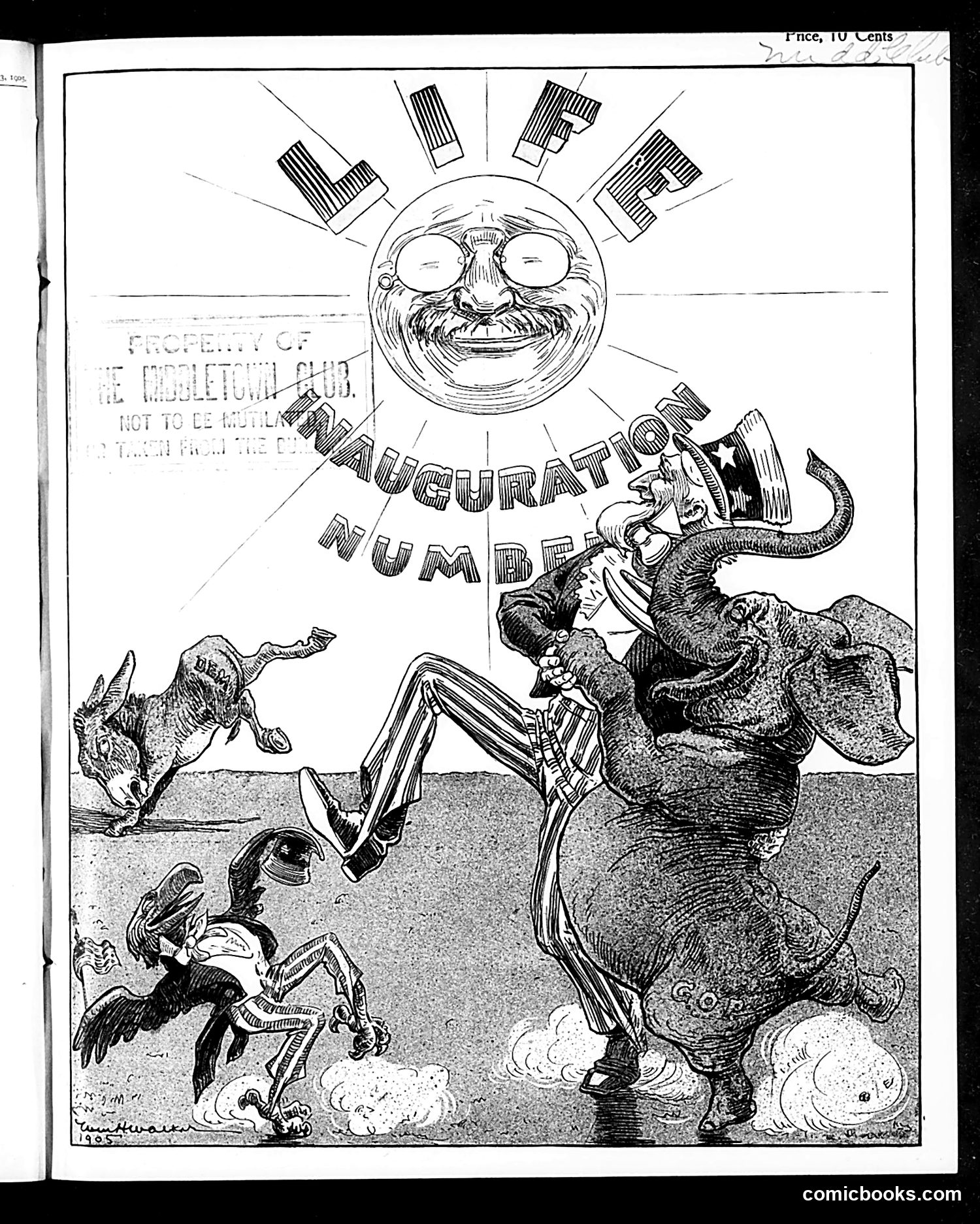
This cartoon satirizes Republican political dominance through the metaphor of "Inauguration Number [X]." The smiling face at top represents Republican success and prosperity, radiating outward like the sun. Below, an elephant (the Republican party symbol) celebrates victoriously while various animal figures—appearing to represent Democratic opponents or rival political forces—are depicted as defeated or fleeing. The houses at the top suggest real estate, property, or material prosperity associated with Republican governance. The overall composition presents Republicans as ascendant and their opposition as diminished. Without the specific issue date visible, the exact historical moment is unclear, but the imagery suggests a period when Republicans held significant political power and wished to celebrate their dominance to Life magazine's readership.
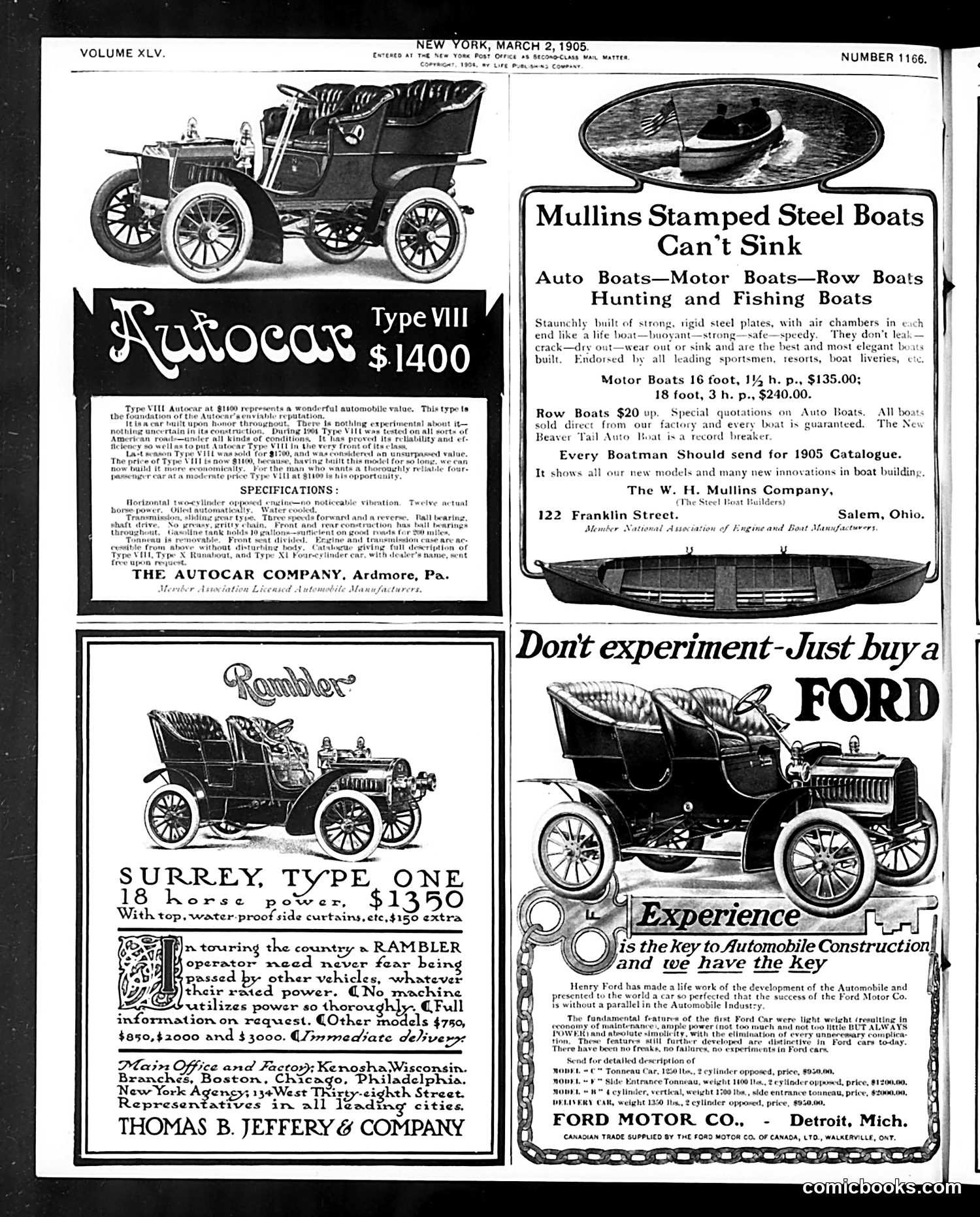
This is primarily **advertising**, not satirical content. The page from *Life* magazine (March 2, 1905) features four automobile advertisements: 1. **Autocar Type VIII** ($1,400) - emphasizes reliability and affordability 2. **Mullins Stamped Steel Boats** - boats marketed as unsinkable, built from steel plates 3. **Rambler by Thomas B. Jeffery Company** ($1,350) - touring vehicle with 18 horsepower 4. **Ford Motor Co.** - promotes Ford automobiles, claiming "Experience is the key to Automobile Construction" The ads target middle-to-upper-class readers interested in new automotive technology. There is **no political satire** on this page. The content reflects early 1900s consumerism and the emerging automobile industry's competitive marketing claims about safety, reliability, and value.
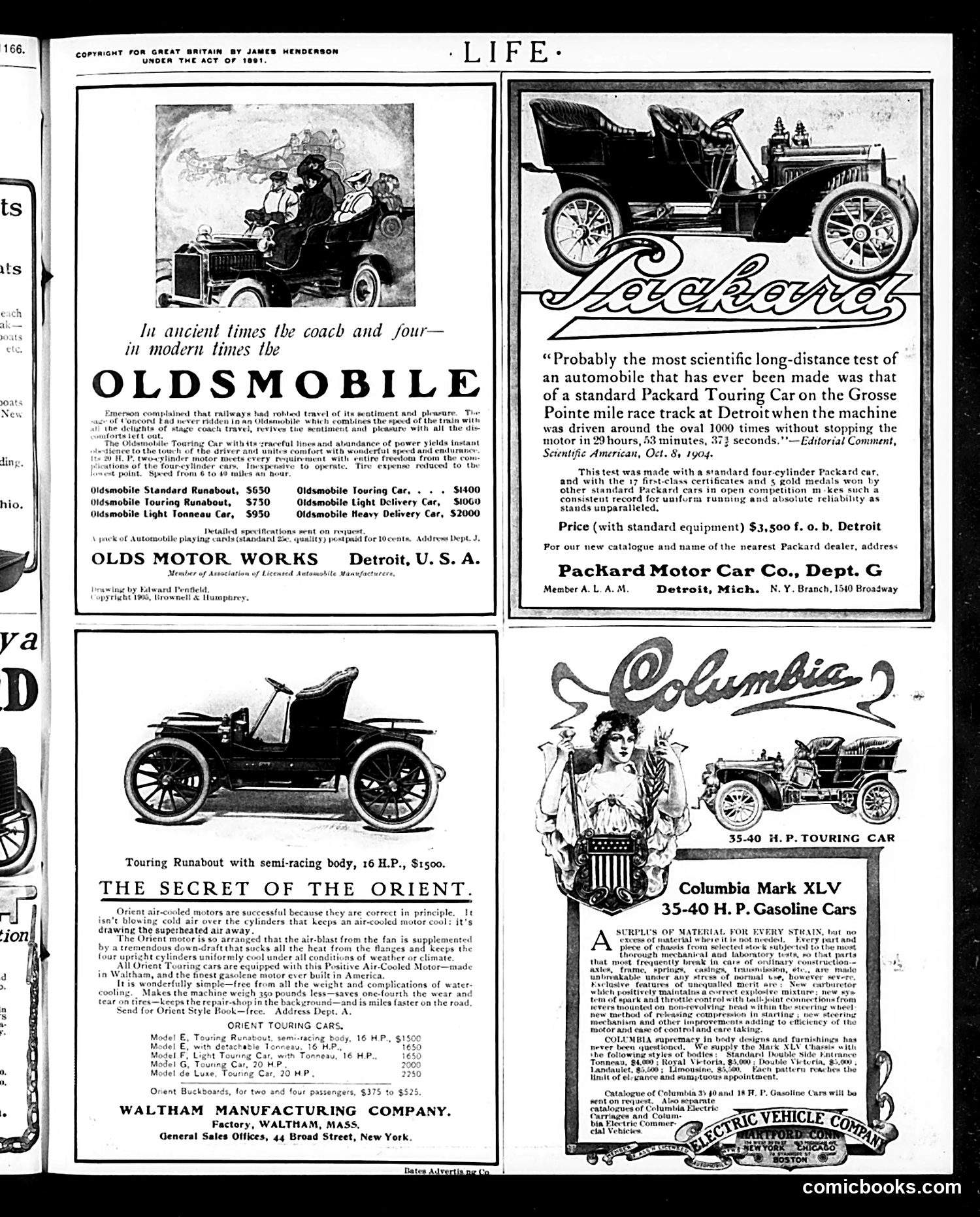
This page is primarily **automobile advertising**, not political satire. It contains four car advertisements from the early 1900s: 1. **Oldsmobile** (top left): Emphasizes reliability, comparing modern cars to historical coaches 2. **Packard** (top right): Highlights a long-distance test where a Packard drove 1,100 laps without stopping 3. **Orient** (bottom left): Markets air-cooled motors as superior engineering 4. **Columbia** (bottom right): Advertises a 35-40 horsepower touring car The only quasi-satirical element is the **Oldsmobile headline** ("In ancient times the coach and four—in modern times the OLDSMOBILE"), which gently mocks outdated transportation by positioning cars as modern progress. This is **not political commentary**—merely competitive marketing between early automobile manufacturers targeting wealthy consumers.
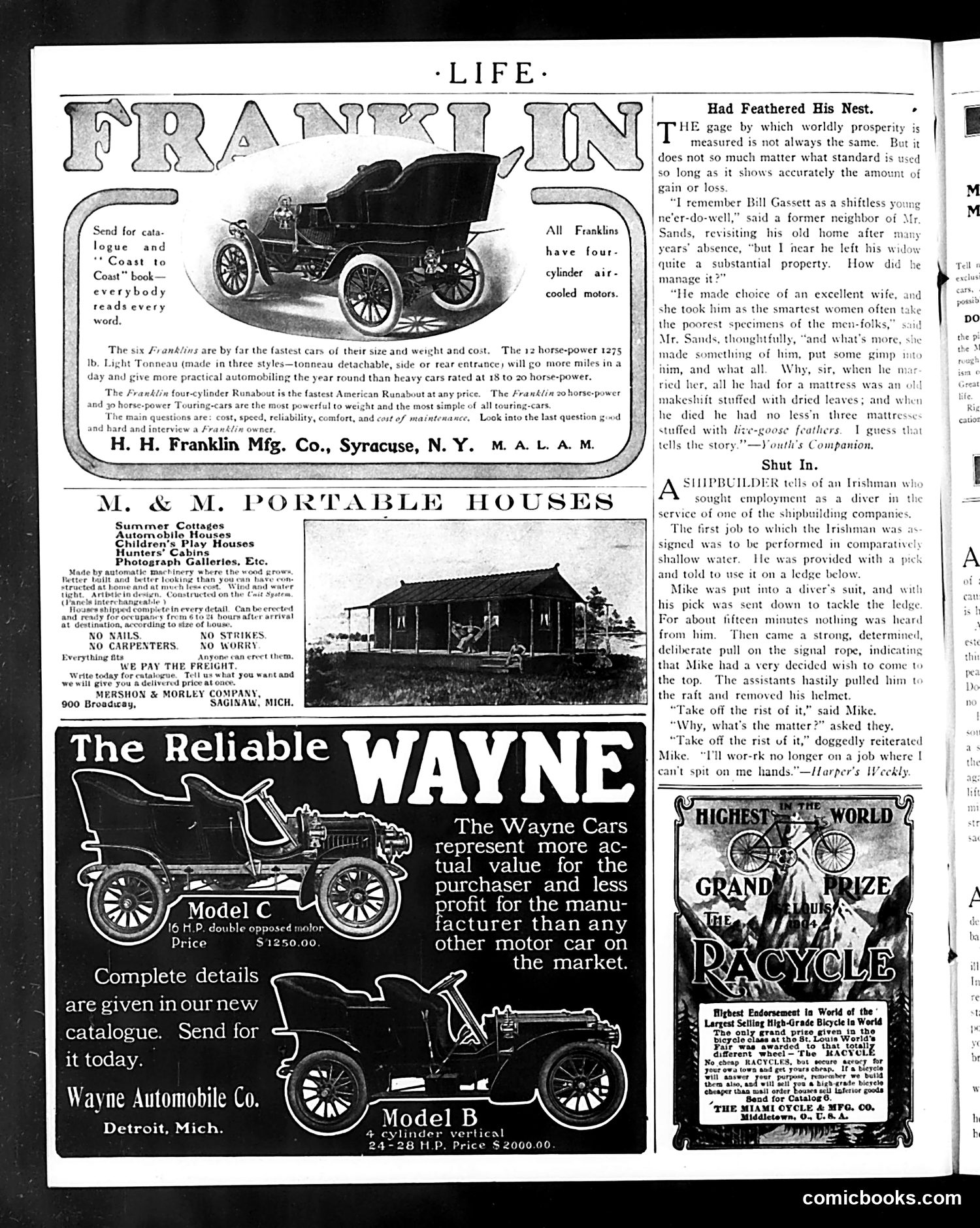
This page is primarily **advertising**, not political satire. It contains four automobile advertisements (Franklin, M. & M. Portable Houses, Wayne, and a bicycle prize offer) alongside two brief narrative articles about ordinary people. The "Frankl In" section features a testimonial about Bill Gassett, a man who became wealthy through good choices, particularly his marriage. The "Shut In" article describes an Irishman working as a diver for a shipping company who nearly drowns but survives. These are human-interest stories rather than satire—common filler content in early 20th-century magazines. The page reflects Life's mixed editorial-advertising format typical of the era, with no apparent political commentary or caricature.
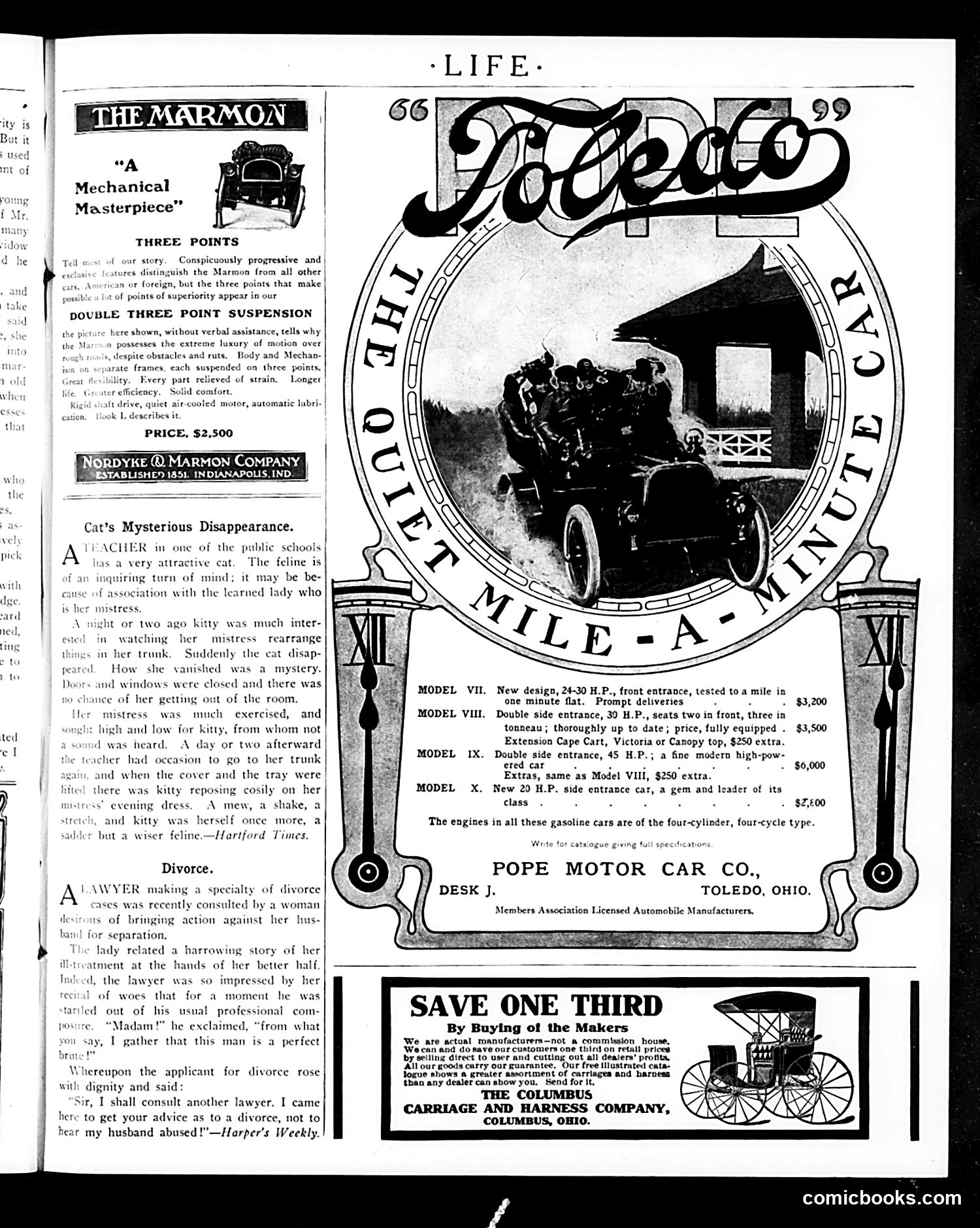
This page is primarily **advertising**, not political satire. The dominant content features two car advertisements: 1. **The Marmon** (top left): A luxury automobile highlighting its "Double Three Point Suspension" system, priced at $2,500—substantial for the era. 2. **Packard** (center): A large advertisement for multiple model cars (VII through X), ranging from $3,200 to $7,000, emphasizing new designs and features. The page also includes two minor human-interest stories ("Cat's Mysterious Disappearance" and "Divorce") and a **Columbus Carriage and Harness Company** advertisement at bottom. The content reflects early 20th-century consumer culture focused on automobiles as status symbols, with no apparent political commentary or satire present.
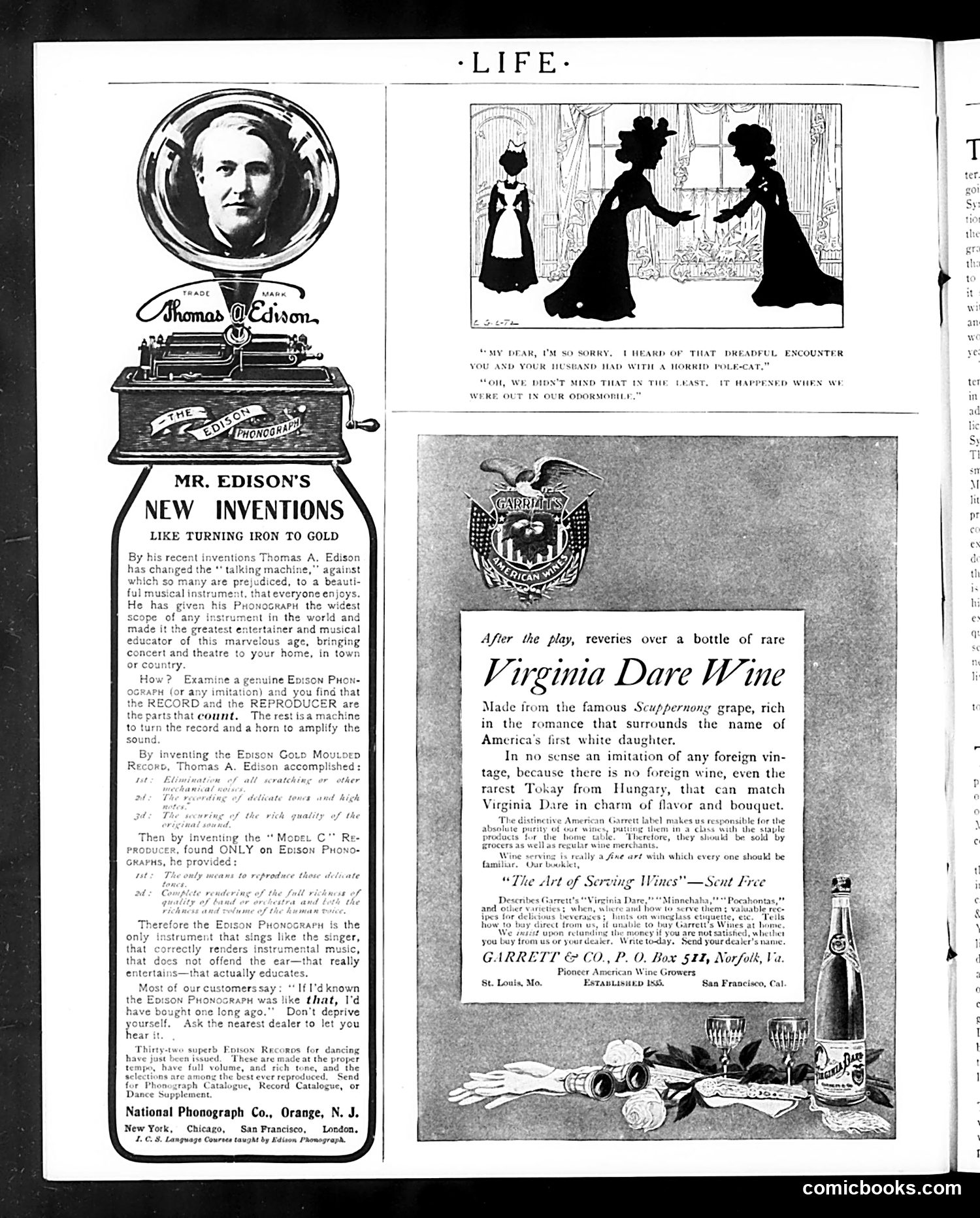
This page mixes advertising with satirical content. The left side advertises Edison's phonograph and gramophone, claiming Edison has "changed the talking machine" into a musical instrument of unprecedented quality. The top right shows a silhouetted domestic scene where a woman apologizes to another woman for an encounter with "a horrid polecat," which "happened when we were out in our automobile." This appears to be gentle satire about early automobile driving hazards and women's social interactions—the polecat encounter serves as an amusing excuse or explanation for some social awkwardness. The remainder of the page is a Virginia Dare Wine advertisement. The page is primarily commercial in nature rather than political satire.
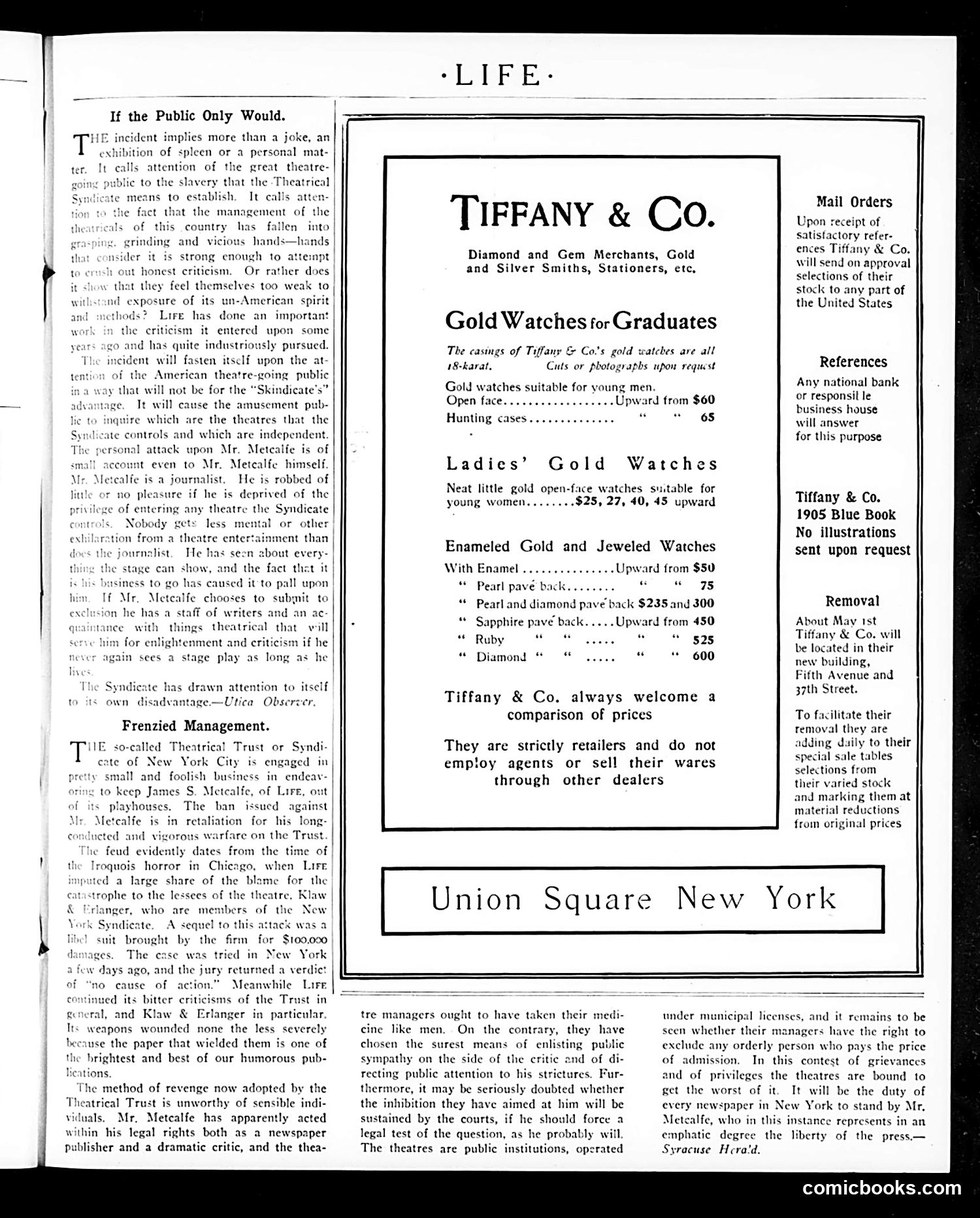
This page is **primarily advertising** for Tiffany & Co., featuring their jewelry and watch offerings. The advertisements occupy the majority of the space. The textual content addresses theatrical business disputes. Two articles discuss conflicts between theater management and critics: 1. "If the Public Only Would" criticizes the Theatrical Syndicate's control over theaters and attacks journalist **Mr. Metcalfe** of *Life* for his criticism of their practices. 2. "Frenzied Management" describes a lawsuit brought by the Syndicate against *Life* for $100,000 in damages over Metcalfe's "vigorous warfare" criticizing their monopolistic control of American theaters. The satire targets the Theatrical Syndicate's attempt to suppress press criticism through litigation rather than addressing legitimate grievances about their theater monopoly. The articles defend independent theater criticism as essential to public interest.
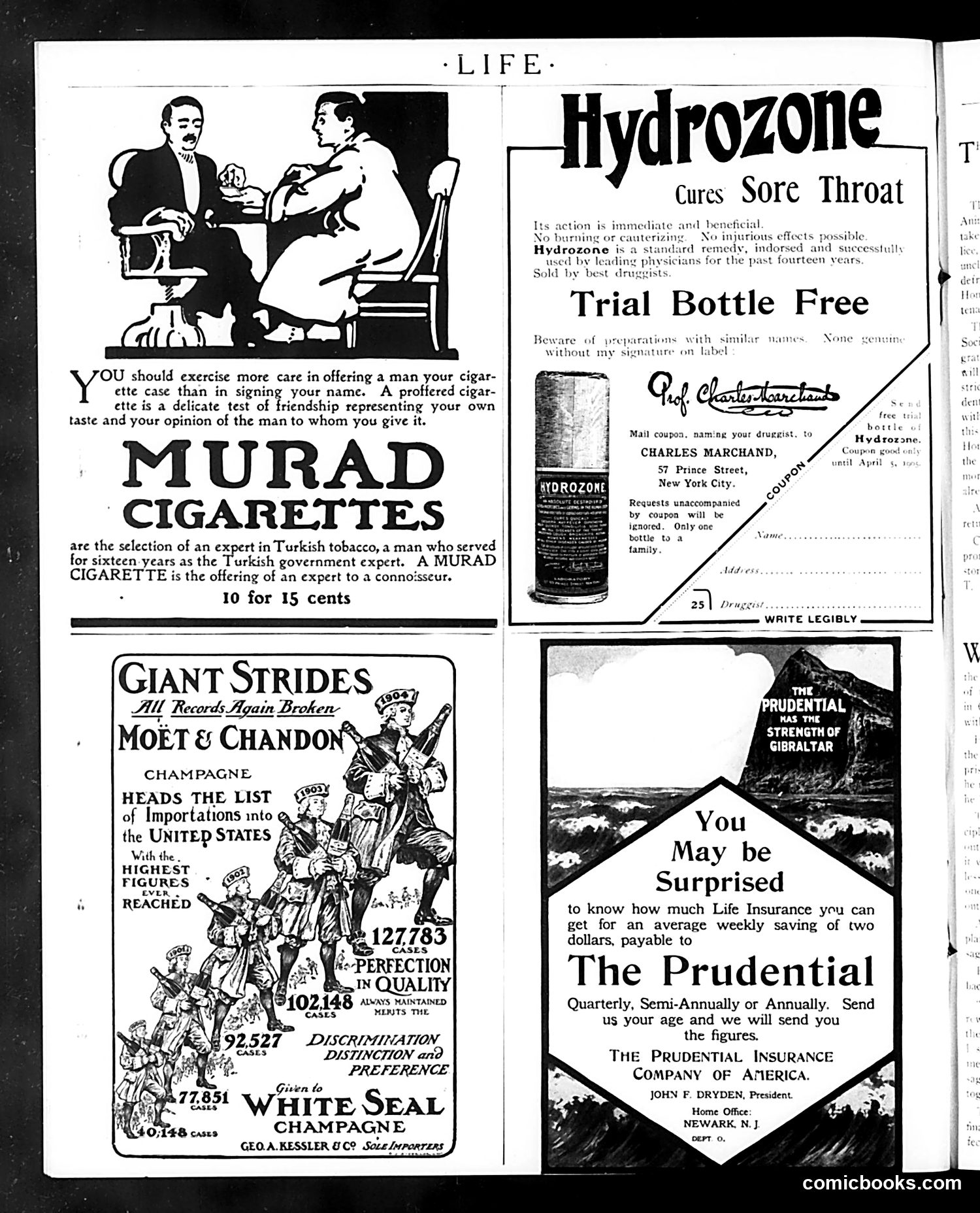
This is primarily an **advertising page** from Life magazine, not a satirical cartoon page. It contains four commercial advertisements: 1. **Murad Cigarettes** - Shows two men in business attire, emphasizing that offering quality cigarettes reflects good judgment and friendship. Marketed as Turkish tobacco selected by a government expert. 2. **Hydrozone** - Patent medicine claiming to cure sore throat, with a coupon offer for a free trial bottle from Charles Marchand in New York. 3. **Moët & Chandon Champagne** - Boasts import records and sales figures, emphasizing "perfection in quality." 4. **The Prudential Insurance Company** - Promotes affordable life insurance through modest weekly savings. The page reflects early 20th-century advertising, featuring products (tobacco, patent medicines, alcohol, insurance) that would face modern regulatory restrictions or skepticism.
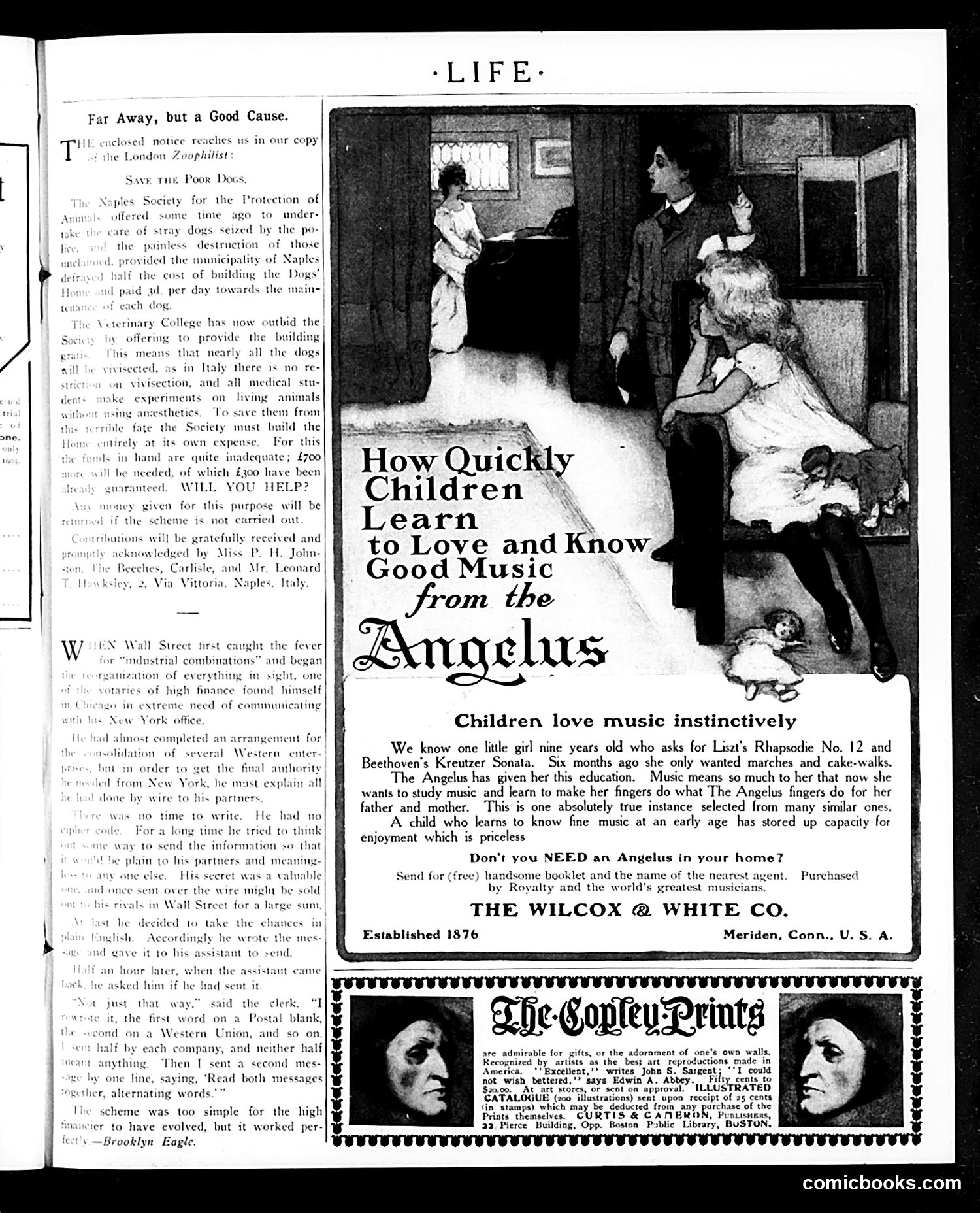
This page contains **two distinct items**: an article about animal welfare and a musical instrument advertisement. **Left column**: "Save the Poor Dogs" describes the Naples Society for Animal Protection's effort to build a shelter for stray dogs. The society requested municipal funding (£700) and private donations. This reflects early 20th-century animal welfare advocacy. **Right side**: A full-page advertisement for "Angelus" music players—mechanical devices that taught children classical music by playing pre-recorded cylinders. The ad shows a family gathered around the device and claims children instinctively love music. It's manufactured by Wilcox & White Co. of Meriden, Connecticut (established 1876). **Bottom**: A small advertisement for "Confey Prints"—portrait prints marketed as home décor. This is primarily an **advertising page** rather than satirical content.
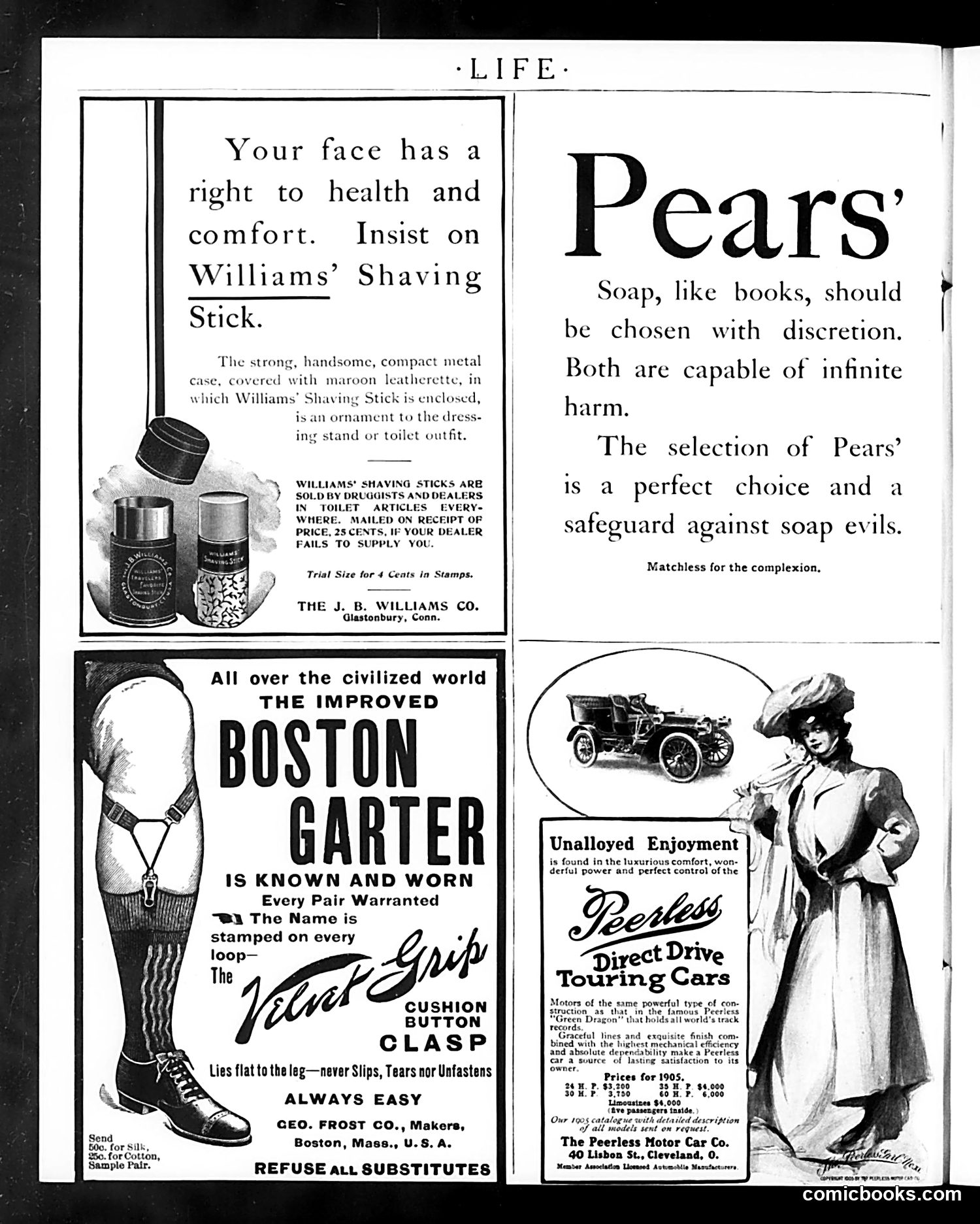
This is a **page of advertisements**, not political cartoons or satire. It contains four product ads typical of early 20th-century Life magazine: 1. **Williams' Shaving Stick** — promotes grooming products with health/comfort messaging 2. **Pears' Soap** — humorously claims soap selection is as important as book selection, warning against "soap evils" 3. **Boston Garter** — advertises men's leg wear with an illustration of a woman's leg, emphasizing durability 4. **Peerless Direct Drive Touring Cars** — showcases an automobile with lifestyle imagery The page reflects **period attitudes about consumption and masculinity**. There's no political satire here—just consumer marketing from an era when such ads appeared regularly in Life's pages alongside its actual editorial cartoons and humor.
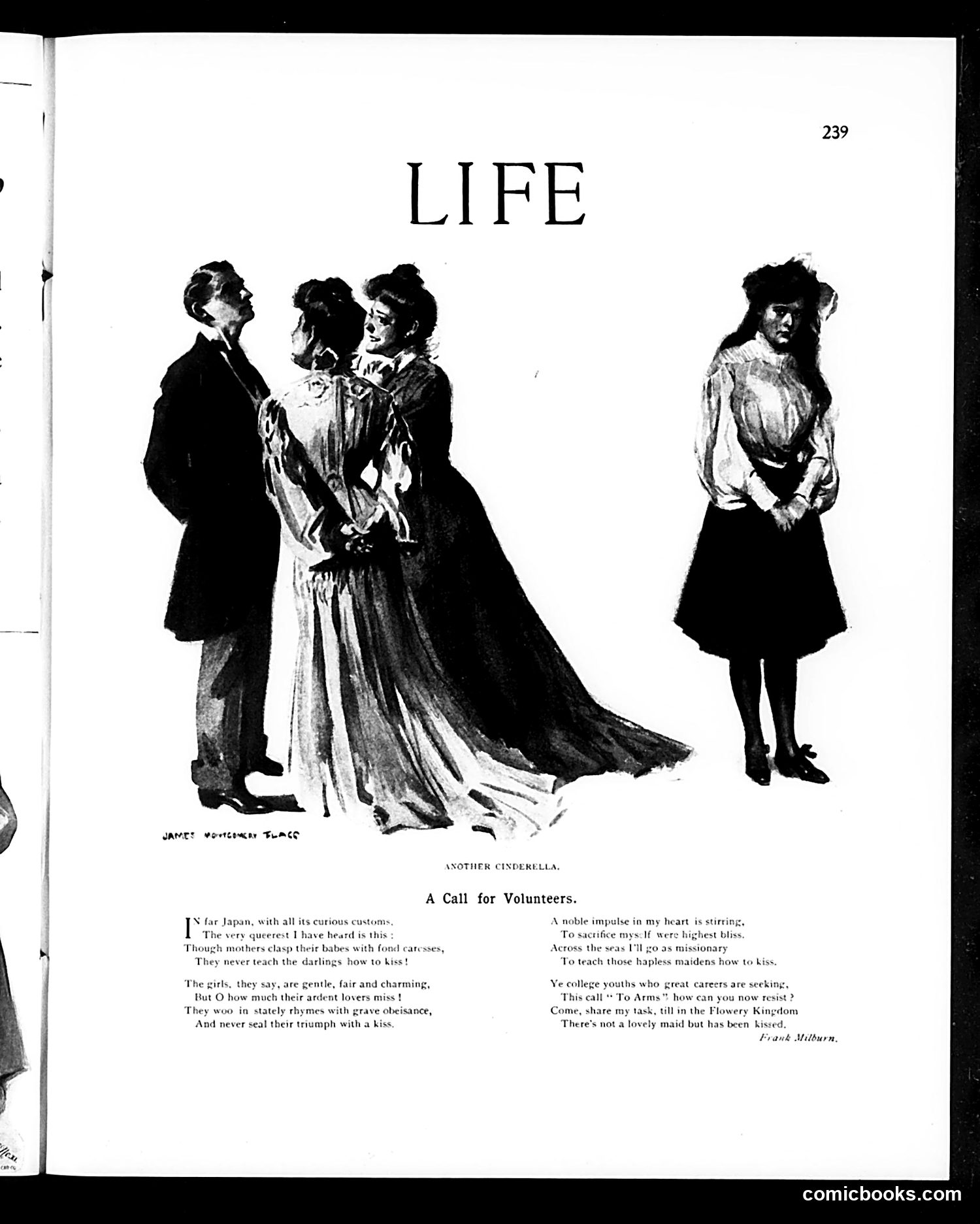
This is a satirical poem titled "Another Cinderella" by Frank Milburn, accompanied by illustrations by James Montgomery Flagg. The satire mocks romantic idealism and appeals to male sacrifice. The poem presents a woman complaining that men won't kiss her, calling on "college youths" to volunteer for romantic service—to "Arms" and to teach "hapless maidens how to kiss." The illustrated figures show a fashionably-dressed woman surrounded by attentive men on the left, and a lonely woman standing apart on the right. The satire ridicules both the entitlement of women expecting male devotion and the broader cultural anxiety about young men's willingness to commit to traditional romantic roles during this era. The "Cinderella" reference suggests a fairy-tale expectation of rescue or devotion that Milburn presents as absurd.
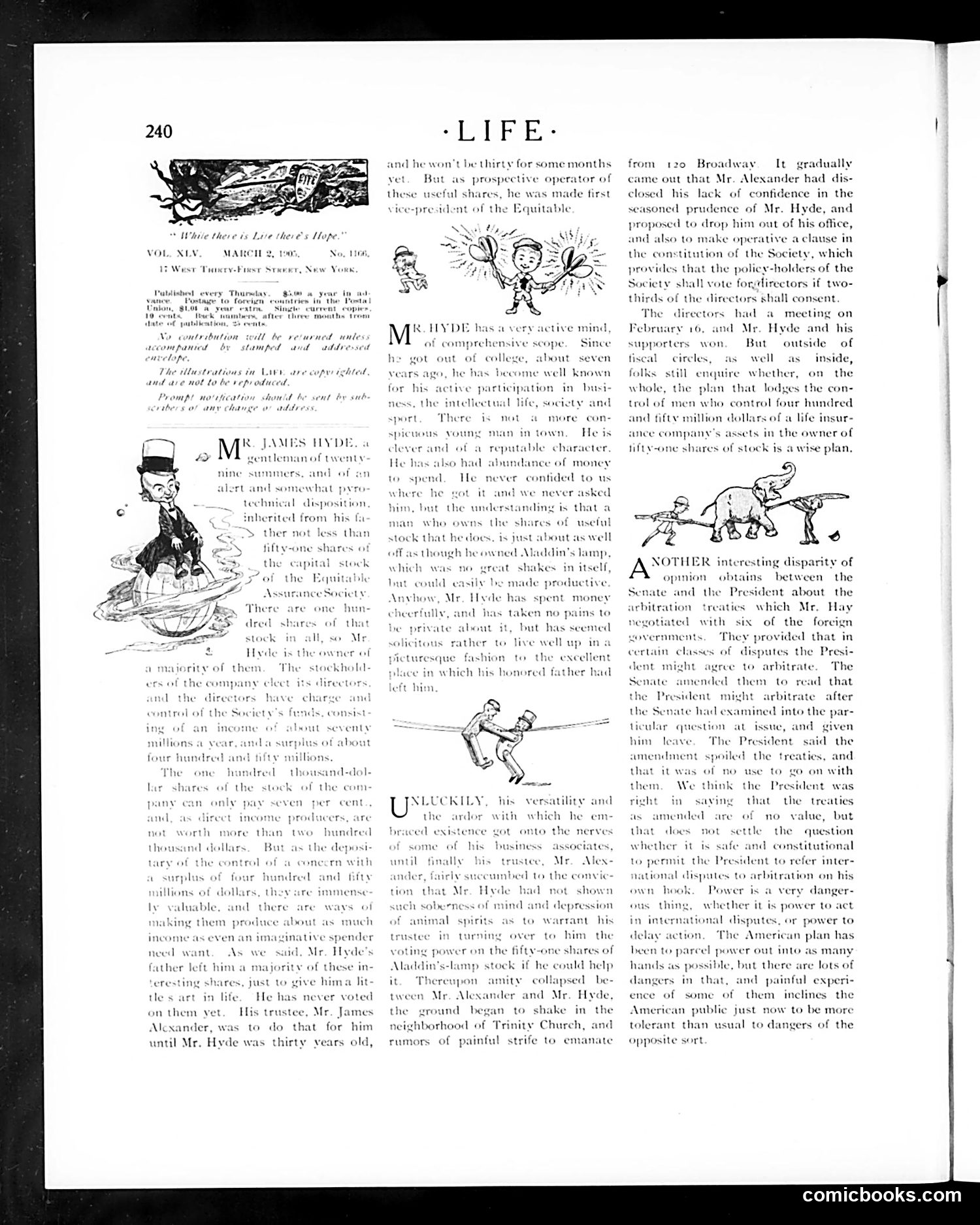
This page from *Life* magazine (March 2, 1906) satirizes **James Hyde**, a wealthy stockholder in the Equitable Life Assurance Society. The caricature depicts Hyde as a grotesque figure riding a globe, mocking his control over a major insurance company's assets—reportedly about $450 million. The satire highlights a corporate scandal: Hyde's father left him controlling shares, which he used despite lacking business experience. The article criticizes how Hyde squandered company money on a lavish lifestyle rather than reinvesting it productively. The cartoon ridicules the absurdity of one young man commanding such vast wealth without earned competence, reflecting Progressive-era outrage over unchecked corporate power and inherited privilege controlling public financial institutions.
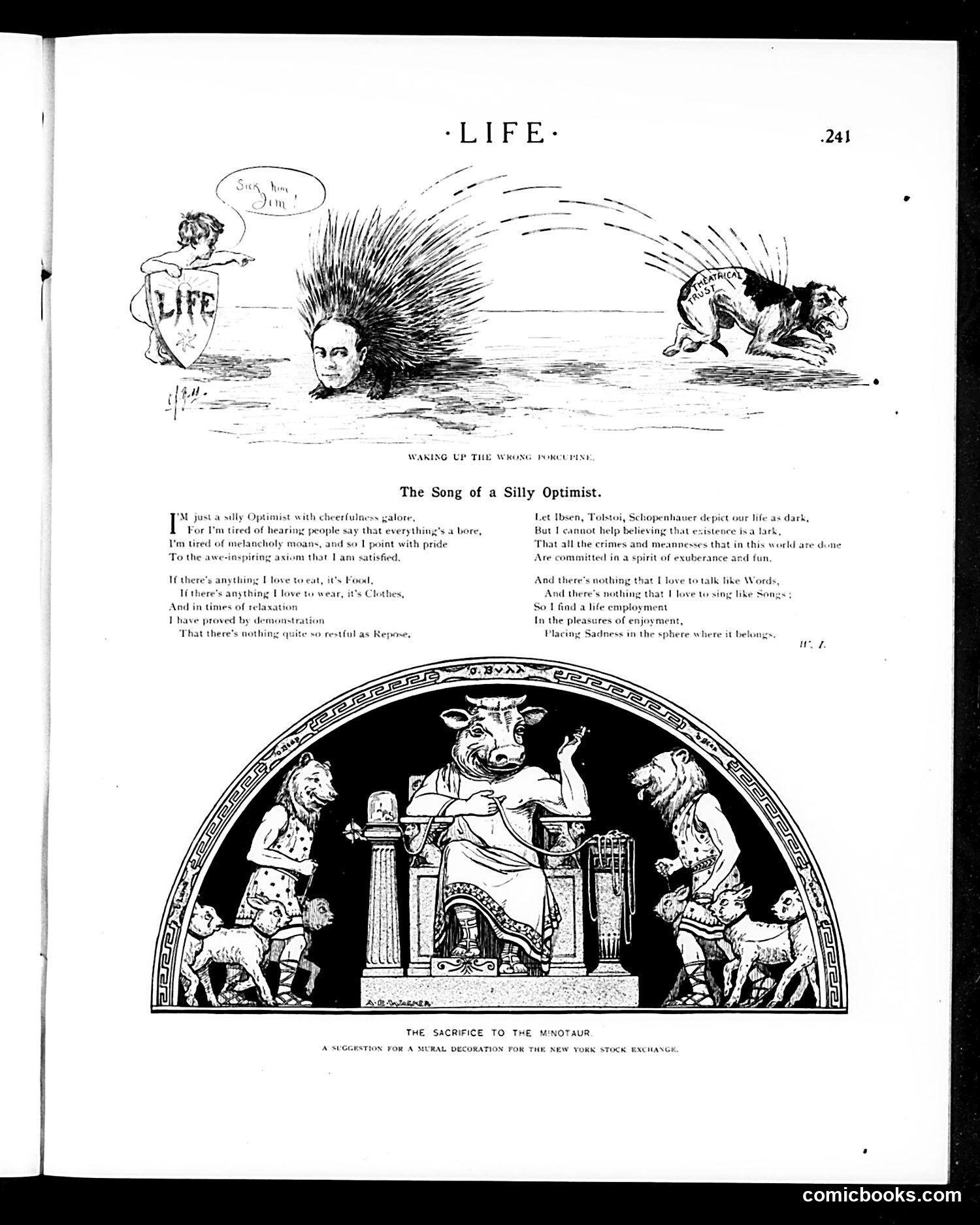
**Top Cartoon: "Waking Up the Wrong Porcupine"** This appears to be visual commentary on naive optimism. A figure labeled "Life" shields itself while encountering a spiky porcupine—suggesting that cheerful, Pollyanna-ish attitudes about existence will inevitably encounter harsh reality. **"The Song of a Silly Optimist" (poem)** The text mocks blind optimism by referencing pessimistic philosophers (Ibsen, Tolstoy, Schopenhauer) while the speaker insists everything—even crimes and meanness—stems from "exuberance and fun." The satire is clear: this optimist is willfully delusional. **Bottom Image: "The Sacrifice to the Minotaur"** This classical allusion depicts a minotaur (half-man, half-bull) as a god receiving sacrifice, with cherubs attending. The subtitle explicitly identifies it as "a suggestion for a mural decoration for the New York Stock Exchange"—bitterly satirizing Wall Street as a bloodthirsty monster demanding human sacrifice. The joke: the stock market is a modern Minotaur devouring victims.
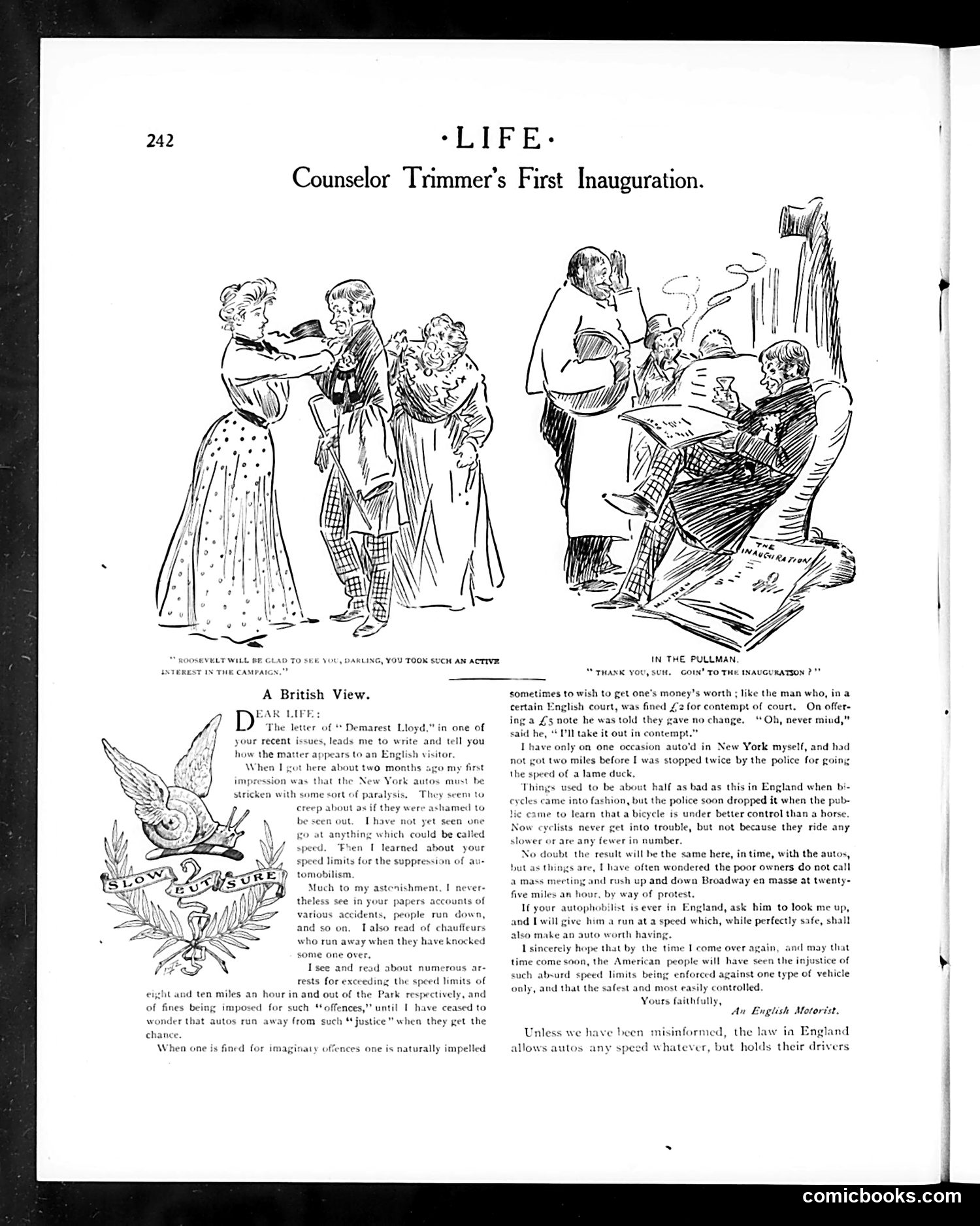
The top cartoon depicts a political figure (likely Theodore Roosevelt, suggested by "Trimmer") being dressed or prepared for inauguration by various handlers and attendants—a visual joke about political manipulation and the artifice of preparing a candidate for public office. The letter below, titled "A British View," is satirical commentary on American automobile regulation. A British motorist writes complaining that American speed limit enforcement is absurdly strict and inconsistently applied—drivers are heavily fined for minor infractions yet still recklessly speed and flee police. He contrasts this with England's more lenient, sensible approach. The satire targets American regulatory excess and hypocrisy: strict laws that don't actually prevent dangerous driving, only generate fines and resentment. The "Pullman" dialogue at top-right appears to reference campaign activities, possibly mocking participation in political events.
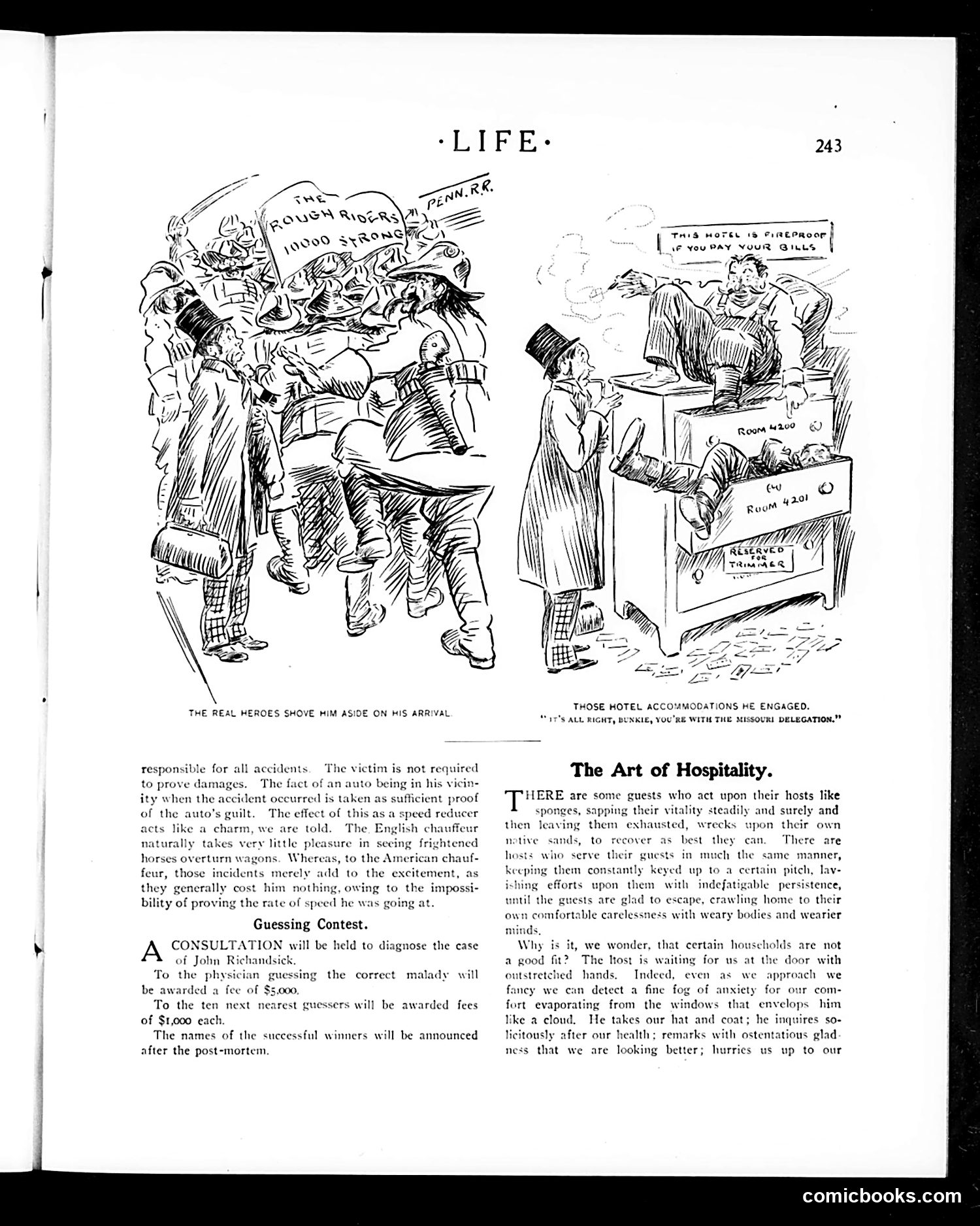
**Left cartoon:** "The Real Heroes Shove Him Aside on His Arrival" depicts a chaotic crowd of people—appearing to be politicians or dignitaries from various railroad and regional delegations (visible text references "Penn. R.R." and "10,000 Strong")—jostling and pushing a central figure upon arrival. The satire mocks the performative chaos of political receptions, suggesting that despite ceremonial importance, the guest is treated rudely by the very people meant to honor him. **Right cartoon:** A hotel desk clerk assures a guest that his room assignment is acceptable because "you're with the Missouri delegation"—implying that shared regional identity substitutes for actual hotel quality. The satire ridicules how poor accommodations are excused through ethnic/regional camaraderie rather than genuine hospitality. Both cartoons mock the gap between pretended courtesy and actual treatment, satirizing early 20th-century American political culture and its shallow performative gestures.
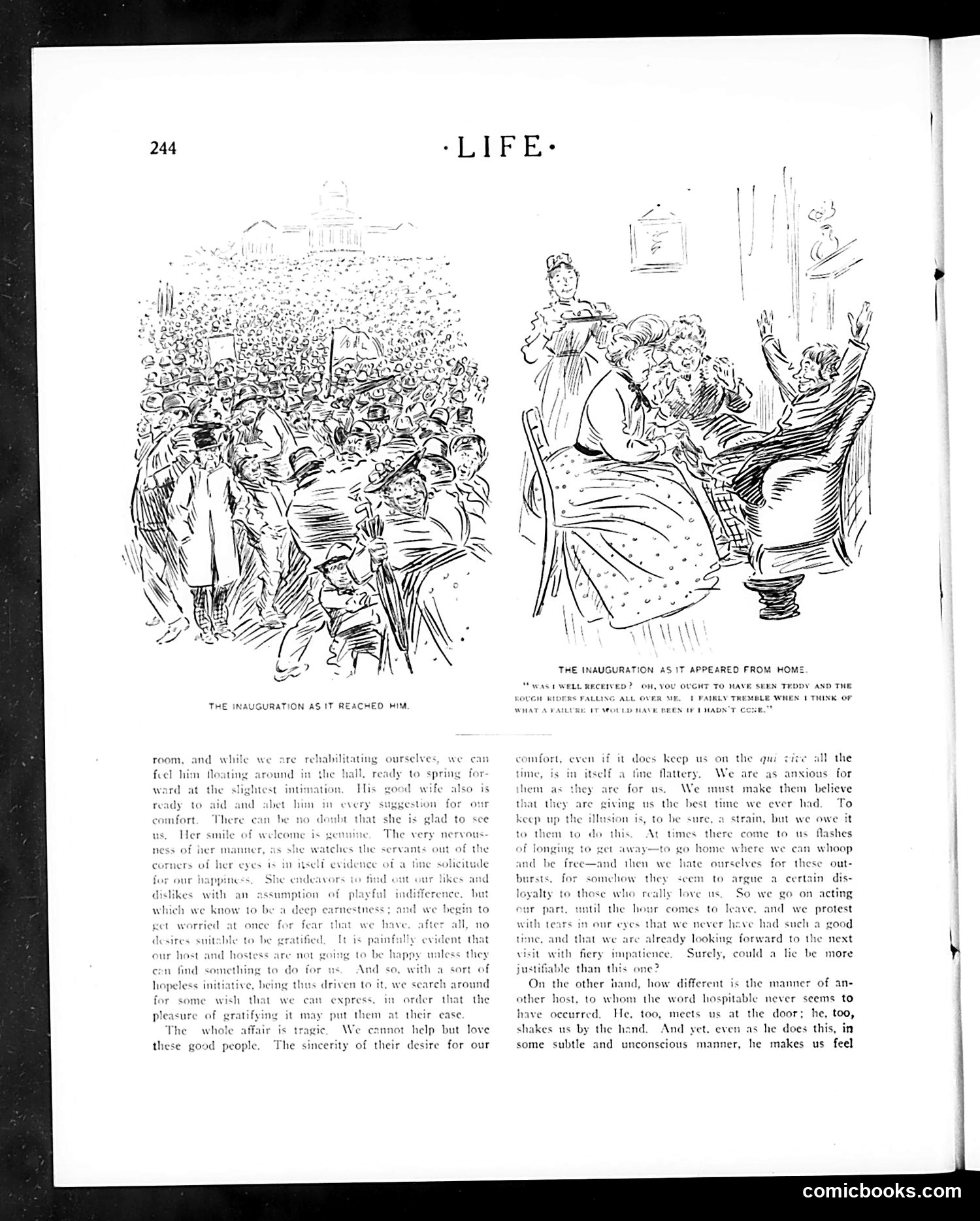
These two cartoons contrast public perception of Theodore Roosevelt's 1901 inauguration with the private reality of being a houseguest. **Left cartoon** ("The Inauguration As It Reached Him"): Shows an enormous crowd at the Capitol, depicting the public spectacle and mass enthusiasm surrounding Roosevelt's inauguration—the ceremonial grandeur as it appeared in news coverage. **Right cartoon** ("The Inauguration As It Appeared From Home"): Shows an awkward domestic scene where a woman nervously entertains guests while a man stands aloof, illustrating the disconnect between public celebration and the mundane, often uncomfortable reality of hosting during major events. The accompanying text suggests tension between performing hospitality (maintaining the "illusion" for guests) and authentic feeling. The captions reference "Teddy" (Roosevelt's nickname) and imply anxiety about the inauguration's impact on everyday life. The satire critiques the gap between national pageantry and personal domestic strain—how monumental public events create pressure and discomfort for ordinary people caught in their wake.
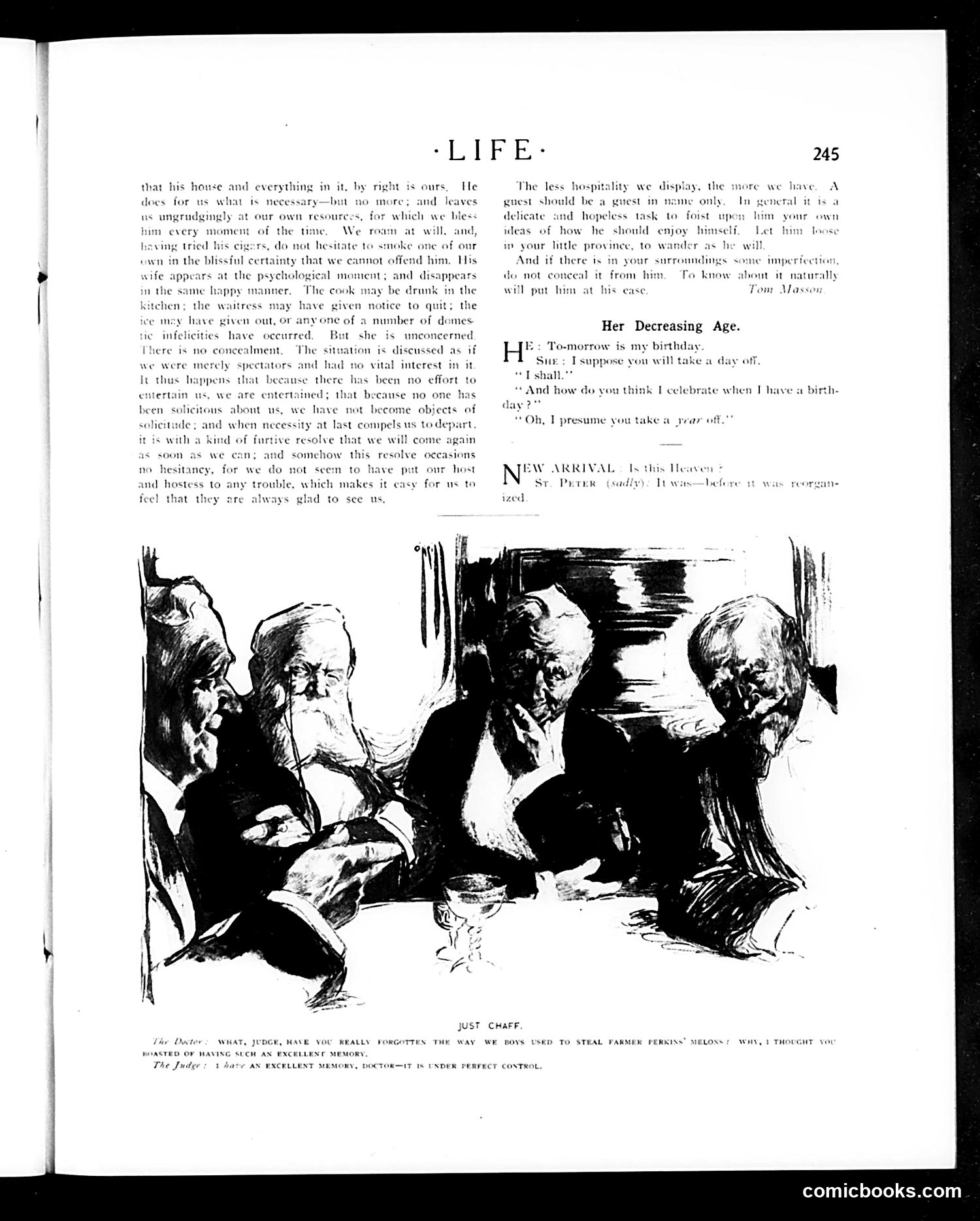
This page contains two separate satirical comic exchanges typical of Life magazine's humor section. **Top cartoon ("Just Chaff"):** A doctor and judge converse at what appears to be a social gathering. The doctor asks if the judge has forgotten how boys used to steal from Farmer Perkins' melon patch. The judge responds that he has an "excellent memory" and claims it's "under perfect control"—the joke being the obvious contradiction: if his memory were truly excellent and controlled, he'd remember the youthful mischief. The satire targets the hypocrisy of respectable older men who deny or whitewash their own past indiscretions. **Bottom section ("Her Decreasing Age"):** A brief dialogue where a woman mentions her birthday tomorrow, and when asked how she'll celebrate, quips she'll "take a year off." The humor plays on the common social convention where women decrease their stated age rather than acknowledge advancing years—she's inverting the joke by literally taking a year off her age. Both rely on observational humor about human vanity and social pretense.
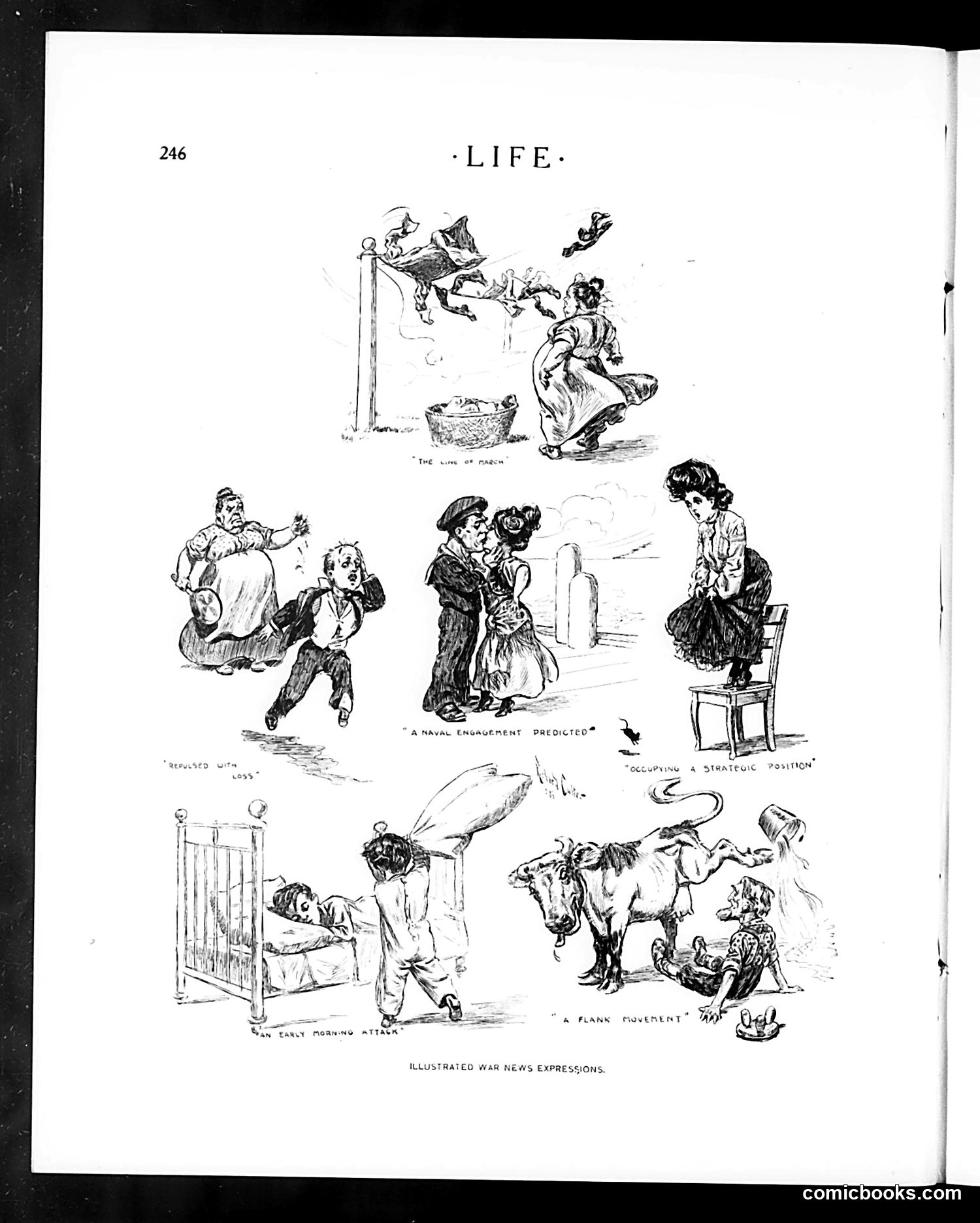
This page of satirical cartoons mocks romantic and domestic clichés during wartime by presenting exaggerated "expressions" common in news coverage: - **"The Line of Parody"**: A woman tosses items from a clothesline while children play below, satirizing sentimental depictions of home life - **"A Naval Engagement Predicted"**: A couple embraces, parodying military terminology applied to romance - **"Occupying a Strategic Position"**: A woman sits formally, mocking military language - **"Repulsed with Loss"**: A man and boy in retreat - **"An Early Morning Attack"**: A bedroom scene with exaggerated action - **"A Flank Movement"**: Goats cause chaos among civilians The humor lies in applying martial language and concepts to domestic scenes, likely critiquing how wartime rhetoric infiltrated everyday American speech and popular media during an unspecified conflict (likely WWI-era, given Life's publication history).
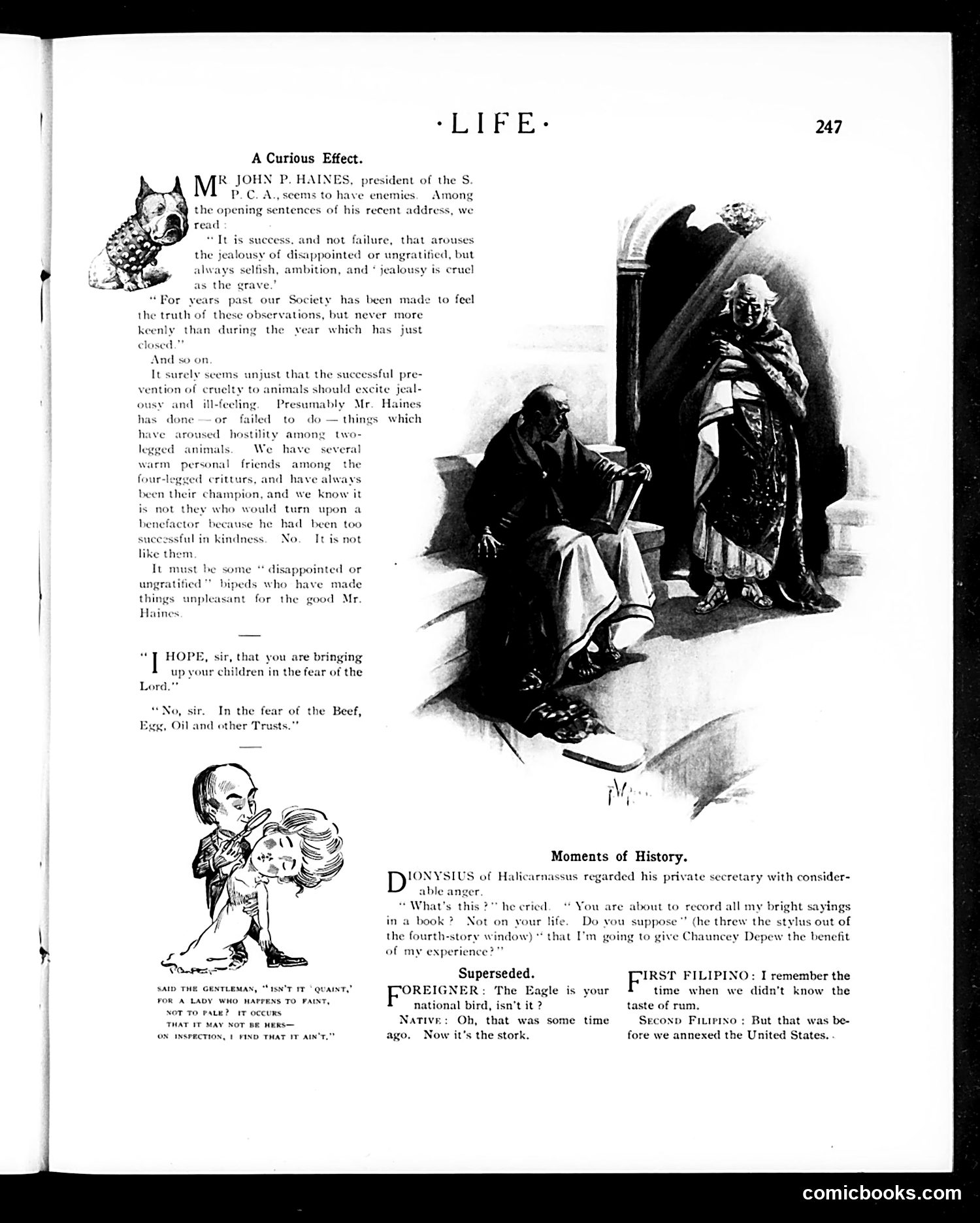
This page contains multiple satirical pieces: **"A Curious Effect"** critiques Mr. John P. Haines, president of the S.P.C.A. (animal welfare organization), suggesting his success in preventing animal cruelty has made enemies jealous. The satire implies that doing good work breeds resentment from disappointed rivals. **"Moments of History"** includes two brief jokes: 1. A classical reference to Dionysius of Halicarnassus, mocking someone's vanity about recording their witticisms. 2. **"Superseded"**: A foreigner and native discuss America's national bird. The joke plays on changing national symbols—the native explains the eagle was replaced by the stork, a dark joke implying American imperialism has "delivered" something unwanted (likely referencing U.S. expansion into the Philippines). The Philippine reference reflects early-1900s American colonial debates, with the joke suggesting colonized peoples view American influence negatively.
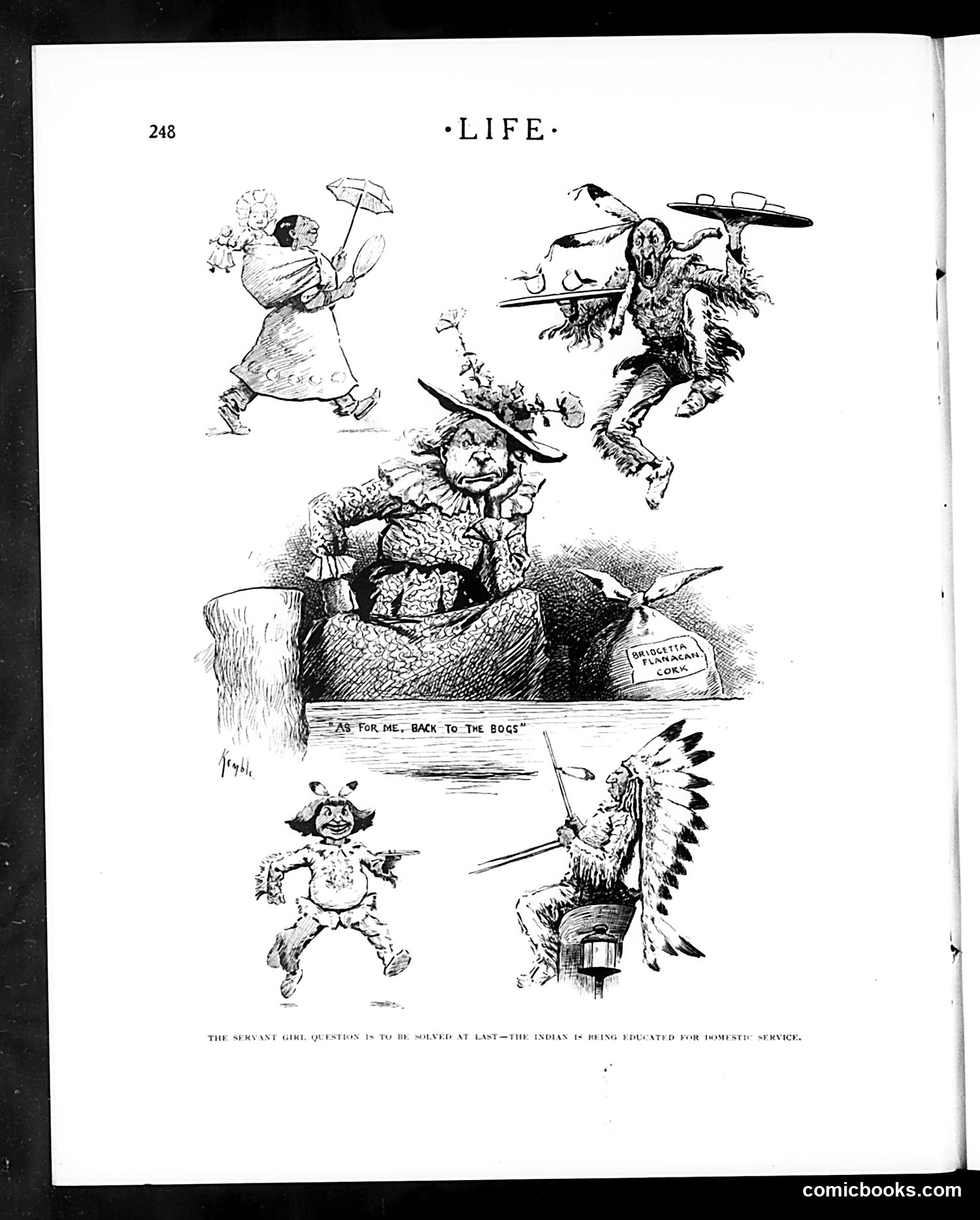
This satirical Life magazine page mocks a proposed solution to the "Servant Girl Question"—a late-19th/early-20th-century concern about domestic labor shortages in America. The cartoon suggests Native Americans should be "educated for domestic service" to solve the servant shortage. The central figure appears to be a stereotypically-drawn Native American being trained as household help. Supporting vignettes show the absurdity: a woman juggling domestic chaos, fantastical creatures, and a Native American chief figure. The satire targets both the actual proposal and underlying prejudices—treating Indigenous peoples as a labor solution and the desperation of middle-class households seeking affordable domestic workers. The grotesque caricatures and chaotic imagery emphasize how ridiculous this "solution" is, while the text ironically presents it as serious policy.
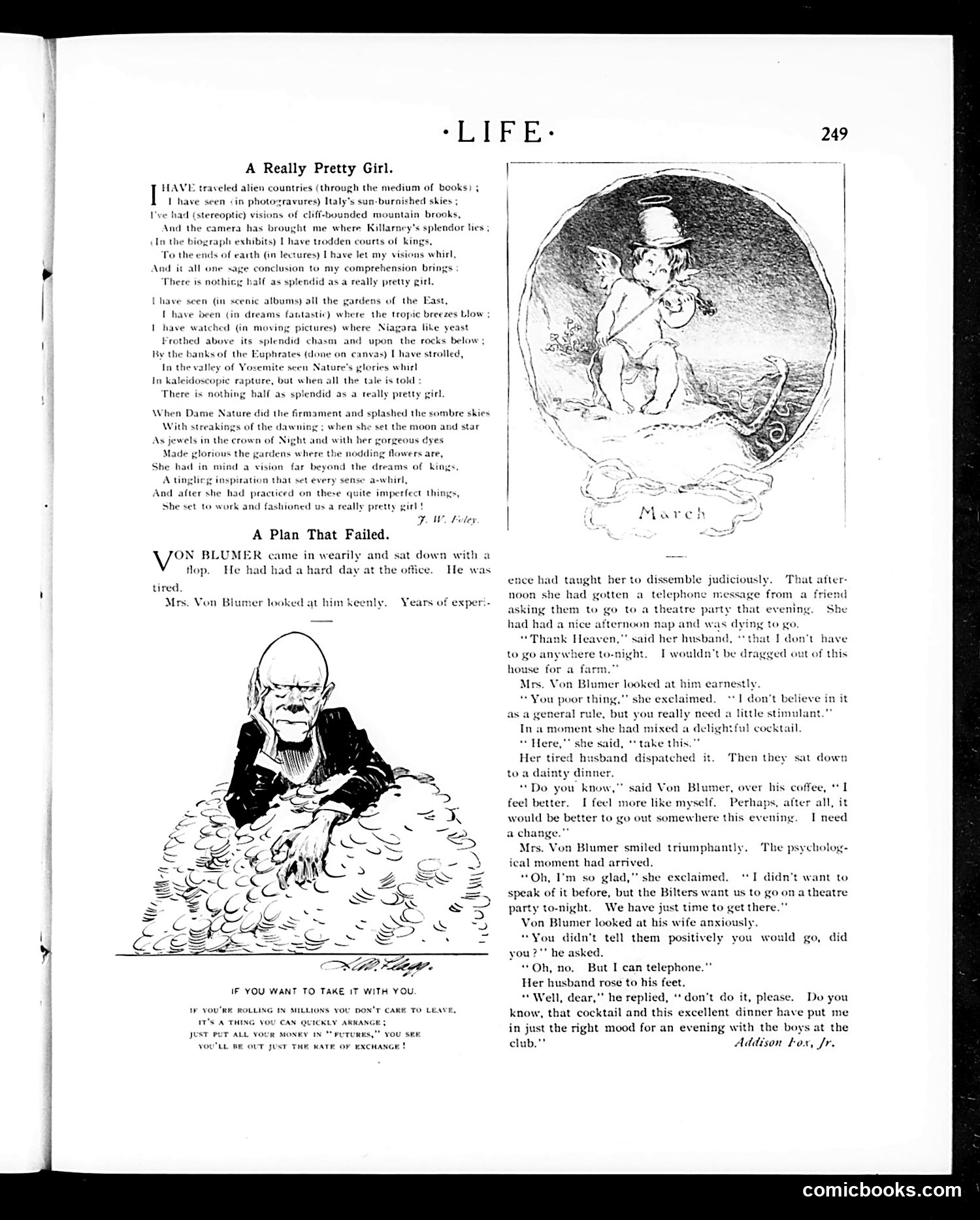
This *Life* magazine page contains two satirical pieces: **"A Really Pretty Girl"** (poem by J.W. Fuller): A romantic poem celebrating female beauty as superior to all world wonders—travel, natural landmarks, even artistic masterpieces. The satire lies in the exaggerated, flowery praise of women's appearance as the ultimate achievement, reflecting early 20th-century gender attitudes that reduced women's value to their looks. **"A Plan That Failed"** (story by Addison Fox, Jr.): A domestic comedy where a tired husband wants to avoid a theater party. His wife strategically gives him a cocktail and nice dinner to improve his mood, banking on psychology to manipulate him into going. The irony: her plan backfires—he feels so good he refuses to leave home. The satire gently mocks both marital manipulation tactics and how quickly a man's priorities shift from social obligation to personal comfort. Both pieces reflect pre-1930s attitudes toward gender roles, domesticity, and marriage dynamics common in American humor magazines of that era.
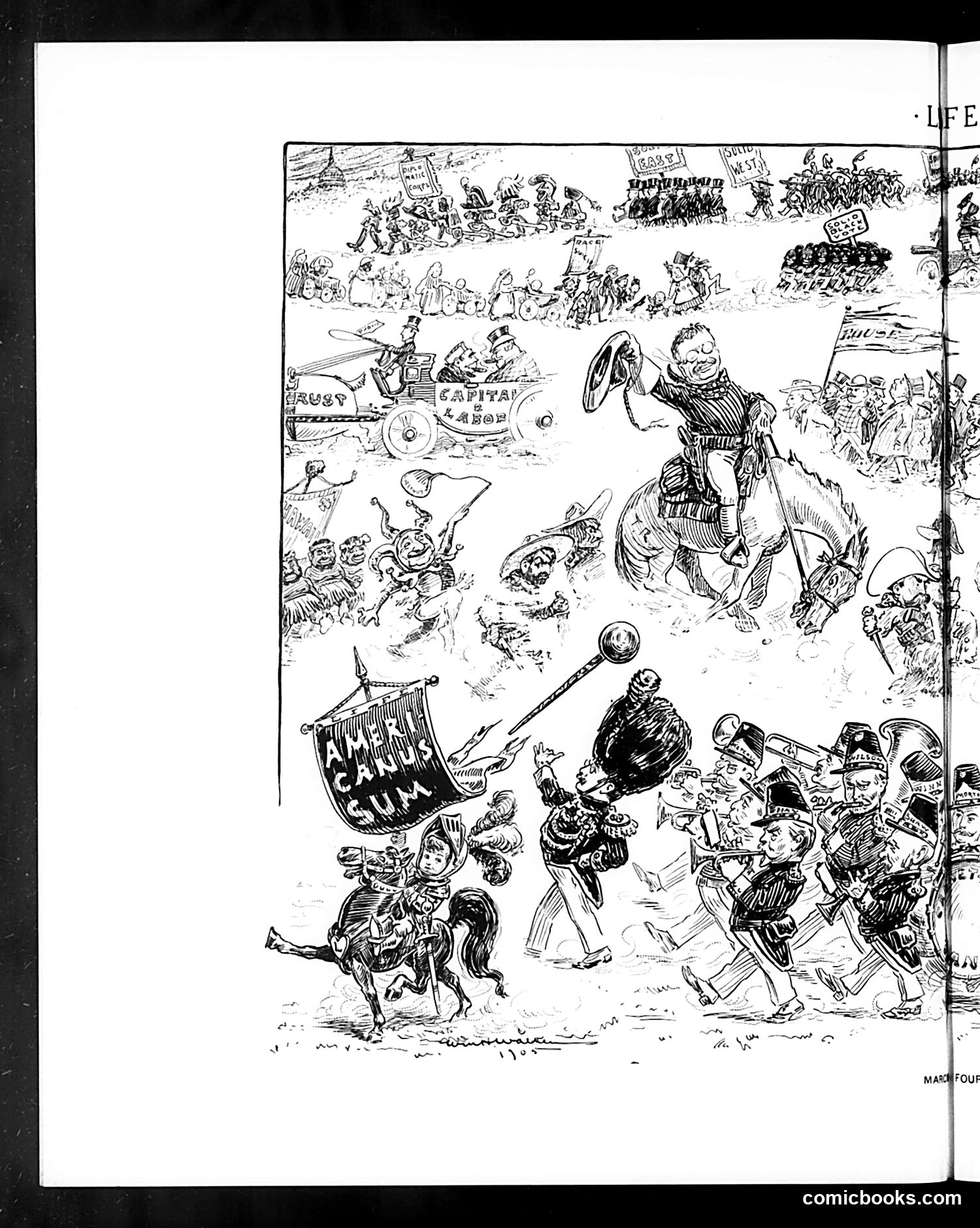
This appears to be a satirical cartoon from *Life* magazine mocking a political procession or parade. The composition shows military and political figures moving through a chaotic scene with crowds. Visible labels include "TRUST," "CAPITAL," and "LABOR," suggesting commentary on American economic tensions—likely referencing conflicts between capitalists, labor unions, and monopolistic trusts during the Progressive Era (early 1900s). The central mounted figure appears to be a caricatured political leader or industrialist directing the proceedings, while soldiers and officials follow. The disorderly crowds and scattered figures suggest social upheaval or disorder accompanying this "march." The overall satire appears to criticize how political and business elites managed economic conflict, portraying their efforts as chaotic or self-serving rather than genuinely resolving labor-capital disputes.
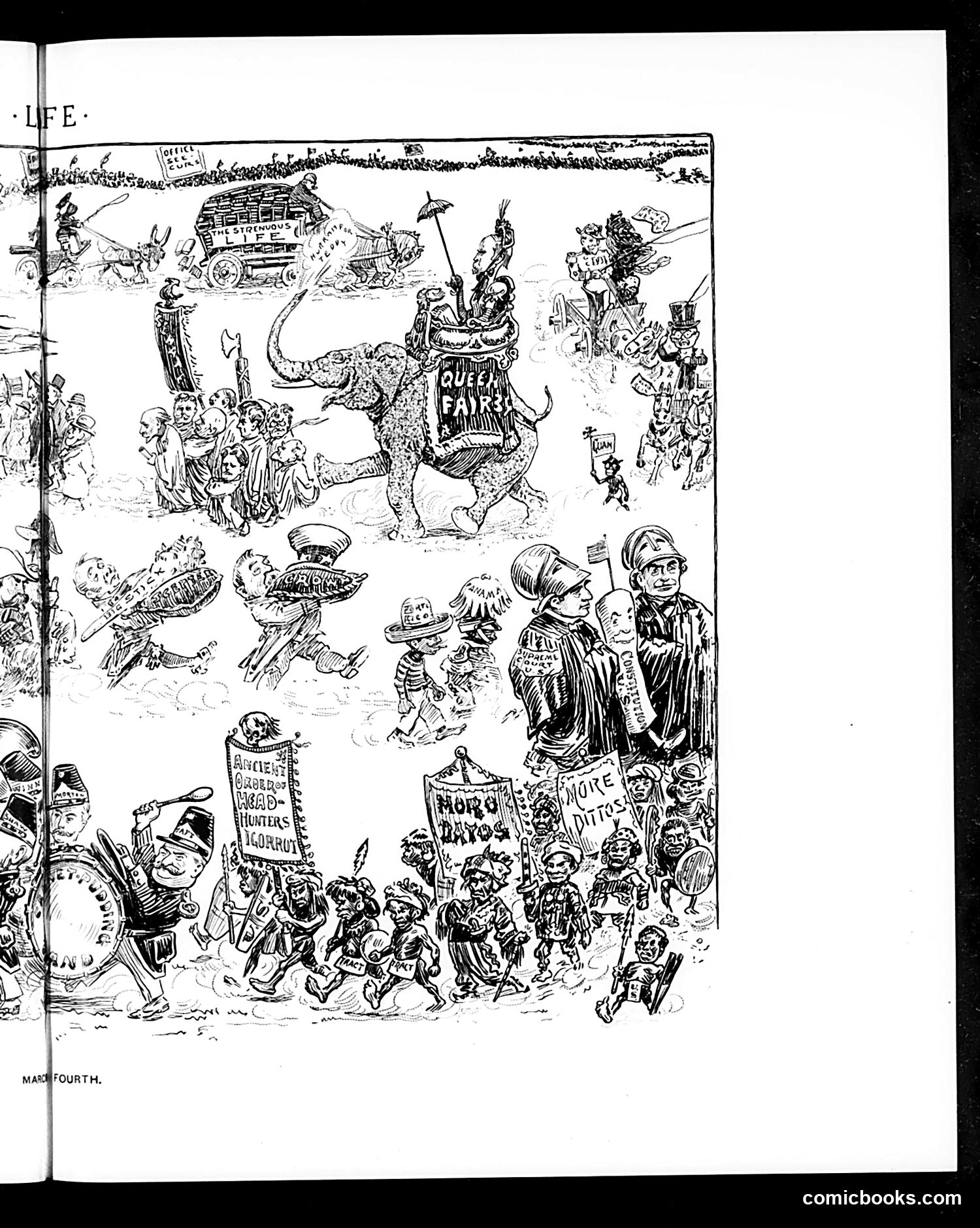
This is a satirical cartoon from *Life* magazine dated March Fourth (likely early 1900s based on style). The central image depicts a large elephant carrying a howdah (ceremonial seat) labeled "QUEEN FAIR'S," surrounded by a carnival-like procession of diverse figures—some appearing to be political caricatures, performers, and common people. The scene appears to satirize either a political event or public spectacle associated with a "Queen Fair." The marching procession below includes figures holding banners (text unclear in reproduction) and various caricatured types. The elaborate, fantastical nature of the procession—with its exaggerated characters and carnival atmosphere—suggests mockery of political pretension, public spectacle, or possibly an international fair or political gathering. Without clearer text visibility, the specific political targets remain somewhat unclear.
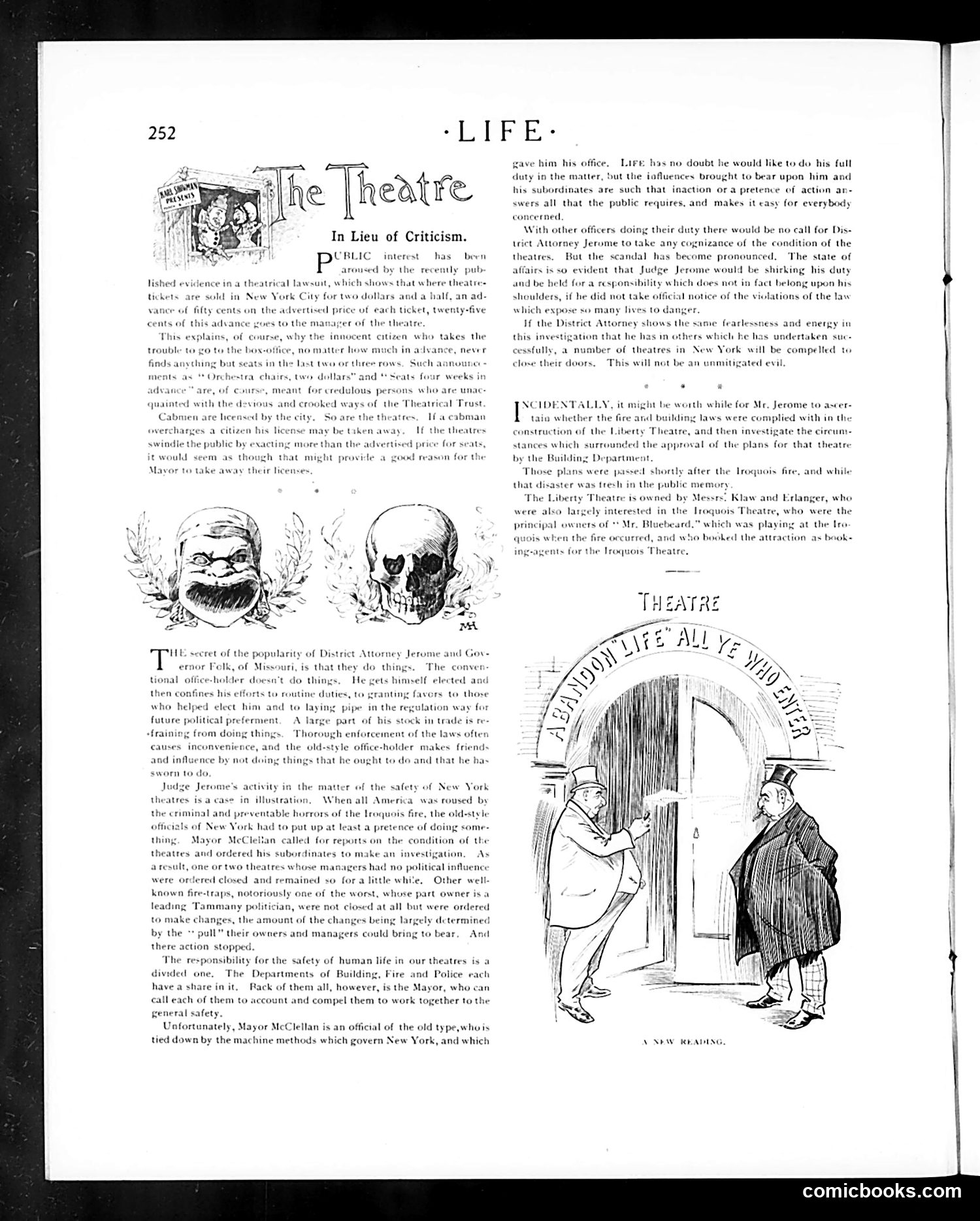
This page critiques the failure of New York City officials to enforce theater safety regulations following a recent major fire (the text references "the Iroquois fire"). **The Main Figures:** - **District Attorney Jerome**: Praised for investigating theater safety violations and taking action - **Mayor McClellan**: Criticized as ineffectual, bound by corrupt "machine methods" and political influence, unwilling to enforce laws unless forced by public scandal - **Governor Folk of Missouri**: Referenced approvingly as a contrast—an official who *does* his duty **The Satire's Point:** The article argues that McClellan only pretends to act on theater safety after the Iroquois disaster became public. Real enforcement requires the District Attorney's intervention because the Mayor is politically compromised. Officials ignore violations until scandals force their hand, and they selectively close only theaters without political connections while protecting well-connected ones. **The Cartoon** (bottom right, captioned "A New Reading") appears to show a figure entering or being welcomed at a door, likely satirizing corrupt access or favoritism. The core message: political corruption endangers lives by preventing honest enforcement of public safety laws.
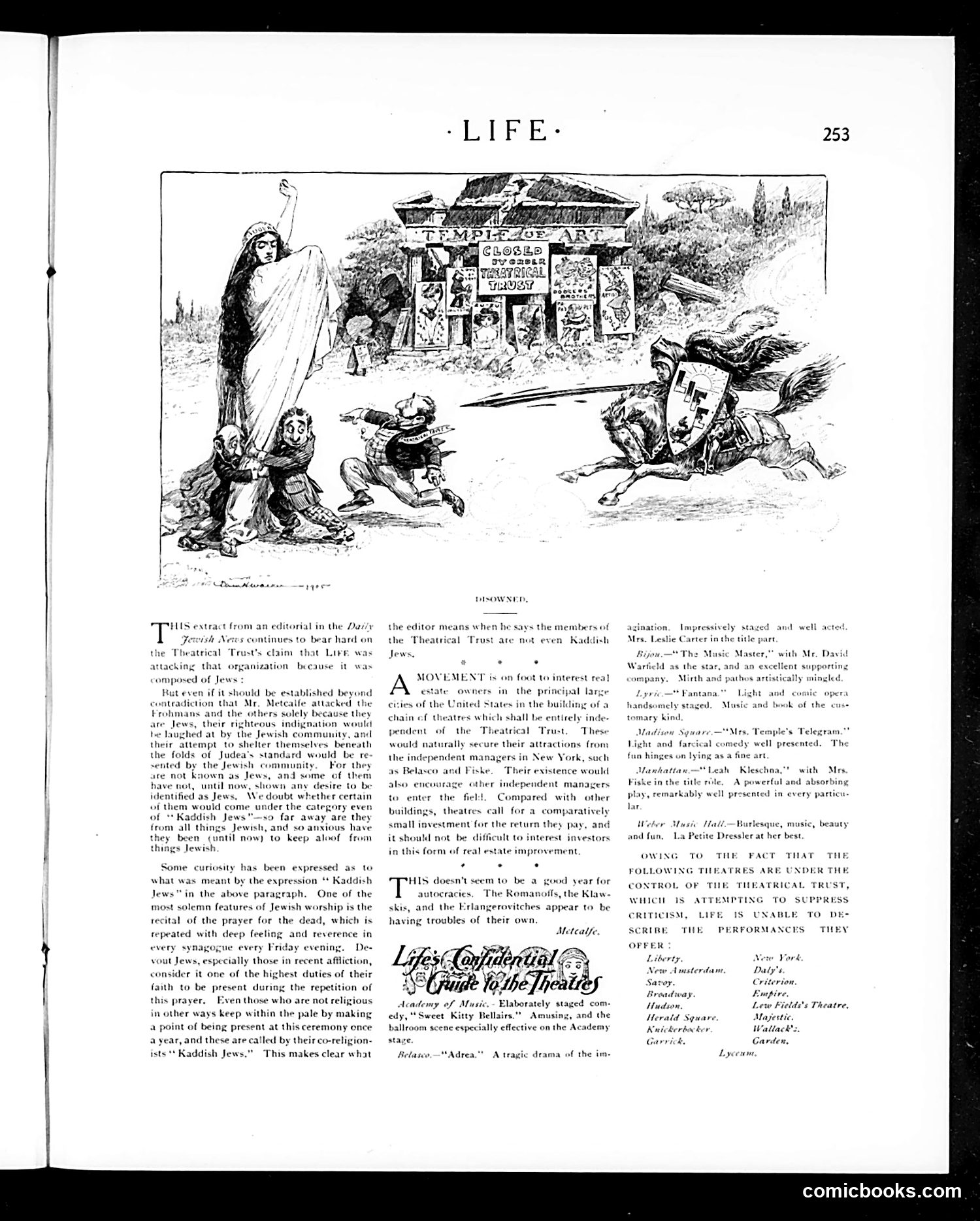
This page satirizes the **Theatrical Trust** (also called the Syndicate), a powerful monopoly controlling American theater in the early 1900s. The cartoon depicts the Trust as a ramshackle "Temple of Art" being attacked by various forces. The editorial discusses **Kaddish Jews**—a derisive term for Jews who ignore their religious heritage except attending prayer for the dead once yearly. The article argues that prominent theater producers (the Frohman brothers and others) attacked by critic William Metcalfe shouldn't claim victimization based on religion, since they've actively distanced themselves from Jewish identity. The satire's point: these theater magnates, having rejected their cultural roots for business success, cannot credibly demand protection as a persecuted minority when criticized. The page also notes Life magazine itself cannot freely critique Trust-controlled theaters due to their monopolistic power—a pointed commentary on censorship through economic control.
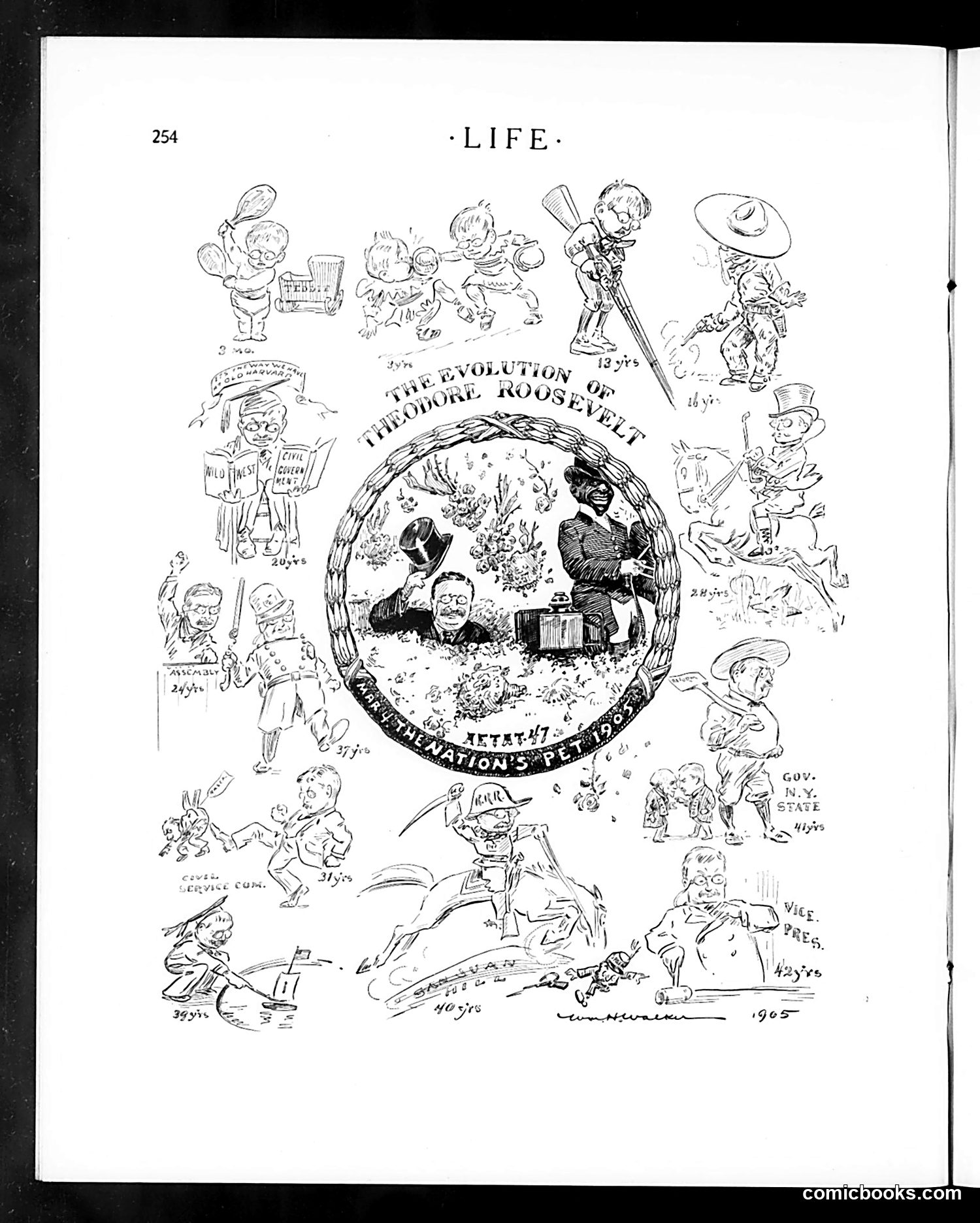
This 1905 political cartoon satirizes Theodore Roosevelt's political trajectory. The central circular design shows Roosevelt at different life stages, surrounded by vignettes depicting his evolution from youth through adulthood. The cartoon traces Roosevelt's various roles and personas—appearing to reference his transformation across different positions and public images. Surrounding figures show him in different contexts, likely representing his shifts in political ideology, career moves, or public perception throughout his life. The title "Evolution" suggests ironic commentary on how Roosevelt reinvented himself politically. The circular "nest" framing may reference his personal or political nesting/settling into power, or satirize the cyclical nature of his career changes. The 1965 signature date visible suggests this is a reproduction or reprinting of an original contemporary piece.
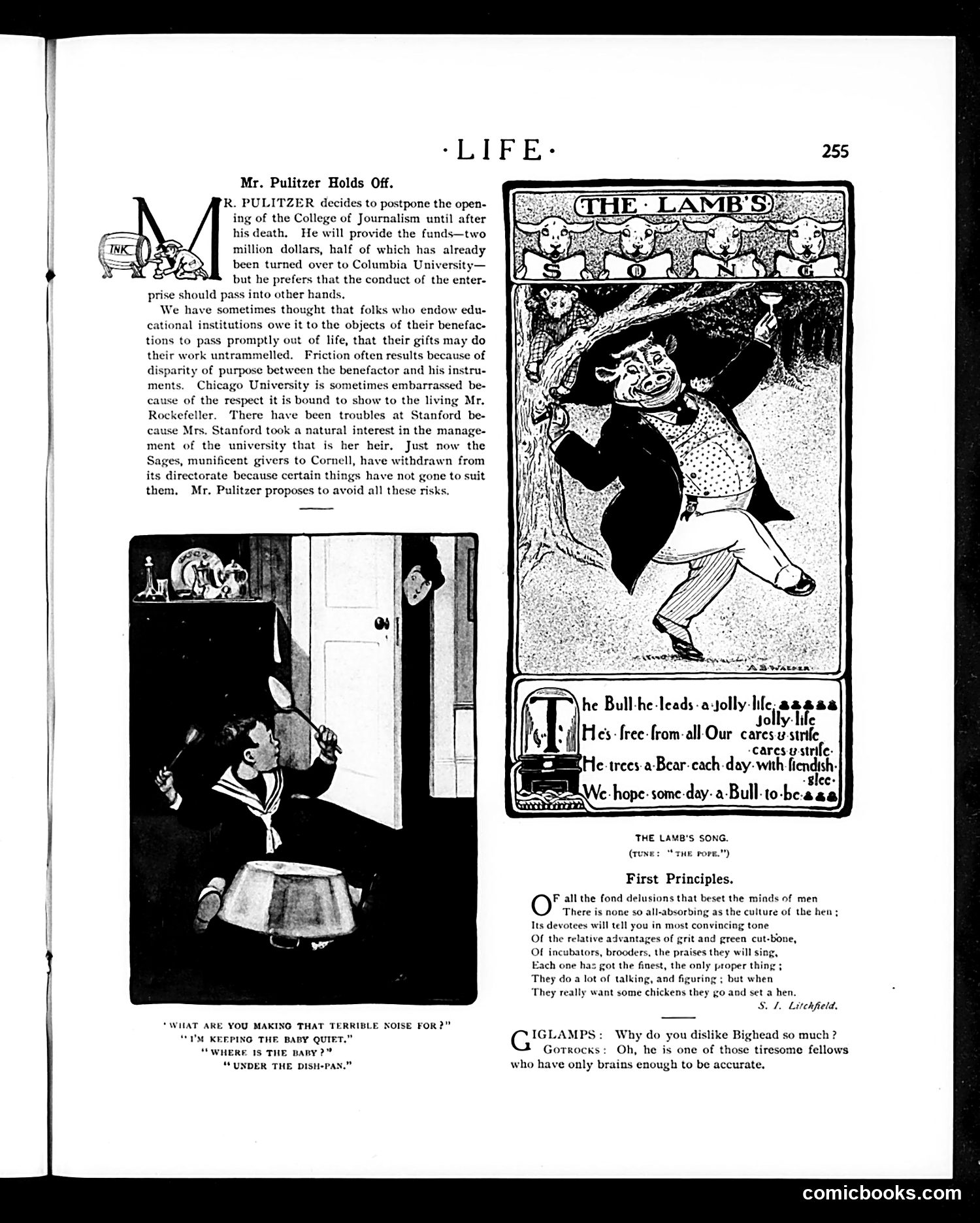
**Main Article - "Mr. Pulitzer Holds Off":** Publisher Joseph Pulitzer is delaying the opening of his promised College of Journalism at Columbia University until after his death. The article satirizes wealthy benefactors who maintain control over their endowments while living, citing friction at other institutions (Chicago University under Rockefeller, Stanford under Mrs. Stanford, Cornell under the Sages). Life's point: donors should die promptly so institutions can operate freely without the benefactor's interference—a darkly humorous critique of ego-driven philanthropy. **"The Lamb's Song" Comic:** A whimsical illustrated fable celebrating carefree bull-calves who live "jolly" lives free from human care, contrasting with working animals. The tone is lighthearted verse. **Bottom Cartoons:** A slapstick domestic scene of someone keeping a baby quiet under a dish-pan, and a joke about "Bighead" being annoyingly accurate—mocking pedantic precision. The page blends social commentary on wealth and institutional control with humorous illustrations typical of Life's satirical approach.
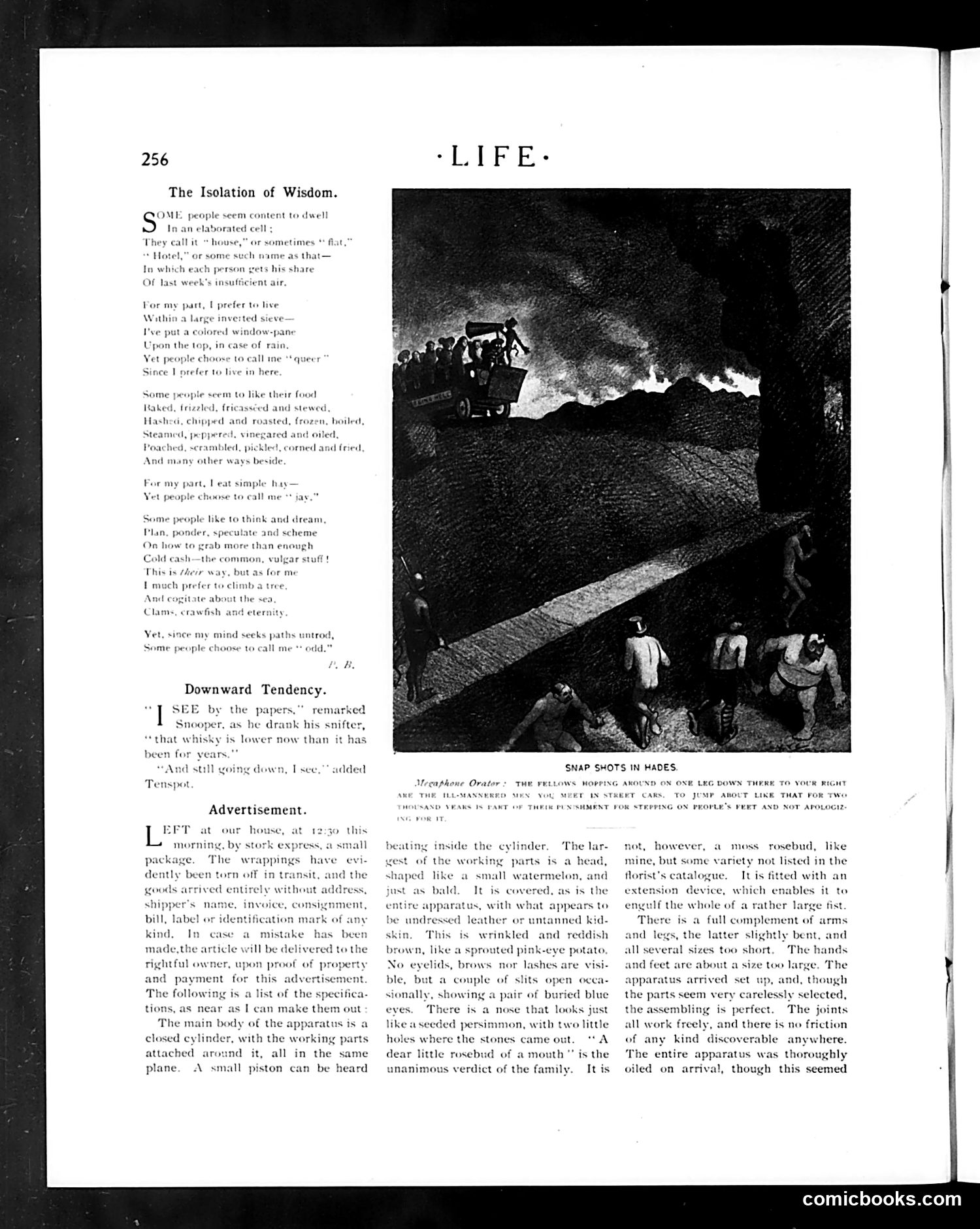
This page contains three separate pieces of satire: **"The Isolation of Wisdom"** (poem, left): A humorous first-person poem mocking nonconformists. The speaker proudly declares unconventional preferences—living in an inverted sieve, eating plain hay while others enjoy elaborate cuisine, preferring trees and sea contemplation to moneymaking—then concludes that society calls him "odd" for thinking differently. The satire cuts both ways: it gently ridicules both the speaker's affected eccentricity and society's dismissal of independent thought. **"Downward Tendency"** (brief dialogue): A man notes that whisky prices have fallen, interpreting this as moral decline—a dry joke about economic pessimism. **"Snap Shots in Hades"** (illustration with caption, right): Shows what appears to be souls in Hell being punished by hopping on one leg for eternity—specifically for "stepping on people's feet and not apologizing." This is light satirical commentary on rudeness as a moral failing warranting eternal punishment, typical of Life's social humor.
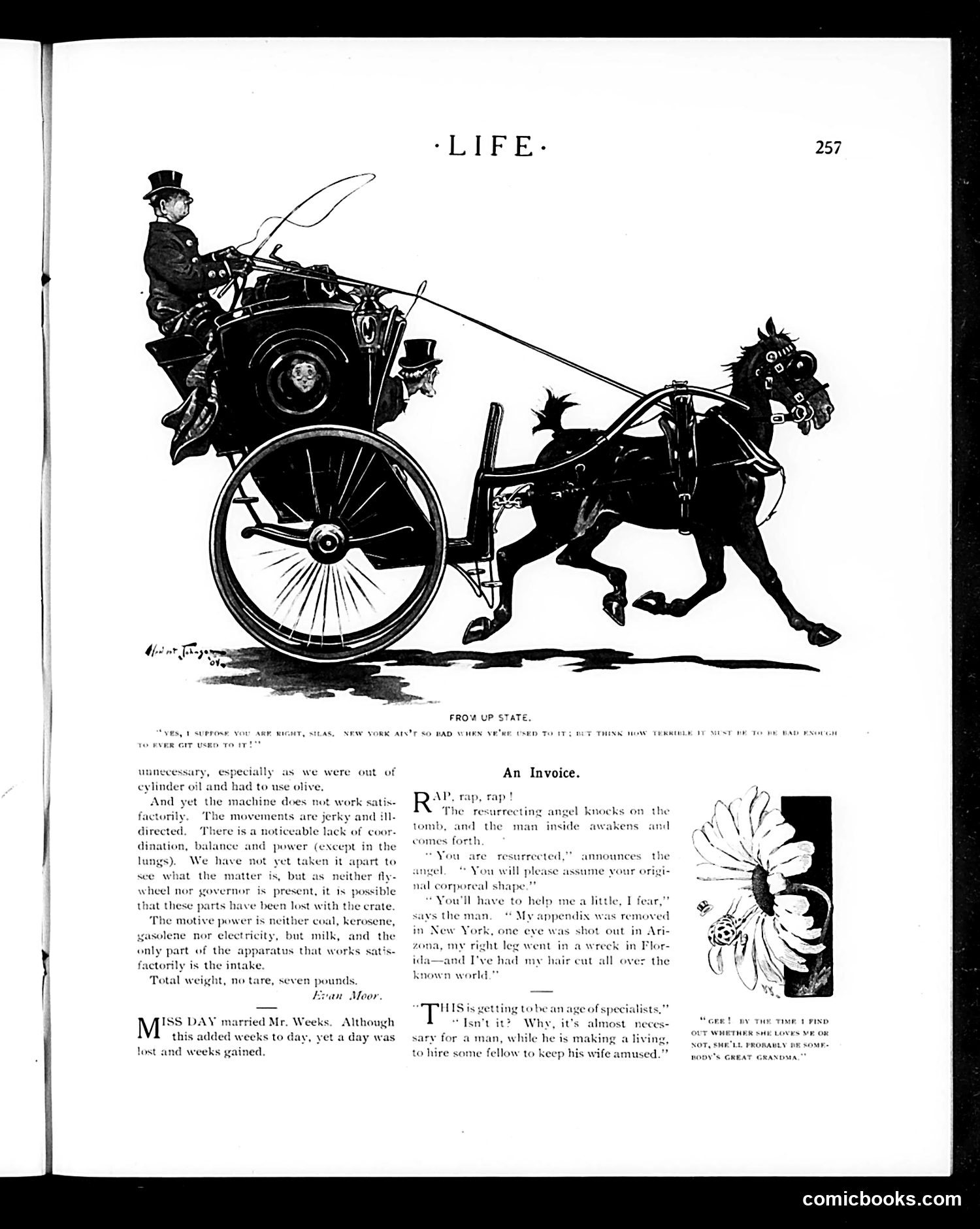
The page contains two distinct satirical pieces: **Top cartoon ("From Up State"):** A man operating an absurdly jerry-rigged vehicle—essentially a horse pulling a makeshift automobile body—symbolizes rural Americans struggling with modern technology. The dialogue mocks rural skepticism about cars, suggesting upstate New Yorkers found automobiles unreliable and preferred traditional horse transport. The satire targets the gap between urban modernity and rural resistance to it. **"An Invoice" section:** This story-and-illustration piece satirizes modern life's complications. A resurrected man discovers his body has been altered by modern surgery and accident (appendix removed, leg broken in Florida, haircut everywhere). The accompanying dialogue about hiring someone to keep one's wife entertained while earning a living mocks both marital discord and the era's emerging "age of specialists"—the modern tendency to outsource life's responsibilities. Both pieces ridicule early 20th-century American anxieties: technological disruption, bodily fragmentation through medical intervention, and social atomization.
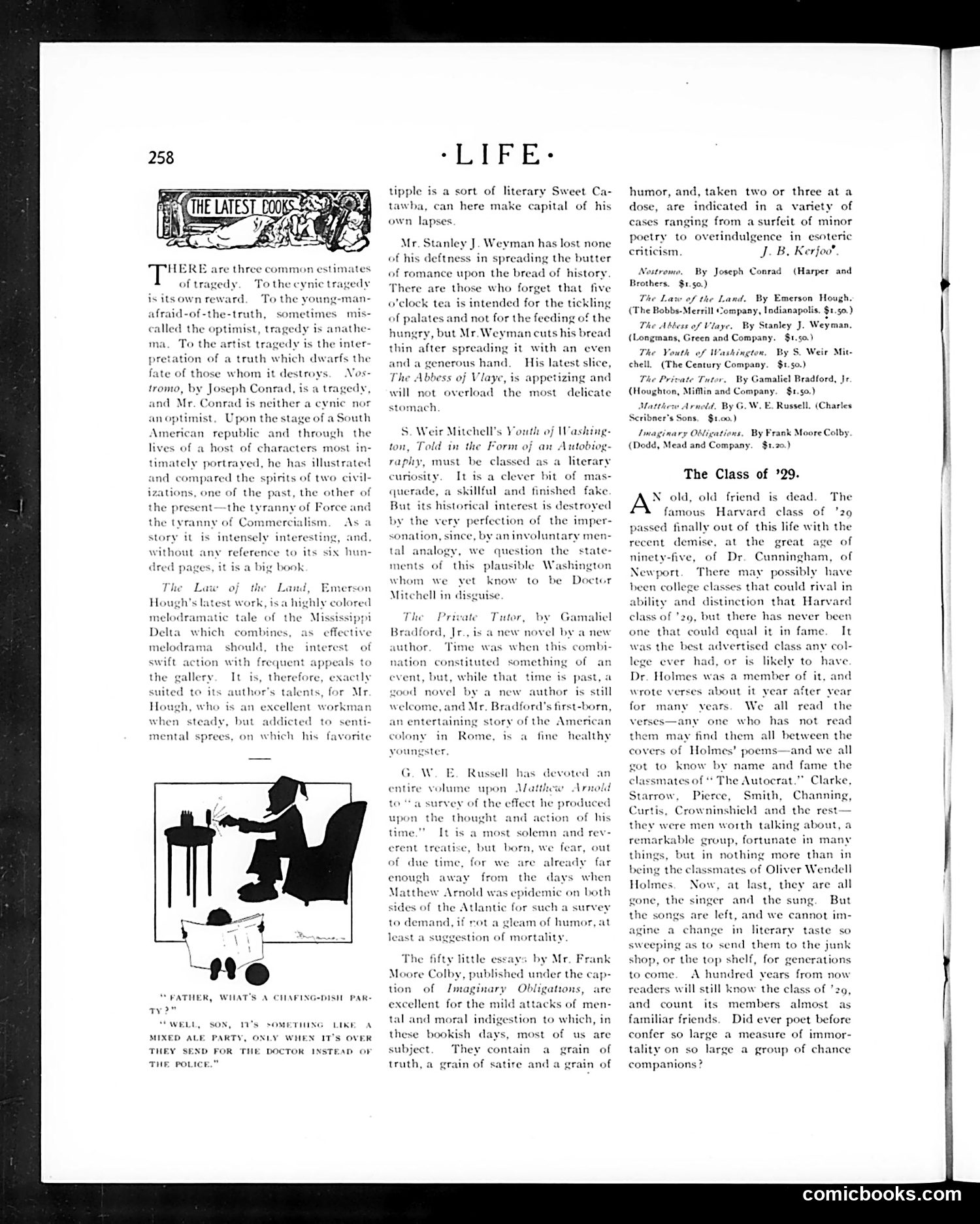
This page contains literary reviews and a single cartoon. The cartoon depicts a father and son discussing a "chafing dish party"—a social gathering where guests cook food together at the table. The father's joke is that such parties resemble "mixed ale parties" except that afterward "they send for the doctor instead of the police," suggesting the food causes illness rather than drunken disorder. The humor relies on the contrast between the genteel, fashionable nature of chafing dish entertaining (popular among the upper classes) and its actual digestive consequences—a mild satire on pretentious dinner party culture. The cartoon mocks both the fad itself and the assumption that refined social activities are automatically safe or beneficial. The page's book reviews discuss contemporary authors including Joseph Conrad, Emerson Hough, and others, establishing the literary context of early 1900s American publishing.
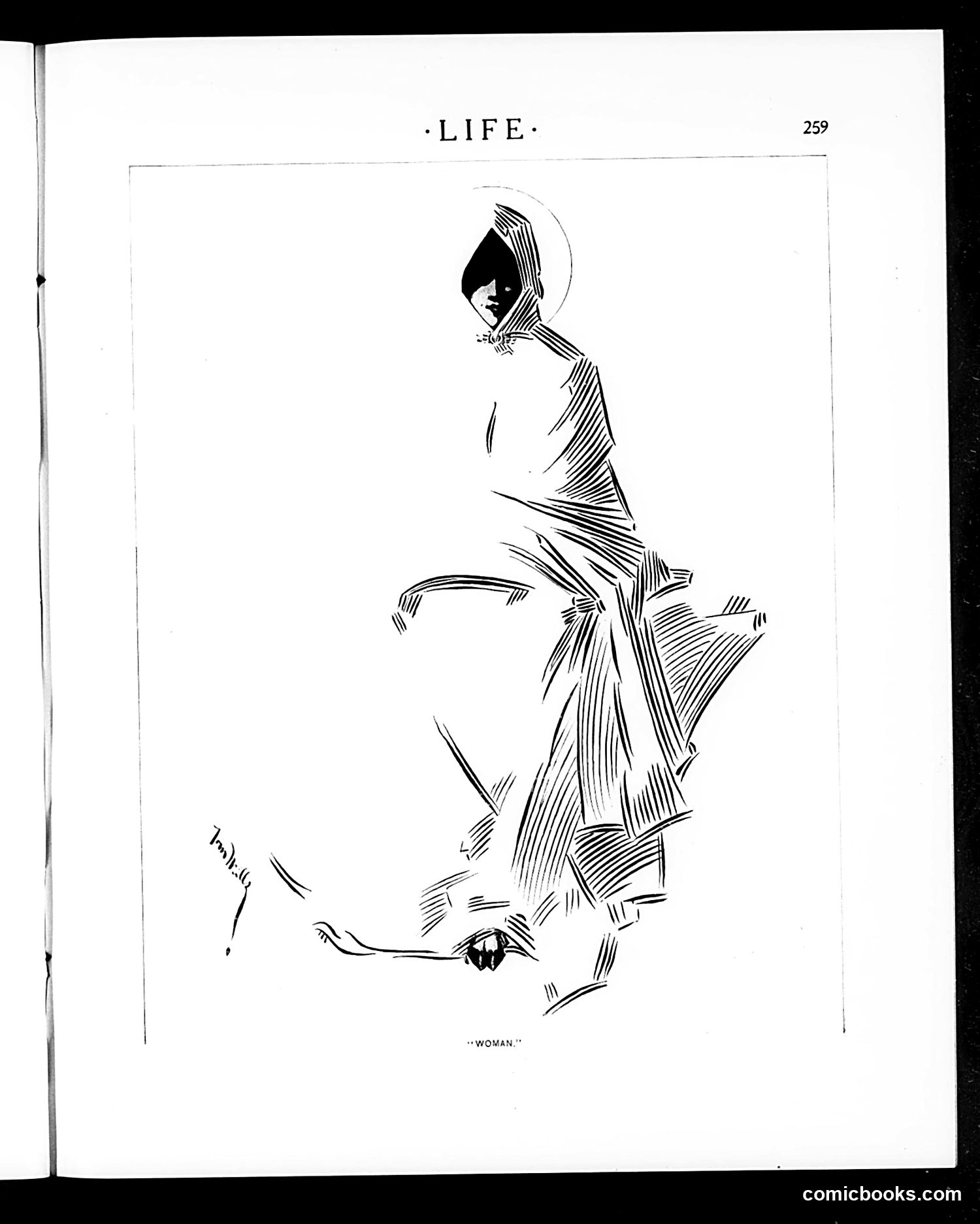
This is a minimalist ink sketch titled "Woman" showing a seated female figure rendered in loose, gestural line work. The drawing emphasizes flowing fabric and silhouette rather than anatomical detail. The style and page number (259) suggest this appeared in Life magazine's satirical section. Without additional context or visible artist signature, I cannot definitively identify the cartoonist or confirm the specific date of publication. The sparse OCR text provides no additional context. The sketch's modernist approach and the simple title suggest it may be social commentary on femininity, fashion, or women's roles—common subjects for Life's satirical cartoons—but the exact satirical intent remains unclear from the image alone.
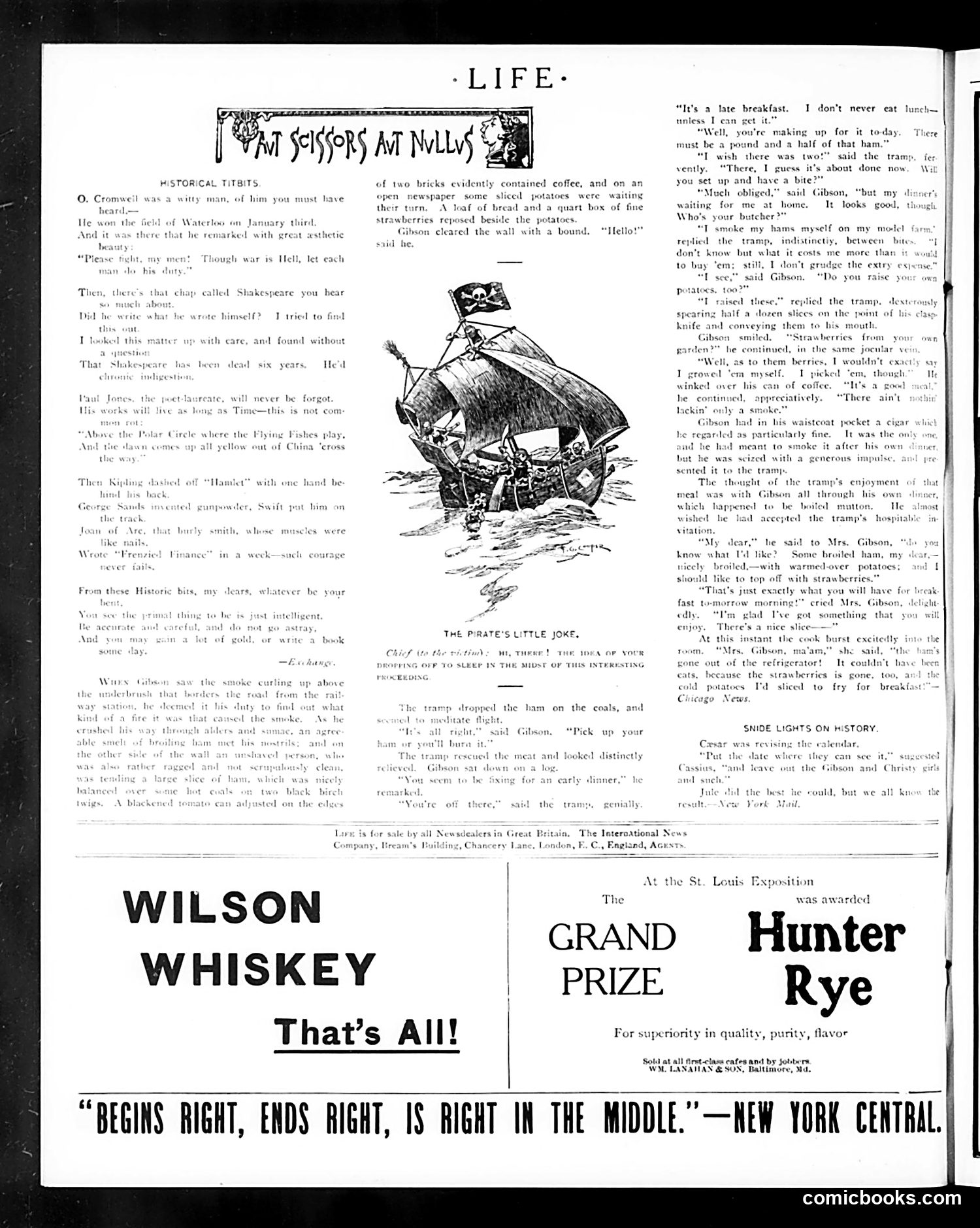
This page contains a humorous short story comic titled "I'm Scissors at Nullus" featuring a tramp (vagrant) who encounters a farmer named Gibson. The narrative depicts their breakfast conversation where Gibson offers the tramp food—ham, bread, strawberries—while sharing historical anecdotes about Cromwell and Shakespeare. **The joke's point:** The tramp repeatedly hints he'd like more food, particularly strawberries. When Gibson mentions his wife wants strawberries "on top" of breakfast, the tramp eagerly accepts—only to have Gibson accidentally drop the ham into coals. The "pirate's little joke" (the story's subtitle) is Gibson's gleeful trick of promising abundant food while ultimately serving less. **Social context:** This satirizes the contrast between rural plenty and vagrant poverty during the early 20th century. The tramp represents the era's homeless population, while Gibson embodies rural self-sufficiency (homegrown strawberries). The page also contains period advertisements for Wilson Whiskey and Hunter Rye whiskey, typical of Life's revenue model.
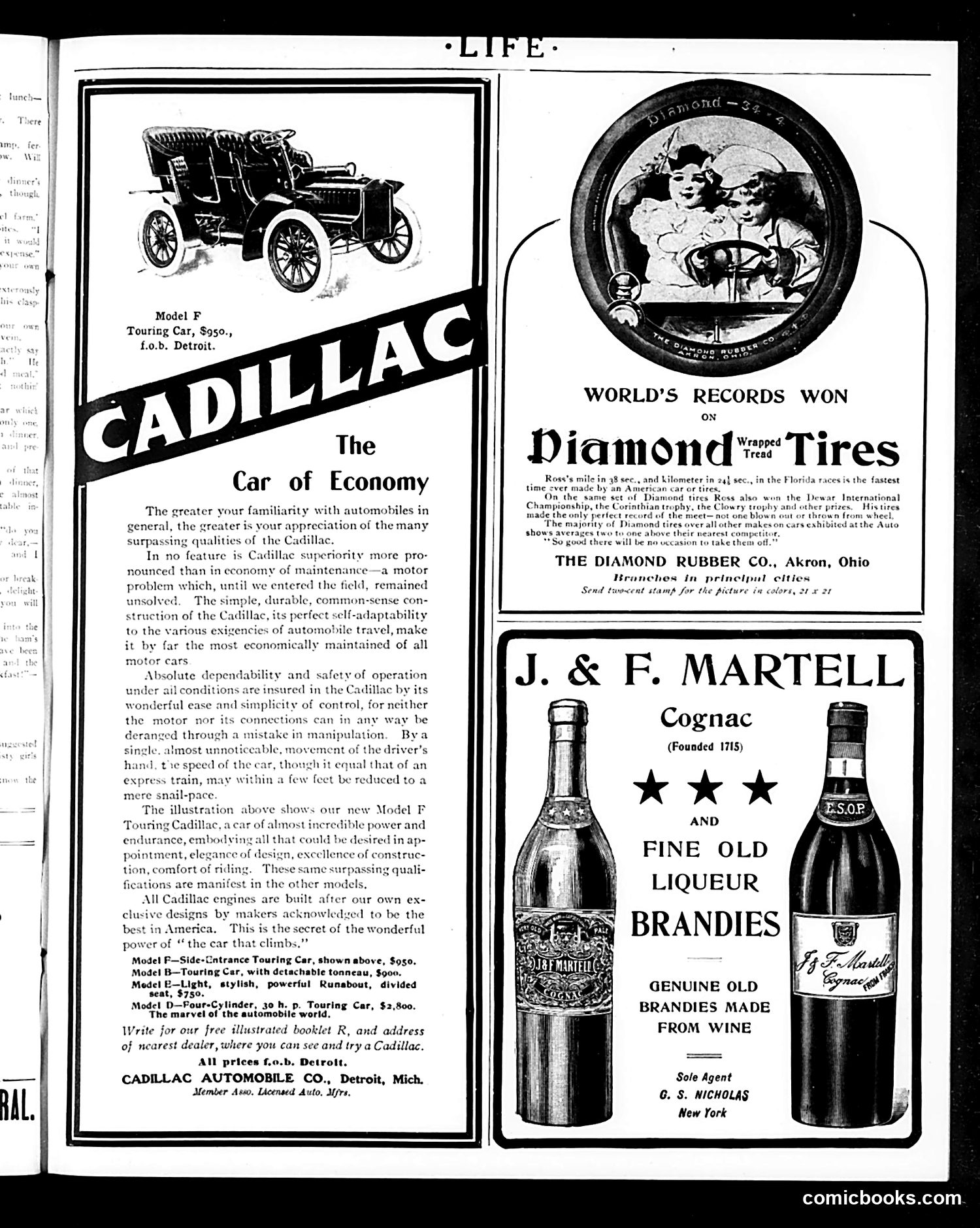
This is primarily an **advertising page**, not a political cartoon. It contains three advertisements from the early 1900s: 1. **Cadillac automobiles** - promoting their Model F Touring Car ($950) as economical to maintain and reliable, with emphasis on simple construction and ease of control. This reflects the era when automobiles were still novel luxuries. 2. **Diamond Wrapped Tread Tires** - claiming world speed records from Florida races, using an image of two figures (appears to be a woman and child) in a car. The slogan "So good there will be no occasion to take them off" suggests tire durability. 3. **J. & F. Martell Cognac and Brandies** - advertising French liqueurs, founded 1715, distributed by G.S. Nicholas in New York. The page reflects early 20th-century advertising aimed at affluent consumers who could afford automobiles and imported spirits. There is **no satirical content or political commentary** visible—it's straightforward commercial advertising typical of Life magazine's revenue model.
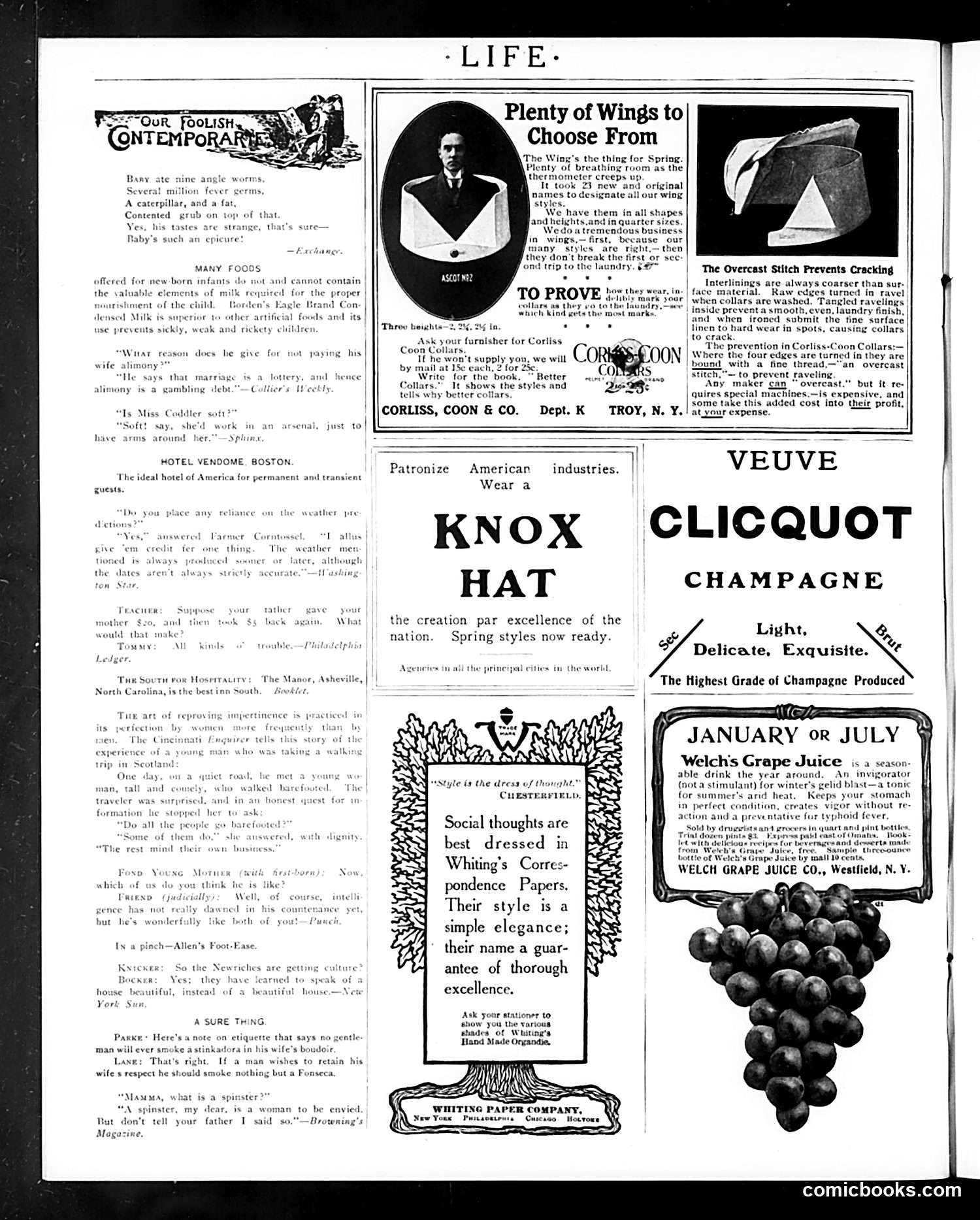
This is primarily an **advertising page** from Life magazine, with minimal editorial content. The page showcases product advertisements typical of the early 20th century. The small comic vignettes ("Our Foolish Contemporaries") are brief humor pieces mocking social pretensions—a wealthy baby with expensive tastes, a man expecting alimony as a "gambling debt," and jokes about etiquette and propriety. These reflect Life's satirical approach to American social foibles. The advertisements promote **mundane household and grooming products**: Corliss-Coon shirt collars (emphasizing durability), Knox hats, Veuve Clicquot champagne, Welch's grape juice, and Whiting's stationery. One notable ad promotes "patronizing American industries" in relation to the Knox hat—likely reflecting early 20th-century protectionist sentiment. The overall page represents Life's business model: satirical social commentary paired with advertising targeting middle and upper-class readers concerned with propriety, quality goods, and genteel taste.
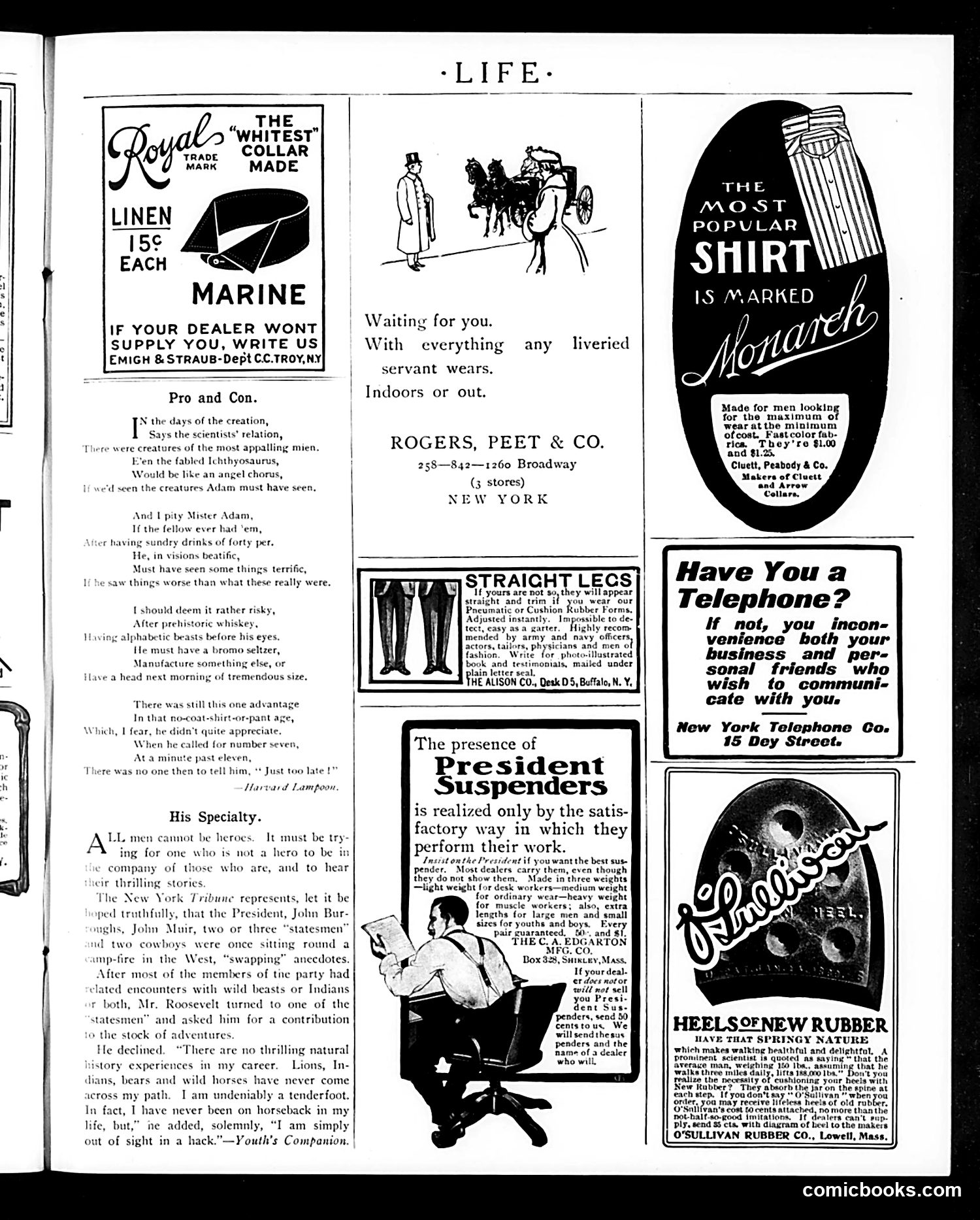
This page is primarily **advertisements and filler content** rather than political satire. The main text is a humorous poem titled "Pro and Con" about Adam in the Garden of Eden, imagining his discomfort seeing prehistoric creatures after drinking "forty per" (whiskey), apparently from *Harvard Lampoon*. Below that is "His Specialty," a anecdote about **President Roosevelt** (appears to be Theodore Roosevelt based on context) at a campfire with John Burroughs, John Muir, and cowboys. A "statesman" declines sharing adventures, claiming he's "simply out of sight in a hack"—a self-deprecating joke about being unremarkable compared to Roosevelt's famous outdoor exploits. The page is otherwise filled with period advertisements for collars, shirts, suspenders, leg straighteners, telephones, and rubber heels—typical early 1900s consumer goods marketed through humorous or health-focused appeals.
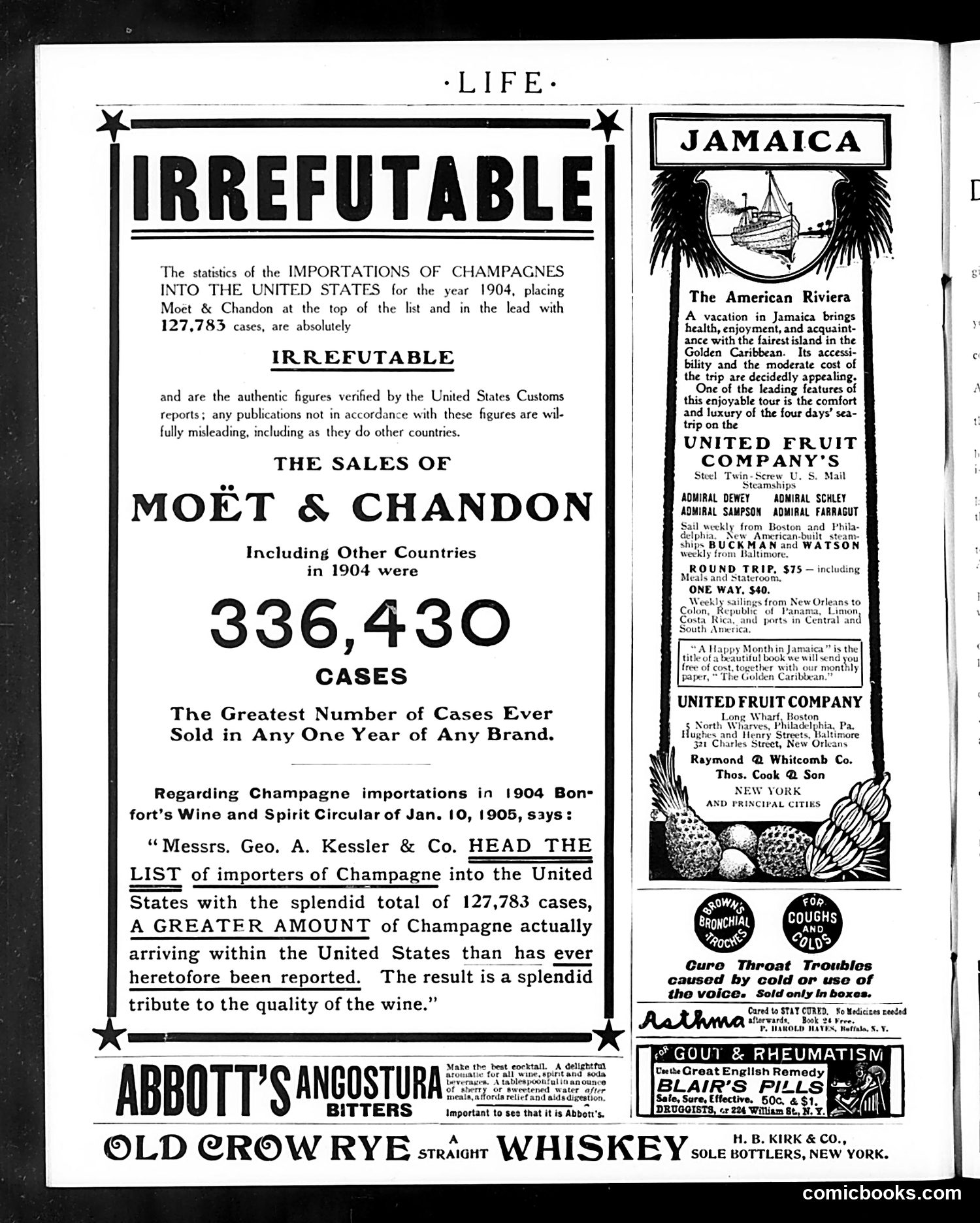
This page is primarily **advertising**, not satire or political commentary. The main feature is a champagne advertisement for Moët & Chandon, claiming "irrefutable" sales dominance in 1904 with 127,783 cases imported to the United States—the highest ever for any single brand. The ad uses language about "authentic figures verified by the United States Customs reports" to assert credibility against competitors. It includes a testimonial from *Bonfort's Wine and Spirit Circular* endorsing importer George A. Kessler & Co. The page also contains travel advertisements (Jamaica vacations via United Fruit Company steamships named after American naval heroes—Dewey, Schley, Sampson, Farragut) and patent medicine ads (throat lozenges, gout remedies). There is **no political cartoon or satire visible**—this appears to be a standard advertisement page typical of early 20th-century magazines that relied heavily on such content for revenue.
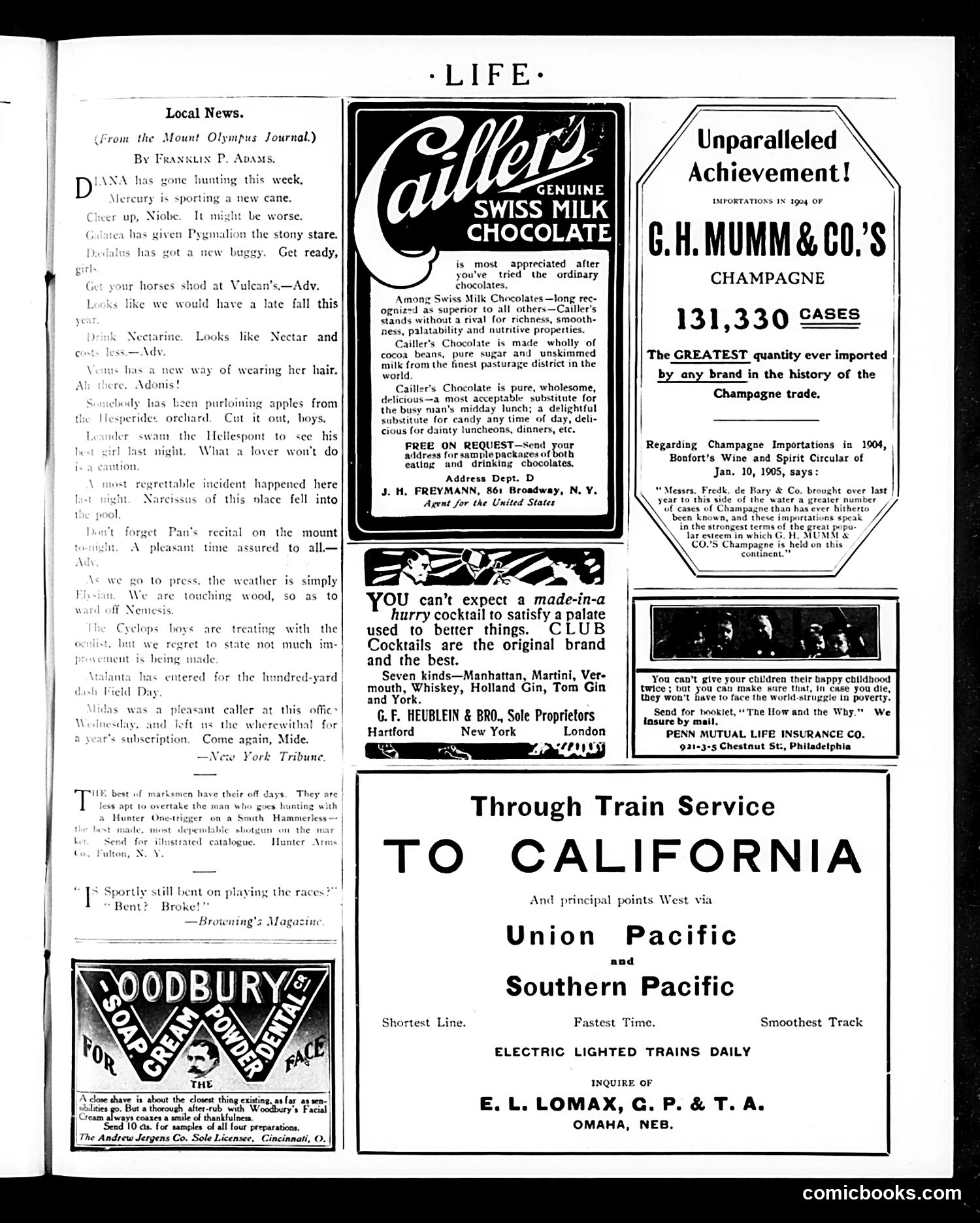
This page is primarily **advertising**, not political satire. However, the top section contains a satirical "Local News" column mocking classical mythology: **The Satire:** Using Greek and Roman mythological figures as fictional residents of "Mount Olympus," the column presents mundane domestic situations as if they involved gods and legendary heroes. Examples: Mercury's new cane, Vulcan's horseshoe shop, Narcissus falling into a pool, Pan's recital. **The Joke:** For educated readers of 1904, the humor derived from the absurd contrast between these figures' grand mythological significance and petty, ordinary modern life. It mocks both classical pretension and contemporary gossip-column trivia by treating them equivalently. **Context:** This satirical approach was typical of *Life* magazine's humor—clever wordplay and allusions targeting educated audiences familiar with classical literature. The remainder is straightforward period advertising: Swiss chocolate, champagne, liqueurs, life insurance, and California train service.
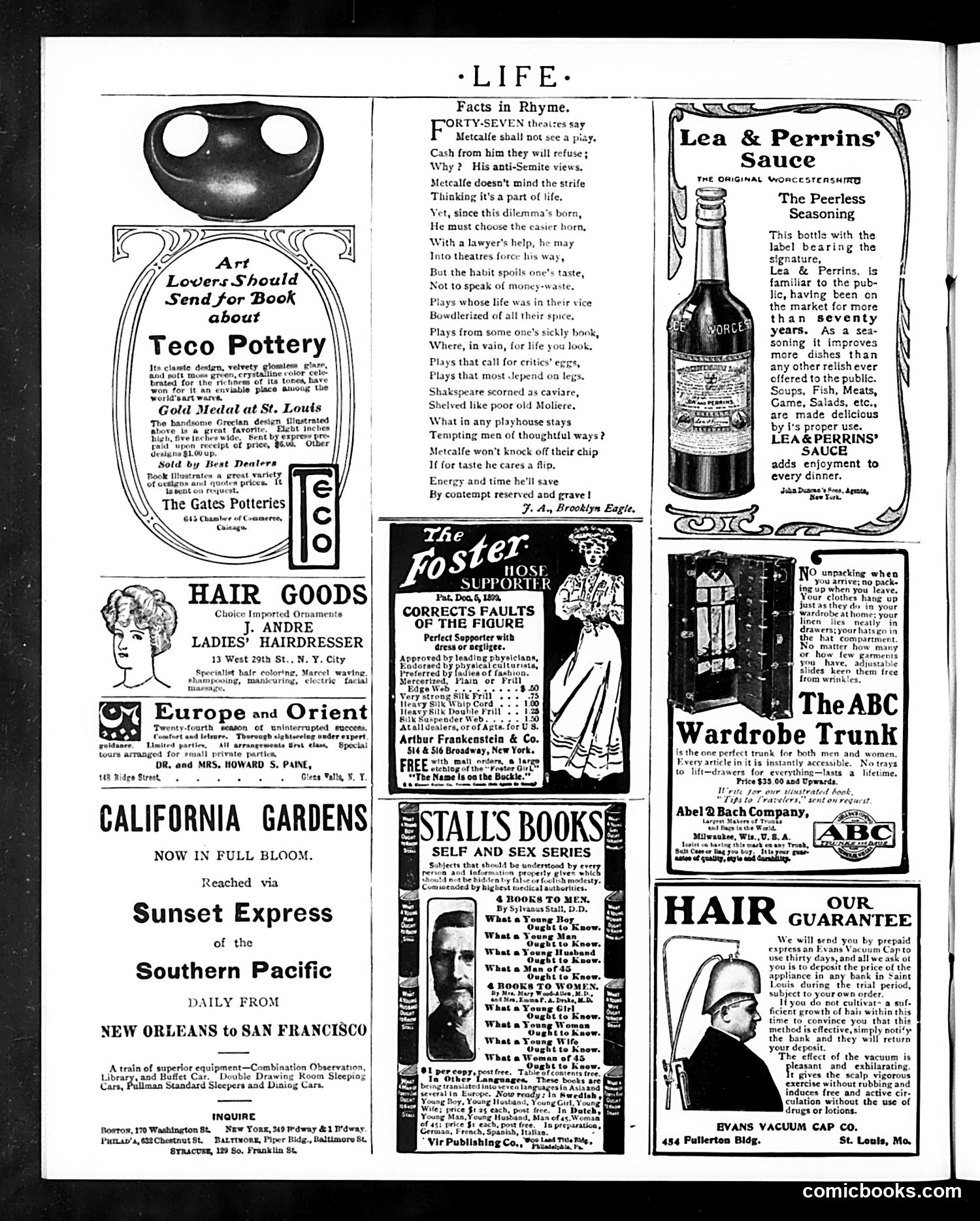
This satirical poem addresses a contemporary controversy: forty-seven theaters have refused to present plays by or featuring **Metcalfe** (likely referring to a specific playwright or performer of the era) due to his **anti-Semitic views**. The satire works on two levels: First, it mocks Metcalfe's position—while he claims indifference ("thinks it's part of life"), the boycott forces him to choose between his prejudices and his livelihood. Second, it suggests this may actually benefit audiences. The poem implies Metcalfe traffics in lowbrow theater ("plays that most depend on legs"), so losing access to his work means theaters will instead stage Shakespeare and serious drama rather than morally compromised entertainment. The joke: his bigotry inadvertently improves public taste. The poem credits the boycott with preventing the "bowdlerizing" (censoring) of classics and keeping them from being "shelved" like forgotten works. This reflects early 20th-century American debates over artistic freedom, Jewish civil rights, and theater standards.
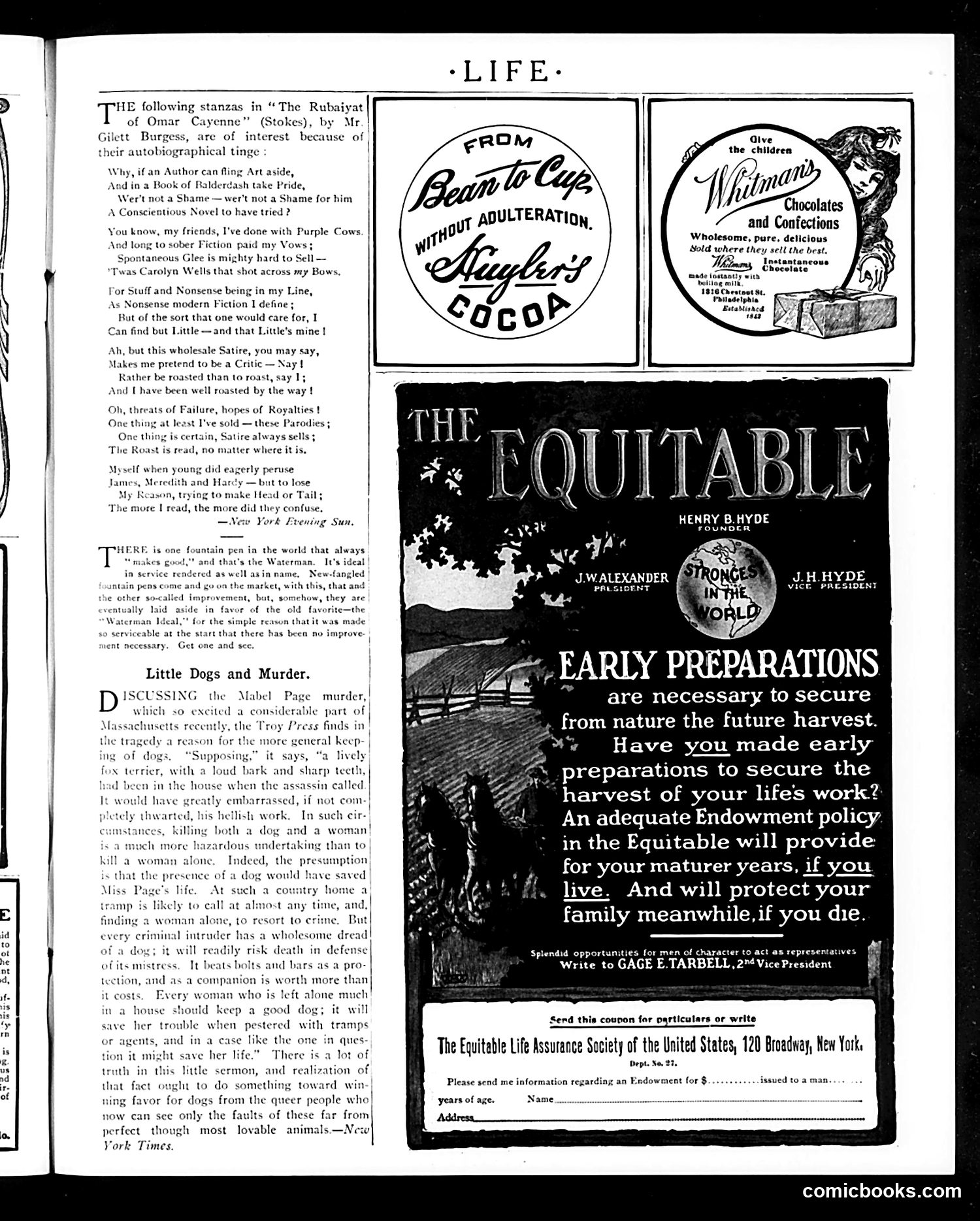
This page contains **satirical poetry and advertisements** rather than editorial cartoons. The main content is a parody poem titled "The Rubaiyat of Omar Cayenne" by Gillet Burgess, mocking his own literary career. Burgess—a humorist known for absurdist verse like "Purple Cow"—uses self-deprecating satire to confess that he writes profitable nonsense and parodies rather than serious literature. He claims serious fiction by James, Meredith, and Hardy confused him, while his own "stuff and nonsense" sells reliably. The poem satirizes both his own commercial choices and the literary establishment's preferences. The advertisements—for Suyler's cocoa, Whitman's chocolates, and Equitable Life Insurance—are typical period marketing, with the insurance ad using mortality anxiety as a sales pitch. The brief article on "Little Dogs and Murder" discusses a real Massachusetts murder case, arguing that dogs provide better home security than locks.
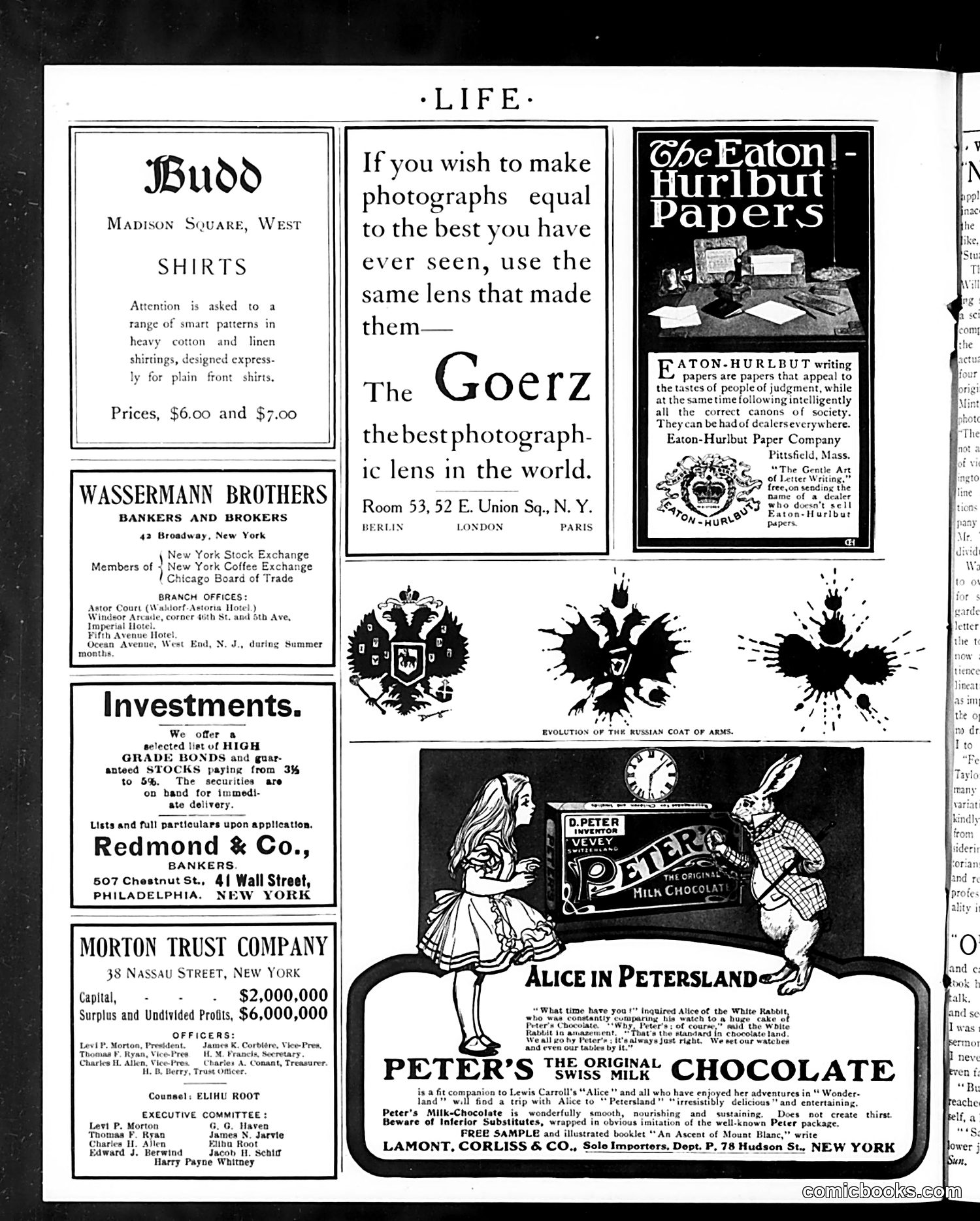
This page is primarily **advertisements** with one notable editorial cartoon element. **The Cartoon:** The center section shows "Evolution of the Russian Coat of Arms"—three progressively elaborate imperial eagles, illustrating Russia's historical coat of arms development. This appears to be a straightforward historical/educational illustration rather than political satire. **The Advertisements** dominate the page, representing typical early 20th-century publications: financial services (Wassermann Brothers, Redmond & Co., Morton Trust Company offering bonds and stocks), luxury goods (Budd Shirts, Goerz camera lenses, Eaton-Hurlbut writing papers), and novelty products (Peter's Swiss Milk Chocolate featuring an "Alice in Petersland" tie-in to Lewis Carroll's *Alice in Wonderland*). The chocolate advertisement is notable for explicitly warning against "inferior substitutes" attempting to imitate their packaging—evidence of early brand protection concerns. The page reflects early 1900s consumer culture and commercial sophistication rather than political commentary.
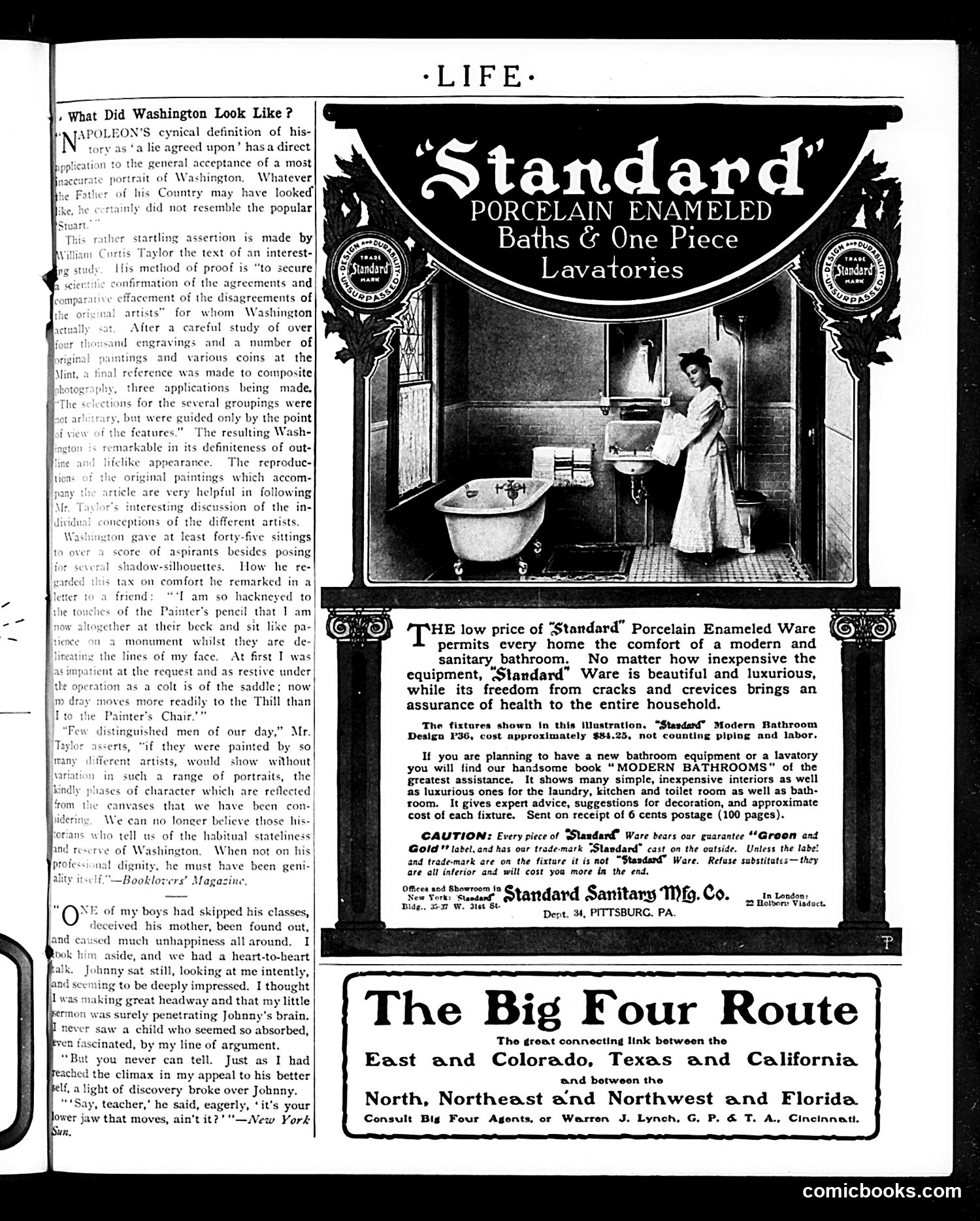
This Life magazine page mixes editorial content with advertising—typical of early 20th-century magazines. **Top section**: An article on George Washington's appearance, discussing how different artists portrayed him inconsistently. The author (William Curtis Taylor) argues that the popular image of Washington as dignified and reserved is likely inaccurate, citing Washington's own complaints about sitting for portraits. **Middle**: A humorous anecdote about a schoolboy named Johnny who, while being scolded for misconduct, becomes fascinated not by his father's moral argument but by noticing his father's lower jaw moves when he talks—missing the point entirely. The joke satirizes children's lack of serious attention. **Bottom**: Two advertisements—one for "Standard" brand porcelain bathroom fixtures, and one for "The Big Four Route," a railroad connecting eastern and western U.S. regions. These are commercial, not satirical content. No political cartoons appear on this page.
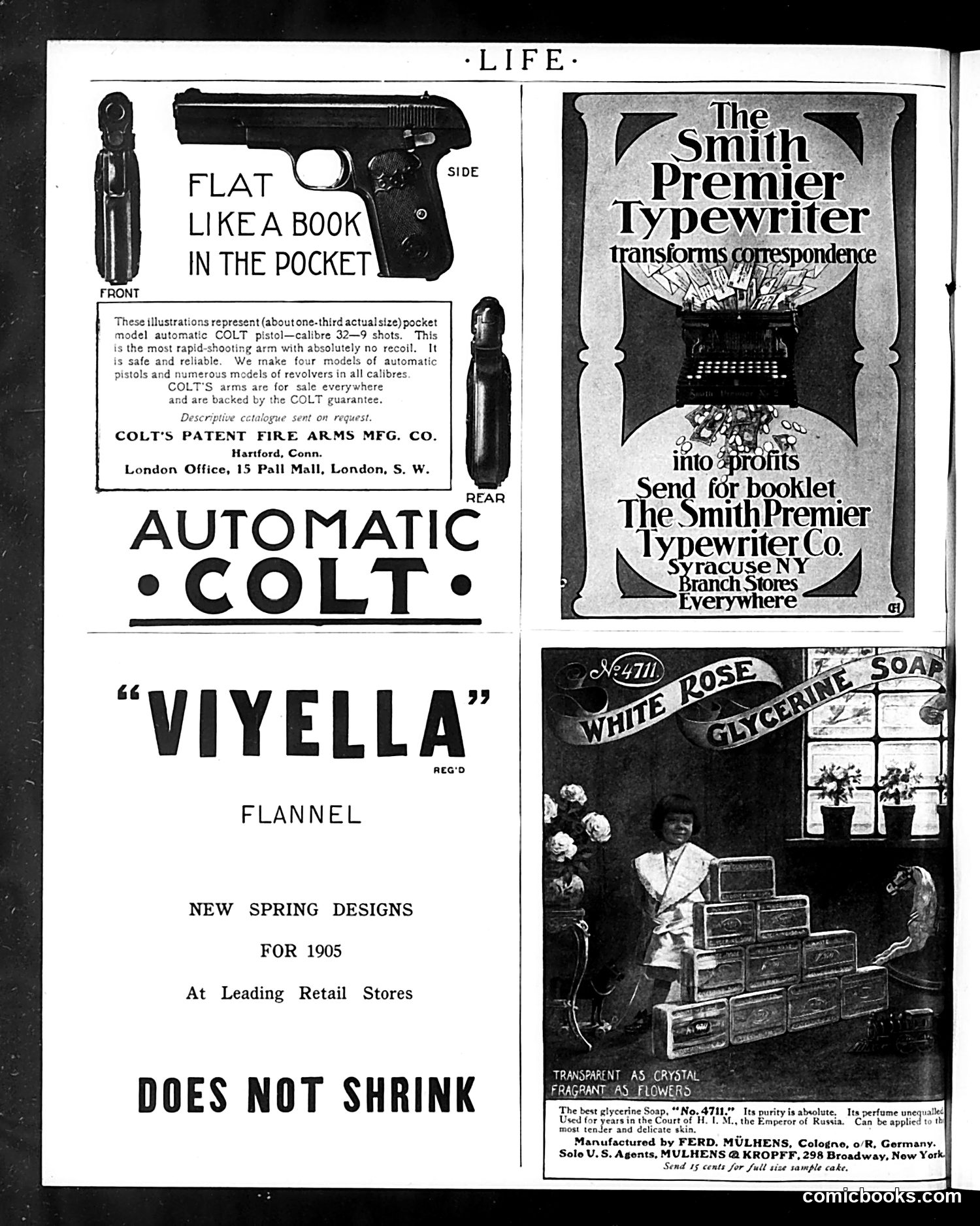
This page is primarily **advertising**, not satire or political commentary. It contains four product advertisements from approximately 1905: 1. **Colt Automatic Pistol**: Marketed as a compact pocket weapon ("flat like a book"), emphasizing rapid fire and "absolutely no recoil." The ad appeals to concealed-carry practicality. 2. **Smith Premier Typewriter**: Promotes business efficiency, with imagery suggesting productivity and profit-making. 3. **Viyella Flannel**: Announces spring 1905 designs for fabric that "does not shrink," targeting retail consumers. 4. **White Rose Glycerine Soap**: Features a woman displaying the product, claiming purity and fragrance quality, manufactured in Germany. These ads reflect early 1900s commercial concerns: personal security, business modernization, consumer goods, and hygiene products. No satirical commentary is apparent; this represents straightforward commercial promotion typical of Life magazine's revenue model.
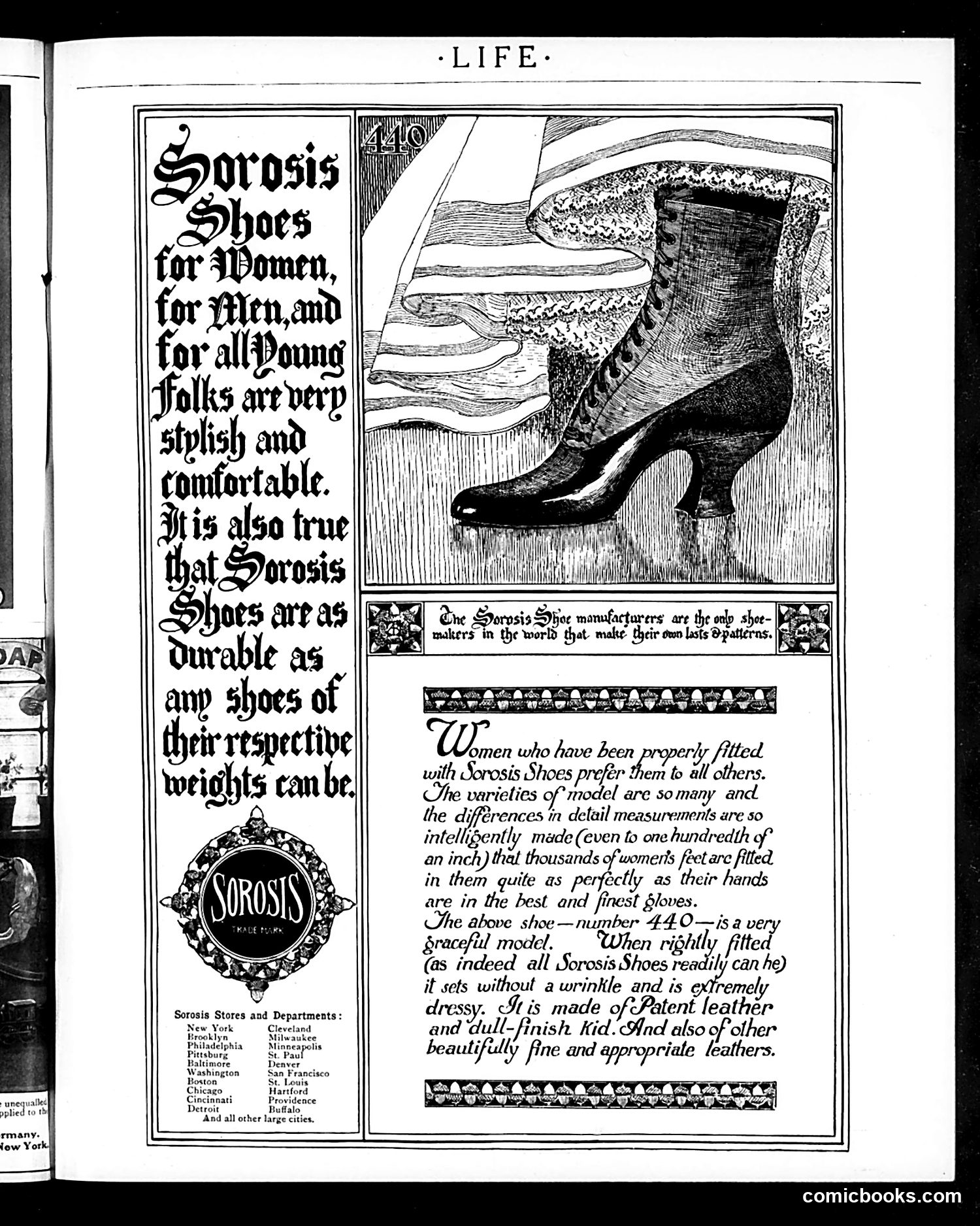
This is primarily a **shoe advertisement**, not political satire. The page promotes Sorosis brand shoes for women, men, and children, emphasizing their stylish design and durability. The illustration shows a women's boot (model #440) in the fashionable high-heeled style of the early 20th century, featuring patent leather and ornate lacing. The advertisement's key selling point is **customization and precision fit**—Sorosis claims their shoes come in numerous models with measurements precise to "one hundredth of an inch," allowing women's feet to fit shoes as perfectly as "their hands are in the best and finest gloves." The decorative border and ornamental logo are typical of period advertising design. A list of Sorosis store locations appears at bottom left. There is **no political cartoon or satire** on this page—it is straightforward commercial promotion from the Life magazine archives.
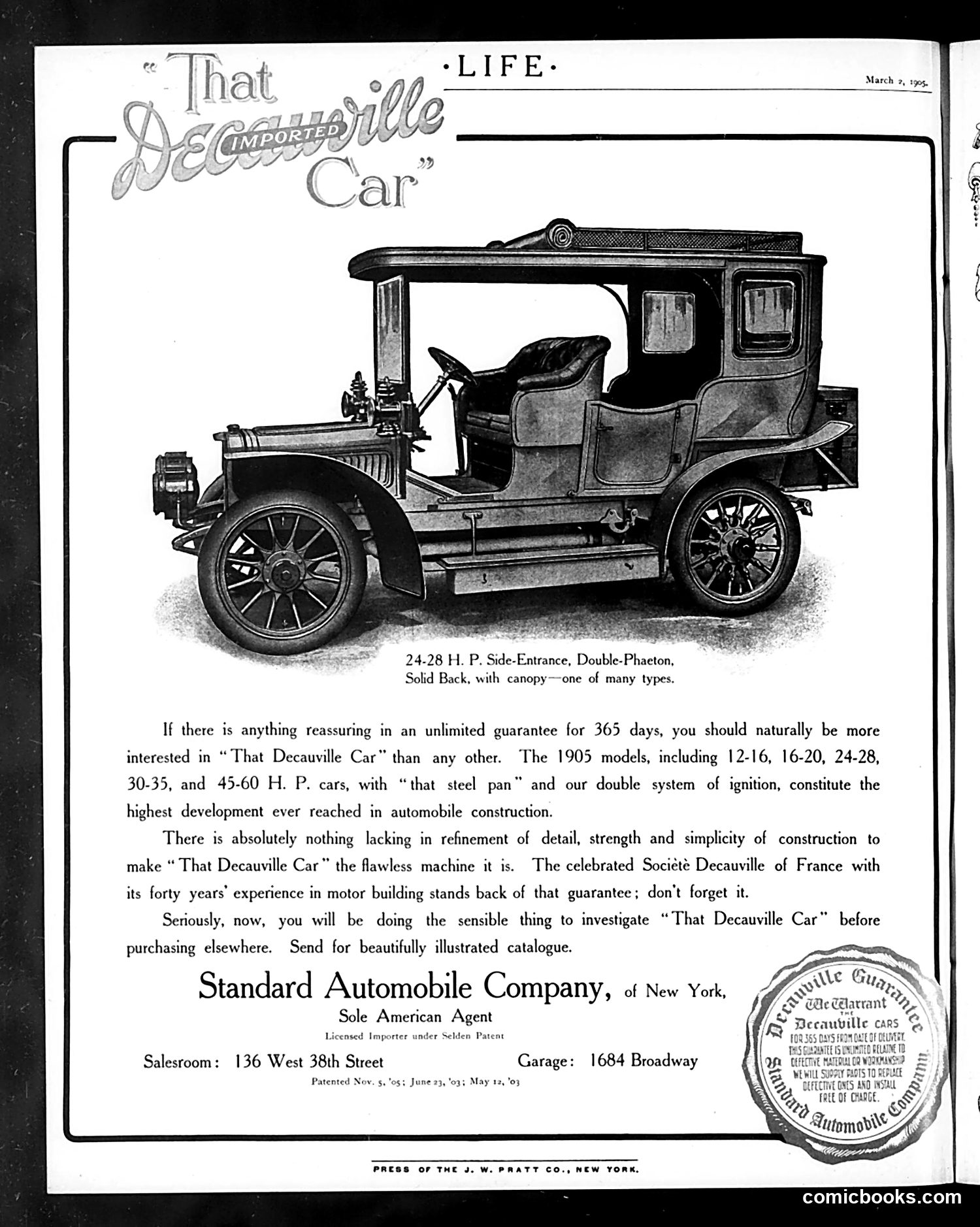
This is a straightforward advertisement for the Decauville automobile, published in *Life* magazine on March 2, 1905. There is no cartoon or satire present—it's a commercial pitch for French-manufactured cars sold in America by the Standard Automobile Company of New York. The ad emphasizes the Decauville's 365-day guarantee, multiple horsepower options (12-16 through 45-60 H.P.), and technical innovations like a "steel pan" and "double system of ignition." It appeals to buyers by invoking the manufacturer's forty years of French engineering expertise. The seal in the lower right reinforces the guarantee promise. The ad's tone is persuasive rather than humorous—it simply encourages readers to investigate before buying elsewhere and request a catalog.