
Life, 1905-03-02 · page 12 of 44
Life — March 2, 1905 — page 12: what you’re looking at
What you’re looking at
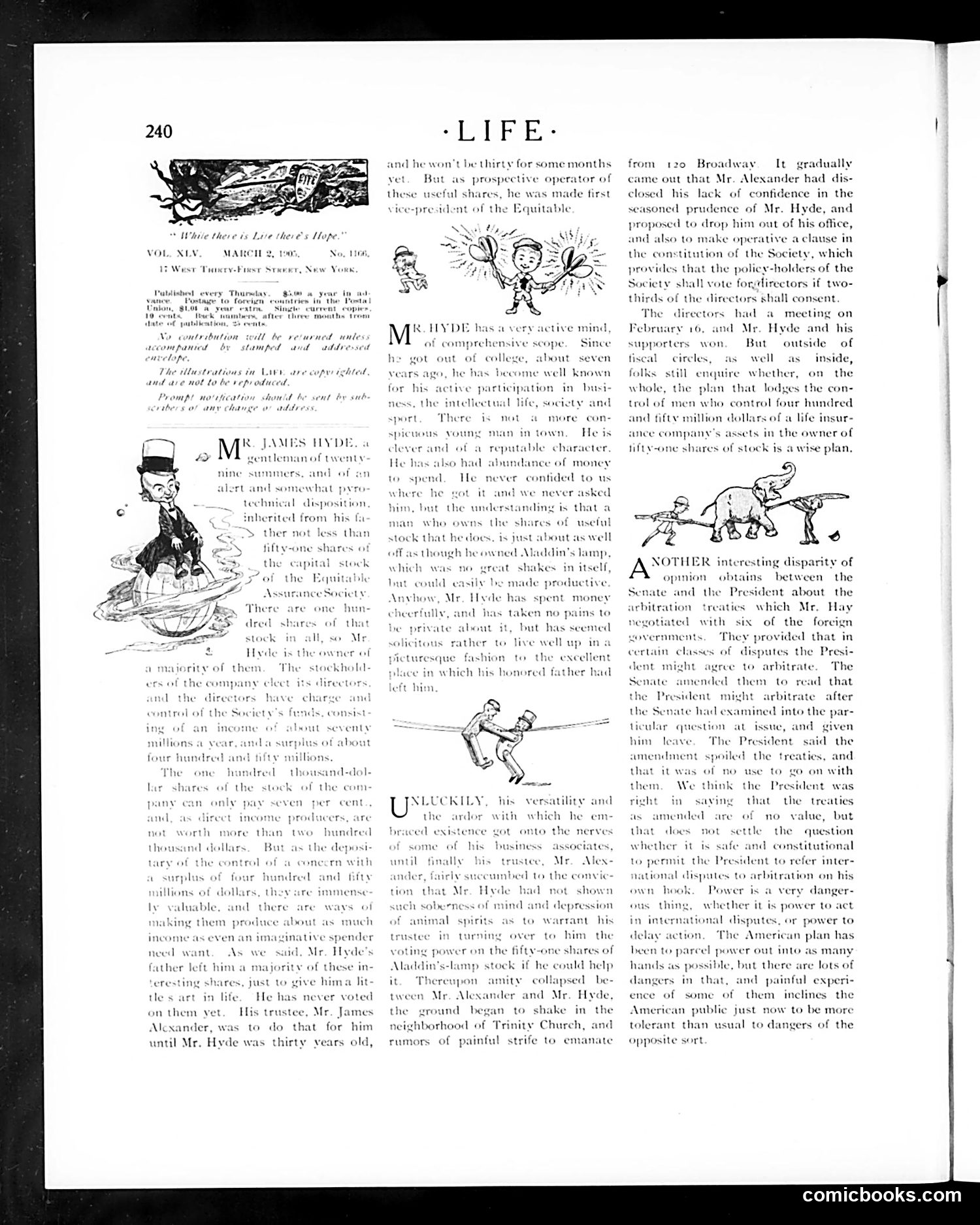
This page from *Life* magazine (March 2, 1906) satirizes **James Hyde**, a wealthy stockholder in the Equitable Life Assurance Society. The caricature depicts Hyde as a grotesque figure riding a globe, mocking his control over a major insurance company's assets—reportedly about $450 million. The satire highlights a corporate scandal: Hyde's father left him controlling shares, which he used despite lacking business experience. The article criticizes how Hyde squandered company money on a lavish lifestyle rather than reinvesting it productively. The cartoon ridicules the absurdity of one young man commanding such vast wealth without earned competence, reflecting Progressive-era outrage over unchecked corporate power and inherited privilege controlling public financial institutions.
📄 Transcribed text from this page (OCR, searchable)
Machine-transcribed from the original scan — historical spelling and the odd misread are preserved.
VOL. XLV. MARCIT 2, 197 No. 108 17 West Tunery-Prese Sraner, New Yous Vo contribution will be velurned unte secompanied by avelope The Mustrations in LAwr are copyrighted. and are not to be reproduced. tamped and addressed Prompt noiification should be sent by sub vibes s of any change a addres R. JAMES HYDE, a gentleman of tw nine ind somewhat pyro: technical disposition inherited from his fa her not less than fifty-one shares of the capital stock As ] Rex, Ther x YES Ares mat 4 IIyde is the owner of LV maiority of them. The stockhold- ers of the company elect s directors nd the director: mirolof the Society's mcome Oo rout seventy ifty millions. handred — thousand-dol- nly pay seven cent. et income producers, arc two) hundr a concern with four hundred and fifty millions of dollars, they are immense ly valuable, and there are ways of raking them produce about as much income as even an imaginative spender need want. As we said, Mr. Hyde's father left him a majority of se in- cresting shares, just to give hima lit- tle s ar He has never voted on them His trustee, Mr. James Alexander, was to do that for him until Mr. Hyde was thirty vears old, aE E 2 won't be thirty for some months and he yet. But as prospective operator of these useful shares, he was made first vice-president of the Equitable HYDE has a very active mind about seven years ago, he me well known for his active participation in busi- ness, the intellectual life, society and sport There is ne nin town, He is young. mi and of a reputable character salso had abundance of money Ile never contided to us it and we never asked him, but the und inding is that a man who owns the shares of useful t he does, is just about as well Idin’s lamp {, was no great: shakes in itse Iut could casily Anvhow, Mr. Hyde riully, is spent: money ns to. ate about but has seemed olicitous rather 1 ive well up ina picturesque fashion to the exceller n which his honored fa 3 5 (JAeYs KILY versatility and the ardor with which he em- existence onto the nerves siness associates, ustee, Mr. Alex- wd to the convic= Mr. Hyde had not. she eness of mind and d under, fairly succum| such so! ession. animal spiri as to Warrant his trustee in turning over to him: the veron the fifty-one shares of Maddit it. Thereupon amity ce tween Mr. Alexander and Mr. Hyde, the ground began to shake in’ the lamp stock if he could help neig Trinity Church, ar rumors of painful strife to emanate from 120 Broadway It gradually came out that Mr. Alexander had dis- closed his lack of confidence in the nd mn out of his office, seasoned prudence of Mr. Hyde proposed to drop hi and also to make operative a clause in the consti provides that the policy-holders of the tion of the Society, which Society shall vote fordirectors if two- thirds of the dircetors shall consent. The directors had a meeting on ry 16, and Mr. Hyde and his But outside of Febru: supporters we fiscal circles, as well as inside, folks still enquire whether, on the whole, the plin that lodges the con- trolof men who control four hundred and fifty million dollars ef a life insur- ance company’s assets in the owner of ifty-one shares of stock is a wise plan, (ANOTHER interesting disparity of between the 1 obtains Senate and the President about the arbitration treaties. which Mr. Hay hegotiated with six of the foreign xovernments, They provided that in opini« certain classes of disputes the Presi- dent might agree to arbitrate. The Senate amended them to read that he President. m the © after ght arbitr Senate had examined into the par- ular question at issue, and given him leave. The President said the amendment spoiled the treaties, and that it was of no use to go on with hem. We think the President was t in saying that the treaties, amended are of no value, but that does not set estion je the qu itutional r inter= nc whether it is safe and cons’ ermit the President to re lational disputes to arbitrati his own hook. Power is a very danger- ous thing whether it is power to act in international dis _ or power to delay action, The American plan has been to parcel power out into as many hands as possible, but there are lots of dangers in th and. painful experi- ence of some of them inclines the American public just now to be more tolerant than usual to dangers of the opposite sort 5 1 | | comicbooks.com