
Life, 1905-03-02 · page 30 of 44
Life — March 2, 1905 — page 30: what you’re looking at
What you’re looking at
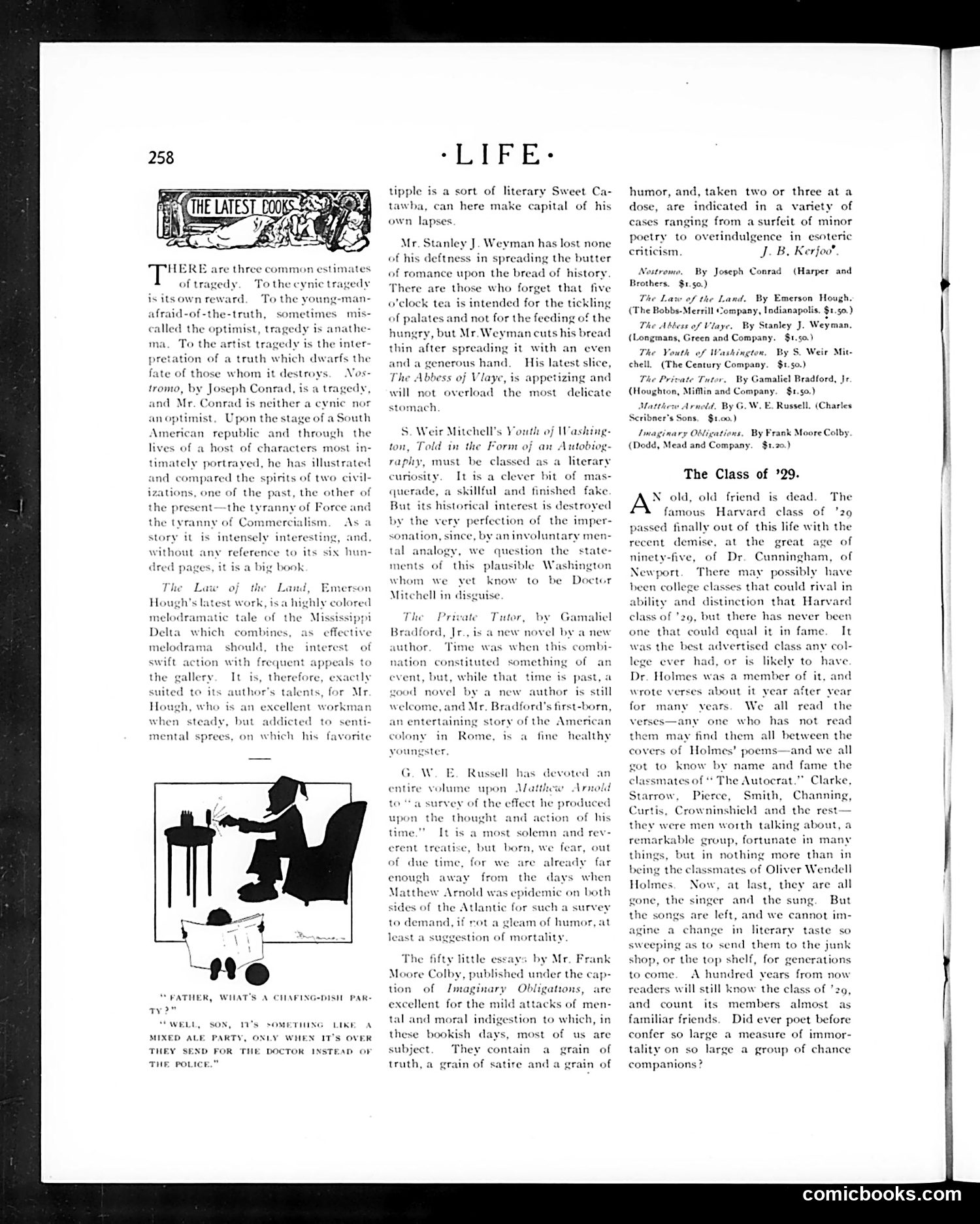
This page contains literary reviews and a single cartoon. The cartoon depicts a father and son discussing a "chafing dish party"—a social gathering where guests cook food together at the table. The father's joke is that such parties resemble "mixed ale parties" except that afterward "they send for the doctor instead of the police," suggesting the food causes illness rather than drunken disorder. The humor relies on the contrast between the genteel, fashionable nature of chafing dish entertaining (popular among the upper classes) and its actual digestive consequences—a mild satire on pretentious dinner party culture. The cartoon mocks both the fad itself and the assumption that refined social activities are automatically safe or beneficial. The page's book reviews discuss contemporary authors including Joseph Conrad, Emerson Hough, and others, establishing the literary context of early 1900s American publishing.
📄 Transcribed text from this page (OCR, searchable)
Machine-transcribed from the original scan — historical spelling and the odd misread are preserved.
of tragedy is itsown reward, To the young-man- afraid-of-the-truth, sometimes mis- called the optimist, tragedy is a To the artist tragedy is the inter nat he- ™ pretation of a truth which dwarfs the fate of those whom it destroys. Nos- tromo, by Joseph Conrad, is a tragedy, and Mr. Conrad is neither a cynic eof aSouth anoptimist. Upon the sta American republic and through the lives of a host of characters most in- timately portrayed, he has illustrated and compared the spirits of two civi izatior s, one of the past, the other of the present—the tyranny of Force and the tyranny of Commercialism. As a Wd g, and, story it is intensely interes! pout any reference to its six hun- dre ges, it is a big book Land, Emerson st work, isa highly colored natic tale of the Mississippi Hough's lat melodrar Delta which combines, as effective melodrama should, the interest of swift action w frequent appeals to the gallery. It is, therefore, exactly suited to its author's talents, for Mr. Hough, who is an excellent workman steady, but addicted to senti- on which his favorite “PATHE 2" WHAT'S A CHAFING*DISIE PAR- “WELL, SON, 11'S SOMETINNG LIKE MIXED ALE PARTY, ONLY WHEN IT's OVER THEY SEND FOR THE DOCTOK INSTEAD OF THE POLICE.” -LIFE- Sweet C. pital of his tipple is a sort of literary tawba, can here make own lapses Mr. Stanley J. Weyman has lost none his deftness in spreading the butter of romance upon the br. There are those who forget that fiv o'clock tea is intended for the tickling of palates and not for the feeding of the hungry, but Mr.W thin after spreading it with n nd. His latest slice, ad of history yman cuts his bread nc and a generous ha The Abbess of Viaye, is appetizing Zand will not overload the most delicate stomach S. Weir Mitchell's Youth of Wash ton, Told in the Form oj an Autobi raphy, must be classed as a literary curiosity, It is a clever bit of mas- querade, a skillful and finished fake But its historical interest is destroyed y perfection of the imper- by the vei sonation, since, by an involuntary men tal an » We question the state- slog ments of this plausible Washing we yet know to be Doctor on whor Mitchell in disguise. liel new The Private Bradford, Jr., is a new novel by wuthor nation constituted something of an me was when this combi- event, but, while that time is past, a good novel by a new author is still welcome, and Mr. Bradford's first-born, an entertaining story of the American colony in Rome, is a fine healthy youngster G. W. E. Russell has devoted an entire volume upon Matthew Arnold a survey of the ¢! 1 the though fect he produced and action of his It is a most solemn and rev- treatise, but born, we fear, out dy far enough away from the days when due time, for we are alte: nic on both * Matthew Arnold was epider sides of the Atlantic for such a sur to demand, 1 ta gleam of humor, at asta suggestion of mortality The fift ys by Mr. Frank Moore Colby, published under the cap- t excellent for the mild attacks of men- little essa on of Imaginary Obligations, are tal and moral indigestion to which, in these bookish days, most of us are subject. They contain a grain of truth, a grain of satire and a grain of humor, and, taken two or three at a dose, are indicated in a variety of cases ranging from a surfeit of minor poetry to overindulgence in esoteric J.B. Kerjoo® Nostromo. By Joseph Conrad (Harper and Brothers. $1.50.) The La the Land. By Emerson Hough. (The Bobbs-Merrill Company, Indianapolis, $1.50.) The Abbess of Viaye. By Stanley J. Weyman, (Longmans, Green and Company. $1.50.) The Youth of Washington. By S. Weir Mite chell. (The Century Company. $1.50.) ¢ Private Tutor, By (Houghton, Mifflin a Matthew Arnetd, By G.W.E. Russell. (Charles Scribner's Sons, $1.00.) criticism. Samaliel Bradford, Jr mpany. $1.50.) Imaginary Obligations. By Frank Moore Colby (Dodd, Mead and Company. $1.20.) The Class of ’29. ‘ old, old friend is dead. The A famous I rd class of ‘20 passed finally out of this life with the recent demise, at the great age of ninety-five, of Dr. Cunningham, of Newport. There may possibly have heen college classes that could rival in abi y and distinction that Harvard class of », but there has never been one that could equal it in fame. It was the best advertised class any col- likely to have nd lege ever had, or Dr. Holmes wa wrote verses about it year after year sa member of it, for many years. We all read the ¢ who has not read verse: them may find them all between the nd we all ot to know by name and fame the classmates of * The Autocrat.” Clarke, Starrow, Pierce, Smith, Channing Curtis, Crowninshield and the rest— they were men worth talkin —any 0} covers of Holmes’ poems—a about remarkable group, fortunate in many things, but in nothing more than in being the classmates of Oliver Wendell Holmes. Now, at last, they are all gone, the singer and the sung. But the songs are left, and we cannot im- agine a change in literary taste so sweeping as to send them to the junk shop, or the top shelf, for generations to come. A hundred years from now readers will still know the class f'29, and count its members almost as familiar friends. Did ever poet before confer so large a measure of immor- tality on so large a group of chance companions? comicbooks.com