
Life, 1905-03-02 · page 14 of 44
Life — March 2, 1905 — page 14: what you’re looking at
What you’re looking at
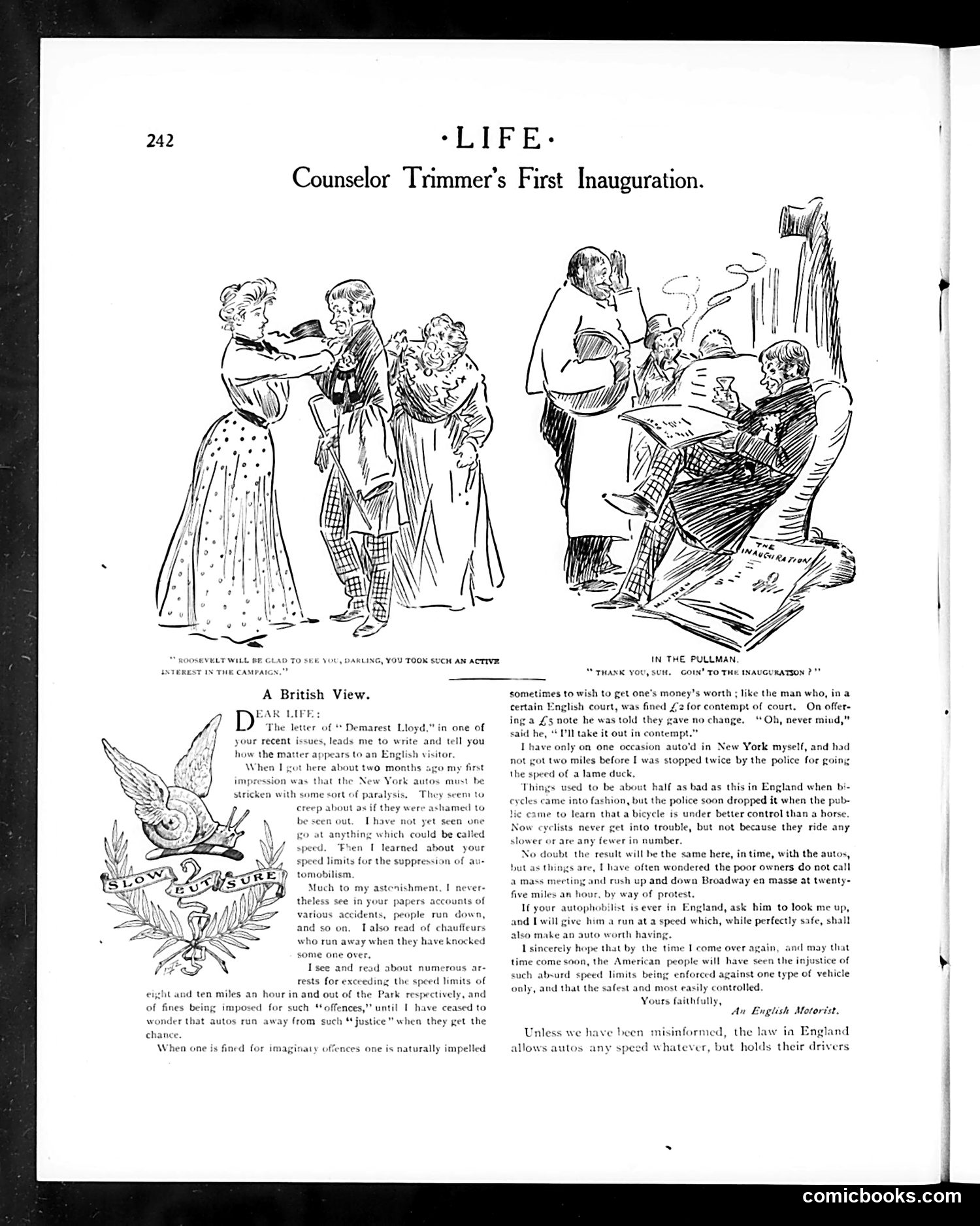
The top cartoon depicts a political figure (likely Theodore Roosevelt, suggested by "Trimmer") being dressed or prepared for inauguration by various handlers and attendants—a visual joke about political manipulation and the artifice of preparing a candidate for public office. The letter below, titled "A British View," is satirical commentary on American automobile regulation. A British motorist writes complaining that American speed limit enforcement is absurdly strict and inconsistently applied—drivers are heavily fined for minor infractions yet still recklessly speed and flee police. He contrasts this with England's more lenient, sensible approach. The satire targets American regulatory excess and hypocrisy: strict laws that don't actually prevent dangerous driving, only generate fines and resentment. The "Pullman" dialogue at top-right appears to reference campaign activities, possibly mocking participation in political events.
📄 Transcribed text from this page (OCR, searchable)
Machine-transcribed from the original scan — historical spelling and the odd misread are preserved.
-LIFE:; Counselor Trimmer’s First Inauguration. SEVELT WILL BE ¢ EREST IN THE CAMPAIGN.” A British View. EAR LIFE: The let your recent issues, I how the mat When I * Demarest Lloyd,” in one of ds me to write and tell you appears to an English visitor, out two months the New York aute They seem to > my first here must be stricken with some sort of paralysis, creep about as if they were ashamed to h be seen out. [have not yet seen one \ go at anything which could be call ‘Fhen [ learned about ye speed limits for the suppression of av bilism. ch to my astonishment. I theless see in your papers accounts of various accidents, people run down, and so on, [also read of chauffeurs who run away when they have knocked some one over, Isee and read about numere Jing the speed lim rests for excees and ten miles an hour in and out of th of fines being imposed for such ‘offences,’ ui justice Park respectively, and il 1 have ceased to wonder that autos run away from such when they get the chance When o1 s fined for imaginaty offences one is naturally impelled LAD TO SEE VOU, DARLING, YOU TOOK SUCH AN ACTIVE IN THE PULLMAN, “THANK YOU, SUH. GOIN? TO THE INAUGURATSON ?"” sometimes to wish to get one’s money’s worth ; like the man who, in a certain English court, was fined £2 for contempt of court. On offer- note he was told t “Oh, never mind,” , PIL take it out in contempt.” Ihave only on one occasion auto'd in New York myself, and had ¢ got two miles before I was stopped twice by the police for going the speed of a lame duck, Thi sed to be about half as bad as this in England when bi- ashion, but the police soon dropped it when the pub- » to learn that a bicycle is under better control than a horse Now cyclists never get into trouble, but not because they ride any slower or are any fewer in number. No doubt the result will be the same here, in time, with the auto: Ihave often wondered the poor owners do not call nd rush up and dowa Broadway en masse at twenty- five mile by way of prot If your autophobilist is ever in England, ask him to look me up, and [will give him a run ata speed which, while perfectly safe, shall also make an auto worth having I sincerely hope that by the t gave no change. a mass meeting may that 1 come over again, ar rican people will have seen the injustice of such absurd speed lin rced against one type of vehicle only, and that the safest and most easily controlled. 's faithfully, An English Motorist, time come soon, t , the law ia England holds their drivers misinfornic Unless we have bee! allows autos any speed whatever, but comicbooks.com