
A complete issue · 22 pages · 1905
Life — February 9, 1905
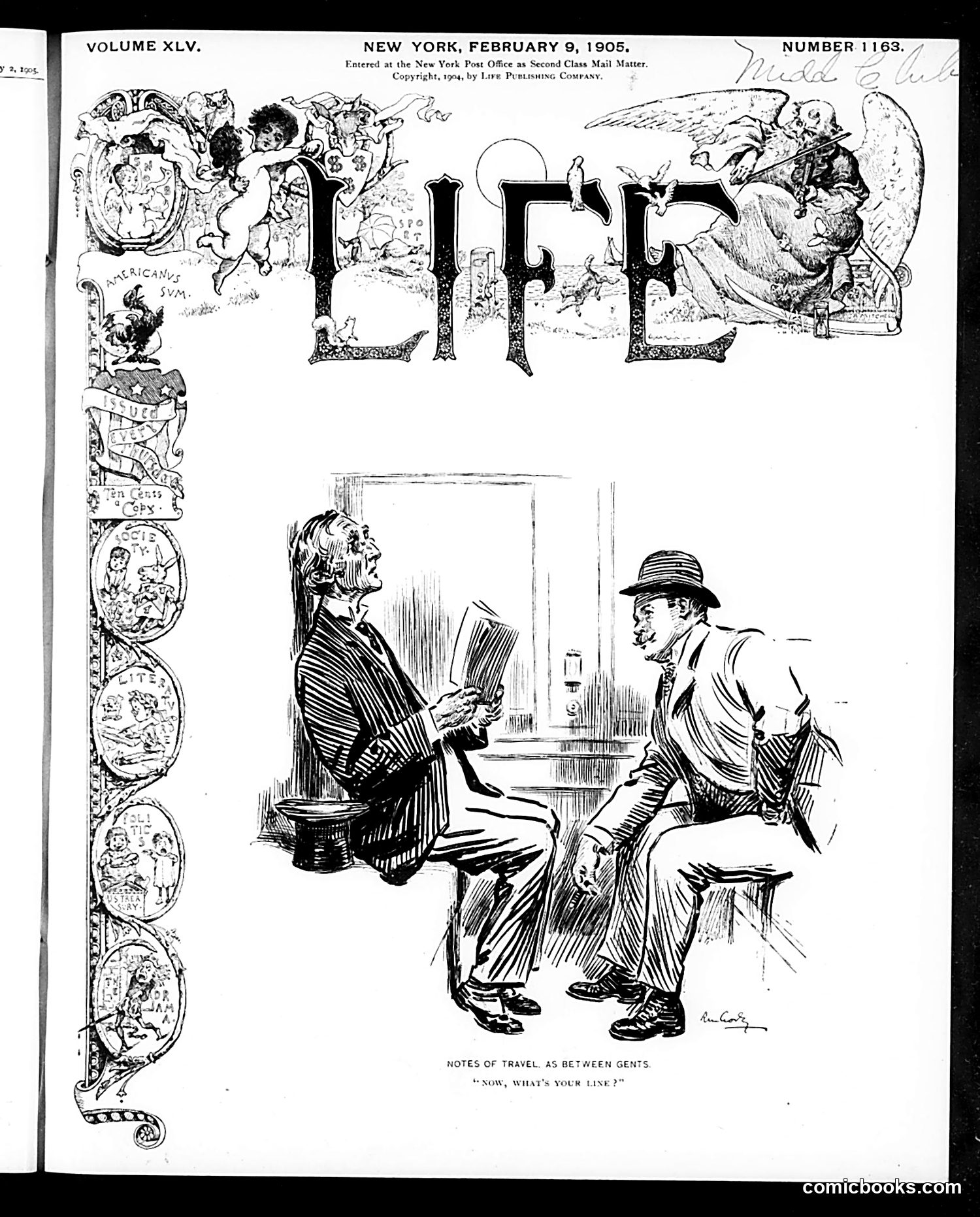
The main cartoon, titled "Notes of Travel as Between Gents," depicts two men in conversation with the caption "Now, what's your line?" This appears to be social satire about travel conversation among gentlemen—specifically mocking the conventional small-talk and status-seeking that occurred when well-dressed men encountered each other. The question "what's your line?" (meaning occupation or social position) represents the era's preoccupation with establishing social hierarchy through professional identity. The ornate left border contains classical medallions, typical of Life's decorative style. The elaborate header illustration above "LIFE" shows cherubs and classical motifs, characteristic of the magazine's aesthetic design. Without additional context, the specific satirical point beyond general social observation remains unclear from the image alone.
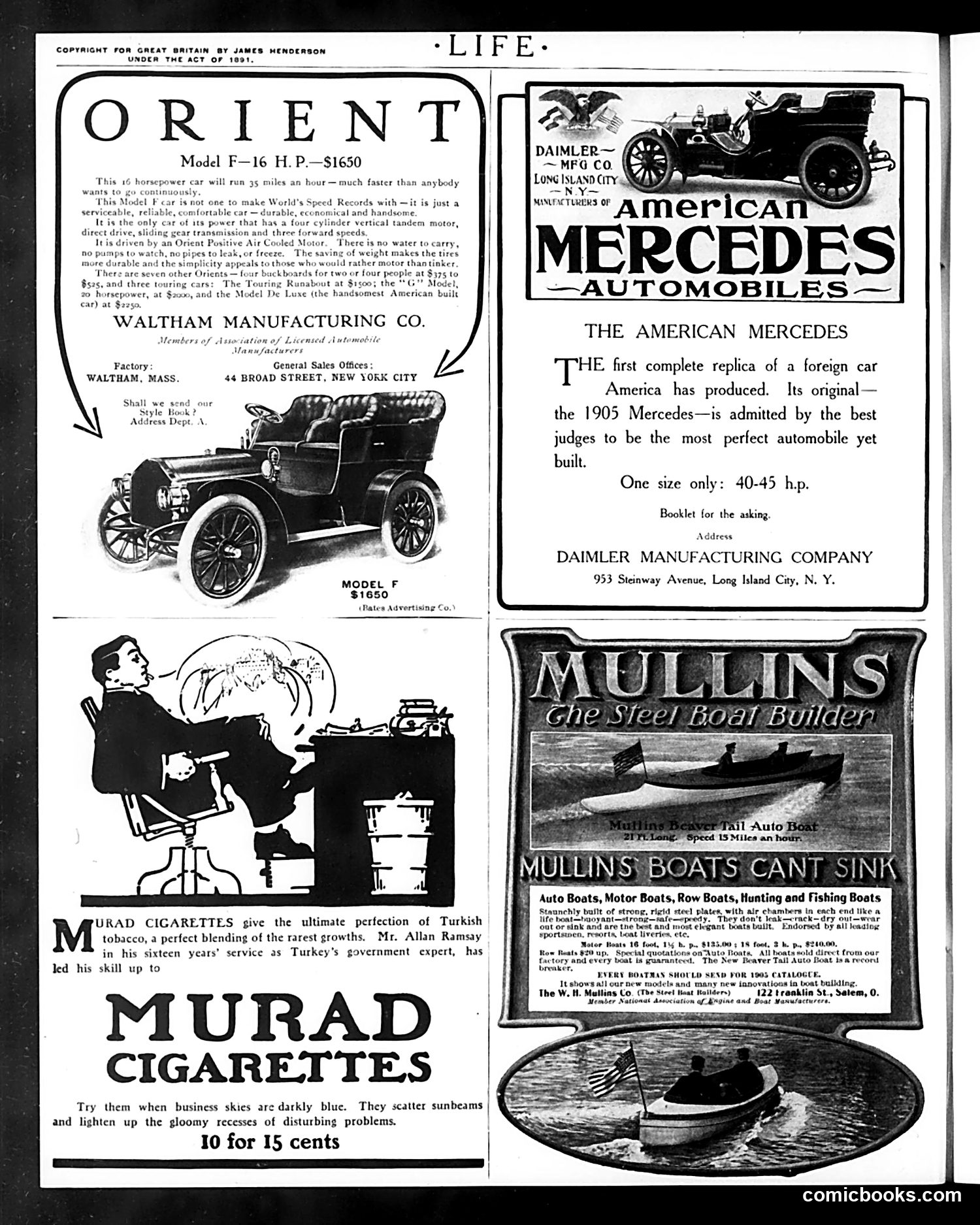
This page is primarily **advertising**, not political satire. It contains four unrelated commercial advertisements from the early 1900s: 1. **Orient automobile** - A Waltham Manufacturing Co. vehicle priced at $1,650 2. **American Mercedes automobiles** - Promoted as "the first complete replica of a foreign car America has produced" 3. **Murad cigarettes** - An ad claiming the product offers "ultimate perfection of Turkish tobacco," featuring a cartoon of a man relaxing 4. **Mullins steel boats** - Advertisements for motorboats claimed to be unsinkable The only cartoon element is the Murad cigarettes illustration showing a satisfied businessman. There is no political commentary or satire evident. This represents typical early-20th-century magazine advertising mixing automobiles, luxury goods, and consumer products.
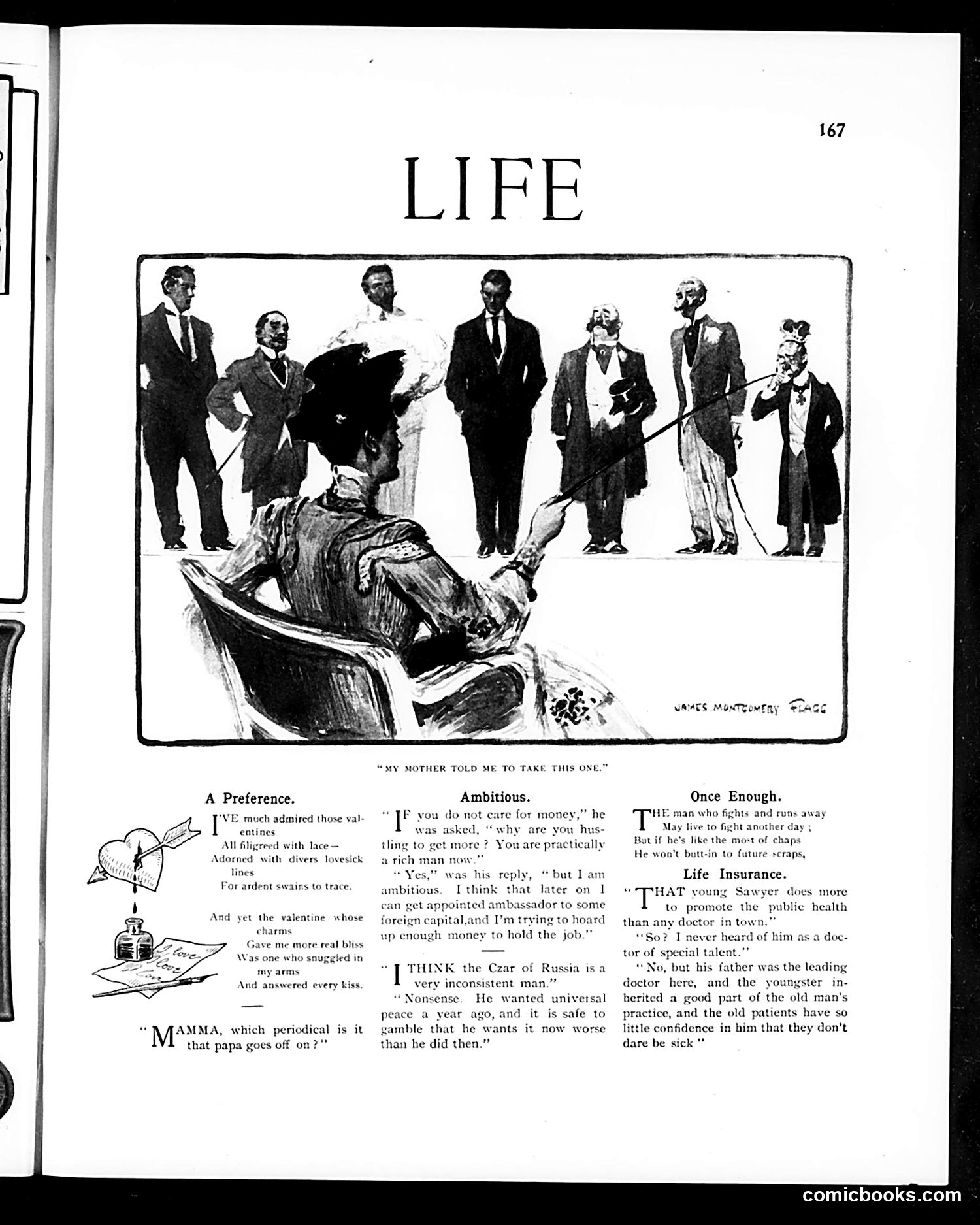
This page contains four separate satirical pieces about social and professional ambitions: **Main Cartoon**: "My Mother Told Me to Take This One" depicts a man in a chair surrounded by formally dressed figures (likely suitors or advisors). The satire appears to mock maternal interference in adult romantic or professional decisions. **Column Pieces**: - "A Preference" jokes about Valentine's Day sentiments - "Ambitious" satirizes social climbing and wealth-seeking behavior - "Once Enough" mocks a young doctor lacking patient confidence compared to his more established father - "Life Insurance" suggests doctors' credibility problems The overall theme critiques vanity, social pretension, and the gap between aspiration and actual merit—common Life magazine targets. The specific references to Russian politics ("The Czar") suggest early 20th-century publication date.
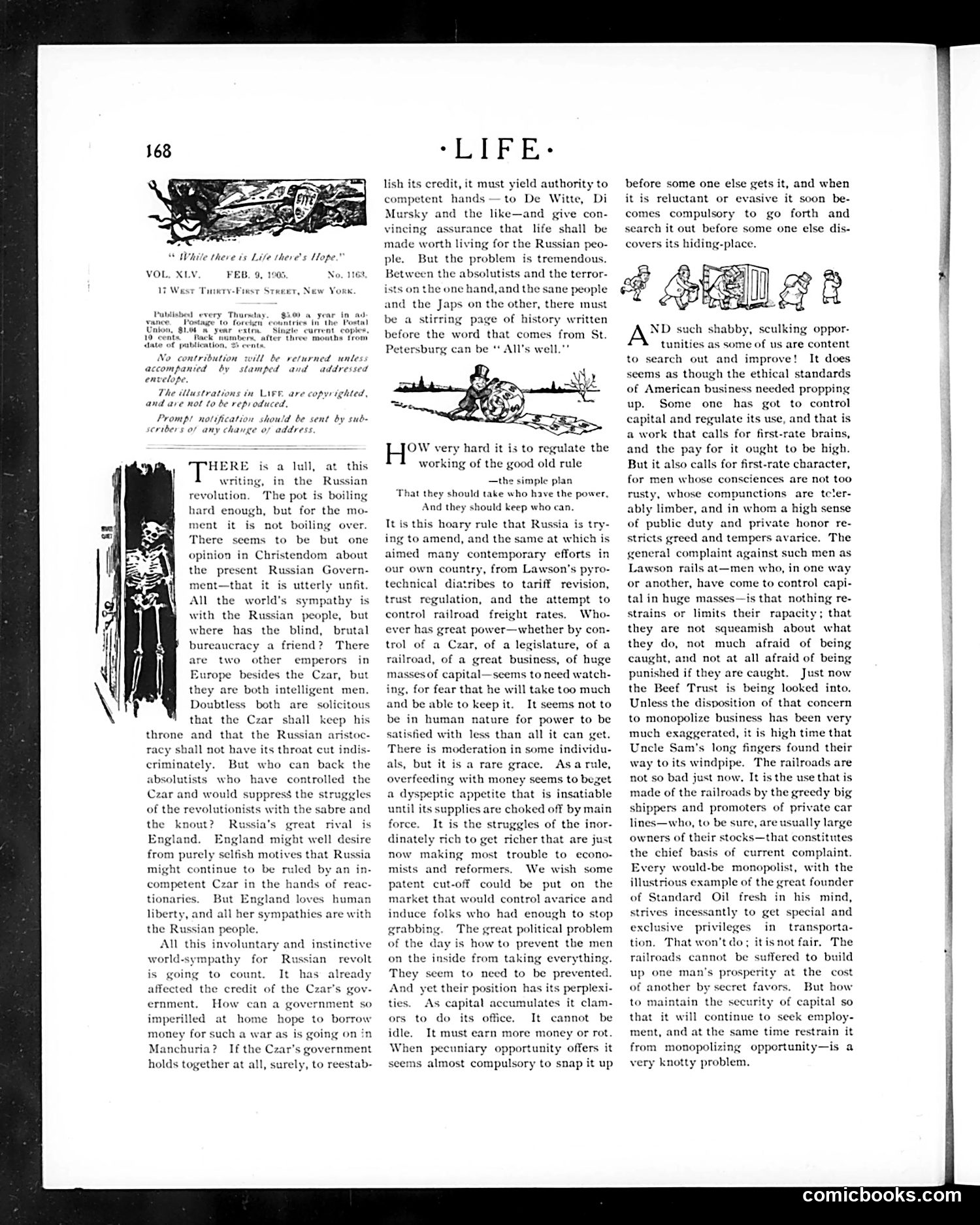
This page presents editorial commentary on Russian revolutionary politics rather than traditional cartoons. The illustrated vignettes show figures in conflict—appearing to depict revolutionary struggle and state authority clashing. The text critiques Russia's difficulty regulating its economy and controlling capital accumulation. It discusses the tension between revolutionary ideals and practical governance, referencing struggles between "absolutists and the terrorists" in Russian politics. The author argues that preventing revolutionary upheaval requires addressing economic grievances, particularly regarding railroad monopolies and capital concentration. The piece suggests that even sympathetic observers worry the Russian government cannot maintain order while restraining capitalist excess—a core political problem of the era. The commentary reflects early-20th-century anxieties about revolution, state power, and economic justice in Russia.
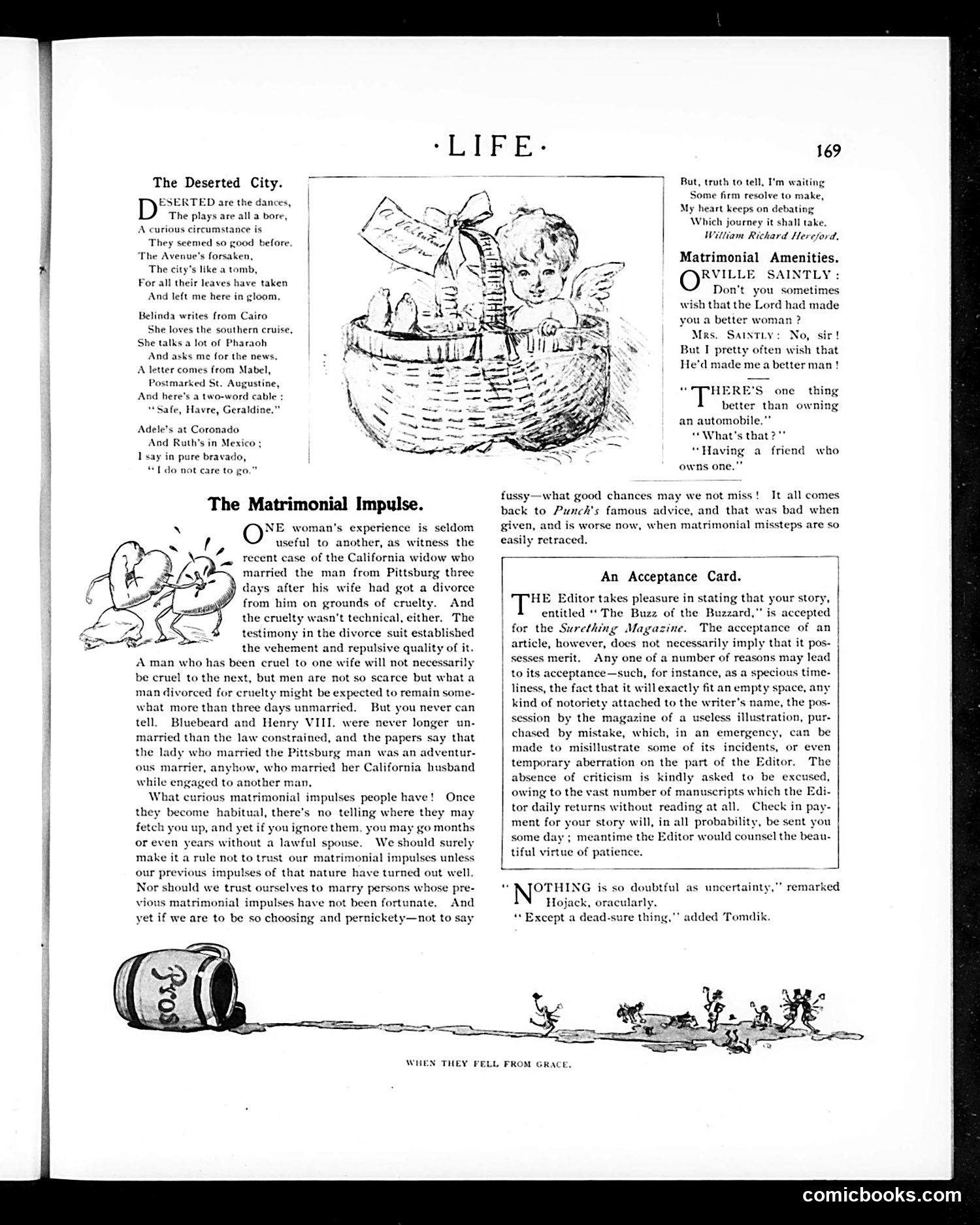
This page contains satirical commentary on marriage and relationships rather than political cartoons. **"The Deserted City"** is a humorous poem about abandoned places and correspondence received from various locations, with no apparent political meaning. **"The Matrimonial Impulse"** discusses a California widow who remarried three days after her divorce, criticizing hasty remarriage decisions. The accompanying cartoon shows a couple in conflict, illustrating marital discord. **"Matrimonial Amenities"** presents a brief comic dialogue mocking gender expectations in marriage—a wife refuses to wish her husband had been "made a better woman," preferring he remain a man. **"An Acceptance Card"** is an editor's note explaining the magazine's submission process and editorial policies regarding rejected manuscripts. The page's satire targets marital impulses and relationship dynamics rather than specific political figures or events.
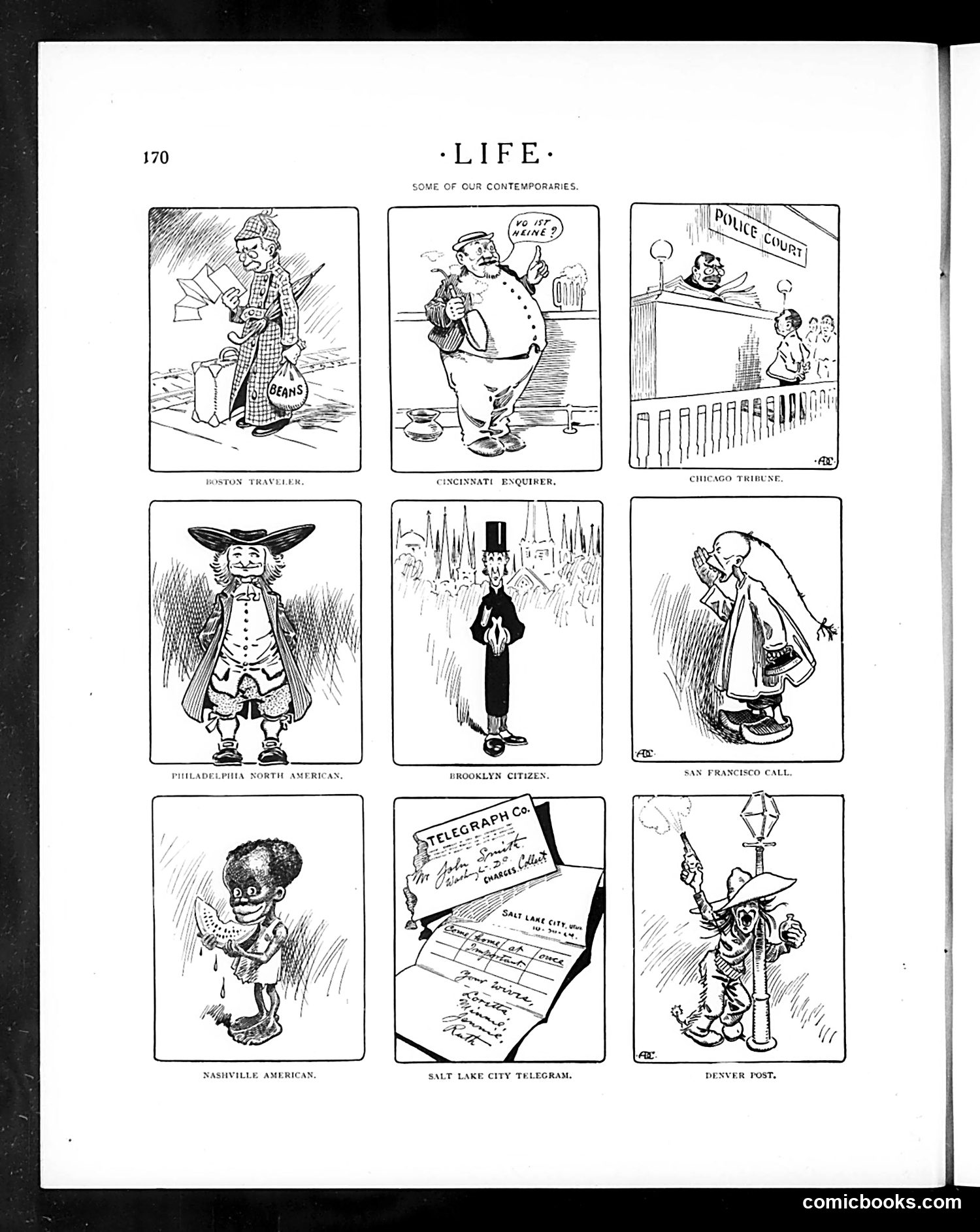
This page presents nine caricatures mocking regional newspaper stereotypes and local character types from major American cities circa early 1900s. Each cartoon exaggerates distinctive traits associated with different publications: - **Boston Traveler**: A bundled figure with newspapers, suggesting provincial attitudes - **Cincinnati Enquirer**: A rotund man obsessed with food/dining - **Chicago Tribune**: A police court scene implying sensationalism - **Philadelphia North American**: An exaggerated figure with oversized ears - **Brooklyn Citizens**: A thin, formal figure representing urban pretension - **San Francisco Call**: A hunched, aggressive prospector type - **Nashville American**: A caricatured Black figure (representing racist period stereotypes) - **Salt Lake City Telegram**: Telegraph forms suggesting commercial focus - **Denver Post**: A frontier character with mining imagery The satire mocks regional stereotypes and editorial personalities of competing newspapers.
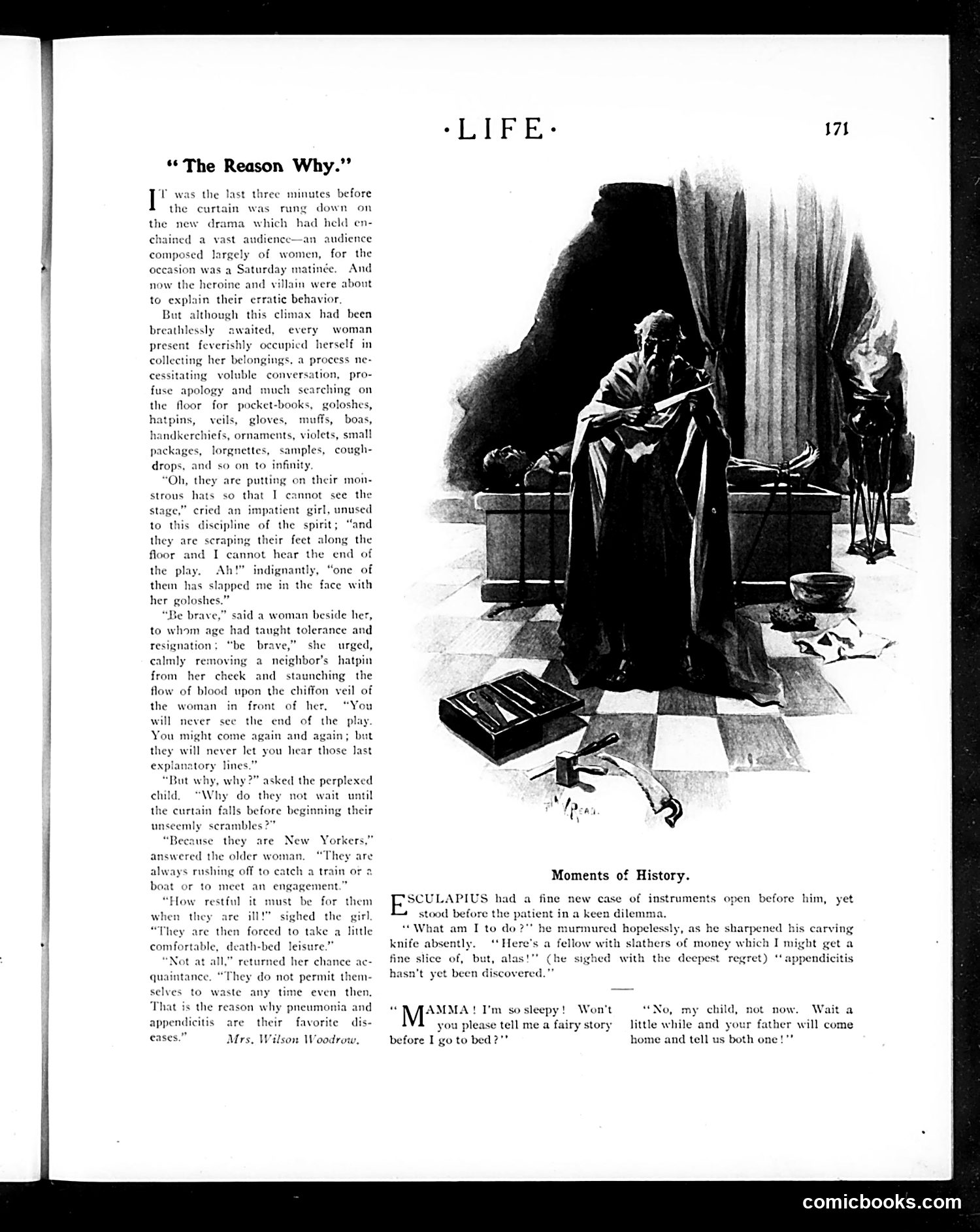
This page contains two separate pieces: **Left section ("The Reason Why"):** A satirical story about theater-goers during a matinee performance, likely from the early 20th century. The humor centers on women audience members scrambling to collect their belongings before the curtain falls, creating commotion. The punchline reveals they rush because they're "New Yorkers" who must catch trains or boats—implying New Yorkers are perpetually hurried and impatient. The satire targets urban rushing culture and female theater-goers' priorities. **Right section ("Moments of History"):** Two brief anecdotes. The first depicts Aesculapius (Greek god of medicine) discovering appendicitis. The second shows a mother declining to tell her child a fairy tale, saying the father will return home with one instead—likely mocking men's tendency to exaggerate or fabricate stories. The illustrations are period ink drawings typical of Life's satirical style.
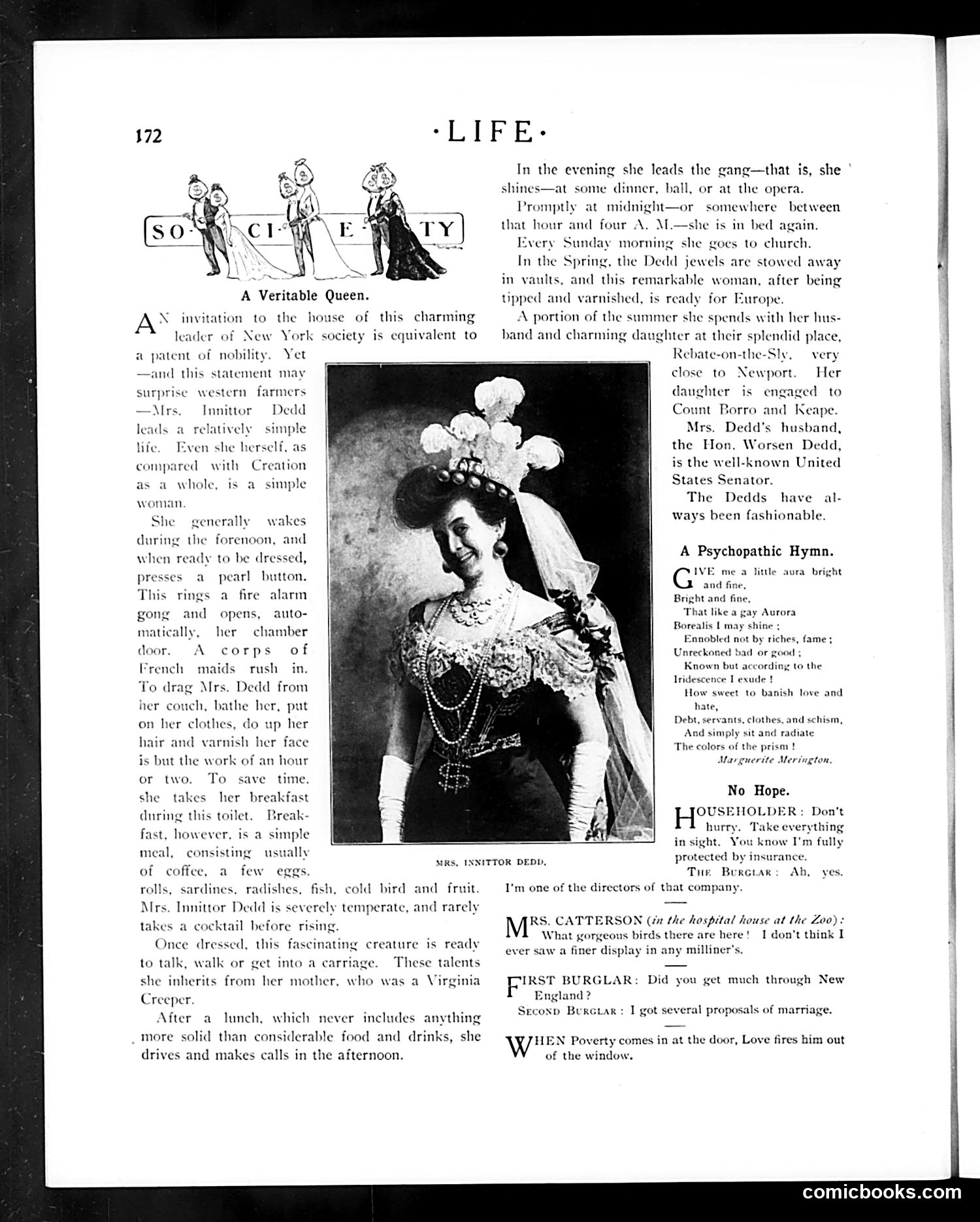
This page satirizes **Mrs. Imittor Dedd**, a prominent New York society leader. The central photograph shows an elaborately dressed woman with an ornate feathered headdress, embodying the excessive fashion and pretension the article mocks. The satire depicts her daily routine: waking late, requiring an hour for her appearance (aided by French maids), taking a light breakfast, making social calls, attending dinners and opera, and returning home by 4 A.M. The piece suggests she leads a superficial, consuming lifestyle despite being "relatively simple" compared to her peers. The accompanying verses and anecdotes mock wealthy socialites' vapidity and materialism. References to her husband—a U.S. Senator—and daughter engaged to "Count Borro" further ridicule the society world's obsession with status and titled connections.
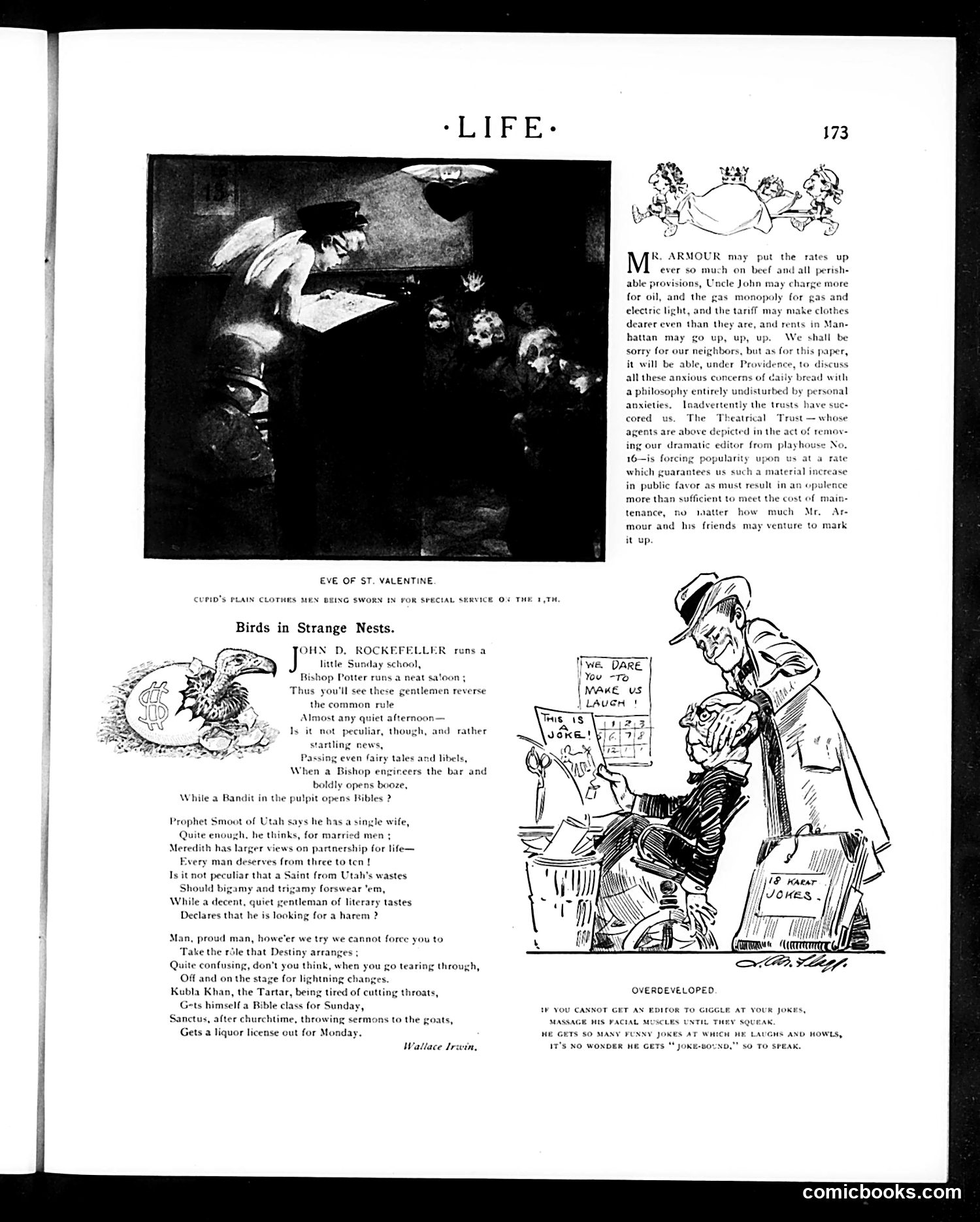
**Top Image:** "Eve of St. Valentine" depicts Cupid in plain clothes being sworn in for special service, likely satirizing military conscription or public service obligations during wartime. **"Birds in Strange Nests"** poem by Wallace Irwin mocks the unconventional lifestyles of wealthy or prominent figures—referencing John D. Rockefeller running a Sunday school, a Bishop operating a saloon, and Prophet Smoot of Utah (likely Apostle Reed Smoot) having "a single wife." The satire criticizes hypocrisy: respectable people engaging in contradictory or questionable activities. **"Overdeveloped"** cartoon jokes about a man who has developed such strong facial muscles from laughing at jokes that he cannot control his expressions, even during serious moments. It's a visual gag about forced cheerfulness or the physical toll of constant joking.
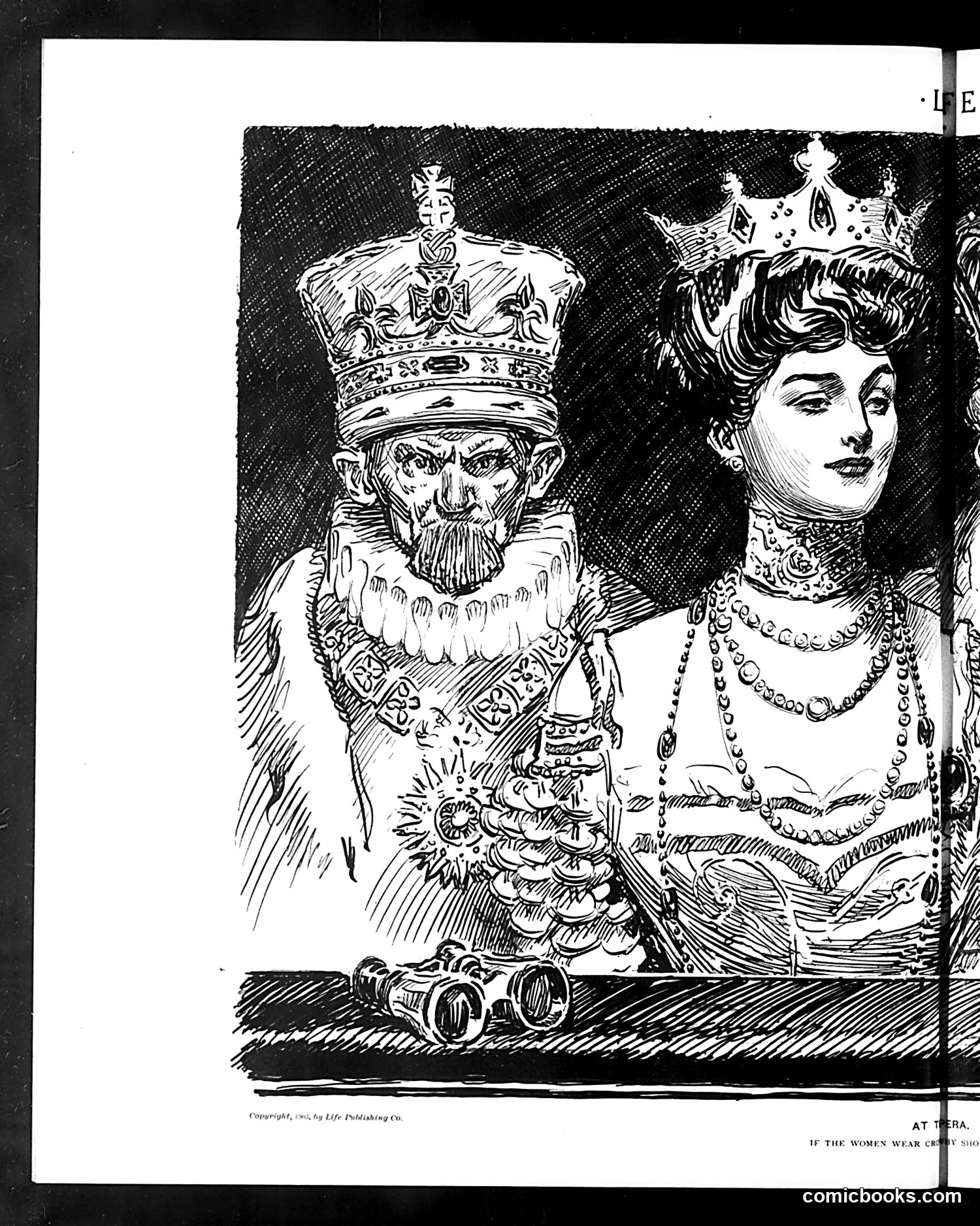
This appears to be a satirical cartoon from *Life* magazine depicting two royal figures in elaborate formal dress with crowns, jewels, and ornate clothing. The man on the left wears a tall crown and has a distinctive beard; the woman on the right wears a tiara and pearl necklaces. The visible caption reads "AT [unclear], IF THE WOMEN WEAR CRISP SHO[unclear]" — the text is partially cut off, making the specific satirical point difficult to determine with certainty. The cartoon likely satirizes European royalty or aristocratic fashion conventions of the era. Without the complete caption and context, I cannot definitively identify which specific political or social commentary the cartoonist intended, though it appears to critique formal royal dress codes or women's fashion expectations among the upper classes.
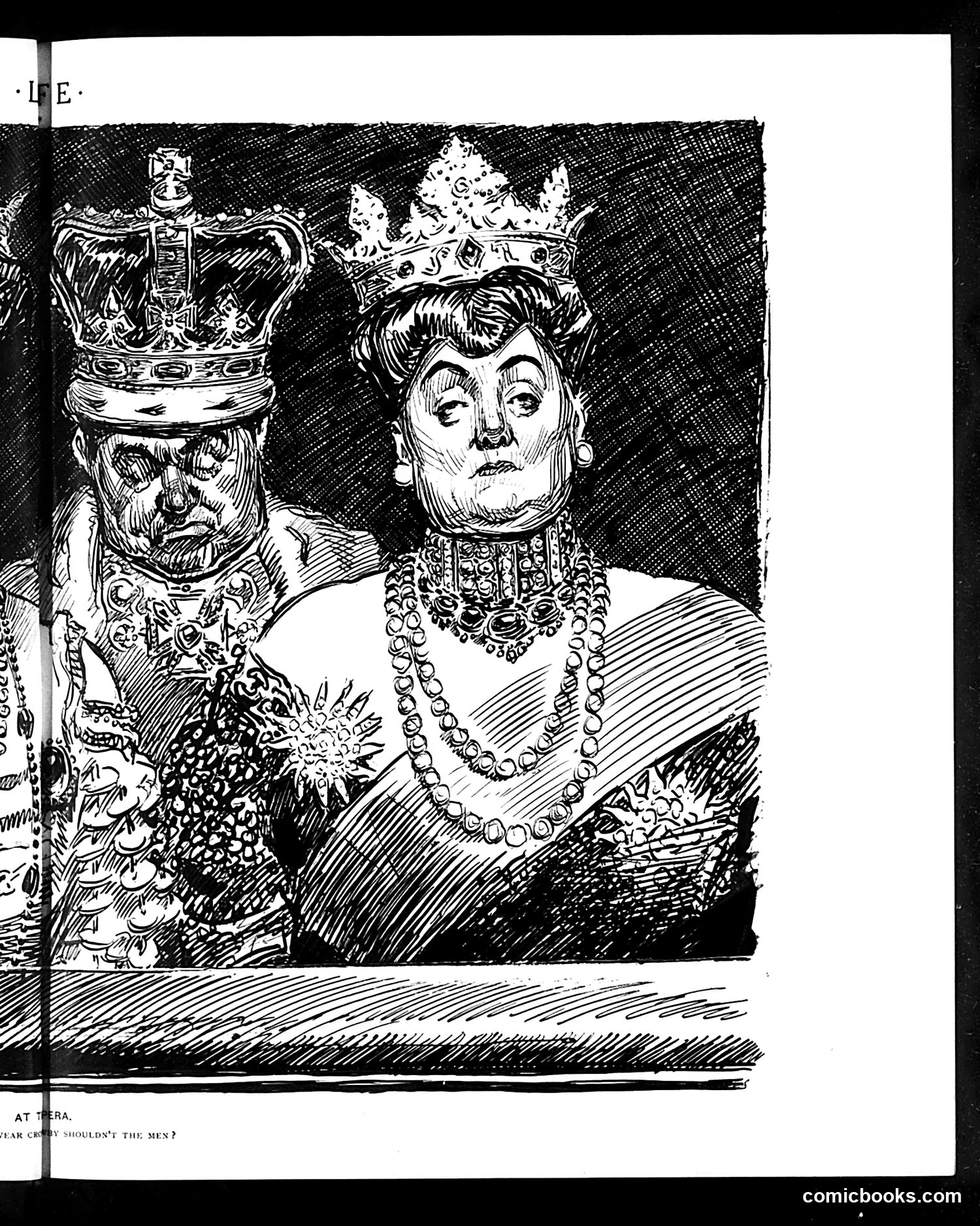
This black and white sketch depicts two royals in elaborate regalia: a bearded king on the left wearing an ornate crown and jeweled chest plate, and a queen on the right wearing a crown, pearl necklaces, and formal dress. The partial caption visible reads "AT THERA" and "...AR CLERGY SHOULDN'T THE MEN?" The cartoon appears to satirize royal or aristocratic pretension through exaggerated detail in their jewelry and formal dress. The incomplete caption suggests commentary on clergy and gender roles, likely mocking some contemporary debate about religious authority and masculinity. However, without the full caption and clear identification of which specific royals or historical moment this references, the precise satirical target remains unclear. The style suggests early-to-mid 20th century publication.
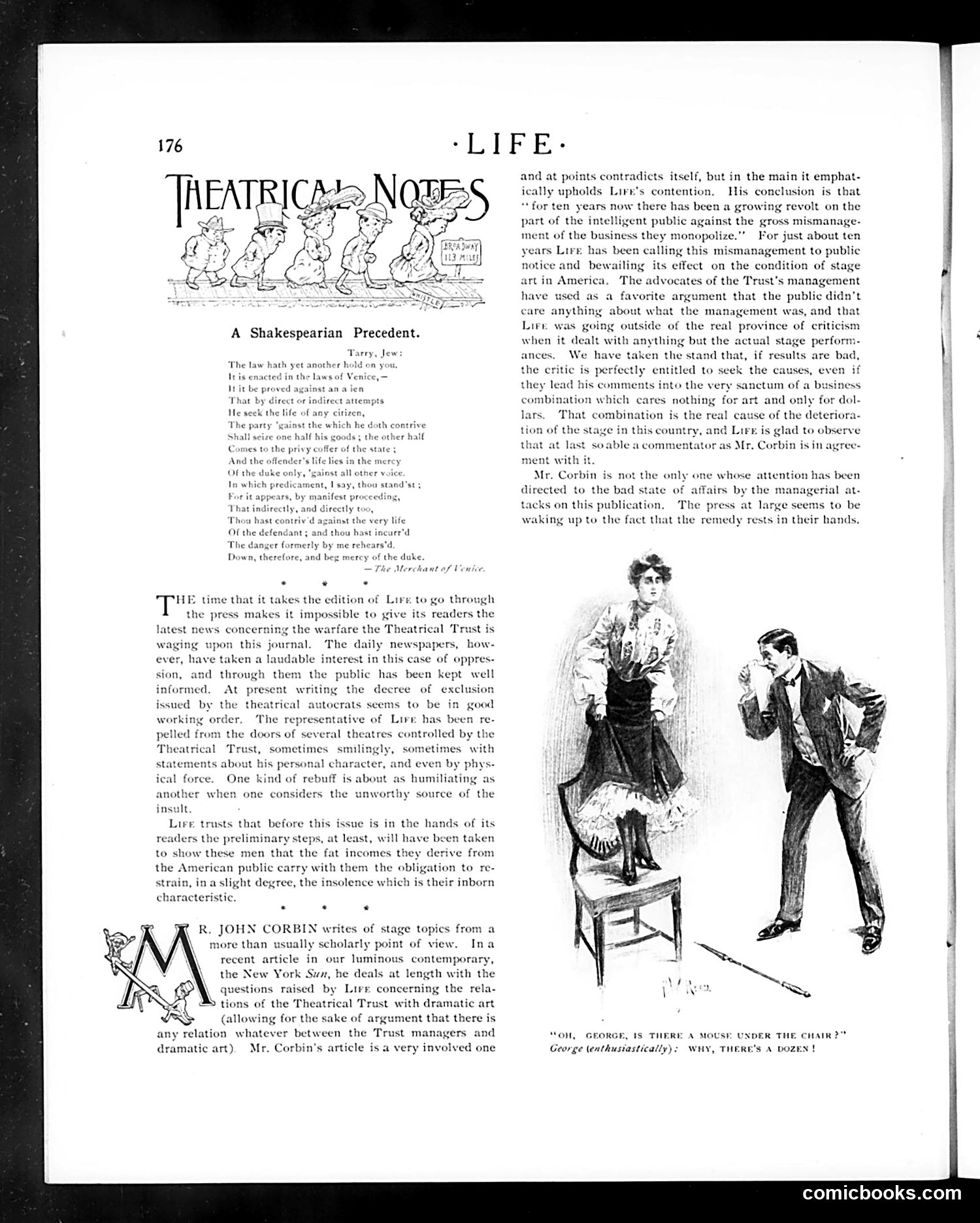
This page discusses theater management conflicts, specifically regarding the Theatrical Trust's alleged mismanagement of American stage production. The text argues that Life magazine has spent "ten years" critiquing the Trust's control over theatrical business. The illustration shows a comedic domestic scene: a woman sits on a chair while a man bends down, apparently checking underneath. The caption reads: "Oh, George, is there a mouse under the chair?" with the response "Why, there's a dozen!" This appears to be a visual metaphor for hidden problems—suggesting that like searching for one mouse and finding many, investigating the Trust's misdeeds reveals numerous underlying issues. The cartoon satirizes the widespread nature of theatrical industry problems that the Trust's management has allegedly concealed from public view.
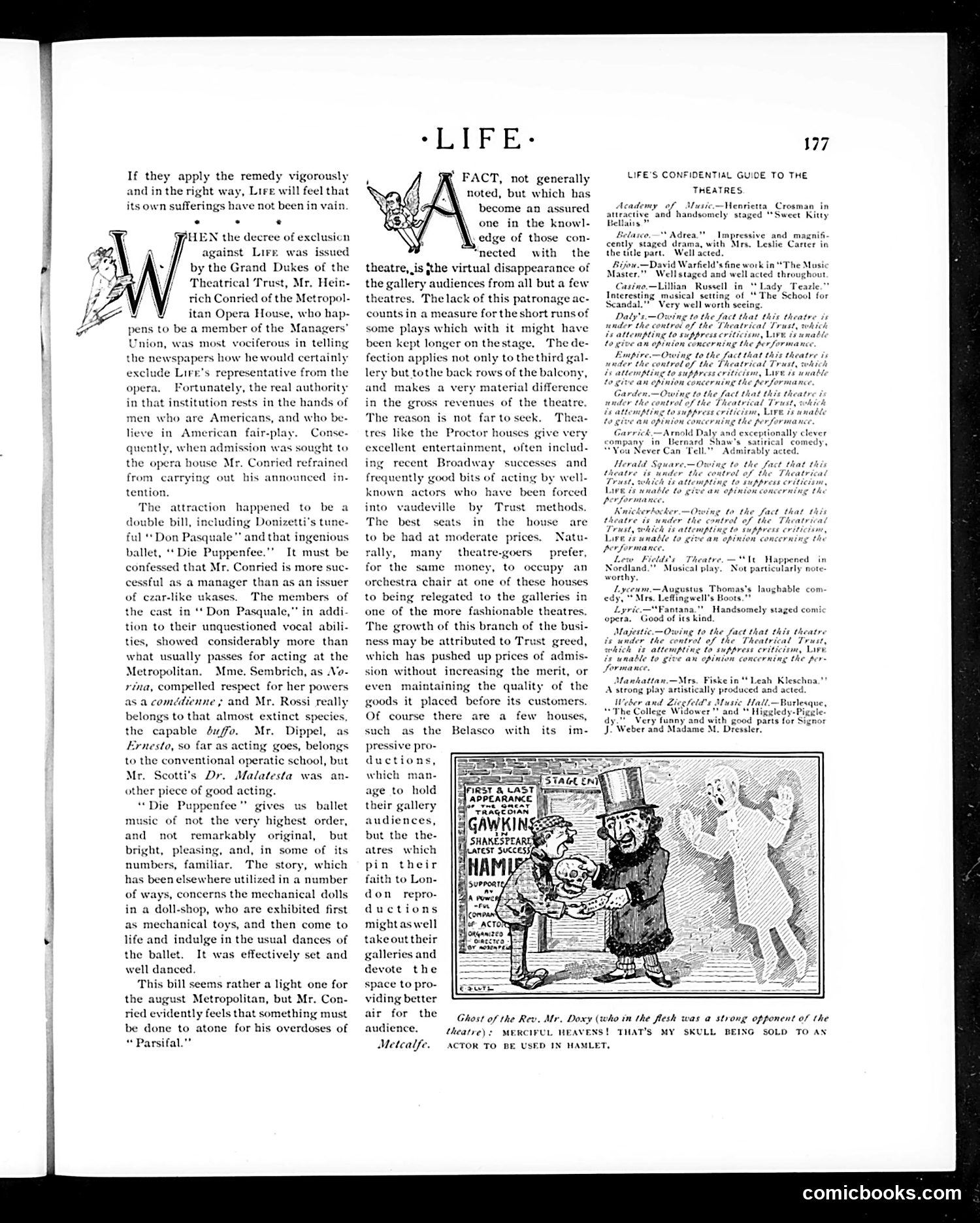
This page critiques the **Theatrical Trust**, a monopoly controlling American theater that exploited both performers and audiences. The main cartoon shows two figures (likely Trust representatives) arguing over a skull labeled "Hamlet"—a visual pun on selling theatrical properties and the Trust's death-grip on the industry. The text discusses **Heinrich Conried** of the Metropolitan Opera, a Trust member who initially tried to exclude Life's theater critic but was overruled by American managers who believed in "fair play." The article also attacks Trust greed: by raising ticket prices while cutting quality, they drove working-class "gallery" audiences to cheaper vaudeville theaters like Proctor's, which offered better entertainment value. This backfired economically, reducing box office revenue. The page represents Life magazine's role as a **satirical watchdog** against corporate monopolies that exploited both artists and audiences during the Progressive Era.
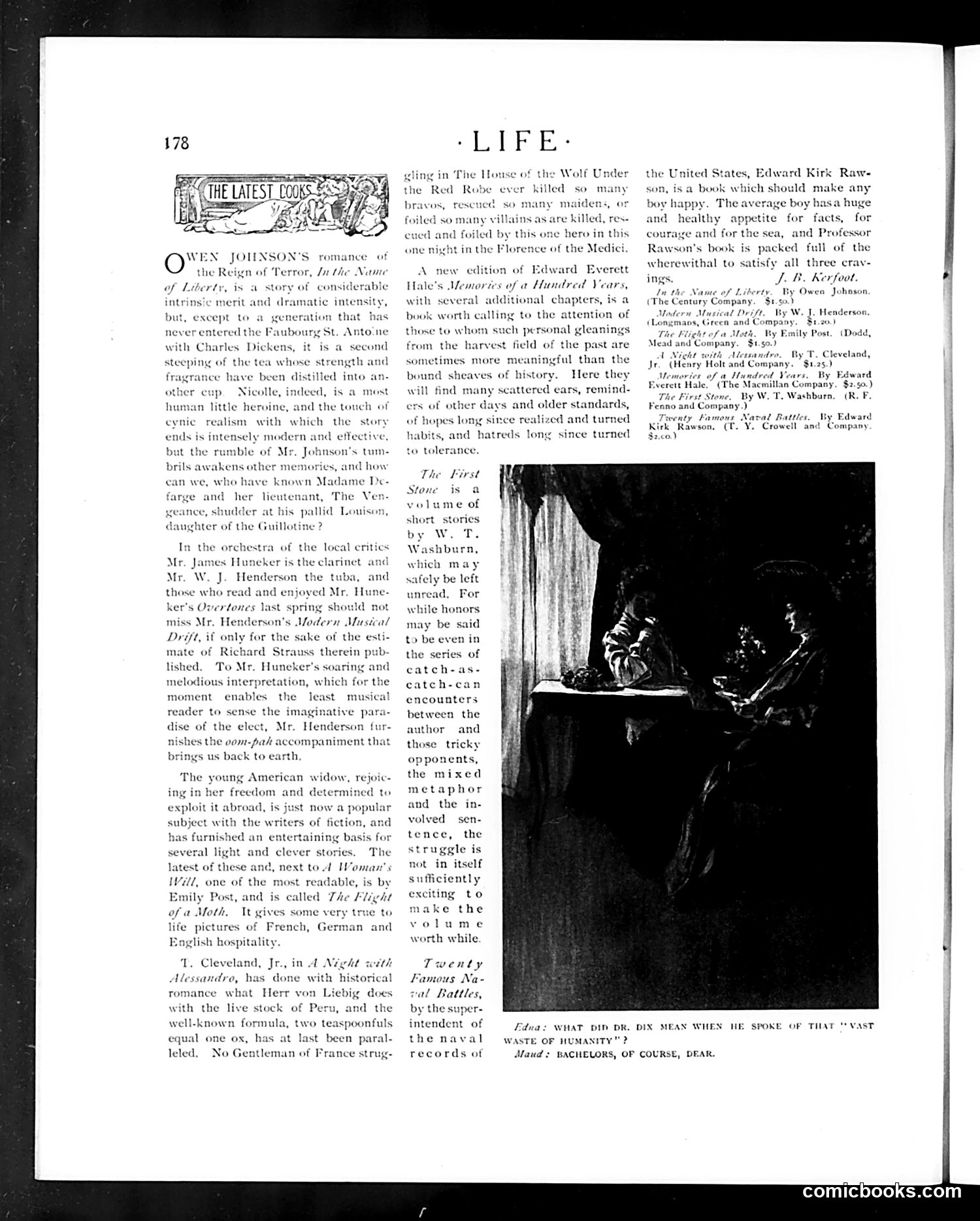
This is a book review section from *Life* magazine discussing recent fiction and literary works. The main cartoon, captioned "EDDA: WHAT DID DR. DIN MEAN WHEN HE SPOKE OF THAT 'VAST WASTE OF HUMANITY'?" with response "BACHELORS, OF COURSE, DEAR," is a contemporary joke about unmarried men—playing on the era's social anxiety about bachelorhood as wasteful or socially undesirable. The reviews discuss popular novels of the period, including works set during the French Revolution and stories about American widows abroad. The text references literary critics like James Huneker and W.J. Henderson, discussing their musical and literary commentary. The overall tone is satirical—typical of *Life*'s editorial voice—gently mocking both contemporary literature and social conventions of the day. The page reflects early 20th-century attitudes toward marriage, literature, and respectability.
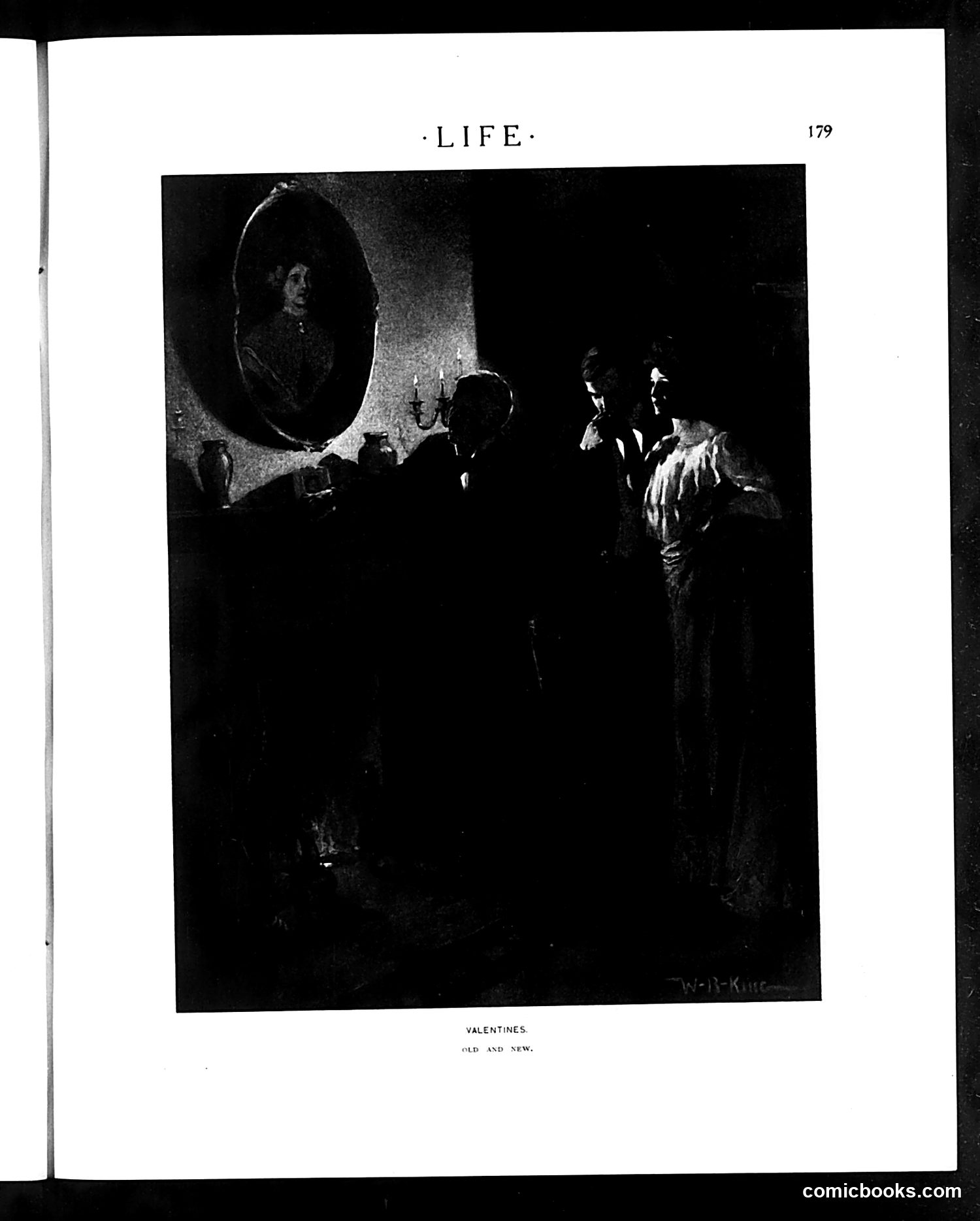
This appears to be a satirical illustration titled "Valentines: Old and New," contrasting romantic traditions. The image shows a darkened interior with figures viewing what appears to be a portrait in an oval frame on the wall—likely representing an "old" valentine, a sentimental romantic gesture. The silhouetted figures on the right, shown in more modern dress and posture, represent the "new" approach to valentines, suggesting contemporary (early 20th century) attitudes toward romance differ from traditional ones. The stark lighting and shadowy composition emphasize the contrast between past sentimentality and modern practicality or cynicism about romantic expression. The satire suggests how quickly courtship customs were evolving in that era.
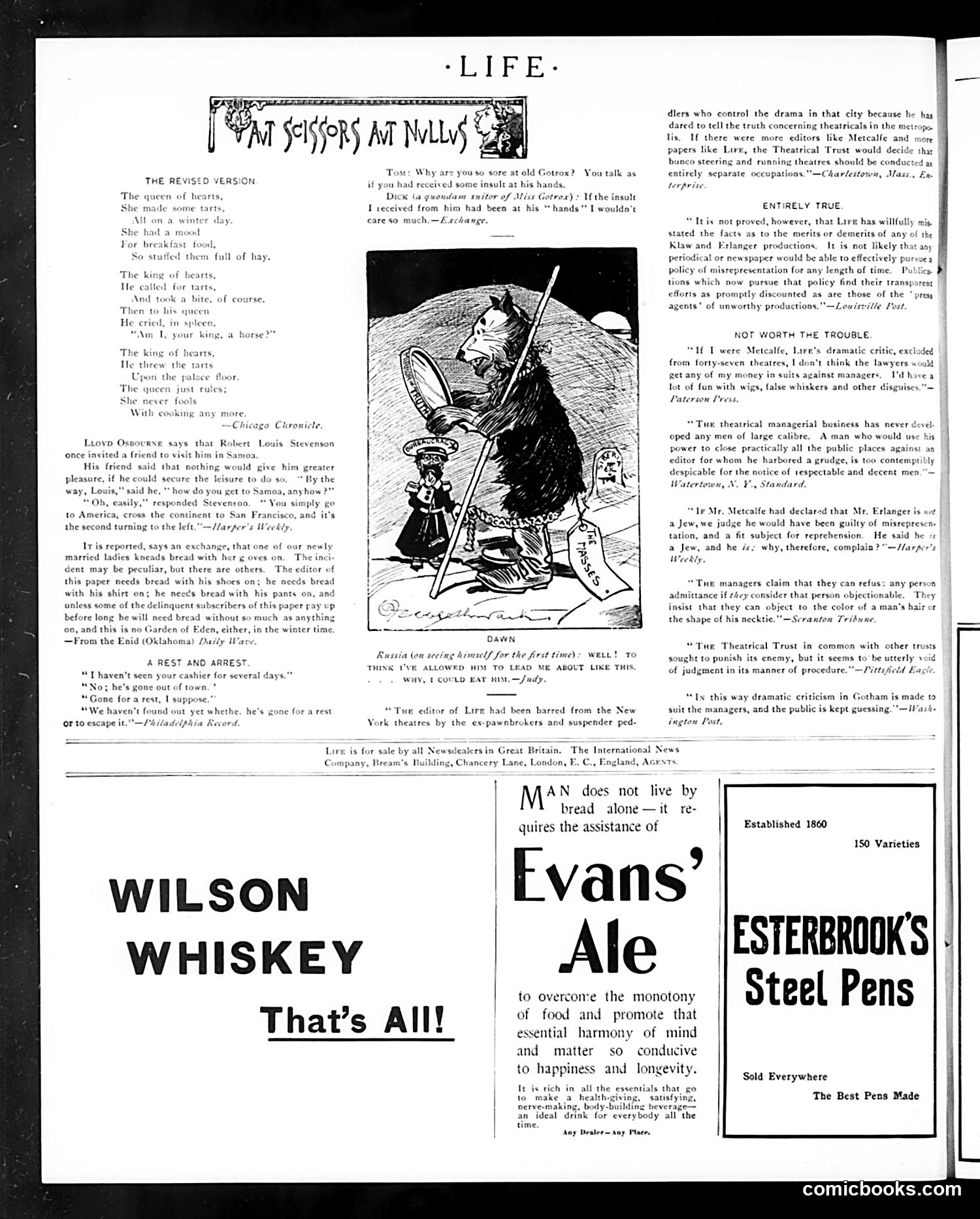
This page from *Life* magazine satirizes theatrical industry power dynamics, specifically targeting the "Theatrical Trust" (likely Klaw and Erlanger, major theater monopolists of the era). The central cartoon depicts a figure wielding large scissors, appearing to cut theatrical productions. The accompanying commentary—presented as debate among newspapers—discusses editor Metcalfe's criticism of theater managers who control New York's dramatic output. The satire centers on how these monopolists suppress unfavorable reviews and control which plays get staged. The various quoted newspaper responses defend *Life's* right to publish theatrical criticism without fear of retaliation, while mocking managers' attempts to silence negative press. The joke is that despite the Trust's power to bar critics from theaters, they cannot actually prevent publications from writing about them. The cartoonist ridicules both the theatrical monopoly's heavy-handed censorship attempts and the absurdity of trying to suppress free speech through intimidation.
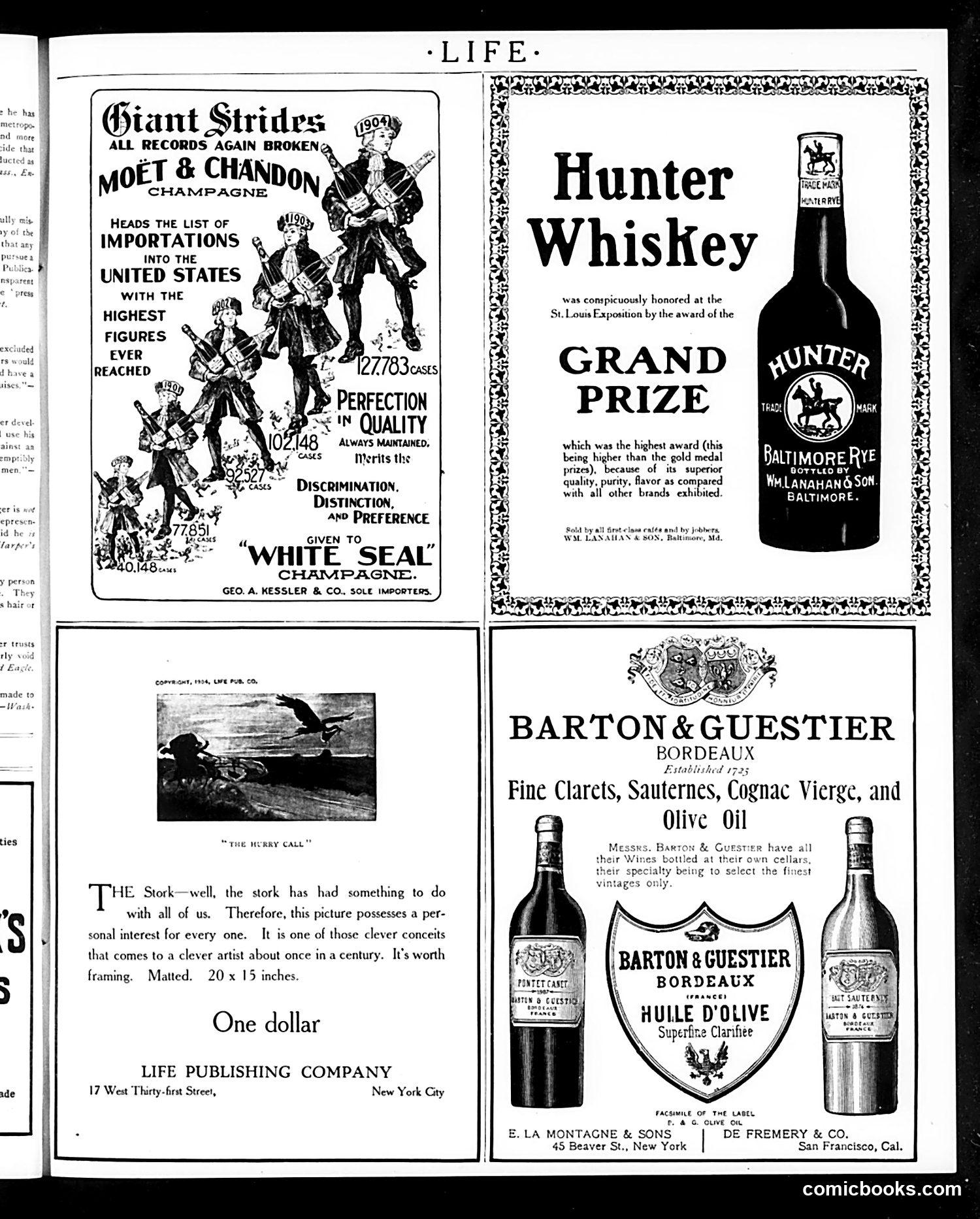
This page consists primarily of **luxury product advertisements** from the early 1900s, not political satire. The ads promote: 1. **Moët & Chandon Champagne** ("White Seal" brand) — emphasizing record-breaking U.S. importation figures and quality awards 2. **Hunter Whiskey** — highlighting a Grand Prize from the St. Louis Exposition (likely 1904), claimed superior to competitors 3. **Barton & Guestier wines and olive oil** from Bordeaux — showcasing French imports and specialty products The one editorial content is "The Hurry Call," a small illustration depicting a stork (symbolizing birth/new babies), offered for $1 as a framing-worthy artwork by Life Publishing Company. **Context for modern readers:** These ads reflect the Gilded Age obsession with imported European luxury goods as status symbols, and the use of international awards to establish prestige—marketing tactics still recognizable today.
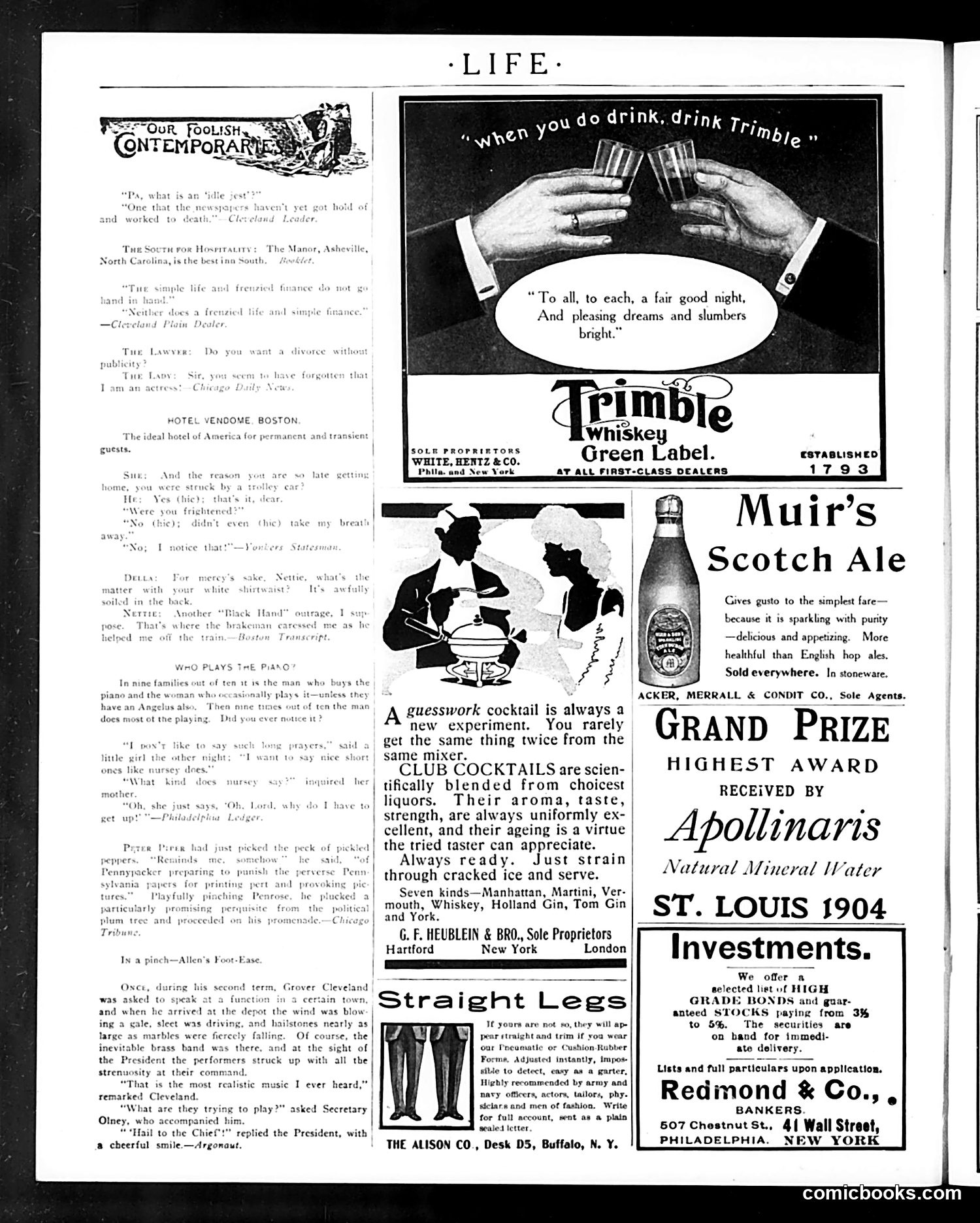
This page is primarily **advertising**, not editorial satire. It contains multiple liquor and financial service advertisements typical of early 1900s Life magazine. The left column includes brief humorous anecdotes ("Our Foolish Contemporaries")—short satirical commentary on social absurdities. One jokes about a lawyer seeking divorce; another mocks a man who claims a trolley car struck him but shows no injury. The central section advertises **Trimble Whiskey** with an illustration of two men toasting, promoting drinking as social refinement. Surrounding ads promote **Muir's Scotch Ale**, **Heublein Club Cocktails** (scientifically blended drinks), and **Apollinaris mineral water** (which won a 1904 St. Louis award). The right side features a "Straight Legs" advertisement for cushioned shoe inserts, claiming military and theatrical endorsement. The bottom includes a humorous anecdote about President Cleveland attending a concert, asking what musicians are "trying to play." The page reflects early 20th-century attitudes: heavy alcohol advertising was mainstream, and humor relied on class-conscious observations about manners and social pretension.
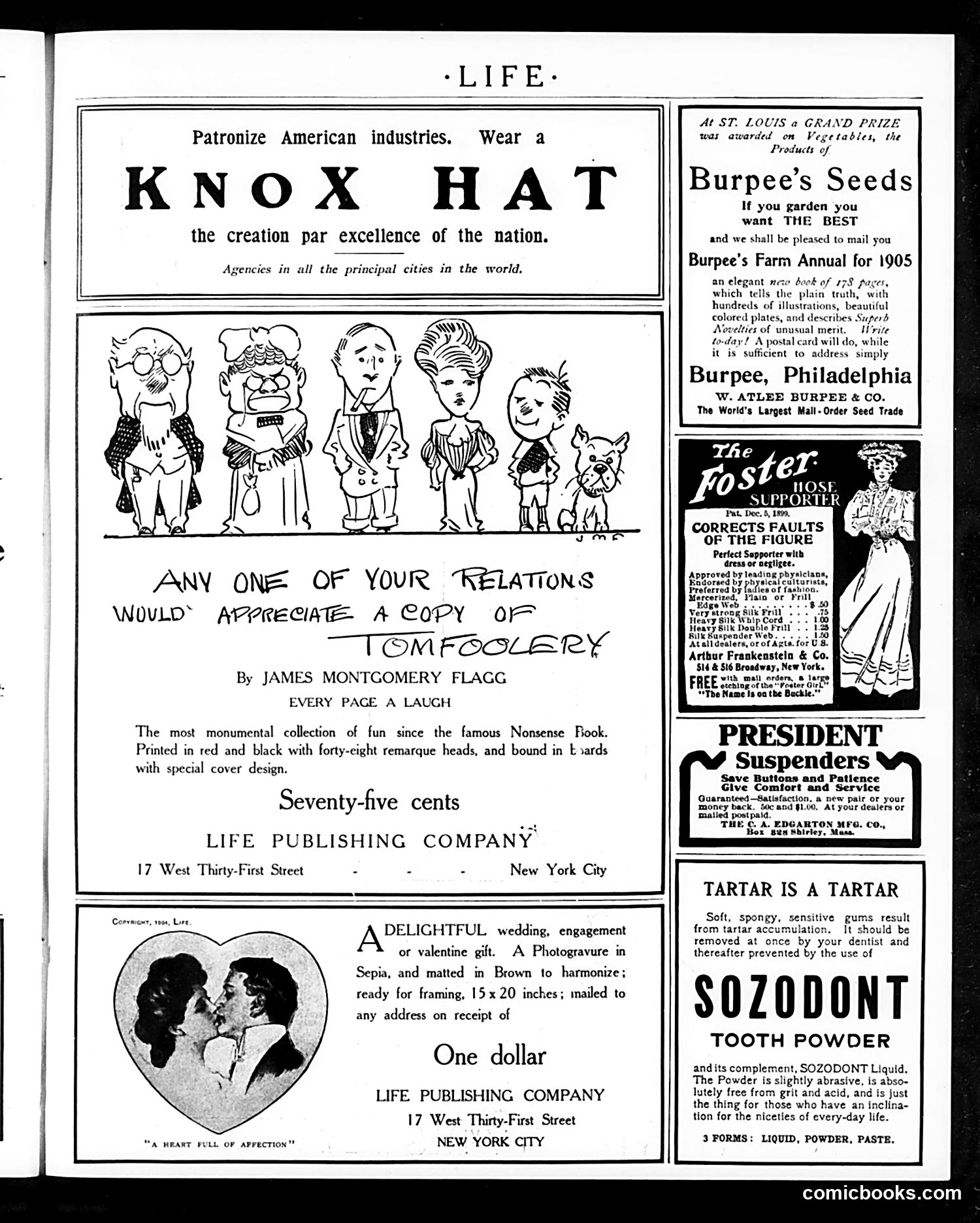
This page is primarily **advertising** with one cartoon feature. The main content is James Montgomery Flagg's "Tomfoolery," a book of humorous drawings advertised for 75 cents—described as containing "forty-eight remarque heads" (caricatures) meant to provide laughs. The cartoon itself shows five exaggerated caricatured figures in a row, likely depicting recognizable public figures or types of the era, though specific identities aren't labeled. The joke appears to reference how "any one of your relations would appreciate a copy," suggesting the caricatures humorously resemble people readers might know. The remainder consists of period advertisements: Knox Hats (promoting American manufacturing), Burpee Seeds, Foster corset supports, President Suspenders, a romantic photogravure gift, and Sozodont tooth powder. These ads reflect early 1900s consumer products and marketing approaches typical of *Life's* satirical magazine format.
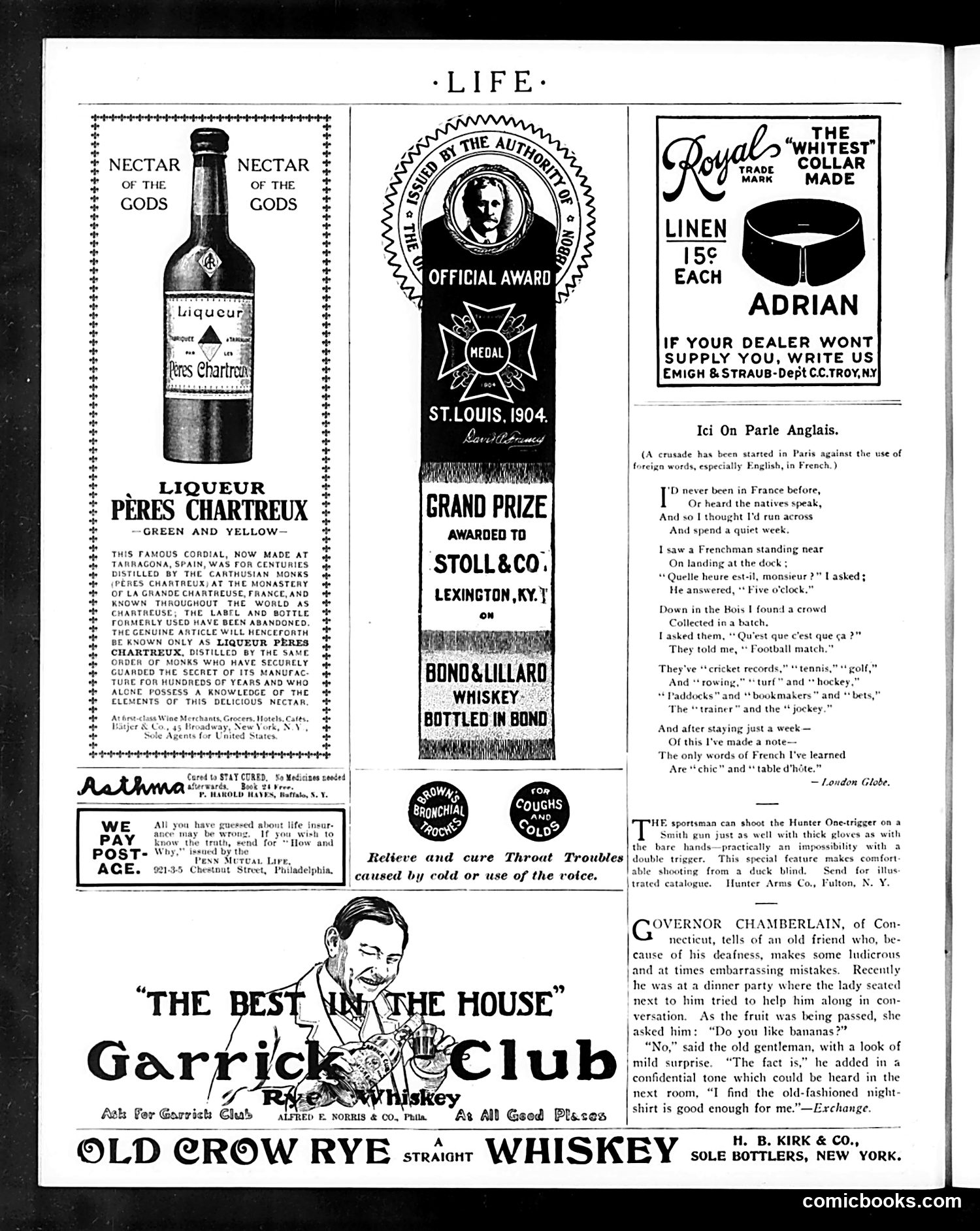
This page contains a satirical poem mocking French linguistic nationalism. The context: Paris had launched a campaign against English words infiltrating French language and culture. The joke: A visiting Englishman asks a Parisian a simple question in French ("What time is it, sir?"), and receives the reply in English: "Five o'clock." Despite France's crusade against foreign words, English has so thoroughly penetrated French vocabulary—especially in sports and leisure—that even resistance is futile. The poem catalogs English sports terms adopted wholesale by Parisians: "cricket," "tennis," "golf," "rowing," "turf," "hockey," "paddocks," "bookmakers," "trainer," "jockey." After a week in France, the narrator has learned only two French phrases, both borrowed from English culture: "*chic*" and "*table d'hôte*." The satire targets French cultural anxiety about English dominance while highlighting the reality that language change cannot be legislated away. It's light mockery of protectionist impulses.
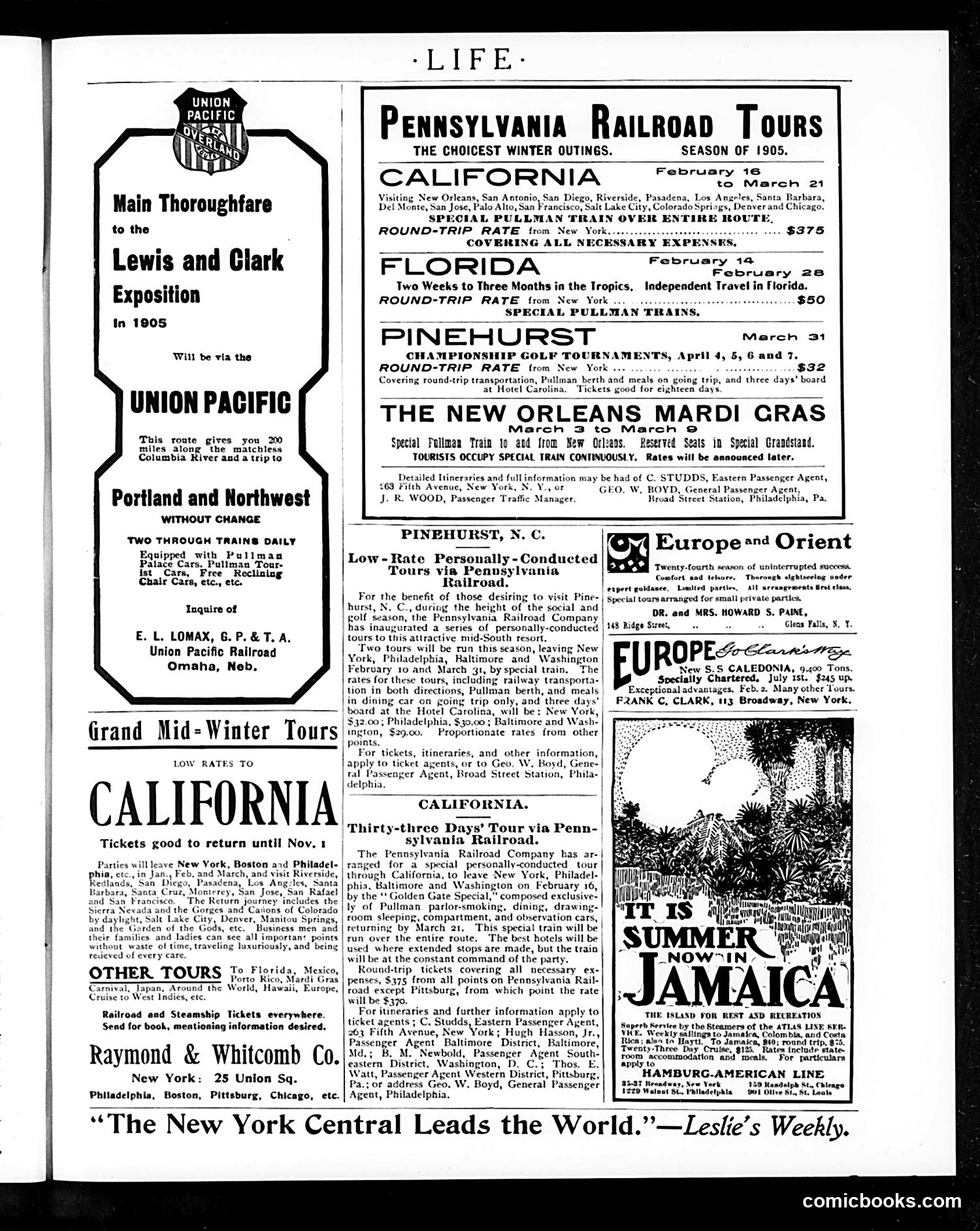
This is primarily a **travel advertisement page** from *Life* magazine (1905), not a political cartoon. It contains no satire or caricature to analyze. The page advertises luxury winter tours offered by railroads and travel companies—the Union Pacific, Pennsylvania Railroad, and Raymond & Whitcomb Company. These promote fashionable destinations for wealthy Americans: California, Florida, Pinehurst golf tournaments, and European tours. The social context: In 1905, such tours represented leisure activities exclusive to the affluent. The emphasis on "Pullman" cars, fine hotels, and personally-conducted journeys reflects the Gilded Age travel industry catering to the upper class. Notable is the advertisement for the Lewis and Clark Exposition (1905)—a real historical event celebrating the famous expedition's centennial. The page's final quote—"The New York Central Leads the World"—is boastful railroad advertising, not editorial commentary.
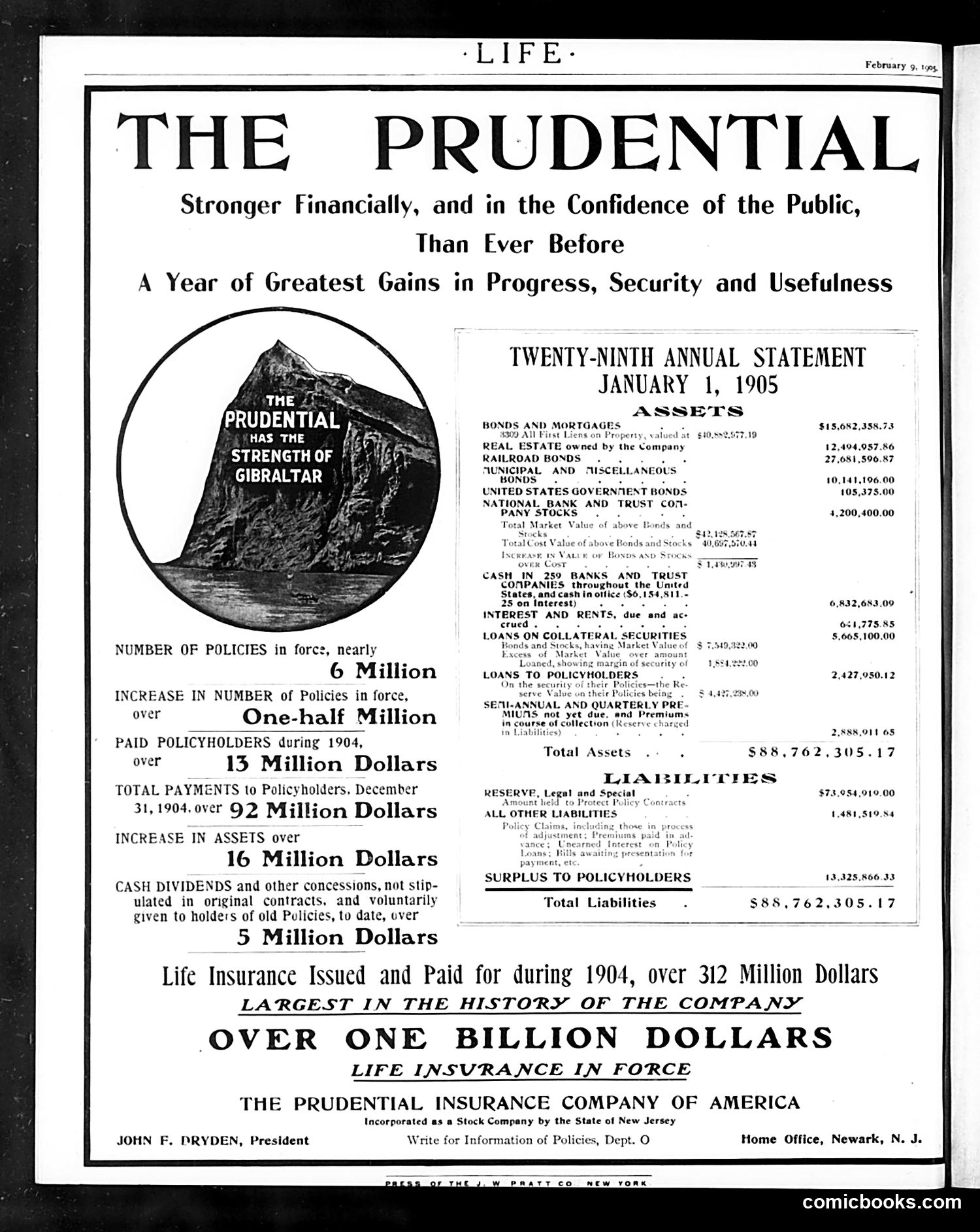
This is primarily a **full-page advertisement** for The Prudential Insurance Company of America, published in *Life* magazine on February 9, 1905. The central image—the Rock of Gibraltar—is a visual metaphor for corporate stability and strength. The accompanying text emphasizes financial solidity through repeated assertions of growth: nearly 6 million policies in force, over 13 million dollars paid to policyholders in 1904, and over 1 billion dollars in life insurance in force. There is **no satire or political cartoon** on this page. Rather, it's a corporate promotional piece leveraging the metaphor of Gibraltar's legendary permanence to reassure potential customers of the company's reliability during an era when insurance companies' financial stability was a legitimate public concern. The detailed financial statements serve as proof of these claims. This represents how *Life*—known for satire—also carried conventional advertising alongside editorial content.