
Life, 1905-02-09 · page 12 of 22
Life — February 9, 1905 — page 12: what you’re looking at
What you’re looking at
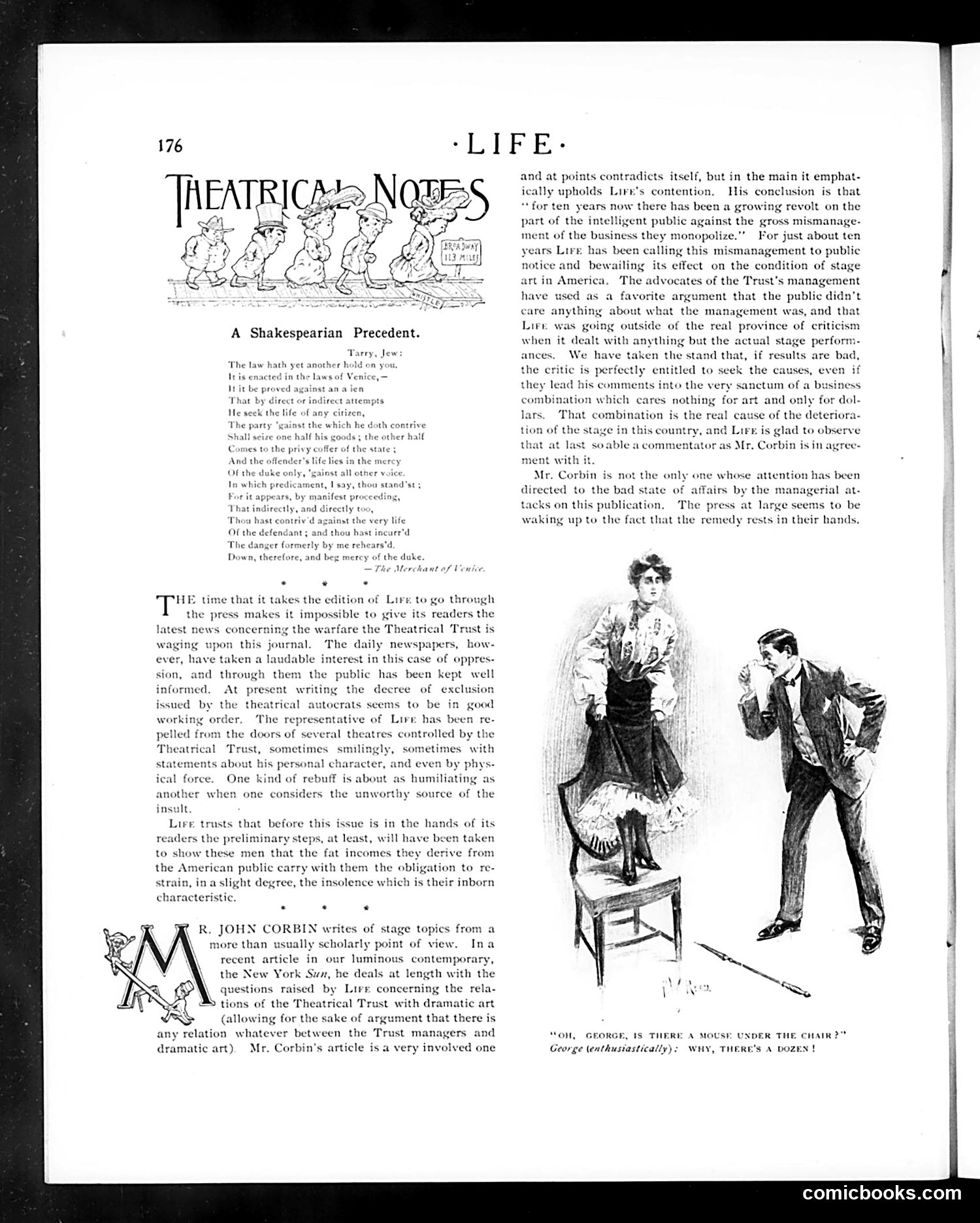
This page discusses theater management conflicts, specifically regarding the Theatrical Trust's alleged mismanagement of American stage production. The text argues that Life magazine has spent "ten years" critiquing the Trust's control over theatrical business. The illustration shows a comedic domestic scene: a woman sits on a chair while a man bends down, apparently checking underneath. The caption reads: "Oh, George, is there a mouse under the chair?" with the response "Why, there's a dozen!" This appears to be a visual metaphor for hidden problems—suggesting that like searching for one mouse and finding many, investigating the Trust's misdeeds reveals numerous underlying issues. The cartoon satirizes the widespread nature of theatrical industry problems that the Trust's management has allegedly concealed from public view.
📄 Transcribed text from this page (OCR, searchable)
Machine-transcribed from the original scan — historical spelling and the odd misread are preserved.
“LIFE: and at points contradicts itself, but in the main it emphat- ically upholds Lire’s contention, His conclusion is that ‘for ten years now there has been a growing revolt on the of the intelligent public against the gross mismanage- ment of the business they monopolize.” For just about ten years Lire has been calling this mismanagement to public notice and bewailing its effect on the condition of stage artin America, The advocates of the Trust's management used as a favorite argument that the public didn’t t care anything about what the management was, and that Lire was going outside of the real province of criticism when it dealt with anything but the stage perform- Varry, Jew ances, We have taken the stand that, if results are bad, 3 28:08 the critic is perfectly entitled to seek the they lead his comments into the very sanctum of a combination which car have A Shakespearian Precedent. The law h auses, even if I1 it be proved against ana ien Th of indirect atter t by din nd onl s nothing for art k the life of any citizen, lars. That combination is the real cause of the deterior: ae webct tieedand tion of the staye in this country, and Lire is glad to observe Comes to the privy coffer of th that at last soable a commentator as Mr. Corbin is in agree- And the offender's life lies i y ment with Of the d only, 's Mr. Corbin is not the only one whose attention has been directed to the bad state of affairs by the managerial at- e seems to be In which predicament, I say, thou stand’st ; For it appears, by manifest proceed tacks on this publication. ‘The press at ls Vhat indirectly, and directly too, Thou hast contriv'd against the very waking up to the fact that the remedy rests in their hands, Of the defendant how hast incurr’d ars'd, The danger forme Down, rey of the duke. HE time that it takes the edition of Lire to go through the press makes it impossible to give its readers the latest news concerning the warf: rical Trust is waging upon this journal. The daily newspapers, ever, have taken a laudable interest in this case of oppres- through them the public has been kept. well informed. At present writing issued by the theatrical autocrats seems to be in good working order. ‘The representative of Lire has been re- re the Thea how- sion, ie decree of exclusion pelled from the doors of several theatres controlled by Theatrical Trust, sometimes smili statements about bis personal character, and even by phys- , sometimes with ical force. One kind of rebuff is about as humiliating as another when one considers th insult. nworthy source of the Lire trusts that before this issue is in the hands of its at least, will have been taken readers the preliminary steps, to show these men that the the American public c strain, ina slight degree, the insolence which is their inborn characte! at incomes they derive from rry with them the obligation to re- R. JOHN CORBIN writes of stage topics from a more than usually scholarly point of view. Ina recent article in our luminous contemporary, the New York Sun, he deals length with the questions raised by Lire concerning the rela- tions of the Theatrical Trust with dramatic art (allowing for the sake of argument that there is any relation whatever between the Trust managers and “on, GEORGE, 18 THERE A MOUSE UNDER THE cHAtR 2 dramatic art). Mr. Corbin’s article is a very involved one George (enthusiastically): WHY, THERE'S A DOZEN ! comicbooks.com